Revelando caracteres diagnósticos de la cubomedusa Chiropsalmus alipes mediante documentación in situ de alta resolución en el Pacífico tropical mexicano
Alexandro Vladimir Isaak Ruiz-Hernández a, Gustavo Padilla-Cárdenas b, Ignacio Cáceres c, *
a Universidad de Guadalajara, Centro Universitario de Ciencias Biológicas y Agropecuarias, Programa de Licenciatura en Biología, Camino Ramón Padilla Sánchez No. 2100, 45110 Nextipac, Zapopan, Jalisco, Mexico
b Zoológico Guadalajara, Acuario del Zoológico Guadalajara, Av. Paseo del Zoológico No. 600, 44390 Guadalajara, Jalisco, Mexico
c Universidad de Guadalajara, Centro Universitario de Ciencias Biológicas y Agropecuarias, Departamento de Ecología Aplicada, Camino Ramón Padilla Sánchez No. 2100, 45110 Nextipac, Zapopan, Jalisco, Mexico
*Corresponding author: ignacio.caceres5441@academicos.udg.mx (I. Cáceres)
Received: 16 January 2026; accepted: 12 May 2026
Abstract
The confirmation of species distributions and taxonomic identification is critical for documenting biodiversity under increasing anthropogenic pressures. This objective is challenging for gelatinous plankton due to logistical constraints related to safety and preservation. This study documents and validates the taxonomic identity of live individuals of Chiropsalmus alipes from Bahía de Banderas (Mexican Tropical Pacific), using high-resolution in situ video and photographic records. The records reveal a combination of diagnostic external morphological features consistent with C. alipes, including a subquadrangular bell; prominent nematocyst warts on the exumbrella, pedalia, and velarium; spatulate pedalia bearing orange tentacles; and elongated, scalloped gastric saccules, some terminating in an umbonate structure. Several of these characters were more clearly observed in live individuals than in preserved material. These findings demonstrate the taxonomic value of high-quality in situ documentation, provide an integrative morphological interpretation of C. alipes based on live individuals, and support the recognition of the species in the Mexican Tropical Pacific, a region where detailed observations of live cubozoans remain limited.
Keywords: Cubozoa; Box jellyfish; In situ documentation; Morphological diagnosis; Mexican Tropical Pacific
Resumen
La confirmación de la distribución de las especies y la identificación taxonómica son cruciales para documentar la biodiversidad bajo las crecientes presiones antropogénicas. Este objetivo resulta desafiante para el plancton gelatinoso debido a las limitaciones logísticas de seguridad y de preservación. Este estudio documenta y valida la identidad taxonómica de individuos vivos de Chiropsalmus alipes en Bahía de Banderas (Pacífico tropical mexicano) mediante registros fotográficos y de video in situ de alta resolución. Los registros revelaron una combinación de caracteres morfológicos externos diagnósticos consistentes con C. alipes, incluyendo una campana subcuadrangular; verrugas prominentes de nematocistos en la exumbrela, pedalio y velario; un pedalio espatulado con tentáculos anaranjados; y sáculos gástricos alargados y festoneados, los cuales terminan en una estructura umbonada. Varios de estos caracteres se observaron con mayor claridad en los individuos vivos en comparación con material preservado. Estos hallazgos demuestran el valor taxonómico de la documentación in situ de alta calidad, proporcionan una interpretación morfológica integradora de C. alipes basada en individuos vivos y apoyan el reconocimiento de la especie en el Pacífico tropical mexicano, una región en donde las observaciones detalladas de cubozoos vivos siguen siendo limitadas.
Palabras clave: Cubozoa; Cubomedusas; Documentación in situ; Diagnóstico morfológico; Pacífico tropical mexicano
Introduction
The analysis and confirmation of marine species distribution are essential for advancing the understanding of marine ecosystem ecology. This endeavor is increasingly important for documenting biodiversity in response to anthropogenic threats (Gervais et al., 2021), as well as for identifying species with the potential to adversely affect human economic activities, including tourism and fisheries (Gershwin et al., 2010; Graham et al., 2014). Nonetheless, research on certain zoological groups, particularly gelatinous plankton, is complicated by multiple factors, such as logistical and safety challenges associated with specimen collection in inaccessible areas and preservation difficulties (Cigliano et al., 2015; Mitchell et al., 2021).
The class Cubozoa Werner, 1973, commonly referred to as box jellyfish, is distinguished by a cube-shaped bell and advanced sensory structures, and notably complex eyes equipped with lenses (Coates, 2003; Nilsson et al., 2005; O’Connor et al., 2009). Currently, some 50 species are recognized, with nearly half described within the last 2 decades (Collins, 2025). Members of this class predominantly inhabit the water column and exhibit a broad global distribution. They play a pivotal ecological role both as active predators and as contributors to carbon transport into deeper oceanic layers (Colin et al., 2013; Garm et al., 2012). In contrast to other cnidarians, cubozoans demonstrate a pronounced capacity for sustained, directional swimming, even against prevailing currents, which warrants their classification as nekton rather than plankton (Bordehore et al., 2024; Colin et al., 2013; Garm et al., 2007; Gordon & Seymour, 2009; Schlaefer et al., 2020, 2021). Additionally, they possess highly potent venoms of significant medical concern in various regions worldwide (Jouiaei et al., 2015; Kintner et al., 2005; Tibballs, 2006).
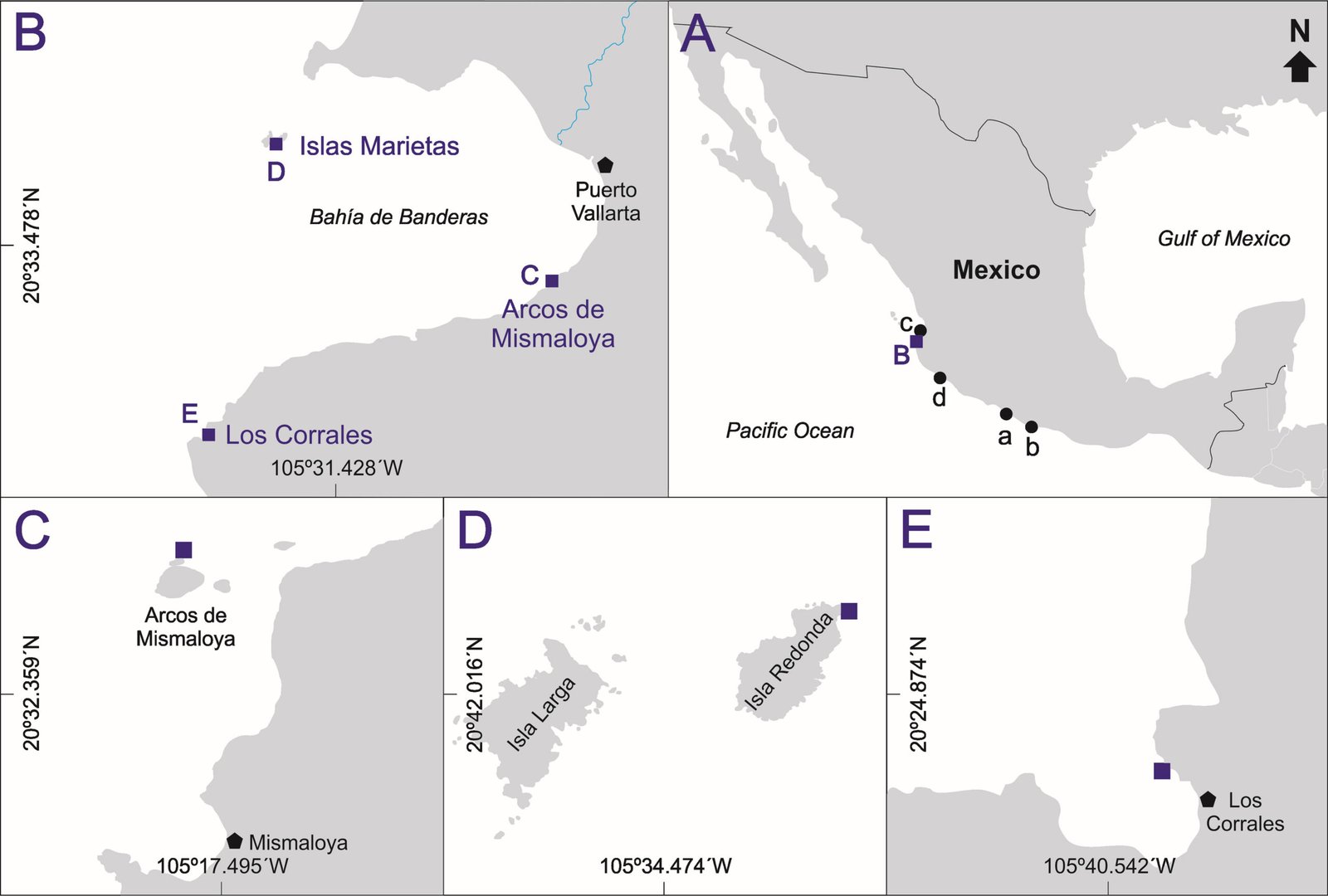
The genus Chiropsalmus Agassiz, 1862 is characterized by the presence of exumbrellar nematocyst warts, pendulous finger-like gastric saccules, and a prominent diverticulum at the bend of the pedalial canal, as detailed in the diagnosis by Gershwin (2006). At present, the genus includes only 2 recognized species (Collins, 2025), both of which are found in Mexican waters: Chiropsalmus quadrumanus (F. Müller, 1859), distributed in the Gulf of Mexico, and C. alipes Gershwin, 2006, originally described from the Mexican Tropical Pacific. The latter species has been documented in both coastal and estuarine environments of the Mexican Pacific, with records spanning from southern Nayarit to the coast of Guerrero (Fig. 1A) (Cupul-Magaña, 2023; Del Moral-Flores et al., 2020; Gershwin, 2006; Jáquez-Bermúdez et al., 2013).
Chiropsalmus alipes is not regarded as a rare species within its distribution range; nevertheless, most available records are derived from preserved, frequently deteriorated specimens or from low-resolution photographs, both of which impede the observation of critical diagnostic features. In this context, in situ visual documentation of live individuals is especially pertinent for taxonomic validation and for accurate interpretation of the species’ external morphology. The present study aims to document and validate the taxonomic identity of C. alipes in the Mexican Tropical Pacific through high-resolution in situ video and photographic records of live individuals. By enabling direct observation of external diagnostic characters under natural conditions, this approach evaluates the reliability and limitations of non-extractive visual records for cubozoan identification, allows comparative reassessment of diagnostic features previously described from preserved material, and contributes to an integrative morphological interpretation of C. alipes based on live individuals.
Materials and methods
The data analyzed in this study were obtained in Bahía de Banderas, situated on the central Pacific coast of Mexico, between the states of Jalisco and Nayarit (Fig. 1B). Bahía de Banderas, one of the largest bays in Mexico, spans approximately from 20°20’ to 20°45’ N, 105°15’ to 105°45’ W, encompassing an area of nearly 1,000 km² and a coastline exceeding 100 km (Plata-Rosas & Filonov, 2007). The region is characterized by a subhumid tropical climate with distinct annual seasonality. The warm, rainy season occurs from June to October, during which sea surface temperatures may reach up to 30 °C. Conversely, the dry season extends from November to May and is marked by cooler temperatures (approximately 24 °C) and a heightened influence of oceanic water masses (Salas-Pérez & Cupul-Magaña, 2005; Velázquez-Ruiz et al., 2012).
The records analyzed in this study were obtained in 2 protected areas: 1) Los Arcos de Mismaloya National Marine Park (Fig. 1C), located on the southern coast of Bahía de Banderas, approximately 10 km from the city of Puerto Vallarta, Jalisco, and characterized by granite rock formations that emerge from the sea; and 2) Islas Marietas National Park (Fig. 1D), situated 8 km off the coast of Punta de Mita, Nayarit, comprising 2 islands (Isla Redonda and Isla Larga). Both parks experience upwelling events from the eastern tropical Pacific coast between February and April (Lavín et al., 2006). Additionally, during periods of intense rainfall, habitats within the bay are vulnerable to sedimentation and eutrophication resulting from the runoff of the Ameca River, which serves as the boundary between Nayarit and Jalisco. Despite their legal protection, both areas are subject to varying degrees of anthropogenic disturbance, including elevated tourist activity and illegal fishing.
In situ records
The initial observation was made during a night SCUBA dive (≈ 8:00 PM) on July 3, 2021, at a depth of 18 m at the La Quijada del Diablo dive site within Los Arcos de Mismaloya. The specimen was recorded on video using an Olympus TG-5 camera equipped with underwater lighting (Supplementary material: Online Supplementary Video S1). The second observation was conducted during a daytime SCUBA dive (≈ 3:15 PM) on July 22, 2021, at the surface near Playa Escondida on Isla Redonda, part of the Islas Marietas. For this record, the specimen was documented through photographs captured with a Fujifilm FinePix XP140 camera.
Additionally, a third record was obtained on July 11, 2021, at a depth of 3 m off Los Corrales beach, in the coastal town of the same name, located at the southern entrance of Bahía de Banderas (Fig. 1E). On this occasion, C. alipes was recorded on video using a GoPro Hero 7 Black camera (Supplementary material: Online Supplementary Video S2). However, the distance at which the footage was captured precluded the clear identification of the species’ diagnostic characteristics.
It is important to note that all records were obtained during recreational SCUBA diving excursions conducted for tourism purposes; consequently, no sampling strategy was implemented to collect and preserve specimens for molecular identification. Video recordings are provided in the Online Supplementary Video (https://doi.org/10.6084/m9.figshare.30964657).
Taxonomic determination and recognition of diagnostic characters
Taxonomic assessment was conducted through the analysis of discernible external morphological features present in the records from both Los Arcos de Mismaloya and Islas Marietas. For the former, individual video frames were extracted at points where the morphological features were most distinctly visible. For the latter, the highest-quality photograph was selected, ensuring optimal visualization of diagnostic characters.
Determination at the supraspecific level adhered to the criteria established by Kramp (1961), whereas identification at the genus and species levels was based on the diagnostic description provided by Gershwin (2006). Diagnostic characters observable in the in situ records were comparatively evaluated against the original description of Gershwin (2006) and unpublished observations by R. Hartwick cited therein. Based on this comparison, an integrative schematic representation was produced to summarize diagnostic characters observable in live individuals and structures reconstructed from the original species description.
Results
Morphological analysis
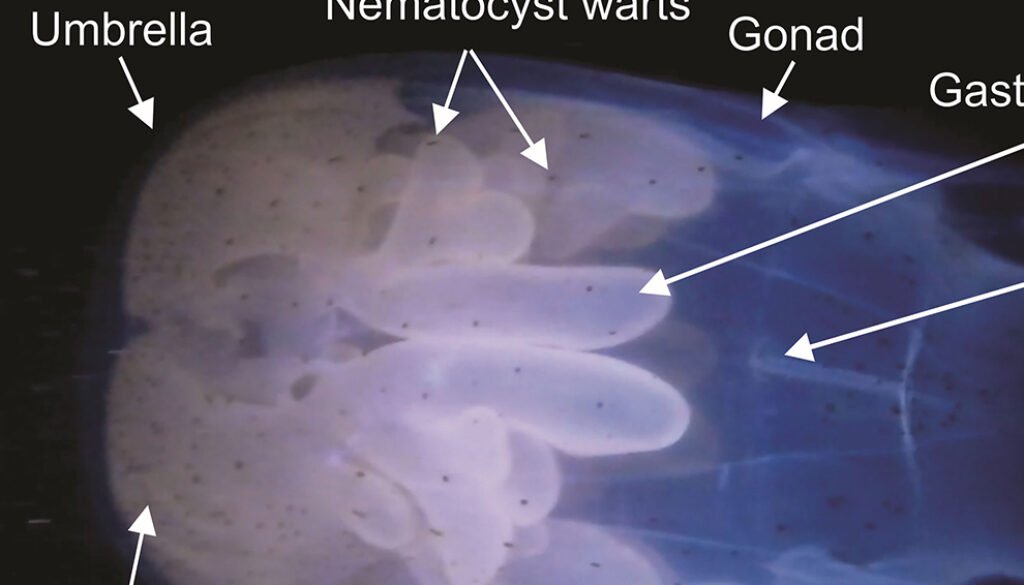
The specimens were determined as C. alipes based on the original diagnosis of Gershwin (2006) and the observable characters in the in situ records obtained in this study. The specimens exhibit a subquadrangular bell, slightly taller than wide, with rounded edges that broaden at the midsection (Fig. 2A). The apex of the bell is either flattened or truncate, and the bell margin remains continuous between the pedalia. Interradial pillars are notably wide, presenting a well-defined longitudinal groove between them (Fig. 2A, C). Both the exumbrella and pedalia are densely covered with conspicuous nematocyst warts; additional freckling, resulting from nematocyst accumulation, is evident on the upper half of the exumbrella and along the pedalial keels (Fig. 2A-C). Each of the 4 interradial pedalia is elongated and spatulate, distally divided into 3-4 short, finger-like projections, from which thick, rounded, orange tentacles originate. Tentacle insertion is narrower at the base and expands distally (Fig. 2B, C). The pedalial canal is simple proximally and branches distally into 3-4 straight terminal canals at the bases of the tentacle-bearing projections (Fig. 2B). At its base, the pedalial canal has a prominent diverticulum, originally described by Gershwin (2006) as volcano-shaped and oriented upward (Fig. 2B). The velarium is broad and also displays an abundance of nematocyst warts (Fig. 2A-C). The rhopaliar niche ostium is faintly visible in Figure 2A, appearing as a frown-shaped structure in which a lens eye can be partially distinguished.
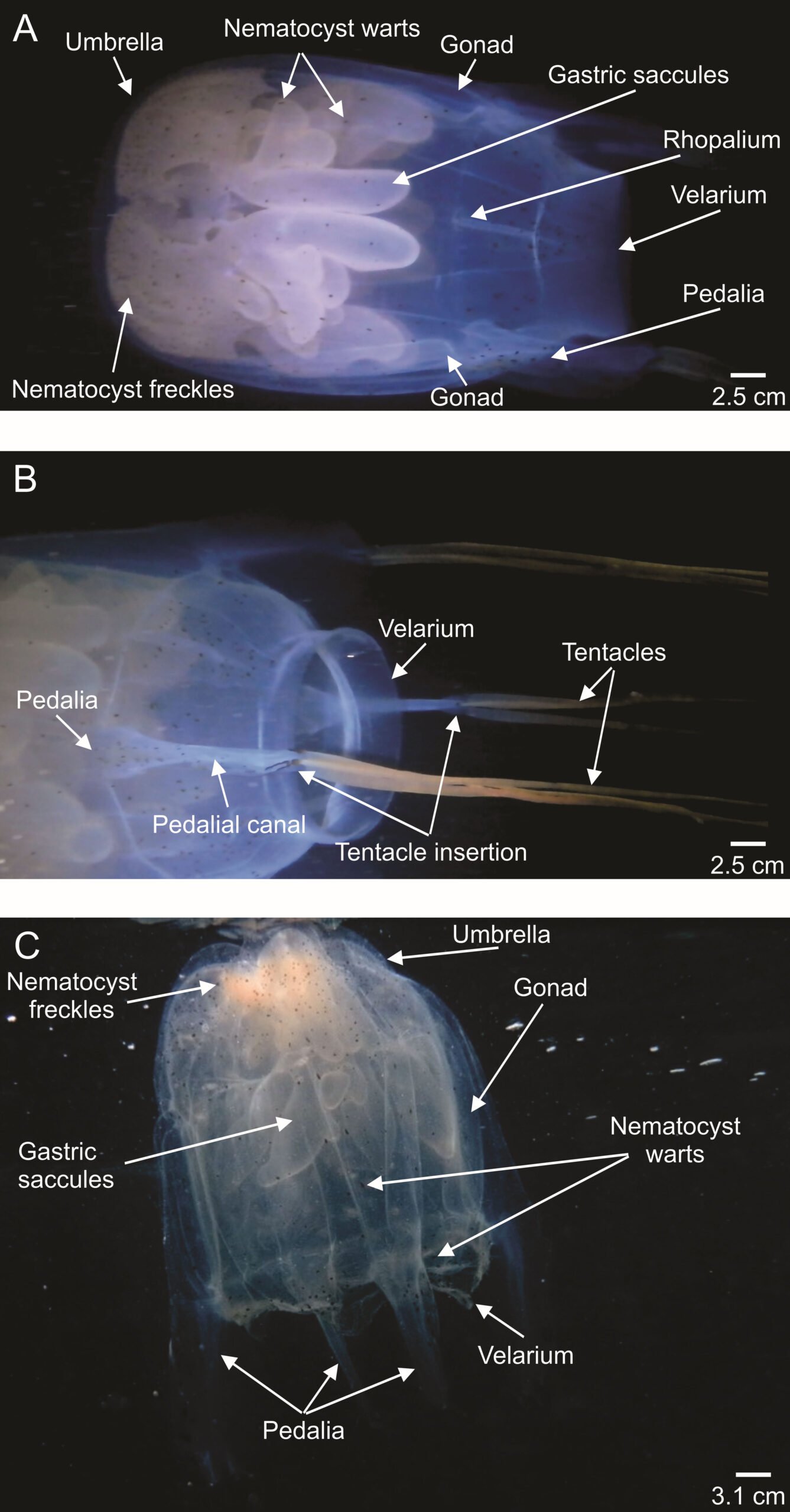
The gonads are characterized by their elongated, translucent, and laminar appearance. They are affixed to the interradius and extend along a substantial portion of the bell’s height, positioned slightly above the base of the pedalial canal (Fig. 2A, C).
The gastric saccules are pendulous, elongated and finger-like, exhibiting 2-3 scalloped divisions at their base. Two principal saccules are visible in radial orientation, extending beyond the midpoint of the bell and sometimes presenting a distally umbonate appearance (Fig. 2A, C). The saccules are whitish in coloration.
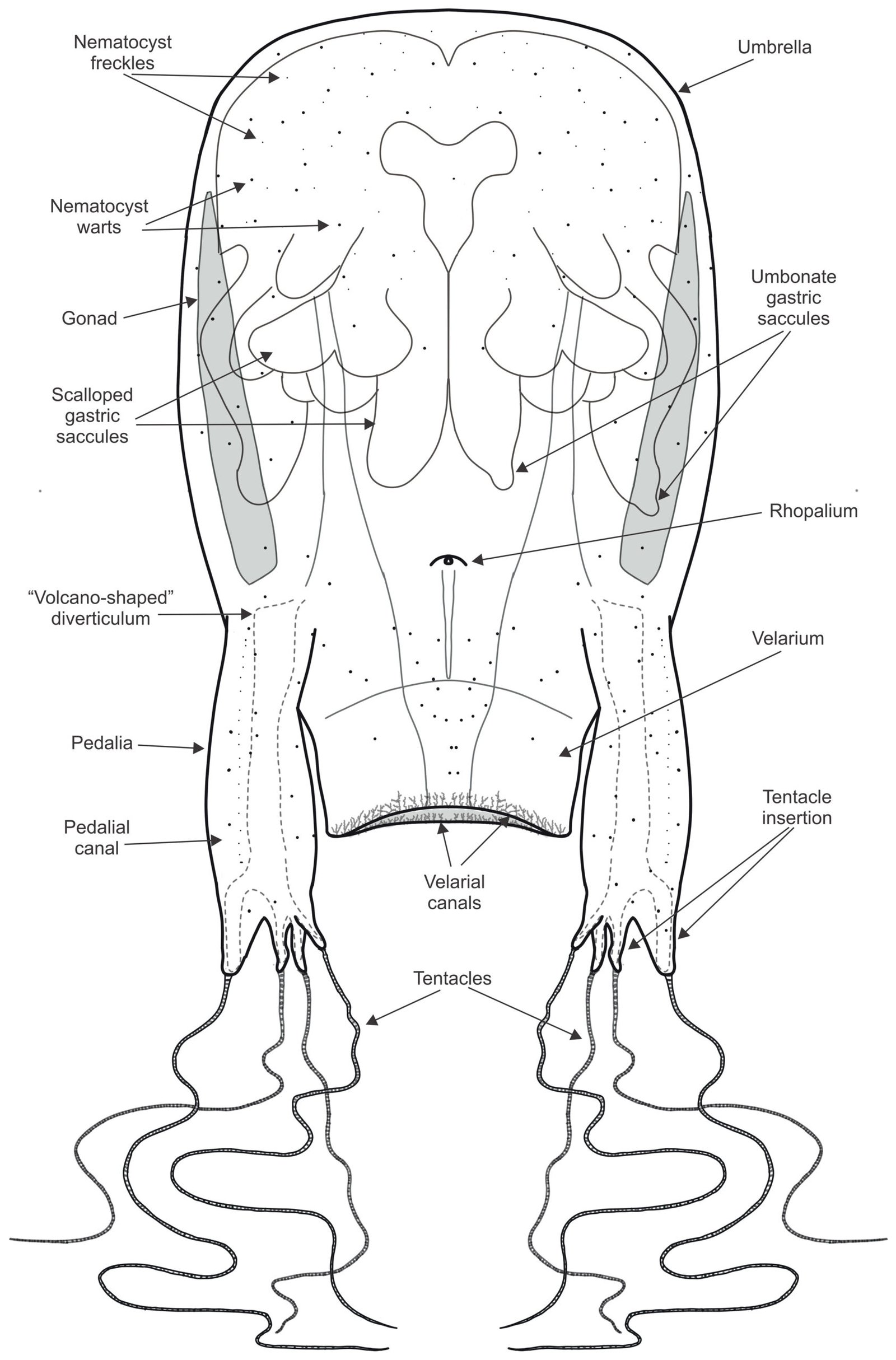
Comparative evaluation of the observable diagnostic characters against the original description of Gershwin (2006) and the unpublished observations of R. Hartwick, revealed both concordant and contrasting morphological traits between preserved and live individuals (Table 1). Based on this comparison, an integrative schematic representation summarizing the principal diagnostic characters of C. alipes observable in live individuals was produced (Fig. 3). The schematic also incorporates structures reconstructed from the original species description that were not clearly distinguishable in the in situ photographic material.
| Diagnostic character | Gershwin (2006) | Hartwick in Gershwin (2006) | Los Arcos in situ record | Islas Marietas in situ record | Notes |
|---|---|---|---|---|---|
| Umbrella taller than wide; truncate apex; broad interradial pillars | Present | – | Visible | Visible | Fig. 2A, C |
| Elongated spatulate pedalia with keels | Present | – | Visible | Visible | Fig. 2A-C |
| Exumbrellar and pedalial nematocyst warts | Present | – | Visible | Visible | Fig. 2A-C |
| Exumbrellar and pedalial keel nematocyst freckles | Present | – | Visible | Visible | Fig. 2A-C |
| Broad velarium | Present | – | Visible | Visible | Fig. 2A-C |
| Velarial nematocyst warts | Absent | Present | Visible | Visible | Fig. 2A-C |
| Jagged velarial canal edges | Present | – | Not visible | Not visible | |
| Distal pedalial clustering of finger-like projections with rounded tentacles | Present | – | Visible | Partially visible | Orange tentacles observed in live individuals, Fig. 2B |
| Pedalial canal with 3–4 distal branches | Present | – | Visible | Visible | Fig. 2B, C |
| Pedalial canal basal “volcano-shaped” diverticulum | Present | – | Partially visible | Partially visible | Fig. 2A, C |
| Laminar gonads | Present | – | Visible | Visible | Fig. 2A, C |
| Short pendant gastric saccules | Present | Absent | Not visible | Not visible | Not observed in live individuals; reported only from preserved material |
| Elongated scalloped gastric saccules | Absent | Present | Visible | Visible | Umbonate distal termination observed in live individuals, Fig. 2C |
| Frown-shaped rhopaliar niche ostia | Present | – | Partially visible | Not visible | Fig. 2A |
| Lensed eyes | Present | – | Partially visible | Not visible | One eye distinguishable, Fig. 2A |
Discussion
The suite of external morphological characters documented in the in situ video and photographic records aligns with the original diagnosis of C. alipes proposed by Gershwin (2006), which was based on preserved specimens. Furthermore, observations of live individuals reveal a degree of morphological variability among C. alipes specimens across records, which is common in gelatinous organisms. Notably, several features correspond with the unpublished observations of Dr. R. Hartwick, cited by Gershwin (2006) in the variation section of the original species description (Table 1). These include the presence of large, pendulous gastric saccules with 2-3 scalloped divisions, and conspicuous nematocyst warts on the velarium. Additionally, the present records document characters not explicitly detailed in the original diagnosis, such as the umbonate distal termination of the gastric saccules observed in situ. These differences likely reflect morphological alterations associated with specimen fixation and preservation, which may obscure or distort delicate external structures in cubozoans. The present observations further demonstrate that several diagnostic characters of C. alipes are more readily and accurately assessed in live individuals than in preserved material, highlighting the value of in situ documentation for cubozoan taxonomy. The integrative schematic representation presented herein (Fig. 3) synthesizes these comparative observations and provides a visual framework for interpreting diagnostic characters of C. alipes in live individuals, including structures that are difficult to distinguish or potentially altered in preserved material.
Formal records of C. alipes have remained scarce since its original description and are predominantly based on preserved material or low-resolution photographs. Gershwin (2006) described the species from fixed specimens collected in Zihuatanejo, Guerrero (Fig. 1A, point a). Subsequent records have extended the known occurrence of the species along the Mexican Tropical Pacific, including Acapulco Bay, Guerrero (Del Moral-Flores et al., 2020) (Fig. 1A, point b), and Nuevo Vallarta, Nayarit (Cupul-Magaña, 2023) (Fig. 1A, point c). Additionally, Cupul-Magaña (2023) proposed that the previously reported record of C. quadrumanus from Barra de Navidad, Jalisco, by Jáquez-Bermúdez et al. (2013) (Fig. 1A, point d), is more accurately attributable to C. alipes, given that C. quadrumanus is distributed in the Gulf of Mexico, whereas C. alipes is characteristic of the Mexican Tropical Pacific. The records presented in this study fall within the currently recognized distribution range of the species; however, their occurrence across multiple localities, depths, and environmental conditions suggests that C. alipes may be under-recorded rather than genuinely rare.
The in situ records obtained in this study substantially enhance the existing morphological knowledge of C. alipes by enabling the direct observation and verification of diagnostic characters in live individuals. Several of these features, including the detailed structure of gastric saccules and the distribution of nematocyst warts, are difficult to assess or may be altered in preserved specimens. These findings underscore the importance of high-quality, non-extractive in situ documentation as a complementary approach to traditional taxonomic methods, particularly for cubozoans, where specimen collection is often constrained by safety, conservation, and logistical limitations.
Acknowledgments
We thank María Del Mar Ponce Limón (Centro de Buceo Aquanautas), Ana Rubí López Martínez, and Michael Farid Zavala for providing the recordings and photographs taken of the organisms. We also thank Fernando Berrios (Universidad Católica del Maule) and Sandra Rodríguez-Huezo (Universidad de Guadalajara) for their advice and support for this publication.
References
Bordehore, C., Manchado-Pérez, S., & Fonfría, E. S. (2024). Swimming ability of the Carybdea marsupialis (Cnidaria: Cubozoa: Carybdeidae): implications for its spatial distribution. Journal of Zoology, 324, 1–10. https://doi.org/10.1111/jzo.13197
Cigliano, J. A., Meyer, R., Ballard, H. L., Freitag, A., Phillips, T. B., & Wasser, A. (2015). Making marine and coastal citizen science matter. Ocean and Coastal Management, 115, 77–87. https://doi.org/10.1016/j.ocecoaman.2015.06.012
Coates, M. M. (2003). Visual ecology and functional morphology of Cubozoa (Cnidaria). Integrative and Comparative Biology, 43, 542–548. https://doi.org/10.1093/icb/43.4.542
Colin, S. P., Costello, J. H., Katija, K., Seymour, J., & Kiefer, K. (2013). Propulsion in Cubomedusae: mechanisms and utility. Plos One, 8, e56393. https://doi.org/10.1371/journal.pone.0056393
Collins, A. G. (2025). World list of Cubozoa: Chiropsalmus Agassiz, 1862. World Register of Marine Species. Retrieved on January 16, 2026 from: https://www.marinespecies.org/aphia.php?p=taxdetailsandid=157923
Cupul-Magaña, F. G. (2023). Registro de la cubomedusa Chiropsalmus alipes Gershwinm, 2006 (Cubomedusae: Chiropsalmidae) en Marina Nuevo Vallarta, Nayarit. Acta Pesquera, 9, 30–32. https://doi.org/10.60113/ap.v9i17.3
Del Moral-Flores, L. F., López-Segovia, E., & Escartín-Alpizar, V. R. (2020). Dos nuevos registros de medusas (Cnidaria: Cubozoa y Scyphozoa) en la Bahía de Acapulco, Guerrero, México. Revista de Investigaciones Marinas, 40, 71–76.
Garm, A., Bielecki, J., Petie, R., & Nilsson, D. E. (2012). Opposite patterns of diurnal activity in the box jellyfish Tripedalia cystophora and Copula sivickisi. The Biological Bulletin, 222, 35–45. https://doi.org/10.1086/BBLv222n1p35
Garm, A., O’Connor, M., Parkefelt, L., & Nilsson, D. E. (2007). Visually guided obstacle avoidance in the box jellyfish Tripedalia cystophora and Chiropsella bronzie. Journal of Experimental Biology, 210, 3616–3623. https://doi.org/10.1242/jeb.004044
Gershwin, L. A. (2006). Comments on Chiropsalmus (Cnidaria: Cubozoa: Chirodropida): a preliminary revision of the Chiropsalmidae, with descriptions of two new genera and two new species. Zootaxa, 1231, 1–42. https://doi.org/10.11646/zootaxa.1231.1.1
Gershwin, L. A., De Nardi, M., Winkel, K. D., & Fenner, P. J. (2010). Marine stingers: review of an under-recognized global coastal management issue. Coastal Management, 38, 22–41. https://doi.org/10.1080/08920750903345031
Gervais, C. R., Champion, C., & Pecl, G. T. (2021). Species on the move around the Australian coastline: a continental-scale review of climate-driven species redistribution in marine systems. Global Change Biology, 27, 3200–3217. https://doi.org/10.1111/gcb.15634
Gordon, M. R., & Seymour, J. E. (2009). Quantifying movement of the tropical Australian cubozoan Chironex fleckeri using acoustic telemetry. In K. A. Pitt, & J. E. Purcell (Eds.), Jellyfish blooms: causes, consequences, and recent advances. Proceedings of the Second International Jellyfish Blooms Symposium, held at the Gold Coast, Queensland, Australia, 24–27 June, 2007 (pp. 87–97). Dordrecht: Springer Netherlands. https://doi.org/10.1007/978-1-4020-9749-2_6
Graham, W. M., Gelcich, S., Robinson, K. L., Duarte, C. M., Brotz, L., Purcell, J. E. et al. (2014). Linking human well-being and jellyfish: ecosystem services, impacts, and societal responses. Frontiers in Ecology and the Environment, 12, 515–523. https://doi.org/10.1890/130298
Jáquez-Bermúdez, L. S., Celis-Gutiérrez, L., & Franco-Gordo, M. C. (2013). Medusas (Cnidaria: Medusozoa) de la costa sur de Jalisco y Colima. In M. C. Franco-Gordo (Ed.), Inventario de biodiversidad de la costa sur de Jalisco y Colima. Vol. 1, Cap. 3 (pp. 32–43). Guadalajara: Universidad de Guadalajara.
Jouiaei, M., Yanagihara, A. A., Madio, B., Nevalainen, T. J., Alewood, P. F., & Fry, B. G. (2015). Ancient venom systems: a review on cnidaria toxins. Toxins, 7, 2251–2271. https://doi.org/10.3390/toxins7062251
Kintner, A. H., Seymour, J. E., & Edwards, S. L. (2005). Variation in lethality and effects of two Australian chirodropid jellyfish venoms in fish. Toxicon, 46, 699–708. https://doi.org/10.1016/j.toxicon.2005.07.015
Kramp, P. L. (1961). Synopsis of the medusae of the World. Journal of the Marine Biological Association of the United Kingdom, 40, 7–382. https://doi.org/10.1017/S0025315400007347
Lavín, M. F., Fiedler, P. C., Amador, J. A., Ballance, L. T., Färber-Lorda, J., & Mestas-Nuñez, A. M. (2006). A review of eastern tropical Pacific oceanography: summary. Progress in Oceanography, 69, 391–398. https://doi.org/10.1016/j.pocean.2006.03.005
Mitchell, D. G., Edgar, A., & Martindale, M. Q. (2021). Improved histological fixation of gelatinous marine invertebrates. Frontiers in Zoology, 18, 29. https://doi.org/10.1186/s12983-021-00414-z
Nilsson, D. E., Gislén, L., Coates, M. M., Skogh, C., & Garm, A. (2005). Advanced optics in a jellyfish eye. Nature, 435, 201–205. https://doi.org/10.1038/nature03484
O’Connor, M., Garm, A., & Nilsson, D. E. (2009). Structure and optics of the eyes of the box jellyfish Chiropsella bronzie. Journal of Comparative Physiology A, 195, 557–569. https://doi.org/10.1007/s00359-009-0431-x
Plata-Rosas, L., & Filonov, A. (2007). Internal tide in the northwestern part of Banderas Bay, Mexico. Ciencias Marinas, 33, 197–215. https://doi.org/10.7773/cm.v33i2.1013
Salas-Pérez, J. J., & Cupul-Magaña, A. L. (2005). Preliminary temporal and spatial patterns of Bahía de Banderas (Mexico) marine circulation derived from satellite and in situ measurements. e-Gnosis, 3, 1–25.
Schlaefer, J. A., Wolanski, E., Lambrechts, J., & Kingsford, M. J. (2021). Behavioural and oceanographic isolation of an island-based jellyfish (Copula sivickisi, Class Cubozoa) population. Scientific Reports, 11, 10280. https://doi.org/10.1038/s41598-021-89755-7
Schlaefer, J. A., Wolanski, E., Yadav, S., & Kingsford, M. J. (2020). Behavioural maintenance of highly localised jellyfish (Copula sivickisi, class Cubozoa) populations. Marine Biology, 167, 40. https://doi.org/10.1007/s00227-020-3646-6
Tibballs, J. (2006). Australian venomous jellyfish, envenomation syndromes, toxins and therapy. Toxicon, 48, 830–859. https://doi.org/10.1016/j.toxicon.2006.07.020
Velázquez-Ruiz, A., Martínez, R. L. M., & Carrillo-González, F. M. (2012). Caracterización climática para la región de Bahía de Banderas mediante el sistema de Köppen, modificado por García, y técnicas de sistemas de información geográfica. Investigaciones Geográficas, 79, 7–19. https://doi.org/10.14350/rig.34534