
Phylogenetic isolation of the jumping spider Amilaps olivacea, with notes on morphology and natural history (Salticidae: Spartaeinae: Lapsiini)
Aislamiento filogenético de la araña saltarina Amilaps olivacea, con notas sobre su morfología e historia natural (Salticidae: Spartaeinae: Lapsiini)
Wayne P. Maddison a, *, Edmundo González-Santillán b
a University of British Columbia, Departments of Zoology and Botany and Beaty Biodiversity Museum, 6270 University Boulevard, Vancouver, British Columbia, V6T 1Z4, Canada
b Universidad Nacional Autónoma de México, Instituto de Biología, Departamento de Zoología, Colección Nacional de Arácnidos, Tercer Circuito s/n, Ciudad Universitaria, Coyoacán, 04510 Ciudad de México, Mexico
*Corresponding author: wayne.maddison@ubc.ca (W. P. Maddison)
Received: 10 November 2025; accepted: 17 August 2026
Abstract
The rarely-seen jumping spider Amilaps mayana Maddison, 2019 has been enigmatic in its phylogenetic placement, having no synapomorphies known to unite it with any other subgroup of salticids. In recent field work in southern México, we found them to be common in limestone alcoves near the entrances of caves. Our phylogenomic analysis based on ultra-conserved elements (UCEs) shows Amilaps to be in the tribe Lapsiini, but phylogenetically isolated as the sister group to all other known genera of the tribe. A preliminary divergence dating analysis hints that it may be the single species most distant from others known within Salticidae. We describe the female for the first time, present photos of living specimens, and give details of its natural history. The discovery of the female reveals that Amilaps mayana is a junior synonym of Sidusa olivacea F.O. Pickard-Cambridge 1901, syn. nov., thus yielding the new combination Amilaps olivacea (F.O. Pickard-Cambridge, 1901), comb. nov.
Keywords: Grutas de Coconá; Karst topography; Phylogeny; Systematics; Taxonomy
Resumen
La araña raramente vista Amilaps mayana Maddison, 2019 ha sido uno de los saltícidos filogenéticamente más enigmáticos, ya que no se conocen sinapomorfías que la relacionen con ningún otro clado de saltícidos. En una recolecta reciente en el sur de México se encontraron ejemplares activos de esta especie sobre roca caliza, cerca de la entrada de cuevas. Se llevó a cabo un análisis filogenómico basado en elementos ultraconservados (UCEs), cuyos resultados muestran que Amilaps pertenece a la tribu Lapsiini y dados los resultados de un análisis de divergencia preliminar, se puede suponer que es el grupo hermano de todos los demás lapsiinos conocidos. Lo cual sugiere que Amilaps es una de las especies de saltícidos filogenéticamente más aisladas que se conocen. En esta contribución se describe la hembra, se presentan fotografías de ejemplares vivos y se aportan detalles de su historia natural, por primera vez. El descubrimiento de la hembra revela que Amilaps mayana es un sinónimo de Sidusa olivacea F.O. Pickard-Cambridge 1901, syn. nov., por lo que se propone la nueva combinación Amilaps olivacea (F.O. Pickard-Cambridge, 1901), comb. nov.
Palabras clave: Grutas de Coconá; Topografía kárstica; Filogenia; Sistemática; Taxonomía
Introduction
Few major phylogenetic mysteries remain among the jumping spiders. Almost all species that are known to any degree can be assigned easily to one of the 7 subfamilies, if not to tribe (Maddison, 2015). However, Amilaps mayana Maddison, 2019, of southern México and Guatemala, has remained enigmatic. Known from just 2 old male specimens, there has been no molecular phylogenetic data available for it. Its morphology excludes it from the 2 subfamilies containing all other salticids known from the North American continent, the enormous Salticinae and the smaller Lyssomaninae. Maddison (2019) placed it with hesitation in the Lapsiini, a small tribe of otherwise South American genera in the subfamily Spartaeinae. This placement was based primarily on Amilaps being in the Americas, like the lapsiines, but on little else. Their general morphological resemblance could very well be plesiomorphic to the family, and thus not an indication of relationship. The synapomorphy that unites all other lapsiines, a reduction to 2 retromarginal cheliceral teeth (Ruiz & Maddison, 2012), is absent in Amilaps (Maddison, 2019). No other synapomorphies are known to unite Amilaps with the remaining Lapsiini, with the Spartaeinae, or for that matter any other subgroup of Salticidae. Thus, with Amilaps’s generalized features, it could have been placed anywhere deep in the salticid tree, perhaps even as sister to the rest of the family. As such, it could play a major role in inferences of the evolution of salticids.
Using specimens obtained from recent field work at the type locality of Amilaps mayana, this paper gathers ultra-conserved element (UCE) data (Faircloth, 2017) to resolve the phylogenetic position of Amilaps. We give the first description of the female, characterize in general terms the natural history of the species, and present photographs and videos of living specimens. Finding the female led to the discovery of an older synonym, and thus the species will be hereafter referred to as Amilaps olivacea (F.O. Pickard-Cambridge, 1901), comb. nov.
Materials and methods
Specimens and morphology
Preserved specimens recently collected are deposited in the Colección Nacional de Arácnidos (CNAN), Instituto de Biología, Universidad Nacional Autónoma de México, and the Beaty Biodiversity Museum (BBM), University of British Columbia. The holotype female of Sidusa olivacea F. O. Pickard-Cambridge, 1901, is in the Natural History Museum, London (NHMUK).
The preserved specimens were examined under both dissecting microscopes and a compound microscope with reflected light. Drawings were made with a drawing tube on a Nikon ME600L compound microscope. Microscope photographs were made on the same microscope and focus-stacked using Helicon Focus v. 4.2.7.
Terminology is standard for Araneae. All measurements are given in mm. Descriptions of color pattern are based on the alcohol-preserved specimen. Carapace length was measured from the base of the anterior median eyes not including the lenses to the rear margin of the carapace medially; abdomen length to the end of the anal tubercle. Abbreviations used: ALE, anterior lateral eye; AME, anterior median eye; PLE, posterior lateral eye; PME, posterior median eye.
Phylogenomics
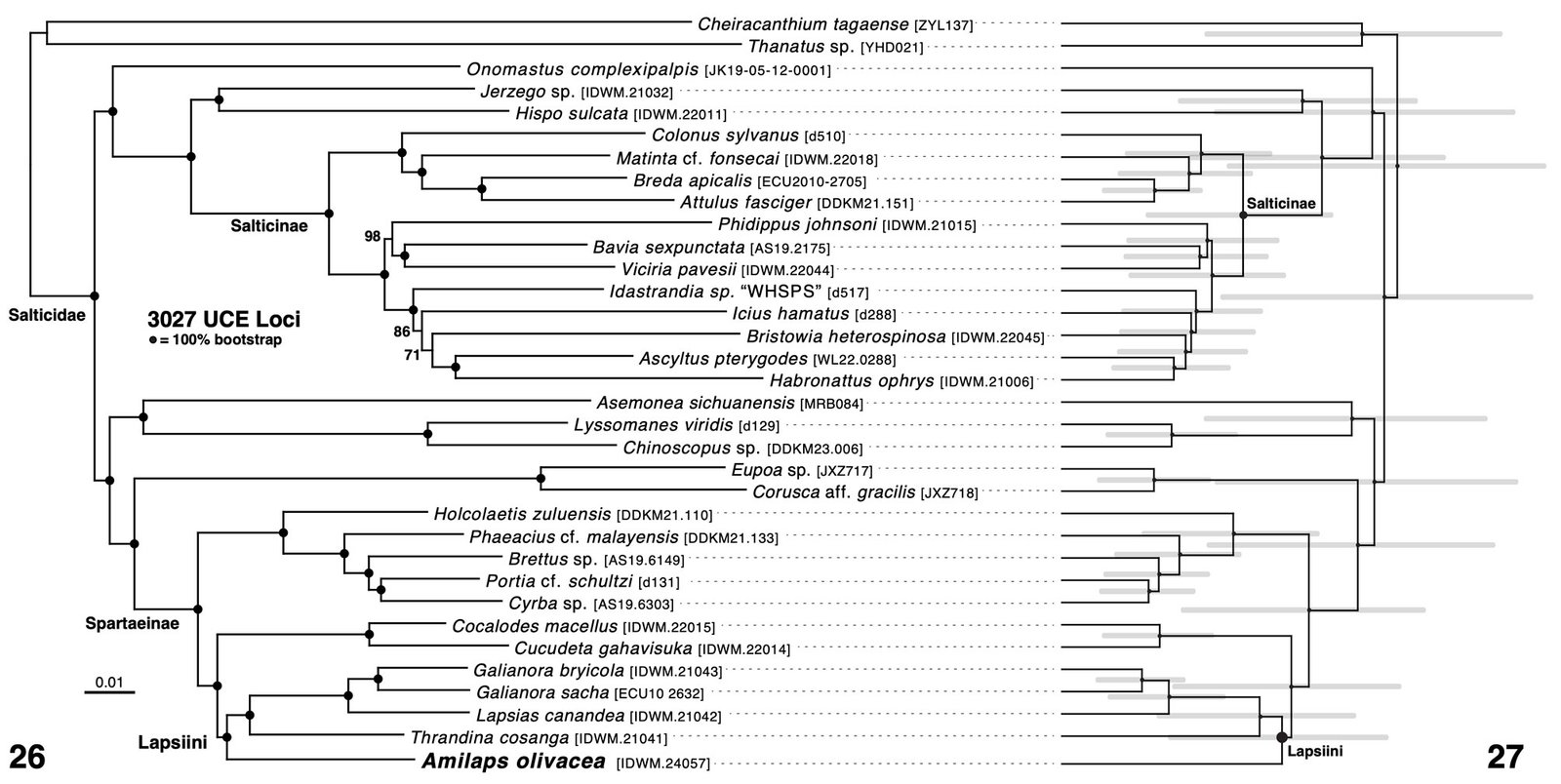
In order to place Amilaps phylogenetically, molecular data was newly gathered from 15 salticids (Table 1) by Ultraconserved Element (UCE) target enrichment sequencing methods (Faircloth 2017), using the RTA v3 probe set (Zhang et al., 2023), and with the assistance of Arbor Biosciences. These data were combined with previously-published data for 17 other salticids and 2 outgroups to assemble a UCE dataset of 34 species spanning all 7 subfamilies. All but 3 of the previously-published taxa are from Zhang et al. (2024); the 2 non-salticid taxa are from Zhang et al. (2023), and Habronattus ophrys Griswold, 1987 is from Maddison (2024a). The specimen information for previously-published data can be found in those papers using the specimen ID code in Figure 26. Molecular protocols followed those of Marathe et al. (2024).
| Species | Specimen | sex | SRA | Reads passed QC | Locality | Lat., long. |
|---|---|---|---|---|---|---|
| Amilaps olivacea (F.O. Pickard-Cambridge, 1901) | IDWM.24057 | ♀ | SAMN53178949 | 3345230 | México: Teapa | 17.564, -92.928 |
| Ascyltus pterygodes (L. Koch, 1865) | WL22.0288 | j. | SAMN53178950 | 5745797 | USA: Oahu | 21.31, -157.79 |
| Asemonea sichuanensis Song & Chai, 1992 | MRB084 | ♂ | SAMN53178951 | 5895745 | China: Ningming Co. | 21.83, 107.02 |
| Attulus fasciger (Simon, 1880) | DDKM21.151 | ♀ | SAMN53178952 | 2603659 | Canada: Burlington | 43.3507, -79.7593 |
| Bavia sexpunctata (Doleschall, 1859) | AS19.2175 | ♂ | SAMN53178953 | 2603659 | Singapore | 1.356, 103.774 |
| Breda apicalis Simon, 1901 | ECU10-2705 | ♂ | SAMN53178954 | 2545037 | Ecuador: Río Bigal | -0.5275, -77.4225 |
| Bristowia heterospinosa Reimoser, 1934 | IDWM.22045 | ♂ | SAMN53178955 | 4292901 | Singapore | 1.38, 103.817 |
| Chinoscopus sp. | DDKM23.006 | j. | SAMN53178956 | 4296450 | Panama: Gamboa | 9.1584, -79.7425 |
| Cucudeta gahavisuka Maddison, 2009 | IDWM.22014 | j. | SAMN53178957 | 4307698 | Papua New Guinea | -6.0145, 145.4117 |
| Hispo sulcata Wanless, 1981 | IDWM.22011 | ♂ | SAMN53178958 | 4256628 | Madagascar | -21.2644, 47.4218 |
| Icius hamatus (C. L. Koch, 1846) | d288 | ♂ | SAMN53178959 | 5689752 | Spain: Sitges | 41.2383, 1.8244 |
| Idastrandia sp. “WHSPS” | d517 | ♂ | SAMN53178960 | 5709864 | Malaysia: Mulu | 4.049, 114.860 |
| Matinta cf. fonsecai (Soares & Camargo, 1948) | IDWM.22018 | ♂ | SAMN53178961 | 4191187 | Ecuador: Jatun Sacha | -1.067, -77.617 |
| Portia cf. schultzi Karsch, 1878 | d131 | ♀ | SAMN53178962 | 3299758 | Madagascar | -22.592, 45.128 |
| Viciria pavesii Thorell, 1877 | IDWM.22044 | ♀ | SAMN53178963 | 6469708 | Singapore | 1.44, 103.7 |
UCE loci were identified among the assembled contigs using the RTA probe set file and PHYLUCE 1.7.3 (Faircloth, 2016; Faircloth et al., 2012). After recovery, each locus was aligned with MAFFT v. 7.505 (Katoh & Standley, 2013) using the L-INS-i option. Poorly aligned areas were trimmed using PhyIN (Maddison, 2024b) as implemented in Mesquite v. 4.01 (Maddison & Maddison, 2025b), with parameters b = 10 d = 2 p = 0.5 e = true occ = 0.5. Loci were discarded if recovered in fewer than 50% of the taxa. The loci were concatenated and rogue subsequences trimmed using Spruceup v.2024.07.22 (Boroweic, 2019) as implemented in Mesquite, with parameters criterion:mean window_size:50 cutoffs:4.0 overlap:25 distance_method:uncorrected. The loci were de-concatenated, after which sequences of less than 50 nucleotides were discarded. For each locus, a RAxML analysis (Stamatakis, 2014) was done to obtain a gene tree, and the locus was discarded if its gene tree had the ratio of the 2 longest branches greater than or equal to 5, a sign of possible paralogy (Maddison et al., 2020). Concatenations and de-concatenations of loci were done in Mesquite. Maximum likelihood phylogenetic analyses on the concatenated alignment were performed with IQ-TREE version 3.0.1 (Wong et al., 2025) using the Zephyr 4.01 package (Maddison & Maddison, 2025a) in Mesquite 4.01 (Maddison & Maddison, 2025b). Analyses were run unpartitioned and used the TEST option (standard model selection followed by tree inference). A bootstrap analysis was done with 500 replicates.
A preliminary Bayesian estimate of relative divergence dates was made on the ML tree from the concatenated alignment by MCMCtree in PAML (Yang, 2007) via special features in IQ-TREE 3.01 (Demotte et al. 2025) that communicate with MCMCtree via Hessians in order to implement the approximate likelihood method (Minh et al., 2025). We used a correlated rates clock model, unpartitioned, root age < 1.0, BDparas = 1,1,0.5. Because our goal is relative divergence dating rather than absolute, the root age specification is likely irrelevant, but dos Reis et al. (2017) suggest that specifying “root age <1.0” is a “safe constraint on root age, used if no fossil for root”. The analysis was run for 100 million MCMC generations (burn-in 10,000, sample every 1,000, number of samples 100,000), by which point the ESS of each node height was greater than 15,000.
Raw reads of new data are deposited in Sequence Read Archive (BioProject submission ID PRJNA1360076; see Table 1). Alignments and trees are deposited in FigShare (https://doi.org/10.6084/m9.figshare.32680758).
Results
Natural history
During field work 26 to 28 August 2024, 12 males, 21 females, and 2 juvenile A. olivacea were found at Grutas de Coconá, Teapa, Tabasco (17.564° N, 92.928° W [17°33’50” N, 92°55’40” W]), ca. 30 m elevation), at the base of a canyon in a small range of hills in tropical rainforest (Fig. 1).
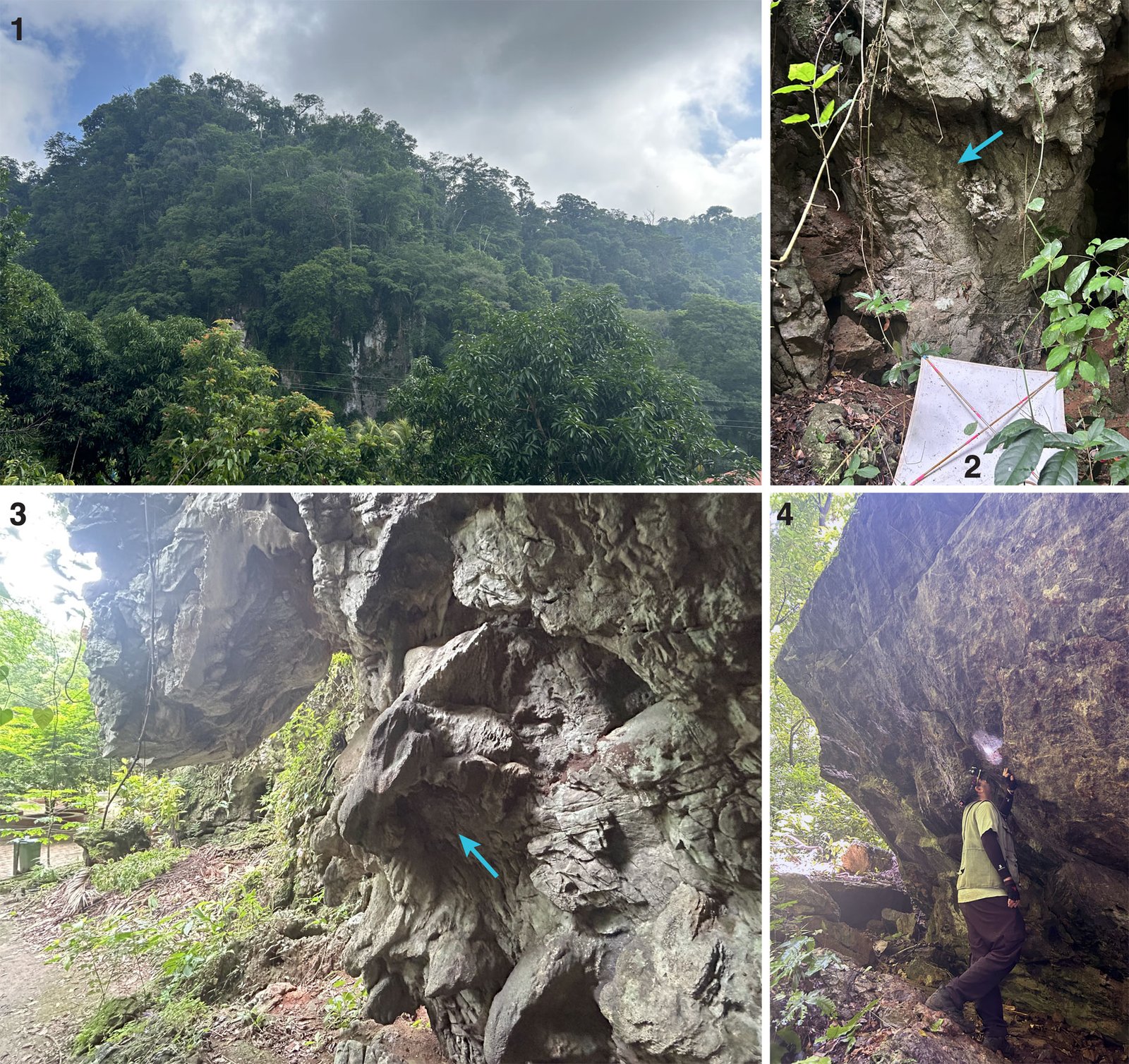
The site is a small tourist park in karst topography, with entrances leading into caves. The steep-sided canyon walls have large patches of bare limestone, either vertical or in recessed alcoves where overhanging limestone shades and protects the surface from rain (Figs. 2-4). Some of the alcoves are shallow dimples (Fig. 3), while others continue inward into the cave system.
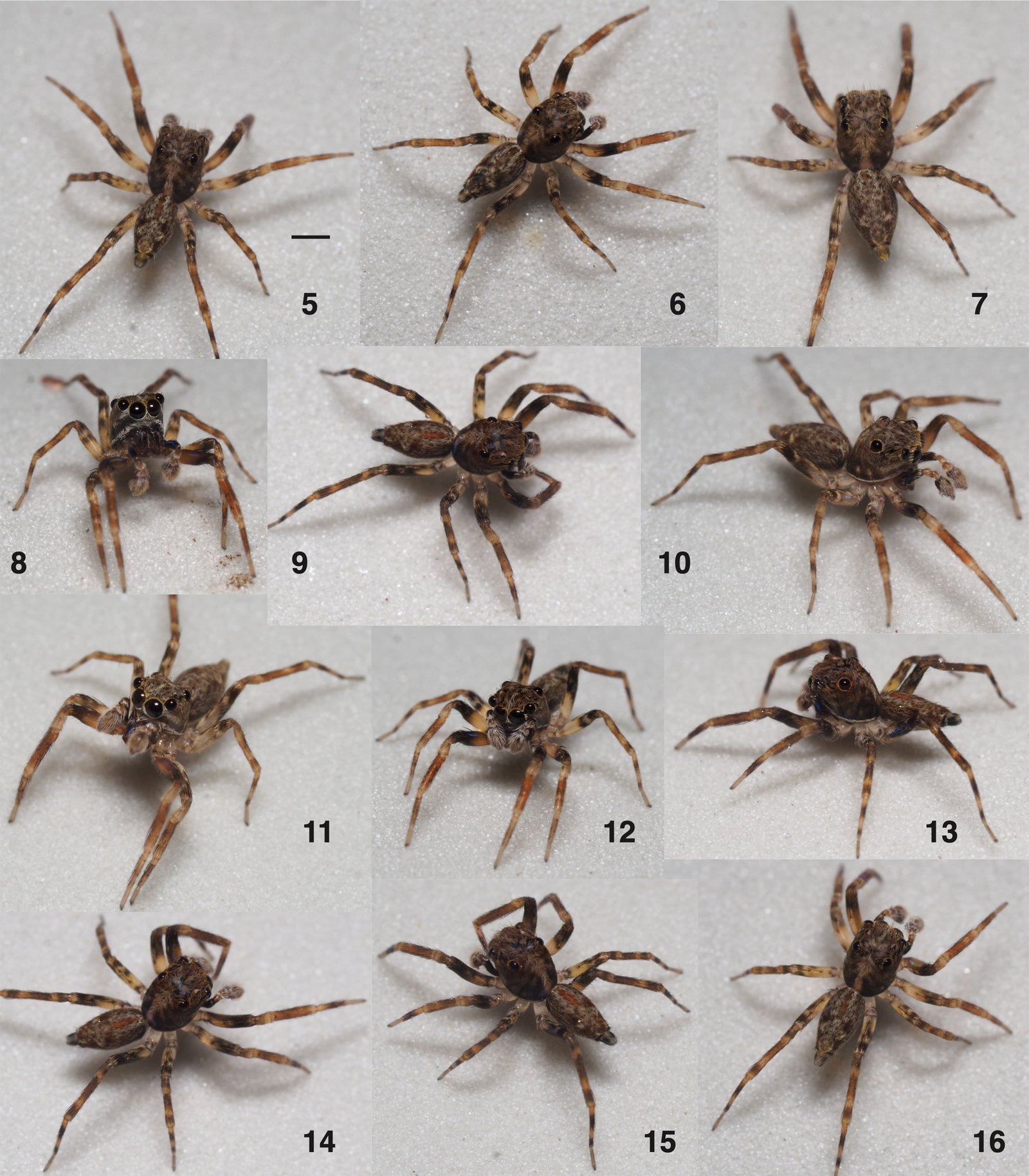
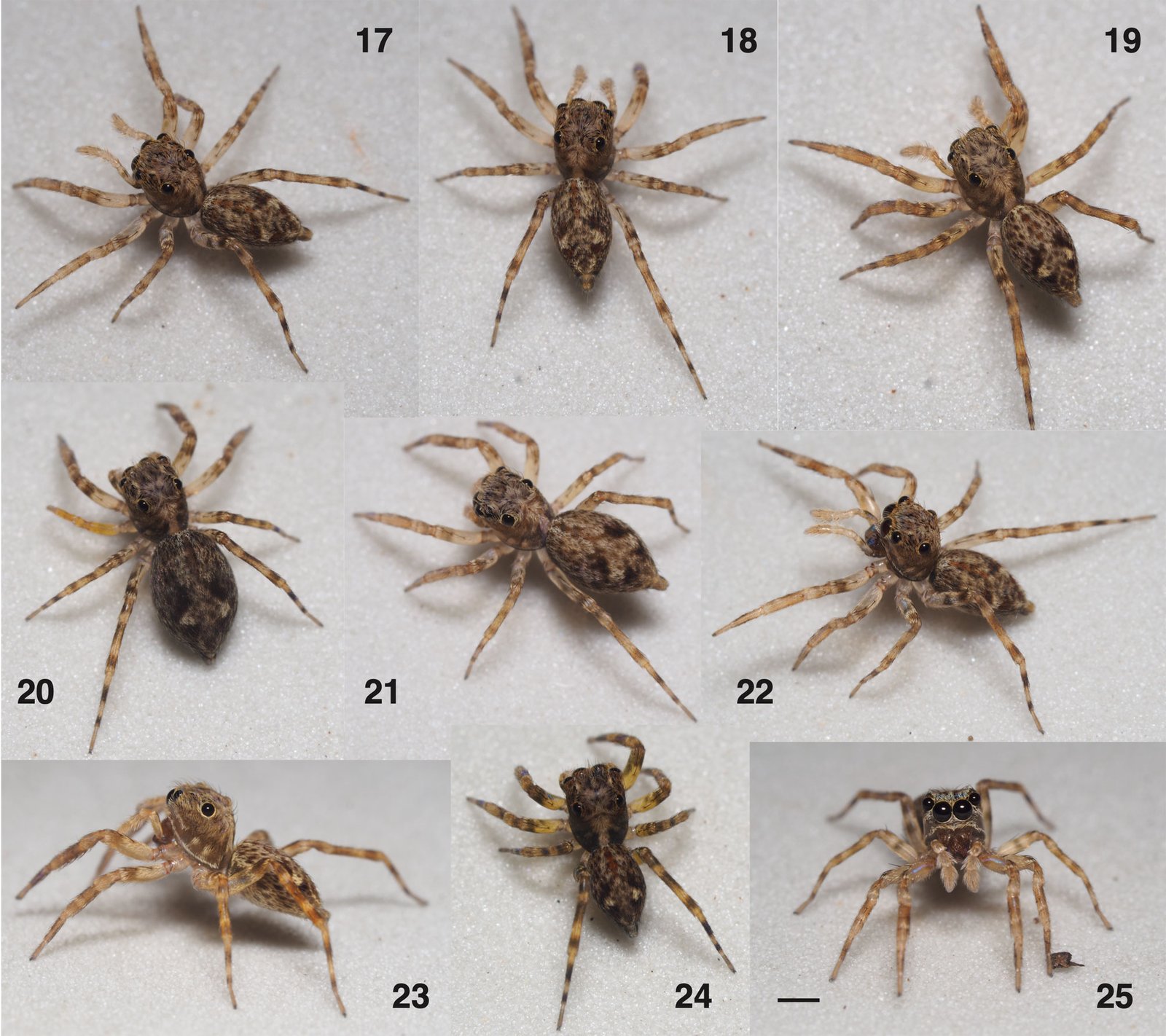
All individuals of Amilaps were found on this limestone in the liminal zone between cave and forest. The great majority were found in alcoves or under overhangs, on the outermost edge of the cave’s limestone and in the shade, but within 1 or 2 metres from the forest’s full light (Figs. 2-4). The surfaces on which they walked were typically dry, though some were found walking over wet patches. The spiders were not on webs or visibly associated with any web of their own or other spiders. None were found with prey. They were sometimes first seen walking, but most were seen motionless. The spiders moved primarily by walking, relatively slowly for a salticid. When disturbed they could run quickly, but were not seen to jump for escape. They have a distinctive gait like that seen in Spartaeini, Cocalodini, other Lapsiini, and some Hisponinae (Maddison, 2006, 2009, 2015), hesitant and yet fluid, waving first, second, and third pairs of legs, seemingly randomly. Figures 5, 6, 17, and 18 show individuals waving 1 or both second legs. Photographs of living specimens are shown in Figures 5-25. A video is available at https://youtu.be/heT9khLhRmE, showing the habitat, locomotory behaviour, and the behaviour of a male interacting with a female.
Phylogenetic placement of Amilaps
Sequencing, cleaning, assembly, and UCE identification resulted in 3,680 RTAv3 UCE loci recovered among the taxa. Of these, 618 were discarded for being recovered in fewer than 50% of the taxa, 25 were discarded for having only sequences less than 50 nucleotides, and 10 were discarded because their gene trees failed the branch length ratio paralogy filter. The remaining 3,027 loci concatenated to an alignment of 1,117,290 sites.
Figure 26 shows the maximum likelihood tree from the concatenated alignment, placing Amilaps olivacea with strong support within the Lapsiini, as sister to the remaining lapsiines, all of which are South American. This is the placement suggested by Maddison (2019). The reduction to 2 retromarginal cheliceral teeth (Ruiz & Maddison, 2012) is therefore a synapomorphy of the South American lineage of lapsiines, but not of all lapsiines. There is still no known morphological synapomorphy for the tribe.
The relative dating analysis (Fig. 27) shows a deep divergence between Amilaps and the other lapsiines, older than the first divergence in the entire subfamily Salticinae.
Taxonomy
Amilaps olivacea (F. O. Pickard-Cambridge, 1901), comb. nov.
Figs. 5-25, 28-35
Sidusa olivacea F. O. Pickard-Cambridge, 1901. Holotype female in NHMUK, examined.
Amilaps mayana Maddison, 2019, syn. nov.
Description of female (measurements from specimen NA24.9873). Carapace length 1.8, width 1.3; abdomen length 2.4. Carapace (Figs. 28, 29): integument light to medium brown except for a central longitudinal band of pale honey, and black around the eyes. Band of pale scales extending posterior for side of AME breaks up into a few discrete spots on lower thoracic sides (Figs. 23, 29). Cream and orange-brown scales clothe the ocular quadrangle, pointing forward in the middle but to the side just anterior to the PLE. PMEs as far medial as the inner edge of the ALE. Fovea long, longer than diameter of PLE. Clypeus narrow, pale except for dark band extending laterally and downward from AME, thinly clothed with white hairs (Fig. 30). Chelicerae light brown proximally and distally, but dark brown centrally. Four small retromarginal and 3 larger promarginal teeth. Palp with tarsal claw. Legs pale honey coloured, with darker annulae. First tibia with 3 pairs of ventral and 2 smaller anterior-lateral macrosetae; first metatarsus with 2 pairs of ventral macrosetae and 1 smaller anterior-lateral one. Leg formula 4132. Length of femur I 1.2, II 1.16, III 1.11, IV 1.49; patella + tibia I 1.51, II 1.4, III 1.3, IV 1.8; metatarsus + tarsus I 1.2, II 1.16, III 1.42, IV 1.9.
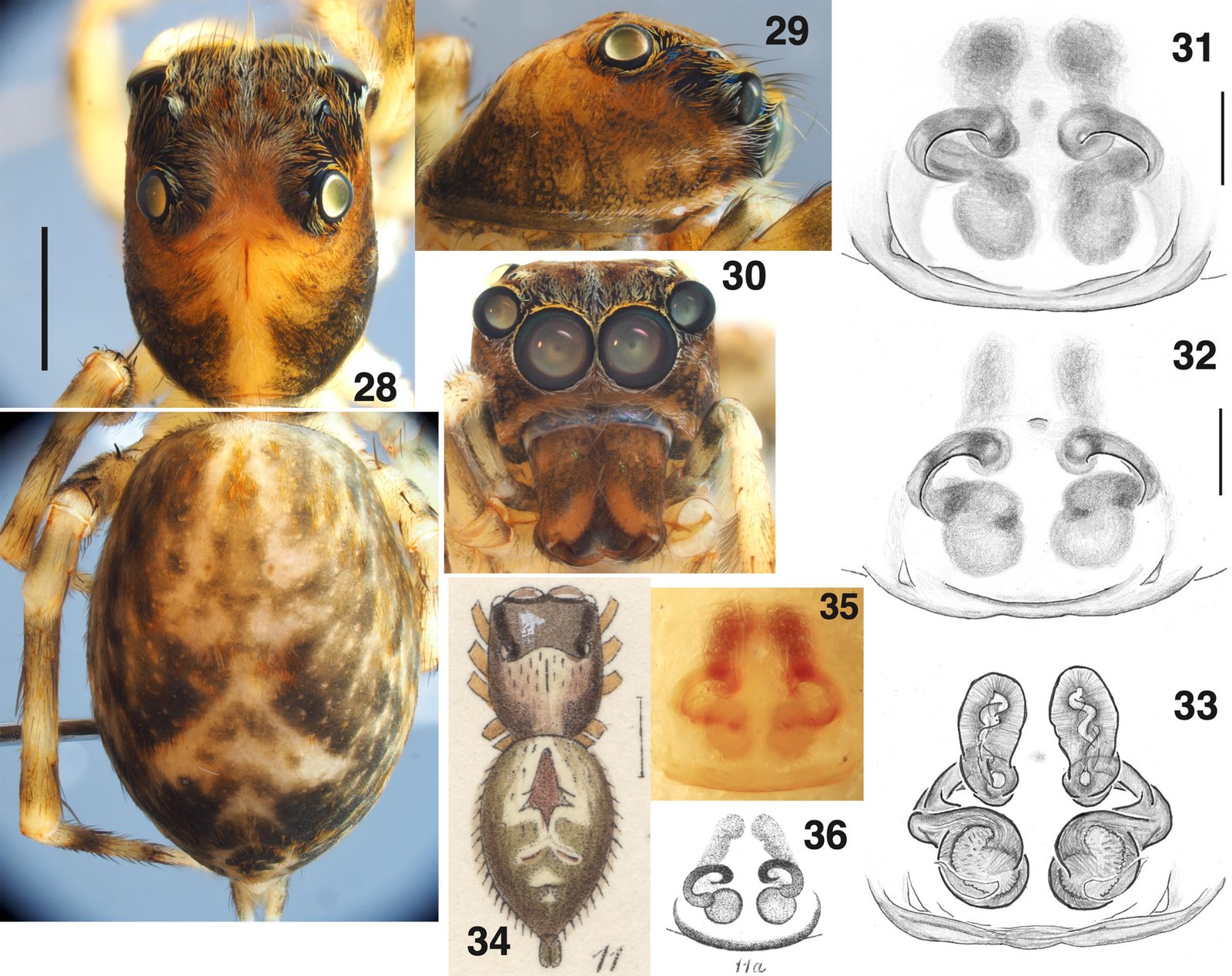
Abdomen light to dark brown with paler cream-coloured medial markings forming a series of approximate triangles, the anteriormost the longest, the middle the widest, and the posteriormost the smallest. Epigyne (Figs. 31, 32) with a large pale posterior depression, framed at the back by a lip along the epigastric furrow. At the front of the depression, openings lie beneath crescent shaped ridges. From the openings a heavily sclerotized twisted duct goes anteriorly, and a duct proceeds from the regions of the openings posteriorly to the spermathecae (Fig. 33). Whether the path to the posterior goes through the anterior twisted duct, or whether the duct forks into anterior and posterior branches, is not clear.
Material examined. México: Tabasco: Teapa, Grutas de Coconá, limestone walls and overhangs. 17.564, -92.928. 30 m elev. 26 to 28 August 2024. Maddison, Menéndez, Torres, González, Cuevas. WPM#24-047a (12 ♂, 21 ♀, 2 juv., CNAN-Ar017743). Chiapas: Mpo. Ocosingo, Area Natural Protegida Lacandonia, 16.7598, -91.0065. 159 m. elev. 31 May 2004, diurnal collecting (1 ♀ CNAN-Ar004581, CNAN).
Distribution. Southeastern Mexico and Guatemala. A male is known from Poptún, Guatemala (Maddison, 2019), and Pickard-Cambridge’s (1901) female of Sidusa olivacea, collected by Sarg, is listed as from “Guatemala”.
Remarks. The holotype female is now faded, but Pickard-Cambridge’s (1901) Figure 11 (our Fig. 34) of it shows markings matching those of Amilaps mayana. We include as well his illustration of the epigyne (his 11a, our Fig. 36) alongside its photograph (our Fig. 35) to show the accuracy of Pickard-Cambridge’s drawings. Pickard-Cambridge’s assigning this species to a euophryine genus, now placed in a different subfamily, may seem like a grave error, but not only has our understanding of phylogeny improved enormously, but also this species does have a superficial resemblance to some euophryines in the region, especially Amphidraus Simon, 1900 and Chapoda G. W. Peckham & E. G. Peckham, 1896. The first author’s 1983 field notes initially recorded it as a small brown euophryine.
Discussion
The divergence time analysis (Fig. 27) suggests that Amilaps olivacea could be the most phylogenetically-isolated single living salticid species — that is, whose closest living relative is the farthest away measured in millions of years along phylogenetic branches. This analysis must be considered preliminary, given the taxon sampling is sparse and the error bars are large. Nonetheless, the results indicate that the split between Amilaps and the South American lineage of lapsiines could be older than the entire subfamily Salticinae. This result does not depend on calibrating the phylogeny within an absolute time frame; we are speaking of relative divergence times. Although there are other small clades of species whose divergence from other salticids may be older than that of Amilaps (e.g., Onomastus Simon, 1900), Amilaps may be the most isolated single species known.
Of course, the apparent phylogenetic isolation of Amilaps olivacea would be diminished by the discovery of living close relatives. Where would we look for such relatives? Amilaps olivacea is known from exposed limestone near caves, and thus might be associated with karst topography in tropical forests. Karst deposits are widespread in Mexico, but the largest continuous deposit is in the southeastern area (Bautista et al., 2023). The Grutas de Coconá are at the northwest limit of the physiographic province Sierras de Chiapas and Guatemala, an extensive karstic area which approximately matches the known distribution of A. olivacea (Tabasco, Chiapas, Guatemala). A particularly promising area to look for close relatives might be the karst areas of Costa Rica, which are isolated from those of Mexico and Guatemala. The Antilles may also be a site to search for new related taxa. Cuba, Dominican Republic, Jamaica, and Puerto Rico contain extensive karstic deposits, which could provide appropriate habitat if covered by a forest humid enough for lapsiines. While close relatives might also occur in South America, they have not yet been found there despite extensive collecting in Colombia and Ecuador in the last few decades.
Despite the phylogenetic isolation of Amilaps, there is no compelling case to change its higher classification. The Lapsiini remains monophyletic even with Amilaps included. Related tribes also have isolated early-diverging lineages, e.g., Holcolaetis Simon, 1886 and Sonoita G. W. Peckham & E. G. Peckham, 1903, within the Spartaeini, and (apparently) Depreissia Lessert, 1942, within the Cocalodini (Maddison et al., 2016). It may be useful to establish a separate subtribe for Amilaps, but that would best wait for a comprehensive review of higher level salticid classification.
Acknowledgements
We are grateful to Victor Castellano Sánchez and Carlos Esquivel for facilitating field work at the Grutas de Coconá. We thank Miguel Menéndez Acuña, Carlos Torres Muñoz and Ximena Cuevas Morales for their assistance in the field, and Kiran Marathe for assistance with the molecular laboratory work. We thank Jan Beccaloni and Jasmin Perera (NHMUK) for loaning the holotype of Sidusa olivacea. This research was supported by funding from an NSERC Canada Discovery Grant. Fieldwork was conducted under permits issued by the Dirección General de Vida Silvestre (Semarnat) to EGS (SPARN/DGVS/04032/24).
References
Bautista, F., Aguilar, Y., Palacio, G., & Gijón-Yescas, N. (2023). The karst landscapes of Mexico. In F. Bautista (Ed.), El karst de México (pp. 139–155). Mexico City: Asociación Mexicana de Estudios sobre el Karst.
Borowiec, M. L. (2019). Spruceup: fast and flexible identification, visualization, and removal of outliers from large multiple sequence alignments. Journal of Open Source Software, 4, 1635. https://doi.org/10.21105/joss.01635
Demotte, P., Panchaksaram, M., Kumarasinghe, H., Ly-Trong, N., dos Reis, M., & Minh, B. Q. (2025). IQ2MC: a new framework to infer phylogenetic time trees using IQ- TREE and MCMCtree with mixture models. EcoEvoRxiv, Preprint. https://doi.org/10.32942/X2CD2X
dos Reis, M., Álvarez-Carretero, S., & Yang, Z. 2017. MCMCTree tutorials. Accessed 1 September 2025 from: https://github.com/dosreislab/mcmctree
Faircloth, B. C. (2016). PHYLUCE is a software package for the analysis of conserved genomic loci. Bioinformatics, 32, 786–788. https://doi.org/10.1093/bioinformatics/btv646
Faircloth, B. C. (2017). Identifying conserved genomic elements and designing universal probe sets to enrich them. Methods in Ecology & Evolution, 8, 1103–1112. https://doi.org/10.1111/2041-210X.12754
Faircloth, B. C., McCormack, J. E., Crawford, N. G., Harvey, M. G., Brumfield, R. T., & Glenn, T. C. (2012). Ultraconserved elements anchor thousands of genetic markers spanning multiple evolutionary timescales. Systematic Biology, 61, 717–726. https://doi.org/10.1093/sysbio/SYS004
Katoh, D., & Standley, D. M. (2013). MAFFT multiple sequence alignment software version 7: improvements in performance and usability. Molecular Biology and Evolution, 30, 772– 780. https://doi.org/10.1093/molbev/mst010
Maddison, W. P. (2006). New lapsiine jumping spiders from Ecuador (Araneae: Salticidae). Zootaxa, 1255, 17–28. https://doi.org/10.11646/zootaxa.1255.1.2
Maddison, W. P. (2009). New cocalodine jumping spiders from Papua New Guinea (Araneae: Salticidae: Cocalodinae). Zootaxa, 2021, 1–22. https://doi.org/10.11646/zootaxa.2021.1.1
Maddison, W. P. (2015). A phylogenetic classification of jumping spiders (Araneae: Salticidae). Journal of Arachnology, 43, 231–292. https://doi.org/10.1636/arac-43-03-231-292
Maddison, W. P. (2019). A new lapsiine jumping spider from North America, with a review of Simon’s Lapsias species (Araneae: Salticidae: Spartaeinae). Zookeys, 891, 17–29. https://doi.org/10.3897/zookeys.891.38563
Maddison, W. P. (2024a). Hivanua, a new genus of harmochirine jumping spiders from the Marquesas Islands (Araneae, Salticidae, Harmochirina). Zookeys, 1200, 215–230. https://doi.org/10.3897/zookeys.1200.120868
Maddison, W. P. (2024b). PhyIN: trimming alignments by phylogenetic incompatibilities among neighbouring sites. PeerJ, 12, e18504. https://doi.org/10.7717/peerj.18504
Maddison, D. R., & Maddison, W. P. (2025a). Zephyr: a Mesquite package for interacting with external phylogeny inference programs. Version 4.01. Accessed 1 September 2025 from: https://zephyr.mesquiteproject.org
Maddison, W. P., & Maddison, D. R. (2025b). Mesquite: a modular system for evolutionary analysis. Version 4.01. Accessed 1 September 2025 from: https://www.mesquiteproject.org
Maddison, W. P., Maddison, D. R., Derkarabetian, S., & Hedin, M. (2020). Sitticine jumping spiders: phylogeny, classification, and chromosomes (Araneae, Salticidae, Sitticini). Zookeys, 925, 1–54. https://doi.org/10.3897/zookeys.925.39691
Maddison, W. P., Maddison, D. R., Zhang, J. X., & Szűts, T. (2016). Phylogenetic placement of the unusual jumping spider Depreissia Lessert, and a new synapomorphy uniting Hisponinae and Salticinae (Araneae, Salticidae). Zookeys, 549, 1-12. https://doi.org/10.3897/zookeys.549.6171
Marathe, K., Caleb, J. T. D., Maddison, W. P., Nisha, B. G., Maliye, C. C., Lohit, Y. T. et al. (2024). Tenkana, a new genus of jumping spiders (Salticidae, Plexippina) from South Asia, with the new Indian species Tenkana jayamangali. Zookeys, 1215, 91–106. https://doi.org/10.3897/zookeys.1215.133522
Minh, B. Q., Lanfear, R., Wong, T., Ly-Trong, N., Trifinopoulos, J., Schrempf, D. et al. (2025). IQ-TREE version 3.0.0 – tutorials and manual: phylogenomic software by maximum likelihood. Accessed 1 September 2025 from: https://www.iqtree.org
Pickard-Cambridge, F. O. (1901). Arachnida – Araneida and Opiliones. In F. D. Godman, & O. Salvin (Eds.), Biologia Centrali-Americana, Vol. 2 Zoology (pp. 193–312). London.
Ruiz, G., & Maddison, W. P. (2012). DNA sequences corroborate Soesiladeepakius as a non-salticoid genus of jumping spiders: placement with lapsiines, phylogeny and description of six new species (Araneae, Salticidae). Zoological Journal of the Linnean Society, 165, 274–295. https://doi.org/10.1111/j.1096-3642.2012.00815.x
Stamatakis, A. (2014). RAxML Version 8: a tool for phylogenetic analysis and post-analysis of large phylogenies. Bioinformatics, 30, 1312–1313. https://doi.org/10.1093/bioinformatics/btu033
Wong, T., Ly-Trong, N., Ren, H., Baños, H., Roger, A., Susko, E. et al. (2025). IQ-TREE 3: Phylogenomic Inference Software using Complex Evolutionary Models. EcoEvoRxiv, Preprint. https://doi.org/10.32942/X2P62N
Yang, Z. (2007). PAML 4: phylogenetic analysis by maximum likelihood. Molecular Biology and Evolution, 24, 1586–1591. https://doi.org/10.1093/molbev/msm088
Zhang, J., Li, Z., Lai, J., Zhang, Z., & Zhang, F. (2023). A novel probe set for the phylogenomics and evolution of RTA spiders. Cladistics, 39, 116–128. https://doi.org/10.1111/cla.12523
Zhang, J., Ni, Y., Marathe, K., Wang, Y. Z., & Maddison, W. P. (2024). Clarifying the phylogenetic placement of Eupoinae Maddison, 2015 (Araneae, Salticidae) with ultra-conserved element data. Zookeys, 1217, 343–351. https://doi.org/10.3897/zookeys.1217.134940