



Normas Editoriales
Instructivo para autores
Condiciones de aceptación:
- Los manuscritos se recibirán en el entendido de que todos los autores están de acuerdo con su publicación.
- Los resultados o ideas contenidas en los trabajos deberán ser originales, es decir, que no habrán sido publicados ni enviados simultáneamente a otra revista para su publicación.
- Los artículos serán evaluados, al menos, por 2 árbitros anónimos seleccionados por el editor asociado.
Proceso editorial:
Los trabajos rechazados podrán reconsiderarse sólo por invitación expresa del editor en jefe. Cuando el trabajo haya sido revisado, el manuscrito con los dictámenes de los revisores se enviará a los autores para realizar las modificaciones pertinentes. Si la versión corregida no fuera devuelta en los 3 meses posteriores a la recepción de la revisión, se considerará que el trabajo ha sido retirado para su publicación.
Tipos de publicaciones
Artículos en extenso. Son trabajos originales en español o inglés, sobre sistemática, biogeografía, ecología y/o evolución de taxones
americanos.
Listas de especies. Se recibirán listados de especies que incluyan un análisis detallado de la información presentada, siempre y cuando
éstos incluyan registros nuevos para la región.
Notas científicas. En este formato se publican trabajos cuya extensión no sobrepase 5 cuartillas, con información concluyente, pero
insuficiente para su análisis en extenso; no se aceptarán resultados preliminares. Se considerarán registros nuevos de especies, siempre
y cuando se justifique su relevancia ecológica o de impacto como especies invasoras.
Reseñas de libros. Se publicarán reseñas de libros de aparición reciente.
Notas de opinión. Manuscritos cortos (no más de 5 cuartillas) en donde el autor exprese su opinión acerca de temas biológicos de
actualidad, siempre que esté sustentada en literatura científica reciente.
Artículos de revisión. Sólo por invitación, se publicarán trabajos que revisen el estado del conocimiento de temas biológicos de
actualidad.
Obituarios. Se publicarán sobre biólogos distinguidos.
Instrucciones para los autores: los manuscritos se enviarán en su versión electrónica (en formato word o rtf) a través de la página:
http://www.revista.ib.unam.mx
Para información adicional o contacto: Instituto de Biología, UNAM, Revista Mexicana de Biodiversidad. Apartado postal 70-153,
C.P. 04510 México, D.F. Tel. (5255) 56 22 91 67; Fax. (5255) 55 50 01 64:
Editor en jefe (Fernando Álvarez): falvarez@ib.unam.mx
Editora técnica (Ma. Antonieta Arizmendi): aarizmen@ib.unam.mx
Árbitros. Los autores propondrán al menos 2 árbitros para la revisión de su manuscrito, para lo cual enviarán el nombre completo,
institución de adscripción y dirección de correo electrónico de los candidatos. La elección definitiva de los árbitros estará a cargo
del editor asociado.
Antes de someter un manuscrito, el autor deberá cerciorarse de haberlo preparado de acuerdo con las normas editoriales que a
continuación se detallan:
● Si el manuscrito está escrito en inglés y los autores no son angloparlantes, un experto deberá revisar el uso del lenguaje antes de
enviarse a la revista. Se recomienda American Journal Experts:
http://www.journalexperts.com/
● El manuscrito deberá acompañarse de una carta de presentación en la que se detalle la relevancia de la investigación y la pertinencia
de su publicación en esta revista, inluyendo los 2 revisores potenciales.● El manuscrito se enviará en formato Word o RTF; las tablas deberán incluirse al final del texto y las figuras se enviarán en un
archivo separado.
● El texto deberá escribirse a doble espacio con todos los márgenes de 25 mm como mínimo.
● La letra deberá ser tipo Times New Roman de 12 puntos a lo largo de todo el manuscrito.
● Deberá dejarse una sangría de 2 cm al inicio de cada párrafo.
● Las palabras no irán separadas en sílabas al final del renglón, ni se justificará el margen derecho.
● No se dejará espacio extra entre párrafos.
● Los renglones del texto deberán numerarse consecutivamente.
Nombres científicos
● Los nombres científicos se escribirán completos la primera vez que se utilicen en el texto. Subsecuentemente, el nombre genérico
se abreviará, excepto cuando aparezca al principio de una oración, en títulos o encabezados.
● Los nombres científicos deberán escribirse en cursivas, no subrayados.
● Las autoridades y fechas son indispensables sólo en los trabajos de sistemática. En estos casos, sólo se anotarán la primera vez que
se mencione el nombre de la especie en el resumen y en el texto.
● Los manuscritos deberán apegarse al Código Internacional de Nomenclatura.
● Los autores y fechas citados como autoridades de nombres científicos no deberán incluirse en la sección de literatura citada.
Artículos en extenso. Los manuscritos deberán escribirse en el formato que a continuación se detalla:
● Las páginas deberán numerarse consecutivamente, iniciando con la página del título.
● Cornisa o encabezado de página. Al inicio de la primera página, escribir el apellido de los autores (usar et al. para más de 2) y
un título corto del trabajo, que no debe exceder de 60 espacios, incluyendo los blancos; por ejemplo, Gutiérrez et al.- Hirudinidae
del Pacífico mexicano.
● Título. A continuación, aparecerá el título del artículo en español al inicio del margen izquierdo y en negritas; en renglón aparte,
la versión del título en inglés. Si el manuscrito está en inglés, el título en este idioma aparecerá en primer lugar.
– El título debe ser breve y descriptivo; no contendrá nombres de autoridades ni fechas de los nombres científicos.
– En el título, se escribirán con letra los números menores a 11; para el resto del texto se usarán símbolos numéricos para toda cifra,
excepto al inicio de la oración en donde se escribirá con letra.
– No se aceptarán trabajos numerados presentados como parte de una serie.
● A continuación, se proporcionarán los nombres completos de los autores, sin negritas, escribiéndolos al inicio del margen izquierdo
de un nuevo renglón, indicando con un asterisco el nombre del autor a quien se enviará la correspondencia.
● En seguida y en un nuevo renglón, se indicarán las direcciones completas, incluyendo las direcciones electrónicas de todos los
autores participantes y señalando con un * la dirección electrónica del autor para correspondencia. Las direcciones se relacionarán
con los nombres de los autores utilizando letras minúsculas en superíndice.
● Resumen. Debe escribirse un resumen que no exceda de 200 palabras, en español, que contenga objetivo, métodos utilizados, con-
clusiones e importancia del trabajo. Si el manuscrito está en inglés, el Abstract en este idioma aparecerá en primer lugar. La sección
se iniciará con la palabra “Resumen” al margen izquierdo, con letras negritas. El texto deberá iniciarse en una línea abajo, en un solo
párrafo, sin subdivisiones y sin citas bibliográficas.
● Palabras clave. En línea aparte, se proporcionará un máximo de 8 palabras clave, que no estén incluidas en el título.
● Abstract. Todo manuscrito debe incluir una versión en inglés del resumen, así como de las palabras clave (keywords), presentados
en la misma forma que en español.
● Introducción. El título para esta sección –así como para las de Materiales y métodos, Resultados, Discusión y Agradecimientos–
deberá escribirse en negritas, al inicio del margen izquierdo de la página (sin sangría).
– El texto de esta sección debe escribirse sin subdivisiones. En las secciones subsecuentes puede subdividirse; los subtítulos deben ir
en cursivas, sin negritas y el texto se inciará en el mismo renglón.
● Materiales y métodos. Esta sección deberá proporcionar la información suficiente que permita juzgar la pertinencia del estudio y/o
su repetibilidad.
● Resultados. El texto contendrá información nueva y concisa.
– Los datos que se presenten en tablas y figuras no deben repetirse en el texto.
– Evite detallar métodos e interpretar resultados en esta sección.
– En los trabajos taxonómicos, el subtítulo “Resultados” se sustituye por “Descripción”.
– Igualmente sin sangría, se inicia el renglón con el nombre científico del taxón en cursivas, con autoridades, fecha y si es el caso,
referencia a figuras.
– En el siguiente renglón se inicia el texto de la descripción; seguirá a la descripción un “Resumen taxonómico”, que incluye, localidad,
número de acceso de la colección donde se han depositado los ejemplares y en el caso de especies nuevas, etimología.
– En la sección denominada “Comentarios taxonómicos”, que reemplaza la Discusión de otros artículos, se comparan taxones similareso relacionados. Esta secuencia de subsecciones se repite para cada taxón.
– Si en los manuscritos taxonómicos la Descripción no incluye todos los resultados, ésta se incorporará a la sección normal de Re-
sultados.
– Para el caso de descripción de nuevas especies, deberá depositarse el tipo o paratipos de los nuevos taxa en alguna colección bio-
lógica institucional reconocida.
– Para el caso de los ejemplares depositados en museos, se requiere indicar los números de acceso para el material tipo y ejemplares
consultados (vouchers). Para el caso de tejidos congelados depositados en museos así como de secuencias de ADN depositadas en
bases de datos, se deberán incluir también los números de acceso. Para los registros de fotocolecta, se deberá incluir un número de
acceso a alguna colección institucional reconocida.
– Indíquese el número del permiso de recolecta de los ejemplares cuando sea pertinente.
● Discusión. En esta parte se incluirá una interpretación y una explicación de la relación entre los resultados y los conocimientos
previos sobre el tema.
● Agradecimientos. Deberán ser concisos. La ética requiere que se consulte previamente a los colegas cuyos nombres se desee incluir
en esta sección.
● Referencias en el texto. Se listarán alfabéticamente.
– Todas las referencias en el texto deberán aparecer en la sección de Referencias y viceversa.
– No se aceptarán citas de estudios o registros no publicados.
– Se citará alfabéticamente de la siguiente manera:
(Aguilar, 2000) o Aguilar (2000) …
(Aguilar y Camacho, 2001) o Aguilar y Camacho (2001)
(Aguilar et al., 2002) o Aguilar et al. (2002)
(Aguilar, 2000; Juárez, 1994; Méndez, 1954)
– En orden alfabético y cronológico (para el mismo autor)— (Juárez, 1958, 1960a, 1960b; Méndez, 1954)).
NOTA: No usar cursivas para: et al.,
No usar el símbolo & (ampersand) en ningún caso si el texto está en español.
● Referencias, el listado contendrá todas las citas que aparezcan en el texto se anotarán en orden alfabético según los ejemplos que
se dan a continuación:
– Artículo en revista:
Brailovsky, H. y Camacho, A. (2003). Especies nuevas de Nematopus (Hemiptera: Heteroptera: Coreidae: Nematopodini) centro y
sudamericanas. Anales del Instituto de Biología, Universidad Nacional Autónoma de México, Serie Zoología, 74, 135-152.
– Libro:
Felsenstein, J., Loute, Y. y Vargas, T. (2003). Inferring Phylogenies. Sunderland, Massachusetts: Sinauer.
– Capítulo en libro:
Hillis, D. M., Mable, B. K., Larson, A., Davies, S. K. y Zimmer, E. A. (1996). Nucleic acids IV: sequencing and cloning. En D. M.
Hillis, C. Moritz y B. K. Mable (Eds.), Molecular systematics (pp. 321-383). Sunderland, Massachusetts: Sinauer.
– Tesis:
Paredes, E. L. (2000). Fauna helmintológica de Rana vaillanti en la región de Los Tuxtlas, Veracruz, México. Tesis doctoral. Facultad
de Ciencias, Universidad Nacional Autónoma de México. México, D. F.
– Referencias electrónicas:
Wieczorek , J. (2001). MaNIS/HerpNetORNIS Georeferencing guidelines. University of California, Berkerley. Recuperado el 07
junio, 2014 de: http://manis.mvz.berkeley.edu
– Nótese que los títulos de las revistas no se abrevian, que hay espacios entre las iniciales, y que las referencias electrónicas llevan
fecha de la última consulta.
– Llamadas y notas. No se permite el uso de llamadas con notas a pie de página en el texto. En las tablas pueden incluirse directa-
mente en un pie de tabla.
● Tablas. La inclusión de tablas deberá limitarse a casos en que los datos no puedan incorporarse adecuadamente en el texto.
– Se incluirán al final del texto (después de la sección de literatura citada), se numerarán consecutivamente y en esa misma secuencia
se referirán en el texto.
– El título de cada tabla se incluirá en la parte superior de éste.
– Evitar las líneas horizontales en el cuerpo de la tabla; las líneas verticales no están permitidas, y el diseño se hará de manera que
no rebase los márgenes de una sola página. No se aceptarán foto-reducciones.
● Figuras. Las figuras deberán numerarse siguiendo la secuencia con la que se mencionan en el texto y se enviarán separadamenteen un solo archivo en formato PDF o Word, en baja resolución para la primera versión del trabajo.
– Se recibirán figuras en blanco y negro; las figuras a color generarán un cargo para el autor en el caso de impresos en papel.
– Todos los pies de figura se agruparán en forma de párrafos, en el orden que están numerados, en la última página del manuscrito.
Se iniciará cada párrafo con la palabra “Figura” y el número correspondiente.
– No es necesario enviar los originales de las figuras la primera vez que se somete a revisión un manuscrito; sin embargo, las copias
deberán tener la calidad suficiente para que los revisores puedan evaluar la figura. Se requerirán los originales cuando el manuscri-
to haya sido aceptado para su publicación. Sólo entonces se enviará la versión electrónica de las figuras en formato TIFF con una
resolución de 300 dpi.
Notas científicas.
● Al igual que los artículos en extenso, las notas deben incluir cornisa, títulos en español/inglés, nombres de autores y sus datos, un
resumen en español y su versión en inglés, así como las palabras clave. Agregar antes de títulos la leyenda “Nota científica” como
renglón aparte.
– El texto deberá escribirse de continuo (sin secciones) y sin espacio extra entre párrafos.
– Los agradecimientos se pondrán como último párrafo, sin encabezado.
– Las referencias, tablas y figuras deberán seguir el mismo formato que en los artículos en extenso.
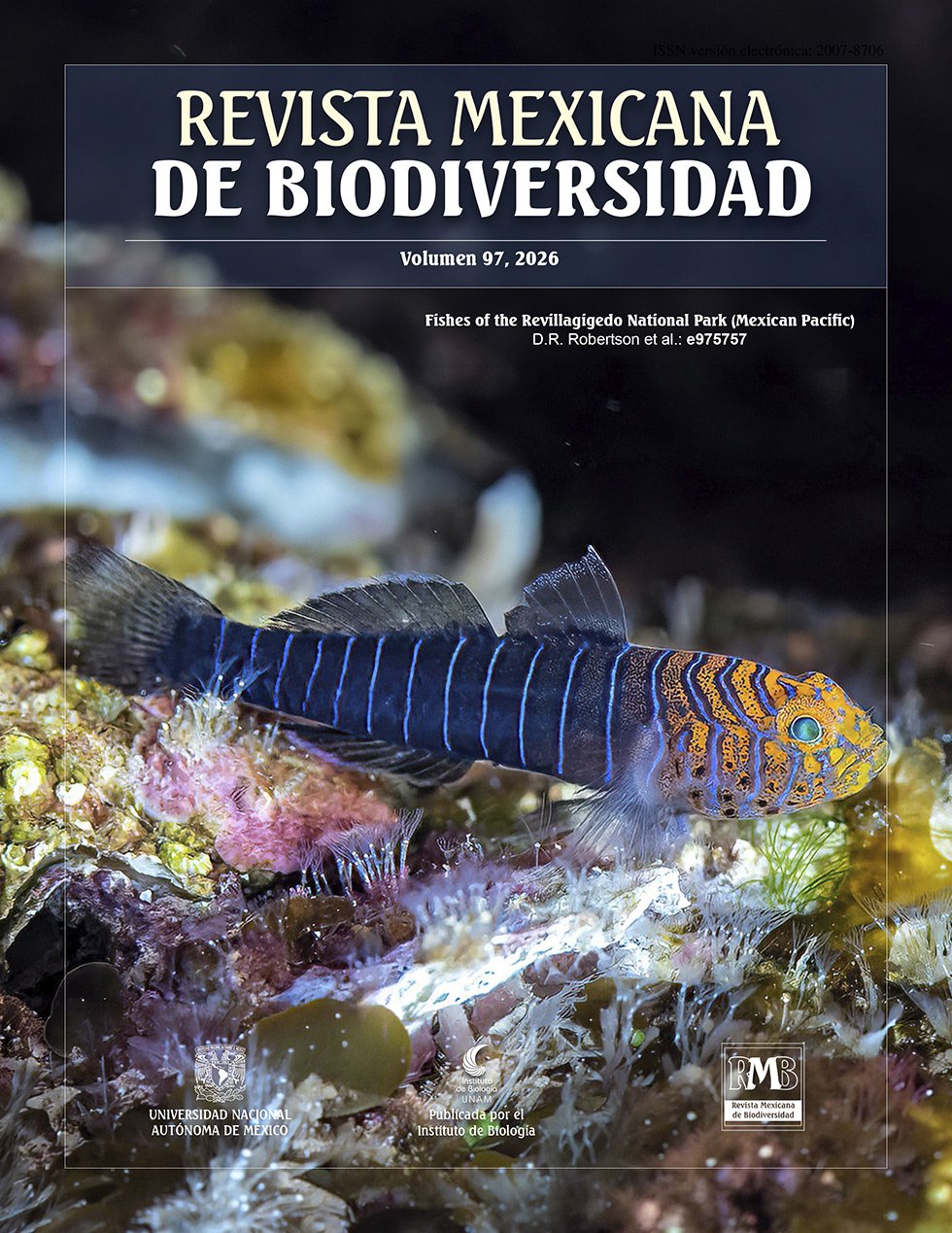
Ilustración de portada. Se invita a los autores a enviar fotografías relacionadas con el tema de su manuscrito, para que participen
en el proceso de selección de la imágenes que se publican en la portada del número correspondiente.