Reproducción y prevalencia de Probopyrus pandalicola (Isopoda, Bopyridae) en Yucatán, sureste de México
Luisa Fernanda Belmar-Wasserman, Mario Martínez-Mayén *
Universidad Nacional Autónoma de México, Instituto de Ciencias del Mar y Limnología, Unidad Académica de Ecología y Biodiversidad Acuática, Apartado Postal 70-305, 04510 Ciudad de México, Mexico
*Corresponding author: mariom@cmarl.unam.mx (M. Martínez-Mayén)
Received: 27 February 2026; accepted: 28 July 2026
Abstract
This study provides data on size at sexual maturity, fecundity, embryo size, brood loss, and prevalence of the isopod Probopyrus pandalicola, parasite of Palaemon mundusnovus, at Sisal, Yucatán, Mexico. A total of 3,549 specimens of P. mundusnovus were captured, of which 214 were found to be infested by P. pandalicola. The prevalence of the parasite was 6.03% and the sex ratio of infested hosts was skewed to females (χ2 = 57.57, p < 0.05). The size at sexual maturity estimated was 3.51 ± 0.54 mm total length (TL). Mean fecundity of ovigerous females with embryos in the first stage of development was 927 ± 516 embryos, ranging from 37 to 2,722 embryos in females between 3.48 and 5.40 mm TL, respectively. The female size and fecundity showed a significant correlation (r2 = 0.70), whereas fecundity varied among specimens of similar size. Newly extruded embryos had a mean length of 0.14 ± 0.02 mm, increasing its volume by 116.66% throughout their development. The estimated embryo loss during incubation was 22.17%. This is the first study of P. pandalicola for the Atlantic coast of Mexico.
Keywords: Bopyrids; Reproduction; Sexual maturity; Fecundity; Embryo loss
Resumen
Este estudio aporta datos sobre reproducción como talla de madurez sexual, fecundidad, tamaño, pérdida de embriones, y prevalencia del isópodo parásito Probopyrus pandalicola de epecímenes obtenidos en Sisal, Yucatán, México. Un total de 3,549 especímenes de P. mundusnovus fueron capturados, de estos, 214 estuvieron infestados por P. pandalicola. La prevalencia del parásito fue 6.03% con tendencia mayor de infestación hacia las hembras (χ2 = 57.57, p < 0.05). La talla de madurez sexual se estimó en 3.51 ± 0.54 mm de longitud total (LT). La fecundidad promedio de las hembras ovígeras con embriones en el primer estadio de desarrollo fue de 927 ± 516, con un rango de 37 a 2,722 embriones en hembras de 3.48 y 5.40 mm LT, respectivamente. Se obtuvo una correlación significativa entre la talla de las hembras y la fecundidad (r2 = 0.70), pero ésta varió en especímenes de talla similar. Los embriones recientes tuvieron un tamaño promedio de 0.14 ± 0.02 mm; a través del desarrollo su volumen aumentó 116.66%, y la pérdida embrionaria durante la incubación fue de 22.17%. Este estudio representa la primera contribución sobre P. pandalicola en la costa Atlántica de México.
Palabras clave: Bopíridos; Reproducción; Madurez sexual; Fecundidad; Pérdida de embriones
Introduction
Crustaceans exhibit a great variability of reproductive strategies that allows them to adapt to particular environmental situations and to increase progeny survival (Martínez-Mayén & Román-Contreras, 2013; Terossi et al., 2010). The study of the reproductive biology of organisms is important since it provides an approximation on the ecology and life history of populations. Thus, information on aspects such as fecundity and size at sexual maturity provides important parameters to understand the life cycle of a species (Pescinelli et al., 2020).
Fecundity, i.e., the number of embryos produced by a female in a given period, indicates the reproductive potential of a species, usually varies as a function of female body size and can be influenced by biological and environmental factors (Ramírez-Llodra, 2002; Sastry, 1983). The size (length or volume) of eggs is considered an indicator of energy investment in embryonic development and provides information for understanding reproductive strategies (Bauer, 1991; Torati & Mantelatto, 2008). Likewise, the size at sexual maturity is a key parameter of any species as it indicates the stage at which an organism has the potential to start reproducing and generate offspring (Martínez-Mayén & Román-Contreras, 2003).
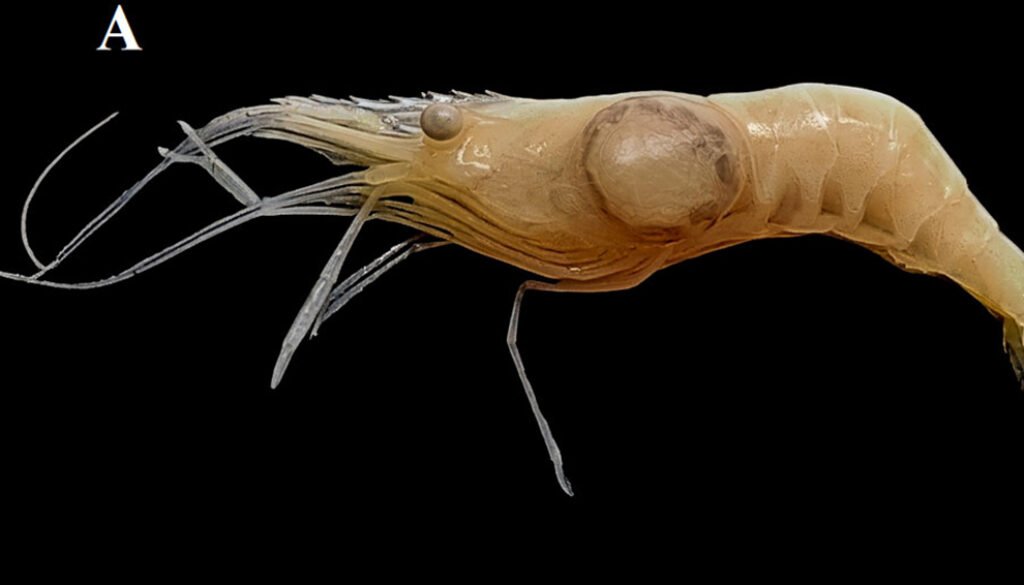
Bopyrid isopods are obligate ectoparasites that typically invade the branchial chambers or the abdomen of caridean shrimps and other decapod crustaceans (Burgos & Itani, 2024; Jay, 1989; Rasch & Bauer, 2015). The males are tiny with a typical isopod body shape, while the females have distorted bodies and are much larger in size (Cericola & Williams, 2015; Román-Contreras, 2008). These parasites feed on the hemolymph and tissues of their hosts (Boyko et al., 2013; Briggs et al., 2017; Sherman & Curran, 2015), and can cause branchial atrophy, modification of sexual characters, sexual sterilization, a reduction in metabolic rate, and partial inhibition of the growth (Beck, 1980; Brinton & Curran, 2015; de Barros et al., 2020; Sherman & Curran, 2015; Van Wyk, 1982). Bopyrid isopods usually infest juvenile shrimp (Beck, 1980; Rasch & Bauer, 2015), and exhibit a complex life cycle that requires a calanoid copepod as an intermediate host and a decapod crustacean as a definitive host (Bortolini-Rosales et al., 2021).
On other hand, the bopyrid prevalence can have a significant impact on the shrimps because the infested individuals are removed from the reproductive population before they reach the sexual maturity (Chaplin-Ebanks & Curran, 2007), which cause a decrease in their populations (Romero-Rodríguez & Román-Contreras, 2013).
Probopyrus pandalicola is a branchial parasitic isopod, widely distributed along the Atlantic coast from New Jersey, USA, to Brazil (Román-Contreras & Martínez-Mayén, 2011). In Mexico, this species is distributed in Tamaulipas, Tabasco, Campeche, Yucatán, and Quintana Roo (Martínez-Mayén & Romero-Rodríguez, 2024, and literature cited herein). It infests mainly caridean shrimp of the genera Macrobrachium and Palaemon (Martínez-Mayén & Romero-Rodríguez, 2024; Román-Contreras, 1993), important species in transferring primary production to higher trophic levels in their ecosystems (Anderson, 1985).
Information on P. pandalicola in Mexico is limited to taxonomic checklists (Aguilar-Perera, 2022; Martínez-Mayén & Romero-Rodríguez, 2024; Román-Contreras, 2008), regional faunal inventories and local distribution data (Castellanos-Osorio et al., 2024; Markham et al., 1990; Rodríguez-Almaraz et al., 2000; Román-Contreras & Martínez-Mayén, 2011). Thus, the purpose of this study was to provide data on the size at sexual maturity, fecundity, embryo size, loss of embryos and prevalence of P. pandalicola infesting the shrimp Palaemon mundusnovus in the southeastern Gulf of Mexico.
Materials and methods
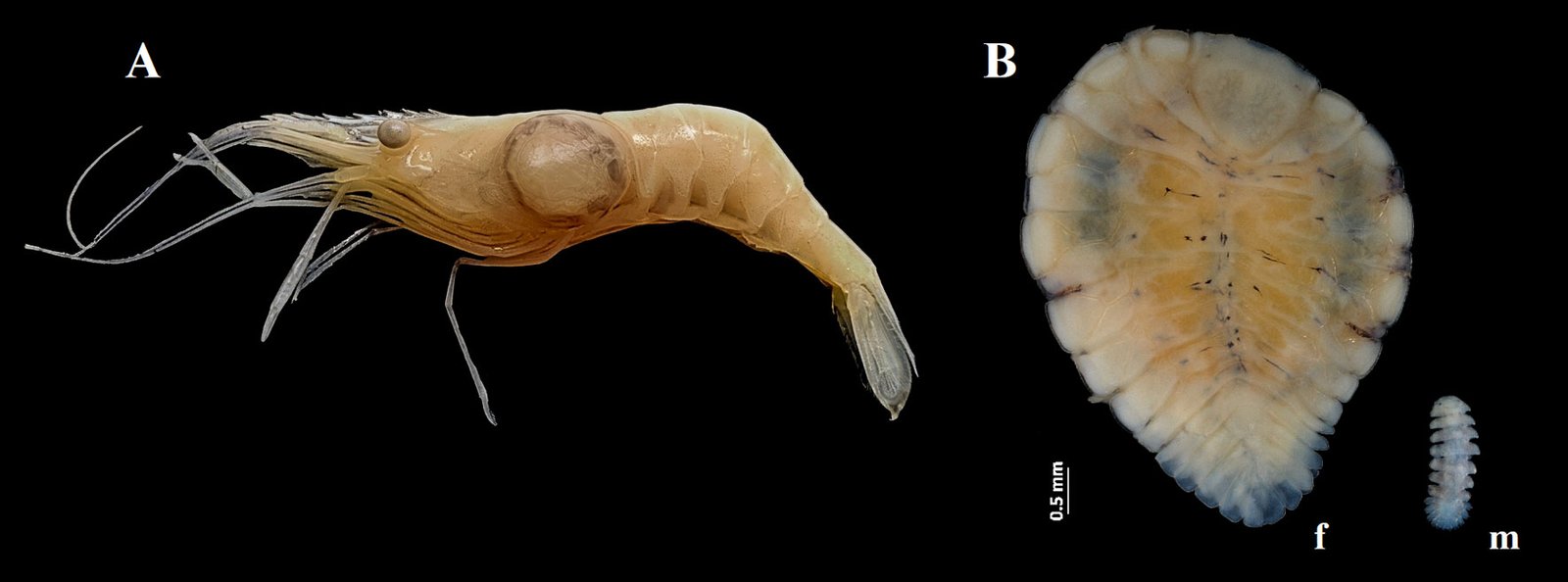
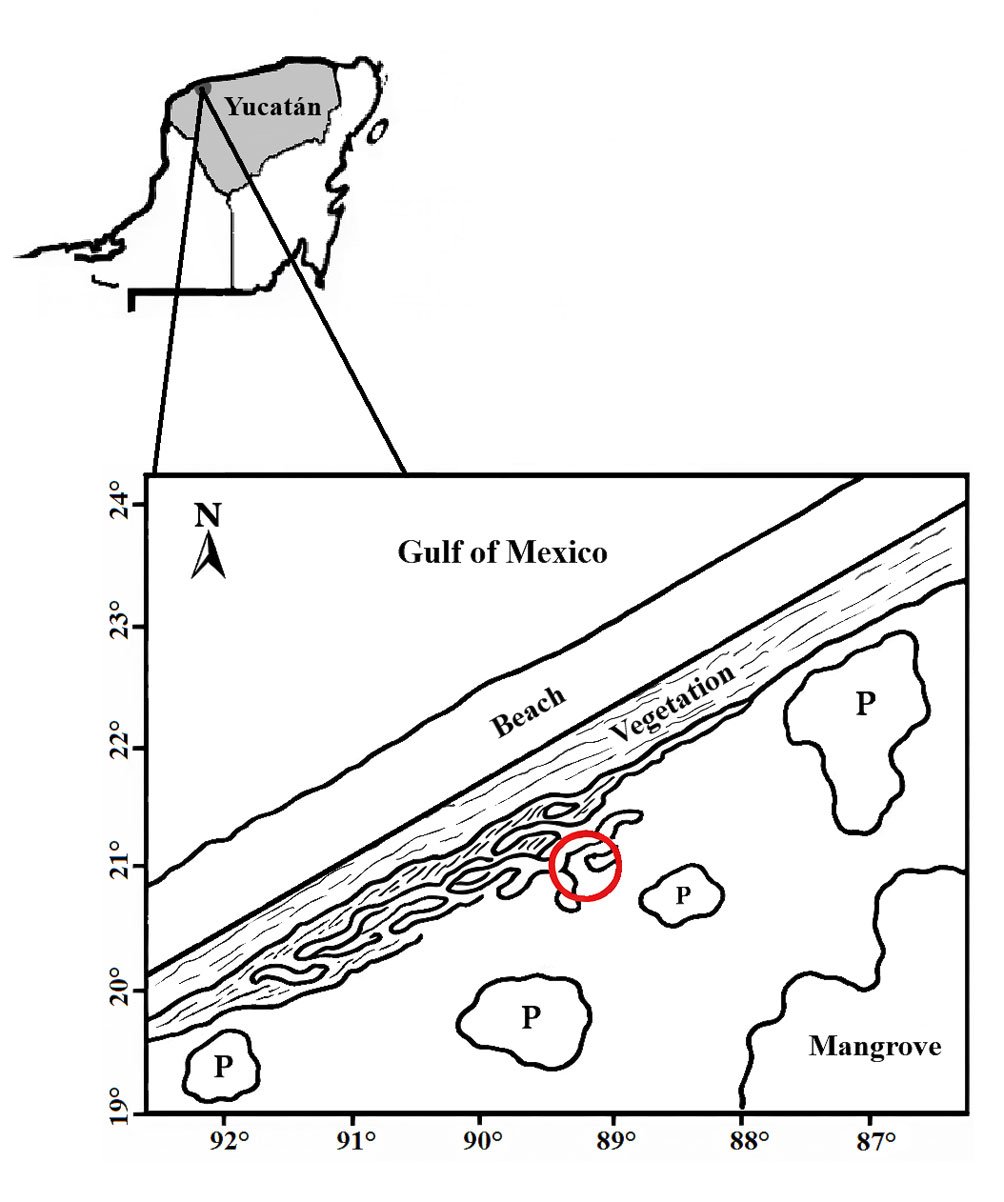
Specimens of Palaemon mundusnovus parasitized with Probopyrus pandalicola (Fig. 1) were collected during 1 diurnal sampling in a wetland known as La Ciénega (21°10.85’ N, 89°58.52’ W) in Sisal, Yucatán, Mexico on April 28th, 2009 (Fig. 2). Shrimps were collected from patches of submerged vegetation and roots of riparian shrubs with a spoon-shaped net (mesh size 1 mm). Immediately after sampling, all specimens were preserved in 96% ethanol. Water temperature during sampling was 30°C. Salinity was not measured, but Zaldívar-Jiménez et al. (2012) recorded a mean value of 36.5 ups at the same time and under similar conditions to those of this study.
The shrimp and parasitic isopods were identified following the taxonomical criteria proposed by Holthuis (1952) and Markham (1985), respectively. The size of the infested shrimp, taken as carapace length (CL), was measured from the postorbital margin to the mid-posterior end of the carapace with a digital caliper (± 0.01 mm accuracy). The specimens were sexed considering the presence (male) or absence (female) of the appendix masculina in the endopods of the 2nd pair of pleopods. The parasites were detached from their hosts, and only in females of P. pandalicola the total length (TL) was measured from the anterior margin of the cephalon to the posterior end of the pleotelson (Cash & Bauer, 1993).
The prevalence was calculated as the number of individuals of a host infected with the parasite divided by the host examined, expressed in percentage (Margolis et al., 1982). Host sex selectivity was evaluated with a chi-square test (Rasch & Bauer, 2015).
The entire brood mass of each ovigerous female was removed from the marsupium with fine forceps, and the development of the embryos was categorized into stages I, II and epicaridium larvae following Beck (1980), and Cash and Bauer (1993) for P. pandalicola. All embryos were counted directly, but the fecundity reported here refers to the total number of embryos in stage I to avoid underestimation related to the embryo loss during embryogenesis (García-Guerrero & Hendrickx, 2005; Wehrtmann et al., 2012); one ovigerous female with 37, and other carrying 50 embryos were not used in the regression analyses between the fecundity vs total length. From each brood mass, 10 embryos were randomly chosen, and their minor (d1) and major (d2) diameters were measured to calculate their volume with the formula V = π(d1)2 * (d2)/6, used for bopyrids by Romero-Rodríguez and Román-Contreras (2013).
Size at sexual maturity (TL50) was calculated, considering all the ovigerous females (Romero-Rodríguez & Román-Contreras, 2013; Tallack, 2007), with the logistic equation P = 1/(1 + exp[-(a + b x TL)]), which relates the proportion of females (P) in each size class with total length (TL), and a and b are the parameters calculated for the regression between P and TL. The size corresponding to 50% sexually mature females was obtained from the relationship TL50 = -(a/b) and using interpolation (Oh et al., 2002; Pescinelli et al., 2020).
The change in embryo volume between stages I and II was evaluated with a one-way ANOVA. The variation in the number of embryos (stage I) with respect to the total length of the female parasite was calculated with simple linear regression analyses. The parameters that describe the equation between these variables were obtained with the least-squares method.
Results
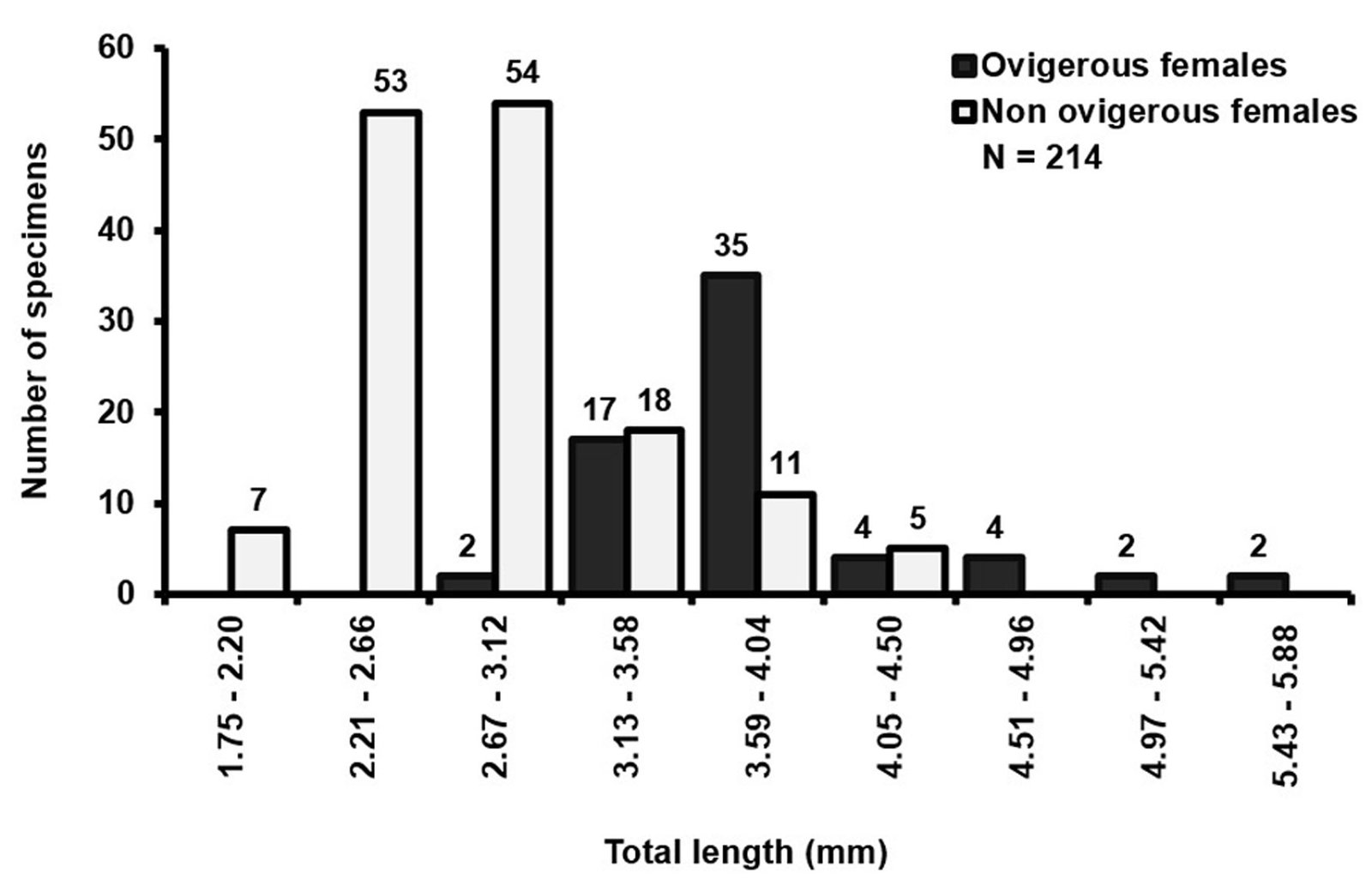
At the sampling site, a total of 3,549 specimens of Palaemon mundusnovus were captured, of which 214 were found to be infested by Probopyrus pandalicola. Host size varied from 2.79 to 6.35 mm CL. The mean size of P. pandalicola females was 3.19 ± 0.70 mm TL (range 1.75-5.64 mm TL), 66 females were ovigerous, with a mean size of 3.90 ± 0.56 mm LT, ranging from 2.98 to 5.64 mm TL, being more abundant at the size class of 3.13-4.04 mm TL (Fig. 3). Bopyrid prevalence in the study area was 6.03%, with significant differences (χ2 = 57.57, p < 0.05) between the number of females (163) and males (51) infested.
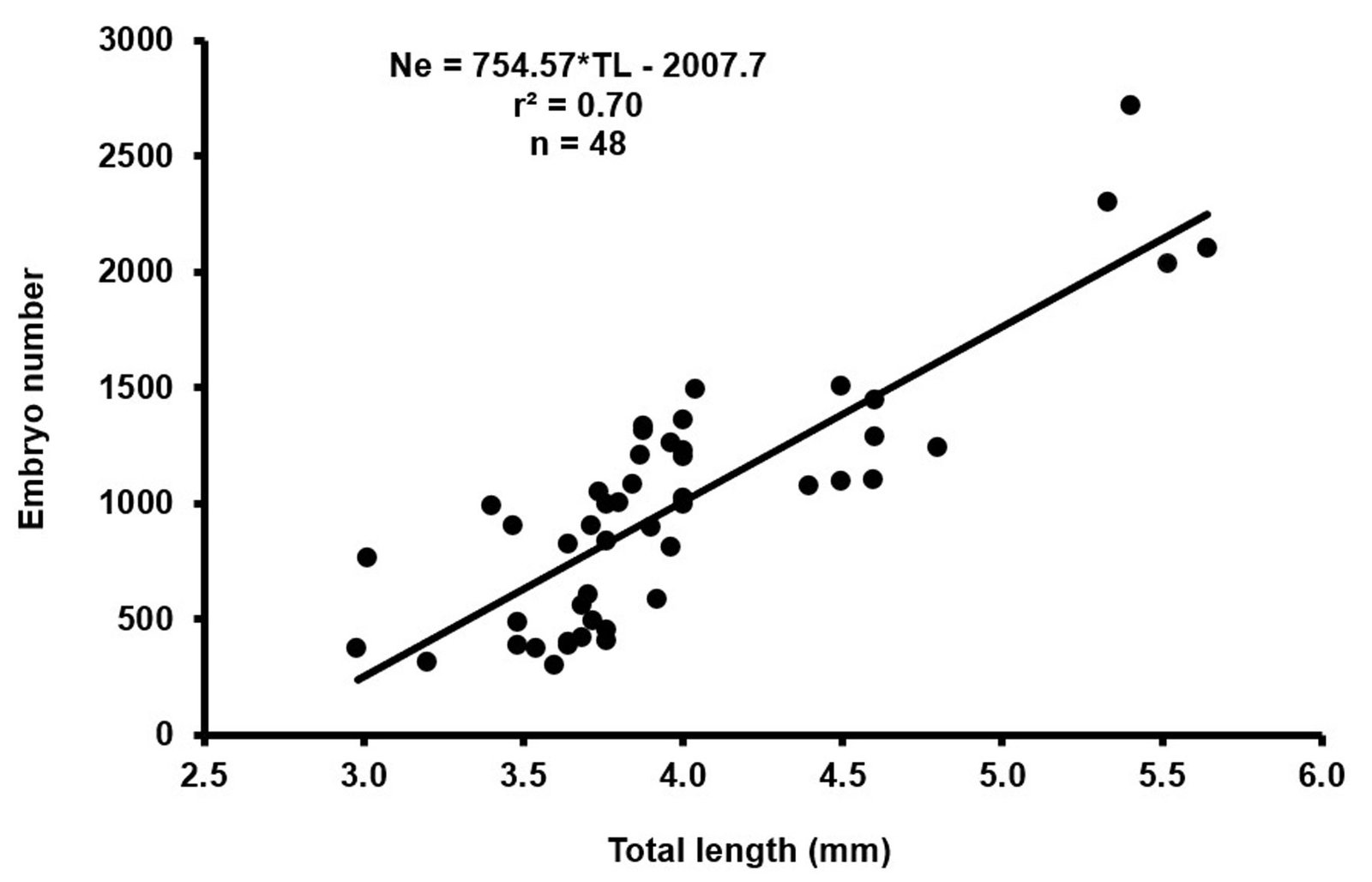
Considering all ovigerous females, the number of embryos varied from 37 to 2,722 (Table 1) with a mean fecundity of 927 ± 516 (n = 66). The mean fecundity of females with embryos in the first stage of development was 961 ± 555 (n = 50) and was correlated significantly (t-test = 10.52, p < 0.05) with female size. Fecundity increased with parasite body size, but not progressively since some smaller females had a higher fecundity than larger ones, also the number of embryos varied in specimens of similar total length (Fig. 4).
| Stage | n | Mean total length (mm) | Number of embryos-range | Number of embryos mean ± sd |
|---|---|---|---|---|
| I | 50 | 4.0 ± 0.60 | 37-2,722 | 961 ± 555 |
| II | 13 | 3.67 ± 0.35 | 106-1,185 | 748 ± 358 |
| Epicaridium | 3 | 3.57 ± 0.23 | 1,043-1,297 | 1,144 ± 135 |
Embryos in stage I were spherical in shape, whitish and had evenly distributed yolk, those in stage II were oblong in shape, brown and pronounced segmentation, the epicaridium larvae had a darker color, fully defined eyes and well-developed appendages. Only 1 developmental stage was found in each embryo mass of the females. The average lengths of the P. pandalicola embryos were 0.14 ± 0.02 mm and 0.23 ± 0.02 mm at stages I and II, respectively, and the mean size of the epicaridium larvae was 0.25 ± 0.01 mm. Mean embryo volume ranged from 0.0012 mm3 in stage I to 0.0026 mm3 in stage II, which represent an increase of 116.66% (F = 778.10, p < 0.05). Fecundity decreased 22.17% between stages I and II.
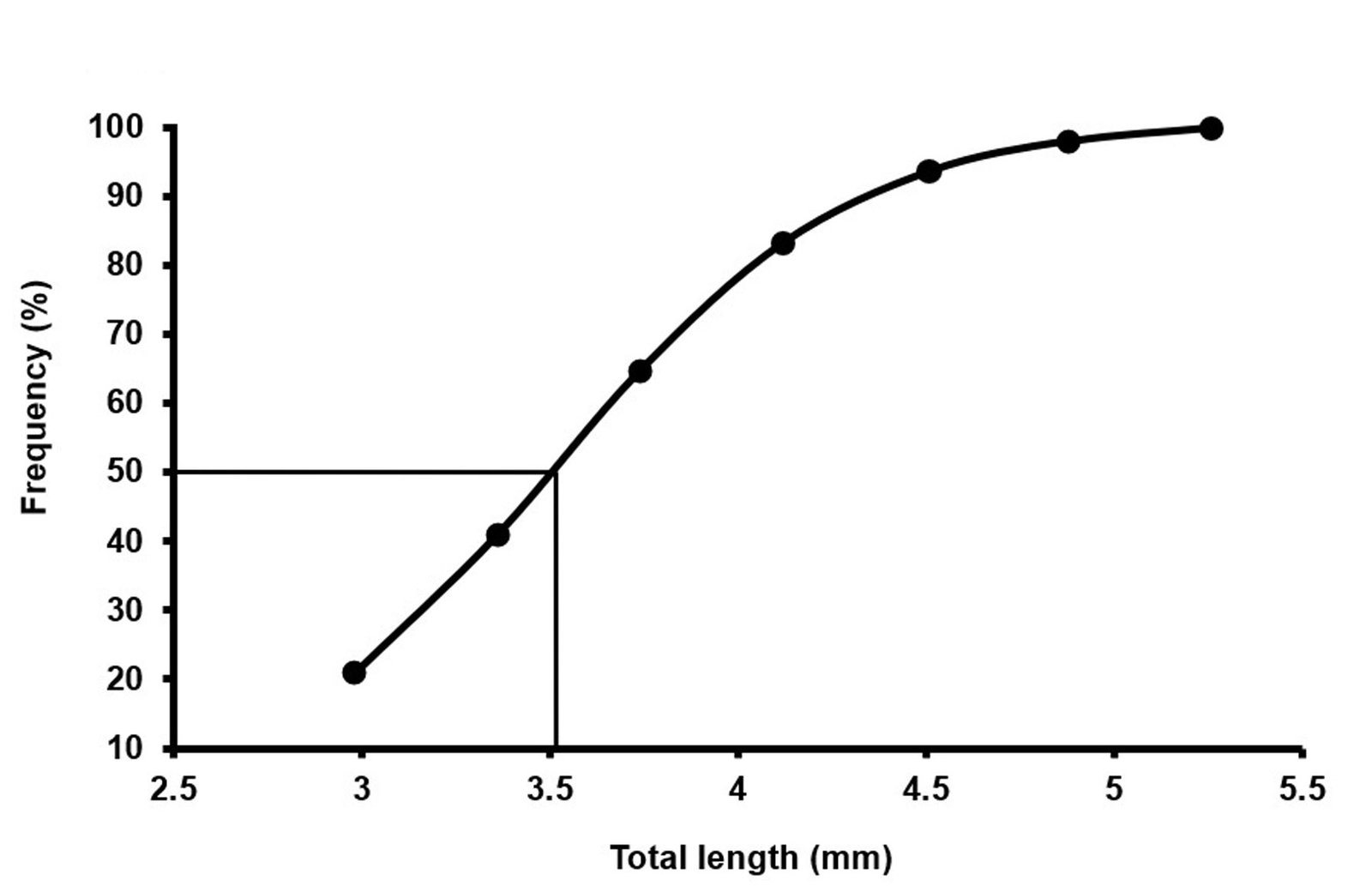
The smallest P. pandalicola ovigerous female was 2.98 mm TL, which can be considered the size at first reproduction for this species in the study area. The relationship between TL and the proportion of ovigerous females is represented by the equation P = 1/(1 + exp[-2.5337 + 8.8974*TL]), thus the estimated size at functional sexual maturity, at which 50% of the females are sexually mature, was 3.51 ± 0.54 mm TL (Fig. 5).
Discussion
In Palaemon, species infested by Probopyrus pandalicola, the levels of prevalence varied from 0.5% to 100% (Beck, 1979; Morris, 1948). The wide variability in parasite prevalence may be the result of interactions between various environmental factors and the abundance and behaviour of the stages in the life cycle of both the parasite and host (Jay, 1989; Pralon et al., 2018), as well as the size of the sample analyzed (Romero-Rodríguez & Román-Contreras, 2013).
The parasite infested mainly female hosts, which agrees with studies by Beck (1979) and Morris (1948) for this species, and other bopyrid species (Jay, 1989; Rasch & Bauer, 2015; Romero-Rodríguez & Román-Contreras, 2013; Truesdale & Mermilliod, 1977; Vargas-Ceballos et al., 2016). The higher infestation of females could represent advantages to the parasite, such as increased longevity and hence, the production of a greater number of spawnings, likewise female hosts have a longer life expectancy than male hosts (Beck, 1979; Romero-Rodríguez & Román-Contreras, 2013; Schuldt & Rodrigues-Capitulo, 1985), but also sex-selectivity could be related to their abundance in the population (Beck, 1979), which coincides with the results obtained in this study since the females predominated over the males in a ratio of 3.1: 1.
In the study area, P. pandalicola begins to produce embryos at 2.98 mm TL, similar value to the 3 mm TL reported by Beck (1980) for the same species in Florida, USA, but higher than the 2.1 mm TL reported by Brinton and Curran (2015) in Georgia, USA, and the 2.80 mm TL reported by Román-Contreras (1993) for P. pacificensis in Guerrero, Mexico. According to Jordá and Roccatagliata (2002), female bopyrids ingest large amounts of hemolymph of the infested shrimp, and this allows females to reach early maturity. Walker (1977) estimated that females of P. pandalicola can ingest about 25% of the hemolymph of Palaemon pugio (cited as Palaemonetes pugio) daily, which influences the growth as well as the embryo production of the parasites as a result of the stable, nutrient rich environment provided by the host (Baeza et al., 2018; Jennings & Calow, 1975; Poulin, 1996).
There are no reports on size at sexual maturity for any species of the genus Probopyrus obtained with the method used in this study; however, maturity is associated with the mean size of the ovigerous females (Roa et al., 1999; Martínez-Mayén & Román-Contreras, 2003). The results of the present study agree with this statement since their mean size was 3.90 mm, similar to the 3.51 mm TL calculated for the sexual maturity, while Beck (1980) reported in the same species mean values that ranged between 5.2-5.4 mm TL. Such discrepancy in size at the sexual maturity in conspecific species may be associated with local environmental abiotic or biotic factors, season of the year in which the study took place (Rasch & Bauer, 2015), and the size and number of specimens sampled (Waddy & Aiken, 2005). In other bopyrids such as Cryptione elongata africana (mentioned as Pseudione elongata africana), Penha-Lopes et al. (2012) calculated sizes at sexual maturity of 4.15 and 4.58 mm TL in distinct localities, while Rasch and Bauer (2015) recorded sizes at sexual maturity of 1.09 and 1.63 mm TL for Urobopyrus processae in 2 different years.
In bopyrid isopods, fecundity is generally related to female size because larger hosts harbor larger parasites which produce a higher number of embryos (Beck, 1980; Rasch & Bauer, 2015). The variation in the number of embryos among female parasites of similar size registered is similar to that reported for P. pandalicola (Beck, 1980), Argeia pugettensis (Jay, 1989), Bopyrinella thorii (Romero-Rodríguez & Román-Contreras, 2008), Athelges takanoshimensis (Cericola & Williams, 2015) and U. procesase (Rasch & Bauer, 2015). Bourdon (1968) and Beck (1980) suggested that this variation is due to the size of the outpocketing in the host carapace caused by the parasite that limits the space available for the embryos. Likewise, sometimes a parasite produces more embryos than what the marsupium or the host’s branchiostegite can contain (Romero-Rodríguez & Román-Contreras, 2008; Schuldt & Rodriguez-Capitulo, 1985). This variation in fecundity could, in part, explain the moderate correlation value (r2 = 0.70) between parasite size and fecundity registered.
The fecundity of P. pandalicola obtained was lower than that reported for the same species in other regions (Table 2). These differences may be attributable to environmental conditions such as temperature, in this respect, Beck (1980), and Brinton and Curran (2015) studying different populations of P. pandalicola recorded ranges of this parameter between 16-24 ºC in Florida, and of 11-31.6 ºC in Georgia, USA, respectively, with higher fecundity values than those of the present study (Table 2). Other factors that could also affect the fecundity are the salinity, presence of toxic elements (Penha-Lopes et al., 2012; Ramírez-Llodra, 2002), embryo size (Martínez-Mayén et al., 2020), and embryo mortality (Cericola & Williams, 2015; Oh et al., 2002). However, the difference in the number of P. pandalicola embryos recorded in this study with respect to other localities is most probably due to the wider range of parasite sizes analyzed in previous studies (Table 2).
| Species | Female size (mm) | Fecundity | Embryo size (mm) | Embryo volume (mm3) | Host(s) | Location | Reference |
|---|---|---|---|---|---|---|---|
| Argeia pugettensis | 4.2-9.0 | 1,600-38,300 | – | – | Crangon franciscorum | Humboldt Bay, California, USA | Jay (1989) |
| Boypyrella harmopleon | 4.25 | 1,405 | 0.14 | 0.0012 | Synalpheus hemphilli | Southwestern Gulf of Mexico | Romero-Rodríguez & Álvarez (2020) |
| Bopyrina abbreviata | 1.15-2.35 | 131-1,548 | 0.102 | 0.0005 | Hippolyte zostericola | Laguna de Términos, Campeche, Mexico | Romero-Rodríguez & Román-Contreras (2013) |
| Bopyrina ocellata | 1.5-3.1 | 330-1,410 | – | – | Hippolyte spp. | Europe (several localities) | Bourdon (1968) |
| Bopyrina ocellata | – | 61-596 | 0.133 | – | Hippolyte obliquimanusa | Brazil (several localities) | Tsukamoto (1981) |
| Bopyrinella thorii | 1.87-3.52 | 83-1,036 | 0.113 | – | Thor floridanus | Bahía de la Ascensión, Mexican Caribbean | Romero-Rodríguez & Román-Contreras (2008) |
| Boypyrione sinalphei | – | – | 0.12 | 0.0008 | Synalpheus brooksi; Synalpheus elizabethae | Arrecife Alacranes, Yucatán, Mexico | Romero-Rodríguez & Álvarez (2020) |
| Epipenaeon ingens ingens | 7.2-26.8 | 83,360 | 0.1479 | – | Penaeus aztecus | Antalya Bay, Turkey | Deval & Koçanci (2021) |
| Munidion pleuroncodis | – | 11,134 | 0.166 | 0.0022 | Grimothea planipes | Isla Socorro, Colima, México | Romero-Rodríguez & Álvarez (2023) |
| Parabopyrella lata | 5.71-6.83 | 2,181-5,998 | – | 0.0311 | Lysmata boggessi | Homosassa Springs, Florida, USA | Baeza et al. (2018) |
| 3.17 | 168 | 0.17 | – | Alpheus normanni | Puerto Morelos, Quintana Roo, Mexico | Romero-Rodríguez & Álvarez (2020) | |
| Parabopyrella thomasi | 4.19 | 1,802 | 0.14 | 0.0013 | Tozeuma carolinense | Bahía de la Ascensión and Bahía del Espíritu Santo, Quintana Roo, Mexico | Romero-Rodríguez & Martínez-Mayén (2018) |
| Probopyrus bithynis | 5.5-7.5 | 5,241 | 0.14-0.160 | – | Macrobrachium ohione | Atchafalaya River, Louisiana USA | Truesdale & Mermilliod (1977) |
| Probopyrus floridensis | – | 1,545 | 0.178 | – | Macrobrachium potiuna | Ilha do Cardoso, São Paulo, Brazil | Rocha & Bueno (2000) |
| Probopyrus markhami | – | – | 0.179 | 0.0028 | Macrobrachium americanum | Río Verde, Oaxaca, Mexican Pacific coast | Romero-Rodríguez & Álvarez (2023) |
| Probopyrus pacificensis | – | – | 0.163 | 0.0019 | Palaemon hiltoni; Palaemon ritteri | Sonora and Colima, Mexican Pacific coast | Romero-Rodríguez & Álvarez (2023) |
| 7.0-9.0 | 5,390-11,800 | – | – | Macrobrachium tenellum | Laguna Coyuca, Guerrero, Mexico | Román-Contreras (1993) | |
| Probopyrus pandalicola | 3.4 | – | 0.15 | – | Palaemon vulgarisb | Progreso, Yucatán, Mexico | Pearse (1936, as Probopyrus creaseri) |
| 3.0-7.5 | 350-11,850 | 0.15 | – | Palaemon paludosusc | Wakulla County, Florida, USA | Beck (1980) | |
| Probopyrus pandalicola | 2.1-5.5 | 391-4,596 | – | – | Palaemon pugiod | Savannah, Georgia, USA | Brinton & Curran (2015) |
| 2.98-5.64 | 37-2,722 | 0.14 | 0.0012 | Palaemon mundusnovus | Sisal, Yucatán, Mexico | Present study | |
| Schizobopyrina striata | 3.27 | – | 0.120 | 0.0008 | Periclimenes infraspinis | Isla Alcatraz, Bahía de Kino, Sonora, México | Romero-Rodríguez & Álvarez (2023) |
| Schyzobopyrina urocaridis | 1.78-2.12 | 205-304 | 0.120 | 0.0008 | Phycomenes siankaanensis | Bahía de la Ascensión and Bahía del Espíritu Santo, Quintana Roo, Mexico | Romero Rodríguez & Martínez-Mayén (2017) |
| Urobopyrus processae | 1.50-3.90 | 85-3,096 | 0.159 | 0.0014 | Ambidexter simmetricus | St. Joseph Bay, Florida, USA | Rasch & Bauer (2015) |
Embryo size is important in the reproductive strategy of a species, as it is often related to the duration of embryonic development (Steel & Steel, 1975). It has been suggested that bopyrid isopods produce embryos smaller than 0.2 mm in diameter (Table 2) and exhibit complex life cycles involving at least 2 hosts (Romero-Rodríguez, 2014; Strömberg, 1971), while other epicarideans (e.g., Entoniscoides okadai) produce larger embryos (ca. 0.2 mm) similar in size to an epicaridium larva, and have an abbreviated larval development (Miyashita, 1940; Strömberg, 1971).
The mean length of the P. pandalicola embryos in stage I recorded here concurs with values reported for this species by Pearse (1936) and Beck (1980), as well as by Truesdale and Mermilliod (1977) for Probopyrus bithynis (Table 2), whereas Probopyrus floridensis, Probopyrus markhami and P. pacificensis produce larger embryos (Table 2). In addition, P. pandalicola embryos are similar in size to those of other branchial bopyrids, for which data are available (Table 2). The mean size of the epicaridium larvae recorded here (0.25 mm) resembles that reported by Beck (1980) (0.25-0.30 mm) for P. pandalicola, and that recorded for P. insularis (0.18-0.25 mm) by Román-Contreras and Bourdon (2001), while Romero-Rodríguez and Álvarez (2023) recorded a value of 0.284 mm for P. markhami.
The size and development of the P. pandalicola embryos did not vary within a brood, as was recorded by Morris (1948) and Beck (1980) for this species and for other bopyrids like Aparapenaeon japonica (Hiraiwa, 1936, cited as Parapenaeon japonica), Epipenaeon ingens (Owens & Glazebrook, 1985), Probopyrus ringueleti (Schuldt, 1993), B. thorii (Romero-Rodríguez & Román-Contreras, 2008), Bopyrina abbreviata (Romero-Rodríguez & Román-Contreras, 2013) and U. processae (Rasch & Bauer, 2015). This phenomenon appears to be common in the Bopyridae (Bourdon, 1968; Schuldt, 1993; Strömberg, 1971) and is due to the male releasing sperm directly onto the external surface of the gonopores and the eggs being fertilized as they pass through them (Burgos & Itani, 2023).
Comparatively, the embryo volume of P. pandalicola is smaller than that of P. markhami and P. pacificensis (Table 2), although the value calculated in this study lies within the range recorded for other bopyrid species (Table 2). Embryo volume increased more than twice over the incubation period (116.66 %), and this value corresponds well with the range of 2-180% recorded for crustaceans (Pandian, 1994). Romero-Rodríguez and Román-Contreras (2013) documented a 60% increase in embryo volume for B. abbreviata, while U. processae and Parabopyrella thomasi embryos increased in volume by 51.03% and 38.46%, respectively (values of increase in volume calculated from data of Rasch and Bauer [2015] and Romero-Rodríguez and Martínez-Mayén [2018], respectively). This increase during incubation is mainly due to embryo growth, biochemical changes and water uptake for the embryo (Clarke, 1993; Pandian, 1970).
Brood loss during the incubation period in crustaceans is a common feature that may be caused by several physical and biological factors (for a review see Kuris, 1991). The only bopyrid embryo loss documented is the 7.21% calculated by Romero-Rodríguez and Román-Contreras (2013) in a population of B. abbreviata, which is considerably lower than that obtained in this study for P. pandalicola (22.17%) but fit well with the range of 4-50% recorded for other crustaceans that incubate embryos in the marsupium (Pandian, 1994). One possible reason for egg loss in P. pandalicola may be an increase in embryo volume during incubation, when the ovigerous mass exceeds the available space of marsupium of parental females, and consequently, some embryos may be discarded (Balasundaram & Pandian, 1982; Kuris, 1991; Ramírez-Llodra, 2002). Another reason may be that embryos may become detached through the first oostegites by the movement of the maxillipeds during embryo grooming by the female parasite, as was observed by Burgos and Itani (2024) in the case of Bopyrus crangorum infesting Palaemon serrifer. Also to be considered is the loss of embryos resulting from the handling of specimens during the collection and processing of specimens (Cericola & Williams, 2015).
The present study is the first one on P. pandalicola from the Atlantic coast of Mexico. Although this study was restricted to a single sampling, our results increase the current understanding of this parasite, and future studies will be carried out to obtain additional information regarding the dynamics, structure and biology, in order to identify possible differences among populations of this species.
Acknowledgements
This paper is part of the first author’s undergraduate thesis. We thank the authorities of the Instituto de Ciencias del Mar y Limnología, UNAM for financing the field work, Andrés Reda Deara (Estación El Carmen, ICMyL, UNAM) and Ramiro Román Contreras for their help with the field work, and Nuno Simões (Unidad Multidisciplinaria de Docencia e Investigación-Sisal, Facultad de Ciencias, UNAM) for the facilities provided during our stay in Sisal, Yucatán, and the two reviewers for the valuable suggestions that improved the manuscript.
References
Aguilar-Perera, A. (2022). Checklist of parasitic isopods (Crustacea: Isopoda) infesting marine decapod and fishes off Mexico’s coasts. Thalassas: An International Journal of Marine Sciences, 38, 113–121. https://doi.org/10.1007/s41208-021-00336-x
Anderson, G. (1985). Species profile: life histories and environmental requirements of coastal fishes and invertebrates (Gulf of Mexico) – Grass shrimp. U.S. Fish and Wildlife Service Biological Report, 82, 1–19.
Baeza, J. A., Steedman, S., Prakash, S., Liu, X, Bortolini, J. L., Dickson, M. et al. (2018). Mating system and reproductive performance in the isopod Parabopyrella lata, a parasitic, castrator of the “peppermint” shrimp Lysmata boggessi. Marine Biology, 165, 1–11. https://doi.org/10.1007/s00227-018-3297-z
Balasundaram, C., & Pandian, T. J. (1982). Egg loss during incubation in Macrobrachium nobilii (Henderson & Mathai). Journal of Experimental Marine Biology and Ecology, 59, 289–299. https://doi.org/10.1016/0022-0981(82)90122-8
Bauer, R. T. (1991). Analysis of embryo production in a caridean shrimp guild from a tropical seagrass meadow. In A. Wenner, & A. Kuris (Eds.), Crustacean Issues 7. Crustacean egg production (pp. 181–191). Rotterdam: A. A. Balkema.
Beck, J. T. (1979). Population interactions between a parasitic castrator, Probopyrus pandalicola (Isopoda: Bopyridae), and one of its freshwater shrimp hosts Palaemonetes paludosus (Decapoda: Caridea). Parasitology, 79, 431–449. https://doi.org/10.1017/S003118200005383X
Beck, J. T. (1980). Life history relationships between the bopyrid isopod Probopyrus pandalicola and one of its freshwater shrimp hosts Palaemonetes paludosus. The American Midland Naturalist, 104, 135–154. https://doi.org/10.2307/2424966
Bortolini-Rosales, J. L., Mejía Estrada, J. A., Alonso-Reyes, M. P., Romero-Rodríguez, J., & Baeza, J. A. (2021). Reproductive biology of the bopyrid isopod Robinione overstreeti, a branchial parasite of the ghost shrimp Callichirus islagrande (Decapoda, Callichiridae) in the Gulf of Mexico. Marine Biology Research, 17, 247–259. https://doi.org/10.1080/17451000.2021.1928221
Bourdon, R. (1968). Les Bopyridae des mers Européennes. Mémoires du Muséum National d’Histoire Naturelle de Paris Nouvel Série A, Zoologie, 50, 77–424
Boyko, C. B., Moss, J., Williams, J. D., & Shields, J. D. (2013). A molecular phylogeny of Bopyroidea and Cryptoniscoidea (Crustacea: Isopoda). Systematics and Biodiversity, 11, 495– 506. https://doi.org/10.1080/14772000.2013.865679
Briggs, S. A., Blanar, C. A., Robblee, M. B., Boyko, C. B., & Hirons, A. (2017). Host abundance, sea-grass cover, and temperature predict infection rates of parasitic isopods (Bopyridae) on caridean shrimp. Journal of Parasitology, 103, 653–662. https://doi.org/10.1645/16-126
Brinton, B. A., & Curran, M. C. (2015). The effect of temperature on synchronization of brood development of the bopyrid isopod parasite Probopyrus pandalicola with molting of its hosts, the daggerblade grass shrimp Palaemonetes pugio. Journal of Parasitology, 101, 398–404. https://doi.org/10.1645/14-599.1
Burgos, L. A., & Itani, G. (2023). Reproductive behaviour of the branchial ectoparasite Bopyrus crangorum (Isopoda: Bopyridae) following ecdysis of the host Palaemon serrifer (Caridea: Palaemonidae). Journal of the Marine Biological Association of the United Kingdom, 103, e67. https://doi.org/10.1017/S0025315423000565
Burgos, L. A., & Itani, G. (2024). Function of maxillipeds and first oostegites in bopyrid isopods inferred from behavioural observation of Bopyrus crangorum infesting Palaemon serrifer. Journal of the Marine Biological Association of the United Kingdom, 104, e65. https://doi.org/10.1017/S0025315424000596
Cash, C. E., & Bauer, R. T. (1993). Adaptations of the branchial ectoparasite Probopyrus pandalicola (Isopoda: Bopyridae) for survival and reproduction related to ecdysis of the host, Palaemonetes pugio (Caridea: Palaemonidae). Journal of Crustacean Biology, 13, 111–124. https://doi.org/10.2307/1549126
Castellanos-Osorio, I., Vásquez-Yeomans, L., & Romero- Rodríguez, J. (2024). New records of Probopyrus pandalicola and Probopyrinella latreuticola (Epicaridea, Bopyridae) from the southern Mexican Caribbean. Latin American Journal of Aquatic Research, 52, 312–317. http://dx.doi.org/10.3856/vol52-issue2-fulltext-3081
Cericola, M. J., & Williams, J. D. (2015). Prevalence, repro- duction and morphology of the parasitic isopod Athelges takanoshimensis Ishii, 1914 (Isopoda, Bopyridae) from Hong Kong hermit crabs. Marine Biology Research, 11, 236–252. https://doi.org/10.1080/17451000.2014.928415
Chaplin-Ebanks, S. A., & Curran, M. C. (2007). Prevalence of the bopyrid isopod Probopyrus pandalicola in the grass shrimp, Palaemonetes pugio, in four tidal creeks on the South Carolina-Georgia coast. Journal of Parasitology, 93, 73–77. https://doi.org/10.1645/GE-3537.1
Clarke, A. (1993). Egg size and egg composition in polar shrimps (Caridea: Decapoda). Journal of Experimental Marine Biology and Ecology, 168, 189–203. https://doi.org/10.1016/0022-0981(93)90259-Q
de Barros, M. S. F., da Silva Neto, L. S., & dos Santos Calado, T. C. (2020). First record of parasitism by Probopyrus pandalicola (Isopoda, Bopyridae) on the freshwater prawn Macrobrachium acanthurus (Decapoda, Palaemonidae) and ecological interactions. Journal of Parasitic Diseases, 45, 273–278. https://doi.org/10.1007/s12639-020-01306-5
Deval, M. C., & Koçanci, F. G. (2021). Infestation and effect of the parasitic isopod Epipenaeon ingens ingens Nobili, 1906 on commercial shrimp species in the eastern Mediterranean: a case study of the population of brown shrimp Penaeus aztecus Ives, 1891. Turkish Journal of Zoology, 45, 557–569. https://doi.org/10.3906/zoo-2101-26
García-Guerrero, M., & Hendrickx, M. E. (2005). Fecundity and reproductive period of Paradella dianae and Uromuna sp. (Peracarida, Isopoda) associated with prop roots of Rhizophora mangle in a tropical coastal lagoon, SE Gulf of California, Mexico. Crustaceana, 78, 769–780. https://doi.org/10.1163/156854005774445492
Hiraiwa, Y. K. (1936). Studies on a bopyrid, Epipenaeon japonica Thielemann. III. Development and life-cycle, with special reference to the sex differentiation in the bopyrid. Journal of Science of the Hiroshima University, 4, 101–141.
Holthuis, L. B. (1952). A general revision of the Palaemonidae (Crustacea Decapoda Natantia) of the Americas. II. The subfamily Palaemoninae. Allan Hancock Publications, Occasional Paper, 12, 1–396.
Jay, C. W. (1989). Prevalence, size and fecundity of the parasitic isopod Argeia pugettensis on its host shrimp Crangon francisorum. The American Midland Naturalist, 121, 68–77. https://doi.org/10.2307/2425657
Jennings, J. B., & Calow, P. (1975). The relationship between high fecundity and the evolution of entoparasitism. Oeco- logia, 21, 109–115. https://doi.org/10.1007/BF00345553
Jordá, M. T., & Roccatagliata, D. (2002). Population dynamic of Leidya distorta (Isopoda: Bopyridae) infesting the fiddler crab Uca uruguayensis at the Río de la Plata estuary, Argentina. Journal of Crustacean Biology, 22, 719–727. https://doi.org/10.1163/20021975-99990286
Kuris, A. M. (1991). A review of patterns and causes of crustacean brood mortality. In A. Wenner, & A. Kuris (Eds.), Crustacean Issues 7. Crustacean egg production (pp. 17–141). Rotterdam: A. A. Balkema.
Margolis, L., Esch, G. W., Holmes, J. C., Kuris, A. M., & Schad, G. A. (1982). The use of ecological terms in parasitology (Report of an ad hoc committee of the American Society of Parasitologists). Journal of Parasitology, 68, 131–133. https://doi.org/10.2307/3281335
Markham, J. C. (1985). A review of the bopyrid isopods infesting caridean shrimps in the northwestern Atlantic Ocean, with special reference to those collected during the Hourglass Cruises in the Gulf of Mexico. Memoirs of the Hourglass Cruises, 7, 1–156.
Markham, J. C., Donath-Hernández, F. E., Villalobos-Hiriart, J. L., & Díaz-Barriga, A. C. (1990). Notes on the shallow- water marine Crustacea of the Caribbean Coast of Quintana Roo, Mexico. Anales del Instituto de Biología, Universidad Nacional Autónoma de México, Serie Zoología, 61, 405–446.
Martínez-Mayén, M., & Román-Contreras, R. (2003). Reproducción de Potimirim glabra (Kingsley, 1878) (Crustacea: Decapoda: Atyidae) en el río Coyuca, Guerrero, México. In M. E Hendrickx (Ed.), Contribuciones al estudio de los crustáceos del Pacífico este 2 (pp. 103– 115). Mazatlán, México: Instituto de Ciencias del Mar y Limnología, UNAM.
Martínez-Mayén, M., & Román-Contreras, R. (2013). Data on reproduction and fecundity of Processa bermudensis (Rankin, 1900) (Caridea, Processidae) from the southern coast of Quintana Roo, Mexico. Crustaceana, 86, 84–97. https://doi.org/10.1163/15685403-00003152
Martínez-Mayén, M., & Romero-Rodríguez, J. (2024). Updated checklist of the bopyrid isopods (Epicaridea, Bopyroidea) from Mexico. Revista Mexicana de Biodiversidad, 95, 1–22. https://doi.org/10.22201/ib.20078706e.2024.95.5453
Martínez-Mayén, M., Romero-Rodríguez, J., & Martínez-Muñoz, M. A. (2020). Population traits and reproduction of the hippolytid shrimp Tozeuma carolinense (Decapoda: Caridea) at Laguna de Términos, Campeche, southwestern Gulf of Mexico. Revista Mexicana de Biodiversidad, 91, e913026. https://doi.org/10.22201/ib.20078706e.2020.91.3026
Miyashita, Y. (1940). On an entoniscid with abbreviated deve- lopment, Entoniscoides okadai, n. g., n. sp. Annotationes Zoologicae Japonenses, 19, 149–157.
Morris, J. A. (1948). Studies on the host-parasite relationship of Probopyrus pandalicola (Packard). Biological Studies of The Catholic University of America (Washington, D. C.), 8, 1–20.
Oh, C. W., Suh, H. L., Park, K. Y., Ma, C. W., & Lim, H. S. (2002). Growth and reproductive biology of the freshwater shrimp Exopalaemon modestus (Decapoda: Palaemonidae) in a lake of Korea. Journal of Crustacean Biology, 22, 357–366. https://doi.org/10.1651/0278-0372(2002)022[0357:GARBOT]2.0.CO;2
Owens, L., & Glazebrook, J. S. (1985). The biology of bopyrid isopods parasitic on commercial penaeid prawns in northern Australia. In P. C. Rothlisberg, B. J. Hill, & D. J. Staples (Eds.), Second Australian National Prawn Seminar (pp. 105–113). Cleveland, Australia: NPS2
Pandian, T. J. (1970). Ecophysiological studies on developing eggs and embryos of the European lobster Homarus gammarus. Marine Biology, 5, 154–167. https://doi.org/10.1007/BF00352599
Pandian, T. J. (1994). Arthropoda-Crustacea. In K. G. Adiyodi, & R. G. Adiyodi (Eds.), Reproductive biology of inverte- brates 6 B (pp. 39–166). Chichester, England: John Wiley and Sons.
Pearse, A. S. (1936). Results of Survey of the Cenotes of Yucatán. VII. Parasites from Yucatán. In A. S. Pearse, E. P. Creaser, & F. G. Hall (Eds.), The cenotes of Yucatán. A zoological and hydrographic survey. No. 457 (pp. 45–59). Washington: Carnegie Institution.
Penha-Lopes, G., Marques, J. F., Leal, M. C., Carvalho, A. F., & Paula, J. (2012). Population structure and reproduction of Pseudione elongata africana (Bopyridae, Isopoda). Western Indian Oceanography Journal of Marine Science, 11, 27–39.
Pescinelli, R. A., Miazaki, L. F., & da Costa, R. C. (2020). Growth, age at sexual maturity, longevity and natural mortality of Alpheus brasileiro (Caridea: Alpheidae) from the south-eastern coast of Brazil. Nauplius, 28, e2020011. https://doi.org/10.1590/2358-2936e2020011
Poulin, R. (1996). The evolution of life history strategies in parasitic animals. Advances in Parasitology, 37, 107–12. https://doi.org/10.1016/S0065-308X(08)60220-1
Pralon, B. G. N., Antunes, M., Mortari, R. C., Bueno, S. L. S., & Negreiros-Fransozo, M. L. (2018). Infestation of two shrimp species of the genus Palaemon Fabricius, 1798 (Decapoda, Palaemonidae) by an isopod of the genus Probopyrus Giard & Bonnier, 1888 (Bopyridae) from the Brazilian southeast coast. Nauplius, 26, e2018026. https://doi.org/10.1590/2358-2936e2018026
Ramírez-Llodra, E. (2002). Fecundity and life-history strategies in marine invertebrates. Advances in Marine Biology, 43, 87–170. https://doi.org/10.1016/S0065-2881(02)43004-0
Rasch, J. A., & Bauer, R. T. (2015). Temporal variation in population structure of the isopod Urobopyrus processae Richardson, 1904 (Isopoda: Bopyridae) infesting the branchial chamber of the night shrimp Ambidexter symmetricus Manning and Chace, 1971 (Decapoda: Processidae). Nauplius, 23, 89–103. https://doi.org/10.1590/S0104-64972015002317
Roa, R., Ernst, B., & Tapia, F. (1999). Estimation of size at sexual maturity: an evaluation of analytical and resampling procedures. Fishery Bulletin, 97, 570–580.
Rocha, S., & Bueno, L. S. (2000). Probopyrus floridensis Richardson, 1904 (Isopoda, Bopyridae) parasitizing the freshwater prawn Macrobrachium potiuna (Müller, 1880), from São Paulo, Brazil. Nauplius, 8, 133–140.
Rodríguez-Almaraz, G. A., Leija-Tristán, A., & Mendoza, R. (2000). Records of caridean shrimps (Crustacea: Decapoda) from the coast of the Mexican Pacific Ocean, Gulf of Mexico and Mexican Caribbean. Bulletin of Marine Science, 67, 857–867.
Román-Contreras, R. (1993). Aspectos biológicos de Probo- pyrus pacificensis Román-Contreras, 1993, parásito del langostino Macrobrachium tenellum (Smith, 1871) en la laguna Coyuca, Guerrero, México (Tesis doctoral). Facultad de Ciencias. Universidad Nacional Autónoma de México. México D.F.
Román-Contreras, R. (2008). Estudios y registros de isópodos epicarideos en México: 1897-2005. In F. Álvarez-Noguera, & G. A. Rodríguez-Almaraz (Eds.), Crustáceos de México: estado actual de su conocimiento (pp. 81–114). Nuevo León, México: Universidad Autónoma de Nuevo León.
Román-Contreras, R., & Bourdon, R. (2001). Probopyrus insularis, a new species (Isopoda: Bopyridae), a parasite of Macrobrachium faustinum (Saussure de, 1857) (Decapoda: Palaemonidae), with criteria to differentiate species of Probopyrus. Proceedings of the Biological Society of Washington, 114, 918–928.
Román-Contreras, R., & Martínez-Mayén, M. (2011). Registros nuevos de parásitos epicarideos (Crustacea: Isopoda) en México y suroeste del golfo de México. Revista Mexicana de Biodiversidad, 82, 1145–1153. https://doi.org/10.22201/ib.20078706e.2011.4.707
Romero-Rodríguez, J. (2014). Ecología poblacional y reproductiva de Bopyrina abbreviata (Isopoda, Bopyridae) en la laguna de Términos, Campeche (Tesis doctoral). Posgrado en Ciencias del Mar y Limnología. Universidad Nacional Autónoma de México. México D.F.
Romero-Rodríguez, J., & Álvarez, F. (2020). New hosts and distribution records for bopyrid isopods parasitising alpheid shrimps (Decapoda, Alpheidae) in the SW Gulf of Mexico and Mexican Caribbean. Journal of Natural History, 54, 2219–2248. https://doi.org/10.1080/00222933.2020.1842535
Romero-Rodríguez, J., & Álvarez, F. (2023). Cataphryxus zapoteca sp. nov. (Isopoda, Bopyridae) and new hosts and records of bopyrid isopods from the Mexican eastern Pacific. Systematic Parasitology, 100, 697–714. https://doi.org/10.1007/s11230-023-10118-z
Romero-Rodríguez, J., & Martínez-Mayén, M. (2017). First record of the bopyrid isopod Schizobopyrina urocaridis (Richardson, 1904) from the Mexican Caribbean coast. Crustaceana, 91, 1183–1194. https://doi.org/10.1163/15685403-00003616
Romero-Rodríguez, J., & Martínez-Mayén, M. (2018). Rediscovery of the bopyrid isopod Parabopyrella thomasi (Nierstraz & Brender à Brandis, 1929), parasite of the arrow shrimp Tozeuma carolinense Kingsley, 1878 (Decapoda, Caridea). Crustaceana, 91, 1183–1194. https://doi.org/10.1163/15685403-00003811
Romero-Rodríguez, J., & Román-Contreras, R. (2008). Aspects of the reproduction of Bopyrinella thorii (Richardson, 1904) (Isopoda, Bopyridae), a branchial parasite of Thor floridanus Kingsley, 1878 (Decapoda, Hippolytidae) in Bahía de la Ascensión, Mexican Caribbean. Crustaceana, 81, 1201–1210. https://doi.org/10.1163/156854008X374522
Romero-Rodríguez, J., & Román-Contreras, R. (2013). Preva- lence and reproduction of Bopyrina abbreviata (Isopoda, Bopyridae) in laguna de Términos, SW Gulf of Mexico. Journal of Crustacean Biology, 33, 641–650. https://doi.org/10.1163/1937240X-00002182
Sastry, A. N. (1983). Ecological aspects of reproduction. In F. J. Vernberg, & W. B. Vernberg (Eds.), The biology of Crustacea 8. Environmental adaptations (pp. 179–270). New York: Academic Press.
Schuldt, M. (1993). El ciclo ovárico de Probopyrus ringueleti Verdi y Schuldt, 1988 (Isopoda: Epicaridea: Bopyridae). Gayana Zoologia, 57, 89–104.
Schuldt, M., &, Rodrigues-Capitulo, A. (1985). Biological and pathological aspects of parasitism in the branchial chamber of Palaemonetes argentinus (Crustacea: Decapoda) by infestation with Probopyrus cf. oviformis (Crustacea: Isopoda). Journal of Invertebrate Pathology, 45, 139–146. https://doi.org/10.1016/0022-2011(85)90002-3
Sherman, M. B., & Curran, M. C. (2015). Sexual sterilization of the daggerblade grass shrimp Palaemonetes pugio (Decapoda. Palaemonidae) by the bopyrid isopod Probopyrus pandalicola (Isopoda: Bopyridae). Journal of Parasitology, 10, 1–5. https://doi.org/10.1645/14-596.1
Steel, D. H., & Steel, V. J. (1975). Egg size and duration of embryonic development in Crustacea. Internationale Revue der Gesamten Hydrobiologie und Hydrographie, 60, 711– 715. https://doi.org/10.1002/iroh.19750600609
Strömberg, J. O. (1971). Contribution to the embryology of bopyrid isopods with special reference to Bopyroides, Hemiarthrus, and Peseudione (Isopoda, Epicaridea). Sarsia, 47, 1–46. https://doi.org/10.1080/00364827.1971.10411191
Tallack, S. M. L. (2007). The reproductive cycle and size at maturity observed in the velvet swimming crab, Necora puber, in the Shetland Islands, Scotland. Journal of the Marine Biological Association of the United Kingdom, 87, 1161–1168. https://doi.org/10.1017/S002531540705978
Terossi, M., Wehrtmann, I. S., & Mantelatto, F. L. (2010). Interpopulation comparison of reproduction of the Atlantic shrimp Hippolyte obliquimanus (Caridea: Hippolytidae). Journal of Crustacean Biology, 30, 571–579. https://doi.org/10.1651/09-3233.1
Torati, L. S., & Mantelatto, F. L. (2008). Uncommon mechanism of egg incubation in the endemic southern hermit crab Loxopagurus loxochelis: how is this phenomenon related to egg production? Acta Zoologica (Stockholm), 89, 79–85. https://doi.org/10.1111/j.1463-6395.2007.00302.x
Truesdale, F. M., & Mermillioid, W. J. (1977). Some observations on the host-parasite relationship of Macrobrachium ohione (Smith) (Decapoda, Palaemonidae) and Probopyrus bithynis Richardson (Isopoda, Bopyridae). Crustaceana, 32, 216– 220. https://doi.org/10.1163/156854077X00665
Tsukamoto, R. Y. (1981). Bopyrina ocellata (Czerniavsky, 1868), isópode parasite assinalada pela primeira vez no Atlântico Sul. (Epicaridea, Bopyridae). Morfologia, desenvolvimento e distribuição geográfica. Ciência e Cultura, 33, 394–401. Van Wyk, P. M. (1982). Inhibition of the growth and repro- duction of the porcellanid crab Pachycheles rudis by the bopyrid isopod, Aporobopyrus muguensis. Parasitology, 85, 459–473. https://doi.org/10.1017/S0031182000056249
Vargas-Ceballos, M. A., López-Uriarte, E., García-Guerrero, M. U., Vega-Villasante, F., Román-Contreras, R., Akintola, S. L. et al. (2016). Infestation of Probopyrus pacificensis (Isopoda: Bopyridae) in Macrobrachium tenellum (Cari- dea: Palaemonidae) in the Ameca River, Jalisco, Mexico: prevalence and effects on growth. Pan-American Journal of Aquatic Sciences, 11, 39–46.
Waddy, S. L., & Aiken, D. E. (2005). Impact of invalid biological assumptions and misapplication of maturity criteria on size-at-maturity estimates for American lobster. Transac- tions of the American Fisheries Society, 134, 1075–1090. https://doi.org/10.1577/T03-216.1
Walker, S. P. (1977). Probopyrus pandalicola: Discontinuos ingestion of shrimp hemolymph. Experimental Parasi- tology, 41, 198–205. https://doi.org/10.1016/0014-4894(77)90145-X
Wehrtmann, I., S, Miranda, I., Lizana-Moreno, C. A., Hernáez, P., Barrantes-Echandi, V., & Mantelatto, F. L. (2012). Reproductive plasticity in Petrolisthes armatus (Anomura, Porcellanidae): a comparison between a Pacific and an Atlantic population. Helgoland Marine Research, 66, 87– 96. https://doi.org/10.1007/s10152-011-0250-7
Zaldívar-Jiménez, A., Herrera-Silveira, J., Pérez-Ceballos. R., & Teutli-Hernández, C. (2012). Evaluación del uso de los humedales de manglar como biofiltro de efluentes de camaroneras en Yucatán, México. Revista de Biología Marina y Oceanografía, 47, 395–405. http://dx.doi.org/10.4067/S0718-19572012000300003