Una especie incrustante nueva de Nymphon (Arthropoda: Pycnogonida) de la bahía de La Paz, golfo de California, México
Angel de León-Espinosa, Jesús Angel de León-González *
Universidad Autónoma de Nuevo León, Facultad de Ciencias Biológicas, Laboratorio de Zoología de Invertebrados No Artrópodos, Av. Pedro de Alba s/n, Cd. Universitaria, 66451 San Nicolás de los Garza, Nuevo León, Mexico
*Corresponding author: jesus.deleongn@uanl.edu.mx (J.A. de León-González)
Received: 08 May 2025; accepted: 22 January 2026
http://zoobank.org/urn:lsid:zoobank.org:pub:E99E4A8E-07FD-4A4C-BD8A-80E4BD6A93EA
Abstract
A new species of pycnogonid belonging to the genus Nymphon is described and illustrated from specimens collected at Bahía de La Paz (Gulf of California), where it is part of the dock fouling community. The new species is morphologically similar to Nymphon littus, both species can be separated based on the dentition of the oviger terminal claw, strigilis formula, the relative size of palp segments and chela ornamentation. An identification key for the species reported from the Eastern Pacific is included.
Keywords: Pycnogonid; Nymphonidae; Nymphon childi; Sea of Cortés; Sea spider; Fouling
Resumen
Se describe e ilustra una especie nueva de picnogónido perteneciente al género Nymphon a partir de especímenes recolectados en la bahía de La Paz (golfo de California), donde forma parte de la comunidad de incrustantes en andadores de muelles náuticos. La especie nueva es morfológicamente similar a Nymphon littus; ambas especies pueden distinguirse según la dentición de la uña terminal del ovígero, la fórmula de la strigilis, el tamaño relativo de los segmentos del palpo y la ornamentación de la quela. Se incluye una clave de identificación para las especies reportadas en el Pacífico oriental.
Palabras clave: Picnogónido; Nymphonidae; Nymphon childi; Mar de Cortés; Araña marina; Incrustantes
Introduction
Nymphon Fabricius, 1794 is the most diverse genus of the class Pycnogonida. Currently the genus includes 269 accepted species (Bamber et al., 2026) but a large number of species are poorly described, making difficult its study (Bamber, 1982; Takahashi et al., 2012). Four species of Nymphon have been recorded, so far, in Mexico (Munilla-León, 2002; de León-Espinosa et al., 2021; Ramírez-Tello et al., 2022): N. apheles Child, 1979, described from Panama City, reported also in Bahía de La Paz, Gulf of California (de León-Espinosa et al., 2021), N. floridanum Hedgpeth, 1948 described from Florida and reported in the Yucatán Channel (Stock, 1986); N. lituus Child, 1979 described from the northeastern Gulf of California, with records in the Pacific coast of Panama (Child, 1979), Ojo de Liebre Lagoon on the western coast of Baja California Peninsula (de León-Espinosa & de León-González, 2015), as well as Bahía Banderas, Nayarit (Villatoro-Ortiz & Salazar-Silva, 2022); and N. pixellae Scott, 1912 described from Vancouver, Canada and reported in the Gulf of California by Child (1979).
During a sampling effort carried out at public and private nautical marinas along the west coast of the Gulf of California, specimens of a new species of the genus Nymphon were collected inhabiting with the algae Padina caulescens Thivy, 1945, and the barnacles Tetraclita stalactifera (Lamarck, 1818) fixed to floating docks not deeper than 0.50 m. Type material was deposited in the Colección Carcinológica de la Facultad de Ciencias Biológicas, Universidad Autónoma de Nuevo León (UANL-FCB-PYCNO).
Materials and methods
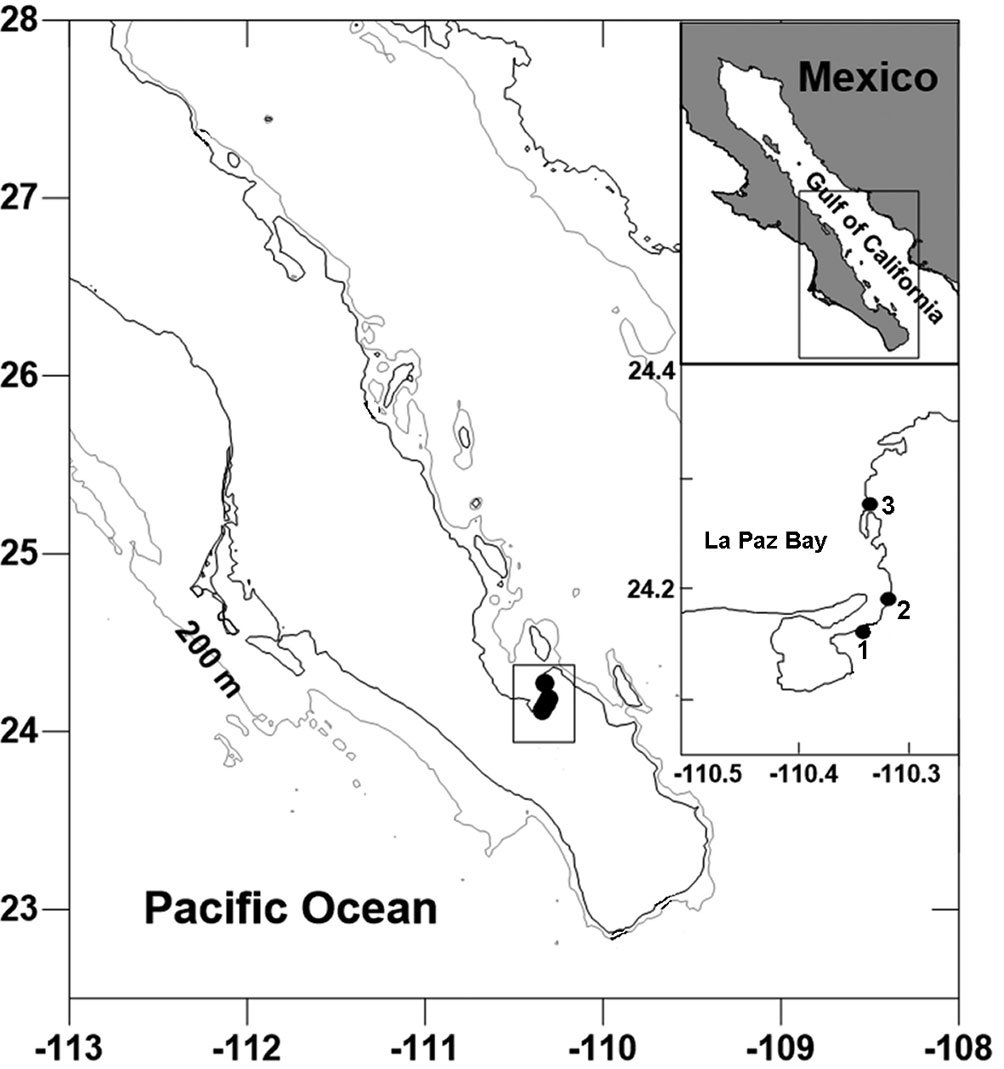
Samples of Nymphon were collected from 3 marine docks located in Bahía de La Paz, Baja California Sur, Mexico (La Paz, Palmira and Cantamar) (Fig. 1). Each encrusting faunal sample was obtained by scraping an area of 400 cm² (20 × 20 cm) located immediately below the sea surface from the edges of the platform and floating docks. The scraping of encrusted fauna was done with a carpenter’s chisel or a spatula following a standard technique (Pech et al., 2023). The encrusted fauna detached from the dock were deposited in plastic bags (Ziploc®) labeled with the date, time and geographic location information for each collection site. The biological samples were later placed in a cooler with seawater obtained from the collection site to transfer to the processing site. At the processing site, specimens from each biological sample were identified and sorted in situ into large taxonomic groups.
The pycnogonid specimens, sorted from the encrusted fauna, were fixed with a 10% formaldehyde solution in 2 mL cryovials. The pycnogonids were then washed a week later with distilled water to remove the excess formalin and salt and then preserved in 70% non-denatured ethanol.
Morphological observations were conducted using a stereomicroscope Olympus SZ, and an Olympus BX51 microscope with differential interference contrast (DIC). The figure backgrounds were cleaned and lightened as necessary, and final figures were assembled on a plate using Paint Shop Pro7. Description of the species is based on the morphology of the holotype.
Description
Class Pycnogonida Latreille, 1810
Order Pantopoda Gerstäcker, 1863
Family Nymphonidae Wilson, 1878
Genus Nymphon Fabricius, 1794
Type species: Nymphon grossipes (O. Fabricius, 1780)
Diagnosis. Trunk usually segmented and elongate. Lateral processes in general are well separated. Ocular tubercle is inserted at the posterior end of the cephalic segment. Abdomen is usually short. Proboscis variable in shape, cylindrical. Cheliphore robust, the scape formed by 1 segment, chelae complete and functional, fingers are long and have teeth of various shape and size. Palps 5-segmented, first one always short; the second one usually longest. The 10-segmented ovigers are present in both sexes, with a strigilis formed by the last 4 segments. They have denticulate spines and usually a toothed terminal claw. Propodus is heelless, main claw usually has auxiliary claws of various sizes. Cement glands, when present, are only present in males and open on the ventral side of the femur.
Remarks. Nymphon the most diverse genus within Pycnogonida, early descriptions are very brief, and type materials are unavailable, making its study very difficult. Traditionally, its species have been placed in artificial groups; however, most species have not been able to be placed in such groups for study.
Nymphon childi sp. nov.
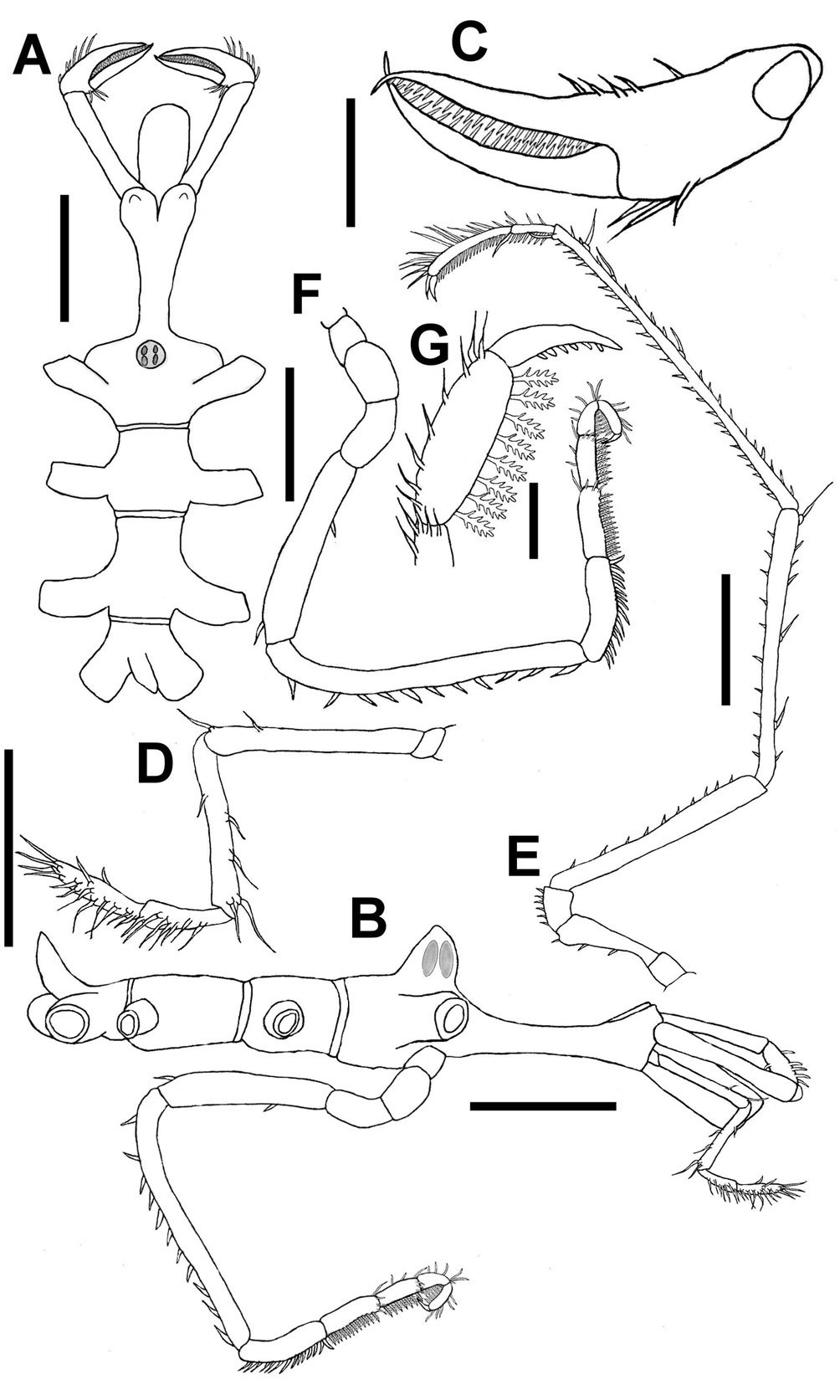
(Fig. 2)
Description. Male holotype (UANL-FCB-PYCNO-0055), trunk slender, fully segmented, neck in front of oviger bases, half the width of trunk, 4.5 times longer than its width, cylindrical, widening in the form of a calyx, with pair of conical, short anterior projections (Fig. 2A, B); lateral processes between first and second pairs separated by 2 times their own diameters, second and third pairs separated by 2.5 times their own diameters, third and fourth pairs separated by their own diameters (Fig. 2A). Ocular tubercle as high as basal width, inserted between first pair of lateral processes and bases of ovigers, cone-shaped, with 2 small papilliform projections, with 2 pigmented pairs of eyes (Fig. 2A, B).
Proboscis cylindrical, longer than wide, horizontal to body (Fig. 2A, B), with 3 smooth lips.
Chelifore scape over-reaching proboscis, chela fingers curved inwards, crossing at tips, 20-21 needle-like teeth of uniform size on each finger, slender, longer than basal part, which is inflated and rectangular, with 5 median ventral spines and 3 large dorsal setae in a row at distal end, next to articulation with movable finger (Fig. 2C).
Abdomen narrowing distally, length over 2 times greatest width, as long as lateral processes of fourth pair of legs, elevated from body at an angle of about 30° (Fig. 2B).
Palps 5-segmented, first segment very short. Second segment longest, with 1 medio-dorsal seta and a large dorso-distal 1. Third segment about 2/3 length of segment 2 with line of 3 ventral setae and latero-distal one; with medio-dorsal small seta. Fourth segment 4.5 times as long as segment 1, with ventral row of 7 setae. Fifth segment 1.1 times as long as fourth segment, with 9 long ventral setae, medio-dorsal small seta, terminal end with cluster of 4 setae (Fig. 2D).
Oviger 10-segmented, inserted in distal half of first lateral processes (Fig. 2B). First 3 segments short, first segment half size of second one, second and third segments subequal. Fourth segment with dorsal seta and ventro-distal one. Fifth segment 1.6 times longer than fourth, with ventral row of 11 setae, dorsal surface bare. Sixth segment as long as first and second segments together, with ventral row of 14 setae. Last 4 segments compose the strigilis, armed with compound ovigerous leg spines, each with the following formula: 12: 7: 5: 8. Compound spines with 3-6 pairs of lateral teeth depending upon the size of the spine. Terminal claw long, curved, with 6 teeth (Fig. 2G). First segment of strigilis with transverse row of 4 distal setae, second one with 2 dorsal isolated setae and distal row with 4 setae, in both dorsal setae longest; third segment with 3 dorsal setae and group of 4 dorso-distal setae; fourth strigilis segment with row of 8 dorsal setae (Fig. 2F, G).
Third leg (Fig. 2E), coxa 1 short, without setae. Coxa 2, 3.3 times longer than coxa 1, with 3 ventral setae. Coxa 3 slightly longer than coxa 1, with row of 6 small ventral setae. Femur long, with 10 scattered ventral setae. Tibia 1 with row of 6 long median-dorsal chaetae and distal spine, ventral row of 10 smaller setae. Tibia 2, 1.3 longer than tibia 1, with row of 17 dorsal setae and 3 median and distal spines, 24 small ventral setae and 1 distal spine. Tarsus with dorsal row of 4 setae, and 7 ventral setae and distal spine. Propodus 2.2 times longer than tarsus, slightly curved, with dorsal row of 13 spines and setae, and row of 22 ventral setae. Main claw short, less than ¼ length of propodus, auxiliary claws nearly as long as main claw.
Measurements of holotype (mm). Trunk length (frontal margin of cephalic segment to tip of fourth lateral process), 2.31; cephalon length, 1.04; width across 2nd lateral processes, 0.93; proboscis length, 0.53; proboscis greatest diameter, 0.22; abdomen length (lateral), 0.22. Palp: seg. 1, 0.05; seg. 2, 0.55; seg. 3, 0.44; seg. 4, 0.24; seg. 5, 0.25. Oviger: seg. 1, 0.13; seg. 2, 0.28; seg. 3, 0.28; seg. 4, 0.8; seg. 5, 1.3; seg. 6, 0.41; seg. 7, 0.3; seg. 8, 0.22; seg. 9, 0.13; seg. 10, 0.17; claw, 0.09. Third leg: coxa 1, 0.28; coxa 2, 0.87; coxa 3, 0.33; femur, 1.99; tibia 1, 2.5; tibia 2, 3.26; tarsus, 0.41; propodus, 0.81; claw, 0.25.
Female paratype (UANL-FCB-PYCNO-0056). Gonopores oval-shaped, present on ventrodistal end of coxa 2 in all leg pairs.
Taxonomic summary
Etymology. This species is named in honor of Dr. C. Allan Child (Department of Invertebrate Zoology, National Museum of Natural History, Smithsonian Institution, Washington) in recognition of his life dedicated to the study of Pycnogonida. The species-group name is a noun in the genitive case (ICZN 1999, Art. 31.1.2).
Type material. Holotype (1 male), (UANL-FCB-PYCNO-0055), paratypes (1 male and 4 females), (UANL-FCB-PYCNO-0056), Marina La Paz, La Paz, Baja California Sur, Mexico, 24°07’29.3” N, 110°20’47.3” W, 3 September 2013.
Additional material. One specimen (female), (UANL-FCB-PYCNO-0059), Marina La Paz, La Paz, Baja California Sur, Mexico, 24°07’29.3” N, 110°20’47.3” W, 14 August 2011. One specimen (male), (UANL-FCB-PYCNO-0057), Marina Palmira, La Paz, Baja California Sur, Mexico, 24°11’05.3” N, 110°18’12.7” W, 3 April 2011; 10 specimens (male), (UANL-FCB-PYCNO-0058), same locality, 15 August 2011. Two specimens (1 male and 1 female), (UANL-FCB-PYCNO-0060), Marina Cantamar, La Paz, Baja California Sur, Mexico, 24°16’44” N, 110°19’49” W, 26 June 2017.
Remarks
From the current Nymphon species known in the world, 21 have been reported from both coasts of America, 10 of these from the Eastern Pacific: N. aculeatum Child, 1994 (California, Oregon); N. apheles Child, 1979 (Panama); N. duospinum (Hilton, 1942) (Alaska); N. heterodenticulatum Hedgpeth, 1941 (Santa Catalina Island, California); N. hirsutum Child, 1995 (Bering Sea); N. lituus Child, 1979 (Gulf of California and Panama); N. longicollum Hoek, 1881 (Chile); N. pixellae Scott, 1912 (Vancouver, Oregon, Gulf of California); P. simulare Child, 1992 (Ecuador) and N. stipulum Child, 1990 (California).
Nymphon childi sp. nov. is morphologically similar to N. lituus Child, 1979 and N. simulare Child, 1992, all have a slender body, the third metamere of the body is longer than wide, the neck is 4 or more times longer than wide, and the tarsus is less than 50% of the length of the propodus. Nymphon childi sp. nov. differ from these species in the following characteristics: 1) the anterior tubercle over insertion of chelifores, conical in N. childi sp. nov., and as low anteriorly curved tubercle in N. lituus, N. simulare does not present anterior tubercles; 2) strigilis formula, of 12: 7: 5: 8 in N. childi sp. nov., 15: 10: 10: 11 in N. littus, and 11:10:10:10 in N. simulare; 3) second segment of the palp is shorter than third and fourth together in N. childi sp. nov. and N. simulare, and sligthly longer in N. littus; 4) third segment of the palp is 1.5 times longer than the fifth in N. childi sp. nov. and N. simulare and subequal to the fifth one in N. littus; 5) chela fingers, with 23 teeth in both chelae in N. childi sp. nov, immovable finger has 29 teeth, movable finger with 33 teeth in N. littus, and 27-28 teeth in N. simulare.
Another closer species to Nymphon childi sp. nov. is N. heterodenticulatum, both have the same structural body plan, proboscis horizontal to body, with a long cylindrical neck longer than wide ending in a structure with calyx shape, similar lateral processes separation, and abdomen shape. However, N. heterodenticulatum presents the ocular tubercle sharply pointed, ending in a cone shaped structure, chelifores with slender chela, fixed finger with 17 teeth, movable finger with 19 teeth; oviger with strigilis with a formula of 9: 9: 7: 7.
This species is currently known only from the type locality: Bahía de La Paz, Baja California Sur, Mexico, attached to dock fouling not deeper than 0.5 m.
Key to Nymphon species from Eastern Pacific
1. Tarsus longer than propodus … 2
— Tarsus shorter than propodus … 4
2. Ocular tubercle well developed; auxiliary claw present; fourth and fifth segment of palp equal in size … 3
— Ocular tubercle and eyes lacking; auxiliary claws absent; fourth segment of palp shorter than the fifth one … N. aculeatum Child, 1994 (California)
3. Auxiliary claws less than half the length of the main claw; strigilis of oviger as follow 20:9:14:12; terminal claw of oviger with 15-17 teeth; movable finger of chela with 35 thin teeth; immovable finger with 20 teeth … N. pixellae Scott, 1912 (Vancouver, Canada)
— Auxiliary claws slightly longer than the main claw; strigilis of oviger as follow 10: 9: 8: 10; terminal claw of oviger with 8 teeth; movable finger of chela with 19 teeth; immovable finger with 17 teeth … N. heterodenticulatum Hedgepeth, 1941 (Santa Catalina Island, California)
4. Short neck, less than twice own width … 5
— Long neck, more than twice own width … 7
5. Auxiliary claws less than half the length of the main claw; cheliphore with long and thin scape … 6
— Auxiliary claws longer than half the length of the main claw; cheliphore with short and robust scape … N. apheles Child, 1979 (Panama)
6. Palp with third segment longer than second one, with a group of long distal chaetae; tarsus longer than half the size of the propodus … N. stipulum Child, 1990 (California)
— Palp with third segment shorter than second one, with short chaetae along surface; tarsus shorter than half the size of the propodus … N. duospinum (Hilton, 1942) (Alaska)
7. Auxiliary claws thin and small, less than ¼ the size of the main claw; chelae with few teeth on both fingers, movable finger with 8 teeth, immovable finger with 5 teeth … N. longicollum Hoek, 1881 (Chile)
— Auxiliary claws equal to, or longer than half the size of the terminal claw … 8
8. Fingers of the chelae shorter than palm, movable finger with 34 teeth, immovable finger with 26 teeth; oviger with strigilis as follow 11: 6: 6: 6; oviger claw with 20 teeth … N. hirsutum Child, 1995 (Bering Sea)
— Fingers of the chelae longer than palm … 9
9. Oviger with strigilis as follow 12: 7: 5: 8; movable finger of chelae with 20 teeth, immovable finger with 20-21 teeth … N. childi sp. nov. (Bahía de La Paz, Gulf of California)
— Last 3 segments of the strigilis with 10 or more compound spines; chelae fingers with more than 20 teeth each … 10
10. Third segment of the palp similar in size of the second one; distal end of neck without distal tubercules … N. simulare Child, 1992 (El Viejo Island, Ecuador)
— Third segment of the palp ½ the size of the second one; distal end of neck with anteriorly curved low tubercle over insertion of chelifores … N. lituus Child, 1979 (Puerto Peñasco, Gulf of California)
Acknowledgements
This work was financially supported by the Universidad Autónoma de Nuevo León (grant number PAICYT 0235). Many thanks to Jesús Flores and Jesús Mendieta for their technical help with the collections and sorting out the specimens from the samples. This work could not be completed without the support of Claudia Arango, Lyudmila Slucheusky and Isabell Clasen who sent us some relevant scientific literature. We thank Mariana Tovar-Hernández for her review of the manuscript, and an anonymous reviewer.
References
Bamber, R. N. (1982). Variation in Nymphon brevirostre (Hodge), and the status of N. rubrum (Hodge) (Arthropoda: Pycnogonida). Biological Journal of the Linnean Society, 17, 275–288. https://doi.org/10.1111/j.1095-8312.1982.tb02022.x
Bamber, R. N., El Nagar, A., Arango, C. P., & Sabroux, R. (Eds.). (2026). Pycnobase: World Pycnogonida Database. Nymphon Fabricius, 1794. Accessed through: World Register of Marine Species at: https://www.marinespecies.org/aphia.php?p=taxdetails&id=134591
Child, C. A. (1979). Shallow-water Pycnogonida of the Isthmus of Panama and the Coasts of Middle America. Smithsonian Contributions to Zoology, 293, 1–86. https://doi.org/10.5479/si.00810282.293
de León-Espinosa, A., & de León-González J. A. (2015). Pycnogonids associated with the giant lion´s-paw scallop Nodipecten subnodosus (Sowerby) in Ojo de Liebre Bay, Guerrero Negro, Baja California Sur, Mexico. Zookeys, 530, 129–149. https://doi.org/10.3897/zookeys.530.6064
de León-Espinosa, A., de León-González J. A., & Gómez-Gutiérrez J. (2021). Pycnogonids from marine docks located along the west coast of the Gulf of California, Mexico. Zootaxa, 4938, 151–195. https://doi.org/10.11646/zootaxa.4938.2.1
ICZN (International Code of Zoological Nomenclature). (1999). International Code of Zoological Nomenclature, 4th Edition. London: International Commission on Zoological Nomenclature.
Munilla-León, T. (2002). Pycnogonida. En J. Llorente-Bousquets, & J. J. Morrone (Eds.), Biodiversidad, taxonomía y biogeografía de artrópodos de México: hacia una síntesis de su conocimiento, Vol. III (pp. 215–222). México D.F.: Comisión Nacional para el Conocimiento y Uso de la Biodiversidad.
Pech, D., Tovar-Hernández, M. A., Bastida-Zavala, R., Carrera-Parra, L. F., de León-González, J. A. y Delgado-Blas, V. H. et al. (2023). Protocolo para el muestreo, análisis y estudio de la biota portuaria en México. Monterrey: Universidad Autónoma de Nuevo León.
Ramírez-Tello, L. M., Tello-Musi, J. L., & López-García, R. (2022). Pycnogonida of Mexican waters: a checklist with observations on diversity and ecology. Bulletin of Marine and Coastal Research, 51, 151–170. https://doi.org/10.25268/bimc.invemar.2022.51.1.1186
Stock, J. H. (1986). Pycnogonida from the Caribbean and the Straits of Florida. Bulletin of Marine Science, 38, 399–441.
Takahashi, Y., Kajihara, H., & Mawatari, S. F. (2012). Sea spiders of the genus Nymphon (Arthropoda: Pycnogonida) from waters around the Nansei Islands, Japan. Journal of Natural History, 46, 1337–1358. https://doi.org/10.1080/00222933.2012.655797
Villatoro-Ortiz, A., & Salazar-Silva, P. (2022). Picnogónidos (Arthropoda: Pycnogonida: Pantopoda) de la bahía de Banderas, Pacífico mexicano. Revista Ciencias Marinas y Costeras, 14, 71–90. https://doi.org/10.15359/revmar.14-2.5