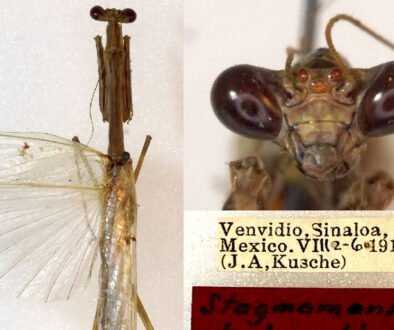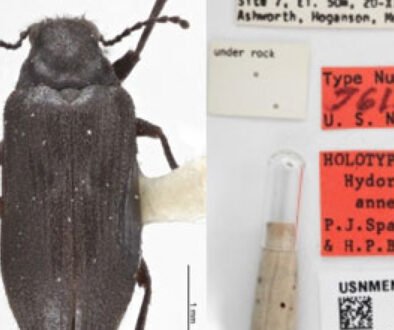
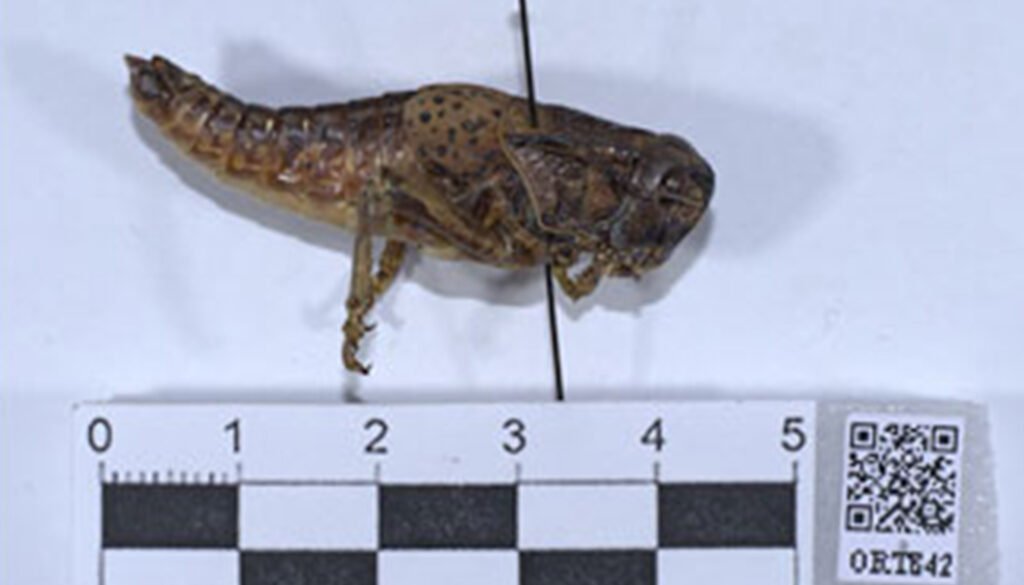
Digitalización e integración de recursos genéticos de Orthoptera (Insecta) dentro del sistema web de las Colecciones Biológicas Nacionales (IBdata) del Instituto de Biología, Ciudad de México, México
Aura Isabel Ortiz-Ramírez a, Iker Cubillos-Macías a, b, Miguel Murguía-Romero c, Mauricio Morgado-Castillo c, Cristina Mayorga-Martínez a, Jovana M. Jasso-Martínez a, *
a Universidad Nacional Autónoma de México, Instituto de Biología, Colección Nacional de Insectos, Tercer Circuito Exterior s/n, Ciudad Universitaria, Coyoacán, 04510 Mexico City, Mexico
b Universidad Nacional Autónoma de México, Posgrado en Ciencias Biológicas, Unidad de Posgrado, Edificio D primer piso, Ciudad Universitaria, Coyoacán, 04510 Mexico City, Mexico
c Universidad Nacional Autónoma de México, Instituto de Biología, Unidad de Informática para la Biodiversidad, Tercer Circuito Exterior s/n, Ciudad Universitaria, Coyoacán, 04510 Mexico City, Mexico
*Corresponding author: jovana.jasso@ib.unam.mx (J.M. Jasso)
Received: 05 February 2026; accepted: 21 April 2026
Abstract
Assessment and digitization of biological collections are critical for maximizing their value as biodiversity repositories and sources of biological public information. By integrating traditional specimen data with their extended digital information, including genetic and genomic data, biological collections can consolidate as dynamic, publicly accessible infrastructures for research. The Colección Nacional de Insectos (CNIN) at the Instituto de Biología (IBUNAM) of the Universidad Nacional Autónoma de México, houses more than 5 million specimens representing 24 insect orders. However, many of the biological collections at IBUNAM need deeper assessment and remain undigitized, such as Orthoptera; an ecologically, economically and culturally important group in Mexico. This study represents an initial effort comprising a 7-step methodology to establish an enhanced digitization standard for this entomological subcollection by linking Orthoptera specimens deposited in the CNIN with their publicly available genetic and genomic resources, integrating them into the web system for biological collections of the IBUNAM, IBdata. This enriched digitization standard has the potential to be extended to other digital collections of the IBUNAM and other institutions. Furthermore, we provide a catalogue of type Orthoptera specimens deposited in the CNIN, along their label data, including photographs, all compiled into IBdata.
Keywords: GenBank; SRA; Type specimens; Data mobilization, CNIN
Resumen
La evaluación y digitalización de las colecciones biológicas son fundamentales para maximizar su valor como repositorios de biodiversidad y fuentes de información pública. Al integrar datos de los especímenes con su información digital extendida, como recursos genéticos y genómicos, las colecciones pueden consolidarse como infraestructuras dinámicas y públicas de investigación. La Colección Nacional de Insectos (CNIN) del Instituto de Biología (IBUNAM) de la Universidad Nacional Autónoma de México, alberga más de 5 millones de especímenes representando 24 órdenes de insectos. Sin embargo, muchas de las colecciones biológicas del IBUNAM requieren mayor evaluación y permanecen sin digitalizar, como Orthoptera, un grupo de importancia ecológica, económica y cultural en México. Este estudio representa un esfuerzo inicial que comprende una metodología de 7 pasos para establecer un estándar de digitalización extendido para esta subcolección, vinculando los especímenes de ortópteros depositados en la CNIN con sus recursos genéticos y genómicos disponibles públicamente, integrándolos al sistema web para las colecciones biológicas del IBUNAM, IBdata. Este estándar de digitalización extendido tiene el potencial de aplicarse a otras colecciones del IBUNAM y de otras instituciones. Adicionalmente, proporcionamos un catálogo de especímenes tipo de Orthoptera depositados en la CNIN, digitalizando sus datos de etiqueta y fotografías en IBdata.
Palabras clave: GenBank; SRA; Especímenes tipo; Mobilización de datos; CNIN
Introduction
Biological collections are primary repositories of global and local biodiversity and a baseline to perform both basic and applied science studies, including taxonomic revisions, biodiversity conservation efforts, identification of biodiversity patterns, and other evolutionary approaches (Hedrick et al., 2020; Meineke et al., 2019). The Instituto de Biología (IBUNAM) at Universidad Nacional Autónoma de México (UNAM) houses the National Biological Collections of Mexico, including the Colección Nacional de Insectos (CNIN), a reference insect collection for the country. In the CNIN there are more than 5 million deposited specimens representing 24 insect orders, including Orthoptera (crickets, grasshoppers, katydids). The Orthoptera subcollection contains nearly 109,000 specimens, with about 30,000 having received curatorial processing, 85% of which are taxonomically identified. These specimens represent Caelifera and Ensifera taxa, most of them belonging to representatives of the families Acrididae and Tettigoniidae, which are highly distributed across the country.
The IBUNAM has implemented an institutional web system that enables the efficient capture and access to data associated with the specimens deposited in its biological collections, the IBdata (https://ibdata4.ib.unam.mx; Murguía-Romero et al., 2024), providing free access to digitized information of over 1.8 million specimens, including taxonomic, collection, biological, geographic and ecological data. Although digitization efforts are currently increasing for various taxa represented in the biological collections housed by the IBUNAM, a significant portion of these collections, including a portion of the CNIN, remains undigitized, as is the case for Orthoptera, a biologically, ecologically, economically and culturally important group of insects in Mexico.
Assessment and digitization of biological collections as well as the enrichment of collection databases represent critical steps for maximizing their value as repositories of biodiversity and as sources of biological public information (Beaman & Cellinese, 2012; Funk, 2018; Hedrick et al., 2020). By integrating traditional specimen data together with high quality images, extended digital information such as genetic and genomic resources, as well as links to associated publications, biological collections can consolidate as dynamic biological infrastructures available to the scientific community (Granados-Mendoza et al., 2024; Lendemer et al., 2020).
We have initiated digitization efforts for the Orthoptera subcollection housed in the CNIN, with an initial focus on type material and specimens for which genetic and genomic data have been generated and are available. This effort aims to establish an enhanced standard for the digitization of this entomological collection by linking Orthoptera specimens deposited in the CNIN with their publicly available genetic resources, as well as to the scientific publications in which Orthoptera of the CNIN have been studied.
Materials and methods
We exhaustively navigated the Orthoptera subcollection at the CNIN to locate any material labeled as type material (holotype, paratype, allotype). Historically, allotypes were used to refer to a specimen of the opposite sex as to the holotype; however, this term is not defined or regulated by the International Code of Zoological Nomenclature (ICZN). Hereafter, we considered allotypes as part of the paratype series of each species whose holotypes are deposited in the CNIN. Holotype-labeled material was separated and assembled in our newly created Orthoptera type collection. We further confirmed the validity of nominal species in the international specialized database Orthoptera Species File (OSF: https://orthoptera.speciesfile.org/; Cigliano et al., 2024). If needed, names were updated to their current accepted status.
We conducted a bibliographic search to identify published works that generated genetic and genomic data from Orthoptera specimens deposited in the CNIN. Their associated genetic and genomic data are publicly available in the databases of the National Center for Biotechnology Information (NCBI) such as GenBank and the Sequence Read Archive (SRA).
We further physically located those specimens in the CNIN and, for these as well as type material, captured their label data information following the Darwin Core standard (DwC: Wieczorek et al., 2012) into IBdata. The data entry interface of IBdata was designed to ensure that specimen records are accurate, complete, updated and uniquely identifiable, enforcing consistency between physical specimens and their records by minimizing inconsistencies, duplications (e.g., entry of 2 specimens with the same catalog number) and missing information. To achieve this, IBdata system employs multiple validation and standardization steps such as taxonomic and geographic catalogs, controlled vocabularies and automated validation and transformation rules.
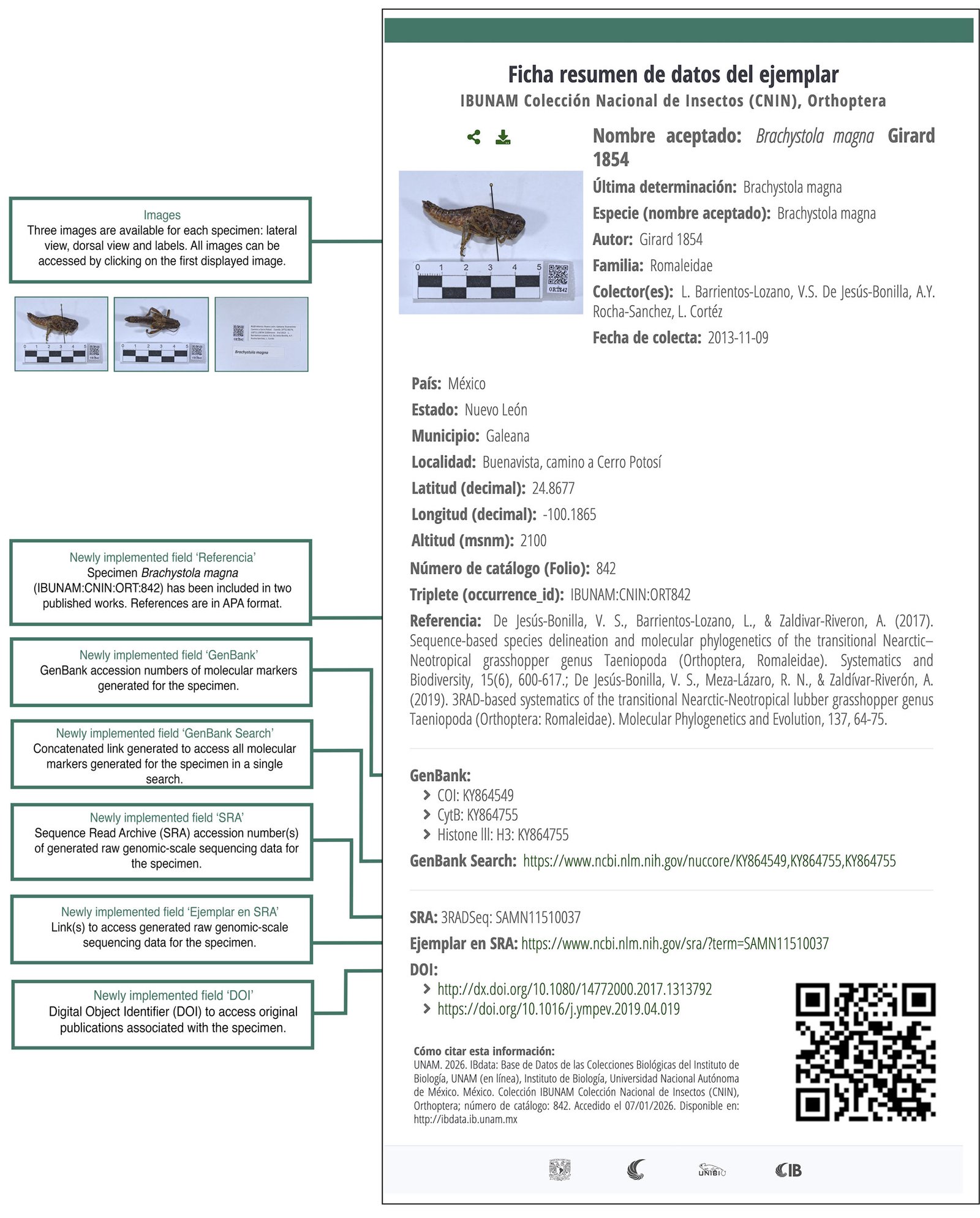
We assigned a Uniform Resource Name (URN; Saint-Andre & Klensin, 2017) to each specimen which consists of a triplet containing acronyms for the institute, the main collection, the subcollection and a unique number for each specimen as follows <Institution>:<Collection>:<Subcollection + catalog number of the specimen>; for example: IBUNAM:CNIN:ORT842. Generated URNs are linked to QR codes that were printed and pinned as an additional label to each specimen, allowing direct access to the Summary Data Sheet into IBdata when scanned with a mobile device.
We created new fields into IBdata to capture links to accession numbers of associated genetic and genomic data as well as to the Digital Object Identifier (DOI) of original publications as follows: field ‘GenBank’ containing a list of accession numbers of all molecular markers generated for each specimen; field ‘GenBank Search’ containing a generated concatenated link to GenBank which displays all accession numbers in the field ‘GenBank’ in a single search; field ‘SRA’ containing a list of accession numbers to raw-genomic data generated for some specimens; field ‘Ejemplar en SRA’ (Spanish for ‘Specimen in SRA’) containing the direct link to raw-genomic data into the SRA database; field ‘DOI’ containing the web link to the original publication to which each specimen is associated and field ‘Referencia’ (Spanish for ‘Reference’) with the reference(s) in APA format.
We imaged dorsal and lateral views of each specimen as well as their labels, all images including the previously generated and printed QR codes. In order to do this, we used a Canon EOS Mark II camera with a 50 mm lens on a stand with side light spotlights. We developed a custom automated tool installed locally to verify for images quality, format, size, and image files integrity. This system also enables automatic renaming of image files by reading QR codes included at the time of images capture, thereby minimizing manual processing during large-scale digitization. Images are subsequently and automatically converted to format WebP through the system to optimize storage without loss of images quality. After renaming and validation, the 3 images generated for each specimen were imported into IBdata and can be accessed both as a direct IBdata search or by scanning the pinned QR label.
Results
As a result of an exhaustive navigation of the Orthoptera subcollection, we located material belonging to 36 species whose type material (holotypes, paratypes) is deposited in the CNIN, representative of the families Acrididae, Gryllidae, Pyrgomorphidae, Stenopelmatidae and Tettigoniidae (Table 1). Seven species have only paratypes deposited in the CNIN, and their respective holotypes are deposited either in the Academy of Natural Sciences of Philadelphia (ANSP), USA or in the Museo Civico di Rovereto (MCRI), Italy (Table 1).
| Family | Species | Author and year | Paratypes associated |
|---|---|---|---|
| Acrididae | Bootettix joerni* | Otte, 1979 | 2 |
| Calotettix huastecus | Buzzetti, Barrientos-Lozano & Fontana, 2010 | 1 | |
| Cephalotettix chinantecus | Fontana, Buzzetti & Mariño-Pérez, 2011 | 1 | |
| Eucephalacris bolivari** | Mariño & Márquez-Mayaudón, 1985 | 2 | |
| Huastecacris zenoni | Fontana & Buzzetti, 2007 | 2 | |
| Melanoplus solitarius | Buzzetti, Barrientos-Lozano & Fontana, 2010 | 1 | |
| Melanoplus mixes | Fontana, Buzzetti & Mariño-Pérez, 2011 | 1 | |
| Melanoplus ludivinae | Fontana, Buzzetti & Mariño-Pérez, 2011 | 2 | |
| Melanoplus oaxacae | Fontana, Buzzetti & Mariño-Pérez, 2011 | 3 | |
| Oaxaca (Oaxaca) carinata | Fontana, Buzzetti & Mariño-Pérez, 2011 | 1 | |
| Oaxaca (Oaxaca) colorata | Fontana, Buzzetti & Mariño-Pérez, 2011 | 5 | |
| Pedies cerropotosi** | Fontana & Buzzetti, 2007 | 2 | |
| Pedies monarca | Buzzetti, Barrientos-Lozano & Fontana, 2010 | 1 | |
| Phaedrotettix toltecus** | Fontana & Buzzetti, 2007 | 1 | |
| Phaedrotettix gualaguises** | Fontana & Buzzetti, 2007 | 2 | |
| Phaedrotettix violai** | Fontana & Buzzetti, 2007 | 2 | |
| Philocleon luceroae** | Fontana & Buzzetti, 2007 | 2 | |
| Poecilocloeus tridentatus | Mariño & Márquez-Mayaudón, 1985 | 11 | |
| Proctolabus diferens | Márquez-Mayaudón, 1963 | 3 | |
| Reyesacris amedegnatoae | Fontana, Buzzetti & Mariño-Pérez, 2011 | 3 | |
| Gryllidae | Gryllus (Gryllus) alexanderi* | Otte & Cowper, 2007 | 3 |
| Pyrgomorphidae | Ichthyotettix stricticaudatus | Fontana, Buzzetti, Mariño-Pérez & García-García, 2011 | 1 |
| Ichthyotettix inexpectatus | Fontana, Buzzetti, Mariño-Pérez & García-García, 2011 | 0 | |
| Stenopelmatidae | Stenopelmatus chilango | Suastes-Jiménez, Barrientos-Lozano & Zaldívar-Riverón, 2023 | 38 |
| Stenopelmatus purepecha | Suastes-Jiménez, Barrientos-Lozano, Gutiérrez-Rodríguez & Zaldívar-Riverón, 2023 | 3 | |
| Stenopelmatus tlaxcalli | Suastes-Jiménez, Barrientos-Lozano & Zaldívar-Riverón, 2023 | 1 | |
| Stenopelmatus sierragordaensis | Suastes-Jiménez, Barrientos-Lozano, Gutiérrez-Rodríguez & Zaldívar-Riverón, 2023 | 1 | |
| Tettigoniidae | Anaulacomera (Bovicercora) crassicerca | Márquez-Mayaudón, 1965 | 3 |
| Anaulacomera (Anaulacomera) acutangulata | Márquez-Mayaudón, 1965 | 13 | |
| Ceraia intermedia | Márquez-Mayaudón, 1958 | 7 | |
| Ceraia tuxtlaensis | Márquez-Mayaudón, 1964 | 4 | |
| Insara oaxacae | Fontana, Buzzetti, Mariño-Pérez & García-García, 2011 | 6 | |
| Melanonotus septentrionalis | Mariño & Márquez-Mayaudón, 1984 | 8 | |
| Montezumina longistyle | Márquez-Mayaudón, 1965 | 3 | |
| Vellea mexicana | Márquez-Mayaudón, 1958 | 4 | |
| Viadana (Proviadana) paralita | Márquez-Mayaudón, 1965 | 2 |
We identified 7 articles in which genetic and genomic data have been generated for Orthoptera specimens deposited in the CNIN-IBUNAM corresponding to the Caelifera families Pyrgomorphidae (Sphenarium spp., Sphenacris crassicornis, Prosphena scudderi) and Romaleidae (Brachystola magna, Chromacris colorata, Cibotopteryx variegata, Romalea spp.); and to the Ensifera family Stenopelmatidae (Ammopelmatus sp., Stenopelmatus spp.) (Table 2). These investigations were centered in species delimitation, generation of phylogenetic hypotheses, population genetics and taxonomic revision of these taxa. The genetic resources generated from these specimens correspond to Cytochrome Oxidase Subunit I (COI), Cytochrome B (CytB), 28S ribosomal RNA, and Histone III (H3). For 200 of these specimens genomic-level data was generated, including low-coverage shotgun sequencing data, Triple-digest Restriction Associated DNA sequencing (3RADseq) and partial or complete mitochondrial genomes (Table 2).
| Original reference | Species included | Number of specimens | Genetic and genomic data generated and publicly available |
|---|---|---|---|
| Pedraza-Lara et al. (2015); Benites et al. (2023) | Prosphena scudderi Sphenacris crassicornis Sphenarium adelinae Sphenarium borrei Sphenarium crypticum Sphenarium histrio Sphenarium macrophallicum Sphenarium mexicanum Sphenarium minimum Sphenarium miztecum Sphenarium occidentalis Sphenarium planum Sphenarium purpurascens Sphenarium rugosum Sphenarium totonacum Sphenarium variabile Sphenarium zapotecum Sphenarium sp. | 176 | Genetic: COI, CytB, 28S Genomic: 3RADseq |
| De Jesús-Bonilla et al. (2017, 2019) | Brachystola magna Chromacris colorata Cibotopteryx variegata Romalea auricornis Romalea centurio Romalea citricornis Romalea eques Romalea gutturosa Romalea obscura Romalea picticornis Romalea reticulata Romalea tamaulipensis Romalea varipennis | 187 | Genetic: COI, CytB, 28S, H3 Genomic: 3RADseq, low-coverage shotgun sequencing data |
| Gutiérrez-Rodríguez et al. (2022); Ruiz-Mendoza et al. (2023); Suastes-Jiménez et al. (2023) | Ammopelmatus sp. Stenopelmatus chilango Stenopelmatus faulkneri Stenopelmatus mineraldelmonte Stenopelmatus perote Stenopelmatus piceiventris Stenopelmatus purepecha Stenopelmatus sartorianus Stenopelmatus sierragordaensis Stenopelmatus talpa Stenopelmatus tlaxcalli Stenopelmatus typhlops Stenopelmatus zimapan Stenopelmatus sp. | 122 | Genetic: COI Genomic: mitogenomes, 3RADseq, low-coverage shotgun sequencing data |
As result of digitization of type specimens and those with genetic data associated, the virtual Orthoptera collection in IBdata currently contains 610 records, from which 485 have Summary Data Sheets containing the 6 newly implemented fields integrating accession numbers, links to NCBI (GenBank and SRA), references and DOIs of original publications (Fig. 1).
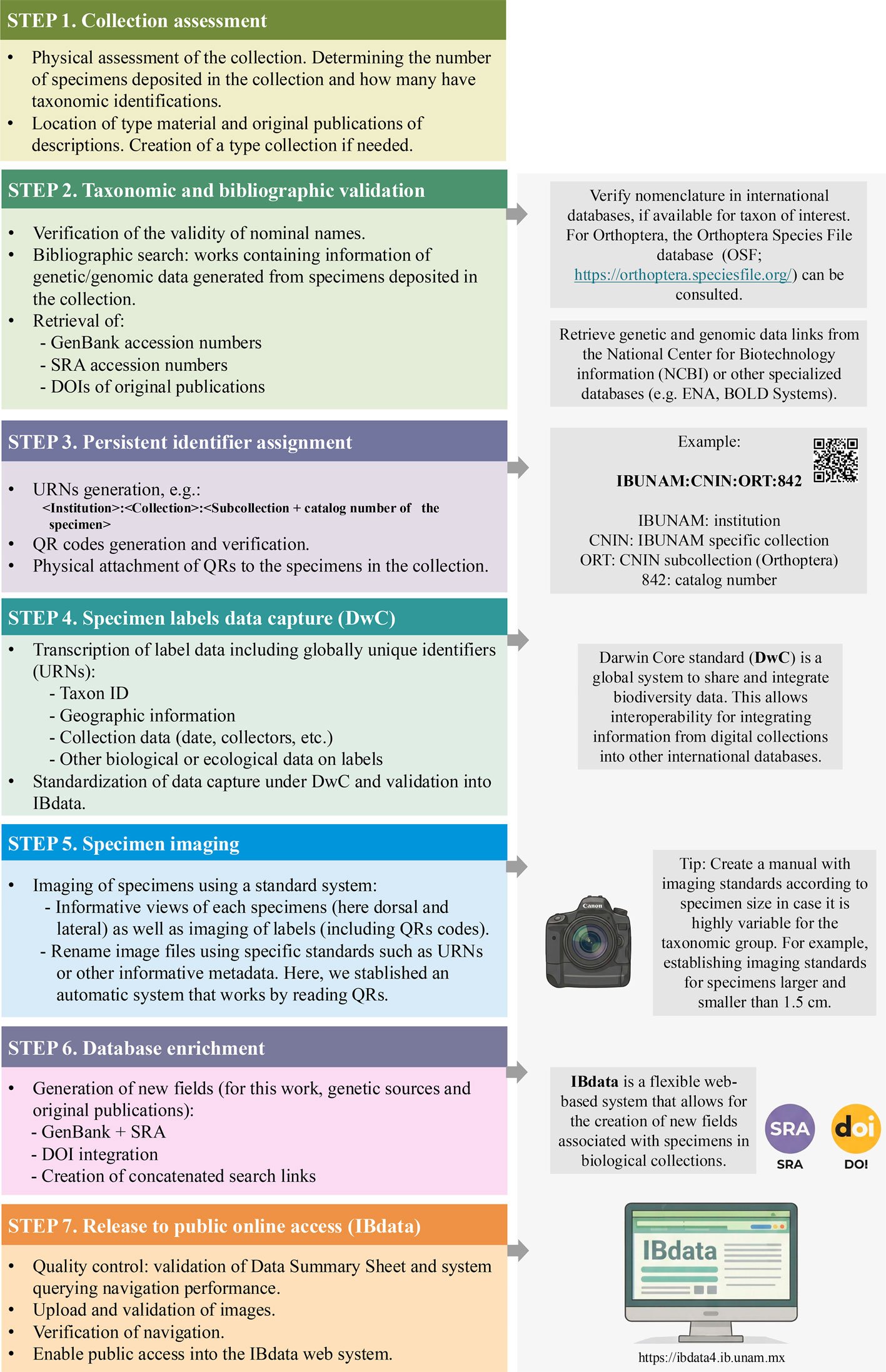
We also generated a 7-phase workflow (Fig. 2) that summarizes the methods applied here, and that can serve as a basic step-by-step guide for users associated not only to IBUNAM collections, but that are interested in initiating or enriching digitization of biological collections in other institutions. Briefly, the workflow includes: 1) initial collection assessment, 2) taxonomic and bibliographic validation, 3) persistent identifier assignment, 4) label data transcription and database capture complying with Darwin Core (DwC), 5) specimens imaging, 6) database enrichment, in the case of this study, genetic information linked to specimens in the collection, and 7) release to public online access (Fig. 2).
Discussion
In this work, 610 new records of Orthoptera specimens collected in Mexico are now available for public consultation, which together with other virtual entomological collections with Orthoptera records, e.g., National Museum of Natural History of the Smithsonian Institution and the Natural History Museum of London, represent important contributions for opening access to Orthoptera information from Mexico and other parts of the world.
The Orthoptera subcollection of the CNIN is currently the only zoological virtual collection in IBdata that contains genetic and genomic data associated in this institutional database, and the only biological collection housed by the IBUNAM that contains associated DOIs to original publications where these specimens have been studied. This effort for enriching the institutional database IBdata is not isolated, there is an important previous initiative that linked genetic resources to type material of the National Herbarium of Mexico (MEXU) (Granados-Mendoza et al., 2024). Considering that the IBUNAM has implemented its own database for managing its biological collections comprising 10 Zoological Collections and the herbarium MEXU, most of which are reference collections in Mexico, this approach can serve as a model for institutional digitization.
The advent of next-generation sequencing technologies (NGS) has increased the production of molecular data from specimens that are subsequently deposited in biological collections, becoming an extension of these preserved specimens and transforming biological collections into dynamic resources of integrative data. Standardized approaches for linking these genetic resources to other data associated with specimens is critical to the enhancement of the scientific value of specimens and collections. In this sense, the adoption of the Darwin Core standard (DwC), a global system to share and integrate biodiversity data (Wieczorek et al., 2012) by the institutional web system IBdata, is crucial to enhance accessibility and long-term value of biodiversity data, enabling interoperability and the integration of its records into major global biodiversity infrastructures such as the Global Biodiversity Information Facility (GBIF: https://www.gbif.org/). This facilitates the incorporation of information of the IBUNAM institutional biodiversity database into large-scale studies, including monitoring of biodiversity, analysis on the impacts of climate change, ecological, phylogenetic and biogeographic studies, as well as meta-analyses.
Revision of specimens in biological collections and digitization of their associated data facilitates assessment of the state of collections and to optimally plan efforts to enhance their preservation and resources allocation (Beaman & Cellinese, 2012; Hedrick et al., 2020). Positively, digitization efforts of Mexican fauna, including insects, are increasing (e.g., Cubillos-Macías et al., 2025; Pinedo-Escatel et al., 2025), which is helping to democratize biological knowledge. In this context, the inclusion of other resources that are valuable extensions of preserved specimens such as genetic and genomic resources as a standard is critical, considering the current global biodiversity loss scenarios.
Acknowledgements
We thank Maryangela Rodríguez-Hamilton for her help with transcription of specimen labels data in an earlier stage of this study, Isabela Midori Watanabe and Alejandro Zaldívar-Riverón for their help verifying data associated with some specimens. I. Cubillos-Macías thanks the Graduate Program in Biological Sciences of the Universidad Nacional Autónoma de México (UNAM) for the support provided during his master’s studies. This work was supported by the institutional (IBUNAM) project PRONAII-2024-3 (Secihti, México), by a Secihti grant (Ciencia y Frontera 2025, project No. CBF-2025-I-21) to JMJM, and grants given by DGAPA-UNAM (PAPIIT, 2025; project No. IA201425) to JMJM and (PAPIIT, 2026; project No. IF200926) to CMM.
References
Beaman, R. S., & Cellinese, N. (2012). Mass digitization of scientific collections: new opportunities to transform the use of biological specimens and underwrite biodiversity science. Zookeys, 209, 7. https://doi.org/10.3897/zookeys.209.3313
Benites, P., Zaldívar-Riverón, A., Meza-Lázaro, R. N., Samacá- Saenz, E., Gutiérrez-Rodríguez, J., & Hernández-López, A. (2023). Multiple introgression events during the diversification history of the edible Mexican grasshopper genus Sphenarium (Orthoptera: Pyrgomorphidae). Molecular Phylogenetics and Evolution, 183, 107774. https://doi.org/10.1016/j.ympev.2023.107774
Cigliano, M. M., Braun, H., Eades, D. C., & Otte, D. (2024). Orthoptera species file. https://orthoptera.speciesfile.org/
Cubillos-Macías, I., Vásquez-Quintero, A. E., Murguía- Romero, M., & Jasso-Martínez, J. M. (2025). Assessment and digitization of Mantodea (Insecta) in the Colección Nacional de Insectos (CNIN) at Instituto de Biología (IBUNAM), Mexico City, Mexico. Zootaxa, 5692, 369–380. https://doi.org/10.11646/zootaxa.5692.2.9
De Jesús-Bonilla, V. S., Barrientos-Lozano, L., & Zaldívar- Riverón, A. (2017). Sequence-based species delineation and molecular phylogenetics of the transitional Nearctic– Neotropical grasshopper genus Taeniopoda (Orthoptera, Romaleidae). Systematics and Biodiversity, 15, 600–617. https://doi.org/10.1080/14772000.2017.1313792
De Jesús-Bonilla, V. S., Meza-Lázaro, R. N., & Zaldívar- Riverón, A. (2019). 3RAD-based systematics of the transitional Nearctic-Neotropical lubber grasshopper genus Taeniopoda (Orthoptera: Romaleidae). Molecular Phylogenetics and Evolution, 137, 64–75. https://doi.org/10.1016/j.ympev.2019.04.019
Funk, V. A. (2018). Collections-based science in the 21st century. Journal of Systematics and Evolution, 56, 175–193. https://doi.org/10.1111/jse.12315
Granados-Mendoza, C., Murguía-Romero, M., & Salazar, G. A. (2024). It’s time to celebrate! Linking genetic resources to the Mexican National Biological Collections custodied by the Institute of Biology of the National Autonomous University of Mexico. Revista Mexicana de Biodiversidad, 95, e955509. https://doi.org/10.22201/ib.20078706e.2024.95.5509
Gutiérrez-Rodríguez, J., Zaldívar-Riverón, A., Weissman, D. B., & Vandergast, A. G. (2022). Extensive species diversification and marked geographic phylogenetic structure in the Mesoamerican genus Stenopelmatus (Orthoptera: Stenopelmatidae: Stenopelmatinae) revealed by mitochondrial and nuclear 3RAD data. Invertebrate Systematics, 36, 1–21. https://doi.org/10.1071/IS21022
Hedrick, B. P., Heberling, J. M., Meineke, E. K., Turner, K. G., Grassa, C. J., Park, D. S. et al. (2020). Digitization and the future of natural history collections. Bioscience, 70, 243–251. https://doi.org/10.1093/biosci/biz163
Lendemer, J., Thiers, B., Monfils, A. K., Zaspel, J., Ellwood, E. R., Bentley, A. et al. (2020). The extended specimen network: A strategy to enhance US biodiversity collections, promote research and education. Bioscience, 70, 23–30. https://doi.org/10.1093/biosci/biz140
Meineke, E. K., Davies, T. J., Daru, B. H., & Davis, C. C. (2019). Biological collections for understanding biodiversity in the Anthropocene. Philosophical Transactions of the Royal Society B, 374. https://doi.org/10.1098/rstb.2017.0386
Murguía-Romero, M., Serrano-Estrada, B., Salazar, G. A., Sánchez-González, G. E., Samper-Palacios, U. M., Gernandt, D. S. et al. (2024). The IBdata web system for biological collections: design focused on usability. Biodiversity Informatics, 18, 1–12. https://doi.org/10.17161/bi.v18i.20516
Pedraza-Lara, C., Barrientos-Lozano, L., Rocha-Sánchez, A. Y., & Zaldívar-Riverón, A. (2015). Montane and coastal species diversification in the economically important Mexican grasshopper genus Sphenarium (Orthoptera: Pyrgomorphidae). Molecular Phylogenetics and Evolution, 84, 220–231. https://doi.org/10.1016/j.ympev.2015.01.001
Pinedo-Escatel, J. A., Blanco-Rodríguez, E., Jarillo, A. M., Becerra-Chiron, I. M., Torres-Moreno, R., Vega- Ovando, F. R. et al. (2025). Annotated type catalogue of the leafhoppers and treehoppers (Insecta: Hemiptera: Auchenorrhyncha) deposited in the collection of Instituto Nacional de Investigaciones Forestales, Agrícolas y Pecuarias, Guanajuato, Mexico. Zootaxa, 5691, 151–192. https://doi.org/10.11646/zootaxa.5691.2.1
Ruiz-Mendoza, P. X., Jasso-Martínez, J. M., Gutiérrez-Rodríguez, J., Samacá-Sáenz, E., & Zaldívar-Riverón, A. (2023). Mitochondrial genome characterization and mitogenome phylogenetics in the central Mexican Stenopelmatus talpa complex (Orthoptera: Stenopelmatidae: Stenopelmatini). Revista Mexicana de Biodiversidad, 94, e945094. https://doi.org/10.22201/ib.20078706e.2023.94.5094
Saint-Andre, P., & Klensin, J. (2017). Uniform Resource Names (URN), namespace definition mechanisms. Internet Engineering Task Force (Technical report), RFC 8141.
Suastes-Jiménez, M. Á., Barrientos-Lozano, L., Gutiérrez- Rodríguez, J., Jasso-Martínez, J. M., & Zaldívar-Riverón, A. (2023). Taxonomic revision of the Stenopelmatus talpa species group (Orthoptera: Stenopelmatidae: Stenopelmatini). Revista Mexicana de Biodiversidad, 94, e945184. https://doi.org/10.22201/ib.20078706e.2023.94.5184
Wieczorek, J., Bloom, D., Guralnick, R., Blum, S., Döring, M., Giovanni, R. et al. (2012). Darwin Core: an evolving community-developed biodiversity data standard. Plos One, 7, e29715. https://doi.org/10.1371/journal.pone.0029715