Los peces asociados a arrecifes del Parque Nacional Revillagigedo (Pacífico mexicano): un inventario curado, comentado e ilustrado
D. Ross Robertson a, *, Benjamin Frable b, Benjamin C. Victor c, William Ludt d, Michelle R. Gaither e, Carlos J. Estape f, Allison Morgan-Estape f, Diane Pitassy g, Katriina L. Ilves h, Omar Domínguez-Domínguez i, Omar Valencia-Méndez j, Arturo Ayala-Bocos k, Edgar Adrián Acevedo-Álvarez i, María Gloria Solís-Guzmán i, A. Karim Awhida-Robinson i, Luis Fernando Martínez-García i, Ayla Gabriela Ramos-Mayoral i, María Elena Castillo-Victor i, Xavier Madrigal-Guridi i, Juan Esteban Martínez-Gómez l, Eloísa Torres-Hernández m, Lee Richter n, Sara Richter n, Andre Michael Goolishian-Hernández o, Serenity Mitchell o, Jeffrey D. Haines p, Alasdair G. Dunlap-Smith q, Ellen Place r, Carol Cox s, Robert Cox s, Fernando Duarte-Ramos t, Carlos Armando Sánchez-Ortiz t
a Smithsonian Tropical Research Institute, Naos Marine Laboratory, Ft Amador, Balboa, Republic of Panamá
b University of California San Diego, Scripps Institution of Oceanography, Marine Vertebrate Collection, 9500 Gilman Drive, La Jolla, CA 92093-0244, USA
c Ocean Science Foundation, 4051, Glenwood, CA 92604, USA
d Natural History Museum of Los Angeles County, Department of Ichthyology, 900 Exposition Blvd., Los Angeles, CA 90007, USA
e University of Central Florida, Genomics and Bioinformatics Cluster, Department of Biology, 4110 Libra Drive, Orlando, FL 32816, USA
f 197 Gulfview Drive, 33036 Islamorada, FL, USA
g Smithsonian Institution, National Museum of Natural History, Museum Support Center, 4210 Silver Hill Rd., Suitland, MD 20746, USA
h Canadian Museum of Nature, Research & Collections, P.O. Box 3443, Sta. D, Ottawa, Ontario, K1P 6P4 Canada
i Universidad Michoacana de San Nicolás de Hidalgo, Facultad de Biología, Laboratorio de Biología Acuática, Edificio R, Planta Baja, Ciudad Universitaria, 58030 Morelia, Michoacán, Mexico
j Centro de Investigación Científica y de Educación Superior de Ensenada, Departamento de Ecología Marina, Carretera Ensenada – Tijuana No. 3918, Zona Playitas, 22860 Ensenada, Baja California, Mexico
k Ecosistemas y Conservación, Proazul Terrestre A.C., Benito Juárez 665, Centro, 2300 La Paz, Baja California Sur, Mexico
l Instituto de Ecología A.C., Red de Interacciones Multitróficas, Carretera antigua a Coatepec 351, Col. El Haya, 91073 Xalapa, Veracruz, Mexico
m Universidad Nacional Autónoma de México, Instituto de Biología, Departamento de Zoología, Pabellón Nacional de la Biodiversidad, Colección Nacional de Peces, Tercer Circuito, Ciudad Universitaria, Coyoacán, 04510 Ciudad de México, Mexico
n Fish Bay #1, 00830 St. John VI, USA
o 5000 estate enighed, PMB 337, 00830 St. John USVI, USA
p 2310 SE Maniton Terrace, 34952 Port St. Lucie, FL, USA
q 50 Tug Mountain Road, Orange, 03741 New Hampshire, USA
r 17117 NE 5th St. 98008 Bellevue, WA, USA
s 202 Coral Dr, 32456 Port St. Joe, FL, 32456 USA
t Universidad Autónoma de Baja California Sur, Departamento de Ciencias Marinas y Costeras, Carretera al Sur Km. 5.5, 23080 La Paz, Baja California Sur, Mexico
*Corresponding author: robertsondr@si.edu (D.R. Robertson)
Received: 27 August 2025; accepted: 13 April 2026
Abstract
Accurate inventories of species living at isolated islands are essential for understanding the biogeographic and functional composition of insular faunas, habitat area vs. faunal-size relations and levels of endemism, as well as for purposes of conservation and management. Constructing such inventories involves new field research and rigorous winnowing of existing records that have errors in specimen identification and metadata or are unsubstantiable due to a lack of reliable source information. This paper provides a curated, photographically illustrated inventory of reef-associated fishes found at the 4 islands in the Revillagigedo National Park (RNP), 400 km southwest of Baja California. We assessed the quality of data about records relating to 364 species and added new data (specimens of 132 species and images of 182 species) that confirm species occurrences at each island in the park. The resultant inventory includes 234 accepted species occurrences, with 121 unaccepted occurrences (33.2% of the assessed species). Among the confirmed species, 166-189 (70.9-80.8%) evidently are park residents. New information indicates that the RNP fauna includes 23 named and probable species of endemics, representing 9.8% of the accepted species and 12.2-13.9% of the residents, highlighting the uniqueness of the RNP and its importance for conservation.
Keywords: Tropical Eastern Pacific; Isolated oceanic island; Rocky reefs; Elasmobranchs; Bony fishes
Resumen
Los inventarios precisos de especies en islas aisladas son esenciales para comprender la composición biogeográfica y funcional de las faunas insulares, las relaciones área-fauna y los niveles de endemismo, además de ser fundamentales para la conservación y manejo. Su elaboración requiere nuevas investigaciones de campo, además de un riguroso cribado de registros existentes con errores de identificación o metadatos no verificables. Este artículo presenta un inventario ilustrado de los peces asociados con arrecifes del Parque Nacional Revillagigedo (PNR), ubicado a 400 km al suroeste de Baja California. Se evaluó la calidad de registros de 364 especies, incorporando datos nuevos (especímenes de 132 especies e imágenes de 182) que confirman presencias en cada una de las islas. El inventario resultante incluye 234 presencias aceptadas y 121 no aceptadas (33.2 % de las especies evaluadas). Dentro las confirmadas, entre 166 y 189 especies (70.9%-80.8%) son residentes del parque. La nueva información indica que la fauna del PNR incluye 23 especies endémicas nombradas y probables, representando 9.8% de las especies aceptadas y entre 12.2% y 13.9% de los residentes, lo que ilustra la singularidad ecológica del PNR y su importancia para la conservación marina.
Palabras clave: Pacífico oriental tropical; Isla oceánica aislada; Arrecifes rocosos; Elasmobranquios; Peces óseos
Introduction
Accuracy in faunal inventories for reef fishes and other reef organisms at isolated tropical islands is important for a variety of reasons. Species inventories often provide the only data used to assess the biogeographic relationships Dubic et al., 2023; Hobbs et al., 2012, 2014; Robertson & Allen, 1996; Robertson & Cramer, 2009), as well as many studies of their composition in terms of functional ecological characteristics (e.g., Bender et al., 2013; Dubuc et al., 2023; Ferrari et al., 2023; Palacios-Salgado et al., 2019; Torres-García et al., 2025), relationships between faunal size, habitat area and island isolation (Dubuc et al., 2024; Hobbs, 2012, 2014; Olivier et al., 2018; Sandin et al., 2008) and levels of endemism (Dubuc et al., 2023; Hobbs et al., 2011, 2014; Robertson & Cramer, 2009; Victor, Grove et al., 2024). Accurate faunal inventories are also essential for management and conservation purposes (IOC-UNESCO, 2024).
Faunal inventories typically are assembled based on various combinations of information in existing scientific and grey-literature publications and in museum databases, some hosted by online aggregators, that refer to specimens collected from the 18th century to the present. They also often include personal observations by authors and the results of new research. However, as time goes by, inventories tend to accumulate species names through the uncritical acceptance of records. Constructors of inventories often fail to question and delete names except those representing obvious errors, such as the inclusion of species that do not occur in the biogeographic region in which the study area is located. However, data from primary sources of information, such as museum collections, particularly older collections, also need to be rigorously evaluated to ensure accuracy in species occurrences on inventories. For example, Mundy (2005) compiled a curated inventory of Hawaiian Islands fishes, which involved a detailed annotated evaluation of supporting information for each species. That inventory included 1,177 verified marine species plus 9.7% of the total evaluated that he regarded as invalid. Another inshore-fishes inventory by Mundy et al. (2010) for parts of the Phoenix and Line Islands included 5.6% of the species as unaccepted or requiring verification. Rates of rejection in other curated local marine fish inventories in some cases are even higher: 14.4% of marine fishes recorded at Malta (Borg et al., 2023) and 18.1% of alien marine fishes recorded at Greece (Zenetos, 2018).
The Revillagigedo Archipelago is an isolated cluster of 4 small, volcanic islands that lie 400 km southwest of the tip of the Baja California Peninsula, Mexico, in what is now the Revillagigedo National Park (RNP), which receives the highest level of protection available to Mexican parks, with no industrial fishing allowed. Research on the archipelago’s fish fauna began with collections between the 1880s and 1890s studied by Gilbert (1890), Heller and Snodgrass (1903), Jordan and Gilbert (1882), Jordan and McGregor (1899), and Snodgrass and Heller (1905). This was followed by another burst of collecting activity in the mid-20th century (Beebe, 1937; Ricker, 1959; Schmitt & Schultz, 1940) and subsequent deposition of substantial collections of specimens made between the 1930s and 1970s at the California Academy of Sciences, the Natural History Museum of Los Angeles County, the University of British Columbia Fish Collection (now part of the Beaty Biodiversity Museum) and the Canadian Museum of Nature, both in Canada, Scripps Institution of Oceanography and the U. S. National Museum of Natural History. In Mexico there are collections of RNP fishes at the Colección Nacional de Peces (CNPE-IBUNAM), the Colección del Laboratorio de Ecología, Escuela Nacional de Ciencias Biológicas, Instituto Politécnico Nacional (ENCB-IPN-LEM), the fish collection at Universidad Michoacana de San Nicolás de Hidalgo (CPUM) and the Colección Ictiológica, Centro Interdisciplinario de Ciencias Marinas, Instituto Politécnico Nacional, Baja California Sur (CICIMAR).
The first major ichthyological inventory of RNP fishes that incorporated information from a variety of sources was that of Castro-Aguirre and Balart (2002). That inventory, which focused on the biogeographic relationships of members of that fauna, included 228 shore —and pelagic fishes— 178 of them reef-associated species. However, it lacked original (primary) source records linked to each of the species included and did not indicate occurrence of each species at the different RNP islands. Subsequently, 2 more comprehensive inventories of RNP fishes were published in 2016. Both included reef-associated and other types of fishes, provided extensive primary-source records and employed some degree of winnowing of doubtful and erroneous records. One inventory, by Del Moral-Flores et al. (2016), which provided information on species occurrences at each of the 4 RNP islands, excluded 36 (8.9%) of the total of 402 species it discussed, most due to changes to nomenclature in the taxonomic literature, but some arising from issues with the geographic ranges of certain species and possible inappropriateness of archipelago habitats for others. The other inventory, by Fourriére et al. (2016), which did not include information on occurrences at each of the RNP islands, classed 10 (2.5%) of 399 species as doubtful occurrences.
Some of the RNP specimens from 19th-mid 20th century museum collections have been reassessed during taxonomic studies that targeted specific groups of archipelago fishes. These include species in various families of blennies (Dawson, 1975; Hastings & Robertson, 1999; Hubbs, 1953; Kresja, 1960; Rosenblatt et al., 2013; Springer, 1962); wrasses (Allen & Robertson, 1992a; Bussing, 1987); pipefishes (Dawson, 1981, 1985; Fritsche, 1980); gobies (Bussing, 1990; Ginsburg, 1947; Miller & Stefanni, 2001); soapfishes and groupers (Allen & Robertson, 1999; Guimares, 1999; McCarthy, 1979); damselfishes (Allen & Woods, 1980); clingfishes (Briggs, 1951, 1955); needlefishes (Collette & Banford, 2001); and frogfishes (Pietsch & Arnold, 2020). However, a substantial fraction of the museum material and its provenance have yet to be reexamined in the light of current taxonomic knowledge. That knowledge, now readily accessible in vast online resources, was not available to people responsible for making and annotating 19th to mid-20th century faunal collections and documenting that information in publications.
Here we expand on the “two 2016 efforts” to produce an improved inventory based on a more comprehensive verification of species records. In addition, in November 2022 a group of 17 scuba divers (7 diving ichthyologists plus 10 citizen-scientist underwater photographers) from Mexico, the USA and Panama spent 9 days diving at the 4 islands of the RNP. The objective of that expedition was to document occurrences of reef fishes at each island by photographing as many species as possible in their natural habitats and collecting specimens of some for further study (see Estape [2023] for a video presentation of that expedition). The present paper developed from that effort by including detailed assessments of species in the RNP based on various types of pre-existing information to produce a comprehensively curated inventory of the archipelagos reef-associated fishes that also documents their distribution among the different islands. That pre- existing information includes records in professional ichthyological publications that provide useable primary- source information: accessible and assessable species-level location data and selected museum specimens that date from collections in the later 19th to mid-20th century that have never been reassessed since those specimens were accessioned by the museums. This paper also incorporates a substantial amount of additional new primary-source data obtained in the RNP at different times during the past decade by different coauthors: specimen collections, DNA analyses, images of live and freshly collected specimens, and reliable field observations.
Materials and methods
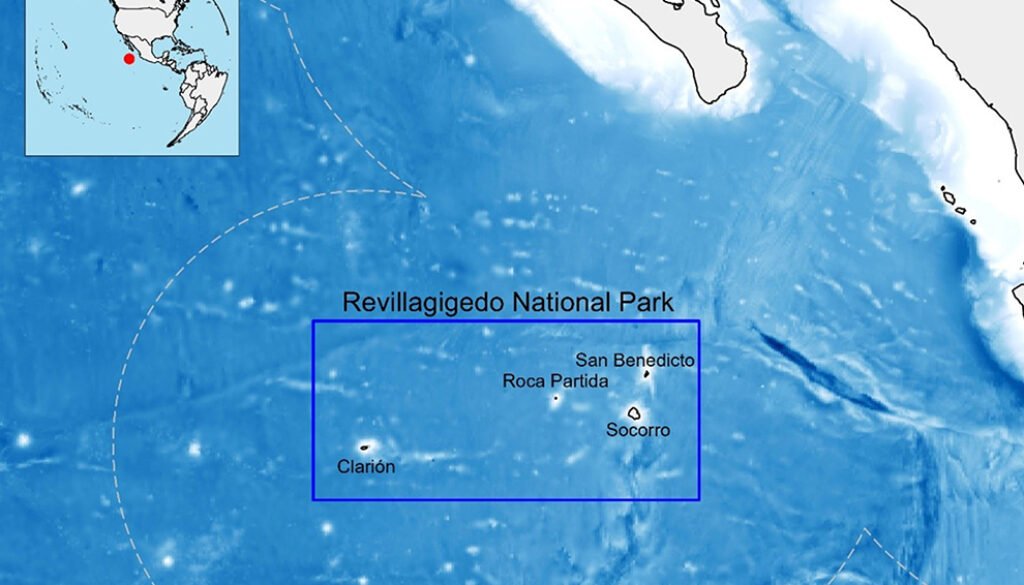
The Revillagigedo Archipelago comprises 4 small volcanic islands situated southwest of the tip of the Baja California peninsula, with the closest island, San Benedicto, 406 km from the tip of Baja and the farthest, Clarion, 700 km from Baja. Three of the islands (Socorro, San Benedicto, and Roca Partida) are relatively close together (50-140 km apart) on the eastern side of the archipelago and are well separated from Clarion Island, the westernmost island, by distances ranging from 290 to 430 km. These islands are the base of the Revillagigedo National Park (the RNP), a rectangular 148,000 km2 marine park bounded by latitudes 17.655° to 20.009° N and longitudes -110.078° to -115.471° W. That reserve encompasses the Revillagigedo archipelago and a surrounding area of 6,400 km2 of deep sea, which is imbedded in a 142,000 km2 buffer zone (Fig. 1). The 4 islands are relatively small, ranging from < 1 ha. for Roca Partida to ~ 130 km2 for Socorro. Marine habitats consist mainly of rocky shorelines plus some soft bottoms, which drop rapidly off into deep water, intertidal rock pools and a few sheltered bays on Socorro and Clarion that have sandy beaches, with 1 on Socorro having a marine lagoon behind it. Reefs of the RNP islands are predominately rocky (Ramírez-Zúñiga et al., 2025), although scattered coral colonies and communities are common.
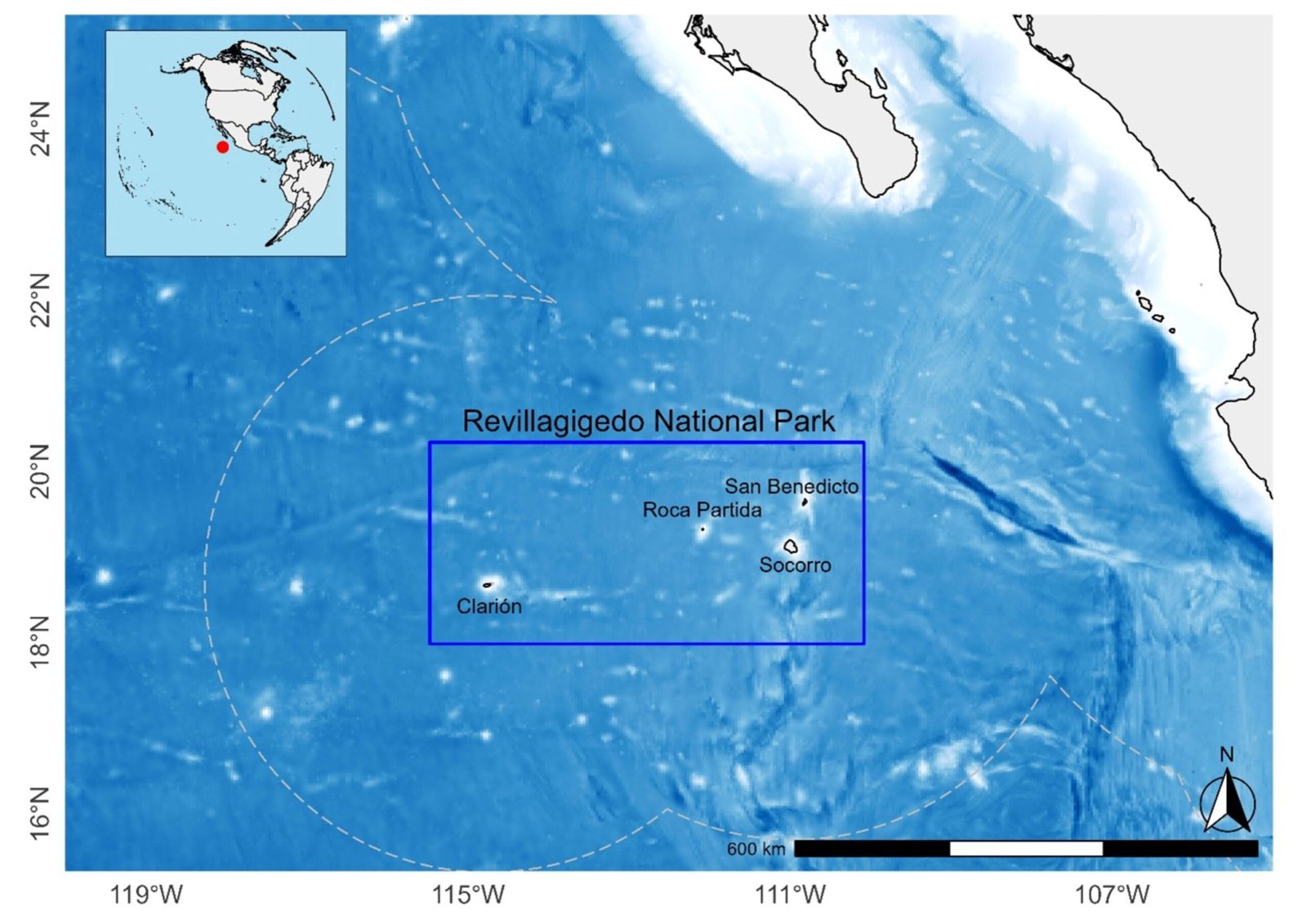
Here we follow the family and genus level classification of fishes as indicated in Eschmeyer’s Catalog of Fishes (Fricke et al., 2026).
Reef-associated fishes
Coral and rocky reefs down to depths of ~ 250 m have reef-fish faunas dominated by members of families of bony fishes found associated with shallow reefs (Baldwin et al., 2018). The inventory presented here focuses on species belonging to such families because those are what are traditionally considered to be reef fishes. Reef-associated fishes include not only demersal and benthic species that live in or on consolidated hard substrata (coral- and rocky reefs) but also demersal and benthic species that are restricted to unconsolidated or soft bottoms (sand, mud, and gravel) immediately adjacent to or within the matrices of reefs. Reef-associated fishes also include pelagic species that live in the water column, facultatively associate with reefs, are regularly seen over and immediately adjacent to them, and have trophic interactions with organisms on reefs. Those trophic interactions can include contributing food to reefs (e.g., material removed from the skin of large pelagics by reef fishes, e.g., Mobula birostris in the RNP (Clarión Angelfish & Manta) or Mola alexandrini at the western Galápagos (Bodianus & Mola) or extracting food from them (e.g., Carcharhinus falciformis and Thunnus albacares preying on juvenile Elagatis bipinnulata on reef at Cocos Is.; Auster et al., 2016). This definition follows Cord et al. (2024) and Robertson (2024).
The inventory presented here, which includes both bony fishes and elasmobranchs, is based on a wider range of species than those classed as reef fishes by Fourriére et al. (2016), who split the fauna into reef fishes and non- reef fishes, with the latter group including many pelagic and soft-bottom fishes that we class as reef-associated (see Robertson [2024] for a list of Tropical Eastern Pacific (TEP) reef-associated bony-fish species), as well as deep-water species belonging to non-reef families. The inventory of Del Moral-Flores et al. (2016) did not consider reef-associated fishes as a separate group.
Categories of species evaluated
The categories are: i) Confirmed/accepted species: species confirmed as part of the RNP fauna comprise those with positive identifications from 1 or more primary sources (see below). Accepted species also include a few common, widely distributed TEP species with distinctive morphological features that make them readily recognizable to divers and that were observed at 1 or more islands by a coauthor of this paper or in existing published professional ichthyological studies. They also include settlement-stage juveniles of benthic and demersal reef-associated species that were collected at a night-light while the ship was anchored immediately adjacent to the 3 largest islands during the 2022 expedition. ii) Unaccepted species: such species lack any identifiable support from primary sources that would confirm their presence in the RNP. They include misidentified museum specimens reassessed as such by museum curators, museum specimens that are too small or in such poor condition as to be unidentifiable to species, those with inadequate or erroneous location data, those whose occurrence is based on museum specimens that have been all lost and demersal/benthic species recorded as present based on specimens of pelagic larvae collected well offshore rather than benthic or settlement stage individuals. iii) Unresolved species: these include species that have been recorded at and plausibly could occur in the RNP, based on their geographic ranges, and occurrence at other TEP offshore islands, but currently lack adequate primary source data that verify their records. They also include species recorded as observed in previous studies that might have been confused with other visually similar species confirmed as present in the RNP.
Residency status
We regard a reef-associated species as being a resident in the RNP if there is evidence of long-term, persistent occurrence or an extant breeding population at 1 or more of the 4 islands. That evidence includes multiple observations of adults and, especially, juveniles at 1 or more of those islands during the 2022 expedition, repeated collections of multiple individuals over many years, multiple vouchered records at 1 or more islands over multiple recent years of ecologically non-cryptic species and recent images from iNaturalist and other sources at those islands. We used the yardstick of “multiple occurrences at multiple islands and/or multiple, well separated years, particularly if there are records since 2000”. This leaves a group we class as uncertain residents. These mainly include a few species that have a single, usually old record in the RNP and that lack recent records due to sampling difficulties may have led to their abundance being underestimated. Among them are some cryptic species, such as ophichthid eels and flatfish that bury in soft bottoms or live deep inside crevices (bythitids) that are normally effectively sampled only with ichthyocides. They also include species typically found below normal scuba depths (e.g., some congrids, tilefishes, serranids, scorpionfishes, and bythitids), that are less likely to have been sampled. Some may eventually be shown to be residents, while others may be vagrants. Non-residents or vagrants: species that do not fit either of the above categories and that have sufficiently few records that they likely represent species that occasionally recruit to the RNP but do not establish a breeding population there. They mainly include demersal, readily visible species living in shallow water, that, if they were residents, would be expected to be recorded repeatedly, in substantial numbers, over multiple years.
Endemics and the rate of endemism
Endemics are species that have a resident population only in the RNP. They include some species known from the mainland or other islands in small enough numbers to lack self-sustaining populations outside the RNP. Genetic evidence of endemism includes RNP populations composed entirely of local haplogroups or almost entirely when there are vagrant individuals at other sites, while non-endemics have substantial amounts of shared haplogroups with other sites, on the mainland and other TEP oceanic islands.
Levels of endemism frequently are measured as the percentage of the total number of species known from a location that are endemics, because those are the only data available. Examples for TEP fishes include Briggs (1974), Briggs and Bowen (2013), Del Moral-Flores et al. (2016), and Fourriére et al. (2014, 2016, 2017). In their discussion of geographic patterns of endemism among shore-fishes of the TEP, Robertson and Cramer (2009) considered endemism in relation to numbers of regional residents and excluded regional vagrants (c.f., Pinheiro et al., 2018). However, they did not consider more localized (provincial or island) endemism in relation to site residency and used the percentage of all species present at each site because residency information was not available for most oceanic islands. McCosker and Rosenblatt (2010) assessed the rate of endemism among Galápagos fishes in relation to local (Galápagos) residency, excluding local vagrants, while Victor, Grove et al. (2024) assessed it both in relation to the total fauna and to residents. If endemism is related to the total local fauna its rate will gradually decline through time as new vagrants appear at a site, even though the number of resident species may remain constant. Vagrants also have quantitatively negligible and temporary influence within local ecosystems, on resident populations or on the evolution of endemic populations. Hence, here we also focus on residents in calculating the rate of endemism for RNP reef-associated fishes.
Data sources
Primary sources used here comprise various types of sources that provide species-level data relating to occurrence of fishes within the RNP that we were able to assess for validity. They include information on specimen records in museum databases and online aggregators of such data, scientific publications by professional ichthyologists that recorded species during fieldwork within the RNP and taxonomic publications that involved examination of museum specimens from the RNP. They also include taxonomically diagnostic images of species taken in the RNP, including images taken by the authors and by visitors to the archipelago that are hosted by iNaturalist. Those sources also include DNA sequence data obtained from collections in the archipelago by some of this paper’s coauthors. The present paper is based on information from primary sources, which include 2 previous comprehensive inventories, by Del Moral-Flores et al. (2016) and Fourriére et al. (2016) — collectively referred to as the “two 2016 inventories”— both of which listed museum data for individual species. Del Moral-Flores et al. (2016) also listed which islands each species had records from, while Fourriére et al. (2016) recorded observations of species in different years, without indicating species occurrences at individual islands in the archipelago. Del Moral-Flores et al. (2016) referred to collections from 4 Mexican museums and 11 museums in other countries and mentioned the physical review of museum specimens. However, besides including a figure of images of 10 common species from 2 museum collections, the Colección Nacional de Peces, IBUNAM (CNPE-IBUNAM) in Mexico and the Natural History Museum of Los Angeles County (LACM) in the USA, that paper does not indicate which other specimens from which museums were examined for verification. Fourriére et al. (2016) reported no examination of any museum specimens.
We used several types of data to vouch for (i.e., validate) the occurrence of different species at different islands in the RNP. i) Taxonomically diagnostic images and specimens obtained during the 2022 expedition. The November 2022 expedition visited all 4 islands on a liveaboard diving support ship, the Quino El Guardián (see Estape, 2023). ii) Taxonomically diagnostic iNaturalist images. Images of fishes taken by citizen scientists available on the iNaturalist website (iNaturalist) that we reviewed and confirmed the identification of provided voucher information about occurrences of species at different islands in different years. iii) Universidad Michoacana Team collecting efforts between 2015-2023 and genetic analyses of RNP fish populations. Groups of ichthyological students from the Universidad Michoacana (UMSNH) laboratory of coauthor ODD made 4 collecting trips (2015, 2016, 2019 and 2023) to Clarion, San Benedicto and Socorro, collecting as many species as possible, particularly those found in tide pools. That collecting by ODD’s laboratory has led to genetic evaluations of the relationships of RNP populations to those on the mainland and other oceanic islands in the TEP, information that we draw on here. In addition, coauthor AAB made a series of visits to various parts of the archipelago in between 2012, 2013, 2014, 2017, 2019, 2022, 2023, 2024 and 2025, where he recorded species he observed while diving at different islands and, in some cases, took underwater videos of unusual species, from which screen captures provide island-specific voucher images used here. iv) UABCS, La Paz efforts between 2016 and 2025. Coauthor CS-O participated in an expedition to the archipelago during 2016 that resulted in a technical report (Aburto-Oropeza et al., 2016) based largely on several thousand hours of videos recorded by BRUVS (Baited Remote Underwater Video Systems). That report provided voucher data for a review of the occurrences of elasmobranchs and chimaeras in the RNP by Becerril-Garcia et al. (2020), which we regard as a primary-source curated inventory. Those videos also produced voucher images of deep- living bony reef fishes species included here. Monitoring reef-fish populations in the RNP by CS-O’s UABCS-La Paz team also produced the most recent record of a new member of the RNP reef-associated fish fauna, in June 2025. v) Reassessment of museum specimens. These were made in cases where no other primary sources of data confirmed the presence of a species in the RNP. In such cases fish curators at various museums examined specimens of particular species to verify their identities. Associated collection-site metadata was also reviewed to verify whether they were collected in the RNP. That information came from a combination of aggregators, including GBIF, OBIS, Conabio (Comisión Nacional para el Conocimiento y Uso de la Biodiversidad), Fishnet2, Vertnet, and iDigBio. In addition, the online databases of museums that supplied data to those aggregators were reviewed because no aggregator provides all the data currently available in individual museum databases that feed data to that aggregator. Museum name codes follow Sabaj (2023). Those museums are: ANSP (Academy of Natural Sciences, Philadelphia), AMNH (American Museum of Natural History), CAS (California Academy of Sciences, San Francisco), CMNFI (the Canadian Museum of Nature), CNPE (Colección Nacional de Peces, IBUNAM, Mexico), CPUM (Colección de Peces de la Universidad Michoacana de San Nicolás de Hidalgo, Morelia), CSLB (California State University, Long Beach, Fish specimens), CUMV (Cornell University Museum of Vertebrates, Ithaca), FMNH (Field Museum of Natural History, Chicago, Zoology Fish Collection), LACM (Natural History Museum of Los Angeles County), MCZ (Museum of Comparative Zoology, Cambridge), NHMUK (Natural History Museum, London), ROM (Royal Ontario Museum, Toronto), SIO (Scripps Institution of Oceanography, San Diego), UBC (University of British Columbia, Beaty Biodiversity Museum; which has too many errors to represent a very reliable source), UF (University of Florida, Florida Museum of Natural History, Ichthyology), UMMZ (University of Michigan Museum of Zoology), USNM (National Museum of Natural History, Smithsonian Institution, Washington DC). In cases where questionable specimens of a particular species were lodged at multiple museums, specimens from only 1 museum typically were reviewed. If the identity in that database was confirmed, we assumed correct identifications of specimens at any other museums, since the object of these reviews was to verify occurrence in the RNP. In situations in which misidentifications or erroneous location data were detected in the first case reviewed, specimens and collection data from another museum were examined, if available. vi) IATTC geographic distribution data of species caught in the international tuna fishery. We also used public domain location records of pelagic species caught in the TEP by the international tuna fishery and recorded by observers of the Inter-American Tropical Tuna Commission (IATTC) to help determine which of those species that are reef-associated are found in the RNP. vii) Genetic analyses of 2022 expedition specimens. We used these to confirm identifications of certain species and to provide data on evolutionary relationships of RNP populations with those on other TEP oceanic islands and the mainland. viii) UNESCO eDNA data. In 2023 a UNESCO sponsored eDNA sampling of water at a total of 21 stations adjacent to all 4 islands. The data on species-level assignments and location of ASV reads of 3 mitochondrial genes, cytochrome oxidase-1 (CO1), 12S and 16S for each species are located at a UNESCO site (UNESCO eDNA) and at OBIS (OBIS-UNESCO eDNA). We reviewed those data and used them to add a few species to the RNP confirmation-required group of-species that had not previously been recorded there and expanded the base of voucher data on some other species that had other existing forms of voucher data. Three species that lack other forms of voucher data have CO1 species-name assignments at the 100% confidence level, as well, in some cases, 16S reads with name assignments with 100% confidence. Given problems in name assignment due to misidentification of reference sequences in GenBank and limitations on the ability of 12S and 16S to reliably distinguish between congeners (Fontes et al., 2024), we added only species in cases in which misidentifications or confusion with other members of the same genus are unlikely, e.g., monospecific families or genera, when a species was the sole member of its genus in the TEP or when all other congeners present in the TEP were also included in the eDNA database. Other eDNA data, again mostly CO1, with 100% confidence species-name assignments, provided additional information on the occurrence and distribution in the RNP of 14 other species already confirmed by other voucher data. ix) Video surveys of deep-living fishes. There have been a few studies of deep-reef fishes in the RNP fauna based on videos collected by dropcams (Giddens et al., 2019), a small ROV (Remotely Operated Vehicle) operated at 30-90 m depth of both reef and adjacent sand habitat (Hollarsmith et al., 2020; Velasco-Lozano et al., 2020) and a submersible (Ayala-Bocos et al., 2015). These have provided useful information through voucher images of identifiable species at different RNP islands and information on mesophotic reef-fish abundances. However, much of the video databases produced by Aburto-Oropeza et al. (2016) and Ayala-Bocos et al. (2015) have yet to be reviewed and may in the future produce confirmation of additional species not mentioned here, as well as information that could help clarify the population status of some species already confirmed from the RNP.
Secondary sources are those that do not provide species-level data linked directly to a primary source, e.g., a georeferenced location from a museum record, or an image or indication from which island(s) in the RNP a species was recorded. Secondary sources include grey literature and government reports about the RNP that include lists of fish species. They also include some ichthyological publications that produce species lists based on data recycled from other published sources and do not individually link listed species to primary sources or to particular islands, e.g., Castro-Aguirre and Balart (2002) and Conanp (2019) and the governmental reports derived from those. The RNP species list used by Torres- García et al. (2025) to examine variation in taxonomic and functional diversity of fishes among various Mexican Pacific reefs also does not include primary-source data, does not refer to either the 2002 or 2016 checklists and appears to have used lists from government reports that recycle secondary data. Hence this paper is treated as an unusable secondary source. Other secondary sources also include digital resources by Robertson and Allen (2006, 2015) for which no primary-source information could be found in 2025 on some RNP location records. Hence, such secondary data cannot be reassessed if the basis for inclusion of each species on an inventory is unclear and such data are not relied upon here.
Results
Accepted species
We assessed the quality of existing primary-source records relating to 364 species included in various RNP databases and added new data (specimens of 132 species and images of 182 species) that confirm species occurrences at the different islands and assist estimation of their population status. Acceptance was based on a variety of factors. While reliable images demonstrated occurrences of many species, most also had other forms of supporting data. Re-examination of specimens of 46 species from 8 museums confirmed their identifications and location data, including 30 species lacking other forms of voucher data. Re-examination of museum specimens also corrected misidentifications of specimens of 12 other species, providing additional data relating to their status as RNP residents (Table 2). The resultant inventory includes 234 accepted species occurrences (including 19 not in both 2016 inventories and another 5 not in one of them), from 165 (80.5%) of the 205 assessed genera and 66 (81.5%) of the 81 assessed families (Tables 1, Supplementary material: Table S1). Among the confirmed species, 166-189 (70.9-80.8%) have sufficient records to be regarded as archipelago residents. That proportion may well increase when more information becomes available on non-resident and “residency uncertain” species.
| Family | Resident | Species | Clarion | Roca Partida | San Benedicto | Socorro | Fourr. accepted | DMF accepted | Supporting data |
|---|---|---|---|---|---|---|---|---|---|
| Acanthuridae | yes | Acanthurus nigricans | Yes | Yes | Yes | Yes | Yes | Yes | Museums (7); inat; observe; 2022- images, specimens, common |
| Acanthuridae | yes | Acanthurus triostegus | Yes | Yes | Yes | Yes | Yes | Yes | Museums (9); inat; observe; 2022- images, specimens, schools |
| Acanthuridae | yes | Acanthurus xanthopterus | Yes | Yes | Yes | Yes | Yes | Yes | Museum (1); inat; observe; 2022- images, singletons |
| Acanthuridae | uncertain | Ctenochaetus marginatus | Yes | Yes | Yes | Yes | Yes | Museum (1); inat; observe; 2022- images, singletons | |
| Acanthuridae | yes | Prionurus laticlavius | Yes | Yes | Yes | Yes | Yes | Yes | Museums (7); inat; pubs; 2022- specimens, images, common |
| Alosidae | no | Sardinops sagax | Yes | (Yes) | Yes | Museum* (1) | |||
| Antennariidae | yes | Abantennarius sanguineus | Yes | Yes | Yes | Yes | Yes | Museums (4); eDNA; 2022- images, specimens, DNA | |
| Antennariidae | no | Antennarius commerson | Yes | Yes | Yes | 2022- specimen, image | |||
| Antennariidae | no | Antennatus strigatus | Yes | Yes | Yes | Museum* (1), image | |||
| Antennariidae | yes | Fowlerichthys avalonis | Yes | Yes | Museum (1); pub; images | ||||
| Anthiadidae | yes | Pronotogrammus multifasciatus | Yes | Yes | Yes | Yes | Museum (1); eDNA | ||
| Apogonidae | yes | Apogon atricaudus | Yes | Yes | Yes | Yes | Yes | Museums (6); inat; pubs; 2022- specimens, images, common | |
| Apogonidae | no | Apogon retrosella | Yes | Yes | Yes | 2022- specimen, image, DNA | |||
| Atherinopsidae | yes | Atherinella eriarcha | Yes | Yes | Yes | Yes | Yes | Museums (4); inat; pubs; 2022- specimens, DNA, common | |
| Aulostomidae | yes | Aulostomus chinensis | Yes | Yes | Yes | Yes | Yes | Yes | Museums (4); inat; observe; 2022- images |
| Balistidae | yes | Balistes polylepis | Yes | Yes | Yes | Yes | Yes | Yes | Museums (5); inat; pubs; observe; 2022- images |
| Balistidae | uncertain | Canthidermis maculata# | Yes | Yes | Yes | Yes | Museum* (2); pub | ||
| Balistidae | yes | Melichthys niger | Yes | Yes | Yes | Yes | Yes | Yes | Museums (7); pubs; inat; observe; 2022- images, specimens, common |
| Balistidae | yes | Sufflamen verres# | Yes | Yes | Yes | Yes | Yes | Yes | Museums* (7); pubs; inat; observe; 2022- images, specimens, common |
| Balistidae | yes | Xanthichthys mento | Yes | Yes | Yes | Yes | Yes | Yes | Museums* (8); pubs; inat; observe; 2022- images, specimens, common |
| Belonidae | yes | Ablennes hians# | Yes | Yes | Yes | (Yes) | Yes | Observe; eDNA | |
| Belonidae | yes | Platybelone pterura | Yes | Yes | Yes | (Yes) | Yes | Museums* (5); pubs; eDNA | |
| Belonidae | uncertain | Tylosurus fodiator# | Yes | Yes | Yes | Yes | Yes | Museums (2); inat; eDNA | |
| Belonidae | yes | Tylosurus melanotus# | Yes | Yes | Yes | Yes | Yes | Museums* (2); eDNA | |
| Blenniidae | yes | Entomacrodus chiostictus | Yes | Yes | Yes | Yes | Yes | Yes | Museums (5); inat; pubs; 2022- images, specimens |
| Blenniidae | yes | Hypsoblennius proteus | Yes | Yes | Yes | Yes | Yes | Yes | Museums (7); pubs; inat; 2022- images, specimens |
| Blenniidae | yes | Ophioblennius clippertonensis# | Yes | Yes | Yes | Yes | Museum (1); inat?; DNA; 2022- images, specimens, DNA | ||
| Blenniidae | yes | Ophioblennius steindachneri# | Yes | Yes | Yes | Yes | Yes | Yes | Museums (6); inat?; pubs; 2022- images, specimens |
| Blenniidae | yes | Plagiotremus azaleus | Yes | Yes | Yes | Yes | Yes | Yes | Museums (3); observe; 2022- images |
| Bothidae | yes | Bothus leopardinus | Yes | Yes | Yes | Yes | Yes | Museums (3); pubs; inat; 2022- images, specimen | |
| Bothidae | yes | Bothus mancus | Yes | Yes | Yes | Yes | Yes | Yes | Museums (2); observe; pubs; inat; 2022- images, specimen |
| Bythitidae | yes | Grammonus diagrammus# | Yes | Yes | Yes | Museums* (2) | |||
| Carangidae | no | Alectis ciliaris# | Yes | Yes | Yes | Museum* (1); images | |||
| Carangidae | uncertain | Caranx caballus# | Yes | Yes | Yes | Yes | (Yes) | Yes | Museums (4); observe; inat singleton, small group; 2022- images, singletons |
| Carangidae | no | Caranx caninus# | Yes | Yes | (Yes) | Yes | observe | ||
| Carangidae | yes | Caranx lugubris | Yes | Yes | Yes | Yes | Yes | Yes | Museums (7); inat; observe; pubs; 2022- images, common |
| Carangidae | yes | Caranx melampygus | Yes | Yes | Yes | Yes | Yes | Yes | Museums (6); observe; inat; pubs; 2022- images, common |
| Carangidae | yes | Caranx sexfasciatus | Yes | Yes | Yes | Yes | Yes | Yes | Museums (6); inat; observe; pubs; 2022- images, schools |
| Carangidae | yes | Decapterus macarellus | Yes | Yes | Yes | Yes | (Yes) | Yes | Museums (4); inat; 2022- images, large schools |
| Carangidae | yes | Decapterus muroadsi | Yes | Yes | Yes | Yes | (Yes) | Yes | Museums* (5); pub |
| Carangidae | yes | Elagatis bipinnulata | Yes | Yes | Yes | Yes | Yes | Yes | Museums (2); inat; pub; observe; 2022- images, common |
| Carangidae | yes | Ferdauia orthogrammus | Yes | Yes | Yes | Yes | Yes | Yes | Museums (5); inat; observe; pub; 2022- images, small schools |
| Carangidae | yes | Naucrates ductor | Yes | Yes | Yes | Yes | (Yes) | Yes | Museum (1); observe; inat |
| Carangidae | yes | Selar crumenophthalmus | Yes | Yes | (Yes) | Yes | Museums* (4); pubs | ||
| Carangidae | no | Selene peruviana# | Yes | (Yes) | Museums* (2) | ||||
| Carangidae | no | Seriola dorsalis# | Yes | Yes | Yes | Yes | Yes | Four: observe; eDNA | |
| Carangidae | yes | Seriola rivoliana | Yes | Yes | Yes | Yes | (Yes) | Yes | Museums (5); pubs; inat; 2022- observe, image |
| Carangidae | yes | Trachinotus stilbe | Yes | Yes | Yes | Yes | Yes | Yes | Museums (6); pubs; inat; observe; 2022- images, schools |
| Carangidae | no | Trachurus symmetricus | Yes | (Yes) | Yes | Pub | |||
| Carangidae | yes | Uraspis helvola | Yes | Yes | Yes | Yes | (Yes) | Yes | Museums (3); inat; 2022- images, schools |
| Carcharhinidae | no | Carcharhinus altimus | Yes | (Yes) | Yes | Museum*(1) | |||
| Carcharhinidae | yes | Carcharhinus albimarginatus | Yes | Yes | Yes | Yes | Yes | Yes | Museums (3); observe; inat; pubs; 2022- images, common |
| Carcharhinidae | yes | Carcharhinus falciformis | Yes | Yes | Yes | Yes | (Yes) | Yes | Museum* (1); pubs; inat; observe; 2022- images, common |
| Carcharhinidae | yes | Carcharhinus galapagensis | Yes | Yes | Yes | Yes | Yes | Yes | Museums (5); observe; inat; pubs; 2022- images, common |
| Carcharhinidae | yes | Carcharhinus limbatus | Yes | Yes | Yes | Yes | Yes | Museums (3); observe; pubs; inat | |
| Carcharhinidae | uncertain | Carcharhinus obscurus | Yes | Yes | Yes | Yes | Pubs; capture; observe | ||
| Carcharhinidae | no | Nasolamia velox | Yes | Yes | Yes | (Yes) | Yes | Pub; capture | |
| Carcharhinidae | yes | Triaenodon obesus | Yes | Yes | Yes | Yes | Yes | Yes | Pubs; observe; inat; 2022- Images, common: |
| Chaenopsidae | yes | Acanthemblemaria mangognatha | Yes | Yes | Yes | Yes | Yes | Museums* (6); pub; 2022- images, specimens, common | |
| Chaenopsidae | uncertain | Chaenopsis alepidota# | Yes | 2022- image | |||||
| Chaetodontidae | no | Chaetodon humeralis# | Yes | Yes | Yes | Yes | Museums (2); pub; inat | ||
| Chaetodontidae | yes | Forcipiger flavissimus# | Yes | Yes | Yes | Yes | Yes | Yes | Museums* (8); pubs; inat; observe; 2022- images, specimens |
| Chaetodontidae | yes | Johnrandallia nigrirostris | Yes | Yes | Yes | Yes | Yes | Yes | Museums (6); observe; inat; pubs; 2022- images, common |
| Chaetodontidae | yes | Prognathodes falcifer# | Yes | Yes | Yes | Yes | Yes | Yes | Pub; observe; images, common |
| Cirrhitidae | yes | Cirrhitichthys oxycephalus | Yes | Yes | Yes | Yes | Yes | Yes | Museums (4); pub; observe; inat; 2022- images, specimens, common |
| Cirrhitidae | yes | Cirrhitus rivulatus | Yes | Yes | Yes | Yes | Yes | Yes | Museums (8); inat; pubs; 2022- images, specimens, common |
| Congridae | yes | Paraconger californiensis | Yes | Yes | Yes | Yes | Yes | Museums* (2) | |
| Congridae | uncertain | Paraconger similis | Yes | Yes | Yes | Museum* (1) | |||
| Cyclopsettidae | uncertain | Citharichthys sp. | Yes | Image | |||||
| Cyclopsettidae | no | Syacium ovale | Yes | (Yes) | Yes | Museum* (1) | |||
| Cynoglossidae | uncertain | Symphurus atramentatus | Yes | (Yes) | Yes | Museum* (1) | |||
| Dactyloscopidae | yes | Dactyloscopus insulatus | Yes | Yes | Yes | Yes | Yes | Museums (4); pub; 2022- image, specimen, DNA | |
| Dactyloscopidae | yes | Gillellus semicinctus | Yes | Yes | Yes | Yes | Museums (2); image; 2022- specimens, DNA | ||
| Dactyloscopidae | yes | Myxodagnus opercularis# | Yes | Yes | Yes | Yes | Museums* (3); 2022- specimen, DNA | ||
| Dasyatidae | no | Hypanus dipterurus# | Yes | Yes | Yes | Yes | Museum (1); pub; image | ||
| Dasyatidae | yes | Hypanus longus# | Yes | Yes | Yes | Yes | Yes | Museums (2); pub; inat; observe; 2022- images | |
| Diodontidae | yes | Chilomycterus reticulatus | Yes | Yes | Yes | Yes | Yes | Yes | Museums (2); inat; observe; 2022- images |
| Diodontidae | yes | Diodon holocanthus | Yes | Yes | Yes | Yes | Yes | Yes | Museums (7); observe; inat; pub; 2022- images, specimens |
| Diodontidae | yes | Diodon hystrix | Yes | Yes | Yes | Yes | Yes | Yes | Museums (4); pubs; observe; 2022- images |
| Echeneidae | uncertain | Echeneis naucrates | Yes | Yes | Yes | Museum | |||
| Echeneidae | yes | Phtheirichthys lineatus | Yes | (Yes) | Yes | Museums* (3) | |||
| Echeneidae | yes | Remora remora | Yes | Yes | Yes | Yes | (Yes) | Yes | Museums (4); inat; pubs; observe; 2022- images |
| Ephippidae | no | Platax teira | Yes | Yes | Images: 2025(2, 1 from inat) | ||||
| Epinephelidae | yes | Alphestes immaculatus | Yes | Yes | Yes | Yes | Yes | Yes | Museums (2); inat; observe; 2022- images, specimens |
| Epinephelidae | yes | Cephalopholis colonus | Yes | Yes | Yes | Yes | Yes | Yes | Museums (7); inat; observe; pubs; 2022- images, specimens, common |
| Epinephelidae | yes | Cephalopholis panamensis | Yes | Yes | Yes | Yes | Yes | Yes | Museums (4); inat; observe; pubs; 2022- images, specimens, common |
| Epinephelidae | yes | Dermatolepis dermatolepis | Yes | Yes | Yes | Yes | Yes | Yes | Museums (2); pubs; inat; 2022- images, specimen |
| Epinephelidae | no | Epinephelus analogus# | Yes | Yes | Yes | Museum* (1); pubs | |||
| Epinephelidae | yes | Epinephelus clippertonensis# | Yes | Yes | Yes | Yes | Yes | Yes | Museums (2); inat; DNA; 2022- images, common |
| Epinephelidae | yes | Epinephelus labriformis# | Yes | Yes | Yes | Yes | Yes | Yes | Museums* (5); inat; DNA; 2022- images, uncommon |
| Epinephelidae | yes | Hyporthodus cifuentesi# | Yes | Yes | Yes | Yes | Yes | Yes | Museum (1); pubs; images |
| Fistulariidae | yes | Fistularia commersonii | Yes | Yes | Yes | Yes | Yes | Yes | Museums* (3); pubs; inat; observe; 2022- images |
| Fistulariidae | uncertain | Fistularia corneta | Yes | Yes | Yes | Yes | Yes | Museums* (2) | |
| Galeocerdonidae | yes | Galeocerdo cuvier | Yes | Yes | Yes | Yes | Yes | Yes | Museums (2); pubs; observe; inat; 2022- images |
| Gobiesocidae | yes | Gobiesox canidens# | Yes | Yes | Yes | Yes | Yes | Museums (3); pubs; DNA; inat; 2022- images, specimens, DNA | |
| Gobiesocidae | yes | Tomicodon absitus# | Yes | Yes | Yes | Yes | Yes | Museums (3); pubs; inat; DNA; 2022- images, specimens, DNA | |
| Gobiesocidae | yes | Tomicodon sp.# | Yes | Museum (1); DNA; 2022- images, specimens | |||||
| Gobiesocidae | no | Tomicodon petersii | Yes | Yes | Museum* (1); pub | ||||
| Gobiidae | yes | Bathygobius ramosus longipinnis# | Yes | Yes | Yes | Yes | Museums* (5); pubs; inat; DNA | ||
| Gobiidae | yes | Chriolepis sp.# | Yes | Yes | Museums (3); 2022- images, specimens, DNA | ||||
| Gobiidae | yes | Coryphopterus urospilus# | Yes | Yes | Yes | Yes | Yes | Museums (3); pub; DNA; 2022- images, specimens, DNA | |
| Gobiidae | yes | Lythrypnus cf. dalli# | Yes | 2022- images, specimens, DNA | |||||
| Gobiidae | yes | Lythrypnus insularis# | Yes | Yes | Yes | Yes | Yes | Museums (5); pub; 2022- images, specimens, DNA | |
| Gobiidae | yes | Schindleria praematura | Yes | Yes | Yes | Yes | Museums (5); eDNA 2022- specimen, DNA | ||
| Grammistidae | yes | Pseudogramma thaumasia | Yes | Yes | Yes | Yes | Yes | Yes | Museums (3); 2022- image, specimens |
| Grammistidae | yes | Rypticus courtenayi# | Yes | Yes | Yes | Yes | Yes | Yes | Museums* (7); DNA; inat; pubs; 2022- images, specimens, DNA |
| Grammistidae | no | Rypticus nigripinnis# | Yes | Yes | Yes | Museum* (1) | |||
| Haemulidae | yes | Anisotremus perezponcedeleoni# | Yes | Yes | Yes | Yes | Yes | Yes | Museums (6); DNA; pubs; inat; 2022- images, specimens |
| Haemulidae | no | Anisotremus taeniatus# | Yes | Yes | Yes | Observe | |||
| Haemulidae | no | Orthopristis cantharina# | Yes | Image | |||||
| Hemiramphidae | uncertain | Hemiramphus saltator# | Yes | (Yes) | Yes | Inat | |||
| Holocentridae | yes | Myripristis berndti | Yes | Yes | Yes | Yes | Yes | Yes | Museum (1); inat; 2022- images, specimens |
| Holocentridae | yes | Myripristis clarionensis# | Yes | Yes | Yes | Yes | Yes | Yes | Museums (9); inat; pubs; 2022- images, specimens, common |
| Holocentridae | no | Myripristis leiognathus# | Yes | Yes | Yes | Yes | Museum* (1); pub; 2022- specimen, image | ||
| Holocentridae | yes | Neoniphon suborbitalis | Yes | Yes | Yes | Yes | Yes | Yes | Museum (5); pubs; 2022- images, specimens |
| Holocentridae | yes | Plectrypops lima | Yes | Yes | Yes | Yes | Museum (1); 2022- image, specimen | ||
| Kuhliidae | yes | Kuhlia mugil | Yes | Yes | Yes | Yes | Yes | Museums (8); pubs; inat; 2022- images, specimens, DNA, schools | |
| Kyphosidae | yes | Kyphosus elegans | Yes | Yes | Yes | Yes | Yes | Yes | Museums (4); pub, observe; inat; 2022- images, specimens, common |
| Kyphosidae | yes | Kyphosus ocyurus | Yes | Yes | Yes | Yes | Yes | Yes | Museums (2); observe; 2022- images, common |
| Kyphosidae | yes | Kyphosus sectatrix# | Yes | Yes | Yes | Yes | Yes | Yes | Museums (5); pubs; observe; inat; 2022- images, specimens, common |
| Kyphosidae | yes | Kyphosus vaigiensis | Yes | Yes | Yes | Yes | Yes | Yes | Museums (4); observe; inat; pub; 2022- image. specimens, observe |
| Labridae | yes | Bodianus diplotaenia | Yes | Yes | Yes | Yes | Yes | Yes | Museums (8); observe; pubs; inat; 2022- images, specimens, common |
| Labridae | uncertain | Halichoeres adustus# | Yes | Yes | Yes | Yes | Yes | Museums (2); inat; pubs; 2022- image, rare | |
| Labridae | yes | Halichoeres insularis# | Yes | Yes | Yes | Yes | Yes | Yes | Museums* (3); inat; observe; pubs; 2022- images, specimens, DNA |
| Labridae | yes | Halichoeres nicholsi# | Yes | Yes | Yes | Yes | Yes | Museums (7); pubs; inat; DNA; 2022- images, specimens, common | |
| Labridae | yes | Halichoeres notospilus | Yes | Yes | Yes | Yes | Museums (5); pubs; inat; 2022- images, observe | ||
| Labridae | yes | Halichoeres sanchezi# | Yes | Yes | 2022- images, specimens | ||||
| Labridae | uncertain | Iniistius pavo | Yes | Yes | Yes | Yes | Yes | Observe; 2022- images | |
| Labridae | yes | Novaculichthys taeniourus | Yes | Yes | Yes | Yes | Yes | Observe; inat; 2022- images, specimens | |
| Labridae | yes | Stethojulis bandanensis# | Yes | Yes | Yes | Yes | Yes | Museum (1); inat; eDNA; 2022- images, observe | |
| Labridae | yes | Thalassoma grammaticum# | Yes | Yes | Yes | Yes | Yes | Yes | Museums (8); pubs; observe, inat; 2022- images, specimens, common |
| Labridae | yes | Thalassoma lucasanum | Yes | Yes | Yes | Yes | Yes | Yes | Museums (5); inat; observe; pubs; 2022- images, common |
| Labridae | no | Thalassoma purpureum | Yes | 2022- image, single individual | |||||
| Labridae | yes | Thalassoma virens# | Yes | Yes | Yes | Yes | Yes | Yes | Museums (6); inat; pubs; observe; 2022- images |
| Labridae | yes | Xyrichtys sp.# | Yes | Yes | Yes | Yes | Images; observe, pub | ||
| (Scarinae) | yes | Calotomus carolinus | Yes | Yes | Yes | Yes | Yes | Yes | Museums* (6); inat; pubs; observe; 2022- images, specimens, common |
| (Scarinae) | no | Scarus compressus | Yes | Yes | Yes | Museum (3); pub; 2022- image | |||
| (Scarinae) | no | Scarus ghobban | Yes | Yes | Yes | Yes | Museum (1); pub; inat; observe; 2022- image | ||
| (Scarinae) | yes | Scarus rubroviolaceus | Yes | Yes | Yes | Yes | Yes | Yes | Museums (4); observe; pub; inat; 2022- images, specimens, DNA, common |
| Labrisomidae | yes | Labrisomus socorroensis# | Yes | Yes | Yes | Yes | Yes | Yes | Museums* (5); pubs; inat; 2022- image |
| Labrisomidae | no | Malacoctenus hubbsi | Yes | Museum* (1) | |||||
| Lamnidae | no | Carcharodon carcharias | Yes | Yes | Yes | Pub | |||
| Latilidae | uncertain | Caulolatilus affinis | Yes | Yes | Yes | Yes | Museum* (1) | ||
| Latilidae | uncertain | Caulolatilus princeps | Yes | Yes | Yes | Pub | |||
| Lobotidae | no | Lobotes pacifica | Yes | (Yes) | Yes | Museum* (1) | |||
| Lutjanidae | no | Hoplopagrus guentherii# | Yes | Yes | Yes | Pub | |||
| Lutjanidae | no | Lutjanus aratus | Yes | 2022- specimen; DNA | |||||
| Lutjanidae | no | Lutjanus argentiventris# | Yes | Yes | Yes | Yes | Yes | Pub; observe; image; 2022- image | |
| Lutjanidae | no | Lutjanus inermis# | Yes | Yes | Yes | Pub | |||
| Lutjanidae | yes | Lutjanus peru | Yes | Yes | Yes | Museum* (1); pub; image | |||
| Lutjanidae | yes | Lutjanus viridis | Yes | Yes | Yes | Yes | Yes | Yes | Museums (9); pubs; inat; 2022- images, specimens, common |
| Mobulidae | yes | Mobula birostris | Yes | Yes | Yes | Yes | (Yes) | Yes | Museum (1); pubs, inat, observe; 2022- images, common |
| Mobulidae | no | Mobula tarapacana# | Yes | Yes | Yes | (Yes) | Yes | Pub; observe; inat | |
| Mobulidae | no | Mobula thurstoni# | Yes | Yes | Yes | Image; eDNA; 2022- image | |||
| Monacanthidae | uncertain | Aluterus monoceros# | Yes | Yes | Yes | Yes | Yes | Museums (1); pub; observe; inat; 2022- images | |
| Monacanthidae | yes | Aluterus scriptus | Yes | Yes | Yes | Yes | Yes | Yes | Museums (5); pubs; inat; observe; 2022- images |
| Monacanthidae | yes | Cantherhines dumerilii | Yes | Yes | Yes | Yes | Yes | Yes | Museums (6); pubs; observe; inat; 2022- images, specimens |
| Mugilidae | yes | Chaenomugil proboscideus | Yes | Yes | Yes | Yes | Yes | Museums (9); pubs; inat; 2022- specimens, DNA | |
| Mugilidae | uncertain | Mugil cephalus# | Yes | Inat | |||||
| Mugilidae | yes | Mugil setosus# | Yes | Yes | Yes | Yes | Museums* (6), Image; pubs | ||
| Mullidae | yes | Mulloidichthys dentatus | Yes | Yes | Yes | Yes | Yes | Yes | Museums* (7); pubs; inat; observe; 2022- images, specimens |
| Muraenidae | yes | Anarchias galapagensis | Yes | Yes | Yes | Yes | Museums* (3) | ||
| Muraenidae | yes | Echidna nebulosa# | Yes | Yes | Yes | Yes | Yes | Museums (2); inat; 2022- images | |
| Muraenidae | yes | Echidna nocturna# | Yes | Yes | Yes | Yes | Yes | Museums (2); pubs; inat; 2022- observe | |
| Muraenidae | yes | Enchelycore octaviana | Yes | Yes | Yes | Yes | Yes | Yes | Museums (2); inat; observe; 2022- image, observe |
| Muraenidae | yes | Gymnomuraena zebra | Yes | Yes | Yes | Yes | Yes | Museum (1); pub; inat; observe; 2022- image | |
| Muraenidae | yes | Gymnothorax castaneus | Yes | Yes | Yes | Yes | Yes | Yes | Museums (3); inat; pub; observe; 2022- images |
| Muraenidae | yes | Gymnothorax dovii | Yes | Yes | Yes | Yes | Yes | Yes | Museums (2); pub; observe; inat; 2022- images |
| Muraenidae | no | Gymnothorax flavimarginatus# | Yes | Yes | Yes | Yes | Museum (1); eDNA; 2022- image | ||
| Muraenidae | yes | Gymnothorax panamensis | Yes | Yes | Yes | Yes | Yes | Yes | Museums (5); inat; pub; 2022- image, specimens, DNA |
| Muraenidae | no | Gymnothorax pictus | Yes | Yes | Yes | Museum* (1); pubs | |||
| Muraenidae | no | Gymnothorax verrilli | Yes | 2022- specimen, DNA | |||||
| Muraenidae | yes | Muraena lentiginosa | Yes | Yes | Yes | Yes | Yes | Museums (3); image; pubs; observe | |
| Muraenidae | yes | Scuticaria tigrina | Yes | Yes | Yes | Yes | Yes | Yes | Museums (3); pub; eDNA; 2022- images |
| Muraenidae | yes | Uropterygius macrocephalus | Yes | Yes | Yes | Yes | Museums* (5); Image; inat; pub; 2022- specimen, DNA | ||
| Narcinidae | yes | Diplobatis ommata | Yes | Yes | Pub; inat; 2022- observe | ||||
| Narcinidae | yes | Narcine entemedor | Yes | Yes | Yes | Yes | Yes | Museums (3); pubs; inat; 2022- images, observe | |
| Ophichthidae | yes | Ichthyapus selachops | Yes | Yes | Yes | Museum* (1); DNA | |||
| Ophichthidae | yes | Myrichthys pantostigmius# | Yes | Yes | Yes | Yes | Yes | Museum* (3); inat; pubs; 2022- images | |
| Ophichthidae | uncertain | Paraletharchus opercularis | Yes | Yes | Yes | Museum* (1) | |||
| Ophichthidae | yes | Quassiremus evionthas | Yes | Pub; images; 2022- image | |||||
| Ophidiidae | yes | Brotula ordwayi# | Yes | Yes | Yes | Yes | Museums* (2); image | ||
| Ostraciidae | yes | Lactoria diaphana | Yes | Yes | Yes | Yes | Yes | Museums* (3); inat; 2022- image, specimen | |
| Ostraciidae | yes | Ostracion meleagris | Yes | Yes | Yes | Yes | Yes | Yes | Museums (6); inat; pubs; 2022- images, specimens |
| Pomacanthidae | yes | Holacanthus clarionensis# | Yes | Yes | Yes | Yes | Yes | Yes | Museums (9); inat; pubs; 2022- images, specimens, common |
| Pomacanthidae | no | Holacanthus passer# | Yes | Yes | Yes | Yes | Yes | Yes | Museum (2); image |
| Pomacanthidae | no | Pomacanthus zonipectus | Yes | Yes | Yes | Museum* (1); observe | |||
| Pomacentridae | yes | Abudefduf troschelii | Yes | Yes | Yes | Yes | Yes | Museums (9); pubs; inat; 2022- images, specimens, common | |
| Pomacentridae | uncertain | Azurina atrilobata# | Yes | Yes | Yes | Yes | Yes | Yes | Museums (2); pubs, observe; 2022- image, specimen, DNA |
| Pomacentridae | yes | Azurina hirundo# | Yes | Yes | Yes | Yes | Yes | Museums (2); inat; pubs; observe; image | |
| Pomacentridae | yes | Chromis alta | Yes | Yes | Yes | Yes | Yes | Yes | Museum (1); pub; images; 2022- image |
| Pomacentridae | yes | Microspathodon bairdii | Yes | Yes | Yes | Yes | Yes | Museums (5); Images; pubs; inat; 2022- images | |
| Pomacentridae | yes | Microspathodon dorsalis | Yes | Yes | Yes | Yes | Yes | Yes | Museums (9); inat; pubs; observe; 2022- images, specimens |
| Pomacentridae | no | Stegastes acapulcoensis# | Yes | Yes | Yes | 2022- image, specimens, DNA | |||
| Pomacentridae | no | Stegastes flavilatus# | Yes | Yes | Yes | Yes | Yes | Yes | Pub; inat; observe; 2022- image, specimens, DNA |
| Pomacentridae | yes | Stegastes leucorus | Yes | Yes | Yes | Yes | Yes | Yes | Museums (7); pubs; inat; observe; 2022- images, specimens, common |
| Pomacentridae | no | Stegastes rectifraenum | Yes | Yes | Yes | Yes | Museums (1): mid-20th century only | ||
| Pomacentridae | yes | Stegastes redemptus# | Yes | Yes | Yes | Yes | Yes | Museums (8); inat; pubs; observe; 2022- images, specimens, DNA, common | |
| Priacanthidae | yes | Cookeolus japonicus | Yes | Yes | Yes | Yes | Yes | Museums (3), pub | |
| Priacanthidae | yes | Heteropriacanthus carolinus# | Yes | Yes | Yes | Yes | Yes | Museums* (5); pubs; inat; 2022- images, specimens | |
| Priacanthidae | yes | Priacanthus alalaua# | Yes | Yes | Yes | Yes | Yes | Yes | Museum* (1); pubs; image |
| Priacanthidae | yes | Pristigenys serrula# | Yes | Yes | Yes | Pubs; image | |||
| Rhincodontidae | yes | Rhincodon typus | Yes | Yes | Yes | Yes | (Yes) | Yes | Pub; inat; observe 2022- images |
| Sciaenidae | yes | Pareques sp.# | Yes | Yes | Yes | Yes | Yes | Museums (4); pub; DNA; 2022- images, specimens, DNA | |
| Scombridae | yes | Acanthocybium solandri | Yes | Yes | Yes | Yes | (Yes) | Yes | Museums (2); inat; observe; eDNA 2022- images, observe |
| Scombridae | yes | Auxis brachydorax | Yes | Yes | Yes | (Yes) | Yes | Museum (1); eDNA; 2022- image, school | |
| Scombridae | no | Euthynnus affinis | Yes | (Yes) | Yes | Museum* (1); observe | |||
| Scombridae | yes | Euthynnus lineatus | Yes | Yes | Yes | Yes | (Yes) | Yes | Museums (3); inat; observe; 2022- image, school, observe |
| Scombridae | yes | Katsuwonus pelamis | Yes | Yes | (Yes) | Yes | Museum (1); pubs; eDNA; 2022- image, school | ||
| Scombridae | yes | Scomber australasicus# | Yes | Yes | Yes | (Yes) | Yes | Museum* (1); pubs | |
| Scombridae | no | Scomber japonicus# | Yes | Yes | (Yes) | Yes | Museum (1); pubs | ||
| Scombridae | Yes | Thunnus albacares | Yes | Yes | Yes | Yes | (Yes) | Yes | Museum (1); observe; pubs; inat; 2022- images; observe, DNA |
| Scorpaenidae | yes | Pontinus vaughani | Yes | Yes | Yes | Yes | Yes | Yes | Museum* (2); images |
| Scorpaenidae | yes | Scorpaena afuerae# | Yes | Yes | Images | ||||
| Scorpaenidae | uncertain | Scorpaena histrio | Yes | Yes | Yes | Yes | Pub; image | ||
| Scorpaenidae | yes | Scorpaena mystes | Yes | Yes | Yes | Yes | Yes | Museums* (4); inat; pubs; 2022- images | |
| Scorpaenidae | yes | Scorpaenodes xyris# | Yes | Yes | Yes | Yes | Yes | Yes | Museums (3); pubs; 2022- images, specimens |
| Serranidae | uncertain | Serranus aequidens# | Yes | Yes | Yes | Museum (1); eDNA | |||
| Serranidae | yes | Serranus socorroensis# | Yes | Yes | Yes | Yes | Yes | Yes | Museums* (3); pubs; observe; 2022- images, specimens |
| Soleidae | yes | Aseraggodes herrei# | Yes | Yes | Yes | (Yes) | Yes | Museums (3); Image; 2022- images, specimens, DNA | |
| Sphyrnidae | yes | Sphyrna lewini | Yes | Yes | Yes | Yes | Yes | Yes | Museum (1); pubs; inat; observe; 2022- images, observe |
| Syngnathidae | yes | Bryx veleronis# | Yes | Yes | Yes | Yes | Museums* (2); pubs; 2022- specimens, DNA | ||
| Syngnathidae | yes | Doryrhamphus melanopleura# | Yes | Yes | Yes | Yes | Yes | Yes | Museums (4); pubs; DNA; 2022- images, specimens, observe, DNA |
| Syngnathidae | no | Syngnathus auliscus | Yes | (Yes) | Yes | Museum* (1) | |||
| Synodontidae | uncertain | Synodus lacertinus | Yes | Yes | Yes | Yes | Yes | Museum (1); 2022- images, specimens, DNA | |
| Tetraodontidae | yes | Arothron hispidus | Yes | Yes | Yes | Yes | Yes | Museum (1); observe; 2022- images, specimens | |
| Tetraodontidae | yes | Arothron meleagris | Yes | Yes | Yes | Yes | Yes | Yes | Museums (10); inat; pubs; 2022- images, specimens, common |
| Tetraodontidae | yes | Canthigaster janthinoptera# | Yes | Yes | Museum (1); inat; DNA; 2022- images | ||||
| Tetraodontidae | yes | Canthigaster punctatissima# | Yes | Yes | Yes | Yes | Yes | Yes | Museums (5); inat; pubs; DNA; 2022- images, specimens, DNA |
| Tetraodontidae | yes | Sphoeroides lobatus | Yes | Yes | Yes | Yes | Yes | Museums (2); inat; pub; 2022- images, specimens | |
| Triglidae | no | Bellator loxias | Yes | (Yes) | Yes | Pub | |||
| Tripterygiidae | yes | Axoclinus multicinctus | Yes | Yes | Yes | Yes | Yes | Museums (3); inat; pub; 2022- images, specimens; DNA | |
| Tripterygiidae | yes | Enneanectes exsul | Yes | Yes | Yes | Yes | Yes | Museums (4); pub; 2022- images, specimens, DNA | |
| Zanclidae | yes | Zanclus cornutus | Yes | Yes | Yes | Yes | Yes | Yes | Museums (6); observe; inat; pubs; 2022- images, specimens, common |
DNA sequencing of specimens, single specimens per species in most cases, collected during the 2022 expedition provided confirmation of the identity of individuals of 35 species. More expansive genetic studies by ODD’s laboratory, some of them previously published (Acevedo-Álvarez et al., 2021; Bernal-Hernández et al., 2024; Torres-García et al., 2024; Torres-Hernández et al., 2021, 2022) and some in progress, provided information on the population status of 15 species in relation to endemism. Both those sets of genetic data provided useful information about the endemism status of RNP species. UNESCO eDNA provided supporting data for 2 old single museum collections (Pronotogramus multifasciatus, the only member of its genus in the TEP, and Serranus aequidens) and 2 species that only had observational records (Ablennes hians and Seriola dorsalis). In addition, 2023 eDNA data provided additional information on the distributions of 11 other species among the different RNP islands that were already confirmed by other primary data as present. Finally, we accepted observation-only records of 5 species with distinctive morphology (Carcharodon carcharhias, Lutjanus inermis, Anisotremus taeniatus, Hoplopagrus guentheri, and Caranx caninus). Based on all sources of data there are 189 species known from Clarion, 126 from Roca Partida, 159 from San Benedicto and 204 from Socorro (Tables 1, Supplementary material: Table S1).
Photographic database of accepted species
The 9 photographers on the 2022 expedition produced more than 5,000 underwater images of living fishes in their natural habitats. Those images confirmed the occurrences of 137 species at various RNP islands, with another 9 species confirmed by specimen images. Similar images from 2 other coauthors (CDC and AAB), taken at Roca Partida, San Benedicto and Socorro in 2015, confirmed 25 island occurrences (Supplementary material: Files S2-4). Live-fish images taken over the past decade by 19 iNaturalist underwater photographers also provided confirmation of 123 species occurrences, among them vouchers of 13 species not photographed during the 2022 expedition, with 71 of those images being included in the 4 island-fauna supplemental plates (Supplementary material: Files S1-S4). Those iNaturalist images provided sole-source documentation of occurrence of 3 species in the RNP, Mobula tarapacana (previously recorded as observed), Hemiramphus saltator and Mugil cephalus. The deep-reef videos of the ROV, BRUV and submersible studies provided voucher images in the supplemental island-fauna plates for 23 occurrences at different islands of 16 species and were the only sources of images for 11 of those species (Aburto-Oropeza et al., 2016; Ayala-Bocos et al., 2015; Hollarsmith et al., 2020). Altogether those various sources provided images of 181 species in 125 genera and 57 families, including 149 species of residents, 144 of them with live-fish images. Images provided the only voucher record of 5 species (Chaenopsis alepidota, Citharichthys sp., Platax teira, Scorpaena afuerae, and Thalassoma purpureum) newly added to the fauna. The 4 island-fauna image plates in Supplementary material: files S1-S4 include 468 field images of living fishes plus 14 of specimens collected there in 2022. Together all those images provide confirmation of 123 species from Clarion (Supplementary material: File S1), 74 from Roca Partida (Supplementary material: File S2), 118 from San Benedicto (Supplementary material: File S3) and 151 from Socorro (Supplementary material: File S4).
Species accounts of accepted species
These accounts expand on the information contained on those species in the 2 “accepted species” tables (Tables 1, Supplementary material: ST1), providing details relating to the occurrence and population status of various species of reef-associated fishes at different islands in the RNP.
Ablennes hians. This pantropical, epipelagic needlefish occurs primarily in offshore areas and is often found inshore around islands (Collette et al., 2015). It is the only member of its genus. In the TEP it is distributed from the Gulf of California and southern Baja to northern Peru, plus the Galápagos, Cocos and Malpelo. The 2002 checklist and both 2016 inventories included A. hians, but without providing primary source information. Although there are relatively few museum records and iNaturalist images of this species in the TEP, that likely reflects the species use of offshore habitats rather than rarity. While there is only one museum record from the Galápagos, Grove and Lavenberg (1997) recorded large schools occurring seasonally in inshore waters of that archipelago. The only museum record relating to the RNP is an SIO specimen of Tylosurus fodiator, misidentified as A. hians, collected just outside the park limits. Coauthor AAB observed small schools (< 10 individuals) of A. hians at a single, high wave-energy site at San Benedicto in 2017, 2019, and 2022. The eDNA expedition of 2023 produced 603 reads of 1 ASV of CO1 plus tens of thousands of reads of multiple ASVs of 16S (100% species-name match in both cases) from Clarion, San Benedicto, and Socorro. Given these observations and the amounts of DNA recovered at the 3 main islands we class A. hians as a resident.
Acanthurus xanthopterus. This Indo-Pacific species is widespread in the TEP, from the Gulf of California to Ecuador and all the oceanic islands. All records of this species in the RNP are recent, from 2007 (Chávez- Comparan et al., 2010) to 2024, with the most multiyear records represented by observations by AAB at Roca Partida, plus the collection of a single specimen by ODD. All images of this readily recognizable, large (to 70 cm TL) species that are available, from both the 2022 expedition and iNaturalist, are of solitary, medium-large to large adults (Supplementary material: Files S1-S4), except for 1 of 2 adults by iNaturalist, and most are from Roca Partida. This species is known to live for up to at least 35 years (Taylor et al., 2024) and what might have been the same individual, was observed in midwater over multiple years at that tiny speck of habitat, likely feeding on the feces of carnivorous and planktivorous fishes (Abesamis et al., 2012), which are particularly abundant at Roca Partida. We tentatively class it as a resident.
Acanthemblemaria mangognatha. See endemics section A.
Alectis ciliaris. The only museum record of this large benthopelagic species is of a single individual collected in 1980 (LACM; specimen ID confirmed) at Socorro. AAB obtained images of 2 adults at San Benedicto in 2023 and observed single adults at that same island in 2017 and 2019 and at Socorro in 2023 and there is an iNaturalist image from Socorro (Supplementary material: File S4). These scattered observations of so few adults and no juveniles of a species known to often form schools do not indicate the presence of a resident population.
Aluterus monoceros. This circumtropical monacanthid is widely distributed in the TEP, from the Gulf of California to Chile and all the offshore TEP islands except Clipperton. The only RNP museum records are of 4 fish collected at San Benedicto in 1951 that are in SIO. Single individuals were photographed at San Benedicto and Socorro in 2022 and AAB observed single individuals at San Benedicto in 2013, Roca Partida in 2014 and Socorro in 2017 and 2023. Fourriére et al. (2016) observed it in 2012-2013 but not in 1994-1999, 2007 or 2010. These records scattered across a large range of years refer to few individuals. This species also associates with offshore flotsam (Hunter & Mitchell, 1966, 1968) and has been videoed at near- surface BRUVS deployed in deep water between Cocos and the Galápagos (Cambra et al., 2021; Vaudo et al., 2023; and see Amonoceros_floatinglog). This pelagic habit may lead to occasional recruitment to the RNP. Due to these issues, we record its population status as uncertain.
Anarchias galapagensis. This small, highly cryptic moray eel is rarely seen or collected without the use of ichthyocides. It has been collected at Socorro in 1939 (2 individuals LACM), 1971 (3 individuals LACM) and 1995 (1 individual CNPE) and at Clarion in 1959 (1 individual LACM), 1971 (10 individuals LACM) and 1974 (1 individual SIO). Since it was collected as recently as 1995 and there were multiple collections at 2 islands over several decades we class this species as a resident.
Anisotremus perezponcedeleoni. See endemics section A.
Anisotremus taeniatus. Both adults and juveniles of A.taeniatus, a common and widely distributed species in the TEP, have very distinctive, conspicuous color patterns that make them readily distinguishable from all other similar species. Hence, although the only record of this species is from an observation, we accept it as a validated occurrence in the RNP, as a vagrant.
Aseraggodes herrei. See endemics section C.
Axoclinus multicinctus. See endemics section A.
Azurina atrilobata. This easily recognized species is abundant on shallow reefs on the mainland, Cocos and the Galápagos and has been recorded only a few times in the RNP. There are specimens at CMNFI collected at Socorro in 1957, and a single specimen at LACM caught in deep water ~ 4 km offshore from San Benedicto (in Baja State in the database, rather than Colima State where the RNP is located), AAB observed it at Roca Partida and San Benedicto in 2012, but not 2013, 2014, 2017, 2019, 2020 or 2023. Chávez-Comparan et al. (2010) did not include this species among those they recorded at Socorro in 2007. It was photographed and a specimen collected from a small group of adults at San Benedicto in 2022 and another collected at Clarion (DNA barcoded) but not encountered at the other 2 islands. This species has been found in abundance associated with offshore flotsam (Hunter & Mitchell, 1966, 1968; Mora et al., 2001) which could facilitate its arrival in groups in the RNP. Given the paucity and intermittency of records it is regarded as an uncertain resident in the RNP.
Azurina hirundo. This species, which was described from specimens collected at Guadalupe Island, is distributed from southern California (where it now appears to have a resident population) to islands scattered along the coast of Baja California (Guadalupe, the Cedros island complex, and Alijos Rocks) and the RNP. Adults of this distinctive, readily recognizable species have a long history of being observed in the 3 easternmost islands, between the early 1990s to the early 2010s (Fourriére et al., 2016), as well as 2016, 2017, 2023, and 2024. Photographs of this species in the RNP are available from 1994, 2015, 2023, and 2024, the last 2 of groups of 9-10 individuals. However, it was not observed at any of the 4 islands during the 2022 expedition. Although its known depth range is fairly shallow, 5~30 m, this active, midwater feeding planktivore may sometimes range into deeper water when feeding and hence was missed by scuba divers in 2022. Azurina atrilobata, for example, is found as deep as 80 m, and Azurina multilineata from the Caribbean down to 130 m. However, Hollarsmith et al. (2020) used an ROV to survey 15 sites between 19-80 m depth at San Benediction and Socorro in 2018 but recorded no A. hirundo. In June 2024, AAB observed thousands of juveniles of this species in shallow water at Roca Partida, which, when he returned in November, had reached about 5 cm TL. We conclude that this species, which we class as a resident, undergoes substantial population fluctuations in the RNP. However, it is also possible that the RNP population is maintained to some extent by influxes of larvae carried south from more northerly populations by the California Current.
Bathygobius ramosus longipinnis. See endemics section B.
Brotula ordwayi. This large ophidiid (reaches 75 cm TL) has been collected once at Roca Partida (LACM, 1939, 1 adult) and an individual was videoed at Socorro in 2015 by CAS (Supplementary material: File S4). There are no other records. This is a deepwater species typically found well below scuba depth limits (depth range to 270 m)and neither Hollarsmith et al. (2020) nor Giddens et al. (2019) recorded this species in their video studies of fishes in deep water in the RNP. Hence, we record its population status as uncertain.
Bryx clarionensis. See endemics section D.
Canthidermis maculata. This semioceanic species is known from the mouth of the Gulf of California to Colombia, plus all the oceanic islands, and from oceanic records, where it associates with flotsam (Hunter & Mitchell, 1966) and BRUVS (Vaudo et al., 2023). There are 2 SIO specimens, collected in 1962 (several kilometers offshore from Socorro) and 1975, plus 1 more recently that is in CPUM. Berry and Baldwin (1966) also recorded it from the RNP. The occasional collection of single individuals over 60 + years indicates a persistent presence, but with an uncertain residency status due to its pelagic habits and scarcity.
Canthigaster punctatissima and Canthigaster janthinoptera. According to Allen and Randall (1977), C. punctatissima has the following species-specific coloration: a brown head and body covered in numerous small, round white to blue-white spots that extend onto the base of the caudal fin, no short pale lines radiating from the eye and no entire or partial ocellus at the base of the dorsal fin. According to those authors the only morphological and morphometric difference between C. punctatissima and the Indo-Central Pacific (ICP) species, C.janthinoptera is their coloration. In addition to a body covered in small round spots like those of C. punctatissima that can also extend onto the base of the caudal fin, C. janthinoptera has pronounced pale lines radiating from the eyes and a large, entire or partial ocellus at the base of the dorsal fin (Allen & Erdmann, 2024; Allen & Randall, 1977). Based on images of C. janthinoptera from the ICP on iNaturalist this species varies geographically in coloration in that large region, with the addition of thin pale lines on other parts of the head and parts of the body in some populations. There are numerous images of Canthigaster at various sites in the TEP that fit the definition of C. janthinoptera. At the RNP small, recently recruited juveniles, whose coloration was not mentioned by either Allen and Erdmann (2024) or Allen and Randall (1977), have a well-defined ocellus at the base of the dorsal fin, lines on the head and longitudinally on the nape and many fewer, more dispersed round spots on the sides of the body than is seen in adults of both species.
Among the adult Canthigaster at the RNP whose images are available from the 2022 expedition and iNaturalist 5 have only round spots on the body and head (Supplementary material: File S5A), 6 have radiating eye lines and a partial dorsal ocellus (Supplementary material: File S5B), and 17 have an intermediate color pattern, with scattered short lines and irregularities in spot form around the eyes and a varying degree of development of the dorsal ocellus (Supplementary material: File S5C, D). ODD and ETH (unpublished data) have found no genetic differences in terms of distribution of CO1 haplotypes within a haplotype network that included TEP fish with (n = 29) and without (n = 46) radiating eye lines (including 2 with and 6 without eye lines from the RNP) and individuals of C janthinoptera from the Indo-West Pacific. Sharing of CO1 lineages is present in various species complexes within Canthigaster (ODD, unpublished data). Given the blurred morphological character boundaries between species within this complex we include both species as part of the RNP fauna, where C. janthinoptera has not been recorded previously. We class both as residents because both are relatively common. We have not examined museum specimens from the RNP listed as “C. punctatissima” to determine how many might have color patterns consistent with C. janthinoptera.
Caranx caballus. This common, widespread TEP endemic carangid is known from southern California to Chile and all the offshore islands. It is a resident in the Galápagos (Victor, Grove et al., 2024), but probably a vagrant at Clipperton (Allen & Robertson, 1997). There is a long history of collections, in small numbers, and observations at all the RNP islands. However, in 2022 we photographed only 3 singleton individuals, ODD’s group collected 1 specimen it between 2015-2023 and there are only 3 separate images in iNaturalist, from 2021, including 2 images of a small group of fish in a multispecies group associated with a floating refrigerator ~ 30km offshore from San Benedicto (Green Jack flotsam). An SIO specimen collected in 1962 was taken in open water several miles from Socorro. This species is notable for repeatedly recruiting in large numbers of adults at the Hawaiian Islands, where it does not persist and is regarded as a non-resident (Mundy, 2005). Adults of this species commonly associate with offshore flotsam (Hunter & Mitchell, 1966, 1968) and have been repeatedly videoed at near-surface BRUVS deployed over deep water between Cocos and the Galápagos, far from land (Cambra et al., 2021; Vaudo et al., 2023). Caranx caballus, which ranges down to depths of 100 m, was not recorded in the ROV mesophotic study at the RNP islands by Hollarsmith et al. (2020) and Velasco- Lozano et al. (2020). Given how few of this species have been seen recently in the RNP it is possible that the low numbers there are maintained entirely by intermittent recruitment of adults from the mainland. Due to its persistently low abundance and strong potential for oceanic dispersal by adults we class this species as an uncertain resident.
Caranx caninus. There are no museum records of this species in the RNP. The only primary source records for this species are observations of single individuals at Roca Partida and San Benedicto in 2012 by coauthor AAB. Hence, we include it as a non-resident. C. caninus appears to be a specialist predator on engraulid fishes (Sánchez- García et al., 2017), none of which have been recorded from the RNP, a factor that may contribute to the lack of a population of this jack in the RNP.
Chaenopsis alepidota. The sole record of this species in the RNP is a photograph of part of the head of a single individual taken at Socorro in 2022. The identification is based on the color pattern of the head, which varies in a species-specific manner among members of that genus. This identification was confirmed by Dr. Phil Hastings, an expert in the taxonomy of TEP chaenopsids. Chaenopsis species are small, cryptic fishes found in sand and rubble habitats, which have not been extensively sampled in the RNP, particularly during this century. Hence, we record its population status as uncertain.
Chaetodon humeralis. The only museum records are from 1959 and 1961 collections at Socorro, housed at UBC and CMNFI (which was supplied with specimens from the UBC collection), the latter with a confirmed identification. There are iNaturalist images from Socorro taken in 2007 (a pair), 2020 (a pair) and 2024 (a single individual). ODD and students collected 4 adults from each of Socorro and Clarion in 2015, plus 2 more adults from Socorro in 2016, but none in 2019 or 2023. This species was not recorded during the 2022 expedition, or observed by AAB at Socorro, San Benedicto, and Roca Partida between 2012 and 2024. Hence, we consider it to be a non-resident, one that repeatedly arrives in the RNP in very low numbers.
Chriolepis sp. See endemics section B.
Cirrhitichthys oxycephalus. This Indo-Pacific species is widely distributed on reefs throughout the mainland (the Gulf of California to Peru) and all the offshore islands of the TEP. It is abundant at all 4 islands in the RNP, hence a resident. A recent genetic study spanning the longitudinal limits of its range (Red Sea to the Americas) found 2 major clades (Torres-García et al. 2024), one in the Indo-central Pacific and the other in the TEP. There are 2 subclades in the TEP, one at Clipperton and the other covering the rest of the TEP, with no indications that the RNP population is genetically isolated from the mainland population. That study also indicated that the name Cirrhitichthys corallicola Tee Van, 1940, type locality Colombia, could be resurrected for the TEP population if it is supported by a reexamination of morphological variation in this species (Torres-García et al., 2024).
Citharichthys sp. While the fish in the screen-grab image taken from a submersible video on sand at 60 m depth at Roca Partida in 2016 is identifiable as a species of Citharichthys (Supplementary material: File S2), it is not possible to determine which species it is due to the orientation of the fish in the image. The putative specimen of Citharichthys xanthostigma in USNM from Clarion was examined and is a misidentified Citharichthys platophrys. However, that record comes from the excluded 1889 Albatross collection compromised by problematic location data (Table 2). There are at least 6 species of this genus known from deep habitats around southern Baja, plus at least 2 insular endemic members of the genus and the Roca Partida fish could be any one of them. Hence, we include the Roca Partida fish as having an uncertain identity and population status.
Coryphopterus urospilus. See endemics section C.
Ctenochaetus marginatus. This surgeonfish, which is found in the central and eastern Pacific, is concentrated mainly from Costa Rica to Colombia on the mainland, with a few records in southern Mexico, and from all the oceanic islands of the TEP, including a multiple records at the Galápagos. Fourriére et al. (2016) recorded this species as observed in the late 1990s and 2007 (the latter by Chávez-Comparan et al. [2010], who did not record it as common), and, although they noted an SIO record from the RNP, the current online SIO catalog lists no specimens from there. There is only one other museum record, a UBC specimen collected in 1959 from Clarion. The few photographic records from 2022-2023 are almost entirely of solitary large adults, with the few iNaturalist images restricted to Socorro. ODD collected 2 individuals from Socorro and AAB has observed single adults and occasional pairs of adults at San Benedicto and Socorro. The general paucity of records, and recent observations restricted to adults of a readily recognizable surgeonfish indicates that C. marginatus has an uncertain residency status in the RNP. This species can live for at least 25 years and may recruit only intermittently from elsewhere to the RNP islands (Clements et al., 2012).
Dactyloscopus insulatus. See endemics section A.
Doryrhamphus melanopleura and Doryrhamphus paulus. See endemics section D.
Echidna nebulosa. This species is widespread and common in many parts of the TEP. There are single iNaturalist images from Socorro (2021) and Clarion (2023) and 3 different individuals were photographed at Clarion in 2022. ODD collected 1 specimen at Clarion in 2015 and 4 at Socorro in 2015, all of them in intertidal rock pools, which are now in CPUM. There are no published museum records from the RNP. Small, reef-living cryptic moray eels are secretive and may not be readily visible and there appear to be sufficient records to class this as a resident.
Echidna nocturna. This species is another small, cryptic moray that is widespread in the TEP. In the RNP there are museum collections from Socorro (CAS 1897 [2], 1925 [1], 1979 [1], SIO 1955 [1]) and Clarion (CAS 1897 [3], 1925 [3]). One individual was observed at San Benedicto in 2022, and ODD collected 9 specimens at Clarion in 2015 and 11 specimens at Socorro in 2015, 2016, and 2023 (all from intertidal rock pools) that are in CPUM. Due to repeated collections over more than 100 y and an abundance of recent collections we class this small, reef-living cryptic moray eel as a resident.
Enneanectes exsul. see endemics section A.
Epinephelus analogus. A single LACM lot of 3 specimens collected in 1971 was examined and found to be misidentified Epinephelus labriformis. A USNM specimen collected in 1938 (Schmidt & Schultz, 1940) was examined and confirmed to be E. analogus. This species also was included among those Chávez-Comparan et al. (2010) recorded as observed. Since there is only 1 confirmed record of this species in the RNP we class it as a waif without a resident population.
Epinephelus clippertonensis and Epinephelus labriformis. E. clippertonensis was described from Clipperton Atoll by Allen and Robertson (1999), who, at that time, thought it was a Clipperton endemic. That description involved comparisons of the morphology, including marked differences in coloration, of 312 E. clippertonensis from Clipperton and 80 E. labriformis from Mexico, Panama, and Peru. Among the latter were 7 USNM specimens from Clarion that were collected in 1889 by the Albatross expedition to the RNP islands and other parts of Mexico. Allen and Robertson (1999) identified those 7 as E. labriformis, based on morphological characteristics other than coloration, which would not have been clearly discernible in those more than century-old specimens. Specimens of some species from different Albatross voyages have been erroneously mixed with those from the 1889 RNP expedition (see comments in the section on unaccepted databases and species) and others have incomplete collection data. The Albatross E. labriformis specimens putatively from Clarion are part of the group with an incomplete collection date, which raises the possibility that they were collected elsewhere. Assessment of the morphology of the 2 species from our very recent collections in the RNP could help resolve the issue of the degree of resemblance of both forms to E. clippertonensis from Clipperton.
Since E. clippertonensis was described it has become evident that, in addition to Clipperton, fish with E. clippertonensis coloration also occur in the RNP (Del Moral-Flores et al., 2016; Fourriére et al., 2016; Hollarsmith et al., 2020; Robertson & Allen, 2006, 2015), southern Baja California, and Alijos Rocks, 290 km west of southern Baja California and 735 km north of the RNP (Craig et al., 2006; and see SIO specimen database). Review of images of live fish from the 2022 expedition and the few (12) available on iNaturalist in late 2024 shows the following, in terms of coloration: RNP fish include 126 E. clippertonensis, 6 E. labriformis and 3 with intermediate coloration (all of the latter 2 groups from 2022 images). Chávez-Comparan et al. (2010) mentioned only E. labriformis as present at Socorro, likely due to lack of knowledge about the differences between the 2 species. At mainland Mexico among images by some of the present coauthors, but mainly from iNaturalist, 168 have coloration of E. labriformis and 2 of E. clippertonensis, both at southern Baja. All images south of Mexico have E. labriformis coloration: Costa Rica (51), Panama (50), Cocos (7) and Galápagos (80). Thus, based on coloration, the great majority of the current RNP population comprises E.clippertonensis, with a few E. labriformis and possibly some hybrids, and E. clippertonensis is largely restricted to offshore islands.
Craig et al. (2006) examined genetic relationships, using CytB mtDNA, among 304 individuals of both species from the mainland between Baja California and the Gulf of California to Panama, plus Cocos, Galápagos, Clipperton and Alijos Rocks, but included none from the RNP. They found that all 24 individuals from Clipperton had E. clippertonensis coloration, but 20 had E. clippertonensis haplotypes and 4 had the most common mainland (E. labriformis) haplotype. While all but 1 of 12 individuals from Alijos Rocks had E. clippertonensis coloration, all but 1 also belonged to a haplogroup only present there, while the remaining individual had the most common E. labriformis haplotype. ODD (unpublished data) sequenced 14 individuals collected in the RNP (no information on coloration available) and they form 2 haplogroups, 11 in a haplogroup closely related to the unique Alijos Rocks haplogroup and 3 in a haplogroup most closely related to E. labriformis. These results support the conclusion that both species are in the RNP, although E. labriformis is much less common. However, the existence of a large, local haplogroup involving the great majority of individuals at the RNP (and other such haplogroups at Alijos Rocks and Clipperton) and a lack of a strong relationship between genetics and E. clippertonensis coloration among fish at Alijos Rocks, Clipperton, and possibly the RNP, indicates that the taxonomic status of E. clippertonensis is complex and currently unresolved. Craig et al. (2006) provided a detailed discussion of various possible explanations of the disconnections between coloration and genetics in E. clippertonensis. See also account of E. clippertonensis in endemics section D.
Forcipiger flavissimus and Forcipiger longirostris. Prior to 1898, when F. flavissimus was described from specimens collected in the RNP, fish from there were identified as F. longirostris, a name that carried over to some mid-20th century collections by UBC from the RNP. Three museums, CMFI, SIO and LACM, house 45 specimens from the RNP, including 19 individuals collected in 2022. The morphology of those was re- examined. Six from CMFI that were collected there in the 1950s and originally labelled F. longirostris are F. flavissimus. Twenty from SIO and 19 from LACM were correctly labelled F. flavissimus. ODD collected 15 individuals in the RNP, which have been examined morphologically and are F. flavissimus. Forty images of different individuals of Forcipiger in the RNP obtained during the 2022 expedition plus 11 from iNaturalist all appear to be F. flavissimus, based on snout length and, when visible, other features indicated in the images in Supplementary material: file S6. Similarly, all of the 25 identifiable (to species) images of Forcipiger taken elsewhere in the TEP that are available on iNaturalist plus 17 images of different individuals taken by CJE and AME at the Galápagos and Baja also appear to be F. flavissimus. Thus, there is no evidence that F. longirostris occurs in the RNP together with F. flavissimus, or anywhere else in the TEP, which is not included in the geographic range of F. longirostris in any modern publications that have such information (e.g., Allen, 1981; Mundy, 2005; Myers & Pratchett, 2010; Randall, 2005, 2007). Forcipiger flavissimus was 1 of the transpacific fishes examined by Lessios and Robertson (2006), who found that 5 individuals from Clipperton and 3 from the RNP had the most common sequence of ATPase mtDNA found among conspecifics from the western side of the Eastern Pacific Barrier, indicating a lack of long-term isolation of the TEP population.
Both species of Forcipiger are found throughout the ICP, indicating similar dispersal capabilities. Both are at all major island groups on the western border of the East Pacific Barrier, including the Line Islands, from where propagules of potential transpacific migrants can be dispatched towards the TEP on the equatorial countercurrent. In Hawaii, where both species are found, Randall (2007) noted that F. longirostris tends to occur in deeper water. The 2 also have dissimilar diets (Konow & Ferry-Graham, 2013; Randall, 2005), indicating that the presence of only 1 of them in the TEP likely is not due to competitive exclusion of the other. While there are no validated records of F. longirostris in the TEP close similarities in the appearance of those 2 species mean that attention should be given to careful review of images taken in the future to verify whether F. longirostris does arrive in the TEP on some occasion.
Gobiesox canidens. See endemics section A.
Grammonus diagrammus. This TEP endemic brotula is a highly cryptic black fish that lives deep in crevices and is rarely seen alive in its habitat. Such forms are rarely caught in abundance without the use of ichthyocides. The fact that it was caught in 2 different years, once with 5 different individuals, suggests that it has a resident population at Clarion.
Gymnothorax flavimarginatus. This is a large (to 120 cm), distinctively colored and not particularly secretive moray that is widely distributed in the Indo-Pacific. It is known from all the TEP oceanic islands, as a vagrant in the Galápagos (Victor, Grove et al., 2024), with a few records from the Mexican mainland and with most records concentrated in mainland Costa Rica and Panama. There are no museum records prior to its collection by ODD (specimens in CPUM) and it was not observed by Fourriére et al. in 1994-1999, 2007, 2010 or 2012-2013. Acceptance by the “two 2016 inventory” studies was based on secondary sources. A single specimen was photographed at Socorro in 2022 and a few reads of CO1 (100% name assignment) at Clarion during the 2023 eDNA study. This species is classed as an RNP non-resident.
Halichoeres adustus. See endemics section D.
Halichoeres insularis. See endemics section A.
Halichoeres nicholsi. See endemics section B.
Halichoeres sanchezi. See endemics section A.
Hemiramphus saltator. Although this species is listed in the 2002 checklist and both 2016 inventories, we were unable to locate any voucher items until a photograph of this species was taken in June 2025 by an iNaturalist contributor at Socorro (Supplementary material: File S4). That image showed a school of 4 individuals, which, the photographer stated, comprised no more than 10 individuals. Because of this paucity of records, we list this species as having an uncertain population status.
Heteropriacanthus carolinus. See Priacanthus alalaua.
Holacanthus clarionensis. See endemics section A.
Holacanthus passer. The only museum records of this species, which is common throughout the rest of the TEP, are a single specimen in CMNFI collected in 1968 at Socorro and 2 in CPUM, one collected at Clarion in 2014 and the other at Socorro in 2015. AAB recorded single individuals at San Benedicto in 2014 and another at Socorro in 2017. Fourriére et al (2016) reported observations in the late 1990s, 2010 and 2012-2013, but did not provide numbers of individuals or the islands at which they were seen. Hollarsmith et al. (2020) and Velasco-Lozano et al. (2020) did not record this species during their ROV mesophotic study. This species was not recorded in 2022. We include an image of a single individual photographed at Roca Partida in 2015, and an image of a likely hybrid of H. passer X H. clarionensis (Supplementary material: File S7) collected at Socorro during the 2022 expedition. Given the rarity of this conspicuous, readily recognizable, demersal species we regard it as a vagrant.
Hypanus dipterurus and Hypanus longus. While there are multiple validated records indicating that H. longus is a resident in the RNP there are many fewer of H. dipterurus. Due to morphological similarities of those 2 species some confusion is inevitable, since a large proportion of the much longer tail of H. longus, which is often used for identification, is frequently lost in live individuals. There are 2 putative RNP records of H. dipterurus in GBIF: one LACM specimen from Socorro, on re-examination, is H. longus and another from MNHN is from the Gulf of California, not the RNP. However, both species were accepted in the curated RNP inventory by Becerril-García et al. (2020), based on an observation at San Benedicto as well as a museum record of H. dipterurus from Socorro (likely the erroneous record from LACM). Since there is one confirmed image of H. dipterurus from Socorro (Supplementary material: File S4) its presence in the RNP is accepted as a vagrant due to the very small number of verified records.
Hyporthodus cifuentesi. Aburto-Oropeza et al. (2017) employed deep water BRUVs and recorded this species as abundant at multiple islands, including Socorro. Hollarsmith et al. (2020) videotaped it at Clarion and San Benedicto using a small ROV, and we include an image from each of those studies. Due to its abundance, we class it as a resident.
Hypsoblennius proteus. See endemics section A.
Iniistius pavo. This species is a medium-sized, Indo- Pacific wrasse found in shallow sand habitats around the fringes of reefs. It is widely distributed in the TEP, from central Pacific Baja to the Gulf of California and south to Colombia, as well as all the offshore islands except Clipperton (which has a minuscule amount of shallow sand habitat). It was photographed at 3 islands in 2022: an adult and a juvenile at each of Clarion and San Benedicto, and an adult at Socorro. AAB only observed it once, at Socorro, in 2023 and Fourriére et al. (2016) observed it in the 1990s, but not in 2007, 2010 or 2012-2013. There are no museum records of this species. It is classed as an uncertain resident due to this pattern of observations.
Kyphosus sectatrix and Kyphosus lutescens. See K. lutescens in unaccepted-species section.
Labrisomus socorroensis. See endemics section A.
Lutjanus argentiventris. This species, which is common on the TEP mainland, often seen in schools, is rare in the RNP. It has been repeatedly observed as single individuals at different locations in different islands in different years: at Clarion in 2013 and 2022 (Supplementary material: File S1), at San Benedicto in 2013, 2017, 2018, and 2024 (Supplementary material: File S3), and at Socorro in 2019. Its rarity and the lack of museum specimens indicates that it is a vagrant that repeatedly arrives from the mainland.
Lutjanus inermis. Chávez-Comparan et al. (2010) recorded this species on 50% of 37 transects at Socorro in 2007 and that it was the ninth most abundant species on those transects. Although there are no voucher specimens or photos of this species it seems reasonable to accept this sole group of observation records owing to the distinctive form and coloration of this species that make it readily distinguishable from other Lutjanus species. Local abundance in this species would not be surprising as it often occurs in large aggregations. As there are no other records of this species from the RNP, L. inermis is classed as a non-resident.
Lythrypnus cf. dalli. See endemics section B.
Lythrypnus insularis. See endemics section A.
Mobula tarapacana and Mobula thurstoni. The only record of M. tarapacana is an iNaturalist image in 2021 at Clarion (Supplementary material: File S1) and an observation at Roca Partida by Becerril-García et al. (2020). The only records of M. thurstoni are a video of a school of at least 25 individuals at Roca Partida in 2018, a photograph of a single individual at Clarion in 2022 and 6 reads of a CO1 ASV obtained by the 2023 eDNA sampling at San Benedicto and assigned to M. thurstoni with 100% confidence. G. Stevens (of Manta Trust, https://www. mantatrust.org/, pers. com. 2024) considers that both these species occur too intermittently to have a resident population in the RNP.
Mugil cephalus. The first visual record of this species in the RNP is from iNaturalist images taken by Alberto Alcalá at southern Socorro in May 2024 (Supplementary material: File S4), with only a small group (~ 6 individuals) observed then. He returned to the same site at Socorro in November 2024 and obtained a photograph of 27 individuals, which he said was part of a school of ~ 80 adults (Mugil). iNaturalist hosts other images of adults of this species taken at Socorro in 2021, 2023, and 2025. Despite the existence of a school of adults, we list residency as uncertain, since there are no other records of this species in the RNP and all those images seem to have been taken at the same general site at Socorro. The type locality for M. cephalus is in Europe. Global-scale genetic studies of M. cephalus, the most recent one by Thieme et al. (2025), have concluded that putatively pantropical M. cephalus actually comprises 16 allopatric species. Those include 2 species in the TEP, Mugil galapagensis (endemic to the Galápagos Islands) and another found from southern California to northern Peru. The only name of a species from that area that is listed in Eschmeyer’s Catalog of Fishes (Fricke et al., 2026) as a synonym of M.cephalus is Mugil mexicanus, type locality Acapulco, which likely is the name that should be applied to the Revillagigedo population as well as the mainland TEP population.
Mugil setosus and Mugil curema. Gilbert (1892) described M. setosus from Clarion, noting its similarity to M. curema and stating that it was abundant there (the type collection includes 14 specimens). M. setosus is 1 of 2 species names that have been proposed for the TEP member of the M. curema species complex. Durand and Borsa (2015), in a genetic study, hesitated to provide a name for TEP members of that complex, among others, until the TEP phylogeny was resolved and proposed the name “Mugil species O”. Their study revealed 2 close mtDNA lineages of that species on the mainland of the TEP. They did not have samples from the RNP in their analysis and did not mention M. setosus. New CO1 DNA- barcode data obtained by ODD (unpublished data) shows that all 6 sequenced RNP specimens belong to 1 of those 2 lineages, as do specimens from mainland Mexico and Costa Rica. The other lineage, 1.5% divergent from the former, occurs throughout the mainland of the TEP, from the Gulf of California to Ecuador. Britzke et al. (2019) compared the morphology of type specimens from Clarion and fish from the Gulf of California, Panama, Ecuador and Peru and found no morphological evidence for more than one species in the complex and concluded that M. sp. O is synonymous with M. setosus. Fourriére et al. (2016) listed only M. setosus for the RNP, while Del Moral-Flores et al. (2016) included both M. setosus and M. curema. Since the type location of M. setosus is the RNP and, to date, only a single lineage has been found there, we consider that to be M.setosus and that it is resident in the RNP.
Myrichthys pantostigmius. see endemics section D.
Myripristis clarionensis and Myripristis leiognathus. In color (uniform red) and form, these 2 species often look almost identical, so are easily confusable to the untrained eye or in less-than-ideal viewing circumstances. However, both species have large, obvious, well-defined scales on the body. The distinguishing feature visible to trained divers with a clear view of these fish and obvious in most well-focused images of these species is the number of scale rows between the lateral line and the spinous dorsal fin: 2.5 rows in M. leiognathus and 3.5 rows in M. clarionensis, with the half row running along the base of the dorsal fin above (and partly covered by) the row below of the 2 or 3 rows of fully visible scales above the lateral line (Supplementary material: File S8). All RNP museum specimens of these 2 species collected that have been examined to date (72 from SIO and 168 from LACM) have been called M. clarionensis, except for 2 juveniles and an adult collected in the 1960s that are housed in CMNFI and were re-examined and confirmed as M. leiognathus. ODD collected 21 specimens, all of which are M clarionensis. On the 2022 expedition we collected 8 M. clarionensis and 1 juvenile M. leiognathus and obtained identifiable images of 69 different individuals at the 4 islands, all of them M. clarionensis. iNaturalist has 7 identifiable images from the RNP labelled, correctly, as M. clarionensis, but none of M. leiognathus. From this we conclude, like Greenfield (1965), that, while M. clarionensis is a common RNP resident, M. leiognathus is an occasional vagrant there and does not have a resident population.
Myxodagnus opercularis. There are a number of museum collections of this species; at Clarion (LACM) in 1971, and at Socorro: 1 in 1925 (CAS), 3 individuals in 1934 (LACM), 4 in 1970 (SIO) and another 2 in 1971 (LACM). This fish is a very small, highly cryptic species that lives buried in the superficial layer of sand and hence unlikely to appear in collections that do not use ichthyocides, which have not been used since the mid-20th century to collect fishes in the RNP. Since multiple individuals were repeatedly collected at Socorro in each of 4 different years over a 46-year period and it was collected at the end of that period at 2 islands we class it as a resident.
Ophioblennius clippertonensis and Ophioblennius steindachneri. There are 2 currently recognized species of this genus in the TEP, O. steindachneri and O. clippertonensis. The latter was first described as a subspecies of O. steindachneri by Springer (1962) based on morphological differences and he included the RNP population, from which he examined 25 specimens collected in 1953 at Socorro (LACM 48933.007), as part of O. steindachneri steindachneri. Subsequently those 2 were raised to species status by Hastings and Springer (2009). To date, O. steindachneri has been thought to be the only species present on the TEP mainland and oceanic islands except Clipperton, which is occupied by the endemic O. clippertonensis (Fricke et al., 2026). Del Moral-Flores et al. (2016) and Fourriére et al. (2016) include only O. steindachneri as part of the RNP fauna. However, DNA barcodes by ODD (unpublished data) of 34 individuals from the Revillagigedos, 17 from Clipperton and 26 from the mainland and Galápagos show 3 haplogroups, 1 for mainland/Galápagos fish (O. steindachneri), separated by 1.3% of uncorrected pairwise genetic distances (p-distances) from 1 haplogroup for Clipperton and 1 haplogroup from the RNP that is closely related (p-distance = 0.6%) to the Clipperton haplogroup. In addition, a few O. steindachneri are present at the Revillagigedos (5 of 34 total) and Clipperton (3 of 17 total) and a single “clippertonensis” haplotype is present on mainland Mexico. Given the present information the simplest explanation is that both species, with a predominance of O. clippertonensis, currently are in the RNP, although further study, particularly involving comparisons of the morphology of fishes collected in 1953 with those collected 70 years later during the present study, may well change that conclusion. Images of Ophioblennius from the RNP show a similar range of variation in coloration to that seen in O. steindachner on the mainland and Galápagos.
Orthopristis cantharina. Once thought to be endemic to the Galápagos, this species is known from Baja California and the Gulf of California as well (GBIF-O. cantharina; Robertson & Allen, 2024). There are no reliable museum records from the RNP (see comments about the problematic databases, below). However, video by AAB at San Benedicto shows what most likely is that species, which has a distinctive shape. The screen-grab image (Supplementary material: File S3) shows 2 large individuals (the species reaches at least 45 cm TL) near a rock on sand adjacent to rocky reef. The more strongly colored individual in the background was swimming rapidly to-and-from around the other individual. Based on this single observation we class O. cantharina as a non-resident.
Pareques sp. See endemics section B.
Platax teira. The native range of this species is restricted to the Indo-West Pacific, with its nearest population about 7,000 km from Mexico. In 2023 a single large adult was photographed at Cabo Pulmo, southeastern Baja, the first record of this species in the TEP. Subsequently, in 2024 and 2025, juveniles and multiple adults have been photographed at various sites scattered along 1,000 km of the southern Mexican mainland coast (Medina-Rosas & Moreno-López, 2025; Petatán-Ramírez et al., 2025). An adult was photographed on the west coast of Socorro in May 2025 and another on the east coast in June 2025 (Supplementary material: File S4). Subsequently an adult was photographed at Roca Partida in December 2025 (Supplementary material: File S2). Because these single, solitary adults provide the only records to date of this species in the RNP we include it as a non-resident. The sudden appearance of adults at very small, isolated locations such as Roca Partida indicates that they, like juveniles, can disperse pelagically, most likely associated with flotsam.
Priacanthus alalaua and Heteropriacanthus carolinus. Priacanthus alalaua is known from the Hawaiian Islands, Guam and Japan as well as the RNP, plus Alijos Rocks, Guadalupe and southwestern Baja California (Hashimoto & Motomura, 2025; Starnes, 1988). Fish in the RNP, where it is a resident, reach a larger size and occur in shallower water than this species at Hawaii (Fitch & Crooke, 1984; Starnes, 1988). Heteropriacanthus carolinus is an Indo-Pacific priacanthid found throughout most of the TEP, including all the oceanic islands, and is a common resident in shallow water in the RNP. The similarity in general body shape and reddish coloration of these 2 species likely will make them difficult to distinguish in underwater images of live individuals that are not high quality closeups. Morphological differences in the preoperculum that distinguish between these 2 species are indicated in File S9.
Pristigenys serrula. The occurrence of this species at the RNP derives from 3 sources. Starnes (1988) noted it as “recorded” there but provided no more information. Del Moral-Flores et al. (2016) and Fourriére et al. (2016) cited secondary sources (Castro-Aguirre & Balart, 2002; Robertson & Allen, 2006, 2015), that likely were based on Starnes (1988). Fourriére et al. (2016) also referred to an occurrence in FishBase, an MNHN record from a problematic database that has been entirely excluded (see comments below about unaccepted databases). Hollarsmith et al. (2020) recorded 2 observations of single individuals at depths of 76-84 m at Clarion, but none at San Benedicto or Socorro. We have included a screen- grab image from that study at Clarion (Supplementary material: File S1). Although these are the only records of this species it ranges down to 250 m depth and is usually found at depths below scuba activity and likely is an RNP resident.
Prognathodes falcifer. This species has a highly distinctive form and color pattern that differs from all other chaetodontids in the northern TEP and allows ready recognition. Fourriére et al. (2016) recorded observations between 1994-1998 and 2010. Hollarsmith et al. (2020) recorded it 12 times at Clarion, San Benedicto and Socorro in 2018 and we include 2 screen-grab images from videos used in that study (Supplementary material: Files S1, S4). Video taken by Ayala-Bocos et al. (2015) at Roca Partida and San Benedicto (Supplementary material: Files S2, S3) shows it to be common at depth. Hence, we regard it as a resident.
Pronotogrammus multifasciatus. This deep-reef species (depth range 40-400 m) is known from California to northern Peru and all the oceanic islands except Clipperton. The only museum specimen was a juvenile collected in 1897, which has been lost from CAS. The UNESCO eDNA project that sampled in 2023 recorded several thousand reads of 2 ASVs of 16S (100% confidence) at each of Clarion, San Benedicto and Socorro. We accept the reliability of the species assingnment for that gene because P. multifasciatus is the only member of its genus in the TEP. Due to the abundance of such reads of a species unlikely to be accessible to shallow collecting at the 3 major islands we class it as a resident.
Rypticus courtenayi. See endemics section A.
Scomber australasicus and Scomber japonicus. Scomber australasicus, which is genetically distinct from S. japonicus (Catanese et al., 2010) evidently has a resident population in the RNP with numerous individuals sampled there over more than 2 decades. There are also a few records in the southwestern Gulf of California. A global phylogeny of Scomber based on mtDNA by Scoles et al. (1998) showed no differentiation of the RNP population from those elsewhere in the Pacific, indicating that the RNP population is unlikely to be endemic. In contrast, the only RNP records available for S. japonicus are CAS specimens collected in 1925, 3 from Clarion and 1 from Socorro. The fact that so few S. japonicus were collected almost 100 years ago, and none since then, indicates it is not resident in the RNP.
Scorpaena afuerae. The 2 records of this deep-reef species (depth range 35-100 m) in the RNP are from videos obtained from a submersible at Roca Partida by Ayala- Bocos et al. (2015) and by an ROV at Socorro by CS-O in 2016. We have identified these as S. afuerae based on those fish having a red body with their pelvic fins and the inner surface of their pectoral fins being white with large red spots (Supplementary material: Files S2, S4). This color pattern is only seen in S. afuerae among all the known species of Scorpaena in the TEP. We tentatively class this species as a resident, based on these 2 records.
Scorpaenodes xyris. This small reef-dwelling scorpaenid, which was described from Baja specimens by Jordan and Gilbert (1892), is common at all 4 RNP islands. A genetic study by Bernal-Hernández et al. (2024) found that while all 44 individuals from the RNP belong to a local mitochondrial lineage, 3 fish from that lineage occur in the Cortés province, 2 in the Panamic province (central Mexico to Peru), and 2 at Clipperton Island. As a result, the RNP population has only a small degree of isolation (0.3% separation) from the other populations.
Selene peruviana. There are a few old records of this benthopelagic, conspicuous and readily recognizable species: 1 from Socorro in 1959, now at CMNFI, which confirmed that identification, another from Socorro at collected in 1972 SIO (collection location uncertain) and 4 at USNM (Albatross 1889 specimens, confirmed identification, excluded from use due to incomplete collection data). We class this species as an RNP non-resident.
Seriola dorsalis. Seriola dorsalis, a large, conspicuous, readily recognizable jack, is a north Pacific species recently split from what was once regarded as a globally distributed species, Seriola lalandi (Martinez-Takeshita et al., 2015). Before the 2023 eDNA study the only primary-source record was a 2012-2013 observation listed by Fourriére et al. (2016). That eDNA study produced a very small number of reads of CO1 and several thousand reads of 16S from the 3 main RNP islands, with 100% assignment to S. lalandi. Based on those genetic data we record it as present, but without a resident population.
Serranus aequidens. Serranus aequidens is a deep- living species (depth range 75-500 m) that would be unlikely to appear in shallow water collections. In addition to 2 USNM specimens collected at Socorro in 1934, whose identity was confirmed by our re-examination, a small number of reads of CO1 with 100% assignment to S.aequidens were obtained at Clarion by the 2023 eDNA research. At present we regard its population status in the RNP as uncertain.
Serranus socorroensis. See endemics section A.
Stegastes flavilatus, Stegastes rectifraenum and Stegastes acapulcoensis. The 5 species of Stegastes for which there are museum collection records in the RNP can be distinguished by various combinations of the number of soft rays of the dorsal, anal and pectoral fins plus the number of lower gill-rakers on the first gill arch, as well as species-specific coloration of live and recently collected individuals (Allen & Woods, 1980). Jordan and McGregor (1899), who made the earliest collections of Stegastes in the RNP, from Clarion, San Benedicto and Socorro, identified them as S. flavilatus and S. rectifraenum. Subsequently, Heller and Snodgrass (1903) included those authors specimens of both species as Stegastes redemptus when they described that species. Ricker (1959) noted that those preserved specimens lacked color that could have been useful for identifying them.
GBIF contains information about UBC specimens named S. flavilatus and S. rectifraenum that were made at Clarion and Socorro between 1957-1963 by P.A. Larkin and colleagues. Those include multiple lots involving numerous individuals of both entities, some of which were transferred to CMNFI. Our examination of 13 individuals in the 1957-1963 CMNFI collection labelled S. flavilatus shows that all were misidentified S. redemptus. In addition, our examination of 20 individuals in 6 lots from Clarion and Socorro between 1959-1963 that were labelled S. rectifraenum shows that 18 were correctly identified and 2 were misidentified Stegastes leucorus. Those UBC collections produced only 1 individual named S. redemptus from Clarion in 1963, and 2 lots of 3 individuals from Socorro in 1962-1963, i.e., at the end of that multi- year collecting effort. However, 2 UBC lots comprising 35 individuals of S. redemptus, but including no S. flavilatus or S. rectifraenum, were obtained from Socorro in 1954 by a different collector (M.A. Newman). We confirmed the identification of 22 of those S. redemptus from 4 collection lots. Collections made between 1925-1955, that are deposited in other museums, also include numerous S. redemptus from both those islands, but no S. flavilatus or S.rectifraenum: 4 lots at LACM and FMNH collected at Clarion, together with 48 lots of 82 individuals, including 1 lot of 32 fish, at CAS. Collections between 1925 and 1955 of S. redemptus, but no S. flavilatus or S. rectifraenum, at Socorro include 17 individuals at CAS, 29 individuals in 3 lots at LACM in 1971-1973 and 3 individuals at SIO during 1956-1973. Thus, collecting efforts by different museums at different times in the mid-20th century at the 2 largest islands in the RNP produced very different numbers of S.rectifraenum as well as an abundance of S. redemptus. Castañeda-Beltrán (1988) collected 9 individuals he identified as S. rectifraenum from Clarion, and visually recorded many individuals under that name as well but made no mention of observing or collecting either S. flavilatus or S. redemptus, which suggests those fish were misidentified. There is a 2007 observation record of S. rectifraenum in Fourriére et al. (2016), but no information about what life stage it involved. Those authors also list LACM as a source of specimens of S. rectifraenum. However, there are no specimens of that species from the RNP in the LACM catalog.
Since the mid-20th century the only vouchered records of S. flavilatus have been an iNaturalist image of a juvenile S. flavilatus at Socorro in 2007, our observations of multiple small juveniles (but no adults or large juveniles) of S. flavilatus at San Benedicto in 2022 and our collection of a juvenile S. flavilatus at Clarion in 2022. We also observed multiple small juveniles of what could have been either S. acapulcoensis or S. rectifraenum (small juveniles of these 2 species have identical coloration) at San Benedicto. DNA barcoding produced 100% matches of the sequences of 2 of those that we collected to S. acapulcoensis, although we recognize that S. rectifraenum and S. acapulcoensis are closely related and broadly share an mtDNA lineage. In contrast, in 2022 we observed and photographed many S.redemptus ranging in size from juveniles to large adults at Clarion, San Benedicto, and Socorro. Given the known misidentification of S. flavilatus from mid-20th century collecting events and that adults of only S. redemptus and S. leucorus have been collected and observed over more than 50 y, we conclude that the only resident Stegastes species in the RNP are those 2 species, which are both common there (Supplementary material: Files S1-S4). However, juvenile S. flavilatus and S. acapulcoensis occasionally recruit there from the mainland but do not establish resident populations. We class S. acapulcoensis, S.flavilatus, and S. rectifraenum as non-residents.
Stegastes leucorus. See endemics section D.
Stegastes redemptus. See endemics section A.
Stethojulis bandanensis. This transpacific wrasse is the only member of its genus in the TEP. ODD collected 2 individuals of this species at Socorro in 2015 and six at Clarion in 2016, which are housed at CPUM. These represent the only museum records. Single individuals were photographed at San Benedicto and Socorro in 2022, and there are iNaturalist images of 4 single individuals taken at Socorro in 2007, 2023, 2024, and 2025. The 2023 eDNA expedition produced 51 reads of 2 CO1 ASVs (99- 100% name assignment confidence) at Socorro and San Benedicto. Because this species has no records prior to 2007 and so few individuals have been observed, we do not regard it as having a resident population.
Thalassoma virens. See endemics section D.
Tomicodon absitus and Tomicodon sp. See endemics sections A and B, respectively.
Tylosurus fodiator. This species, which is endemic to the TEP, extends from the Gulf of California to Ecuador and all the offshore islands, except Clipperton. While there are RNP museum records from the early to mid-20th century, the numbers of individuals involved are low. A single individual was seen and photographed during the 2022 expedition and AAB recorded none at any island between 2012-2024. There are iNaturalist images from 2020, 2021, 2024, and 2025 at Socorro, and one from 2024 at Clarion. However, most such images are of fish at a distance, making certain identification difficult. It is large, conspicuous and easy to catch by hook and line. The 2023 eDNA sampling produced 66 reads of CO1 (100% species assignment to Tylosurus crocodilus (of which T. fodiator was, until recently, classed as a subspecies) at Clarion and San Benedicto. Due to the combination of the paucity of collecting and photographic records and the eDNA data we class it as an uncertain resident in the RNP.
Tylosurus melanotus. This Indo-Pacific species, another large member of the genus, is known from the Gulf of California to Colombia, plus all the offshore islands except the Galápagos. Collette and Banford (2001) stated that T. melanotus replaces Tylosurus pacificus at the Revillagigedos and other offshore islands in the TEP, although only T. pacificus is known from the Galápagos as a vagrant (Victor, Grove et al., 2024). There are 2 RNP collection records of single individuals collected at Socorro. The 1952 specimen initially cataloged in USNM as T. pacificus was examined by Collette and Banford (2001) and reidentified as T. melanotus. LACM also has a specimen identified as T. pacificus, collected at Socorro in 1955, which our re-examination showed to be a misidentified T. melanotus. Del Moral-Flores et al. (2016) and Fourriére et al. (2016) recorded both T. pacificus and T. melanotus at the RNP, citing both LACM and USNM as sources of the T. pacificus record but not providing a primary source for T. melanotus. The 2023 eDNA sampling produced 64 reads of CO1 with 100% species assignment to Tylosurus acus, of which T. melanotus was previously classed as a subspecies, at all 4 islands. Due to the paucity of (old) museum records combined with the few recent eDNA data, we class it as an uncertain resident in the RNP.
Xyrichtys sp. See endemics section B.
Unaccepted databases and species
Two rejected databases: i) a database at the USNM from the Albatross 1889 Expedition. In February-April 1889 the USS Albatross collected fishes in Pacific Mexico, including Guadalupe Island, Alijos Rocks, the Revillagigedo Islands, the Gulf of California and the Pacific coast of Baja California (Tanner, 1889). Fishes were sampled at 3 Revillagigedo islands between March 4-11, Clarion for 1.25 days, then Socorro for 2.5 days and finally San Benedicto for less than 1 day. Specimens from that expedition are in the collections of the USNM and MCZ. The MCZ collection is relatively small, with no obvious errors. However, the USNM collection was evidently assembled in pieces at different times, as indicated by large variation in catalog numbers, and various records have vague collection dates. The 131-series of catalog numbers in particular has a relatively large number of location errors and vague collection dates (no date, or 1889 without a day and month date, or March 1889 rather than the known collection dates at the RNP islands). That 131-series also includes 3 ariid catfishes supposedly obtained at Clarion: Ariopsis sp., Notarius insculptus, and Notarius troschelii. Members of this family are egg- brooders, do not have a pelagic juvenile phase that would enable oceanic dispersal and lack confirmed records from any of the TEP offshore islands. Further, N. insculptus is restricted to Panama and Colombia and the specimens of these 3 species apparently came from a single collection in Panama or Colombia, which were visited by the Albatross on a different cruise to that at the RNP. Because ariids are not reef-associated fishes in the TEP they are not included among the unaccepted group of such species considered here. This case provides an example of the degree of unreliability of the 131-series dataset, which is why we excluded from the accepted species list all species for which 131-series records represent the sole RNP record: Chaetodipterus zonatus, Chloroscombrus orqueta, C. platophrys, Eucinostomus argenteus, and Symphurus leeorum. The 131-series records also include Diplectrum euryplectrum, which, since the LACM 1939 record of that species is also erroneous, is also excluded from the accepted species list. In addition, we also discounted 131-series records for Caranx sexfasciatus, Caulolatilus princeps, O. cantharina, and S. peruviana, all of which have more recent records that we regard as validated and, hence, retain them as members of the RNP fauna. Based on known or likely erroneous location records from the Albatross USNM collection for species with various non- 131-series catalog numbers we also excluded Orthopristis chalceus (known from mainland Mexico), Mugil thoburni (a Galápagos endemic; Durand & Borsa, 2015; Victor, Grove et al., 2024), Centropyge bicolor/= Holacanthus bicolor/= Holacanthus mesoleucus (an Indo-West Pacific species recorded in the USNM ledger as from St Lucia), Sebastes carnatus (a temperate NE Pacific species), S. peruviana (identification confirmed, but incomplete collection data) and Guentheridia formosa (from Panama in the ledger; a species restricted to the mainland between El Salvador and Ecuador). Finally, 2 USNM Albatross- collection specimens labelled Carcharhinus plumbeus that we examined are both newborn size and lack complete data on collection dates. Because Carcharhinus species are notoriously difficult to identify at that stage of development and there are no other validated records of this species in the TEP the RNP record of this species is not accepted. Location errors are not uncommon in 19th century and early 20th century collections from expeditions that visited multiple, widely dispersed sites, which were then divided between collections in different institutions then, much later, reassembled in one museum. These including errors related to the Galápagos fish fauna arising from the 1888 Albatross expedition to the Galápagos, Colombia and Panama (Victor, Grove et al., 2024). ii) A Muséum National d’Histoire Naturelle, Paris (MNHN) database. There is 1 database in GBIF that we excluded entirely, which is from the Muséum National d’Histoire Naturelle, Paris (MNHN). This, which is geolocated in GBIF at 20o N latitude, -110o W longitude, at the northeastern corner of the RNP, has been cited as support for some fish occurrences in the RNP by Del Moral-Flores et al. (2016) and Fourriére et al. (2016). It is a compendium of records of 71 species with collection dates between 1867 and 1999 that, in GBIF, includes the statement that it is from the “Baie de Californie”, i.e., the Gulf of California. For some species listed in that database collecting locations in that Gulf are actually included, e.g., Espíritu Santo Island for Syacium ovale. It also includes records of west Atlantic and Indo-west Pacific species. Incorrectly georeferencing alone makes it irrelevant to RNP occurrences. That database includes records we reject for 15 accepted species and 6 unaccepted species (Tables 2, Supplementary material: Table S1). Assessments leading to non-acceptance of species in the RNP fauna Our assessments of the 364 reef-associated fishes that potentially are members of the RNP fauna indicate that there are erroneous records of 121 species in 87 genera, 54 families, eliminating 33% of the assessed species, 19% of the assessed genera and 16% of the assessed families (Table 2). Of those 121 species, 46 were misidentified or were unidentifiable and 4 were synonymized with other species also included by both 2016 inventories. Further, 37 lacked vouchers, acceptance of their records in the “two 2016 inventories” having been based on secondary sources (Bautista-Romero et al., 1994; Castro-Aguirre & Balart, 2002; Robertson & Allen, 2006, 2015) and lacked verifiable primary-source data (specimens, images or reliable observations). For 45 species review of location data showed that their records were not from within the RNP, while in 22 species all specimens were lost, permanently precluding assessment and 2 species were represented solely by pelagic larvae collected well offshore, and hence were not accepted. Finally, 40 of the 121 species had multiple issues relating to their rejection, e.g., misidentification plus unreliable location data. Of those 121 species 32 were not mentioned by either of the “two 2016 inventories”, 50 had been accepted by both and another 11 accepted on one inventory but not mentioned by the other. In addition, 8 species were accepted on one inventory but rejected on the other and only 3 species had been rejected in both inventories. Re-examination of museum specimens during the assessment process established that in 45 cases, involving 28 species from 8 museums, those specimens were misidentified accepted species.
| Family | Recorded identification | Name authority | Correct identification | Fourr. | DMF | Problems | Data and sources relating to problems |
|---|---|---|---|---|---|---|---|
| Acanthuridae | Acanthurus achilles# | Shaw, 1803 | – | Yes | ID, voucher | Chan74: grey literature, many identification issues | |
| Acanthuridae | Prionurus punctatus | Gill, 1862 | P.laticlavius | Yes | Yes | synonym | Ld19: synonym; both species recorded by Fourr & DMF |
| Aetobatidae | Aetobatus narinari | Gill, 1865 | Yes | Yes | voucher | BG20: no evidence; TEP form now named A. laticeps | |
| Anthiadidae | Acanthistius pictus | (Tschudi, 1846) | – | – | lost, location | UBC: specimen lost; Peruvian species | |
| Apogonidae | Apogon dovii | Günther, 1861 | Yes | Yes | voucher, location | No primary source; southern TEP species | |
| Apogonidae | Apogon guadalupensis | Osborn & Nichols, 1917 | A.atricaudus | Yes | Yes | synonym | Lea22: synonym; both species recorded by Fourr & DMF |
| Atherinopsidae | Atherinops affinis | (Ayres, 1860) | Doubt | – | voucher | No primary source | |
| Balistidae | Melichthys vidua | (Richardson, 1845) | Yes | Yes | ID | DMF: cite Rick, which does not mention M. vidua | |
| Balistidae | Sufflamen fraenatum# | (Latreille, 1804) | S.verres# | – | Reject | ID | J&M; USNM* |
| Balistidae | Xanthichthys auromarginatus# | (Bennett, 1832) | Sufflamen verres# | – | – | ID | Giddens: DRR reviewed video to identify* |
| Balistidae | Xanthichthys lineopunctatus# | (Hollard, 1854) | X. mento# | – | Yes | ID | SIO*; CUMV*; MCZ*; CAS (lost); UBC |
| Balistidae | Xanthichthys ringens | (Linnaeus, 1758) | X.mento# | – | – | ID, location | CMNFI*; Atlantic species |
| Belonidae | Tylosurus pacificus# | (Steindachner, 1876) | T.melanotus# | Yes | Yes | ID | USNM*; LACM*; C&B2001: ID* |
| Carangidae | Chloroscombrus orqueta# | Jordan & Gilbert, 1883 | Yes | Yes | location | Albatross 1889: USNM*, unreliable location | |
| Carangidae | Decapterus punctatus | (Cuvier, 1829) | D. muroadsi | – | Reject | ID, location | CMNFI*; Atlantic species; DMF: inferred is D. muroadsi |
| Carangidae | Euprepocaranx dorsalis | (Gill, 1863) | Alectes ciliaris# | Yes | Yes | ID | LACM*; E. dorsalis is name change from Carangoides otrynter |
| Carangidae | Gnathanodon speciosus | (Forsskål, 1775) | – | Yes | voucher | No primary source | |
| Carangidae | Hemicaranx zelotes | Gilbert, 1898 | Yes | – | voucher | No primary source | |
| Carcharhinidae | Carcharhinus acronotus | (Poey, 1860) | – | – | lost, location | UBC: lost; Atlantic species | |
| Carcharhinidae | Carcharhinus brachyurus | (Günther, 1870) | C.falciformis | Yes | Yes | ID, lost | LACM*; CSLB*; UBC: specimen lost; BG20: not mentioned |
| Carcharhinidae | Carcharhinus leucas# | (Muller & Henle, 1839) | Yes | Yes | ID | CB88: description vague; BG20: not accepted | |
| Carcharhinidae | Carcharhinus melanopterus# | (Quoy & Gaimard, 1824) | – | – | lost | UBC: specimen lost; present at Isla del Coco | |
| Carcharhinidae | Carcharhinus perezii | (Poey, 1876) | – | – | lost, location | UBC: specimen lost; Atlantic species | |
| Carcharhinidae | Carcharhinus plumbeus# | (Nardo, 1827) | Doubt | – | ID | B-G: unconfirmed; Albatross 1889: USNM – identification unreliable | |
| Chaenopsidae | Acanthemblemaria crockeri# | Beebe & Tee- Van, 1938 | A.mangognatha*# | – | – | update | SIO*; UBC*; records precede description of A. mangognatha |
| Chaenopsidae | Acanthemblemaria hancock#i | Myers & Reid, 1936 | A.mangognatha*# | Doubt | – | update, location | Rick; H&R*; southern TEP species; records precede description of A. mangognatha |
| Chaenopsidae | Acanthemblemaria macrospilus$ | Brock, 1940 | A.mangognatha*# | Doubt | – | update | CAS*; SIO*; records precede description of A. mangognatha |
| Chaetodontidae | Chaetodon meyeri | Bloch & Schneider, 1801 | Yes | Yes | voucher | No primary source | |
| Chaetodontidae | Forcipiger longirostris# | (Brousonnet, 1782) | F.flavissimus# | Yes | Reject | ID | CMNFI*; SIO*; CAS |
| Cirrhitidae | Oxycirrhites typus | Bleeker, 1857 | Yes | Yes | voucher | No primary source | |
| Clinidae | Heterclinus tristis | (Klunzinger, 1872) | Axoclinus multicinctus# | – | – | ID, location | UBC*: genus endemic to Southwest Pacific correct Rosenblatt; |
| Congridae | Ariosoma gilberti | (Ogilby, 1898) | A. hemiaspidus | Yes | Yes | larvae | SIO*: larvae |
| Congridae | Heteroconger digueti | (Pellegrin, 1923) | Yes | Yes | lost | CAS: lost; no other primary sources | |
| Cyclopsettidae | Citharichthys xanthostigma | Gilbert, 1891 | C. platophrys# | Doubt | Yes | ID, location | Albatross 1889: USNM*, location unclear |
| Cyclopsettidae | Citharichthys gilberti | Jenkins & Evermann, 1889 | Citharichthys sp.# | Yes | Yes | ID, larvae | SIO*: larvae collected well offshore, fin-ray counts not of C. gilberti; LACM*: small, unidentifiable to species |
| Cyclopsettidae | Syacium latifrons | (Jordan & Gilbert, 1882) | Doubt | – | voucher | No primary source | |
| Cynoglossidae | Symphurus leeorum | Jordan & Bollman, 1890 | Yes | – | location | USNM: location doubtful | |
| Diodontidae | Diodon eydouxii | Brissout de Barneville, 1846 | Yes | Yes | voucher | No primary source | |
| Dussumieridae | Etrumeus acuminatus | Gilbert, 1890 | Yes | – | voucher | B-R94: grey literature, unconfirmed | |
| Echeneidae | Remora albescens | (Temminck & Schlegel, 1850) | Yes | Yes | lost, voucher | CAS: lost; no other primary sources | |
| Embiotocidae | Embiotoca jacksoni | Agassiz, 1853 | Doubt | – | location | CAS*: San Benito (Baja), not San Benedicto | |
| Epinephelidae | Alphestes multiguttatus | (Günther, 1867) | Yes | Yes | voucher | CAB; no primary source | |
| Epinephelidae | Epinephelus quinquefasciatus | (Bocourt, 1868) | Yes | Yes | lost, ID, voucher | SIO*: lost & too small to reliably identify to species; no voucher | |
| Epinephelidae | Hyporthodus niphobles | Gilbert & Starks in Gilbert, 1897 | Yes | Yes | location | SIO: outside RNP | |
| Epinephelidae | Mycteroperca jordani | (Jenkins & Evermann, 1889) | Yes | Yes | voucher | No primary source | |
| Epinephelidae | Mycteroperca prionura | Rosenblatt & Zahuranec, 1967 | Epinephelus labriformis# | Yes | – | ID | LACM* |
| Epinephelidae | Mycteroperca sp. | E.labriformis# | – | – | ID | LACM* | |
| Ephippidae | Chaetodipterus zonatus# | (Girard, 1858) | Yes | Yes | location | Albatross 1889: USNM*, ID correct but location unclear | |
| Fistulariidae | Fistularia petimba | Lacepede, 1803 | F.commersonii | – | – | ID, location | LACM*; UBC; DMF suggest F.corneta; pantropical except for TEP |
| Gerreidae | Diapterus brevirostris | Sauvage, 1879 | Yes | Yes | voucher | no primary source | |
| Gerreidae | Diapterus sp. | – | – | ID, location | USNM*: unidentifiable, location suspect | ||
| Gerreidae | Eucinostomus argenteus# | Baird & Girard, 1855 | – | – | location | Albatross 1889: USNM, location Panama; west Atlantic species | |
| Gerreidae | Eucinostomus gracilis | (Gill, 1862) | – | – | location | UBC: location = Tres Marías Is. | |
| Ginglyostomidae | Ginglymostoma unami | Del Moral- Flores et al., 2015 | – | – | voucher | BG20: no evidence; MNHN: Gulf of California; no primary source | |
| Girellidae | Girella nigricans | (Ayres, 1860) | Yes | Yes | lost, voucher | CAS: lost; no other primary sources | |
| Gobiesocidae | Arcos sp. | Tomicodon sp.# | – | – | ID | UBC*: small, unidentifiable to species | |
| Gobiesocidae | Gobiesox aethus# | (Briggs, 1951) | G. canidens# | Yes | Yes | ID | ODDDNA: only G. canidens present |
| Gobiesocidae | Gobiesox adustus# | Jordan & Gilbert, 1882 | G.canidens# | Yes | Yes | ID | ODDDNA: only G. canidens present |
| Gobiesocidae | Tomicodon eos | (Jordan & Gilbert, 1882) | Yes | Reject | voucher | SIO: not in catalog; no primary source | |
| Gobiesocidae | Tomicodon zebra | (Jordan & Gilbert, 1882) | Yes | Yes | voucher | SIO: not in catalog; no primary source | |
| Gobiidae | Barbulifer pantherinus | (Pellegrin, 1901) | – | Reject | location | MNHN: Gulf of California; no primary source | |
| Gobiidae | Lythrypnus pulchellus# | Ginsburg, 1938 | L. insularis# | Yes | Yes | update | Records precede L. insularis description |
| Gobiidae | Lythrypnus rhizophora# | (Heller & Snodgrass, 1903) | L.insularis# | Doubt | reject | update, location | Records precede L. insularis description; L. rhizophora is southern TEP species |
| Gobiidae | Lythrypnus zebra# | (Gilbert, 1890) | L. insularis# | Yes | Yes | update | Records precede L. insularis description |
| Grammistidae | Rypticus bicolor | Valenciennes, 1846 | R.courtenayi# | Doubt | Reject | ID, lost | CMNFI*; SIO*; CAS: lost |
| Grammistidae | Rypticus saponaceus | (Bloch & Schneider, 1801) | R.courtenayi#? | – | Reject | location | DMF: misidentified R. courtenayi; Atlantic species; MNHN: Gulf of California |
| Haemulidae | Anisotremus surinamensis | (Bloch, 1791) | A. perezponcedeleoni# | – | – | ID, location | UBC*; West Atlantic species |
| Haemulidae | Orthopristis chalcea | (Günther, 1864) | Yes | Reject | location | Albatross 1889: USNM*, unreliable location | |
| Kyphosidae | Kyphosus lutescens# | (Jordan & Gilbert, 1882) | K.sectatrix# | – | Yes | synonym | K&C13,16: synonym; ODDDNA supports synonym |
| Labridae | Bodianus pulcher | (Ayres, 1854) | – | – | lost, location | CAS: lost, location error – San Benito is in Baja | |
| Labridae | Halichoeres chierchiae# | Di Caporiacco, 1947 | H.nicholsi?# | Yes | Yes | Voucher, ID | No voucher; ID = H. nicholsi? |
| Labridae | Halichoeres dispilus# | (Günther, 1864) | H.insularis?# | Yes | Yes | Voucher, ID | No voucher; ID = H. insularis? |
| Labridae | Halichoeres melanotis# | (Gilbert, 1890) | H. sanchezi# | Yes | Yes | voucher, ID | SIO: not in catalog; ID = H. sanchezi (sister species) |
| Labridae | Halichoeres semicinctus | (Ayres, 1859) | H. insularis# | Doubt | – | ID, lost | LACM*; CAS: lost |
| Labridae | Thalassoma lutescens | (Lay & Bennett, 1839) | T.grammaticum | Yes | Reject | ID | T.lutescens in TEP = misidentified T. grammaticum |
| (Scarinae) | Nicholsina denticulata# | (Evermann & Radcliffe, 1917) | Calotomus carolinus | Yes | Yes | ID, voucher | USNM*; CMNFI*; CPUM*; CC10: no voucher |
| (Scarinae) | Scarus perrico | Jordan & Gilbert, 1882 | S.compressus? | Yes | Yes | voucher, location | SIO: not in catalog; MNHN: Gulf of California; no primary source |
| Labrisomidae | Labrisomus multiporosus | Hubbs, 1953 | L. socorroensis# | Yes | Yes | ID | UBC: in catalog as L. socorroensis |
| Labrisomidae | Labrisoums xanti# | Gill, 1869 | L.socorroensis# | Yes | Yes | ID | LACM*: L. socorroensis |
| Labrisomidae | Malacoctenus margaritae# | (Fowler, 1944) | Labrisomus? | Yes | Yes | ID, voucher | CC10; DMF; no voucher, = juvenile Labrisomus? |
| Lutjanidae | Lutjanus novemfasciatus | Gill, 1862 | – | – | ID | H20 video: unidentifiable; VL not mentioned | |
| Mobulidae | Mobula mobular | (Bonaterre, 1788) | Doubt | Yes | voucher | BG20: no evidence; synonym of M. mobular | |
| Mugilidae | Mugil curema# | Valenciennes, 1836 | M.setosus | Yes | Yes | synonym | Br19: TEP population is synonym; both species listed by Fourr & DMF |
| Mugilidae | Mugil thoburni# | (Jordan & Starks, 1896) | – | Yes | location | Albatross 1889: USNM -location Galápagos; a Galápagos endemic | |
| Mullidae | Pseudupeneus grandisquamis | (Gill, 1863) | Mulloidichthys dentatus | Yes | Yes | ID | SIO* |
| Muraenidae | Enchelynassa canina | (Quoy & Gaimard, 1824) | Gymnothorax sp. | – | – | ID | CPUM* |
| Muraenidae | Gymnothorax mordax | (Ayres, 1859) | G. flavimarginatus?# | – | – | ID, voucher | CB88: identification undecided; G. flavimarginatus & G. mordax coloration similar |
| Muraenidae | Gymnothorax undulatus | (Lacepède, 1803) | Yes | Yes | voucher | B&R: no mention; no primary source | |
| Muraenidae | Muraena argus | Yes | Yes | voucher | No primary source | ||
| Muraenidae | Muraena clepsydra | Yes | Yes | voucher | No primary source | ||
| Muraenidae | Uropterygius marmoratus | (Lacepede, 1803) | U.macrocephalus | – | – | ID, location | CMNFI*; U. marmoratus; Indo-west Pacific, not known |
| Muraenidae | Uropterygius polystictus | Myers & Wade, 1941 | Yes | Yes | voucher | CAB; no primary source | |
| Muraenidae | Uropterygius versutus | Bussing, 1991 | Yes | Yes | voucher | B91: no mention; no primary source | |
| Nematistiidae | Nematistius pectoralis | Gill, 1862 | Yes | Yes | location | MNHN: Gulf of California; no primary source | |
| Ophichthidae | Myrichthys tigrinus | Girard, 1859 | M. pantostigmius# | – | Yes | ID, location | SIO*; LACM*; M. tigrinus rename is M. xystrurus; MNHN: Gulf of California |
| Opistognathidae | Opistognathus punctatus | Peters, 1869 | Yes | Yes | location | SIO: outside study area | |
| Opistognathidae | Opistognathus rhomaleus | Jordan & Gilbert, 1881 | Yes | Yes | location | SIO: specimen = aquarium eggs, vague location | |
| Opistognathidae | Opistognathus rosenblatti | Allen & Robertson, 1991 | Yes | Yes | location | SIO: location suspect | |
| Oplegnathidae | Oplegnathus insignis | (Kner, 1867) | – | Reject | location | DMF: no source; Galápagos/Peru species | |
| Ostraciidae | Acanthostracion notacanthus | (Bleeker, 1863) | – | – | location, lost | CAS: lost; Atlantic species | |
| Polynemidae | Polydactylus approximans | (Lay & Bennett, 1839) | – | Reject | voucher | DMF: no source | |
| Polynemidae | Polydactylus opercularis | (Gill, 1863) | – | – | lost | CAS: lost | |
| Pomacanthidae | Centropyge bicolor | (Bloch, 1787) | Chaetodontoplus mesoleucus | – | – | location | Albatross 1889: USNM, Indo-west Pacific species, ledger says St. Lucia |
| Pomacentridae | Abudefduf concolor | (Gill, 1862) | Abudefduf declivifrons | Doubt | Reject | location, lost | CAS: lost; southern TEP species; A.declivifrons occurs in Mexico |
| Pomacentridae | Chromis limbaughi | Yes | Yes | voucher, lost | CAS: lost; no primary source | ||
| Pomacentridae | Chromis punctipinnis | (Cooper, 1863) | – | – | location | J&M: NHMUK location = San Benito (Baja), not San | |
| Pomacentridae | Hypsypops rubicundus | (Girard, 1854) | Yes | Yes | voucher, lost | CAS: lost; no primary source | |
| Sciaenidae | Cynoscion xanthulus | Jordan & Gilbert, 1882 | Yes | Reject | location | LACM: mainland site | |
| Sciaenidae | Roncador stearnsii | (Steindachner, 1875) | – | – | location | CAS: location = Baja | |
| Scorpaenidae | Scorpaena tierrae | Hildebrand, 1946 | S.mystes | – | – | ID, location | UBC*; Peruvian species. |
| Scorpaenidae | Scorpaena sp. | – | – | ID | LACM*: too small for reliable identification | ||
| Scorpaenidae | Scorpaenopsis gibbosa | (Bloch & Schneider, 1801) | – | – | location, lost | CAS: lost; Indian Ocean endemic | |
| Scorpaenidae | Sebastes carnatus | (Jordan & Gilbert, 1880) | – | Reject | location | Albatross 1889: USNM, temperate NE Pacific species, location unreliable | |
| Serranidae | Diplectrum euryplectrum | Jordan & Bollmann, 1890 | Serranidae | Yes | Yes | ID, lost, location | LACM*: too small for reliable identification; Albatross 1889: USNM, specimens lost, location unreliable |
| Serranidae | Serranus psittacinus# | Valenciennes, 1846 | S socorroensis# | – | Yes | ID | S&H: predates description of S.socorroensis |
| Sparidae | Calamus brachysomus | (Lockington, 1880) | – | – | voucher | no primary source | |
| Sphyraenidae | Sphyraena argentea | Girard, 1854 | Yes | Yes | lost, ID | SIO: lost, too small for reliable identification | |
| Syngnathidae | Syngnathus sp. | Bryx veleronis# | – | – | ID | LACM* | |
| Synodontidae | Synodus hoshinonus | Tanaka, 1917 | – | – | lost, location | CAS: lost; Indo-west Pacific species | |
| Tetraodontidae | Guentheridia formosa | (Günther, 1870) | Yes | Reject | location | Albatross 1889: USNM: location = Panama | |
| Triglidae | Prionotus albirostris | Jordan & Bollman, 1890 | Doubt | – | voucher | No primary source |
CPUM is the only Mexican museum or research collection from which we have examined RNP specimens to verify their identification and metadata. Fricke et al. (2024) provide comprehensive information on species occurrences in Mexican ichthyological collections in their checklist of Mexican fishes. They list Mexican collections for some of the reef-associated species in the Castro- Aguirre and Balart (2002) checklist that we included in Table 2 (and Table 3) here, but do not indicate whether those collections contain specimens from the RNP of those species: Carcharhinus brachyurus, Carcharhinus leucas, Aetobatus laticeps, Mobula mobular, Muraena argus, Uropterygius polystictus, Serranus psittacinus, Gnathanodon speciosus, Nematistius pectoralis, Abudefduf declivifrons, Halichoeres dispilus, and Labrisomus multiporosus. If any of those collections include RNP specimens those should be examined to verify identities and collection metadata. Species accounts of selected unaccepted species Below are species accounts of 18 unaccepted species that expand on the reasons for their rejection summarized in Table 2.
| Family | Problem | Scientific name | Name authority | Fourriére et al., 2016 | Del Moral-Flores et al., 2016 | Sources of information about problems |
|---|---|---|---|---|---|---|
| Balistidae | Voucher | Pseudobalistes naufragium# | (Jordan & Starks, 1895) | Yes | Yes | CC10: observation – possible misidentification |
| Belonidae | ID, lost, source | Strongylura exilis# | (Girard, 1854) | Yes | Yes | CB88: possible misidentification; CMNFI*: misidentified Platybelone pterura; CAS: lost; SIO: unlocatable |
| Carangidae | eDNA only | Decapterus macrosoma | Bleeker, 1851 | eDNA: 14r CO1 | ||
| Carapidae | ID, location | Echiodon exsilium# | Petit, 1934 | SIO: misidentified as Carapus mourlani, location suspect | ||
| Chanidae | eDNA only | Chanos chanos | (Fabricius, 1775) | eDNA: 21r CO1; MNHN is Gulf of California | ||
| Congridae | location | Gorgasia punctata# | Meek & Hildebrand, 1923 | SIO: location suspect | ||
| Opistognathidae | location | Opistognathus fossoris# | Bussing & Lavenberg, 2003 | SIO: location suspect | ||
| Paralichthyidae | eDNA only | Paralichthys californicus | (Ayres, 1859) | eDNA: 21r CO1, 735r 16S | ||
| Scombridae | ID | Sarda chilensis# | (Cuvier, 1832) | Yes | Yes | UBC: not in UBC online database |
Acanthurus achilles. The only record of this species in the RNP is an unpublished grey literature report by Chan (1974), which was accepted by Del Moral-Flores et al. (2016) but not mentioned by Fourriére et al. (2016). That account demonstrated an obvious lack of familiarity with RNP fishes as most species were only identified to genus. It described A. achilles as common at San Benedicto and in Hawaii but did not mention Acanthurus nigricans, which is common at both the RNP and the Hawaiian Is. Other records in that article likely represent confusion of names, including multiple records of E. analogus (as grouper) but no mention of the common E. clippertonensis (as E. labriformis since this publication preceded the description of E. clippertonensis) and of F. longirostris (a Hawaiian species) but not F. flavissimus. Hence, we attribute this report of A. achilles to misidentification and regard it as erroneous. Although there are a few validated records of A. achilles from Clipperton and Baja California, there is no evidence of a resident population in the TEP.
Carcharhinus leucas. The only record of this species in the RNP is a single juvenile Carcharhinus collected in 1982 by Castañeda-Beltrán (1988) at Clarion and recorded as C. leucas. Becerril-García et al. (2020) cited Castañeda- Beltrán as doubtful and do not include C. leucas in their curated inventory of RNP elasmobranchs. Juveniles of morphologically similar Carcharhinus species can be hard to identify, the very short description of the individual collected by Castañeda-Beltrán (1988) is not definitive for C. leucas and could represent any of several other Carcharhinus species known from the RNP. Hence, this record of C. leucas at the Revillagigedo Islands is not accepted.
Carcharhinus melanopterus. The specimen collected in Socorro in 1959 that was deposited in the UBC collection under this name has been destroyed. However, there are confirmed records of this species at Cocos Is. (Fourriére et al., 2017) so it is possible that this record in the RNP is correct. We record its presence in the RNP as unaccepted as there is no way to resolve whether or not the UBC specimen was correctly identified.
Gobiesox aethus. Briggs (1951) described G. aethus based on a single specimen from Clarion and to date it, along with G. canidens, has been regarded as an endemic (Del Moral-Flores et al., 2016; Fourriére et al., 2016). Torres-Hernández et al. (2022) assessed DNA barcode sequences of 6 specimens from Clarion and 19 from Socorro as part of a phylogeographic study of the widely distributed Gobiesox adustus. Sampling of additional individuals has brought the total number of CO1 sequences from the RNP to 45 and indicates that only 1 species, an endemic, is present there. Since the description of G. canidens preceded that of G. aethus by Briggs (1951), the likely name of the RNP endemic population is G. canidens and G. aethus is a synonym.
Halichoeres chierchiae, Halichoeres dispilus, and Halichoeres melanotis. Juveniles of these 3 species, which are very common inhabitants on mainland reefs, resemble, respectively, juveniles of the Revillagigedos form of H. nicholsi and the Revillagigedo endemics H. insularis and H. sanchezi. Given that the records of all 3 in the RNP are based entirely on unvouchered observations of each species, misidentification is a reasonable explanation for all 3 cases and they likely represent invalid records.
Kyphosus lutescens. This species was named by Jordan and Gilbert (1892) based on a single, all-yellow specimen collected at Socorro. Recently it was synonymized with K. sectatrix, a pantropical species, by Knudsen and Clements (2013, 2016) based on morphological comparisons. However, Del Moral-Flores et al. (2016) included K. lutescens as an RNP endemic and rejected K. sectatrix in their inventory. In contrast, Fourriére et al. (2016) included only K. sectatrix in their inventory. Coloration of RNP specimens varies from all-yellow to all white to all- grey, with many fish showing intermediate patterns with varying degrees of 2 or 3 colors on different parts of the body (Supplementary material: Files S1-S4; iNaturalist images; Robertson & Allen, 2024; Valencia-Méndez et al., 2018). Similar local color variation is known in other populations of K. sectatrix elsewhere in the Indo-Pacific. In addition, newly available DNA barcodes of yellow and grey morphs from the RNP by ODD (unpublished data) show that they belong to a single haplogroup and support Knudsen and Clement’s (2016) conclusion that K. lutescens is a synonym of K. sectatrix. In the eastern Pacific K sectatrix occurs not only at the Revillagigedos, but also Baja California, the Galápagos, Isla del Coco, Roca Alijos and Guadalupe Island.
Labrisomus xanti. See comments about L. socorroensis in endemics section.
Malacoctenus margaritae. The only record of this labrisomid species is from Chávez-Comparan (2010), who did not mention observing any other species of labrisomids. Del Moral-Flores et al. (2016) pointed out that this species is a southern TEP species occurring on the mainland from Costa Rica southwards and proposed that what Chávez-Comparan (2010) saw could have been Malacoctenus mexicanus, which occurs on the Mexican mainland. Fourriére et al. (2016) also referred to this record as M. mexicanus. We suggest that more likely it was either a juvenile Labrisomus or even E. exsul. In the absence of vouchers confirming otherwise we exclude M. margaritae/mexicanus from the accepted species set.
Mugil curema. See M. setosus in accepted section.
Mugil thoburni. This species was described in 1896, from specimens collected in the Galápagos and currently is regarded as a Galápagos endemic (Victor, Grove et al., 2024). Both Del Moral-Flores et al. (2016) and Fourriére et al. (2016) recorded it in the RNP, based on a USNM record that is from a collection with many erroneous location records (see above) and thus is not considered a validated record.
Nicholsina denticulate. The few records of this species in the RNP consist of specimens deposited in CMNFI (2 individuals collected in 1968) and USNM (3 individuals collected in 1994), plus observations by Chávez-Comparan (2010) and 4 possible individuals collected at Socorro by ODD. Reexamination of those 2 sets of museum specimens, supported by DNA results of the 4 ODD fish (unpublished data), show that they are all Calotomus carolinus. Thus, the only remaining potential records of N. denticulata are from observations, and Chávez- Comparan (2010) listed neither species as common. Young individuals of both species have very similar forms and mottled brownish camouflage coloration and can easily be confused, while IP individuals are also quite similar in form and color. Only the TP males of those 2 species are readily distinguishable by color patterns (Robertson & Allen, 2024). Given the fact that the museum specimens were incorrectly identified we think that misidentification is also likely with those observational records. We only observed and photographed C. carolinus at the RNP in 2022 and the only photographs in iNaturalist are of C. carolinus (n = 37 taken between 2017 and 2025). Hence, we list N. denticulata as part of the non-accepted group.
Serranus psittacinus. See S. socorroensis in endemics section.
Sufflamen fraenatum. Del Moral-Flores et al. (2016) suggested that specimens of S. fraenatum from the TEP represent misidentified Sufflamen verres, which is common throughout the region and the RNP. Specimens named S. fraenatum (Balistes capistratus and Pachynathus capistratus are synonyms) were collected at Clarion and Socorro in 1897 by Jordan and McGregor (1898). However, in which museum Jordan and McGregor’s specimens are housed is not clear. The USNM has specimens of B. capistratus renamed as S. verres, that were collected at Socorro and Clarion in by the Albatross expedition of 1883-1889, i.e., before S. verres was described in 1904. GBIF also lists 5 museum records from the Gulf of California and the Galápagos, but only the latter postdates the description of S. verres. Reexamination of specimen data for a 1957 Seckenburg Museum “S. fraenatum” from the Galápagos showed that it had already been reidentified as S. verres. We agree with Del Moral-Flores et al. (2016) that the S. fraenatum records from the RNP are misidentified S. verres. Although Palacios-Morales et al. (2014) identified a juvenile Sufflamen collected on the southern coast of Mexico as S. fraenatum, the color pattern of that individual resembles that of juvenile S. verres rather than juvenile S. fraenaum and genetic reassessment (by ODD, unpublished data) shows that it is indeed an S. verres. Hence, there is no convincing evidence of any occurrences of S. fraenatum in the TEP. However, that species is distributed throughout the Indo-Central Pacific, including isolated islands and archipelagos, indicating a strong capability for dispersal. It occurs at all major island groups on the western edge of the East Pacific Barrier, including the Line Islands, which is the most likely location to dispatch propagules of transpacific migrants towards the TEP on the equatorial countercurrent. Hence, it does have the geographic and biological potential to be a transpacific migrant to the TEP and might well be recorded there in the future.
Tylosurus pacificus. Del Moral-Flores et al. (2016) and Fourriére et al. (2016) recorded T. melanotus and T. pacificus in the RNP. The T. pacificus records are based on misidentified T. melanotus (see account of T. melanotus among accepted species).
Xanthichthys lineopunctatus and Xanthichthys auromarginatus. Xanthichthys mento was described from a specimen from Clarion by Jordan and Gilbert (1882), who made no mention of X. lineopunctatus, which has a generally similar color pattern to X. mento. Records labelled as X. lineopunctatus from the RNP, collected in the mid-20th century, still exist in several museums. Our reexaminations of such specimens from SIO, MCZ and CUMV now shows that they are X. mento. In any case, X. lineopunctatus is an Indo-west Pacific species, with its nearest population 11,000 + km from the Americas (Matsuura, 2022), so is highly unlikely to occur in the TEP. However, 3 other species of Xanthichthys: X. auromarginatus, Xanthichthys caeruleolineatus and Xanthichthys greenei, do occur at the Line Islands on the western edge of the East Pacific Barrier and X. caeruleolineatus occurs as a vagrant at Cocos and Galápagos. Giddens et al. (2019) recorded deep-living fishes using dropcams in the RNP and other offshore islands in the TEP. Inspection by DRR of a relatively low-quality image from a video that they identified as X. auromarginatus that was kindly provided by J. Giddens indicates it was a S. verres and not a Xanthichthys species.
Review of an RNP specimen labelled Xanthichthys ringens, an Atlantic species, in CMNFI, also showed that it is X. mento. The only species we have observed or collected in the RNP between 2012-2025 is X. mento, which is very common at all 4 islands, and there are numerous records of this species in the RNP from the 1940s to the present, including many iNaturalist images. Based on this information we conclude that the only species in the RNP, and elsewhere in the TEP, are X. mento as a resident, and X. caeruleolineatus as a vagrant at southern sites in the TEP.
Species whose presence in the RNP requires confirmation
In addition, there are 9 potential occurrences in need of confirmation through more robust voucher data (see Table 3).
Pseudobalistes naufragium. The only record of this species in the RNP is an observation by Chávez-Comparan et al. (2010), who did not list it among the common species they observed. They also did not record the life stage of the individual(s) observed. While adults of P. naufragium usually are readily distinguishable from adults of Balistes polylepis, another plain colored balistid that is common and found throughout the RNP, the juveniles of those 2 species can appear quite similar. Hence, without a voucher, the record of P. naufragium is listed as unresolved.
Strongylura exilis. There are several records of this species in the RNP. Three needlefishes identified as S. exilis in the UBC catalog that were collected both during and shortly after the 1954-1958 activity discussed by Ricker (1959) that subsequently were transferred to CMNFI were reexamined and identified as Platybelone pterura. There is a 1925 CAS record from Clarion, but the specimen has been lost and there is no other information about it in the CAS online catalog. A specimen relating to the 1946 record in the SIO database, of a synonym, Tylosurus stolzmanni, cannot be located and the record has been removed from the catalog. Castañeda-Beltrán (1988) collected 2 needlefishes from Clarion in 1982 that he named S. exilis and recorded that they ranged between 83 to 100 cm TL. Although S. exilis is known to reach a maximum size of 91cm TL (Love et al., 2021), 2 other belonids confirmed from the RNP that reach 100 cm are T.crocodilus and T. melanotus, either of which might have been named as S. exilis by Castañeda-Beltrán (1988). It should also be noted that there has been confusion about the application of correct genus names to TEP Tylosurus and Strongylura species collected during the 20th century that are in various museum collections: e.g., Tylosurus exilis (CAS), Strongylura fodiator (UBC), T. stolzmanni (SIO), and Strongylura galapagensis (ANSP), the last a synonym of T. pacificus. Given the absence of confirmed records, the confusion about identifications and names of needlefish specimens and a lack of putative records since 1982, we consider the occurrence of S. exilis in the RNP to be unresolved.
Echiodon exsilium, Gorgasia punctata and Opistognathus fossoris. The records of these 3 species, which are known to occur in the Gulf of California and the mainland Mexican coast, come from a single small lot of 4 species obtained by A. Kerstitch (University of Arizona) that, according to the SIO catalog, was collected at Clarion on June 1, 1993. That specimen lot, initially in the University of Arizona collection, was later moved to SIO. When they were reexamined by author BF the identities of G. punctata and O. fossoris were confirmed but the E. exsilium was found to have been misidentified as Carapus mourlani. The only other species collected by Kerstitch during 1993 listed in the SIO catalog is a different lot of 2 Pontinus vaughani, also collected on June 1, but, according to the SIO catalog, “doubtfully obtained at La Paz”, southern Baja. If Kerstitch collected fish at the Revillagigedo islands in 1993, it seems likely that there would be more than 1 small lot containing 3 species for which there are no other records in the RNP. Given this conflicting information about the June 1 collecting location and the lack of information about other fish specimens collected by Kerstitch from currently unknown locations during 1993, we regard these 3 sole- source records as requiring confirmation.
Sarda chilensis. Del Moral-Flores cited Ricker (1959) as the source of the only record of this species in the RNP. Ricker (1959) indicated that a specimen collected at Socorro was deposited in the UBC collection. However, the UBC online database in GBIF (UBC database, GBIF) does not contain any records of this species from the RNP.
Fricke et al. (2024) list Mexican collections for 4 of the species included in Table 3: P. naufragium, S. exilis, E. exsilium, and S. chilensis. If any of those collections include RNP specimens of those species, they should be examined to verify identities and collection metadata.
Using the UNESCO eDNA study we added 3 species not previously recorded from the RNP to the “requiring confirmation” group, due to the potential for eDNA to be derived from larvae rather than adults and to relatively low numbers of reads of ASVs of CO1 for each of those species: Decapterus macrosoma (the 2 other members of the genus found in the TEP were also detected by eDNA from the RNP, as well as by other voucher information), Chanos chanos (a monospecific family), and Paralichthys californicus (whose GenBank reference sequence we determined is correct). Decapterus macrosoma is known from the Galápagos and C. chanos from all the other TEP oceanic islands. Paralichthys californicus occurs on the Pacific coast of Baja as far south as Magdalena Bay and its larvae could be occasionally swept to the RNP by the southerly flow of the California Current.
Endemism of the RNP reef-associated fish fauna
Fourriére et al. (2016) listed 12 species as RNP endemics, while Del Moral-Flores et al. (2016) listed 23. Information presented in the species accounts below indicate that while 12 of the species mentioned by both 2016 inventories are validate endemics, 4 more mentioned only by Del Moral-Flores et al. (2016) are also endemics, and another 7 species, one of them included on both inventories and another only on the Del Moral-Flores et al. (2016) inventory, are probable endemics. In addition, another 3 species (one of them on the Del Moral-Flores et al. (2016) inventory as an endemic) are potential endemics (Table 4). However, we disagree with the listing of 7 other species as endemics in one or both 2016 inventories, as explained in the species accounts of unaccepted endemics, below. In combination our investigations indicate that there are 16 described and named endemics, another 7 probable endemics, only 2 of them named, and 4 potential endemics (see Table 4 and species accounts below). Those included some species that have been recorded from the mainland but evidently lack self-sustaining populations there.
| Family | Species | Endemic Status | Known from | Fourriére et al. (2016) | Del Moral-Flores et al. (2016) |
|---|---|---|---|---|---|
| Blenniidae | Hypsoblennius proteus | Known | B, C, P, S | Yes | Yes |
| Chaenopsidae | Acanthemblemaria mangognatha | Known | B, C, S | Yes | Yes |
| Dactyloscopidae | Dactyloscopus insulatus | Known | B, C, S | Yes | Yes |
| Gobiesocidae | Gobiesox canidens | Known | C, P, S, (B?) | Yes | Yes |
| Gobiesocidae | Tomicodon absitus | Known | B, P, S | Yes | Yes |
| Gobiesocidae | Tomicodon sp. | Probable | C | New data | New data |
| Gobiidae | Bathygobius ramosus longipinnis | Probable | C, S, (B?) | No | Yes |
| Gobiidae | Chriolepis sp. | Probable | B, C, S | New data | New data |
| Gobiidae | Coryphopterus urospilus | Potential | B, C, S | New data | New data |
| Gobiidae | Lythrypnus cf. dalli | Probable | C | New data | New data |
| Gobiidae | Lythrypnus insularis | Known | B, C, S | Yes | Yes |
| Haemulidae | Anisotremus perezponcedeleoni | Known | B, C, P, S | New data | New data |
| Labridae | Halichoeres insularis | Known | B, C, P, S | No | Yes |
| Labridae | Halichoeres nicholsi | Probable | B, C, S | New data | New data |
| Labridae | Halichoeres sanchezi | Known | B, S | New data | New data |
| Labridae | Xyrichtys sp. | Probable | C, S, (B & P?) | Yes | Yes |
| Labrisomidae | Labrisomus socorroensis | Known | B, C, S | Yes | Yes |
| Pomacanthidae | Holacanthus clarionensis | Known | B, C, P, S | No | Yes |
| Pomacentridae | Stegastes redemptus | Known | B, C, S | No | Yes |
| Sciaenidae | Pareques sp. | Probable | B, C, S | New data | New data |
| Serranidae | Rypticus courtenayi | Known | B, C, P, S | Yes | Yes |
| Serranidae | Serranus socorroensis | Known | B, C, P, S | Yes | Yes |
| Soleidae | Aseraggodes herrei | Potential | B, C, S | No | No |
| Syngnathidae | Bryx clarionensis | Potential | C, S, (B?) | No | Yes |
| Trypterigiidae | Axoclinus multicinctus | Known | B, C, S | Yes | Yes |
| Trypterigiidae | Enneanectes exsul | Known | B, C, S | Yes | Yes |
Named endemic species accounts
Acanthemblemaria mangognatha. There are no records of this species, described by Hastings and Robertson (1999) as a Revillagigedo endemic, from anywhere in the TEP other than the RNP. Museum specimen records of 3 mainland congeners, Acanthemblemaria crockeri, Acanthemblemaria hancocki, and Acanthemblemaria macrospilus, at the RNP all predate that description. None of them were accepted by Del Moral-Flores et al. (2016) or Fourriére et al. (2016) and specimens of each have been shown to be A. mangognatha (Hastings & Robertson, 1999; our own specimen reviews).
Anisotremus perezponcedeleoni. The RNP population previously known as Anisotremus interruptus was described as an RNP endemic, A. perezponcedeleoni, by Acevedo-Álvarez et al. (2021), who used both morphological and genetic data to arrive at that conclusion.
Axoclinus multicinctus and Enneanectes exsul. These are 2 small, cryptobenthic triplefins. A. multicinctus was described by Allen and Robertson (1992c) and E. exsul by Rosenblatt et al. (2013). Those are the only 2 tripterygiids currently known from the RNP and recorded there since 2000. Records from the 1950s and 1960s of Axoclinus carminalis, Axoclinus lucillae, Axoclinus sp., Enneanectes sexmaculatus (= A. carminalis) and Enneapterygius sp. (a genus that does not occur in the neotropics) have not been curated since being deposited under those names in UBC and most likely are of either or both A. multicinctus and E. exsul as there are no records of any other tripterygiids being collected in the RNP since those UBC collections. The same applies to the 1925 CAS collection of “Tripterygion dubius” in the RNP, a species name that does not appear in Eschmeyer’s Catalog of Fishes (Fricke et al., 2026) from a genus that does not occur in the Americas.
Dactyloscopus insulatus. This Revillagigedos endemic species, which is known from all 3 main islands in the RNP, was described as an endemic subspecies of Dactyloscopus pectoralis by Dawson (1975) and subsequently raised to the species level by Hastings and Springer (2009). There are no records of this species from anywhere in the TEP other than the RNP and no other members of the genus have recorded from the RNP. We obtained images and specimens at Socorro in 2022.
Gobiesox canidens. Briggs (1951) described 2 species of Gobiesox from the RNP: G. aethus, based on a single specimen from Clarion, and G. canidens, based on 5 specimens from Socorro. To date both species have been regarded as endemics (Del Moral-Flores et al., 2016; Fourriére et al., 2016; Fricke et al., 2024, 2026). Torres- Hernández et al. (2022) examined genetic relationships among populations of G. adustus (Jordan & Gilbert, 1882), assessing DNA barcode sequences of 155 individuals across the great majority of its geographic range, from Baja California to Ecuador and Isla del Coco, and including 6 specimens from Clarion and 19 from Socorro. The Revillagigedo haplotypes formed a single haplogroup segregated by a p-distance of 2.6% from the Baja California haplogroup, the nearest other haplogroup, and there are no mainland haplotypes in the RNP. Subsequent sampling of additional individuals has brought the total number of sequences from the RNP to 45 and reinforces earlier indications that only 1 haplogroup and species is present there. A more comprehensive, integrative taxonomic analysis of the Revillagigedo population will be presented by ETH at a later stage. Gobiesox canidens is the likely name of the RNP endemic population since its description preceded that of G. aethus in Briggs (1951). Images show that fish from the RNP resemble G. adustus in coloration, a dark brown fish with thin pale blue-white irregular lines crossing the head and running longitudinally along the body (Supplementary material: Files S1, S4, and G. adustus color)
Halichoeres insularis. This species was described by Allen and Robertson (1992a) from specimens collected at Socorro in 1991. It is now known to also occur at Clarion and San Benedicto. While Del Moral-Flores et al. (2016) accepted this species as an endemic, Fourriére et al. (2016) did not, without explanation. This was likely due to supposed records from Alijos Rocks and Guadalupe Island indicated by Robertson and Allen (2015). Those were predicated on the assumption that a photo of a terminal phase male taken at Guadalupe (Guadalupe Halichoeres) was in fact H. insularis. However, during the 2022 expedition DRR searched for but was unable to find any TPs like that from Guadalupe, despite the superabundance of H. insularis in the RNP (aggregations of scores to hundreds of individuals were common at all 3 major islands). The only color phases seen in 2022 were those described by Allen and Robertson (1992a). Hence, we conclude that there is another, as yet undescribed species of Halichoeres related to H. insularis at Guadalupe and perhaps Alijos Rocks. Based on that we treat H. insularis as an RNP endemic. The taxonomic status of the Guadalupe population remains to be investigated.
Halichoeres sanchezi. This distinctively colored species was recently described as a new endemic wrasse from the RNP, currently known only from San Benedicto and Socorro (Victor, Frable et al., 2024) and nowhere else in the TEP. Halichoeres melanotis is the sister of H. sanchezi and reports of the former in the RNP made before 2024 most likely actually refer to H. sanchezi.
Holacanthus clarionensis. This species was listed as an endemic by Del Moral-Flores et al. (2016), but not by Fourriére et al. (2016). It is common at all 4 Revillagigedo islands, where photographs of aggregations of scores of individuals are easily obtained. Records on the mainland are scattered from southern Mexico to the central Gulf of California, along southwestern Baja up to Cedros Island and at Guadalupe Island. As of December 2024, GBIF had 26 primary-source records from the mainland, from 1959 to the present; those include 12 photographs from iNaturalist. AME&CJE photographed single fish at Cabo Pulmo and Cabo San Lucas in 2021-2022. All photographic records from sites other than the RNP are of single isolated adults. The similarly sized sister of H. clarionensis, H. passer, can live up to 20 years (Fernández-Rivera et al., 2016) and mainland records of H. clarionensis that have accumulated over the past 85 y most likely refer to single, long-lived isolated waifs rather than members of a self- maintaining mainland population. Hence, we regard H. clarionensis as a Revillagigedos endemic. We include an image of a likely hybrid of H. passer X H. clarionensis (Supplementary material: File S7) collected at Socorro during the 2022 expedition. Coauthor AAB obtained an image (video screengrab) of another such hybrid at Socorro in 2024.
Hypsoblennius proteus. This species was described by Krejsa (1960) as endemic to the RNP, based on 37 specimens in 4 museums from all 4 RNP islands. He compared those to 217 specimens of Hypsoblennius brevipinnis from sites scattered throughout Baja California and the Gulf of California, Cocos, Panama, Colombia, Ecuador, Peru and the Galápagos. He did not mention finding H. proteus anywhere except the RNP or finding H. brevipinnis in the RNP. As noted by both 2016 inventories, H. proteus is endemic to the RNP and the only member of its genus known from there.
Labrisomus socorroensis. This species was described as an RNP endemic by Hubbs (1953), based on 2 specimens collected at Socorro. Hubbs noted its similarity to L. xanti, including in the structure of its (preserved) color pattern and distinguished the 2 based on patterns of scalation on the side of the head. Hubbs (1953) also examined 559 L. xanti and described L. multiporosus, based on 253 specimens, without mentioning the occurrence of either species in the RNP. A LACM specimen from Clarion collected in 1971 that was listed as L. xanti was reexamined and reidentified as L. socorroensis. As of January 2026, there are 9 images of live Labrisomus from Socorro in iNaturalist, 7 labelled L. xanti and 2 labelled L. socorroensis. The Ricker (1959) specimen recorded as L. multiporosus with a UBC number is listed in the UBC catalog as L. socorroensis, and all of that museum’s specimens of Labrisomus from the RNP are listed as L. socorroensis (see GBIF).
ODD (unpublished data) DNA barcoded 28 individuals of Labrisomus from the RNP; 25 of those belong to a haplogroup composed solely of RNP fish, separated from a haplogroup containing mainland L. xanti by a p-distance of 0.6%. In addition, 2 RNP specimens have haplotypes found in the L. xanti haplogroup. There are various scenarios that could explain the existence of a few “L. xanti” haplotypes in the RNP, including its presence there as vagrants, hybridization with its close relative, L. socorroensis, and an early stage of speciation by L. socorroensis (see Craig et al., 2006 for a detailed discussion of a similar situation in Epinephelus clippertonensis). Until this situation is examined in greater depth, involving morphology and other genes, we suggest that L. socorroensis should be regarded as endemic to the RNP and the presence of L. xanti as unresolved.
Lythrypnus insularis. Both Del Moral-Flores et al. (2016) and Fourriére et al. (2016) listed this species among the RNP endemics. Bussing (1990) described this species from 54 specimens collected at Clarion and 33 collected at Socorro, and this is the only member of the genus he noted as occurring in the RNP. RNP records of congeners (Lythrypnus sp., Lythrypnus pulchellus, Lythrypnus rhizophora, and Lythrypnus zebra) in the collections of LACM, SIO and CAS from the RNP all refer to fish collected in 1925, 1953, 1955, 1959, 1970 and 1971 and named as such long before Bussing’s description. A few records from 1971 were reidentified as L. insularis after Bussing’s description of that species. Lythrypnus insularis has not been recorded anywhere other than at the RNP. In 2022 we collected 7 L. insularis from Socorro, 27 from Clarion and 1 from San Benedicto. DNA barcodes of 7 L. insularis from Socorro and 15 from Clarion collected in 2022 by ODD (unpublished data) show only 1 species present, with a suggestion of some separation of the Socorro and Clarion populations. Del Moral-Flores et al. (2016) and Fourriére et al. (2016) both recorded L. pulchellus and L. zebra as present in the RNP. However, given the lack of records of either of those species since 1971 when the L. insularis specimens described by Bussing (1990) were collected, we conclude that L. insularis is the only named species among that group that is present in the RNP. A limited number of DNA barcodes of L. pulchellus, L. rhizophora, and L. zebra as well as a large sample of L. insularis from Socorro and Clarion indicate distinct separation of the RNP populations, and that differences between L. insularis and the 3 others vary from 7.5% for L. rhizophora to 10.3% for L. pulchellus and 15.3% for L. zebra. The 2022 specimens and photographs of 50 + different individuals show the same basic, although variable, color pattern: body reddish anteriorly shading to dark grey posteriorly with 13-14 long thin, dark-edged iridescent vertical blue bars; head reddish to golden with varying degrees of red to gold spotting on side and lower part of head (lower spots with dark centers in some fish), with thin, dark-edge blue cross bars on nape and cheeks; iris reddish to gold; fins vary from transparent to grey, the unpaired fins darkest.
Rypticus courtenayi. This species was described as an RNP endemic by McCarthy (1979), in a paper reviewing the taxonomic status of the 3 TEP species: Rypticus bicolor, R. courtenayi, and Rypticus nigripinnis. McCarthy based his description of R. courtenayi on 80 specimens he examined from Clarion, San Benedicto and Socorro. He also examined 237 specimens of R. bicolor and 203 of R. nigripinnis and made no mention of either species at the RNP. Guimares (1999), in his review of the genus, also considered R. courtenayi to be the only species in the RNP. Major distinguishing features of the 3 species include the number of dorsal-fin spines, patterns of pores on the head and jaws, shape of the chin and color pattern. Five museum collections (LACM, USNM, SIO, CMNFC and CAS) from the RNP that predate McCarthy’s paper have specimens labelled as either R. bicolor (or its synomym Rypticus xanti) or R. nigripinnis. Only 1 (adult) among those specimens from LACM, CMNFI and SIO that were in an identifiable state has morphology consistent with R. nigripinnis rather than R. courtenayi. Prior to 2022 ODD obtained 12 specimens from the RNP, plus specimens of R. bicolor (n = 36) and R. nigripinnis (n = 7) from the mainland, Cocos, Galápagos and Clipperton. DNA barcodes (ODD unpublished data) clearly separate those 3 species into 3 haplogroups, with p-distances = 1.7% separating R. courtenayi from R. bicolor and 4.9% separating R. courtenayi from R. nigripinnis. During the 2022 expedition 2 juveniles were collected from Roca Partida. Although head pore patterns of those 2 were of the R. nigripinnis type their DNA barcodes clustered with those of R. courtenayi, indicating that differences in pore patterns described by McCarthy (1979) are not definitive for juveniles. The haplotype of 1 individual in a sample of 14 Rypticus from Clipperton also clustered with the R. courtenayi haplogroup, the remainder with R. bicolor. This was the only non-RNP R. courtenayi to be recorded either in museum collections or identified by DNA barcodes outside the RNP. The combination of morphology of McCarthy’s large sample of RNP fish and these DNA results strongly indicate that R. courtenayi is an RNP endemic, with occasional waifs reaching Clipperton Island and occasional waifs of R. nigripinnis reaching the Revillagigedo islands.
Serranus socorroensis. There are no records of S. socorroensis which was described from 5 Socorro specimens by Allen and Robertson (1992b) anywhere in the TEP other than the RNP. There are records of 2 other Serranus species from the RNP: S. psittacinus (as Prionodes fasciatus) by Snodgrass and Heller (1905), who simply mentioned it as occurring in those islands, without further comment or reference to a specimen; and a USNM record (USNM 94027) of S. aequidens from Socorro, which was cited by Fourriére et al. (2016). Our reexamination of that USNM specimen confirms that identification. Castro-Aguirre and Balart (2002) included S. psittacinus in the Revillagigedos fauna, citing Snodgrass and Heller (1905), as did Del Moral-Flores et al. (2016). Since there are no voucher specimens or other records of S. psittacinus from the Revillagigedos, and the structure of its color pattern resembles that of S. socorroensis, which was described long after Snodgrass and Heller’s paper, Heller and Snodgrass’s record most likely refers to S. socorroensis. We conclude that, at present, S. socorroensis and S. aequidens represent the only 2 confirmed species of Serranus known from the RNP islands, the former as an endemic.
Stegastes redemptus. This species is known from all Revillagigedo islands except Roca Partida. There are a few mainland records from southern Baja California: 5 in GBIF between 1960-2018, a photograph of a juvenile at Baja California taken in 2018 on iNaturalist, and photographs of a single individual taken at Ventana by CJE & AME in 2021. Hence, we conclude that the few mainland records are of single, isolated waifs, that there is no established population anywhere other than the RNP and that it is endemic to that park.
Tomicodon absitus. Briggs (1955) described T. absitus from 11 specimens collected at Socorro. This was considered to be the sole endemic member of the genus in the RNP by Del Moral-Flores et al. (2016), Fourriére et al. (2016), and Fricke et al. (2026). DNA barcoding of Revillagigedo specimens of the genus by ODD (unpublished data) shows that there are 2 haplogroups separated by a p-distance of 19.5%, 1 at Socorro (n = 22) and the other at Clarion (n = 52). Three other Tomicodon species have been recorded at the RNP at various times: Tomicodon eos, Tomicodon petersii, and Tomicodon zebra. The sequences of the 2 Revillagigedos lineages do not cluster with the sequences of the latter 2 of those 3 (Torres- Hernández et al., 2022), or with sequences of 3 other species of Tomicodon that occur in mainland Mexico but have not been recorded at the RNP, Tomicodon boehlkei, Tomicodon humeralis, and Tomicodon myersi. There are no sequences available for T. eos for comparison. The only possible validated record of those 6 non-endemic species in the Revillagigedos is of T. petersii, an LACM specimen from Socorro identified by Briggs (1955). These results indicate that there are 2 endemic Tomicodon species at the Revillagigedos, T. absitus at Socorro (and probably San Benedicto and Roca Partida) and Tomicodon sp., an undescribed species, from Clarion and that waifs of T. petersii may occasionally manage to recruit to the RNP. A more comprehensive, integrative taxonomic analysis of the 2 Revillagigedo populations will be presented by ETH at a later stage.
Probable endemic species accounts
Bathygobius ramosus longipinnis. This cryptobenthic species, which lives in intertidal habitat, was described as a subspecies endemic to the RNP by Ginsburg (1947). Del Moral-Flores et al. (2016) included it as an endemic subspecies, while Fourriére et al. (2016) referred to it simply as B. ramosus, which occurs on the mainland from the Gulf of California to Peru. However, Miller and Stefani (2001), which was cited in neither 2016 inventory, regarded it as a valid subspecies, based on morphological comparisons, but also noted similarities with the population at the Tres Marías Islands, in the mouth of the Gulf of California. ODD collected 15 individuals at both Clarion and Socorro, as well as substantial numbers of individuals from mainland sites throughout the rest of B. ramosus range, between Baja California and Ecuador. Together the Clarion and Socorro populations represent a very well-defined CO1 haplogroup (ODD unpublished data) that is well separated (by 3.6%) from B. ramosus haplogroups on the mainland. This indicates that the RNP population, with no other haplogroups present there, most likely is endemic. Although information is lacking on the genetic relationship of the Tres Marías population to those in the RNP and the mainland it seems unlikely that it will be closely allied to the RNP population, since the Tres Marías are much closer to the mainland (< 90 km) than to the RNP (500 km). The Galápagos and Clipperton are populated by other members of the genus (Miller & Stefani, 2001), while B. ramosus also occurs at Isla del Coco (Fourriére et al., 2017: ODD unpublished CO1 data).
Chriolepis sp. Neither 2016 inventory mentions any Chriolepis from the RNP. This undescribed cryptobenthic species was collected at Clarion and San Benedicto by the 2022 expedition and at San Benedicto in 2023 by ODD. There is an SIO collection of 39 specimens of Chriolepis from Clarion in 1955, by R. Rosenblatt et al., who labeled it Chriolepis n. sp. There also are LACM records of a Chriolepis sp. collected in 1939 (n = 8) and 1971 (n = 6) from Clarion and Socorro, but those specimens are listed in the catalog as lost, so are not included here. Findley (1983) examined the LACM specimens and concluded that those from the RNP likely represent an endemic but did not describe and name it because the specimens were so small. No other members of the genus have been recorded from the RNP. A description of this probable endemic species is in preparation by OV-M.
Halichoeres nicholsi. Halichoeres nicholsi was described by Jordan and Gilbert (1882), from a single specimen collected at Socorro in 1880 by the USS Hassler and named after the captain of the ship during that cruise. Subsequently 5 other names were synonymized with H. nicholsi by Bussing (1987): Halichoeres sellifer Gilbert, 1890 from Clarion, Halichoeres macgregori from Panama Gilbert and Starks 1904, and 3 from the Galápagos: Halichoeres maculosus Clark, 1936, Halichoeres stictus and Halichoeres stigmasepia, both by Fowler (1944). There are consistent, pronounced coloration differences between all 3 color phases (juvenile, IP adult, TP adult) of the RNP population and those phases from populations on the mainland between Mexico and Ecuador and at the Galápagos (Supplementary material: File S10). These color differences are evident in underwater photos from Clarion, San Benedicto and Socorro (mainly from the 2022 expedition, with 40 others from iNaturalist) as well as many iNaturalist images from the mainland and Galápagos, plus some taken on the mainland in 2023, and at Galápagos in 2024 by AME and CJE: juveniles in the RNP almost invariably (35 of 38 individuals) have red- brown dark markings on a white body, while those from the mainland and Galápagos (and 1 from the Revillagigedos) typically have blackish to chocolate-brown dark markings on a white background (n = 78), and rarely red-brown markings (n = 3). IP adults from the mainland have white and yellow bodies with a blackish mid-lateral stripe along the body and a strong black vertical bar above that stripe under the center of the spinous dorsal fin (n = 187). Those from the RNP invariably (n = 32) have reddish brown bodies and fins, with or without a poorly developed dark vertical bar under the spinous dorsal fin. All terminal phase individuals at the RNP (n = 25) have a pale bluish- white body with an indistinct grey bar at mid-body and a large yellow patch covering the cheek and operculum. Terminal phase fish from the mainland also have bluish- white bodies, plus a broad black bar on the upper 2/3 of the body under the center of the spinous dorsal fin, with a yellow blotch at the front edge of that bar, and blue spots on the cheeks. Only 1 of 124 TPs from the mainland, at Cabo San Lucas, had a color pattern intermediate between those 2 TP color patterns, the remaining 123 exhibited the non-Revillagigedo pattern.
DNA barcoding by ODD (unpublished data) shows that the 27 specimens from Socorro and Clarion form 1 haplogroup and 37 fish from the mainland plus 27 from Galápagos form another, although those 2 haplogroups only differ by a p-distance of 0.23%. Evolutionary change in color patterns seems to proceed more rapidly than change in mtDNA genetic markers (Craig et al., 2006) and, in labrids, color differences are often the most pronounced morphological features separating sister species. The consistent, marked differences in coloration (morphology) between those 2 groups, in combination with that small genetic difference, indicates that the Revillagigedo population is a local endemic, named H. nicholsi.
Lythrypnus cf dalli. This species was discovered and collected at Clarion Is. during the 2022 expedition. Based on its color pattern it is a close relative of Lythrypnus dalli, which has not been recorded in the RNP, although there are some differences in color patterns between the 2 (Supplementary material: File S11). A limited number of DNA barcodes of this species differ by 3.5% from barcodes of L. dalli from Peru and 2.7 % from barcodes from each of the allopatric populations of L. dalli found in California/northern Baja California and in the Gulf of California (ODD and BV, unpublished data), which are known to be well separated genetically (Bernardi et al., 2003). These genetic and morphological differences support the view that the Clarion population likely is an RNP endemic.
Pareques sp. There are 5 species of Pareques currently known from the TEP, 4 named and 1 undescribed (Chao, 1995). They include 3 with very similarly colored plain brown adults: Pareques viola from mainland Nicaragua to Peru, Pareques perissa, endemic to the Galápagos islands, and an undescribed species (Pareques species A; see Robertson & Allen, 2024) from mainland Mexico. The coloration of adults of the Pareques sp. in the RNP is very similar to that of adults of both P. viola and P. species A. from mainland Mexico. In his review of the TEP members of the genus McPhail (1963) only dealt with P. viola among those 3, which he considered to occur in mainland Mexico and the RNP as well as the southern TEP. DNA barcodes of 2 specimens from San Benedicto (from BOLD) and 2 from Clarion (collected by the 2022 expedition) differ by 4.82%, on average, from P. viola and 10.1% from P. species A, with P. viola differing by 9.5% from P. species A (see also the molecular phylogeny based on CO1 in Carvalho-Filho et al., 2022). This result is surprising in that the sister to the RNP population is far more distant from the archipelago (2,800 km) than is the population of P. species A., in Mexico (400 km), although this geographic relationship parallels those seen in B. clarionensis and A. herrei. Based on these levels of genetic difference among those Pareques populations we class the RNP population as probably endemic to those islands.
Tomicodon sp. See species account for T. absitus in endemics section. This species, found only at Clarion, is genetically highly divergent (p-distance separation 19.5%) from T. absitus at Socorro.
Xyrichtys sp. A. The evidence for the presence of this species (Robertson & Allen, 2024) are relatively low- quality photographs of live individuals at Socorro, some from the 1980s and others, by author CC, from 2015. Examination of specimens are essential for confirming the taxonomic identity and status of this species vis a vis RNP endemism. Both 2016 inventories regarded it as an RNP endemic and here we consider that it likely is an undescribed endemic species.
Potential RNP endemics species accounts
Aseraggodes herrei. This small, highly cryptic, sand- living flatfish was described from a single specimen collected in the Galápagos. There evidently is a population in the RNP as it has been collected at Clarion, 3 specimens in 1971, LACM, and Socorro, 2 specimens in 1977, SIO; plus 5 specimens taken at Clarion by the 2022 expedition. ODD and students collected 2 at Clarion and 1 at San Benedicto during their multiyear collecting activity. This species is evidently largely restricted to living at the offshore islands and is also known from the Galápagos, Cocos and Malpelo, a minimum of 2,800 km from Socorro. Single SIO specimens collected in each of 1961 and 1977 at the southeast tip of Baja California might represent waifs from the RNP population. Given the great distance separating those northern and southern TEP populations it is possible that they are sufficiently genetically isolated to represent separate species, with the northern one endemic to the RNP.
Bryx clarionensis. Bryx veleronis was described by Herald (1940) based on 10 specimens collected in the Galápagos (holotype location) in 1938, and 18 individuals obtained at Clarion in 1934, the latter apparently collected by benthic trawl. Subsequently, B. clarionensis was described by Fritsche (1980) from 8 specimens dip-netted at a nightlight at southeast Clarion in 1955. He compared those specimens with 7 of the Clarion specimens of the same size range that Herald used to describe B. veleronis and separated the 2 groups based on the lengths of their snouts relative to head length: distinctly longer in B. clarionensis than in B. veleronis, with no intergradation. He included both species in the RNP fauna. Dawson (1985) synonymized B. clarionensis with B. veleronis, stating: “The recently described B. clarionensis, based on planktonic specimens and distinguished only be a somewhat longer snout, is here considered conspecific with B. veleronis”. While Fourriére et al. (2016) included only B. veleronis in their RNP inventory, Del Moral-Flores et al. (2016) listed both species, with B. clarionensis as an RNP endemic.
We collected 30 specimens of Bryx during the 2022 expedition by dipnet at a nightlight at southeastern Clarion, where Fritzsche’s (1955) specimens were collected. The range of absolute snout lengths in a sample of 9 of those 2022 fish was much wider than reported by Fritsche for both species at Clarion, with intergradation of sizes rather than a dichotomy that he used to separate them. The DNA barcodes of 8 of those fish include 3 closely related haplotypes (0.3% separation; see Bryx), with the individuals with the shortest and longest snouts having the same haplotype. These results support Dawson’s (1985) conclusion that there is only 1 species in the RNP and here we follow that publication, which is the most recent general review of the taxonomy of TEP pipefishes, in calling that population B. veleronis with B. clarionensis as a synonym.
Herald (1940) noted that the 18 Clarion B. veleronis he examined had more dorsal-fin rays (25-28) than the 13 fish from the Galápagos, Costa Rica and Colombia (21-24), while Fritsche (1955) recorded that the 8 B. clarionensis from Clarion also had 25-28 dorsal fin rays. However, dorsal fin rays of the 9 2022 fish ranged from 23 to 26, demonstrating some overlap between the RNP population (by 4 of 35 individuals) and those from the southern TEP. Outside the RNP B. veleronis is known only from mainland Costa Rica to Colombia and the southern oceanic islands (Cocos, Galápagos and Malpelo, but not Clipperton). Hence the RNP population may well be sufficiently isolated from those other populations (by ~ 2,800 km or more) to represent an endemic species, called B. clarionensis. Since genetic data from those southern populations of B. veleronis currently are lacking, the status of the population in the RNP remains to be resolved.
Coryphopterus urospilus. This species, the only member of this neotropical genus in the TEP, is widely distributed throughout the region, from southern Baja California and the Gulf of California to Peru, and all the offshore islands except Clipperton. It is common at the 3 major islands of the RNP. ODD (unpublished data) DNA barcoded 31 individuals from the RNP, as part of a region- wide study. Twenty-five of those belong to a haplogroup restricted to the RNP, with that population separated by an average of 0.6% from other haplogroups found on the mainland and the Galápagos. Species not accepted as RNP endemics We reviewed data available for 6 species considered to be RNP endemics by Del Moral-Flores et al. (2016), one more considered endemic in both 2016 inventories and one that is abundant throughout the RNP islands and much less common on the mainland that was not included among the endemics in either 2016 inventory. The species accounts of those 8 below indicate why we concluded that none are RNP endemics.
Doryrhamphus paulus. Doryrhamphus paulus was described by Frische (1980) from specimens collected in the RNP, who used the name D. melanopleura (type locality eastern Indian Ocean, described in 1858) for the population in the remainder of the TEP and the rest of the Indo-Pacific. Dawson (1981) in turn called the RNP population Doryrhamphus excisus paulus, using Doryrhamphus excisus excisus for the population in the rest of the TEP and much of the Indo-Pacific. Del Moral- Flores et al. (2016) referred to D. paulus as an endemic RNP species, while Fourriére et al. (2016) included it as a non-endemic subspecies of Doryrhamphus excisus. The west and central Pacific populations most recently reverted to the name D. melanopleura, which is also used for non- RNP populations in the TEP by Fricke et al. (2026). DNA sequencing (CytB) of 27 specimens by ODD (unpublished data) from the RNP, plus 50 elsewhere in Mexico, Costa Rica, Ecuador and the Galápagos shows that there are 3 discrete haplogroups in the TEP (Lessios & Robertson, 2006). While 1 haplogroup includes the great majority of RNP specimens, a few individuals from another major haplogroup also occur in the RNP and more than 1/3 of the Galápagos population also belongs to that “RNP” haplogroup. Thus, while there is evidence of partial isolation of the RNP population, the level of haplotype sharing with the Galápagos indicates that there likely is no RNP endemic population. To complicate matters further, Doryrhamphus californiensis (Gill, 1862) was described from Baja after D. melanopleura but before D. paulus and may be either a synonym of D. melanopleura (Frische, 1980) or taxonomically valid (Stiller et al., 2022). Until this complex taxonomic situation in the TEP is formally resolved by further study, we refer to the entire TEP population as D. melanopleura.
Epinephelus clippertonensis. Epinephelus clipperto– nensis was listed as a Revillagigedos endemic by Del Moral-Flores et al. (2016) but not Fourriére et al. (2016). However, while it is common in the RNP it also has a resident population at Clipperton Island, its type locality, and likely one at southern Baja as well. Hence it is not endemic to the RNP.
Gobiesox aethus. See species account in unaccepted- species section.
Halichoeres adustus. This species was described by Gilbert (1890) based on 3 specimens collected at Socorro in 1889. It was listed as an RNP endemic by Del Moral- Flores et al. (2016) but not Fourriére et al. (2016). However, since it is also known from the mainland between the mouth of the Gulf of California and Colombia, as well as Isla del Coco and the Galápagos (Bussing, 1987; Victor, Grove et al., 2024), there is no evidence that the RNP population is endemic. Interestingly, this species appears to be relatively rare in the RNP, with a single individual photographed during the 2022 expedition, with only 2 images in iNaturalist from 2025, and 1 taken by AAB in 2025. There also are very few museum specimens. Hence, we consider its residency status in the RNP to be uncertain.
Kyphosus lutescens. See species account in unaccepted-species section.
Myrichthys pantostigmius. Although Del Moral- Flores et al. (2016), but not Fourriére et al. (2016), included this among the RNP endemics, it is also common enough at Clipperton to be listed as a resident there by Allen and Robertson (1997). Hence, it is not a Revillagigedos endemic. Myrichthys pantostigmius is the only member of the genus with a confirmed presence in the RNP, while reports of Myrichthys xystrurus (as Myrichthys tigrinus) are misidentifications of that species.
Stegastes leucorus. Neither Del Moral-Flores et al. (2016) nor Fourriére et al. (2016) list this species, which is the most common member of its genus throughout the RNP, as an endemic. Other members of its clade are endemics at other TEP offshore islands: Stegastes baldwini at Clipperton and Stegastes beebei at the Galápagos, Cocos and Malpelo. The latter also has scattered isolated mainland records between Costa Rica and Peru. Stegastes leucorus has the largest and most widespread set of mainland records of any potential Revillagigedo endemic, with about 60 primary source records in GBIF, scattered from southern Mexico to southern California. Author CS-O has observed multiple small aggregations of 4-5 adults and also juveniles in the Cabo San Lucas area, which indicates that there likely is a small self-sustaining population on the mainland. Hence, we do not regard it as endemic to the RNP.
Thalassoma virens. This is another species that was also listed as a Revillagigedos endemic by Del Moral- Flores et al. (2016) but not Fourriére et al. (2016). However, Allen and Robertson (1997) recorded it as a resident at Clipperton, and it also occurs around the tip of the Baja Peninsula (Victor et al., 2001). Hence it is not endemic to the RNP.
Deep-reef species
Species of reef-associated fishes in the Greater Caribbean that are mostly or entirely restricted to mesophotic, and greater depths represent about 15% of the regional reef-associated fauna there, and include regional endemics (Robertson et al., 2022). There is information on such species for Cocos and Galápagos, which have had the most intensive taxonomic research involving deep-reef fishes of any sites in the TEP. Table 5 provides a list about 16 such species in the RNP, none of which are endemic to the archipelago.
| Family | Species | Habitat | Resident | Fourriére et al. (2016) | Del Moral-Flores et al. (2016) | Aburto-Oropeza et al. | Giddens et al. (2019) | Hollarsmith et al. (2020) | This study |
|---|---|---|---|---|---|---|---|---|---|
| Chaetodontidae | Prognathodes falcifer | Open reef | Yes | Yes | Yes | Live image | Live image | ||
| Congridae | Paraconger similis | Soft bottom | uncertain | Yes | Yes | Confirmed | |||
| Cyclopsettidae | Citharichthys sp. | Soft bottom | uncertain | New data | New data | Live image | |||
| Epinephelidae | Hyporthodus cifuentesi | Open reef | Yes | Yes | Yes | Yes | Yes | Live image | Live image |
| Holocentridae | Pristigenys serrula | Open reef | Yes | Yes | Yes | Live image | Live image | ||
| Latilidae | Caulolatilus affinis | Reef & sand | uncertain | Yes | Yes | Confirmed | |||
| Latilidae | Caulolatilus princeps | Reef & sand | uncertain | Yes | Yes | Yes | Accepted | ||
| Lutjanidae | Lutjanus peru | Open reef | Yes | Yes | Yes | Yes | Yes | Live image | |
| Ophidiidae | Brotula ordwayi | Reef | Yes | Yes | Yes | Live image | |||
| Pomacentridae | Chromis alta | Open reef | Yes | Yes | Yes | Live image | Live image | ||
| Priacanthidae | Cookeolus japonicus | Open reef | Yes | Yes | Yes | Confirmed | |||
| Priacanthidae | Priacanthus alalaua | Open reef | Yes | Yes | Yes | Confirmed | |||
| Serranidae | Serranus aequidens | Soft bottom | uncertain | Yes | Not listed | Confirmed | |||
| Scorpaenidae | Pontinus vaughani | Open reef | Yes | Yes | Yes | Live image | |||
| Scorpaenidae | Scorpaena afuerae | Reef & sand | Yes | New data | New data | Live image | |||
| Triglidae | Bellator loxias | Soft bottom | No | Yes | Yes | Accepted |
Discussion
Accepted species
The assessments made of 364 potential members of the RNP reef-associated fish fauna indicate that only 234 (64.3%) are validated members, a number that is lower by ~ 12% than the number of the same set of taxa accepted by the “two 2016 inventories”. Among that set of 234 species, 187 are known from Clarion, 126 from Roca Partida, 160 from San Benedicto and 201 from Socorro. These numbers contrast to the number of reef-associated species (178, 155 of which are in our accepted group) listed by Castro- Aguirre and Balart (2002) and numbers of (all types of) species they listed at the 3 main islands: 80 for Clarion, 15 for San Benedicto and 111 for Socorro. All of the reef- associated fishes included in that 2002 checklist are also included in the 2016 inventories and among the species assessed here. The numbers arrived at here also represent substantial increases in the number of species listed by the 2016 inventories: 3.3% more than all (reef-associated and non-reef) species listed for Clarion by Del Moral- Flores et al. (2016) (Fourriére et al. [2016] did not provide individual island data), 98% more at Roca Partida and 26% more at San Benedicto. Although the number in Socorro is 6.5% less than the total number in Del Moral-Flores et al. (2016) that is due to a combination of the abundance there of non-reef species and our rejection of various species they listed as part of the fauna (2016) (see below). That list accepted only 155 of the 201 reef-associated fishes (i.e., 22.9% fewer) we include with validated records from Socorro.
Among the 19 accepted species not mentioned in both 2016 inventories, only 3 (P. multifasciatus, Diplobatis ommata, and the probable endemic Chriolepis sp.) had been collected prior to the publication of those inventories, while all the others are more recent additions. Those 19 include 7 species added by the 2022 expedition that were not in either 2016 inventory and represent new additions to the fauna: C. alepidota, Gymnothorax verillii, Lutjanus aratus, O. clippertonensis, and T. purpureum, plus 1 new endemic (H. sanchezi) and 1 probable endemic (L. cf. dalli. at Clarion). Three of those represent new residents: O.clippertonensis and the 2 endemics.
Analyses of the functional structure of reef-fish faunas based on simple faunal inventories typically include all members of the fauna (e.g., Bender et al., 2017; Dubuc et al., 2023; Ferrari et al., 2023; Palacios-Salgado et al., 2019). We suggest that at this “occurrence” level the most appropriate set of species for functional-structure analyses is the residents, although local inventories often do not provide information on residency. Residents represent the ecologically important sector of the fauna and non-residents are too rare as individuals to have an ecological impact on the residents or other elements of the local ecosystem. The residents among the accepted set for the RNP differ from those in the 2 2016 checklists. Three species in 3 genera have been removed (G. aethus, K. lutescens, and Prionurus punctatus) and 10 species in 10 genera added: O. clippertonensis, P. multifasciatus, D. ommata, Quassiremus evionthas, S. afuerae, and C. janthinoptera, plus 4 new actual or probable endemics Tomicodon sp., Chriolepis sp., L. cf. dalli, and H. sanchezi. However, the effects of that change in this small percentage (< 5%) of residents on the functional structure of the fish assemblage would be much smaller than the effects of the removal of ~ 20% non-residents from the assemblage. The results of functional analyses would also have differed without the removal of the unaccepted third of the species from a wide diversity of genera and families that we assessed (see below) or the rejection of 20.4-22.1% of the species accepted by the 2 2016 checklists (see below). Photographic database Species with photographs represent 59-75% of those known from each island and images from various sources presented here document 77.4% of the 234 accepted species. This represents a solid start to more complete documentation of the fauna using taxonomically diagnostic images, which unequivocally demonstrate occurrence, and, in some cases, provide information about population status. Those numbers also demonstrate the value that citizen scientist contributions can make to research on faunal inventories, some as coauthors of this paper and others as depositors of taxonomically useful images in iNaturalist.
Unaccepted species
Our assessments of the 364 reef-associated fishes that potentially are members of the RNP fauna indicate that there are erroneous records of 121 (33.2%) of the assessed species, 19% of the assessed genera and 18% of the assessed families (Table 2). Those errors are due to a variety of reasons, with most arising from misidentification or inability to identify (38.0%), a lack of vouchers (30.6%) or incorrect location data (37.2%). Loss of museum specimens in 18.0% of those species means that their occurrence is unresolvable using existing information. Multiple types of problems were present in 33.1% of those species. Of those 121 species, 27 were included in the 2002 checklist, 32 were not mentioned in either of the “two 2016 inventories”, 52 had been accepted by both and another 13 accepted in one 2016 inventory but not by the other. Eight species were accepted on one 2016 inventory but rejected on the other and only 3 species had been rejected on both those inventories. Re- examination of museum specimens of 72 species showed that 38% of those species had been misidentified or, in a few cases, were unidentifiable, in some species involving multiple individuals from multiple museums. Those misidentified and unidentifiable cases involved older records of specimens collected in the 19th to mid-20th century, highlighting the necessity to physically review specimens in older collections. Reviewing metadata of old collections is also important, as experience with the 1889 Albatross collections has shown. The level of rejection of potential members of the RNP fauna is distinctly higher than in other studies of fish faunas that culled erroneous and unsupported records (Borg et al., 2023; Mundy, 2005; Mundy et al., 2010; Victor, Grove et. al., 2024). This reflects the relative importance of the previously unassessed inventory of old records that have been found to be erroneous in the present case. However, among those 121 excluded species are a number whose proximity to the RNP on mainland Mexico could allow them to recruit to the RNP and be included as validated members of the fauna in the future.
Endemic species and the endemism rate
The “two 2016 inventories” and the present study differ in terms of how many species they regard as endemics or probable endemics and which species those are, due to a combination of factors. Those include new information about the genetics and morphology of species long known from the RNP (A. perezponcedeleoni, H. nicholsi, B. ramosus, Pareques sp.), the recent discovery of new additions to the RNP fauna (H. sanchezi, L. cf dalli, Tomicodon sp.), synonymization (G. aethus and K. lutescens), rediscovery of an unnoticed, probably endemic species (Chriolepis species) and the presence (E. clippertonensis, H. adustus, M. pantostigmius, and T. virens) or absence (L. insularis, H. clarionensis, S. redemptus) of resident populations of species outside as well as inside the RNP. The 3 main islands have similarly high numbers of endemics and probable endemics. Most actual and probable endemics are present at more than 1 of the main islands and are present at Clarion as well as the eastern islands (Table 4). All but 2 species are present at multiple islands, with 2 likely restricted to Clarion and another 2 restricted to multiple eastern islands, a reflection of the fact that Clarion is as isolated from the main eastern islands as they are from Baja California.
Fourriére et al. (2016) estimated the reef-fish endemism rate to be 5.5% of 235 species or 4.8% of the expanded reef-fish inventory of 271 from that paper that includes various other taxa and ecotypes that we included as reef- associated, as did Fourriére et al. (2017) for Cocos. Del Moral-Flores et al. (2016) in turn estimated 7.1% of the 366 species of all types that they regarded as validated, equivalent to 9.8% of the 268 species of those that are reef- associated. However, they overestimated the number of endemics (see above) and taking that into account reduces their endemism rates to 4.9% and 6.7% respectively. Other estimates of RNP endemism rates include 9-10% of a fauna of ~ 100 species by Briggs (1974) and 8% of 212 species by Robertson and Cramer (2009), and Briggs and Bowen (2013). The 16 named endemics plus 7 probable endemics identified here produce an estimate of 9.8% of the entire 234- member reef-associated assemblage accepted here. However, endemics have evolved in response to local, long-term conditions in the RNP, including the persistent presence in abundance of other residents. Since at any time non-residents are present in very small numbers and, that presence often is transient, that group of species is ecologically irrelevant to the community-level evolutionary processes involved in the development of endemics. Hence, we suggest that the most relevant part of the assemblage for determining the endemism rate is the resident species. Our data indicate that the endemism rate of known endemics is 8.5-9.6% of the residents, and 12.2- 13.9% of the residents if probable endemics are included.
Two other TEP offshore islands have comparably comprehensive data about endemism rates: Cocos Island and the Galápagos. For Cocos, 13 species of endemics represent 3.7% of the entire reef-associated fauna of 355 species (Fourriére et al., 2017; who do not present information on the residency of species in their inventory). For the Galápagos, 43 endemics represent 10.2% of the entire reef-associated fauna of 432 species and 12.2% of the members of that fauna that are residents (Victor, Grove et al., 2024). However, while the rate of endemism in the RNP is similar to that of the current estimate for the Galápagos, we think the RNP rate will rise further as more research is done on the integrative taxonomy of members of the RNP fauna and may also do so for Cocos and Galápagos with more such research there as well.
Deep-reef fishes in the RNP
Such fishes are members of typical reef-fish families that have depth ranges restricted largely or entirely to mesophotic and greater depths that are below normal scuba limits (Baldwin et al., 2018; Pinheiro et al., 2019). In the Greater Caribbean intensive sampling with crewed submersibles has shown that deep-reef fishes constitute substantial proportions of both regional and (well-studied) local faunas (Robertson et al., 2022). A total of 16 such species are currently known from the RNP. They include 14 species listed by the “two 2016 inventories” plus 2 recently found through examination of images collected by a submersible (by ABB) and BRUVS (by CAS-O) in 2016. The 15 of those that are named represent 6.3% of the accepted species, 10 are residents and none are endemics. In contrast, at Cocos Island, 46 (13.0%) of the 355 reef- associated fishes (Fourriére et al., 2017) and the Galápagos, 59 (13.7%) of 432 reef-associated fishes are deep-living species (Victor, Grove et al., 2024). In both cases they include endemics (3 at Cocos and 6 at the Galápagos) as well as other residents. Those 2 sites have a much longer history of more intensive taxonomic research on their deep faunas than does the RNP. To date there has been no research specifically aimed at thoroughly documenting the deep-reef fish fauna of the RNP, particularly any small, cryptic species like those that feature in the deep- reef faunas of Cocos and the Galápagos. Hence, it is quite probable that more research will yield not only more deep- reef additions to the RNP fauna, but also more (deep) endemics.
How many valid reef-associated fishes are known from the RNP?
Fourriére et al. (2016) accepted as validated 235 species of reef fishes, plus another 36 species they did not class as reef fishes but which we include in that group. Fourriére et al. (2017) also included as reef fishes in their inventory of Cocos Island reef fishes only part of the set of species we class here as reef-associated. Fourriére et al. (2016) discounted only 13 species as doubtful or unconfirmed. Our assessment agrees with their 13 discounts but does not accept 5 of the species they did accept. Thus, among the 271 species Fourriére et al. (2016) included in their checklist (of both reef and non-reef fishes) we accept as validated only 213, 78.6% of those they accepted and 91.0% of those we accept as validated. Del Moral- Flores et al. (2016) in turn accepted only 210 (89.7%) of the 234 species of reef fishes we included as validated, accepted another 58 species we rejected, and discounted a further 17 species we also did not accept. Thus, the net number of species among the 268 included that are also included in our set of accepted species is 78.9% of those they accepted. Neither of those “two 2016 inventories” mentioned another 37 species that we assessed but did not accept or 19 other species that we did accept and only one of those 2 inventories accepted another 6 species that we also accepted.
Our assessment indicates that there are validated records for 234 reef-associated fishes and that we do not accept records of another 121 species for various reasons. This set of validated species is 16-17% smaller than the sets of species included in the “two 2016 inventories”, but ~ 11% larger than numbers of such species in those inventories that we regard as validated.
Most previous sampling in the RNP has been directed at rocky reefs in shallow (scuba depth or intertidal) water. However, that sampling failed to find a substantial number of species that use that habitat and were collected and photographed subsequently to the publication of the 2016 inventories. There are 16 species of deep-living reef fishes currently known from the RNP (Table 5). These, which include both hard-reef species and those living in sand habitat, constitute 6.8% of the reef-associated fishes in the RNP fauna as currently known. The relative abundance of such deep-reef fishes is distinctly higher at other TEP offshore islands with much better sampled deep habitats, 13% of those at Cocos (Fourriére et al., 2017) and 14.7% at Galápagos (Victor, Grove et al., 2024). In addition, while the former both have deep-living endemics, none are currently known from the RNP.
Insufficient collecting attention has been directed at RNP habitats other than rocky reefs, including sand and rubble bottoms in both shallow (scuba-depth) areas as well as deep-reef hard-bottom and sand-rubble habitats. Rhodolith beds are a pantropical habitat often found associated with reefs and are known to support diverse faunas of reef-associated fishes (Anderson et al., 2023). In the TEP t rhodolith beds occur from Mexico to Panama on the mainland, as well as Cocos, the Galápagos and the RNP (Diaz-Licona et al., 2025). Using a small ROV, Hollarsmith et al. (2020) found extensive rhodolith beds at Clarion at 40-80 m, in which they recorded 25 species of reef fishes, with habitat variation produced by differing fleshy algal assemblages associated with those beds at different parts of the island. A recent study of shallow (2- 25m depth) rhodolith beds at Cocos Island (Diaz-Licona et al., 2025) listed 37 species of reef fishes living in them. Sampling effort, particularly towards small cryptobenthic species, should be directed at that habitat at all the RNP islands. To date, most research has been focused on the 3 eastern islands of the RNP, due to their greater accessibility. Additional field and laboratory research on integrative taxonomy needs to be made to compare and contrast the faunas of the eastern islands (Roca Partida, San Benedicto and Socorro) with that of Clarion. Given the existence of endemics restricted to either Clarion or the eastern islands, further work on documenting the Clarion fauna likely would yield additional species and local endemics. Due to these sampling biases, we think that there are more, quite possibly substantially more, unknown reef-associated fishes in the RNP that more extensive sampling of such habitats would reveal, including the discovery of deep-living endemics.
Concluding remarks
There are 2 aspects to the construction of this new inventory of RNP reef-associated fishes: reassessment of existing information and the addition of new information. The assessment of the potential inventory of RNP reef- associated fishes described here produced marked changes in the validated inventory, with non-acceptance of 1/3 of the potential members of the fauna that were indicated by old information. This demonstrates that detailed examination of the variety of primary sources of data is essential for producing reliable inventories and culling erroneous and unsupported records. Grey literature reports and ichthyological publications that do not provide details of, or assess the validity of, voucher information and simply recycle previously published information only tend to produce inflated, unreliable inventories. Our analysis has shown how common unsupported records can become in inventories. Older museum records, particularly those from research programs that collected at multiple locations scattered over a region on multiple occasions, can have significant error rates due to a lack of rigorous record keeping, loss of original associated metadata and fragmentation and transfers of parts of old collections among different collections at different times. Misidentifications of specimens in old collections reflect the lack of the range of reliable information that is now available: comprehensive taxonomic studies that are identifiable through Fricke et al. (2026); comprehensive online databases from museums that provide details about their specimens and their provenance; and museum curators who have the time to check identification of specimens and their provenance metadata; and diving imagery produced by citizen scientists, such as those from RNP activity by iNaturalist contributors and by members of the 2022 expedition. Participation of citizen-scientist photographers in expeditions and as coauthors of arising publications to which they make significant contributions will provide recognition of the value of their efforts (Mason et al., 2025).
Expanding the base of such information through recent field and laboratory research and analyses has also made significant contributions to understanding what species are in the RNP and what their status is with respect to residency and insular endemism. Citizen scientists who contribute images, for example to iNaturalist, have made and will continue to make invaluable contributions to that effort. New genetic evaluations of individuals and populations of reef-associated fishes in the RNP that we reported and the first results of eDNA studies have demonstrated their utility for additions to the inventory through species identification and assessment of the level and geographic pattern of endemism within the RNP as well as between the RNP and the mainland and elsewhere in the TEP. The isolation of Clarion from the eastern islands of the RNP, which has resulted in it being under-sampled during this century, has produced some microendemics, as demonstrated by the few genetic data mentioned above. The number of members of the fauna, including endemics, newly recorded by a single, short expedition in 2022 clearly demonstrates that there is much still to learn.
Fourriere et al. (2016) statistically estimated the size of the RNP reef-fish fauna, and concluded that it was well documented, with only ~ 9 species likely present in addition to the 235 they listed. However, assessments of those 235 species led to us including only 177 of them in the group of accepted species presented here, to which we added 21 species not mentioned in their study, 7 of them newly discovered during the 2022 expedition, plus 36 species that Fourriere et al. (2016) listed as non-reef types. Further research likely will show that some of the 121 species that we did not accept due to data inadequacies and some of the 9 species requiring confirmation are valid members of the fauna. In addition, there are reasons to believe that other species of reef-associated fishes await discovery in the RNP. There are sampling deficits of particular habitats (e.g., rhodolith beds and other deep- reef habitats, which could be sampled by technical divers); comprehensive review of various ROV, BRUV and submersible videos of shallow and deep reef fishes is lacking; there have been highly uneven sampling efforts directed at different ecotypes of fishes at different times during the past 125 years (e.g., no use of ichthyocides to collect hidden cryptobenthic species in subtidal areas for many decades); and there has been much less comprehensive sampling at Clarion than at the eastern islands. Many species currently accepted as part of the RNP fauna evidently are vagrants. Ocean currents that impinge on the archipelago carry fish recruits there from Baja California, the Mexican mainland and southern parts of the TEP, as well as the central Pacific. The influx of currently undocumented vagrants can be expected to continue indefinitely, gradually increasing the number of species confirmed at the RNP. While the present size of the RNP fauna undoubtedly is larger than the 234 species documented here, the question of how much larger would best be addressed through research aimed at an array of sampling gaps and at genetic relations among populations of broad range of species found at both Clarion and the eastern islands of the RNP.
Acknowledgements
Thanks to Dora María Sierra Palma (owner of the Liveaboard, Quino El Guardián, which supported the 2022 expedition), Susan Long of Mexicanliveaboards. com and the crew of the Quino El Guardián during that expedition. H. J. Walker, P. A. Hastings, and J. M. Kim provided help with specimen identification and analyses of museum records at SIO; D. Catania assisted regarding the existence of specimens at CAS, N. Bailly identified some UBC specimens and facilitated loans of others to the LACM for review. C. Lowe helped with the identification of shark specimens at Long Beach Museum, D. Long with identifications of elasmobranchs and A. Driskell (USNM) for help with DNA data. Arturo Ayala- Bocos would like to thank the Undersea Hunter Deep Sea submersible and its pilot, Diana Benito, for sharing some videos used here. Angélica Tamayo provided the image of P. teira she took at Socorro in 2025, and Jordan Hollarsmith shared images from her RNP ROV study. Various people helped obtain the permission to collect during the 2022 expedition: Alberto Tirado Arámburo, Universidad Autónoma de Baja California Sur (UABCS); Gustavo Cruz Chávez, UABCS; Everardo Mariano Meléndez (Conanp); Josué Melesio Tiscareño Villorin (Conanp); Luz Eréndida Frías Hernández (Conanp) and Georgina Guadalupe Villavicencio Rousseau (Conanp). The Mexican Navy provided generous logistical support for collecting activities of the research group of ODD at Socorro and Clarion islands between 2015-2023, ODD extends a special thanks to all the people from Universidad Michoacana de San Nicolás de Hidalgo who helped with fieldwork between 2015-2023. Samples were collected under the permits SGPA/DGVS/02920/15 of 18 March 2015 and its extension SGPA/DGVS/12333/15 of 28 October 2015 granted to JEMG and PPF/DGOPA-035/15, PPF/DGOPA-065/21, PPF/DGOPA-085/22, and SGPA/ DGVS/005723/18 to ODD. Collections and photography during the 2022 expedition were done under permit PPF/ DGOPA-099/22 to Carlos Armando Sánchez Ortiz. We thank a reviewer for useful comments on the ms.
References
Abesamis, R., Clements, K. D., Choat, J. H., McIlwain, J., Myers, R., Rocha, L. A. et al. (2012). Acanthurus xanthopterus. The IUCN Red List of Threatened Species 2012: e.T177989A1512937. Retrieved on August 20, 2024 from: http://dx.doi.org/10.2305/IUCN.UK.2012.RLTS.T177989A1512937.en
Aburto-Oropeza, O., Ballesteros, E., Ezcurra, E., Friedlander, A., Henning, B., Hoyos, M. et al. (2017). Archipiélago de Revillagigedo: biodiversidad, amenazas y necesidades de conservación. San Diego, California: UC San Diego, Aburto Lab.
Aburto-Oropeza, O., & Hull, P. M. (2008). A probable spawning aggregation of the leather bass Dermatolepis dermatolepis (Boulenger) in the Revillagigedo Archipelago, México. Journal of Fish Biology, 73, 288–295. https://doi.org/10.1111/j.1095-8649.2008.01909.x
Allen, G. R. (1981). Butterfly and angelfishes of the world, Vol. 2 Second Edition. Sydney, Australia: Mergus.
Allen, G. R., & Erdmann, M. V. (2024). Reef fishes of the East Indies, Second Edition, Volumes I–III. Perth, Australia: Tropical Reef Research.
Allen, G. R., & Randall, J. E. (1977). Review of the sharpnose pufferfishes (subfamily Canthigasterinae) of the Indo- Pacific. Records of the Australian Museum, 30, 475–511. https://doi.org/10.3853/j.0067-1975.30.1977.192
Allen, G. R., & Robertson, D. R. (1992a). Deux nouvelles especes de Girelles (Labridae: Halichoeres) du Pacifique oriental tropical. Revue française d’Aquariologie, 19, 47–52.
Allen, G. R., & Robertson, D. R. (1992b). Serranus socorroensis, a new species of serranid fish from the tropical eastern Pacific Ocean. Revue française d’Aquariologie, 19, 37–40.
Allen, G. R., & Robertson, D. R. (1992c). Three new species of Triplefins (Pisces: Tripterygiidae) from Malpelo and Socorro Islands, in the tropical eastern Pacific. Revue française d’Aquariologie, 19, 53–56.
Allen, G. R., & Robertson, D. R. (1997). An annotated checklist of the fishes of Clipperton Atoll, tropical eastern Pacific. Revista de Biologia Tropical, 45, 813–843
Allen, G. R., & Robertson, D. R. (1999). Epinephelus clippertonensis, a new species of serranid fish from the tropical eastern Pacific. Revue française d‘Aquariologie Herpétologie, 26, 11–15.
Allen, G. R., & Woods, L. P. (1980). A review of the damselfish genus Stegastes from the eastern Pacific with the description of a new species. Records of the Western Australian Museum, 8, 171–198.
Anderson, A. B., Pinheiro, H. T., Batista, M. B., Francini-Filho, R. B., Gomes, L. E. O., Bernardino, A. F. et al. (2023). Biogeographic patterns of marine fishes associated with rhodolith beds in the Southwestern Atlantic reveal an ecotone of biodiversity. Biodiversity and Conservation, 32, 821–837. https://doi.org/10.1007/s10531-022-02528-0
Auster, P. J., Sánchez-Jiménez, A., Rodríguez-Arrieta, J. A., Quesada, A. J., Pérez, C., Naranjo-Elizondo, B. et al. (2016). Facilitative behavioral interactions between deepwater piscivores at Isla del Coco National Park and Las Gemelas Seamount, Costa Rica. Revista de Biología Tropical, 64, 187–196. https://doi.org/10.15517/rbt.v64i1.23425
Ayala-Bocos, A., Hoyos-Padilla, M., García-Benito, D., & Martínez-Castillo, V. (2015). New record of the frogfish Fowlerichthys avalonis (Actinopterygii, Antennariidae) at the oceanic Revillagigedo Archipelago, west Mexico. Marine Biodiversity Records, 8, 1–4. https://doi.org/10.1017/S1755267215000275
Berry, F. H., & Baldwin, W. J. (1966). Triggerfishes (Balistidae) of the eastern Pacific. Proceedings of the California Academy of Sciences (Series 4), 34, 429–474.
Baldwin, C. C., Tornabene, L., & Robertson, D. R. (2018). Below the mesophotic. Scientific Reports, 8, 4920. https://doi.org/10.1038/s41598-018-23067-1
Bautista-Romero, J., Reyes-Bonilla, D. B., & Lluch-Cota, S. E.(1994). Aspectos generales sobre la fauna marina. In A. Ortega-Rubio, & A. Castellanos-Vera (Eds.), La Isla Socorro, Reserva de la Biosfera Archipiélago Revillagigedo, México Publ. Núm. 8 (pp. 247–276). La Paz, México: CIBNOR.
Beebe, W. (1937). The Templeton Crocker Expedition. II. Introduction, itinerary, list of stations, nets and dredges. Zoologica, 22, 33–46.
Becerril-García, E. E., Gutiérrez-Ortiz, M. A., Preciado- González, P. A., & Ayala-Bocos, A. (2019). Presence of Remora remora on Mobula birostris in Revillagigedo National Park, Mexico. Marine and Freshwater Research, 71, 414–417. https://doi.org/10.1071/MF19089
Becerril-García, E. E., Hoyos-Padilla, E. M., Henning, B., & Salinas-De León, P. (2020). Sharks, rays, and chimaeras of the Revillagigedo National Park: an update of new and confirmed records. Journal of Fish Biology, 97, 1228–1232. https://doi.org/10.1111/jfb.14457
Bender, M. G., Leprieur, F., Mouillot, D., Kulbicki, M., Parravicini, V., Pie, M. R. et al. (2017). Isolation drives taxonomic and functional nestedness in tropical reef fish faunas. Ecography, 40, 425–435. https://doi.org/10.1111/ecog.02293
Bender, M. G., Pie, M. R., Rezende, E. L., Mouillot, D., & Floeter, S. R. (2013). Biogeographic, historical and environmental influences on the taxonomic and functional structure of Atlantic reef fish assemblages. Global Ecology and Biogeography, 22, 1173–1182. https://doi.org/10.1111/geb.12099
Bernardi, G., Findley, L., & Rocha-Olivares, A. (2003). Vicariance and dispersal across Baja California in disjunct marine fish populations. Evolution, 57, 1599–1609. https://doi.org/10.1111/j.0014-3820.2003.tb00367.x
Bernal-Hernández, M. E., Beltrán-López, R. G., Robertson, D. R., Baldwin, C. C., Espinoza, E., Martínez-Gómez, J. E. et al. (2024). Cryptic diversity in Scorpaenodes xyris (Jordan & Gilbert 1882) (Scorpaeniformes: Scorpaenidae) throughout the Tropical Eastern Pacific. Journal of Molecular Evolution, 92, 842–860. https://doi.org/10.1007/s00239-024-10212-w
Borg, J. A., Dandria, D., Evans, J., Knittweis, L., & Schembri, P. J. (2023). A critical checklist of the marine fishes of Malta and surrounding waters. Diversity, 15, 225. https://doi.org/10.3390/d15020225
Böhlke, E. B., & Randall, J. E. (2000). A review of the moray eels (Anguilliformes: Muraenidae) of the Hawaiian Islands, with descriptions of two new species. Proceedings of the Academy of Natural Sciences of Philadelphia, 150, 203–278.
Briggs, J. C. (1951). A review of the clingfishes (Gobiesocidae) of the eastern Pacific with descriptions of new species. Proceedings of the California Zoological Club, 1, 57–108.
Briggs, J. C. (1955). A monograph of the clingfishes (Order Xenopterygii). Stanford Ichthyological Bulletin, 6, 1–224.
Briggs, J. C. (1974). Marine Zoogeography. New York: McGraw-Hill
Briggs, J. C., & Bowen, B. W. (2013). Marine shelf habitat: biogeography and evolution. Journal of Biogeography, 40, 1023–1035. https://doi.org/10.1111/jbi.12082
Britzke, R., Menezes, N. A., & Nirchio, M. (2019). Redescription of Mugil setosus Gilbert 1892 with comments on the occurrence of Mugil curema Valenciennes 1836 in the Pacific Ocean (Teleostei: Perciformes: Mugilidae). Zootaxa, 4671, 396–406. https://doi.org/10.11646/zootaxa.4671.3.5
Bussing, W. A. (1987). Los peces de la familia Labridae de la Costa Pacífica de Costa Rica. Revista de Biología Tropical, 33, 81–98.
Bussing, W. A. (1990). New species of gobiid fishes of the genera Lythrypnus, Elacatinus and Chriolepis from the eastern tropical Pacific. Revista de Biología Tropical, 38, 99–118.
Bussing, W. A. (1991). A new species of eastern Pacific moray eel (Pisces: Muraenidae). Revista de Biología Tropical, 39, 97–102.
Cambra, M., Lara-Lizardi, F., Peñaherrera-Palma, C., Hearn, A., Ketchum, J. T., Zarate, P. et al. (2021). A first assessment of the distribution and abundance of large pelagic species at Cocos Ridge seamounts (Eastern Tropical Pacific) using drifting pelagic baited remote cameras. Plos One, 16, e0244343. https://doi.org/10.1371/journal.pone.0244343
Carvalho-Filho, A., Oliveira, C., Maximiano, L., Tavera, J., Acero, A. P., & Marceniuk, A. P. (2022). Review of the Pareques acuminatus (Bloch & Schneider, 1801) species complex, with revalidation of Pareques lineatus (Cuvier, 1830) from the Western Atlantic (Percomorphacea: Sciaenidae). Zootaxa, 5195, 401–418. https://doi.org/10.11646/zootaxa.5195.5.1
Castañeda-Beltrán, E. (1988). Prospección de la fauna ictiológica de isla Clarión, México. Biología Marina, Secretaría de Marina, México, 4, 97–136.
Castro-Aguirre, J. L., & Balart, E. F. (2002). La ictiofauna de las Islas Revillagigedo y sus relaciones zoogeográficas, con comentarios acerca de su origen y evolución. In M. L. Lozano-Vilano (Ed.), Libro jubilar en Honor al Dr. Salvador Contreras Balderas (pp. 153–170). Monterrey: Facultad de Ciencias Biológicas, Universidad Autónoma de Nuevo León.
Catanese, G., Manchado, M., & Infante, C. (2010). Evolutionary relatedness of mackerels of the genus Scomber based on complete mitochondrial genomes: strong support to the recognition of Atlantic Scomber colias and Pacific Scomber japonicus as distinct species. Gene, 452, 35–43. https://doi.org/10.1016/j.gene.2009.12.004
Chan, G. L. (1974). Report of biological observations of the Revillagigedo expedition. NAUI BioMarine Exploration Seminar, College of Maine, United States; unpublished, unreviewed report. https://www.biodiversitylibrary.org/bibliography/155008
Chao, N. L. (1995). Sciaenidae. In W. Fischer, F. Krupp, W. Schneider, C. Sommer, K. E. Carpenter, & V. H. Niem (Eds.), Guía FAO para la identificación para los fines de la pesca. Pacífico centro-oriental. Volumen III. Vertebrados – Parte 2 (pp. 1201–1813). Organización de las Naciones Unidas para la Agricultura y la Alimentación.
Chávez-Comparán, J. C., Patiño-Barragán, M., Calderón- Riveroll, G., Lezama-Cervantes, C., Lara-Chávez, B., Ibarra-Castillas, M. et al. (2010). Lista de peces generada por censos visuales submarinos en la isla Socorro Colima, México. Revista Cubana de Investigaciones Pesqueras, 27, 72–78.
Clements, K. D., Choat, J. H., Abesamis, R., McIlwain, J., Myers, R., Nanola, C. et al. (2012). Ctenochaetus marginatus. The IUCN Red List of Threatened Species 2012: e.T177964A1504292. https://dx.doi.org/10.2305/IUCN.UK.2012.RLTS.T177964A1504292.en
Collette, B. B., & Banford, H. M. (2001). Status of the eastern Pacific agujon needlefish Tylosurus pacificus (Steindachner, 1876) (Beloniformes: Belonidae). Revista de Biología Tropical, 49 (Suppl. 1), 51–57.
Collette, B., Polanco-Fernández, A., & Aiken, K. A. (2015). Ablennes hians. The IUCN Red List of Threatened Species 2015: e.T13486514A15603320. https://dx.doi.org/10.2305/IUCN.UK.2015-4.RLTS.T13486514A15603320.en
Collette, B. B., & Graves, J. (2019). Tunas and billfishes of the World. Johns Hopkins University Press, Baltimore, Maryland.
Collette, B. B., Nakatsuka, S., & Suzuki, J. (2023). Scomber japonicus. The IUCN Red List of Threatened Species 2023: https://dx.doi.org/10.2305/IUCN.UK.2023-1.RLTS.T170306A170083106.en
Cord, I., Floeter, S. R., Araújo, G. S., Quimbayo, J. P., Robertson, D. R., Victor, B. C. et al. (2024). Atlantic reef fishes: distributions and life-history traits (Version 1) [Data set]. Zenodo. https://doi.org/10.5281/zenodo.13655554
Dawson, C. E. (1975). Studies on eastern Pacific sand stargazers (Pisces: Dactyloscopidae). 2. Genus Dactyloscopus, with descriptions of new species and subspecies. Science Bulletin, Natural History Museum of Los Angeles County, 22, 1–61
Dawson, C. E. (1981). Review of the Indo-Pacific pipefish genus Doryrhamphus Kaup (Pisces: Syngnathidae), with descriptions of a new species and a new subspecies. Ichthyological Bulletin of the J. L. B. Smith Institute of Ichthyology, 44, 1–27
Dawson, C. E. (1985). Indo-Pacific pipefishes (Red Sea to the Americas). Gulf Coast Research Laboratory, Ocean Springs, Mississippi. Del Moral-Flores, L. F., Negrete, J. M. G., & Camacho, A. F. G. (2016). Peces del archipiélago de las islas Revillagigedo: una actualización sistemática y biogeográfica. Biocyt: Biología, Ciencia y Tecnología, 9, 596–619.
Díaz-Licona, C. A., Schubert, N., González-Gamboa, V., Tuya, F., Azofeifa-Solano, J. C., & Fernández-García, C. (2025). Rhodolith beds in the Eastern Tropical Pacific: Habitat structure and associated biodiversity. Aquatic Botany, 201, 103914. https://doi.org/10.1016/j.aquabot.2025.103914
Dubuc, A., Quimbayo, J. P., Alvarado, J. J., Araya-Arce, T., Arriaga, A., Ayala-Bocos, A. et al. (2023). Patterns of reef fish taxonomic and functional diversity in the Eastern Tropical Pacific. Ecography, 2023, e06536. https://doi.org/10.1111/ecog.06536
Durand, J. D., & Borsa, P. (2015). Mitochondrial phylogeny of grey mullets (Acanthopterygii: Mugilidae) suggests high proportion of cryptic species. Comptes Rendus Biologies, 338, 266–277
Estape, A. M. (2023). Documenting reef-fish diversity in the Revillagigedo Archipelago, Pacific Mexico, November 2022. Zenodo. https://zenodo.org/records/8146184
Ferrari, D. S., Floeter, S. R., Leprieur, F., & Quimbayo, J. P. (2023). A trait-based approach to marine island biogeography. Journal of Biogeography, 50, 528–538. https://doi.org/10.1111/jbi.14549
Findley, L. T. (1983). A revision of the eastern Pacific species of the gobiid genus Chriolepis (Teleostei: Gobiidae) (Mexico, Latin America) (Ph.D. Dissertation). University of Arizona, Tucson AZ.
Fitch, J. E. (1956). Pacific mackerel. California Cooperative Oceanic Fisheries Investigations Progress Report, 1956, 29–32.
Fitch, J. E., & Crooke, S. J. (1984). Revision of eastern Pacific catalufas (Pisces: Priacanthidae) with description of a new genus and discussion of the fossil record. Proceedings of the California Academy of Sciences, 43, 301–315.
Fontes, J. T., Katoh, K., Pires, R., Soares, P., & Costa, F. O. (2024). Benchmarking the discrimination power of commonly used markers and amplicons in marine fish (e) DNA (meta)barcoding. Metabarcoding and Metagenomics, 8, 295–320. https://doi.org/10.3897/mbmg.8.128646
Fourriére, M., Alvarado, J. J., Ayala-Bocos, A., & Cortes, J. (2017). Updated checklist and analysis of completeness of the marine fish fauna of Isla del Coco, Pacific of Costa Rica. Marine Biodiversity, 47, 813–821. https://doi.org/10.1007/s12526-016-0501-6
Fourriére, M., Reyes-Bonilla, H., Ayala-Bocos, A., Ketchum, J. A., & Chávez-Comparan, J. C. (2016). Checklist and analysis of completeness of the reef fish fauna of the Revillagigedo Archipelago, Mexico. Zootaxa, 4150, 436–466. http://doi.org/10.11646/zootaxa.4150.4.4
Fourriére, M., Reyes-Bonilla, H., Rodríguez-Zaragoza, F. A., & Crane, N. (2014). Fishes of Clipperton Atoll, Eastern Pacific: checklist, endemism, and analysis of completeness of the inventory. Pacific Science, 68, 375–395. https://doi.org/10.2984/68.3.7
Fricke, R., Eschmeyer, W. N., & Van der Laan, R. (Eds.). (2026). Eschmeyer’s Catalog of fishes: genera, species, references. Electronic version last accessed on 1 March, 2026. http://researcharchive.calacademy.org/research/ichthyology/catalog/fishcatmain.asp
Fricke, R., Reséndiz-López, M. A. & Oseguera-Rodríguez, A. S. (2024). Fishes and lampreys of Mexico. An annotated checklist. Mexico City: Conabio.
Fritzsche, R. A. (1980). Revision of the eastern Pacific Syngnathidae (Pisces: Syngnathiformes), including both recent and fossil forms. Proceedings of the California Academy of Sciences, 42, 181–227. GBIF: Global Biodiversity Information Facility. https://www.gbif.org;lastaccessedonAugust13,2025
Giddens, J., Goodell, W., Friedlander, A., Salinas-de-León, P., Shepard, C., Henning, B. et al. (2019). Patterns in bathyal demersal biodiversity and community composition around archipelagos in the Tropical Eastern Pacific. Frontiers in Marine Science, 6, 1–15. https://doi.org/10.3389/fmars.2019.00388
Gilbert, C. H. (1890). A preliminary report on the fishes collected by the steamer Albatross on the Pacific coast of North America during the year 1889, with descriptions of twelve new genera and ninety-two new species. Proceedings of the United States National Museum, 13, 49–126.
Gilbert, C. H. (1892). Descriptions of thirty-four new species of fishes collected in 1888 and 1889, principally among the Santa Barbara Islands and in the Gulf of California. In Scientific results of explorations by the U. S. Fish Commission Steamer Albatross (pp. 539–566). Proceedings of the United States National Museum, 14(No. 880).
Ginsburg, I. (1947). American species and subspecies of Bathygobius, with a demonstration of a suggested modified system of nomenclature. Journal of the Washington Academy of Sciences, 37, 275–284.
Gotshall, D. W. (1998). Sea of Cortez marine animals: a guide to the common fishes and invertebrates – Baja California to Panama. Monterey, CA: Sea Challengers.
Greenfield, D. W. (1965). Systematics and zoogeography of Myripristis in the eastern tropical Pacific. California Fish and Game, 51, 229–247.
Grove, J. S. & Lavenberg, R. J. (1997). The fishes of the Galápagos Islands. Stanford, CA: Stanford University Press.
Guimarães, R. Z. P. (1999). Revision, phylogeny and comments on biogeography of soapfishes of the genus Rypticus (Teleostei: Serranidae). Bulletin of Marine Science, 65, 337–379.
Hashimoto, S., & Motomura, H. (2025). First Japanese records of Priacanthus alalaua (Perciformes: Priacanthidae) from the Ryukyu Islands.Biogeography, 27, 47-51. https://doi.org/10.11358/biogeo.27.47
Hastings, P. A., & Robertson, D. R. (1999). Acanthemblemaria atrata and Acanthemblemaria mangognatha, new species of eastern Pacific barnacle blennies (Chaenopsidae) from Isla del Coco, Costa Rica, and Islas Revillagigedo, Mexico, and their relationships with other barnacle blennies. Revue française d‘Aquariologie Herpétologie, 25, 107–118.
Hastings, P. A., & Springer, V. G. (2009). Recognizing diversity in blennioid fish nomenclature (Teleostei: Blennioidei). Zootaxa, 2120, 3–14. https://doi.org/10.11646/zootaxa.2120.1.2
Heller, E., & Snodgrass, R. E. (1903). Papers from the Hopkins Stanford Galápagos expedition, 1898–1899. XV. New fishes. Proceedings of the Washington Academy of Sciences, 5, 189–229.
Herald, E. S. (1940). A key to the pipefishes of the Pacific American coasts with descriptions of new genera and species. Report Allan Hancock Pacific Expedition, 1932– 1938, 9, 51–64.
Hobbs, J. P. A., Jones, G. P., & Munday, P. L. (2011). Extinction risk in endemic marine fishes. Conservation Biology, 25, 1053–1055. https://doi.org/10.1111/j.1523-1739.2011.01698.x
Hobbs, J. P. A., Jones, G. P., Munday, P. L., Connolly, S. T., & Srinivasan, M. (2012). Biogeography and the structure of coral reef fish communities on isolated islands. Journal of Biogeography, 39, 130–139. https://doi.org/10.1111/j.1365-2699.2011.02576.x
Hobbs, J. P. A., Newman, S. J., Mitsopoulos, G. E. A., Travers, M. J., Skepper, C. L., Gilligan, J. J. et al. (2014). Checklist and new records of Christmas Island fishes: the influence of isolation, biogeography and habitat availability on species abundance and community composition. Raffles Bulletin of Zoology (Suppl.), 30, 184–202.
Hollarsmith, J. A., Winquist, R. O. T., Velasco-Lozano, M., DuBois, K., Reyes-Bonilla, H., Neumann, K. C. et al. (2020). Habitats and fish communities at mesophotic depths in the Mexican Pacific. Journal of Biogeography, 47, 1552–1563. https://doi.org/10.1111/jbi.13842
Hubbs, C. (1953). Revision of the eastern Pacific fishes of the clinid genus Labrisomus. Zoologica, Scientific Contributions of the New York Zoological Society, 38, 113–136.
Hunter, J. R., & Mitchell, C. T. (1966). Association of fishes with flotsam in offshore waters of Central America. US Fishery Bulletin, 66, 13–29.
Hunter, J. R., & Mitchell, C. T. (1968). Field experiments on the attraction of pelagic fish to floating objects. Journal du Conseil / Conseil Permanent International pour l’Exploration de la Mer, 31, 427–434. iNaturalist. https://doi.org/10.25607/4wbg-d349
Jordan, D. S., & Evermann, B. W. (1903). Descriptions of new genera and species of fishes from the Hawaiian Islands. Bulletin of the U. S. Fish Commission, 22, 161–208.
Jordan, D. S., & Gilbert, C. H. (1882). Notes on a collection of fishes made by Lieut. Henry E. Nichols, U. S. N., on the west coast of Mexico, with descriptions of new species. Proceedings of the United States National Museum, 4, 225–233.
Jordan, D. S., & McGregor, R. C. (1899). List of fishes collected at the Revillagigedo Archipelago and neighboring islands. United States Commission of Fish and Fisheries, Report of the Commissioner, 24, 271–284.
Klimley, A. P., Ketchum, J. T., Lara-Lizardi, F., Papastamatiou, Y. P., & Hoyos-Padilla, E. M. (2022). Evidence for spatial and temporal resource partitioning of sharks at Roca Partida, an isolated pinnacle in the eastern Pacific. Environmental Biology of Fishes, 105, 1963–1974. https://doi.org/10.1007/s10641-021-01206-4
Knudsen, S. W., & Clements, K. D. (2013). Revision of the family Kyphosidae (Teleostei: Perciformes). Zootaxa, 3751, 1–101. https://doi.org/10.11646/zootaxa.3751.1.1
Knudsen, S. W., & Clements, K. D. (2016). World-wide species distributions in the family Kyphosidae (Teleostei: Perciformes). Molecular Phylogenetics and Evolution, 101, 252–266. http://dx.doi.org/10.1016/j.ympev.2016.04.037
Konow, N., & Ferry-Graham, L. (2013). Functional morphology of butterflyfishes. In M. S. Pratchett, M. L. Berumen, & B. G. Kapoor (Eds.), The Biology of butterflyfishes (pp. 19–47). Boca Raton, Florida: CRC Press.
Krejsa, R. J. (1960). The eastern, tropical Pacific fishes of the genus Blenniolus, including a new island endemic. Copeia, 1960, 322–336. https://doi.org/10.2307/1439760
Lara-Lizardi, F., Hoyos-Padilla, M., Ketchum, J. T., & Galván- Magaña, F. (2018). Range expansion of the whitenose shark, Nasolamia velox, and migratory movements to the oceanic Revillagigedo Archipelago (west Mexico). Journal of the Marine Biological Association of the United Kingdom, 98, 949–953. https://doi.org/10.1017/S0025315417000108
Lea, R. N., Fraser, T. H., Baldwin, C. C., & Craig, M. T. (2022). Five valid species of cardinalfishes of the genus Apogon (Apogonidae) in the eastern Pacific Ocean, with a redescription of A. atricaudus and notes on the distribution of A. atricaudus and A. atradorsatus. Ichthyology & Herpetology, 110, 106–114. https://doi.org/10.1643/i2020137
Lessios, H. A., & Robertson, D. R. (2006). Crossing the impassable: genetic connections in 20 reef fishes across the Eastern Pacific Barrier. Proceedings of the Royal Society B, 273, 2201–2208.
Love, M. S., Bizzarro, J. J., Cornthwaite, A. M., Frable, B. W., & Maslenikov, K. P. (2021). Checklist of marine and estuarine fishes from the Alaska–Yukon Border, Beaufort Sea, to Cabo San Lucas, Mexico. Zootaxa, 5053, 1–285. https://doi.org/10.11646/zootaxa.5053.1.1
Ludt, W. B., Bernal, M. A., Kenworthy, E., Salas, E., & Chakrabarty, P. (2019). Genomic, ecological, and morphological approaches to investigating species limits: A case study in modern taxonomy from Tropical Eastern Pacific surgeonfishes. Ecology and Evolution, 9, 4001– 4012. https://doi.org/10.1002/ece3.5029
Martínez-Takeshita, N., Purcell, C. M., Chabot, C. L., Craig, M. T., Paterson, C. N., Hyde, J. R. et al. (2015). A tale of three tails: cryptic speciation in a globally distributed marine fish of the genus Seriola. Copeia, 103, 357–368. https://doi.org/10.1643/CI-124-224
Mason, B. M., Mesaglio, T., Heitmann, J. B., Chandler, M., Chowdhury, S., Gorta, S. B. Z. et al. (2025). iNaturalist accelerates biodiversity research. BioScience, 2025, biaf104. https://doi.org/10.1093/biosci/biaf104
Matsuura, K. (2022). Family Balistidae, Triggerfishes. In P. C. Heemstra, E. Heemstra, D. A. Ebert, W. Holleman, & J. E. Randall (Eds.), Coastal fishes of the western Indian Ocean, Volume 5 (pp. 414–429). Makhanda, South Africa: South African Institute for Aquatic Biodiversity.
McCarthy, L. V. (1979). Eastern Pacific Rypticus (Pisces: Grammistidae). Copeia, 1979, 393–400. https://doi.org/10.2307/1443213
McCosker, J. E., & Rosenblatt, R. H. (2010). The fishes of the Galápagos Archipelago: an update. Proceedings of the California Academy of Sciences, 61, 167–195.
McPhail, J. D. (1961). A review of the Tropical Eastern Pacific species of Pareques (Sciaenidae). Copeia, 1961, 27–32. https://doi.org/10.2307/1440167
Medina-Rosas, P., & Moreno-López, J. A. (2025). First records of the Indo-Pacific Platax teira (Forsskål, 1775), Longfin Batfish (Perciformes, Ephippidae), in the Tropical Eastern Pacific. Check List, 21, 427–432. https://doi.org/10.15560/21.2.427
Miller, P. J., & Stefanni, S. (2001). The eastern Pacific species of Bathygobius (Perciformes: Gobiidae). Revista de Biología Tropical, 49 (Suppl. 1), 141–156.
Mora, C., Francisco, V., & Zapata, F. A. (2001). Dispersal of juvenile and adult reef fishes associated with floating objects and their recruitment into Gorgona Island reefs, Colombia. Bulletin of Marine Science, 68, 557–561.
Mundy, B. C. (2005). Checklist of the fishes of the Hawaiian Islands. Bishop Museum Bulletin in Zoology, 6, 1–703.
Mundy, B. C., Richard, W., Demartini, E., Greene, B., Zgliczynski, B., Schroeder, R. E. et al. (2010). Inshore fishes of Howland Island, Baker Island, Jarvis Island, Palmyra Atoll, and Kingman Reef. Atoll Research Bulletin, 585, 1–132. https://doi.org/10.5479/si.00775630.585
Myers, R., & Pratchett, M. (2010). Forcipiger longirostris. The IUCN Red List of Threatened Species 2010: e.T165667A6085300. http://dx.doi.org/10.2305/IUCN.UK.2010-4.RLTS.T165667A6085300.en
Ochoa-López, E., Villavicencio-Garayzar, C. J., & Ruiz-Gaytán, A. (1997). First record of whitetip reef shark, Triaenodon obesus on the west coast of México (Revillagigedo Archipelago). Revista de Biologia Tropical, 44/45, 687–688.
Olivier, D., Loiseau, N., Petatán-Ramírez, D., Millán, O. T., Suárez Castillo, A. N., Torre, J. et al. (2018). Functional biogeography of the reef fishes of the islands of the Gulf of California: Integrating functional divergence into marine conservation. Global Ecology and Conservation, 16, e00506. https://doi.org/10.1016/j.gecco.2018.e00506
Palacios-Morales, G., Torres-Hernández, E., Campos-Medina, A., & Domínguez-Domínguez, O. (2014). Taxonomic and genetic corroboration of the presence of the bridled trigger fish Sufflamen fraenatum (Balistidae) for the coast of Mexico. Revista Mexicana de Biodiversidad, 85, 641–644. https://doi.org/10.7550/rmb.36883
Palacios-Salgado, D. S., Campos-Dávila, L., Granados-Amores, J., Cruz-Escalona, V. H., Peterson, M. S., Moreno-Sánchez, X.G. et al. (2019). Functional diversity in fish assemblages of the Tropical Eastern Pacific Ocean: a review of two decades of progress in the functional diversity approach. Hidrobiológica, 29, 17–40. https://doi.org/10.24275/uam/izt/dcbs/hidro/2019v29n1/Palacios
Petatán-Ramírez, D., Webster, P., Boye, L., Vázquez-Vera, L., & Reyes-Bonilla, H. (2025). First record of Platax teira (Forsskål, 1775), Longfin Batfish (Acanthuriformes, Ephippidae), in Cabo Pulmo National Park, Mexico. Check List, 21, 534–538. https://doi.org/10.15560/21.3.534
Pietsch, T. W., & Arnold, R. J. (2020). Frogfishes. Biodiversity, zoogeography, and behavioral ecology. Baltimore: Johns Hopkins University Press.
Pinheiro, H. T., Rocha, L. A., Macieira, R. M., Carvalho-Filho, A., Anderson, A. B., Bender, M. G. et al. (2018). South- western Atlantic reef fishes: zoogeographical patterns and ecological drivers reveal a secondary biodiversity centre in the Atlantic Ocean. Diversity and Distributions, 24, 951– 965. https://doi.org/10.1111/ddi.12729
Pinheiro, H. T., Shepherd, B., Castillo, C., Abesamis, R. A., Copus, J. M., Pyle, R. L. et al. (2019). Deep reef fishes in the world’s epicenter of marine biodiversity. Coral Reefs, 38, 985–995. https://doi.org/10.1007/s00338-019-01825-5
Ramírez-Zúñiga, M. A., Molina-Alonso, A., Carmona-Ruiz, Y. A., León-Solórzano, E., Salgado-Castrejón, M., Serviere- Zaragoza, E. et al. (2025). Arrecifes rocosos. In Área marina del Parque Nacional Revillagigedo: pasado, presente y futuro de la investigación marina. Retrieved on July 25 from https://escholarship.org/uc/item/3wp552dt
Randall, J. E. (2005). Reef and shore fishes of the South Pacific. New Caledonia to Tahiti and the Pitcairn Islands. Honolulu: University of Hawaii Press.
Randall, J. E. (2007). Reef and shore fishes of the Hawaiian Islands. Honolulu: Sea Grant College Program, University of Hawai’i.
Ricker, K. E. (1959). Fishes collected from the Revillagigedo Islands during the 1954–1958 cruises of the “Marijean”. Institute of Fisheries, University of British Columbia, Vancouver, Canada Museum Contribution, 4, 1–10.
Robertson, D. R. (2024). Reef-associated bony fishes of the Tropical Eastern Pacific: a database (Version 1). Zenodo. https://doi.org/10.5281/zenodo.13863109
Robertson, D. R., & Allen, G. R. (1996). Zoogeography of the shorefish fauna of Clipperton Atoll. Coral Reefs, 15, 121–131.
Robertson, D. R., & Allen, G. R. (2006). Shorefishes of the Tropical Eastern Pacific: an information system. CD-ROM. Smithsonian Tropical Research Institute, Balboa, Panama (superseded, no longer available).
Robertson, D. R., & Allen, G. R. (2015). Shorefishes of the Tropical Eastern Pacific: online information system. Version 2.0. Smithsonian Tropical Research Institute, Balboa, Panama (superseded, no longer available).
Robertson, D. R., & Allen, G. R. (2024). Shorefishes of the Tropical Eastern Pacific: online information system. Version 3.0. Smithsonian Tropical Research Institute, Balboa, Panama. www.stri.org/sftep
Robertson, D. R., & Cramer, K. (2009). Marine shore-fishes and biogeographic subdivisions of the Tropical Eastern Pacific. Marine Ecology Progress Series, 380, 1–17.
Robertson, D. R., Tornabene, L., Lardizabal, C. C., & Baldwin, C. C. (2022). Submersibles greatly enhance research on the diversity of deep-reef fishes in the Greater Caribbean. Frontiers in Marine Science, 8, 800250. https://doi.org/10.3389/fmars.2021.800250
Rosenblatt, R. H., Miller, E. C., & Hastings, P. A. (2013). Three new species of triplefin blennies of the genus Enneanectes (Teleostei, Tripterygiidae) from the tropical eastern Pacific with a key to Pacific species of Enneanectes. Zootaxa, 3636, 361–373. https://doi.org/10.11646/zootaxa.3636.2.7
Sabaj, M. H. (2023). Codes for Natural History Collections in Ichthyology and Herpetology (online supplement). Version 9.5 (10 Nov 2023). American Society of Ichthyologists and Herpetologists, Washington, DC. Retrieved from https://asih.org
Sandin, S. A., Vermeij, M. J., & Hurlbert, A. H. (2008). Island biogeography of Caribbean coral reef fish. Global Ecology and Biogeography, 17, 770–777.
Sánchez-García, C., Escobar-Sánchez, O., Valdez-Pineda, M. C., Ramírez-Pérez, J. S., Morán-Angulo, R. E., & Moreno- Sánchez, X. G. (2017). Selective predation by crevalle jack Caranx caninus on engraulid fishes in the SE Gulf of California, Mexico. Environmental Biology of Fishes, 100, 899–912. https://doi.org/10.1007/s10641-017-0615-0
Schmitt, W. L., & Schultz, L. P. (1940). List of the fishes taken on the Presidential Cruise of 1938. Smithsonian Miscellaneous Collections, 98, 1–10.
Schultz, L. P. (1946). A revision of the genera of mullets, fishes of the family Mugilidae, with descriptions of three new genera. Proceedings of the United States National Museum, 96, 377–395.
Scoles, D. R., Collette, B. B., & Graves, J. E. (1998). Global phylogeography of mackerels of the genus Scomber. Fishery Bulletin, 96, 823–842.
Snodgrass, R. E., & Heller, E. (1905). Papers from the Hopkins- Stanford Galápagos Expedition, 1898–1899. XVII. Shore fishes of the Revillagigedo, Clipperton, Cocos and Galápagos Islands. Proceedings of the Washington Academy of Science, 6, 333–427.
Springer, V. G. (1962). A review of the blenniid fishes of the genus Ophioblennius Gill. Copeia, 1962, 426–433.
Starnes, W. C. (1988). Revision, phylogeny and biogeographic comments on the circumtropical marine percoid fish family Priacanthidae. Bulletin of Marine Science, 43, 117–203.
Stevens, G. (2023). https://www.mantatrust.org/.Accessed2023
Stiller, J., Short, G., Hamilton, H., Saarman, N., Longo, S., Wainwright, P. et al. (2022). Phylogenomic analysis of Syngnathidae reveals novel relationships, origins of endemic diversity and variable diversification rates. BMC Biology, 20, 75. https://doi.org/10.1186/s12915-022-01271-w
Tanner, Z. L. (1889). Report upon the investigations of the U.S. Fish Commission steamer Albatross for the year ending June 20, 1889. Report of the U.S. Commission of Fish and Fisheries for 1888 (1892), XVI, 395–512.
Taylor, B. M., Prince, J., Mutz, S., Pardee, C., Wiley, J., Robertson, D. R. et al. (2024). A widespread, consistent, and perplexing biphasic pattern in log catch-at-age data from a widely-harvested family of tropical reef fishes. Fish and Fisheries, 25, 910-917. https://doi.org/10.1111/faf.12853
Teague, G. W. (1951). The sea-robins of America: a revision of the triglid fishes of the genus Prionotus. Comunicaciones Zoológicas del Museo de Historia Natural de Montevideo, 3, 1–59.
Thieme, P., Reisser, C., Bouvier, C., Rieuvilleneuve, F., Béarez, P., Coleman, R. R. et al. (2025). Historical biogeography of the Mugil cephalus species complex and its rapid global colonization. Molecular Phylogenetics and Evolution, 205, 108296. https://doi.org/10.1016/j.ympev.2025.108296
Torres-García, R., Ramírez-Ortiz, G., De León-Siller, E., Beas-Luna, R., Lorda, J., Malpica-Cruz, L. et al. (2025). Taxonomic and functional richness of fish in temperate and tropical reefs of the Mexican Pacific. Ciencias Marinas, 50, e3512. https://doi.org/10.7773/cm.y2025.3512
UNESCO (Organización de las Naciones Unidas para la Educación, la Ciencia y la Cultura). (n.d.). eDNA expedition to the Archipiélago de Revillagigedo. OBIS database. Retrieved on 3 March, 2025, from https://obis.org/dataset/c8705088-d0be-4a84-985b-c2cabcbc0879
Valencia-Méndez, O., Domínguez-Domínguez, O., López- Pérez, A., Martínez-Gómez, J. E., & Ayala-Bocos, A. (2018). Partial albinism in the Revillagigedo sea chub Kyphosus sectatrix (Perciformes: Kyphosidae) from Clarion Island, Mexico. Revista Mexicana de Biodiversidad, 89, 572–576. https://doi.org/10.22201/ib.20078706e.2018.2.2242
Vaudo, J. J., Plum, T. S., Logan, R. K., Wetherbee, B. M., & Mahmood, S. S. (2023). Diversity and spatiotemporal variation of an Eastern Tropical Pacific pelagic vertebrate community assessed with drifting pelagic BRUVS. Marine Biology, 170, 157. https://doi.org/10.1007/s00227-023-04308-y
Velasco-Lozano, M. F., Ramírez-Ortiz, G., Reyes-Bonilla, H., & Hollarsmith, J. A. (2020). Fish assemblages at mesophotic depths in the Pacific: a comparison between continental and oceanic islands of Mexico. Ciencias Marinas, 46, 321–342. https://doi.org/10.7773/cm.v46i4.3112
Victor, B. C., Frable, B. W., & Ludt, W. B. (2024). Halichoeres sanchezi n. sp., a new wrasse from the Revillagigedo Archipelago of Mexico, tropical eastern Pacific Ocean (Teleostei: Labridae). PeerJ, 12, e16828. https://doi.org/10.7717/peerj.16828
Victor, B. C., Grove, J. S., Long, D. J., Robertson, D. R., Keith, I., Bensted-Smith, W., & Salinas-de-León, P. (2024). List of Fishes of the Galápagos Archipelago, Ecuador (Version 2.0). Journal of the Ocean Science Foundation, 41, 54–111. https://doi.org/10.5281/zenodo.14057695
Victor, B. C., Wellington, G. M., Robertson, D. R., & Ruttenberg, B.(2001). Effects of the El Niño-Southern Oscillation event on the distribution of reef associated labrid fishes in the eastern Pacific Ocean. Bulletin of Marine Science, 69, 279–288.
Zenetos, A., Corsini-Foka, M., Crocetta, F., Gerovasileiou, V., Karachle, V., Simboura, M. et al. (2018). Deep cleaning of alien and cryptogenic species records in the Greek Seas (2018 update). Management of Biological Invasions, 9, 209– 226. https://doi.org/10.3391/mbi.2018.9.3.04