Estrategias del uso del espacio y esfuerzo de forrajeo en dos especies de chipe Neotropicales (Parulidae) de parvada durante su periodo no reproductivo
Emerenciano Rivera a, *, Brian McLaren a, Eric Hernández-Molina b
a Faculty of Natural Resources Management, Lakehead University, 955 Oliver Road, Thunder Bay, P7B5E1 Ontario, Canada
b Pronatura Sur, A.C., Calle Dr. Navarro No. 5, Barrio El Cerrillo, 29220 San Cristóbal de las Casas, Chiapas, Mexico
*Corresponding author: erivera@lakeheadu.ca (E. Rivera)
Received: 22 August 2025; accepted: 24 December 2025
Abstract
We explored habitat use and foraging effort in 2 migratory species, the Golden-cheeked warbler and the Townsend’s warbler (Parulidae) to identify wintering habitats and foraging costs associated to group behavior. First, we compared densities, sex/age ratios and use of foraging substrates within and between species as a function of habitat conditions in 2 landscapes of varying forest cover. Then, we estimated home range and proxies of foraging effort to identify potential fitness costs of group behavior. Densities along with sex and age ratios of the 2 focal species differed between higher and lower quality sites, with adult males of both species being more abundant in flocks. Higher frequency in use of inner branches and trunks and lower stratums such as the understory at the micro-site level was observed in the Townsend’s warbler, whereas use of outermost leaves, twigs and upper stratums such as canopy were observed in the Golden-cheeked warbler. Home ranges of individual Townsend’s warblers overlapped areas used by flocks suggesting potential benefits of retaining a territory in areas where flocks occur. Traveled distances, daily used areas and searching times were higher in lower-quality sites for both species with increased group size as an underlying variable influencing cumulative searching times.
Keywords: Competition; Golden-cheeked warbler; Mixed-species bird flocks; Neotropics
Resumen
Exploramos el uso de hábitat y esfuerzo de forrajeo en 2 especies migratorias, el chipe de cachetes amarillos y el chipe de Townsend (Parulidae) para identificar hábitats invernales y costos energéticos asociados con el comportamiento de grupo. Primero, comparamos densidades, la proporción sexo-edad y el uso de sustratos de forrajeo dentro y entre especies en función de las condiciones ambientales en 2 paisajes con diferente proporción de cobertura forestal. Posteriormente, comparamos el área de distribución y el esfuerzo de forrajeo para identificar costos energéticos asociados al comportamiento de grupo. Las densidades y proporción de sexo-edad fueron diferentes para las 2 especies entre sitios de alta y baja calidad. El uso mayoritario de substratos interiores como ramas y troncos y estratos bajos en sotobosque fue observado en del chipe de Townsend, mientras que el chipe de cachetes amarillos utilizo con más frecuencia substratos externos como hojas, ramas inmaduras y el dosel. El ámbito hogareño del chipe de Townsend mostró superposición temporal con el área utilizada por parvadas sugiriendo potenciales beneficios adicionales al retener un territorio. La distancia de viaje, área de uso diario y tiempo de forrajeo fue mayor en sitios de menor calidad para ambas especies siendo el tamaño de grupo un factor determinante.
Palabras clave: Competencia; Chipe cachetes amarillos; Parvadas mixtas forrajeras; Neotrópico
Introduction
Territoriality during the breeding period is an adaptive strategy of space use that most warbler species (Parulidae) use to secure habitats where reproductive success and survival rates are higher (Brown, 1969; Holmes et al., 1989; Sih, 1980; Stephen & Krebs, 1986). Conversely, during the nonbreeding period, alternative strategies of space use such as floating and group behavior (e.g., coordinated foraging among individuals in a species or between 2 or more different species), among others, are also selected to maximize fitness and reduce carry-over effects (i.e., lower breeding success due to delayed arrival or poor body condition) in the following reproductive season (Brown & Sherry, 2008; Greenberg & Salewski, 2005; Lima & Dill, 1990; Norris, 2005; Winker, 1998). While trait-biased habitat segregation still occurs in the wintering grounds with adult males or females occupying higher-quality habitats (Marra, 2000; Marra et al., 2015; Stutchbury, 1994), group behavior is more common as the dry season progresses in the wintering grounds (Brown & Sherry, 2008; Greenberg & Salewski, 2005; Powell, 1985). Transfer of social information on resource location and predation risk drives aggregation of monospecific or mixed-species bird flocks (Gil et al., 2017; Goodale et al., 2010; Valone, 2007), where additional fitness benefits, such as higher foraging efficiency and reduced predation rates, may be accrued by flock attendants, including former territory owners that join flocks (Dolby & Grubb, 1998; Krause & Ruxton, 2002; Sridhar et al., 2009; Terborgh, 1990). Group behavior is widespread in the wintering neotropical grounds (King & Rappole, 2000), but the net per-capita effect of flocking on fitness often varies among attendants (e.g., between dominant or more experienced and competitive adult individuals and subordinate or first year juvenile individuals), an outcome that is mediated by group size and environmental conditions (Goodale et al., 2020; Mokross et al., 2018; Pollard & Blumstein, 2008; Smith, 1976).
In the Mesoamerican Region, pine-oak forest environments are facing accelerated rates of deforestation due to chronic extraction of wood, and land clearing for agriculture, livestock grazing and housing development (Ramírez-Marcial et al., 2001). Habitat loss and degradation have reduced the availability of wintering areas used by migratory birds, forcing individuals into lower quality habitat as a function of higher occupancy in habitats where seasonal survival is higher (Morris, 1988; Steven et al., 2020). Weather seasonality in addition to land use change also limit forest insect productivity which in turn promote shifts in strategies of space use and potential overlap between otherwise segregated species or individuals (Janzen, 1980; Kent et al., 2022). To maximize fitness, warbler species may opt for the least costly strategy that provides the most benefits (e.g., defending a territory), but this may depend on the quantity and quality of available habitats as well as additional opportunities provided by others such as mixed-species flocks (Powell, 1985; Smith et al., 2010; Sridhar et al., 2009). When territory quality changes and resources are limited, aggregation in flocks often increase as a function of habitat degradation and resource location when prey density is sparse (Jullien & Clobert, 2000; Munn & Terborgh, 1979). However, a trade-off between finding profitable food sites and increased foraging costs, such as competition and higher foraging effort, may be possible when groups are larger and forage in “risky” areas without protective cover or along forest edges (Hutto, 1988; McNamara & Houston, 1992; Mokross et al., 2018; Pomara et al., 2007; Telleria et al., 2001). Foraging in open areas is known to increase perceived predation risk in forest birds and exerts non-lethal effects on flocks by inducing changes to group size (Laundré et al., 2010). On the other hand, a larger flock group may spend more time foraging as they are less vigilant and would establish social hierarchies as food resources may be quickly depleted (Sridhar et al., 2009).
While differential strategies of space use and patterns of habitat selection in wintering populations results in differential survival rates for most territorial warbler species (Greenberg & Salewski, 2005; Steven et al., 2020), limited data on social structure of species during flocking may also constrain development of strategies to protect them in their non-breeding grounds. Despite observed changes in species composition, sex-age structure, and social dynamics of flocks under changing habitat conditions (Gentry et al., 2022; Gil et al., 2017), it remains less known about how closely relative species that join flocks differ in their habitat use as a function of site quality (e.g., undisturbed vs disturbed) and how this also reflects the variation in foraging effort as an indirect proxy for fitness.
Our main objective was to assess patterns of habitat use at the micro (foraging substrate/layers) and meso (forest stand) levels within and between 2 congeneric migratory warbler species that coexist in flocks during the non-breeding period. Our secondary objective was to assess foraging effort as a function of group behavior measured through proxies on energy expenditure to determine whether differences in these responses also vary within and between the 2 species. Our overall goal was to provide evidence on changes in spatial variation in habitat use and foraging effort as a function of site quality. Assessing these responses is informative to identify wintering areas and to identify costs associated with changing environments, aiming to tailor specific interventions in forest stand structure and composition in landscapes where populations of migrant species including threatened species coexist with the local resident avifauna.
To achieve the objectives, we used field observations on foraging substrate and stratums use by both the focal species and flocks. In addition, we used telemetry to estimate home range in some individuals to confirm if their territories overlap with flock occurrence as a potential strategy to maximize fitness. We then determined the potential effects on energy expenditure proxies that might result for flocking individuals, specifically foraging effort measured by daily travel distance, size of daily use areas, and cumulative searching times during foraging. Outcomes were explored across 2 study sites in Chiapas, México, one in primary forest habitat, “Moxvquil”, with lower anthropogenic disturbance and one suboptimal or secondary forest, “Encuentro”, with higher anthropogenic disturbance (Komar et al., 2011). We predicted differential use of substrates within and between species to limit negative interactions with adult males and females preferentially occurring in areas of flock occurrence, whereas juveniles will occur in the most disturbed habitats and at a lower proportion in flocks. Lastly, we predicted that lower density of trees, canopy cover and smaller height and diameter at breast height (D. B. H.) of trees at Encuentro should force longer searching times and travel distances, as well as larger daily use areas. Opposite responses were expected at the low-disturbance site, Moxviquil.
Materials and methods
In this research, we used as a study system 2 Neotropical-Nearctic migratory warbler species (family Parulidae), the Golden-cheeked warbler (Setophaga chrysoparia), hereafter GCWA, and the Townsend’s warbler (Setophaga townsendi), hereafter TOWA, that co-occur in flocks during their non-breeding period. The former species breeds exclusively in mature oak-juniper woodlands of central Texas (Wahl et al., 1990), whereas TOWA breeds in coniferous forests of northwestern USA (Wright et al., 1998). Both species overwinter in the Mesoamerican pine-oak forest ecoregion that extends from southern México to northwestern Nicaragua, a common nonbreeding area for warblers and a region where a steady decline in abundance of most migratory species is partially explained by habitat loss and degradation (Birdlife International, 2020). GCWA shows latitudinal sexual segregation and occurs at low densities across its nonbreeding grounds (Rappole et al., 2000), but underestimation of densities needs further confirmation as difficulty in distinguishing plumage characteristics may confound current estimates (Komar et al., 2011). TOWA co-occurs at similar elevations (1,200-2,900 m) and environments (pine-oak forests) although its winter range of distribution is larger than its close relative, GCWA, during their non-breeding periods (Wright et al., 1998). Both species join other migrants and residents in mixed-species flocks as a foraging strategy to deal with the variation in resource supply and predation risk throughout their wintering areas (Vidal et al., 1994). GCWA is considered an oak tree specialist and is listed as endangered in both the IUCN Red List Category and the NOM-059-SEMARNAT 2010 (Birdlife International, 2020; King et al., 2012; Semarnat, 2010). Conversely, TOWA shows little specialization in foraging, occurring in both primary and secondary habitats, but also forage in oak during the nonbreeding season (Greenberg et al., 2001). Being congeneric, the 2 warbler species share ecological and morphological similarities, and may compete for resources such as prey located on same foraging substrates (Losin et al., 2016; Newell et al., 2014). To date, no study has assessed microhabitat preferences and foraging effort during the non-breeding period, excepting for their occurrence in flocks (King & Rappole, 2000; Komar et al., 2011; Vidal et al., 1994).
Surveys were carried out in 2 study sites within the municipality of San Cristóbal de las Casas, in the state of Chiapas, México. Site 1 (Moxviquil) is a nature reserve (privately owned by Pronatura Sur) with an area of 101 ha and average altitude of 2,200 m, where the dominant vegetation types are second-growth oak forest and pine-oak associations. Closed canopy forest dominates and the density of trees, especially oaks, is relatively high compared to other landscapes where the Golden-cheeked warbler overwinters (Vidal et al., 1994). Moxviquil is assumed to be a primary habitat (higher quality) for the Golden-cheeked warbler where survival may be higher compared to lower-quality habitat where disturbance have simplified stand structure and composition along with open areas (Komar et al., 2011). Site 2 (Encuentro) comprises remnant patches of pine-oak forest within land used largely for grazing with semirural scattered housing settlements. The forest in Encuentro has been used mainly for wood extraction, an activity that creates open areas and forest stands with noncontinuous canopy cover and a lower density of trees than at Moxviquil. Encuentro is considered a secondary habitat (lower quality) with lower density for the Golden-cheeked warbler (Komar et al., 2011).
Vegetation data were obtained in each study site: Moxviquil (low disturbance) and Encuentro (high disturbance). We established 10 plots (0.1 ha in size) in the 2 study sites (Moxviquil, n = 5, and Encuentro, n = 5) where we measured the following variables per plot: number of oak tree species larger than 5 cm at diameter breast height, D. B. H. (diameter at breast height) of trees measured, oak tree height in meters using a Suunto clinometer, tree canopy cover percentage using a spherical crown densiometer, and total abundance of epiphytes per plot by counting the number of individuals per tree. Epiphytes were included as a known reservoir of insect prey for many bird species (Nadkarni & Matelson, 1989). All variables were measured using standard techniques in forest mensuration (Kershaw et al., 2017). To compare vegetation characteristics between Moxquivil and Encuentro, we used analysis of variance (ANOVA) for number of trees, D. B. H., height per site and a Kruskal Wallis test for the variables with data not normally distributed (i.e., epiphytes and canopy cover).
Survey seasons ran from November to March when migrants were assumed to be occupying winter habitats and not migrating farther southward. Sampling was carried out in one season: Nov. 2018 – Feb. 2019, but additional information from 2 previous seasons (Nov. 2016 – Feb. 2017 and Nov. 2017 – Feb. 2018) was provided by a local organization (Pronatura Sur). This was aimed to increase sample size to obtain an average metric of flock group size and foraging effort proxies through seasons and per site. Information provided by Pronatura Sur was obtained using the same field methods as in this study.
Based on confirmation of previous occurrence of the 2 study warbler species in 2 pine-oak forest sites, we selected 5 plot locations per site (Moxviquil, n = 5 and Encuentro n = 5) where flocks have been observed continuously through years (Pronatura Sur, pers comments). In each study site and plot we started the surveys by locating the flock formation at dawn (06:00 local time) to match the peak activity of birds. Once a flock (i.e., a group of individuals of at least 2 or 3 different species moving and foraging together) was located, we followed them until members abandoned the formation (usually 2 to 3 h on average). During the surveys we remained silent at a safer distance of 50 m to avoid interfering with their activity and counted and classified every GCWA and TOWA individual by sex and age (i.e., immature or first year, second year and adult) within a flock to obtain densities as well as flock group size. We were sure to count every individual even when flocks where foraging in the tree canopies whose heights were between 10 and 13 m on average. While flocks were moving across the landscape, flock speed was not an issue to follow them throughout terrain. To estimate densities of GCWA and TOWA per plot and year, we divided the number of individuals in a flock by its Minimum Convex Polygon (MCP) area in hectares. Normality assumptions on density data distributions were assessed with chi-square goodness-of-fit tests. Density comparisons by habitat were based on paired samples t-tests with an alpha value at 0.1 to acknowledge low sample size and improve the power of the tests.
Data on foraging traits for each individual were obtained through focal observations in periods of 60 s when warblers were spotted in flocks. To describe foraging by these individuals, we counted frequencies of observations on various substrate locations (outermost leaves, outer twigs 2-4 m from trunk, inner major branches 0-2 m from trunk, and trunk) and heights within the tree canopy (vertical layers: in shrubs or 0-1 m from the forest floor, in the understorey 1-2 m from the forest floor, at mid-level 2-8 m from the forest floor, and in the tree canopy), expressed as percent frequency of use for each substrate and vertical layer (Sodhi & Paszkowski, 1995). To compare the use of foraging substrates and vertical forest layers between species in both study sites and between sites we used general lineal models with family = binomial and a link function = logit to assess differences as a function of site and species.
We collected data on these metrics by using the same flocks we surveyed to determine flock characteristics (sex and age and flock group size). During the 2018-2019 survey season, we first located the foraging flocks and confirmed the occurrence of the 2 focal warbler species within them. We then followed each flock by visually tracking and recording their geographic positions every few minutes using the “tracklog” function of a GARMIN eTrex 22x GPS unit (precision ± 5 m, 40 to 60 location points per hour period where number of points varied as a function of flock aggregation time). The coordinate points dataset for each flock was used to obtain daily travel distance, calculated here as the sum of distances in meters between each geographic individual point in the data set. To estimate size of daily used areas, we took readings every 5 minutes with a different GPS unit to delineate a MCP per flock, with area expressed in hectares and estimated as the total area in size divided by the number of flocks in each site (Worton, 1989). Given that it was not possible to differentiate between feeding and moving time, we obtained the average cumulative searching time, estimated here as the total time spent by a flock while traveling until flock was disbanded. The 3 metrics: flock travel distance, daily used areas, and searching time, were considered as proxies for foraging time. Each metric was pooled across all surveyed flocks by season (3 seasons in total: 2016-2017; 2017-2018; 2018-2019) and study site to obtain mean and standard error that were compared between sites but not between years as there was no difference in each metric estimate across years. To compare travel distances, daily use areas and cumulative searching times between sites we used ANOVA. Then we used a generalized linear mixed model with family = gaussian, and a link function = identity with survey year (visit) as a random variable and group size as explanatory variable to assess if effort (cumulative searching time) varied as a function of these variables. We selected this latter variable as independent in the GLMM as the daily travel distance and daily used area were highly correlated (r = 0.88, N = 30, p < 0.001). All differences between vegetation variables and associations between variables used in ANOVA and the GLMM were considered significant at α ≤ 0.05. Analyses were performed with JMP® statistical software and R.
We obtained a banding permit from the Secretary of Natural Resources and the Environment (permit: 09/K5/–0127/01/20: SEMARNAT in Mexico) and approval from the Animal Care Committee at Lakehead University respecting the Canadian Council on Animal Care (CCAC) guidelines for Animal Use Protocol (permit: #11 2018, Romeo # 1466788). CCAC approval is a university requirement for field work involving research using live animals, even outside Canada. To capture birds in the Moxviquil site, we selected the same locations used to estimate group size, sex-age ratios and foraging substrates/layers use. However, search effort was limited only to this site due to logistic and safety constrains in the Encuentro site which was not sampled for this purpose. In the 5 locations/plots we placed mist nets to capture birds belonging to the 2 focal species. To increase capture probabilities, we used audio playbacks of their calls when they were likely in defended territories. Nets were placed during the month of February 2020, when the focal species were still occupying the site and we followed the individuals for 21 days due to battery transmitter duration. Sampled individuals were fitted with nano-transmitters (Model LB-2X, Holohil Systems Ltd.) using a harness made from elastic thread. Transmitter weight was 0.31 g, equivalent to less than 5% of the weight range in the 2 species (9-15 g), aimed to avoid movement constraints and unnecessary energetic demand. We tracked the individuals with a Telonics R-4 receiver and a hand-held antenna. Tracking began 24 h after capture and ran continuously until the battery life of the transmitter ended (7 weeks on average). With all tracked point locations, we then estimated minimum convex polygons for the 5 flocks and Kernel Utilization Distributions (KUD) in Moxviquil to generate 95% volume distribution contour for the home range and 50% volume distribution contour for the core foraging areas and potential territories in those individuals tagged with radio transmitters (Worton, 1989). This information was used to assess the spatial overlap between each MCP per flock and individual home ranges obtained from tagged individuals while foraging in flocks. Open JUMP GIS software (Steiniger & Hunter, 2012) was used to perform the home range analysis and estimation.
Results
Vegetation differed between sites, but not between plots at each site. Moxviquil forest plots were higher in density of mature oak trees, higher average tree height, denser canopy cover, and higher abundance of epiphytes than in Encuentro (Table 1).
| Variables | Moxviquil | Encuentro | Test statistic | p |
|---|---|---|---|---|
| Number of trees per site (1,000 m2) | 111 ± 1.3 | 47 ± 0.8 | F1,566 = 38.8 | < 0.001 |
| Diameter at breast height (cm) | 16.9 ± 0.2 | 18.3 ± 0.7 | F1,566 = 444.8 | < 0.001 |
| Average height of oak trees (m) | 13.8 ± 0.2 | 12.6 ± 0.7 | F1,566 = 4.34 | 0.037 |
| Mean abundance of epiphytes* | 2,780 ± 650 | 480 ± 70 | χ2 = 17.7 | < 0.001 |
| Canopy cover (%)* | 80.0 ± 0.2 | 63.6 ± 0.5 | F1,566 = 740.4 | < 0.001 |
Mean number of individuals per flock did not differ between plots at either site, but flocks were larger at Encuentro (35 ± 3 individuals) than at Moxviquil (27 ± 2 individuals; F1,28 = 5.64, p = 0.02). Group size varies from 13 to 40 individuals in Moxviquil and 20 to 45 in Encuentro. The total number of species in the mixed flocks was similar for Moxviquil (15 species) and Encuentro (16 species). The most abundant other species in flocks were the hermit warbler (Setophaga occidentalis), crescent-chested warbler (Oreothlypis superciliosa), hutton’s vireo (Vireo huttoni), and blue-headed vireo (Vireo solitarius), all forest dependant migratory species. While flocks were numerous at both sites, focal species relative abundances were lower, i.e., 1 or 2 GCWA individuals per flock and 3 to 5 TOWA individuals per flock in the more disturbed site (Encuentro) when compared with Moxviquil. When assessing densities of the focal species in this study, we only found 16 GCWA individuals at Moxviquil and 11 at Encuentro in 3 pairs of flocks (n = 5 per site × 2 sites = 10, total 30 flocks) across the 3 years. GCWA densities were not different between its preferred (0.71 ± 0.14 ha-1) and secondary habitats (0.65 ± 0.12 ha-1) at Moxviquil (t8 = 0.386, p = 0.71). TOWA densities were also not different between habitats at Moxviquil (3.1 ± 0.6 ha-1 and 3.2 ± 0.7; t8 = 0.11, p = 0.99). In Encuentro, densities of GCWA were higher in its preferred habitat (0.67 ± 0.1 ha-1) than in its secondary habitat (0.37 ± 0.7 ha-1; t8 = 3.28, p = 0.01). TOWA densities did not differ between habitats in Encuentro (2.5 ± 0.7 ha-1, 1.7 ± 0.4 ha-1; t8 = 1.24, p = 0.24).
Across 3 survey seasons at Moxviquil, 16 GCWA individuals were found. Nine were males, 7 were females. Eleven were adults (9 males and 2 females), and 5 (all females) were immatures. At Encuentro, 10 adult GCWA males alongside only 1 immature female was found. At Moxviquil, 53 TOWA individuals were found, 28 males and 25 females. Age was assessed in only 32 of these individuals because plumage similarities between juvenile male and females made assessment of the other 21 individuals difficult; 29 were adults and only 3 were immatures. Fourteen were adult males, and 15 were adult females. In the immature category, 2 were males, and 1 was a female. At Encuentro, 54 TOWA individuals were found, 37 males and 17 females. Forty-three of these were aged; 40 were adults, 1 an immature male and 2 immature females. In sum, for both focal species, age ratios differed (adults dominated) at Moxviquil, while both sex and age ratios differed (males and adults dominated) at Encuentro (Table 2).
| Variables | Moxviquil | Encuentro |
|---|---|---|
| GCWA sex ratio | 1.2 : 1 m (9): f (7) | 9 : 1 m (10): f (1) |
| GCWA age ratio | 2.2 : 1 a (11): imm (5) | 9 : 1 a (10): imm (1) |
| TOWA sex ratio | 1.1 : 1 m (28): f (25) | 9.6 : 1 m (37): f (17) |
| TOWA age ratio | 2.1 : 1 a (29): imm (3) | 4 : 1 a (40): imm (3) |
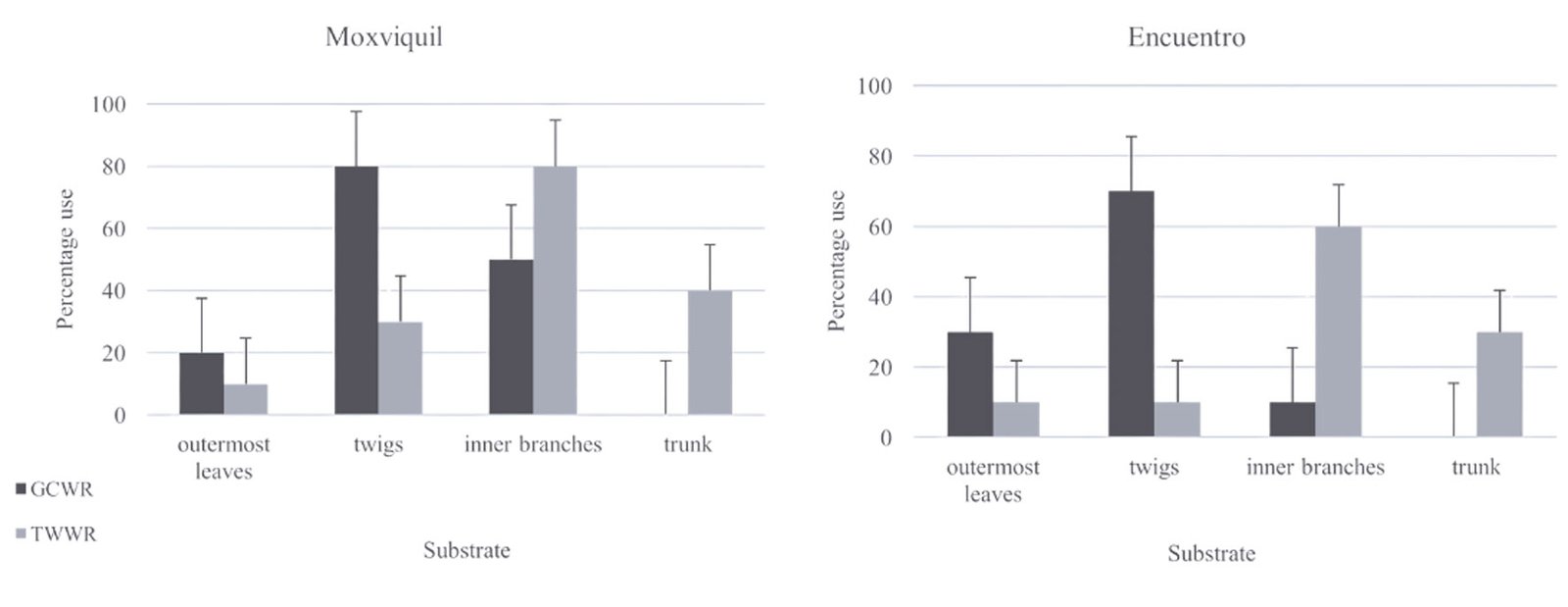
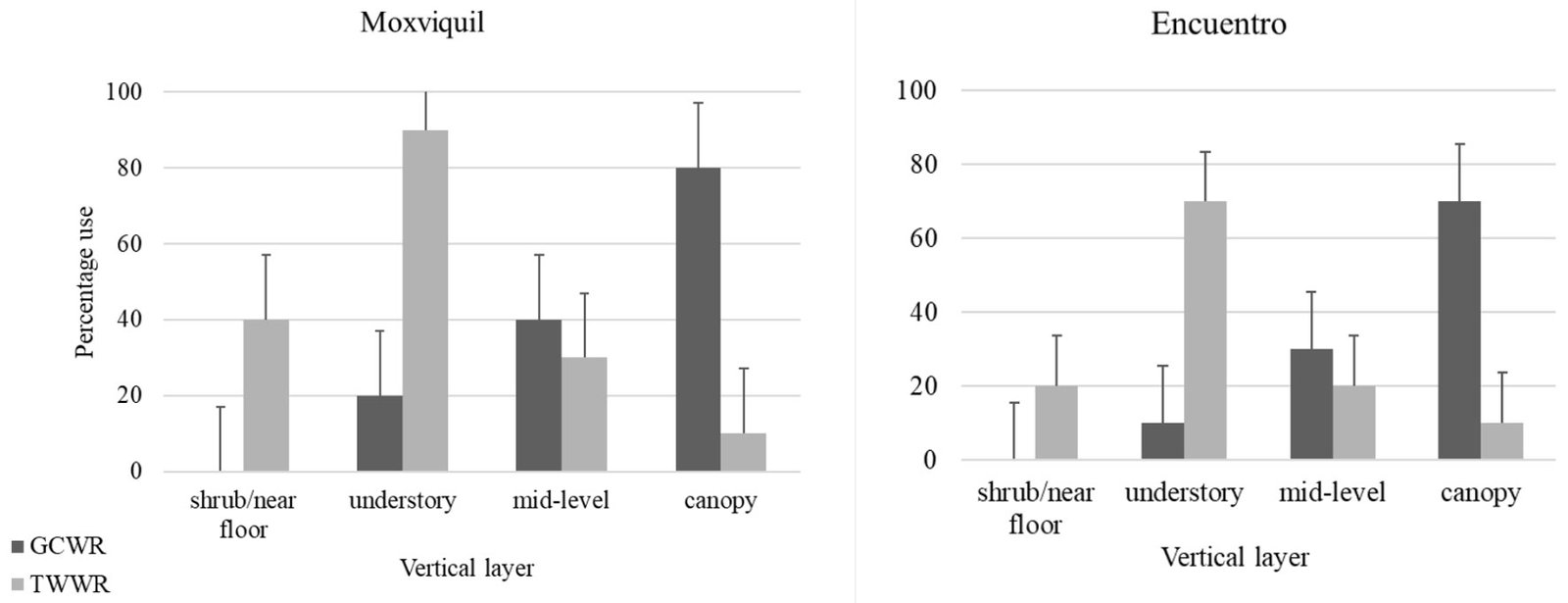
Sample sizes of individuals in Moxviquil were n = 16 GCWA and n = 16 TOWA, whereas in Encuentro, they were n = 11 GCWA and n = 11 TOWA. Foraging observations in the GCWA corresponded to oak tree species use (more than 90% in Quercus spp.) whereas TOWA used oak and pine tree species (70% and 30% in Pinus sp.). Proportional use of foraging substrates such as twigs and trunks differed between species, but not between sites (Fig. 1, B = 1.46, SE = 0.64, z = -3.6, p = 0.007; B = 2.9, SE = 1.09, z = 2.6, p = 0.008). However, use of substrates such as inner branches differed between species and between sites (B = 1.7, SE = 0.62, z = 2.7, p = 0.006; B = -1.26, SE = 0.64, z = -1.98, p = 0.04) being this effect most notably at Encuentro. When referring to vertical layers use, differences in use of understory and canopy were found between species in both sites (B = 3, SE = 0.71, z = 4.2, p < 0.0001; B = -3.04, SE = 0.95, z = -3.2, p = 0.001) where proportional use of the understory was higher in TOWA, while on the other had, proportional use of canopy was higher in the GCWA in both sites (Fig. 2).
Daily travel distance by flocks differed between sites (F1,28 = 5.7, p = 0.02), being lower at Moxviquil (1.02 ± 0.80 km) than at Encuentro (1.30 ± 0.12 km). Daily used areas were statistically different (F1,28 = 5.1, p = 0.03) between Encuentro (3.27 ± 2.94 ha) and Moxviquil (2.03 ± 0.16 ha), but 2 areas at Encuentro were much larger (6.9 and 12.3 ha) than the average size at this site. Cumulative searching time differed between sites (F1,28 = 6.6, p = 0.01) and where lower at Moxviquil (160 ± 8 min) than at Encuentro (194 ± 11 min; Table 3).
| Variables | Moxviquil | Encuentro | Test statistic | p |
|---|---|---|---|---|
| Daily travel distance (meters) | 1.02 ± 0.8 | 1.3 ± 0.1 | F1,28 = 5.7 | 0.02 |
| Daily used area (hectares) | 2.03 ± 0.1 | 3.27 ± 2.9 | F1,28 = 5.1 | 0.03 |
| Cumulative searching time (minutes) | 160 ± 8 | 194 ± 11 | F1,28 = 6.6 | 0.01 |
The GLMM showed that cumulative searching time only increased as a function of flock group size (B = 3.29, SE = 0.44, t = 7.47, p < 0.001), and accounting for this effect in the GLMM resulted in significant differences in cumulative searching times across the 2 study sites although no effect of survey year and vegetation variables was related to this effort variable searching time (Table 4).
| Term | Coefficient | Std. error | t | p |
|---|---|---|---|---|
| Intercept | 77.26 | 37.92 | 2.03 | 0.05 |
| Site | – 9.32 | 32.18 | – 0.29 | 0.77 |
| Flock group size | 2.40 | 0.69 | 3.48 | < 0.01 |
| Flock size × site | 0.53 | 0.95 | 0.56 | 0.58 |
| Canopy cover percentage | 0.14 | 0.50 | 0.28 | 0.77 |
| Number of oak trees | 0.03 | 0.27 | 0.12 | 0.90 |
| Average tree height (m) | 5.81 | 10.75 | 0.54 | 0.59 |
| Mean number of epiphytes | – 0.39 | 0.58 | – 0.68 | 0.50 |
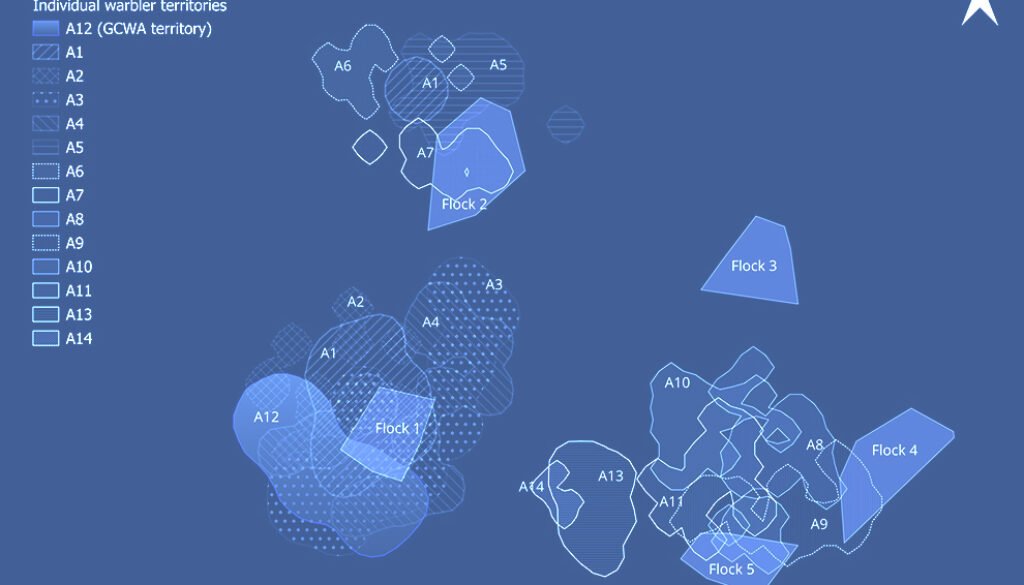
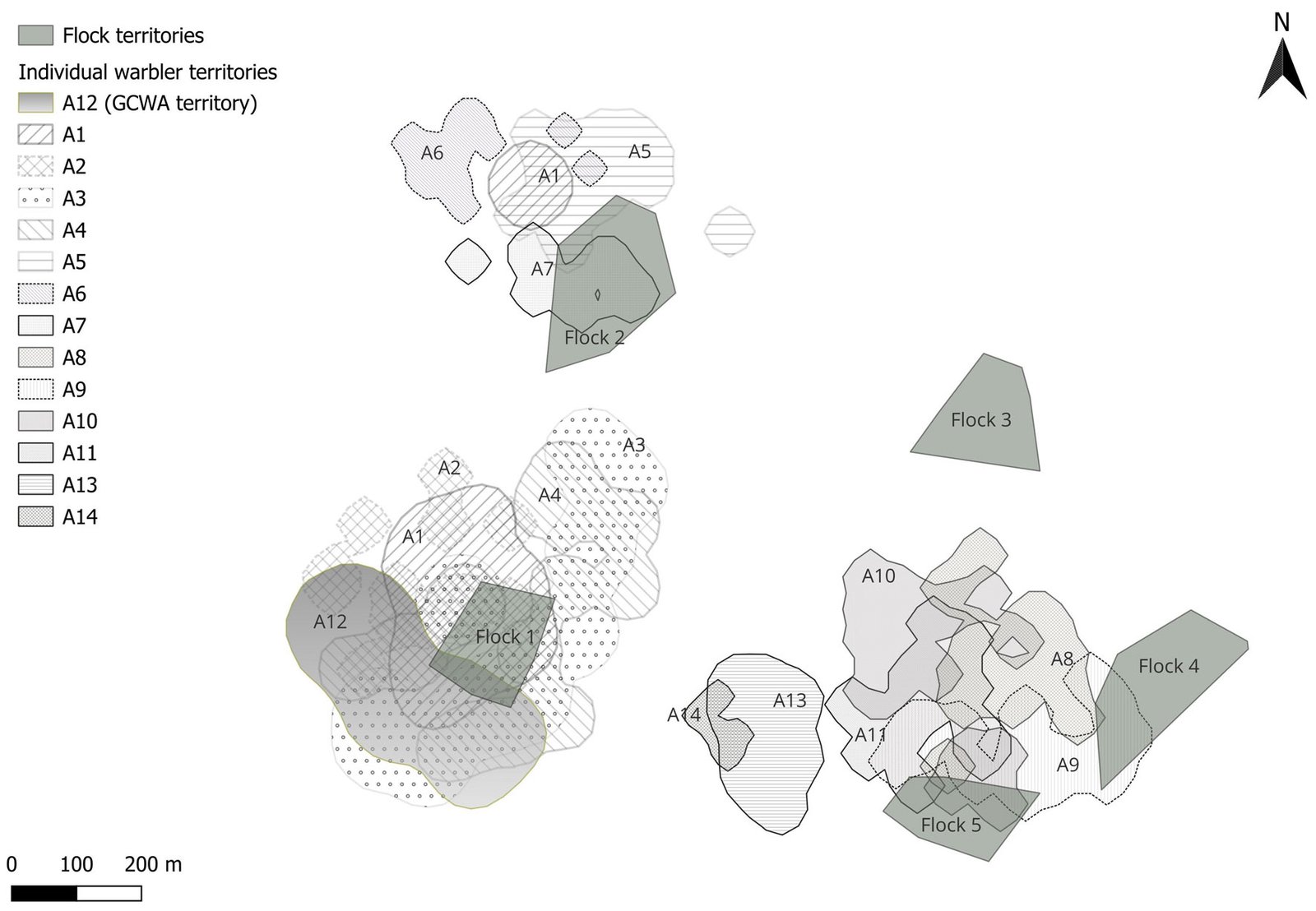
Fifteen adults were captured (TOWA, n = 14; GCWA, n = 1); 10 of 14 TOWA were males and the GCWA was a female. Median daily use area for all tracked individuals was 4.5 ± 0.8 ha; median home range (95% KUD) and core area (50% KUD) were 4.6 ± 0.7 ha and 1.4 ± 0.3 ha, respectively. Male home ranges (95% KUD for 10 captures) were smaller (3.5 ha, 1.6-5.5 ha 95% CI) than those of females (4 captures; 6.8 ha, 4.1-9.6 ha; t = 2.40, p = 0.03). Spatial overlap between flocks and home ranges was observed in 4 out of 5 flocks whereas temporal overlap throughout a larger survey window needs to be completed. The GCWA individual and 11 TOWA individuals out of 14 (80%) overlapped their home range either with 1 or 2 flocks, and the mean area of overlap was 0.76 ± 0.20 ha. Each home range overlapped a mean of 4.3 other home ranges, and individuals overlapped their home range more often in 2 of the 4 flocks observed (Fig. 3).
Discussion
Both focal warbler species were found together in mixed flocks at both sites. Flocks were larger at Encuentro, as predicted for a more disturbed landscape. For both species, adults were more commonly found in flocks, with males and females in equal proportions at Moxviquil whereas males were mostly found at Encuentro flocks, suggesting that intraspecific competition between males and females or with juveniles within flocks may be stronger in the lower-quality habitat (Encuentro) as seen for other groups where social hierarchies change once when in flocks (Darrah & Smith, 2014; Krebs, 1973; Martínez & Robinson, 2016). All tagged individuals with transmitters also occurred regularly in the Moxviquil flocks, despite theory predicting advantages of securing territories during unfavourable seasons (Marra et al., 2015), here, the relatively dry winter season. However, while this may hold for some species, plasticity in foraging behavior and strategies of space use is widespread in most migratory species (Greenberg & Salewski, 2005). Due to sample size and evidence from 1 location site, this assumption of territoriality needs further research to confirm if territorial individuals defend areas where flocks occur and throughout longer periods. While we predicted higher densities of juveniles in the Encuentro site, GCWA females and juveniles were found in similar proportions at both sites, although GCWA males were more abundant than females and juveniles in flocks. Some researchers have suggested latitudinal segregation in GCWA, where males occupy the northernmost nonbreeding grounds and females occur as far south as Nicaragua (Vidal et al., 1994). However, male abundance is also higher within the southernmost sites suggesting potential competition between males and juveniles for flock positions as it occurs in most tropical flocks, where hierarchies are established and whose impacts on foraging rates often determine foraging success on attendants (Goodale et al., 2020; Sridhar et al., 2011). In this study, only 1 adult GCWA female was captured and continuously observed in the same territory at Moxviquil during the duration of transmitter battery (21 days), whereas higher ratios of GCWA male adults in flocks of both sites also confirmed an increased abundance of adults when compared with females and juveniles. While it is possible that male adults are more common than females and juveniles when in flocks, other warbler species have shown equal proportions between males and females in flocks as observed in TOWA (King & Rappole, 2000). Further research is needed to confirm if same adult-juvenile proportions hold across latitudes or altitudes and if similar plumages of juveniles GCWA and TOWA may confound identification by observers. This is relevant because differential survival rates between adults and juveniles in a population through restricted access to juveniles by adults may determine population size and potential carryover effects (Marra et al., 2005; Norris, 2005).
When observing foraging responses at the substrate level, TOWA did not show any preference for a specific substrate and vertical layer. However, its foraging preferences over tree mid-level layers, may suggest an overlap and potential competition for microhabitats and insect resources with GCWA, influencing thereby shifts in habitat use of the latter species, as shown by Greenberg et al. (2001) for the black-throated green warbler (Setophaga virens). However, confirming the observed behavior of GCWA when TOWA is absent may show that competition is not a factor that determines foraging behavioral traits in the GCWA. While additional species in the flock may overlap in habitat use with GCWA, a test on trait similarity could also show if interspecific interactions had a displacement effect (e.g., through interference competition) on GCWA behavior.
As predicted, GCWA had “risky” foraging traits associated with a higher number of outermost leaves and twigs maneuvers and proportional use of canopy by GCWA at Encuentro, demonstrated through differential use of these substrates when compared with Moxviquil. Whether these behaviors potentially relate to resource partitioning, a specialization on specific insect prey are an evolutionary (morphological and behavioral) adaptation in response to past competition remains to be tested (Kent et al., 2022; Morris, 1988). On the other hand, GCWA used inner branches, trunks and the understory (forest floor/near shrubs) at a lower proportion at the disturbed site, suggesting that at Encuentro, TOWA may better defend or occupy these microsites that pose less predation risk in a disturbed forest landscape (Whittingham & Evans, 2004). While differential microhabitat use in the GCWA can be also attributed to competition by other species in the flock, TOWA may be more prone to compete with GCWA due to its ecological and morphological similarities. Despite observed niche differentiation between GCWA and TOWA, dominance hierarchies within flocks are known to reduce prey harvest rates if individuals increase vigilance and reduce foraging rates when they are displaced to the group periphery (Hamilton, 1971; Krause, 1994; Smith, 1976; Suhonen et al., 1993). Moreover, habitat partitioning and differences in foraging traits between species, has been described as an outcome of competition in areas with limited resources and higher predation risk (Greenberg et al., 2001; Martínez & Robinson, 2016). Given that resource partitioning also allows for coexistence of closely related species in resource limited environments (MacArthur, 1958), it may be necessary to measure prey abundance and differences in survival within and between species in habitats of varying quality as an extension of this study.
Group size potentially influenced effort and, thereby, the amount of time GCWA and TOWA spent foraging in flocks, especially in the more disturbed landscape. For forest-dwelling birds, a reduction in forest patch area and canopy cover, along with an increase in the distance between forest patches, may exert non-lethal effects on flocks by inducing changes to group size as seen in the more disturbed site, Encuentro (Gil et al., 2017; Laundre et al., 2010; Maldonado-Coelho & Marini, 2004; McNamara & Houston, 1992; Pollard & Blumstein, 2008). While larger groups are an immediate response to perceived predation risk in areas where forest structure and composition is less complex than in primary forests (Laundré et al., 2010; Telleria et al., 2001), a bigger group, on the other hand, may affect prey harvest rates if interspecific competition is higher between phylogenetically related flocking species whose niches overlap (Kent et al., 2022). However, to observe this response an assessment of agonistic bouts (e.g., chasing) and substrate use/dietary overlap needs to be recorded to confirm interference and exploitative competition. Nevertheless, an increase in flock size should still provide information on prey location as a function of disturbance at a site like Encuentro, where more competitors may still deplete foraging areas more rapidly (Gil et al., 2017; Hutto, 1988). The opposite may be expected in non-territorial systems or in systems with less competition such as in Moxviquil, where flocks were smaller and sex-age ratios were more even. Foraging effort also seemed to increase with flock size, as daily use areas, travel distances and searching time were larger or longer in Encuentro. However, a merely increase in group size may not be an indicative of higher foraging effort as vegetation characteristics at the landscape level such as patch area size and distance between forest fragments may have a bigger impact on foraging behavior (Mokross, 2018; Telleria, 2001). The increase in foraging effort proxies at Encuentro is proposed here as an indirect effect of group size which varied between sites due to the potential effect of changes in vegetation structure, where reduced density of trees and lower canopy cover forces groups to allocate more time to searching for food over longer distances (Laundré et al., 2010; Mokross et al., 2018). While larger flocks provide early detection and protection against predators through mobbing calls and risk dilution (Elgar, 1989; Valone, 2007), the less abundant species in a mixed flock may be also more conspicuous to predators through increased apparent competition with the more abundant species (Holt & Lawton, 1993; Jullien & Clobert, 2000). Landscape and habitat conditions likely influenced the variation in foraging effort and potential energy expenditure in GCWA, but it seems that adults, found more often in flocks within the disturbed site Encuentro, are trading off foraging efficiency and higher threat of predation for larger group sizes (Gil et al., 2017; Krause & Ruxton, 2002). This response calls to test for additional effects on foraging effort on flocking individuals because dominants are assumed to secure the higher quality habitats with reduced foraging costs (Marra et al., 2015).
Most captured TOWA individuals occupied home ranges coincident with the territory of one or more flocks. Home ranges that overlapped flock territories were smaller than those that did not, suggesting that joining flocks does not require a larger home range. However, given the smaller sample size on captured individuals for GCWA, this affirmation should be taken with precaution. The smaller ranges, occupied by mostly adult males, presumably more competitive individuals, may be the outcome of a recognized benefit of maintaining a fixed territory when a flock shows site fidelity or occurs in the same areas across different seasons as shown previously (Darrah & Smith, 2014). Tropical bird flocks have been also shown to be stable in composition and size, occupying and defending the same foraging areas through several seasons (Martínez & Robinson, 2016; Thomson et al., 2003). A further interpretation is that juvenile individuals do not have a flock near their home range, or do not hold a home range, as relatively few females and no immatures were captured during the study. Thus, a dual strategy, in which territory-holders, also observed outside flocks may forage locally and alone or where they may also regularly opt for group foraging, may be the case for these warblers where variation in food supply occurs both spatially and temporally, especially where environmental changes also occur rapidly (Greenberg & Salewski, 2005). However, increasing the survey window (through years) and sample size in future study of the 2 warblers will allow to test for the idea that not only do some overwintering warblers adhere to territories, illustrating despotic behaviour (Marra et al., 2015; Stutchbury, 1994), but they also position their individual territories along with flock territories to limit the occupation of both by subordinates or less competitive individuals. Assessing this information through additional research is relevant because differential strategies of space use may translate into differential survival and contribution to population size that will carry over the next breeding season for most Neotropical-Nearctic migratory bird species.
Conservation implications. The association of the 2 focal species with different foraging substrates and vertical layers in this study is important to design forest management strategies that prioritize mature trees with higher structural and horizontal complexity and plant species composition at the forest stand level, where species find suitable substrates and stratums to forage. A strong association between GCWA and oak tree species also suggest this native species should be prioritized during reforestation activities to increase forest cover in the disturbed site Encuentro and to increase tree abundance in Moxviquil, where wood extraction is still present. Given that searching efforts were larger in Encuentro, potentially as a function of larger search areas, it is recommendable to increase connectivity and decrease open area size where flocks may reduce their travelled distances and daily home ranges. Managing habitat for additional species that compose flocks, mostly migrant species, as seen in the Moxviquil site through continuous protection, will also promote habitat occupancy for the GCWA, which seems to be an obligated flock member as all observations of individuals, but one, were made in flocks.
Acknowledgments
To Secihti México (former Conacyt) who provided financial support through a doctoral scholarship awarded to first author. To Pronatura Sur and “Alianza para la conservación de los bosques de pino-encino de Mesoamérica” staff including Eric Hernández Molina and Claudia Macías Caballero who allowed field work at the Moxviquil Reserve (SCLC, Chiapas) and shared personnel and valuable field data to complement this study.
| No. | Family | Species | English name |
|---|---|---|---|
| Moxviquil | |||
| 1 | Parulidae | Setophaga townsendi | Townsend’s warbler |
| 2 | Parulidae | Oreothlypis superciliosa | Crescent-chested warbler |
| 3 | Vireonidae | Vireo huttoni | Hutton’s vireo |
| 4 | Aegithalidae | Psaltriparus minimus | Bushtit |
| 5 | Vireonidae | Vireo solitarius | Solitary vireo |
| 6 | Parulidae | Peucedramus taeniatus | Olive warbler |
| 7 | Parulidae | Setophaga occidentalis | Hermit warbler |
| 8 | Parulidae | Mniotilta varia | Black and white warbler |
| 9 | Tyrannidae | Contopus pertinax | Greater pewee |
| 10 | Parulidae | Setophaga chrysoparia | Golden-cheeked warbler |
| 11 | Parulidae | Cardellina Pusilla | Wilson’s warbler |
| 12 | Furnariidae | Lepidocolaptes affinis | Spot-crowned woodcreeper |
| 13 | Parulidae | Cardellina rubrifrons | Red-faced warbler |
| 14 | Parulidae | Myioborus miniatus | Slate-throated redstart |
| 15 | Certhidae | Certhia americana | American woodcreeper |
| Encuentro | |||
| 1 | Parulidae | Setophaga occidentalis | Hermit warbler |
| 2 | Parulidae | Setophaga townsendi | Townsend’s warbler |
| 3 | Parulidae | Oreothlypis superciliosa | Crescent-chested Warbler |
| 4 | Vireonidae | Vireo huttoni | Hutton’s vireo |
| 5 | Vireonidae | Vireo solitarius | Solitary vireo |
| 6 | Certhidae | Certhia americana | American woodcreeper |
| 7 | Parulidae | Peucedramus taeniatus | Olive warbler |
| 8 | Furnariidae | Lepidocolaptes affinis | Spot-crowned woodcreeper |
| 9 | Parulidae | Cardellina Pusilla | Wilson’s warbler |
| 10 | Parulidae | Mniotilta varia | Black and white warbler |
| 11 | Tyrannidae | Contopus pertinax | Greater pewee |
| 12 | Parulidae | Setophaga chrysoparia | Golden-cheeked warbler |
| 13 | Tyrannidae | Mitrephanes phaeocercus | Tufted flaycatcher |
| 14 | Parulidae | Cardellina rubrifrons | Red-faced warbler |
| 15 | Parulidae | Setophaga virens | Black-throated green warbler |
| 16 | Parulidae | Myioborus miniatus | Slate-throated redstart |
References
Brown, D. R., & Sherry, T. W. (2008). Alternative strategies of space use and response to resource change in a wintering migrant songbird. Behavioral Ecology, 19, 1314–1325. https://doi.org/10.1093/beheco/arn073
BirdLife International. (2020). Species factsheet: Golden-cheeked warbler Setophaga chrysoparia. Downloaded July 28, 2025, from https://datazone.birdlife.org/species/factsheet/golden-cheeked-warbler-setophaga-chrysoparia
Brown, J. L. (1969). Territorial behavior and population regulation in birds: a review & re-evaluation. The Wilson Bulletin, 81, 293–329.
Brown, D. R., & Sherry, T. W. (2008). Alternative strategies of space use and response to resource change in a wintering migrant songbird. Behavioral Ecology, 19, 1314–1325. https://doi.org/10.1093/beheco/arn073
Darrah, A., & Smith, K. (2014). Ecological and behavioral correlates of individual flocking propensity of a tropical bird. Behavioral Ecology, 25, 1064–1072. https://doi.org/10.1093/beheco/aru086
Dolby, A. S., & Grubb, T. C. (1998). Benefits to satellite members in mixed species foraging groups: an experimental analysis. Animal Behaviour, 56, 501–509. https://doi.org/10.1006/anbe.1998.0808
Elgar, M. A. (1989). Predator vigilance & group size in mammals and birds: a critical review of the empirical evidence. Biological Reviews, 64, 13–33. https://doi.org/10.1111/j.1469-185X.1989.tb00636.x
Gentry, R. K. E., Roche, D. P., Mugel, S. G., Lancaster, N. D., Sieving, K. E., Freeberg, T. M. et al. (2022). Social dynamics of core members in mixed-species bird flocks change across a gradient of foraging habitat quality. Plos One, 17, e0262385. https://doi.org/10.1371/journal.pone.0262385
Gil, M. A. Z., Emberts, H. J., & St. Mary, C. M. (2017). Social information on fear and food drives animal grouping & fitness. American Naturalist, 189, 227–241. https://doi.org/10.1086/690055
Goodale, E., Beauchamp, G., Magrath, R. D., Nieh, J. C., & Ruxton, G. D. (2010). Interspecific information transfer influences animal community structure. Trends in Ecology & Evolution, 25, 354–361. https://doi.org/10.1016/j.tree.2010.01.002
Goodale, E., Sridhar, H., Sieving, K. E., Bangal, P., Colorado, Z., & Farine, D. R. (2020). Mixed company: a framework for understanding the composition and organization of mixed-species animal groups. Biological Reviews, 95, 889–910. https://doi.org/10.1111/brv.12591
Greenberg, R., Gonzáles, C. E., Bichier, P., & Reitsma, R. (2001). Nonbreeding habitat selection and foraging behavior of the Black-throated green warbler complex in southeastern Mexico. Condor, 103, 31–37. https://doi.org/10.1093/condor/103.1.31
Greenberg, R., & Salewski, V. (2005). Ecological correlates of wintering social systems in New World and Old-World migratory passerines. In R. Greenberg, & P. P. Marra (Eds.), Birds of two worlds: the ecology & evolution of migration (pp. 336–358). Baltimore, MD: John Hopkins University Press.
Hamilton, G. (1971). Geometry of the selfish herd. Journal of Theoretical Biology, 31, 295–311. https://doi.org/10.1016/0022-5193(71)90189-5
Holmes, R. T., Sherry, T. W., & Reitsma, L. (1989). Population structure, territoriality, and overwinter survival of two migrant warbler species in Jamaica. Condor, 91, 545–561. https://doi.org/10.2307/1368105
Holt, R., & Lawton, J. (1993). The ecological consequences of shared natural enemies. Annual Review of Ecology & Systematics, 25, 495–520. https://doi.org/10.1146/annurev.ecolsys.25.1.495
Hutto, R. L. (1988). Foraging behavior patterns suggest a possible cost associated with participation in mixed-species bird flocks. Oikos, 51, 79–83. https://doi.org/10.2307/3565809
Janzen, D. H. (1980). Heterogeneity of potential food abundance for tropical small birds. In A. Keast, & E. S. Morton (Eds.), Migrant birds in the Neotropics: ecology, behavior, distribution, & conservation (pp. 545–556). Washington, D.C.: Smithsonian Institute Press.
Jullien, M., & Clobert, J. (2000). The survival value of flocking in neotropical birds: reality or fiction? Ecology, 81, 3416–3430. https://doi.org/10.1890/0012-9658(2000)081[3416:TSVOFI]2.0.CO;2
Kent, C. H., Huh, K., Chieko, S., Judson, K., Powell, L., & Sherry, T. (2022). High resource overlap and small dietary differences are widespread in food-limited warbler (Parulidae) communities. Ibis, 164, 44–59. https://doi.org/10.1111/ibi.13006
Kershaw, J. A. Jr., Ducey, M. J., Beers, T. W., & Husch, B. (2017). Forest mensuration, Fifth Edition. John Wiley & Sons. https://doi.org/10.1002/9781118902028
King, D. I., Chandler, C. C., Rappole, J. H., Chandler, R. B., & Mehlman, D. W. (2012). Establishing quantitative habitat targets for a “Critically endangered” neotropical migrant (Golden-cheeked warbler: Dendroica chrysoparia) during the nonbreeding season. Bird Conservation International, 22, 213–221. https://doi.org/10.1017/S095927091100027X
King, D., & Rappole, J. (2000). Winter flocking of insectivorous birds in montane pine-oak forests in middle America. Condor, 102, 664–672. https://doi.org/10.1093/condor/102.3.664
Krause, G. D. (1994). Differential fitness returns in relation to spatial position in groups. Biological Reviews, 69, 187–206. https://doi.org/10.1111/j.1469-185X.1994.tb01505.x
Krause, G. D., & Ruxton, J. (2002). Living in groups. Oxford, U.K.: Oxford University Press. https://doi.org/10.1093/oso/9780198508175.001.0001
Krebs, J. R. (1973). Social learning and the significance of mixed-species flocks of chickadees (Parus spp.). Canadian Journal of Zoology, 51, 1275–1288. https://doi.org/10.1139/z73-181
Komar, O., Smith, C., & Wolf, C. (2011). Winter ecology, relative abundance and population monitoring of Golden-cheeked warblers (Dendroica chrysoparia) throughout the known & potential winter range. Technical Report. Texas Parks & Wildlife Department. MOA E69 #172003.
Laundré, J. W., Hernandez, L., & Ripple, W. J. (2010). The landscape of fear: ecological implications of being afraid. Open Ecology Journal, 3, 1–7. https://doi.org/10.2174/1874213001003030001
Lima, S. L., & Dill, L. M. (1990). Behavioral decisions made under the risk of predation: a review and prospectus. Canadian Journal of Zoology, 68, 619–640. https://doi.org/10.1139/z90-092
Losin, N., Drury, J. P., Peiman, K. S., Storch, C., & Grether, G. F. (2016). The ecological and evolutionary stability of interspecific territoriality. Ecology Letters, 19, 260–267. https://doi.org/10.1111/ele.12561
MacArthur, R. H. (1958). Population ecology of some warblers of northeastern coniferous forests. Ecology, 39, 599–619. https://doi.org/10.2307/1931600
Maldonado-Coelho, M., & Marini, M. A. (2004). Mixed-species bird flocks from Brazilian Atlantic forests: the effects of forest fragmentation and seasonality on their size, richness and stability. Biological Conservation, 116, 19–26. https://doi.org/10.1016/S0006-3207(03)00169-1
MacArthur, R. H. (1958). Population ecology of some warblers of northeastern coniferous forests. Ecology, 39, 599–619. https://doi.org/10.2307/1931600
Martínez, A., & Robinson, S. (2016). Using foraging ecology to elucidate the role of species interactions in two contrasting mixed-species flock systems in northeastern Peru. Wilson Journal of Ornithology, 128, 378–390. https://doi.org/10.1676/wils-128-02-378-390.1
Marra, P. (2000). The role of behavioral dominance in structuring patterns of habitat occupancy in a migrant bird during the nonbreeding period. Behavioral Ecology, 11, 299–308. https://doi.org/10.1093/beheco/11.3.299
Marra, P., Studds, C., Wilson, S., Sillet, T., Sherry, T., & Holmes, R. (2015). Nonbreeding period habitat quality mediates the strength of density-dependence for a migratory songbird. Proceedings of the Royal Society B, 282, 20150624. https://doi.org/10.1098/rspb.2015.0624
McNamara, J. M., & Houston, A. I. (1992). Evolutionarily stable levels of vigilance as a function of group size. Animal Behaviour, 43, 641–658. https://doi.org/10.1016/S0003-3472(05)81023-1
Mokross, K., Potts, J., Rutt, C., & Stouffer, P. (2018). What can mixed-species flock movement tell us about the value of Amazonian secondary forests? Insights from spatial behavior. Biotropica, 50, 664–663. https://doi.org/10.1111/btp.12557
Morris, D. W. (1988). Habitat-dependent population regulation and community structure. Evolutionary Ecology, 2, 253–269. https://doi.org/10.1007/BF02214286
Munn, C. A., & Terborgh, J. W. (1979). Multi-species territoriality in neotropical foraging flocks. Condor, 81, 338–347. https://doi.org/10.2307/1366956
Nadkarni, N., & Matelson, T. (1989). Bird use of epiphyte resources in Neotropical trees. Condor, 91, 891–907. https://doi.org/10.2307/1368074
Newell, F. L., Beachy, T. A., Rodewald, A. D., Rengifo, C., Ausprey, I., & Rodewald, P. (2014). Foraging behavior of migrant warblers in mixed-species flocks in Venezuelan shade coffee: interspecific differences, tree species selection, and effects of drought. Journal of Field Ornithology, 85, 134–151. https://doi.org/10.1111/jofo.12056
Norris, R. (2005). Carry-over effects and habitat quality in migratory populations. Oikos, 109, 178–186. https://doi.org/10.1111/j.0030-1299.2005.13671.x
Pomara, L., Cooper, R. J., & Petit, L. (2007). Modelling the flocking propensity of passerine birds in two Neotropical habitats. Oecologia, 153, 121–133. https://doi.org/10.1007/s00442-007-0701-7
Pollard, K. A., & Blumstein, D. T. (2008). Time allocation and the evolution of group size. Animal Behaviour, 76, 1683–1699. https://doi.org/10.1016/j.anbehav.2008.08.006
Powell, G. V. N. (1985). Sociobiology and adaptive significance of interspecific foraging flocks in the Neotropics. Ornithological Monographs, 36, 713–732. https://doi.org/10.2307/40168313
Pulliam, H. R., & Danielson, B. J. (1991). Sources, sinks, and habitat selection: a landscape perspective on population dynamics. American Naturalist, 137, S50–S66. https://doi.org/10.1086/285139
Ramírez-Marcial, N., González-Espinosa, M., & Williams-Linera, G. (2001). Anthropogenic disturbance and tree diversity in Montane Rain Forests in Chiapas, Mexico. Forest Ecology & Management, 154, 311–326. https://doi.org/10.1016/S0378-1127(00)00639-3
Rappole, J. H., King, D. I., & Leimgruber, P. (2000). Winter habitat and distribution of the endangered Golden-cheeked warbler (Dendroica chrysoparia). Animal Conservation, 2, 45–49. https://doi.org/10.1017/S1367943000000731
Semarnat (Secretaría del Medio Ambiente y Recursos Naturales). (2010). Norma Oficial Mexicana NOM-059-SEMARNAT-2010, Protección ambiental – Especies nativas de México de flora y fauna silvestres – Categorías de riesgo y especificaciones para su inclusión, exclusión o cambio – Lista de especies en riesgo. Diario Oficial de la Federación. 30 de diciembre de 2010, Segunda Sección, México.
Sih, A. (1980). Optimal behavior: can foragers balance two conflicting demands? Science, 210, 1041–1043. https://doi.org/10.1126/science.210.4473.1041
Smith, J. A., Reitsma, L. R., & Marra, P. P. (2010). Moisture as a determinant of habitat quality for a nonbreeding Neotropical migratory songbird. Ecology, 91, 2874–2882. https://doi.org/10.1890/09-2212.1
Smith, S. (1976). Ecological aspects of dominance hierarchies in black-capped chickadees. Auk, 93, 95–107.
Sodhi, N., & Paszkowski, A. (1995). Habitat use and foraging behavior of four parulid warblers in a secondary forest. Journal of Field Ornithology, 66, 277–288.
Steiniger, S., & Hunter, A. (2012). OpenJUMP HoRAE–A free GIS and toolbox for home-range analysis. Wildlife Society Bulletin, 36, 600–608. https://doi.org/10.1002/wsb.168
Steven, A., Wolfe, J., Kellerman, J., Sherry, T., Stutchbury, B., Bayly, N. et al. (2020). Habitat ecology of Nearctic-Neotropical migratory landbirds on the nonbreeding grounds. Condor, 122, 1–18. https://doi.org/10.1093/condor/duaa055
Stutchbury, B. J. (1994). Competition for winter territories in a Neotropical migrant: the role of sex and age. Auk, 111, 63–69. https://doi.org/10.2307/4088505
Sridhar, H., Beauchamp, G., & Shanker, K. (2009). Why do birds participate in mixed-species foraging flocks? A large-scale synthesis. Animal Behaviour, 78, 337–347. https://doi.org/10.1016/j.anbehav.2009.05.008
Stephens, D. W., & Krebs, J. R. (1986). Foraging theory. Princeton, N.J.: Princeton University Press.
Suhonen, J., Halonen, M., & Mappes, T. (1993). Predation risk and the organization of the Parus guild. Oikos, 66, 94–100. https://doi.org/10.2307/3545200
Telleria, J. L., Virgos, E., Carbonell, R., Pérez-Tris, J., & Santos, T. (2001). Behavioral responses to changing landscapes: flock structure and anti-predator strategies of tits wintering in fragmented forests. Oikos, 95, 253–264. https://doi.org/10.1034/j.1600-0706.2001.950207.x
Terborgh, J. (1990). Mixed-species flocks and polyspecific associations: costs and benefits of mixed groups to birds & monkeys. American Journal of Primatology, 21, 87–100. https://doi.org/10.1002/ajp.1350210203
Thomson, R. L., Forsman, J. T., & Mönkkönen, M. (2003). Positive interactions between migrant and resident birds: testing the heterospecific attraction hypothesis. Oikos, 134, 431–438. https://doi.org/10.1007/s00442-002-1140-0
Valone, T. J. (2007). From eavesdropping on performance to copying the behavior of others: a review of public information use. Behavioral Ecology & Sociobiology, 62, 1–14. https://doi.org/10.1007/s00265-007-0439-6
Vidal, R. M., Macías-Caballero, C., & Duncan, C. (1994). The occurrence and ecology of the golden-cheeked warbler in the highlands of northern Chiapas, Mexico. Condor, 96, 684–691. https://doi.org/10.2307/1369471
Wahl, R., Diamond, D. D., & Shaw, D. (1990). The Golden-cheeked warbler: astatus review. Fort Worth, TX: Ecological Services, U.S. Fish & Wildlife Service.
Whittingham, M., & Evans, K. (2004). The effects of habitat structure on predation risk of birds in agricultural landscapes. Ibis, 146, 210–220. https://doi.org/10.1111/j.1474-919X.2004.00370.x
Winker, K. (1998). The concept of floater. Ornitologia Neotropical, 9, 111–119.
Worton, B. J. (1989). Kernel methods for estimating the utilization distribution in home-range studies. Ecology, 70, 164–8. https://doi.org/10.2307/1938423
Wright, A. L., Hayward, G. D., Matsuoka, S. M., & Hayward, P. H. (1998). Townsend’s warbler (Setophaga townsendi). In P. G. Rodewald (Ed.), The birds of North America. Ithaca, N.Y.: Cornell Lab of Ornithology. https://doi.org/10.2173/tbna.333.p