Relationship of the establishment of Dendroctonus adjunctus and Arceuthobium vaginatum with the structure of a Pinus hartwegii forest in Nevado de Colima, Mexico
Angel Rolando Endara-Agramont *, Rebeca Dennise Varo-Rodríguez, José Jonathan Aguirre-Zúñiga, Claudia Guadalupe Enríquez-Sánchez y Alma Abigail Luna-Gil
Universidad Autónoma del Estado de México, Instituto de Ciencias Agropecuarias y Rurales “El Cerrillo Piedras Blancas”, 50000 Toluca, Estado de México, México
*Autor de correspondencia: arendaraa@uaemex.mx (A.R. Endara-Agramont)
Recibido: 6 mayo 2024; aceptado: 29 julio 2025
Resumen
Las poblaciones de Pinus hartwegii se establecen por encima de 3,500 m snm, en torno a las montañas más altas del país, una de ellas es el Parque Nacional Volcán Nevado de Colima, mismo que está afectado por Arceuthobiumvaginatum y Dendroctonusadjunctus. El objetivo de la investigación fue determinar el daño provocado por ambos patógenos sobre la estructura y regeneración del bosque de P. hartwegii. Para ello, se instalaron 384 unidades de muestreo (UM de 1,000 m2 cada uno), donde se registró información dasonómica asociada a niveles de infestación de muérdagos y descortezadores. De acuerdo con los resultados obtenidos, 20% del bosque se encuentra infestado por muérdago y descortezador. Además, se presenta la eliminación del dosel dominante y reducción de árboles sanos > 40 DN en los sitios afectados. Por lo anterior, se concluye que los altos niveles de infestación de D. adjunctus y la superficie infestada por A. vaginatum afectan la estructura del bosque y, por tanto, comprometen el establecimiento de la regeneración natural, siendo la ladera oeste en torno al volcán la más afectada.
Palabras clave: Muérdago; Descortezador; Pinus hartwegii; Alta montaña; Estrato arbóreo
Abstract
The populations of Pinus hartwegii are established above 3,500 m asl, around the highest mountains in the country, one of them is the Nevado de Colima Volcano National Park, which is affected by Arceuthobium vaginatum and Dendroctonus adjunctus. The objective of the research was to determine the damage caused by both pathogens on the structure and regeneration of the P. hartwegii forest. To this, 384 sampling units were installed (MU of 1,000 m2 each), where forest information associated with mistletoe and bark beetle infestation levels was recorded. According to the results obtained, 20% are attacked by mistletoe and bark beetle. In addition, the elimination of the dominant canopy and reduction of healthy trees > 40 DN is presented in the affected sites. From the above, it is concluded that the high levels of infestation of D. adjunctus and the surface infested by A. vaginatum affect the structure of the forest and, therefore, compromise the establishment of natural regeneration, with the western slope around the volcano the most affected.
Keywords: Mistletoe; Bark beetle; Pinus hartwegii; High mountain; Tree stratum
Introducción
Los bosques templados de México cubren 15% de la superficie forestal, distribuidos en 5 regiones: Península de Baja California, Sierra Madre Occidental, Sierra Madre Oriental, Sierra Madre del Sur y el Sistema Volcánico Transmexicano (SVTM) (Sánchez-González, 2008). Se encuentran en un rango altitudinal de 1,800 a 4,000 m snm, donde se establecen más de 60 especies del género Pinus (Farjon et al., 1997; Styles, 1993) y hasta 8 especies del género Abies (Gernandt y Pérez-de la Rosa, 2014; Villaseñor, 2016).
En Jalisco convergen la Sierra Madre Occidental y el Sistema Volcánico Transmexicano, donde se establecen 34 especies de coníferas (Gernandt y Pérez-de la Rosa, 2014), es una de las entidades con mayor diversidad forestal. Sin embargo, para el periodo 2012-2021 se reportaron 345 notificaciones de saneamiento, lo que representa una superficie total de 54,157.70 ha, en 7,347.02 de ellas, las notificaciones se levantaron por insectos descortezadores y en 33,064.31 por plantas parásitas. El Parque Nacional Volcán Nevado de Colima abarca 2 de las principales regiones afectadas (Tuxpan y Zapotlán el Grande), cuenta con bosques de Pinus hartwegii y Abies religiosa (Sivicoff, 2022).
Las poblaciones de Pinus hartwegii se establecen sobre 3,500 m snm, en las laderas de los edificios volcánicos más altos del país (Endara et al., 2013). Estos bosques se ven afectados por plantas parásitas del género Arceuthobium (Endara-Agramont et al., 2022; Sáenz et al., 2020) e insectos descortezadores del género Dendroctonus (Endara et al., 2023).
México concentra la mayor diversidad de especies del género Arceuthobium (23) (Villaseñor, 2016); las afectaciones por plantas parásitas predisponen a los árboles al ingreso de descortezadores (Ferrenberg, 2020; Mathiasen, 2019), debido a la pérdida de vigor y reducción en el crecimiento de los árboles parasitados (Cibrián-Tovar et al., 1995) y, posteriormente, facilitando el ingreso de hongos ambrosiales que conducen a la muerte del hospedero (Farrell et al., 2001). En rodales de pino con múltiples agentes de perturbación (Dendroctonus ponderosa y Arceuthobium vaginatum subs. cryptopodum) se encontraron bajos porcentajes de copas vivas y una predisposición a la acumulación de combustible (Klutsch et al., 2014). Por su parte, en poblaciones de Pinus contorta con historiales de mortalidad en más de 70% del dosel causado por descortezador, se concluye que el manejo de los individuos muertos propicia la regeneración hasta 4 veces mayor que en rodales no tratados (Collins et al., 2011). Este escenario, podría influir negativamente en la combinación de muérdagos y descortezadores en la zona de estudio, puesto que la regeneración restante puede ser infectada por el muérdago.
México alberga 13 especies del género Dendroctonus (Armendáriz-Toledano y Zúñiga, 2017), que afectan, al menos, a 20 especies de coníferas de los géneros Pinus, Pseudotsuga, Abies y Cupressus (Cibrián-Tovar et al., 1995; Salinas-Moreno et al., 2004). La función de los descortezadores en ecosistemas naturales es inducir el recambio de especies vegetales a través de la infestación de árboles viejos o estresados hasta causarles la muerte, para posteriormente dar paso a nueva generación del componente arbóreo y, con ello, permitir el establecimiento de individuos con mejores condiciones de competitividad (Christiansen y Bakke, 1988).
Uno de los controles poblacionales de los descortezadores son las temperaturas invernales, que ayudan a mantener bajas las poblaciones de las larvas y a retrasar el desarrollo de los adultos (Raffa et al., 2008); sin embargo, en las últimas décadas el aumento de la temperatura en verano está acelerando el desarrollo de los adultos, al incrementar su capacidad reproductiva y fecundidad, lo que implica una mayor cantidad de generaciones de descortezadores al año (Lombardero et al., 2000; Sáenz et al., 2020).
El Parque Nacional Volcán Nevado de Colima (PNVNC) reporta la presencia de insectos descortezadores en sus bosques de pino desde 1963 (Conanp, 2006). De la misma manera, Arceuthobium vaginatum afecta 14% de la superficie de los bosques de pino establecidos por encima de 3,500 m snm. (Endara et al., 2023). Por lo anterior, el objetivo de la investigación fue determinar el daño provocado por el descortezador y el muérdago enano sobre la estructura y regeneración del bosque de P. hartwegii del Nevado de Colima.
Materiales y métodos
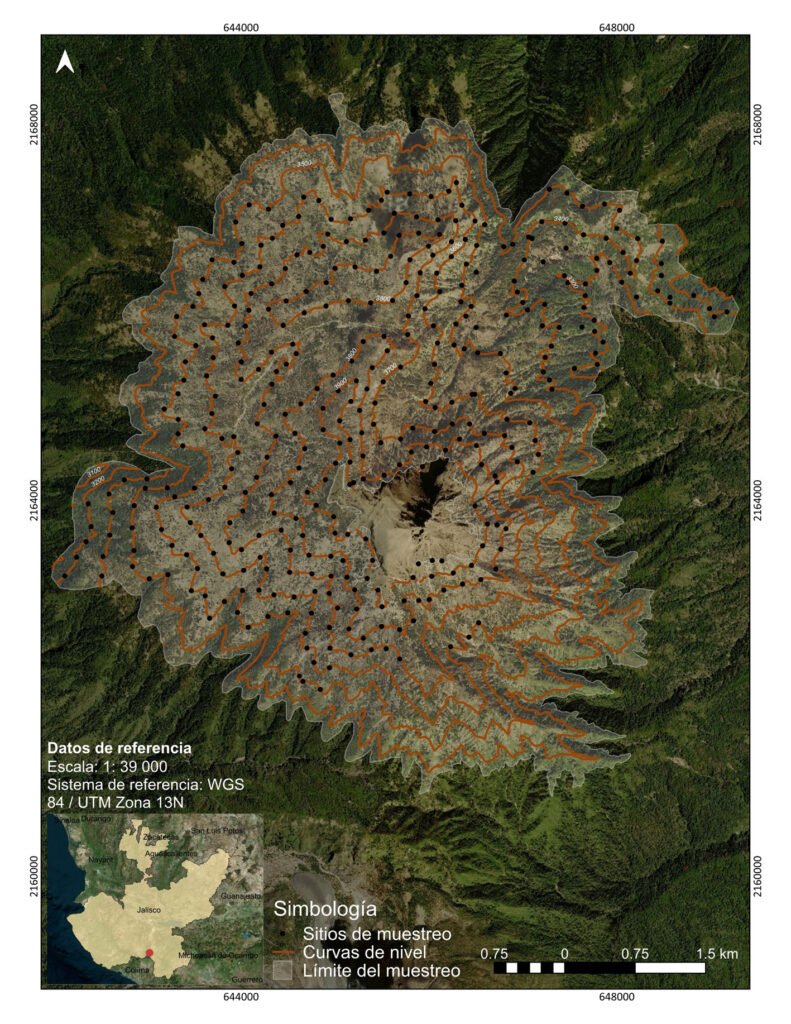
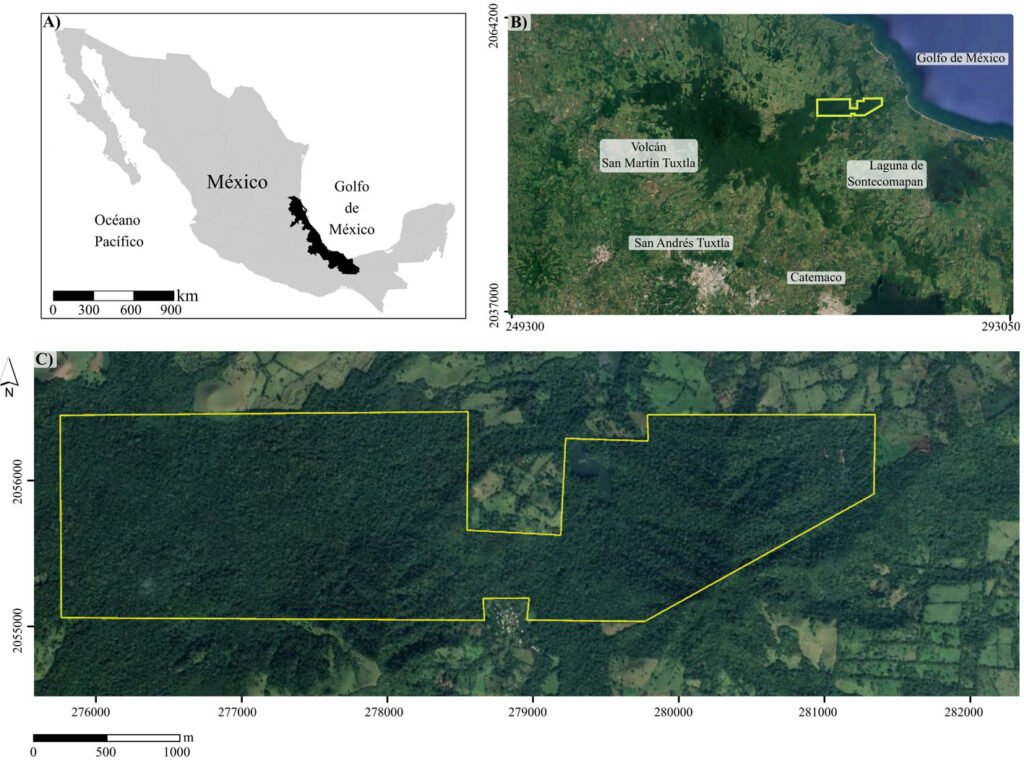
El PNVNC fue decretado en 1936 y cuenta con una superficie de 6,554 ha, alcanza una altitud de 4,270 m snm (fig. 1). El tipo de clima es semifrío con verano fresco corto, subhúmedo con precipitaciones en verano C (w2)(w)(x´)c(e). Los tipos de suelo más importantes son regosol, andosol, litosol y en menor escala, cambisol. En el límite altitudinal superior arbóreo se establece una población de Pinus hartwegii asociado con el zacatonal alpino (3,500-4,100 m snm), entre 3,300 y 3,500 se distribuyen los bosques de Alnus jorullensis y Abies religiosa, mientras que el bosque mesófilo de montaña entre 3,000 y 3,300 m snm. Estos ecosistemas albergan aproximadamente 172 especies de plantas vasculares,124 de mamíferos y 117 de aves (Conanp, 2006).
Figura 1. Área de estudio y sitios de muestreo.
Se establecieron 384 unidades de muestreo (UM) temporales en 3,086 ha del bosque de P. hartwegii del Parque Nacional Nevado de Colima, Jalisco, México. Los sitios se instalaron por encima de 3,500 m snm y hasta 3,900 m snm. Para ello se utilizó la intensidad mínima de muestreo del inventario forestal de reconocimiento, esto permitió dar la representatividad a la superficie muestreada; posteriormente, se adaptó el método de transectos, utilizando las curvas de nivel como líneas de acceso al bosque (Dauber, 1995); sobre cada línea se instalaron las UM con una equidistancia de 300 m y una separación altitudinal de 100 m, esto debido a la variación climática asociada a la altitud (Mayer y Ott, 1991).
Cada UM abarca una superficie de 0.1 ha (17.86 m de radio), en el levantamiento de información del sitio como altitud, pendiente y exposición se utilizaron instrumentos de precisión (brújula Suunto Tandem y GPS Garmin Rino 700). El registro de la regeneración (< 2.5 cm de DN), juveniles (≥ 2.5 < 7.5 de DN) y fustales (≥ 7.5 cm de DN) permitió cuantificar al arbolado (DN y altura total) y clasificar sus niveles de infestación por muérdagos enanos (Hawksworth, 1983) e insectos descortezadores (Billings y Espino, 2005).
Con base en la NOM-019, se determinó la presencia de descortezadores (< a 3 árboles con presencia de grumos blandos) y brotes (≥ a 3 árboles con presencia de grumos blandos) en cada UM (DOF, 2018). Para determinar la especie de descortezador se observaron la presencia de grumos de coloración transparente a blanca en la corteza de los árboles infestados, donde se realizaron colectas manuales de individuos adultos y se preservaron en alcohol etílico al 70% (Macías et al., 2004). Posteriormente, se llevaron a laboratorio y se observaron bajo un microscopio estereoscopio LEICA y un óptico MOTIC (40X) para su identificación utilizando las claves taxonómicas de Wood (1982) y Cibrián-Tovar et al. (1995), además de la observación de la varilla seminal (Lanier et al., 1988; Perusquía, 1978). En arbolado con presencia de muérdago enano se colectaron muestras botánicas, las cuales fueron prensadas y llevadas al herbario de la Facultad de Ciencias Agrícolas de la Universidad Autónoma del Estado de México, donde se identificaron mediante claves taxonómicas (Rzedowski y Calderón, 2011).
La información de sitios e individuos permitió generar valores numéricos por sitios (sanos e infestados), así como niveles de infestación (bajo, medio y alto); estos datos se visualizaron en el software ArcGIS ver.10.8, donde se utilizó la extensión para la interpolación de datos del vecino natural (Sibson, 1982), con ello se generaron mapas temáticos para la distribución espacial ambos patógenos. La densidad del arbolado se traduce en la sumatoria de individuos juveniles y fustales sanos (DN ≥ 7.5), así como el número de árboles muertos en pie por hectárea, para ello, se consideraron los rangos propuestos por Endara et al. (2013) y Rojas et al. (2019): denso (≥ 336 ind./ha), semidenso (< 336 ≥ 150 ind./ha) y fragmentado (< 150 ≥ 20 ind./ha).
La estructura horizontal se determinó mediante la agrupación de los individuos por categoría diamétrica, iniciando en la categoría de 10 (≥ 7.5 < 12.4 cm DN). Para la estimación de los estratos arbóreos (estructura vertical) se agruparon a todos los juveniles y fustales con sus alturas totales, los cuales se sometieron a una prueba de Anova para identificar diferencias mínimas significativas en el paquete estadístico MINITAB Release 12.21. (Endara et al., 2013). Para determinar el efecto de la afectación de muérdagos y descortezadores, se separaron los sitios sanos de los infestados (presencia de muérdago y descortezador) y así compararlos. Se cuantificó todo el renuevo clasificándolo en plántulas (< 30 cm de altura), brinzales (≥ 30 cm < 1.5 m de altura) y latizales (≥ 1.5 m de altura < 2.5 cm DN); a este grupo se sumaron los juveniles, ya que todavía son altamente vulnerables a incendios forestales y aún no garantizan su establecimiento en el bosque.
Resultados
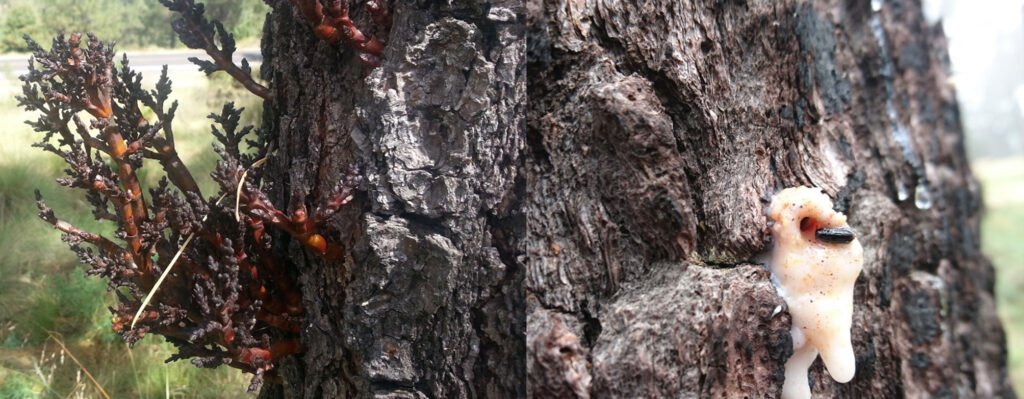
El trabajo en laboratorio permitió identificar al escarabajo de los pinos de montaña Dendroctonus adjunctus (fig. 2) afectando al pino de las alturas (P. hartwegii), mismo que ha sido reportado en esta ANP desde 1963 (Conanp, 2006). En esta investigación se determinó que 24% de los sitios presentan brotes activos (52 sitios) y 15% solo con presencia (32 sitios).
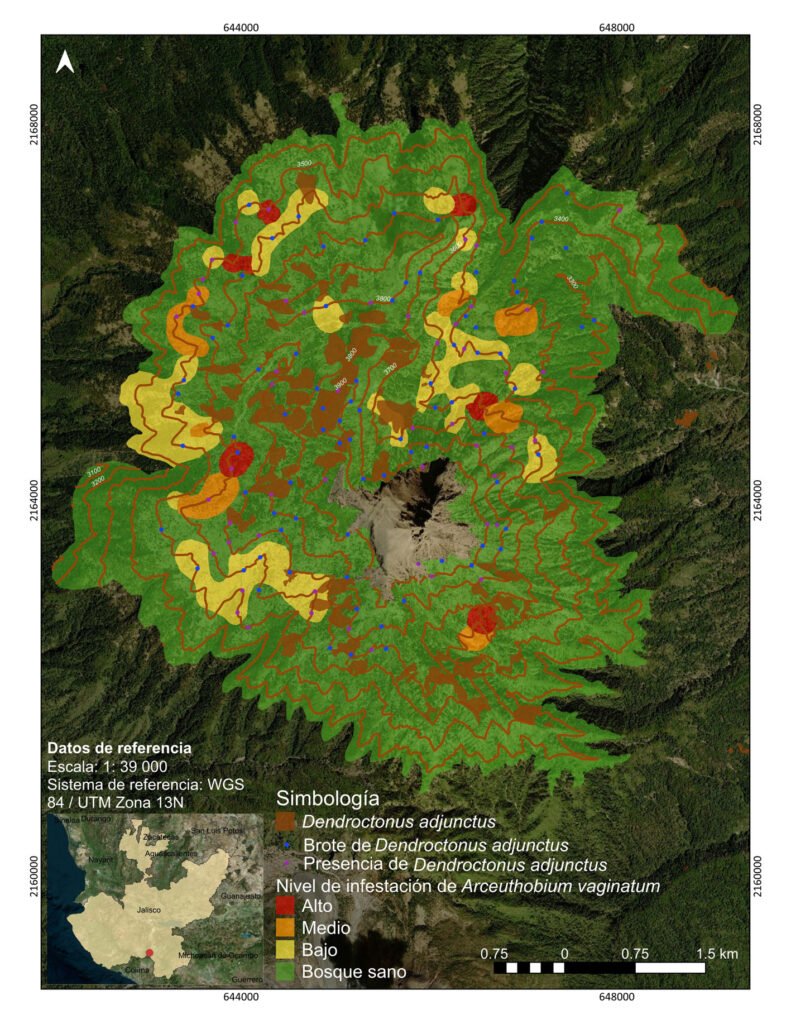
Las colectas de material botánico permitieron identificar a la especie de muérdago enano Arceuthobium vaginatum, que para el PNVNC ya había sido reportado por Ruiz (1994) y Endara et al. (2023) y cubre una superficie de 417 ha (14%), mientras que el descortezador abarca 209 ha (7%), ambos parecen tener un patrón de distribución similar, ya que más de 70% de la superficie se concentra en la ladera oeste en torno al Volcán Nevado de Colima (fig. 3). Respecto a la altitud, tanto el muérdago como el descortezador están distribuidos desde 3,500 y hasta 3,900 m snm, el descortezador en polígonos grandes y continuos, el muérdago en parches más dispersos (de arbolado juvenil y con niveles de infestación: bajo 298 ha, medio 79 ha y alto 39 ha).
Figura 2. Izquierda, Arceuthobium vaginatum; derecha, Dendroctonus adjunctus en Pinus hartwegii.
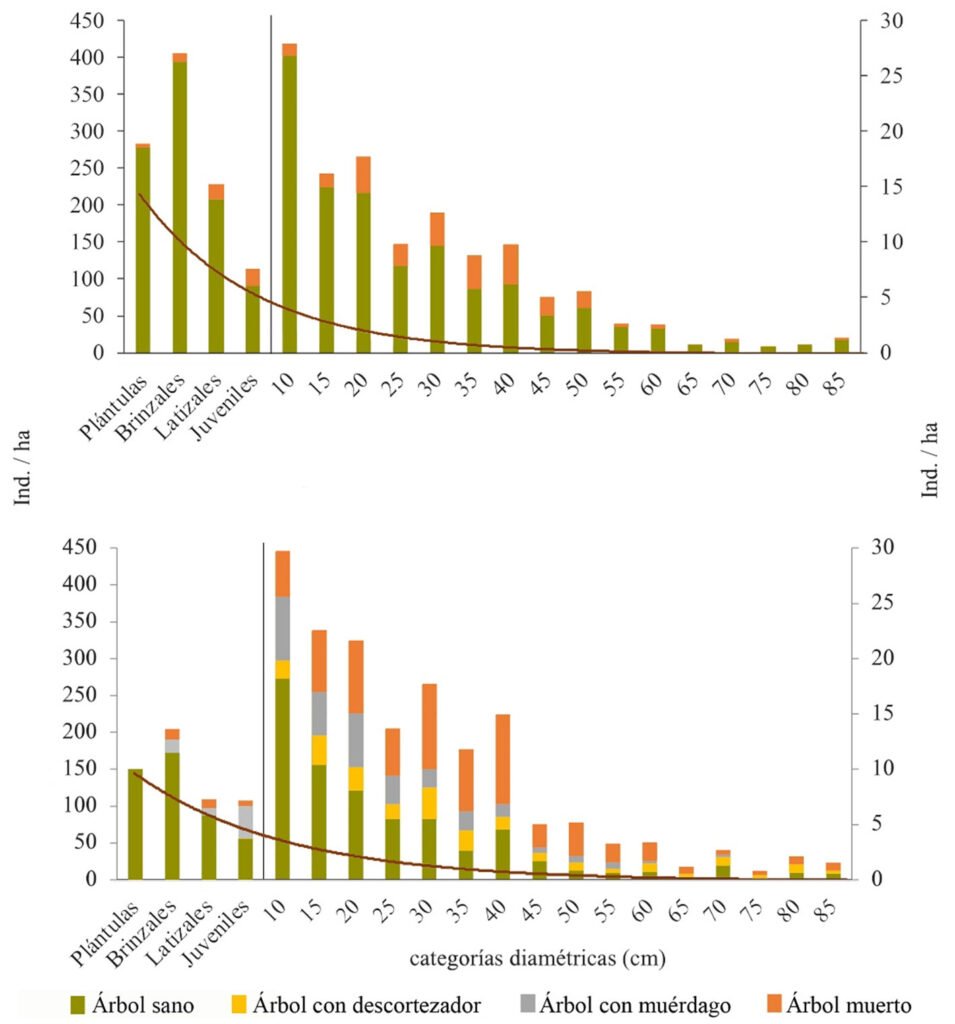
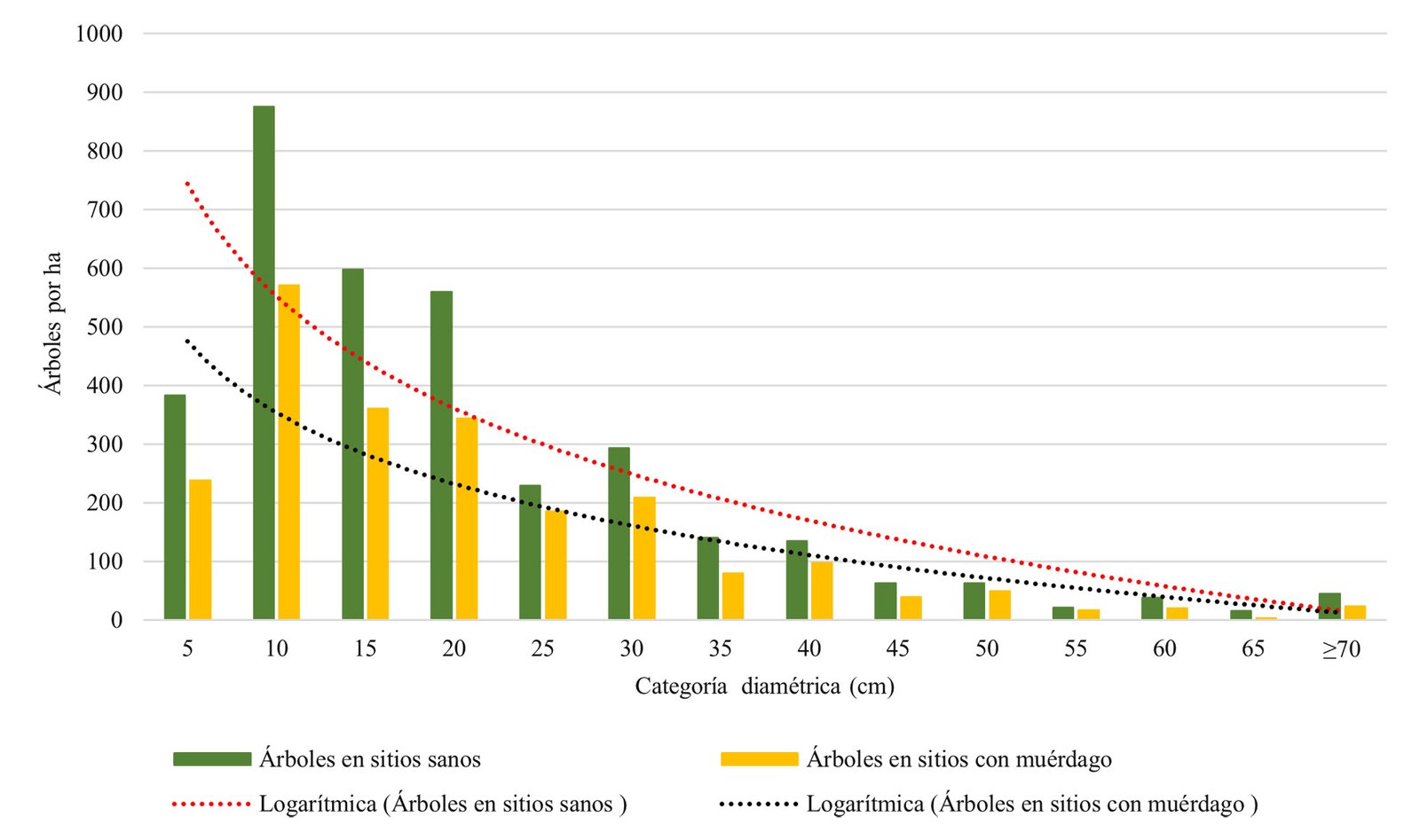
La distribución de la estructura horizontal muestra una marcada diferencia entre los sitios con y sin muérdago y descortezador; en primer lugar, es notoria la reducción del número de árboles sanos, provocada por el establecimiento, tanto de muérdago como de descortezador, misma que se refleja en 48% menos en las categorías de regeneración y 59% menos en arbolado adulto (categorías 10-85 cm); en segundo lugar, la ausencia de arbolado con potencial semillero (> 35 cm) puede comprometer el establecimiento de la regeneración natural de la especie (fig. 4).
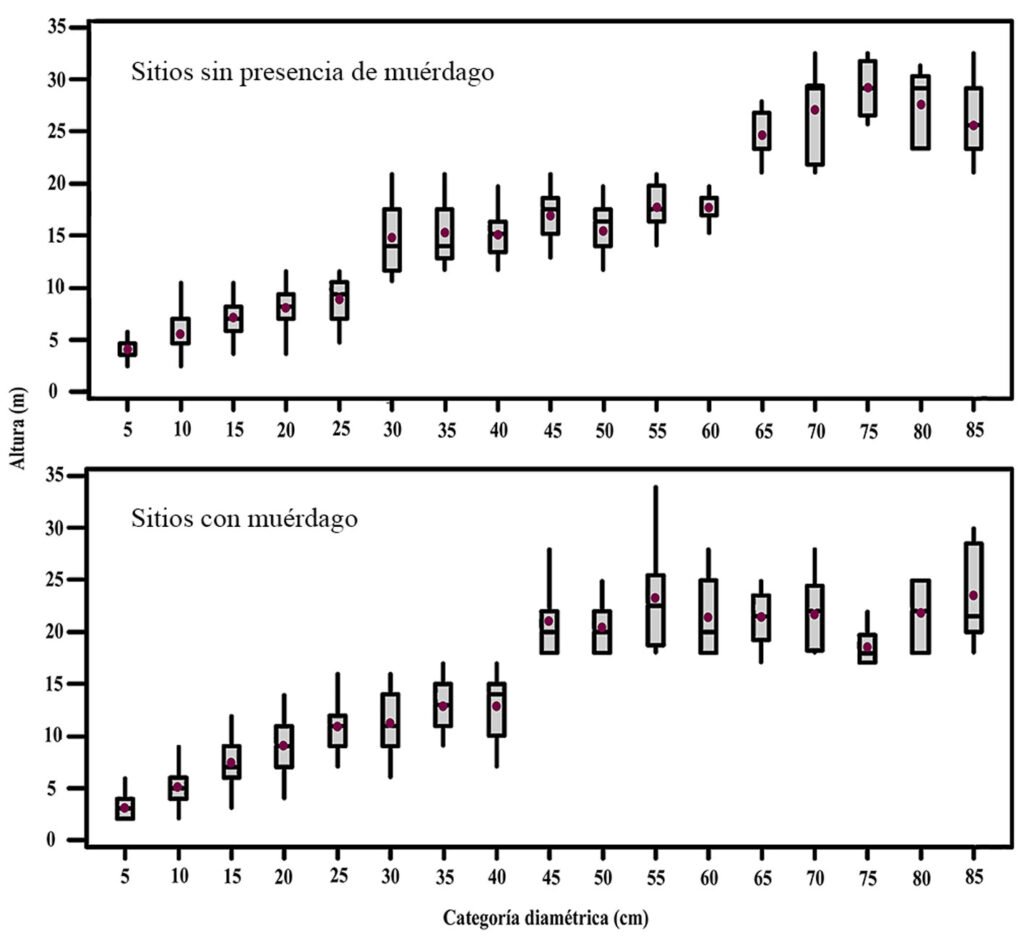
El Anova utilizado para conocer la distribución del arbolado agrupado por sus alturas en sitios sanos e infestados muestra la presencia de 3 estratos bien diferenciados en el bosque sin infestaciones y solo 2 en el bosque infestado (fig. 5); esto atribuido a la mortalidad de arbolado adulto en zonas con brotes activos de descortezador.
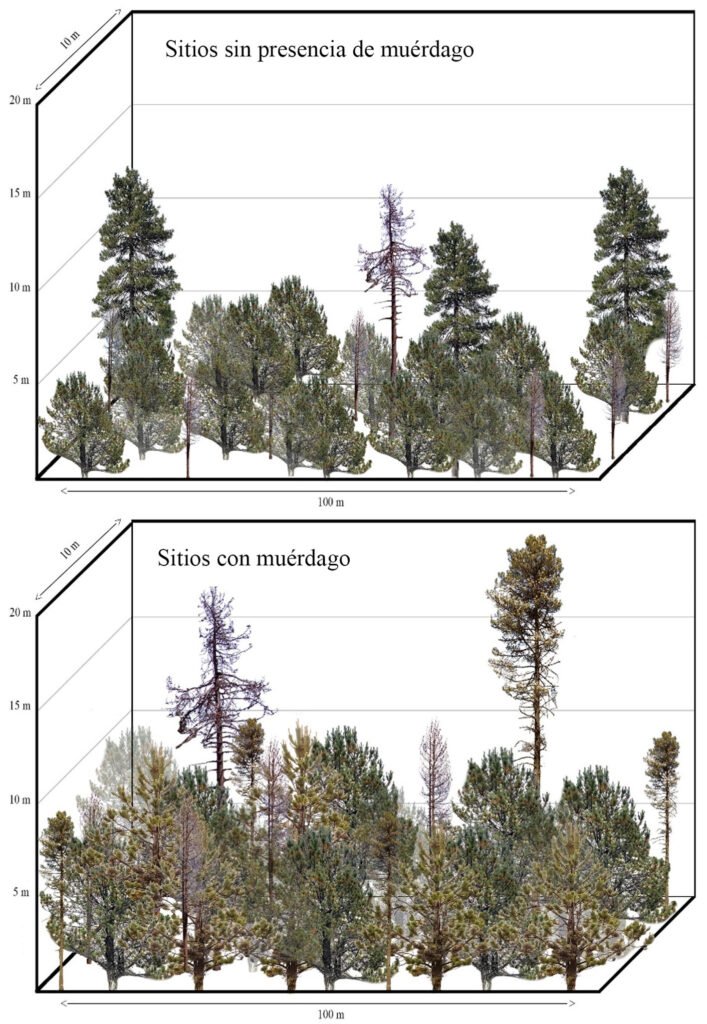
La representación gráfica del estrato arbóreo muestra que, el bosque sin infestación, pese a presentar 3 estratos en el análisis estadístico, el número de árboles del estrato superior no es representativo (4 ind./ha-1), ya que al graficar un bosque de 1,000 m2, éste desaparece, atribuido a la baja densidad de estos bosques (236 ind./ha-1). Por otra parte, los bosques infestados presentan una densidad mayor (263 ind./ha-1), esto se explica por la preferencia del descortezador por arbolado adulto, mismos que conforman los bosques densos del parque nacional (fig. 6).
Discusión
El descortezador de los pinos de montaña (Dendroctonus adjunctus) se distribuye en el centro de México sobre los principales sistemas montañosos (García-Navarrete et al., 2021), donde su impacto es mayor (Pérez-Miranda et al., 2021). La presencia de los escarabajos descortezadores de montaña está directamente relacionada con el establecimiento de muérdagos enanos; Endara et al. (2023) reportaron que más de 50% de los árboles enfermos en el Monte Tláloc y Nevado de Toluca presentan la sinergia de ambos patógenos. En el presente estudio, se reporta que 14% de la superficie del bosque de pino (Pinus hartwegii) está afectado por Arceuthobium vaginatum y 7% por D. adjunctus. En términos de superficie, el Nevado de Colima es la única montaña donde se pudo cuantificar la superficie infestada por descortezadores debido a la afectación en parches pequeños de bosques densos de arbolado adulto, esto parece favorecer su dispersión gradual hacia los árboles sanos en torno a los sitios de arbolado muerto en pie con brotes activos hacia los bordes. Al respecto, Cuellar et al. (2013) y Ruiz-González et al. (2018), reportan que, a mayor densidad de arbolado, aumenta el riesgo de la infestación por descortezadores del género Dendroctonus; esto concuerda con lo encontrado en este estudio, ya que los bosques densos son los que presentan mayor cantidad de arbolado muerto por descortezador. En contraste, Sosa et al. (2018) señalan que las altas densidades del arbolado no parecen ser los sitios favoritos para el escarabajo, aunque esto pueda deberse a que dicho estudio no se realizó en sitios de condición de infestación masiva.
Figura 3. Distribución espacial de muérdago enano y descortezador. Fuente: Endara et al. (2023) y trabajo de campo.
Lo anterior, aunado a que la presencia de Dendroctonus, es mayor en diámetros más grandes (Vázquez-Ochoa et al., 2022), provoca la reducción del número de árboles semilleros y, por lo tanto, puede comprometer el establecimiento de la regeneración natural. Por un lado, el descortezador está causando mortalidad en arbolado adulto (muchos de ellos semilleros), por el otro, el muérdago está atacando arbolado juvenil, esta combinación crea condiciones que puede contribuir a una mayor vulnerabilidad de los bosques (Aguirre et al., 2024), además de afectar en gran medida al establecimiento de la regeneración natural, ya que se ha registrado que la infección de muérdago enano reduce el éxito reproductivo del árbol y, a su vez, disminuye el reclutamiento (Queijeiro-Bolaños y Cano-Santana, 2015).
Dado que la homogeneidad en estructura y edad de los bosques son determinantes para la incidencia de insectos descortezadores (Raffa et al., 2008), la afectación de arbolado adulto y juvenil altera la distribución de la estructura vertical del bosque y ocasiona la desaparición del dosel dominante, ésto incrementa la vulnerabilidad de estos bosques ante incendios forestales y estrés de calor (Quintero-Gradilla et al., 2019), ya que no cuentan con un estrato superior bien definido, que cumple la función de dar sombra a los estratos medio e inferior. Además, dicho estrato protege a los árboles jóvenes de eventos climáticos como huracanes con rachas de viento de alta intensidad.
El clima es otra variable importante que limita la dispersión de los descortezadores, principalmente en la temporada de invierno (García-Navarrete et al., 2021). Sin embargo, las temperaturas en las zonas altas del país están incrementando (Sáenz et al., 2020), dados estos escenarios climáticos futuros, D. adjunctus probablemente alcanzará sitios altitudinales superiores (Estrada-Contreras et al., 2022). En el presente estudio, el escarabajo descortezador alcanza 3,900 m snm, mientras que, Salinas-Moreno et al. (2010) reportaron a D. adjunctus en intervalo de 3,100 y 3,500 m snm. Al mismo tiempo, el hospedero también migrará altitudinalmente, pues las zonas bajas del parque prácticamente carecen de arbolado adulto del pino de las alturas, esto probablemente debido a que el incremento actual del clima está reduciendo el vigor de P. hartwegii en las partes bajas, provocada por las altas temperaturas (Gallardo-Salazar et al., 2023).
Figura 4. Efecto de Arceuthobium vaginatum y Dendroctonus adjunctus sobre la estructura de Pinus hartwegii. Arriba, sitios sin muérdago descortezador; abajo sitios atacados por ambos patógenos.Figura 5. Estimación del estrato arbóreo en Pinus hartwegii (estructura vertical).
Las poblaciones del insecto descortezador han aumentado en años recientes, especialmente en la zona norte y centro de su distribución (Vázquez-Ochoa et al., 2022), además, los mayores brotes de descortezadores en México han ocurrido en el Eje Neovolcánico Transversal (del-Val y Sáenz-Romero, 2017). En este sentido y dado que, D. adjunctus presenta un comportamiento agresivo de colonización (Armendáriz-Toledano et al., 2018), produce alta mortalidad de pino, por lo que es necesario incorporar medidas de prevención para reducir sus afectaciones, principalmente sobre arbolado semillero y juvenil, y así disminuir los daños y cambios en la dinámica y estructura de los bosques.
El bosque de Pinus hartwegii del Parque Nacional Volcán Nevado de Colima está siendo afectado por Arceuthobium vaginatum y Dendroctonus adjunctus. La ladera oeste en torno al volcán Nevado de Colima es la más afectada, por un lado, el descortezador se distribuye en los bosques densos de arbolado adulto entre 3,600 y 3,800 m snm; mientras que el muérdago se establece en bosques fragmentados de arbolado juvenil entre 3,500 y 3,600 m snm, con pendientes ligeras y mayor exposición al sol. En ambos casos, los niveles de infestación afectan la estructura y comprometen la regeneración natural de P. hartwegii.
El 20% de la superficie muestreada presenta el establecimiento de uno u otro patógeno, por lo que, es necesario dar seguimiento a la dinámica de estas poblaciones, ya que pueden alterar el equilibrio natural de este ecosistema, principalmente en términos de estructura y regeneración del bosque.
Figura 6. Representación gráfica de la estructura vertical de poblaciones de Pinus hartwegii.
Agradecimientos
A los directivos del Parque Nacional Nevado de Colima y a la Conanp por su aprobación para la realización del estudio. Un agradecimiento especial al Grupo de Alta Montaña, quienes nos apoyaron en el trabajo de campo. Este estudio fue financiado por el proyecto Conacyt-Conafor/A3-S-130105.
Referencias
Aguirre, Z. J., Heredia, B. R., Franco, M. S, Fredericksen, T. S. y Endara, A. A. (2014). Occurrence and effect of dwarf mistletoe (Arceuthobium globosum and A. vaginatum) in high-elevation forests in México. Trees, Forests and People, 18, 100706. https://doi.org/10.1016/j.tfp.2024.100706.
Armendáriz-Toledano, F. y Zúñiga, G. (2017). Illustrated key to species of genus Dendroctonus (Coleoptera: Curculionidae) occurring in Mexico and Central America. Journal of Insect Science, 17, 34. https://doi.org/10.1093/jisesa/iex009
Armendáriz-Toledano, F., Zúñiga, G., García-Román, J., Valerio-Mendoza, O. y García-Navarrete, P. G. (2018). Guía ilustrada para identificar a las especies del género Dendroctonus presentes en México y Centroamérica. Ciudad de México: Red Temática de Salud Forestal/ Consejo Nacional de Ciencia y Tecnología/ Instituto Politécnico Nacional.
Billings, R. F. y Espino, V. (2005). El gorgojo descortezador del pino (Dendroctonus frontalis) en Centroamérica: cómo reconocer, prevenir y controlar plagas. Texas, USA: Texas Forest Service Publication.
Chávez-Salcedo, L. F., Queijeiro-Bolaños, M. E., López-Gómez, V., Cano-Santana, Z., Mejía-Recamier, B. E. y Mojica-Guzmán, A. (2018). Contrasting arthropod communities associated with dwarf mistletoes Arceuthobium globosum and A. vaginatum and their host Pinus hartwegii. Journal of Forestry Research, 29, 1351–1364. https://doi.org/10.1007/s11676-017-0544-y
Christiansen, E. y Bakke, A. (1988). The spruce bark beetle of Eurasia. En A. Berryman (Ed.), Dynamics of forest insect populations: patterns, causes, implications (pp. 479–503). Boston, MA: Springer US. https://doi.org/10.1007/978-1-4899-0789-9_23
Cibrián-Tovar, D., Méndez-Montiel, J. T., Campos-Bolaños, R., Tates III, H. O. y Flores-Lara, J. E. (1995). Insectos forestales de México. México D.F.: Universidad Autónoma Chapingo.
Collins, B. J., Rhoades, C. C., Hubbard, R. M. y Battaglia, M. A. (2011). Tree regeneration and future stand development after bark beetle infestation and harvesting in Colorado lodgepole pine stands, Forest Ecology and Management, 261, 2168–2175. https://doi.org/10.1016/j.foreco.2011.03.016
Conanp (Comisión Nacional de Áreas Naturales Protegidas). (2006). Programa de Conservación y Manejo Parque Nacional Volcán Nevado de Colima. México: Comisión Nacional de Áreas Naturales Protegidas.
Cuéllar-Rodríguez, G., Equihua-Martínez, A., Villa-Castillo, J., Estrada-Venegas, E. G., Méndez-Montiel, T. y Romero-Nápoles, J. (2013). Análisis espacio-temporal de los bosques de Pinus cembroides Zucc. atacados por Dendroctonus mexicanus Hopkins. Revista Mexicana de Ciencias Forestales, 4, 42–49. https://doi.org/10.29298/rmcf.v4i17.419
Dauber, E. (1995). Guía práctica y teórica para el diseño de un inventario forestal de reconocimiento. Santa Cruz. BOLFOR.
del-Val, E. y Sáenz-Romero, C. (2017). Insectos descortezadores (Coleoptera: Curculionidae) y cambio climático: problemática actual y perspectivas en los bosques templados. TIP. Revista Especializada en Ciencias Químico-Biológicas, 20, 53–60. https://doi.org/10.1016/j.recqb.2017.04.006
DOF (Diario Oficial de la Federación). (2018). NORMA OFICIAL MEXICANA NOM-019-SEMARNAT-2017 lineamientos técnicos para la prevención, combate y control de insectos descortezadores. México D.F.
Endara, A. R., Calderón-Contreras, R., Nava-Bernal, G. y Franco, S. (2013). Analysis of fragmentation processes in high-mountain forests of the Centre of Mexico. American Journal of Plant Sciences, 4, 697–704. https://doi.org/10.4236/ajps.2013.43A088
Endara, A. R., Heredia, R. L., García, L. A., Luna, A. A. y Aguirre, J. J. (2023). Distribución espacial del descortezador Dendroctonus adjunctus Blandford, 1897 (Coleoptera: Curculionidae, Scolytinae) en dos bosques de alta montaña del centro de México. Acta Zoológica Mexicana, 39, e3911. https://doi.org/10.21829/azm.2023.3912569
Endara-Agramont, A. R., Heredia-Bodadilla R. L., García-Almaraz, L. A., Luna-Gil, A. A., Franco-Mass, S. y Cibrián-Llanderal, V. D. (2022). Factores asociados con la distribución espacial de muérdagos enanos en dos poblaciones de Pinus hartwegii del centro de México. Revista Mexicana de Biodiversidad, 93, e935008. https://doi.org/10.22201/ib.20078706e.2022.93.5008
Estrada-Contreras, I., Ruiz-Montiel, C., Ibarra-Zavaleta, S. P., Sánchez-Velásquez, L. R., Hoyos-Rivera, G. J., Cristóbal-Salas, A. et al. (2022). Predicting distribution overlaps between Dendroctonus adjunctus Blandford 1897 and six Pinus species in Mexico under global climate change. Canadian Journal of Forest Research, 52, 1201–1211. https://doi.org/10.1139/cjfr-2022-0022
Farjon, A., de la Rosa, J. A. P. y Styles, B. T. (1997). A field guide to the pines of Mexico and Central America. Kew, Reino Unido: Royal Botanic Gardens.
Farrell, B. D., Sequerira, A. S., O’Meara, B. C., Normark, B. B., Chung, J. H. y Jordal, B. H. (2001). The evolution of agriculture in beetles (Curculionidae Scolytinae and Platypodinae). Evolution, 55, 2011–2027. https://doi.org/10.1111/j.0014-3820.2001.tb01318.x
Ferrenberg, S. (2020). Dwarf mistletoe infection interacts with tree growth rate to produce opposing direct and indirect effects on resin duct defenses in lodgepole pine. Forests, 11, 222. https://doi.org/10.3390/f11020222
Gallardo-Salazar, J. L., Lindig-Cisneros, R. A., López-Toledo, L., Endara-Agramont, A. R., Blanco-García, A. y Sáenz-Romero, C. (2023). Analysis of the vigor of Pinus hartwegii Lindl. along an altitudinal gradient using uav multispectral images: evidence of forest decline possibly associated with climatic change. Forests, 14, 1176. https://doi.org/10.3390/f14061176
García-Navarrete, P. G., Soria-Ortiz, G. J. y González-Salazar, C. (2021). Interacciones potenciales parásito-hospedero entre el escarabajo Dendroctonus (Coleoptera: Scolytidae) y Pinus (Pinaceae) en México. Revista de Biología Tropical, 69, 1004–1022. https://doi.org/10.15517/rbt.v69i3.45910
Gernandt, D. S. y Pérez-de la Rosa, J. A. (2014). Biodiversidad de Pinophyta (coníferas) en México. Revista Mexicana de Biodiversidad, 85 (Suplem.), S126–S133. https://doi.org/10.7550/rmb.32195
Hawksworth, F. (1983). Mistletoes as forest parasites. En M. Calder y P. Bernhardt (Eds.), The biology of mistletoes (pp. 320–329). Nueva York: Academic Press.
Klutsch, J. G., Beam, R. D., Jacobi, W. R. y Negrón, J. F. (2014). Bark beetles and dwarf mistletoe interact to alter downed woody material, canopy structure, and stand characteristics in northern Colorado ponderosa pine, Forest Ecology and Management, 315, 63–71. https://doi.org/10.1016/j.foreco.2013.12.024
Lanier, G. N., Hendrichs, J. P. y Flores, J. E. (1988). Biosystematics of the Dendroctonus frontalis (Coleoptera: Scolytidae) complex. Annals of the Entomological Society of America, 81, 403–418. https://doi.org/10.1093/aesa/81.3.403
Lombardero, M. J., Ayres, M. P., Lorio Jr., P. L. y Ruel, J. J. (2002). Environmental effects on constitutive and inducible resin defenses of Pinus taeda. Ecology Letters, 3, 329–339. https://doi.org/10.1046/j.1461-0248.2000.00163.x
Macías, S. J., Domínguez, A. N., López, J. C. y Mérida, R. A. (2004). Monitoreo de descortezadores y sus depredadores mediante el uso de semioquímicos. Manual operativo. Tapachula, Chiapas, México: ECOSUR/ Conafor/ Comisión Nacional de Áreas Naturales Protegidas/ USDA Forest Service.
Martínez, S. M., Madrigal, H. S., Vázquez, C. I., Velasco, B. E., Morales, N. C. y Villareal, G. F. (2015). Efecto de Arceuthobium vaginatum (Willd.) Presl. subsp. vaginatum en Pinus hartwegii Lindl. en Colima. Revista Mexicana de Ciencias Forestales, 6, 44–55. https://doi.org/10.29298/rmcf.v6i29.215
Martínez-Martínez, N., Ramírez-Dávila, J. F., Lara-Vázquez, F. y Figueroa-Figueroa, D. K. (2021). Distribución espacial de muérdago enano en la Reserva de la Biosfera Mariposa Monarca. Colombia Forestal, 22, 65–81. https://doi.org/10.14483/2256201X.17163
Mathiasen, R. L. (2019). Susceptibility of red fir and white fir to fir dwarf mistletoe (Arceuthobium abietiunum) in California. Forest Pathology, 2019, e12516. https://doi.org/10.1111/efp.12516
Mayer, H. y Ott, E. (1991). Gebirgswaldabau-Schutzwaldpflege: ein waldbauulicher Beitrag zur Landschaftsokologie und zum Umweltschutz (Silviculture in mountain forest-management of protection forest: a silvicultural contribution to landscape ecology and environmental protection). 2a Ed. Gustav Fischer, Stuttgart.
Pérez-Miranda, R., González-Hernández, A., Velasco-Bautista, E., Romero-Sánchez, M. E., Arriola-Padilla, V. J., Acosta-Mireles, M. et al. (2021). Análisis temporal de la distribución de Dendroctonus mexicanus Hopkins (1905) en México (2009-2018). Revista Mexicana de Ciencias Forestales, 12, 27–55. https://doi.org/10.29298/rmcf.v12i67.1079
Perusquía, O. J. (1978). The pine bark beetles, Dendroctonus spp.: taxonomy and distribution. Boletín Técnico Núm. 55. México D.F.: Instituto de Investigaciones Forestales, Secretaría de Agricultura y Recursos Hidráulicos.
Queijeiro-Bolaños, M. E. y Cano-Santana, Z. (2015). Dinámica temporal de la infestación por muérdago enano (Arceuthobium globosum y A. vaginatum) en Zoquiapan (Parque Nacional Iztaccíhuatl Popocatépetl), México. CienciaUAT, 9, 6–14. https://doi.org/10.29059/cienciauat.v9i2.705
Queijeiro-Bolaños, M., Cano-Santana, Z. y García-Guzmán, G. (2014). Incidence, severity, and aggregation patterns of two sympatric dwarf mistletoe species (Arceuthobium spp.) in Central Mexico. European Journal of Forest Research, 133, 297–306. https://doi.org/10.1007/s10342-013-0762-6
Quintero-Gradilla, S. D., Jardel-Peláez, E. J., Cuevas-Guzmán, R., García-Oliva, F. y Martínez-Yrizar, A. (2019). Cambio postincendio en la estructura y composición del estrato arbóreo y carga de combustibles en un bosque de Pinus douglasiana de México. Madera y Bosques, 25, 1–14. https://doi.org/10.21829/myb.2019.2531888
Raffa, K. F., Aukema, B. H., Bentz, B. J., Carroll, A. L., Hicke, J. A., Turner, M. G. et al. (2008). Cross-scale drivers of natural disturbances prone to anthropogenic amplification: the dynamics of bark beetle eruptions. BioScience, 58, 501–517. https://doi.org/10.1641/B580607
Rojas-García, F., Fredericksen, T.S., Vazquez-Lozada, S. y Endara-Agramont, A. R. (2019). Impact of timber harvesting on carbon storage in montane forests of central Mexico. New Forests, 50, 1043–1061. https://doi.org/10.1007/s11056-019-09714-z
Ruiz, M. M. A. (1994). Estudio taxonómico de los muérdagos(Loranthaceae)del Nevado de Colima y Volcán de Fuego, Jalisco-Colima, México(Tesis). División de Ciencias Biológicas y Ambientales, CUCBA. Universidad de Guadalajara, México.
Ruiz-González, C. G., Méndez-González, J., Cambrón-Sandoval, H., García-Aranda, A., Montoya-Jiménez, C. y Sosa-Díaz, L. (2018). Distribución altitudinal y estacional de Dendroctonus adjunctus Blandford y Dendroctonus brevicomis Leconte en Coahuila, México. Revista Fitotec- nia Mexicana, 41, 519–526. https://doi.org/10.35196/rfm.2018.4-A.519-526
Rzedowski, J. y Calderón, R. C. (2011). Flora del bajío y de regiones adyacentes. VISCACEAE, Fascículo 170. Instituto de Ecología, A.C. Centro Regional del Bajío, Pátzcuaro, Mich.
Sáenz-Romero, C., Mendoza-Maya, E., Gómez-Pineda, E., Blanco-García, A., Endara-Agramont, A., Lindig-Cisneros, R. et al. (2020). Recent evidence of Mexican temperate forest decline and the need for ex situ conservation, assisted migration, and translocation of species ensembles as adaptive management to face projected climatic change impacts in a megadiverse country. Canadian Journal of Forest Research, 50, 843–854. https://doi.org/10.1139/cjfr-2019-0329
Salinas-Moreno, Y., Mendoza, G. M., Barrios, M. A., Cisneros, R., Macías-Sámano, J. y Zúñiga, G. (2004). Areography of the genus Dendroctonus (Coleoptera: Curculionidae: Scolytinae) in Mexico. Journal of Biogeography, 31, 1163–1177. https://doi.org/10.1111/j.1365-2699.2004.01110.x
Salinas-Moreno, Y., Vargas, C. F., Zúñiga, G. J., Ager, A. y Hayes, J. L. (2010) Atlas de distribución geográfica de los descortezadores del género Dendroctonus (Curculionidae: Scolytinae) en México. Ciudad de México: Instituto Politécnico Nacional/ Comisión Nacional Forestal.
Sánchez-González, A. (2008). Una visión actual de la diversidad y distribución de los pinos de México. Madera y Bosques, 14, 107120. https://doi.org/10.21829/myb.2008.1411222
Sibson, R. (1982). A brief description of natural neighbor interpolation. En John Wiley y Sons (Eds.), Interpolating multivariate data (pp. 21–36). Nueva York.
Sivicoff (2022). Programa operativo estatal de sanidad forestal para el estado de Jalisco. Zapopan, Jalisco. Comité Técnico Estatal de Sanidad Forestal Jalisco, Comisión Nacional Forestal.
Sosa, D. L., Méndez, G. J., García, A. M., Cambrón, S. V., Villarreal, Q. J., Ruiz, G. C. et al. (2018). Distribución potencial de barrenadores, defoliadores, descortezadores y muérdagos en bosques de coníferas de México. Revista Mexicana de Ciencias Forestales, 9, 187–208. https://doi.org/10.29298/rmcf.v9i47.159
Styles, B. T. (1993). Genus Pinus: a Mexican purview. (pp. 397-420). En T. P. Ramamoorthy y A. Lot (Eds.), Biological diversity of Mexico: origins and distribution (pp. 397–420). New York: Oxford University Press.
Vázquez-Ochoa, M. F., Sánchez-Velásquez, L. F., Hernández-Vargas, G., Ibarra-Zavaleta, S. P., Ruiz-Montiel, C. y Pineda-López, M. (2022). La presencia de Dendroctonus es diferente entre especies de pinos y sus diámetros en la región del Parque Nacional Cofre de Perote, México. Revista Mexicana de Biodiversidad, 93, e934048. https://doi.org/10.22201/ib.20078706e.2022.93.4048
Villaseñor, J. L. (2016). Checklist of the native vascular plants of Mexico. Revista Mexicana de Biodiversidad, 87, 559–902. https://doi.org/10.1016/j.rmb.2016.06.017
Wood, D. L. (1982). The role of pheromones, kairomones, and allomones in the host selection and colonization behavior of bark beetles. Annual Review of Entomology, 27, 411–446. https://doi.org/10.1146/annurev.en.27.010182.002211
Pseudoregma panicola (Hemiptera: Aphididae), un registro nuevo sobre Arundo donax y su potencial como plaga urbana en México
Ana Lilia Muñoz-Viveros a, Damaris Arce-Lara a, Rebeca Peña-Martínez b, Alfonso David Ríos-Pérez c, Álvaro de Obeso-Fernández del Valle c, Juan Manuel Vanegas-Rico a, *
a Universidad Nacional Autónoma de México, Facultad de Estudios Superiores Iztacala, Unidad de Morfología y Función, Laboratorio de Control de Plagas, Av. de los Barrios No. 1, Los Reyes Iztacala, 54090 Tlalnepantla de Baz, Estado de México, Mexico
b Instituto Politécnico Nacional, Escuela Nacional de Ciencias Biológicas, Prolongación de Carpio y Plan de Ayala, Sto. Tomás, 11340 Ciudad de México, Mexico
c Tecnológico de Monterrey, Departamento de Bioingeniería, Escuela de Ingeniería y Ciencias, Av. Eugenio Garza Sada 2501, 64849 Monterrey, Nuevo León, Mexico
Received: 30 April 2024; accepted: 28 February 2025
Abstract
Aphids are phytophagous insects that can affect the health of wild and urban vegetation, their effect being enhanced when they are exotic. The study was conducted in the garden of the Vasconcelos library, Mexico City. Insects were collected on ornamental Poaceae during December 2019, February 2020, and continued post-pandemic in 2023 (May-August 2023). Organisms were quantified and searched for natural enemies; morphological and molecular analyses of insects and plants were carried out. The aphid was determined as Pseudoregma panicola and Arundo donax as its host and first world report. Pseudoregma panicola and Arundo donax have molecular similarities with populations from Yunnan, China. The review of the scarce material from Mexico shows that P. panicola was collected from 1979 to 1981, on 3 wild species of Poaceae: ca. Phragmites in Morelos, Paspalum sp. and another undetermined species in Tamaulipas. The entomophagous present were: scarce larvae of Chamaemyiidae, and adults of the coccinellids Harmonia axyridis and Hippodamia convergens. The absence of parasitoids during 3 years of research, in addition to the low population of entomophagous, indicates an unfinished process of adaptation to this urban pest.
Keywords: Exotic insects; Poaceae; Chamaemyiidae
Resumen
Los áfidos son insectos fitófagos que pueden afectar la salud de la vegetación silvestre y urbana, cuyo efecto se potencia cuando son exóticos. El estudio se realizó en el jardín de la biblioteca Vasconcelos, Ciudad de México. Se recolectaron insectos sobre Poaceae ornamentales durante diciembre 2019, febrero 2020 y se continuó postpandemia en 2023 (mayo a agosto 2023). Se cuantificaron los organismos y se buscaron enemigos naturales; se realizaron análisis morfológicos y moleculares de los insectos y la planta. Se determinó el áfido como Pseudoregmapanicola y Arundo donax como su hospedante, lo cual constituye el primer reporte mundial. Pseudoregma panicola y Arundo donax tienen cercanía molecular con poblaciones de Yunnan, China. La revisión del escaso material de colección en México muestra que P. panicola se recolectó de 1979 a 1981, sobre 3 especies silvestres de Poaceae:ca. Phragmites en Morelos, Paspalum sp. y otra especie sin determinar en Tamaulipas. Los entomófagos presentes fueron escasas larvas de Chamaemyiidae y adultos de los coccinélidos Harmonia axyridis e Hippodamia convergens. La ausencia de parasitoides durante 3 años de investigación, además de la baja población de entomófagos, indica un proceso inconcluso de adaptación de esta plaga urbana.
Aphids are among the most significant pest groups affecting urban vegetation (Tello et al., 2005). They damage a wide range of host plants by sucking the juices from leaves and stems and producing honeydew. The damage is evident through symptoms such as discolored, battered, and yellowed leaves, as well as stunted growth, which detracts from the aesthetics of green areas and could represent a disease reservoir (Peña-Martínez, 1992; Rozo-Lopez et al., 2023; Tubby & Webber, 2010). Phytosanitary inspections are crucial in urban areas to ensure healthy vegetation, which, in turn, contributes to thermal comfort and indirectly reduces the risks of diseases (Tochaiwat et al., 2023; Yang et al., 2023).
In Mexico City, one of the largest cities in the world, commercial and tourist activities may facilitate the introduction of insect pests. The incursion of exotic aphids to Mexico can lead to severe economic impacts, like those generated by M. sorghi (also cited as M. sacchari) in sorghum crops during 2015 and 2016 (Peña-Martinez et al., 2016; Rodríguez-del Bosque & Terán, 2015). Therefore, it is essential to promptly document the presence of these exotic phytophagous insects and their hosts to mitigate potential damage to agricultural activities (Barczak et al., 2021; Korányi et al., 2021). Consequently, this study aims to report the presence of the aphid Pseudoregma panicola in ornamental plants in Mexico City.
Materials and methods
The sampling site was the garden of the Vasconcelos Public Library, located in Mexico City (19°26’53.5” N, 99°09’01.8” W; 2,241 m asl). This garden was created in 2006 to refurbish the city’s train station and incorporates 168 plant species from different sites (garden staff, personal communication).
The sample period spans from December 2019 to February 2020, when we observed and collected pest insects weekly. Following the COVID-19 pandemic, sampling was restarted in January 2023 to follow up on maintenance staff observations about the pest on Poaceae specimens used as ornamentals. The fieldwork at each visit consisted of 2 steps: photographing leaves (adaxial and abaxial side) with aphid colonies, including a metal ruler as a size reference, and sampling of these leaves, preserving them in airtight plastic bags for subsequent processing (rearing, mounting, and identifying natural enemies) in the Laboratorio de Control de Plagas de la Facultad de Estudios Superiores, Iztacala, UNAM. At the same time, another part of the plant material was provided to the herbarium of the same institution for identification.
The photographs were edited with Gimp software ver. 2.10.32 (The GIMP Development Team, 2023) to obtain tricolor images (green = leaf area, red = aphid specimens, white = background), including a centimeter scale. Then, images were processed with Image J software ver. 11 (Rasband, 2018) to estimate the area covered by the aphids on the adaxial and abaxial sides of the leaves. The abundance was calculated and compared with the M. sorghi infestation counting scale proposed for sorghum leaves (Bowling et al., 2015), using the original photos and Image J. Means and standard errors were calculated using SPSS software ver. 24.0 (IBM, 2016).
Some aphid specimens were processed according to the technique described by Blackman and Eastop (1994) and were identified according to the Noordam keys (1991). Part of the specimen material was preserved in 96% ethanol and kept refrigerated. Later, it was sent to the Laboratorio de Estrategias Ambientales y Fitotecnologías, of the Departmento de Bioingeniería at the Tecnológico de Monterrey for DNA extraction.
Molecular analyses were performed using cytochrome c oxidase I (COI) as suggested by several publications for aphids (Corsini et al., 1999; Folmer et al., 1994; Nováková et al., 2013; Zhang et al., 2011). A PCR reaction to amplify a COI fragment was performed using the primers LCOI490 and HCO2198 (Folmer et al., 1994). The reaction was performed using a denaturing step of 95° for 3 min, followed by 35 cycles of 95° for 1 min, 45° for 1.5 min, and 72° for 1 min, and finishing with an extension of 3 min at 72°. The amplicon was purified using a QIAGEN PCR Purification Kit following the manufacturer’s instructions. Finally, the amplicon was sequenced using Sanger sequencing with the same primers, and the sequence was uploaded to NCBI with the accession number PQ196704. Once the sequence was obtained, a BLAST was performed to identify the organism (Altschul et al., 1990). Similar sequences were downloaded, cropped, and aligned (muscle algorithm) using MEGA XI when the organisms were identified. A phylogenetic tree was created using maximum likelihood (Tamura et al., 2021).
An ecological niche model was made with the field records in Mexico (by the authors) and from the Global Biodiversity Information Facility (GBIF.org, 2024) in Darwin Core format. The obtained data were subjected to 2 debugging processes: elimination of those records with coordinates 0 and 0, and elimination of duplicate data. Climatological variables were downloaded from WorldClim at a resolution of 5 arc minutes (≈ 10 km2) (Fick & Hijmans, 2017). The variables combining temperature and precipitation information, Bio8 – Mean temperature of the wettest quarter, Bio9 – Mean temperature of the driest quarter, Bio18 – Precipitation of the warmest quarter, and Bio19 – Precipitation of the coldest quarter, were removed due to the spatial anomalies they generate (Escobar et al., 2014).
The remaining 15 variables were used globally (except Antarctica) to avoid the risk of niche truncation (Chevalier et al., 2022). The variables were entered into the Niche A software (Qiao et al., 2016), and a principal component analysis (PCA) was performed. The 15 components were used to conduct ecological niche modeling based on the calibration zone and a 0.5-degree buffer (M, of the BAM model, Soberón et al., 2017). Using the ntbox package, more than 400 possible models were built within R, of which the one with the best omission and commission rates was kept (Osorio-Olvera et al., 2020). The resulting model was subjected to the MOP (Mobility-Oriented Parity) validation test, and only those regions that showed a low risk of extrapolation (near 1) were used (Owens et al., 2013).
Results
According to taxonomic identification and molecular test results, the specimens corresponded to Pseudoregma panicola (Takahashi) (Fig. 1). The host plant was determined by Izta Herbarium as Arundo donax L. The population density of P. panicola on this plant was estimated at 255 ± 65.4 individuals (range 75-750) per colony/leaf, with a more significant presence on the abaxial side, representing 46% of its cover. The leading group of associated entomophagous insects were silver fly larvae (Diptera: Chamaemyiidae), with an average abundance of 2.4 ± 0.8 (range 1-5) individuals/leaf over 3 years, besides a few adults of coccinellids (Coleoptera: Coccinellidae), Hippodamia convergens L., and Harmonia axyridis Pallas (0.12 ± 0.01 individuals per leaf/year). The population density of all predators was low compared to the pests. In the case of coccinellids, they were occasional, and immatures were not obtained.
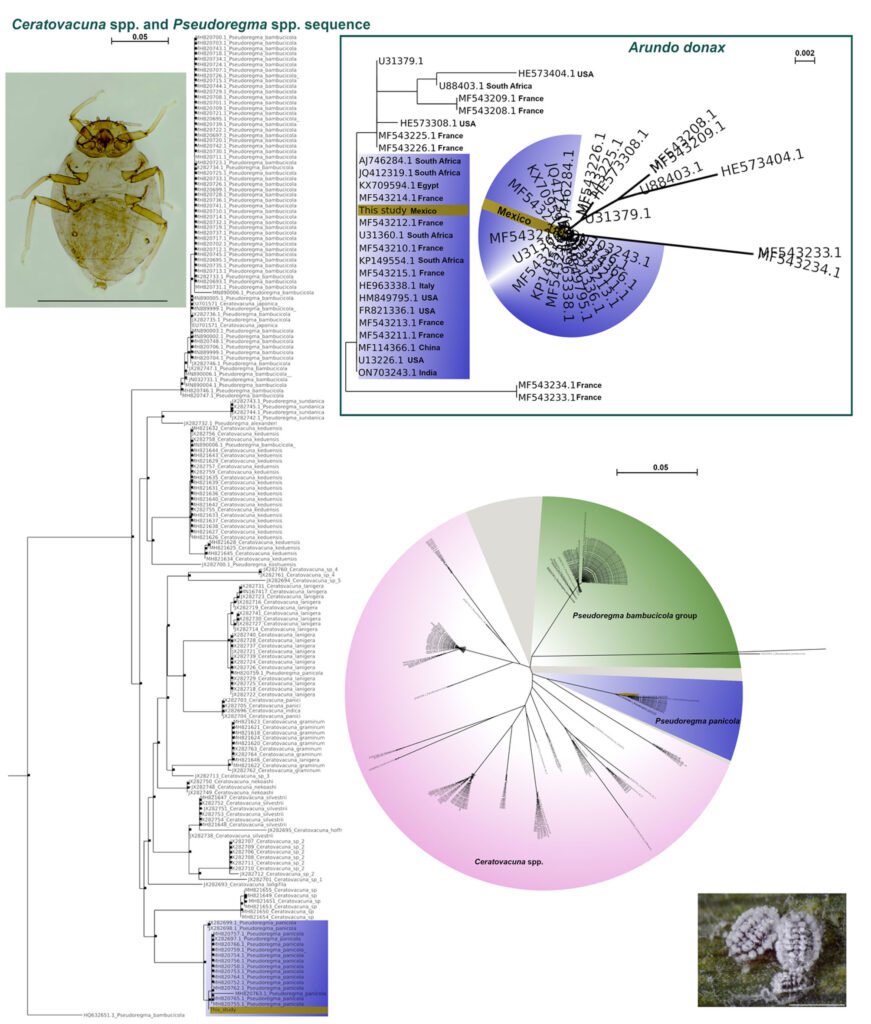
Molecular sequence analysis indicated that the aphid P. panicola and its host A. donax, are most closely related to those sequenced from South Africa, Egypt, India, Italy, USA, and China (Fig. 2). Specimens of P. panicola from the latter country are most closely related to those sequenced from Poaceae in Yunnan Province, China, and, to a lesser extent, to specimens collected from Phyllostachys nigra Lodd. former Lindl. In the same region, the Fujian Province (Rui-Ling et al., 2013) (Fig. 3).
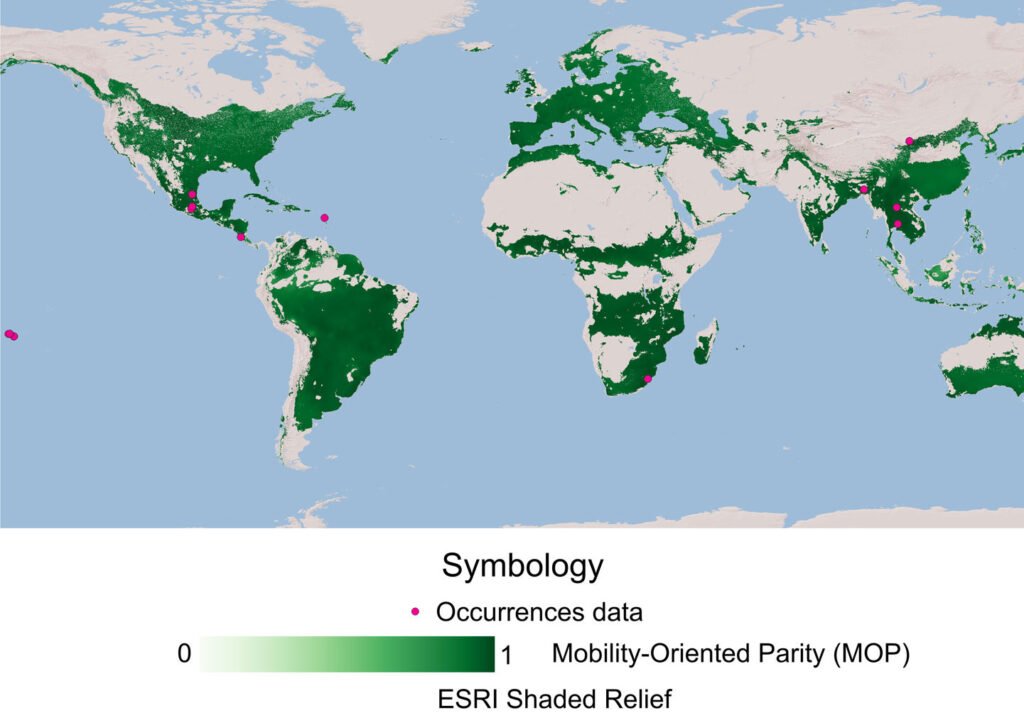
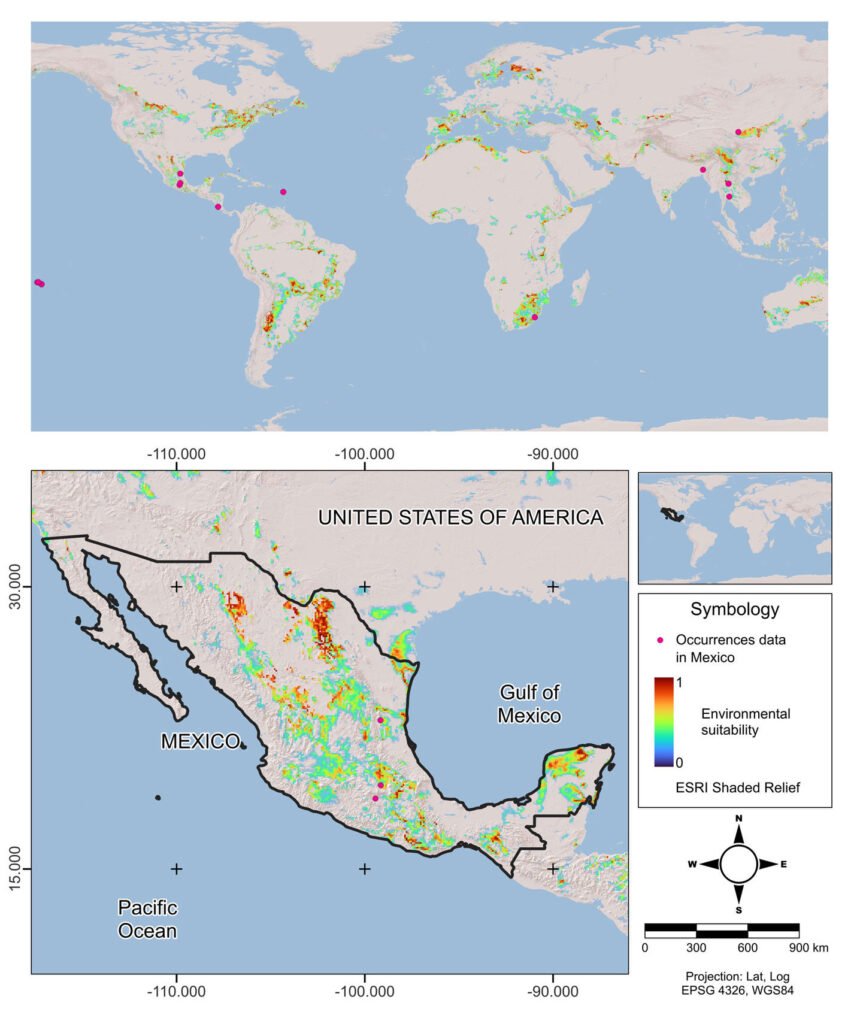
The model was only built with 60 occurrence points, of which 3 were obtained by the authors. The MOP achieved acceptable accuracy and a low risk of extrapolation values for Mexico, despite the fact that only 63 occurrence points were established (Fig. 4). For Mexico, regions such as the Yucatán Peninsula, the Valley of Mexico and northern and central Mexico seemed the most suitable to P. panicola distribution.
Discussion
The aphid P. panicola is reported in 4 continents: Africa —Argelia (Samia y Benoufella-Kitous, 2021), Asia —China (Holman, 2009; Riu-Ling, 2013), Japan (Holman, 2009), India (Holman, 2009; Singh & Singh 2018), Indonesia (Noordam, 1991), Nepal (Holman, 2009), and south of the Asian continent (Brumley, 2020), Oceania —Australia (Brumley, 2020) and New Zealand (Cottier, 1953), and America —Cuba, Costa Rica, Guadalupe, Puerto Rico, and Venezuela (Villalobos-Muller et al., 2010).
In Mexico, this species was initially reported by Peña-Martínez (1985), without specifying the host plant or location. Unedited documentary information from the Aphidomorpha collection of Mexico indicates that the aphid was collected by J. Butze at Coatlán del Río, Morelos, in 1979, on a host tentatively identified as Phragmites. The insects were identified by Dr. Remaudière in 1981, and the slide was subsequently donated to the former Dirección General de Sanidad Vegetal, today named Senasica. There are 2 unique slides in the Aphidomorpha collection: the first was surveyed from undetermined Poaceae on September 2nd, 1981, and the second on Paspalum sp. on September 4th, 1981; both collected by J. Holman and R. Peña-Martínez from Reserva de la Biosfera El Cielo, Gómez Farías, Tamaulipas, and corroborated in 2024 by the aphid specialists Ana Lilia Muñoz Viveros and Rebeca Peña Martínez.
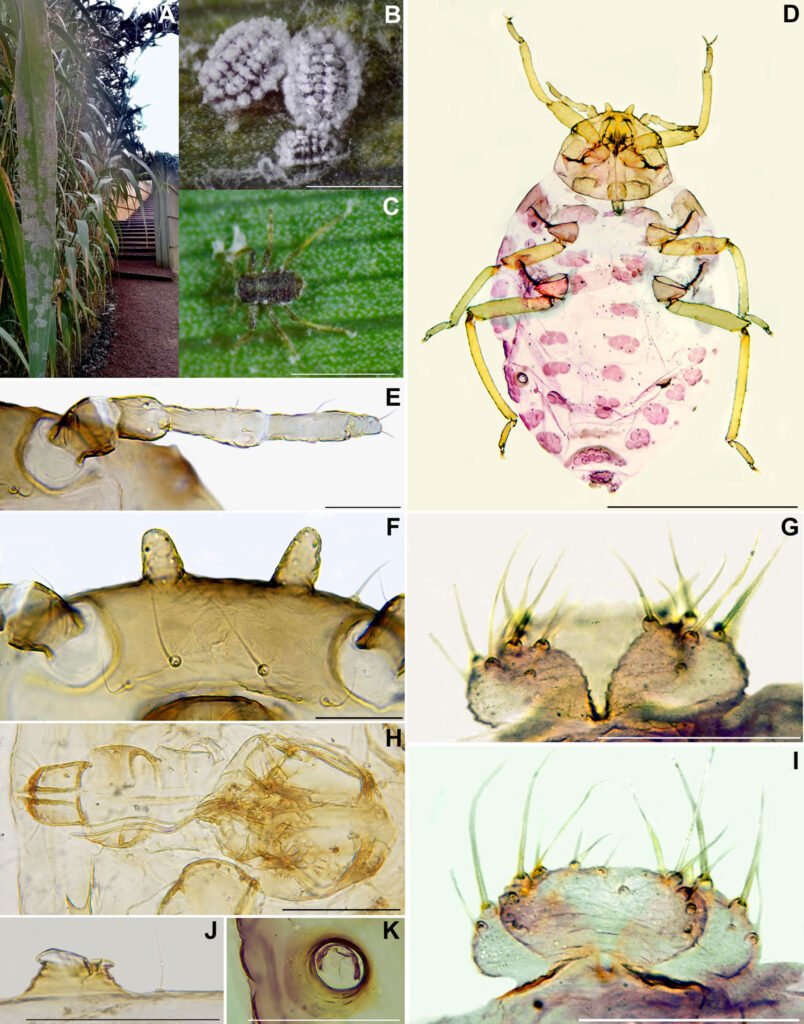
Figure 1. Colonies and structures of Pseudoregma panicola. A, Leaf of Arundo donax infested by P. panicola colonies; B, live adults and nymph waxy covered, 1 mm scale; C, first instar nymph, 0.5 mm scale; D, habitus of aptera, 0.5 mm scale; E, antenna, 0.1 mm scale; F, frontal horns, 0.1 mm; G, ana plate bilobed, 0.1 mm scale; H, rostrum, 0.1 mm scale; I, cauda knobbed, 0.1 mm scale; J, K, sifunculus, lateral view and frontal view, 0.1 mm scale.Figure 2. Comparative dendrogram of Hormaphidinae aphids and comparative dendrogram of Arundo donax sequences, registered in Genbank and specimens from the study site.Figure 3. Mobility-oriented parity (MOP) values of the worldwide ecological niche model of Pseudoregma panicola.
Regarding P. panicola feeding, different genera of Poaceae were recorded as hosts: Andropogon, Arthraxon, Bambusa, Capillipedium, Cyrtococcum, Eragrostis, Ichnanthus, Indocalamus, Lasiacis, Oplismenus, Panicum, Paspalum, Phragmites, Phyllostachys, Pseudoechinolaena, Setaria, Stenthotheca, and Thysanolaena (Favret & Miller, 2012; Holman, 2009; Rui-Ling et al., 2013; Singh & Singh, 2018). Arundo donax is a new record of the host, which develops as secondary vegetation in the country, even as an ornamental, in various urban areas of Mexico City.
In Vasconcelos Library, A. donax occupies 80 m2 of the 2,600 m2 total garden area and is placed as a green barrier to hide the walls and give a feeling of thickness. The origin of purchase of this plant is uncertain; furthermore, no aphids or any other phytophagous have been recorded that have affected it since its placement (garden staff, personal communication). This green area is located near downtown Mexico City, where 3 public transportation systems converge, providing connections to the south, north, and east of the city, as well as to the airport, potentially facilitating the introduction of pest insects. Records on Phyllostachys nigra in Mexico indicate its presence in Nuevo León, Sinaloa, and San Luis Potosí (iNaturalist, 2024). Additionally, there are a few reports on the American continent (GBIF 2023), which also does not correspond to the continental distribution of P. panicola, suggesting that this plant is not the cause of its dispersal in America. A possible approach to discern the dispersal of P. panicola in Mexico would be the trade from Yunnan and other provinces of China to Central America and the USA, where Mexico is part of the naval route, and where plants with roots and foliage are sold for floral arrangements (Economic Complexity Observatory, 2023).
According to the Bowling’s scale infestation per leaf, the abundance of P. panicola on A. donax (up to 750 aphids) is higher than M. donacis (range 12 to 500 aphids) on the same host in Mexico (Vanegas-Rico et al., 2023), and M. sorghi on Sorghum (≈ 20-136 aphids) in Texas (Brewer et al., 2022). The low diversity of predators and the absence of parasitoids on P. panicola suggests that the potential natural regulators were in the process of adaptation during that period. Regarding exotic aphid populations, M. sorghi was detected in 2015, and more recently, M. donacis on A. donax in 2023. In the case of M. sorghi, at least 19 entomophagous (including 2 parasitoids) were recorded in northeastern Mexico sometime after its first report in the country (Rodríguez-del Bosque et al., 2018). The effect of natural enemies in Texas, 14 predators and 2 parasitoids, shows low abundance after 3-4 years of population studies (Brewer et al., 2022) compared to the initial report as a pest, where more than 1,000 aphids per leaf were observed (Bowling et al., 2015).
Figure 4. Ecological niche model of Pseudoregma panicola. The color bar depicts the environmental suitability of the species worldwide and Mexico.
In the case of M. donacis, coccinellids and silver flies were observed preying on aphids during their first report in Mexico (Vanegas-Rico et al., 2023). Recently, laboratory observations indicated that ladybugs and silver flies could consume all instars of M. donacis; in fact, a low percent of parasitism (˂ 5%) was observed in the Valley of Mexico and Ensenada, Baja California (pers. com. Vanegas-Rico).
The identity of silver flies remains unknown due to limited material and inconclusive molecular results. This Diptera group can feed on different species of adelgids, aphids, soft scales, and other hemipterans (Gaimari et al., 2024; Salas-Monzón et al., 2020; Satar et al., 2015; Vanegas-Rico et al., 2010), exhibiting a density-dependence with their prey (Vanegas-Rico et al., 2017). The last bioecological aspect is relevant because it influences the success of biological control programs (Gaimari, 1991; Havill et al., 2018), and has favored the selection of some silver fly species as biological control agents in Europe (Justesen et al., 2023), USA (Ross et al., 2011; Havill et al., 2018), and Israel (Mendel et al., 2020).
According to site management personnel statements, P. panicola is controlled through broad-spectrum insecticide and sanitary pruning. This last method is frequently used when dry, greyish leaves and white spots (aphid wax) are observed. As a result, the aphid population densities recorded since 2023 are low (18.5 ± 4.2) and scarcer in coccinellids (2.6 ± 1.4) and silver flies (0.4 ± 0.1). So far, there was no evidence of parasitism in additional surveys of 2024. In the 2023 and 2024 samples, predation was observed on the aphid colonies and coccinellid eggs, mainly by H. axyridis andsporadic Syphid and Scymninae larvae. This suggests the continued adaptation process of these entomophagous and a possible adverse effect of pest management. Therefore, a biological control strategy for conservation must be implemented to promote the permanence of beneficial organisms and increase their populations.
Arundodonax has been encouraged as an ornamental plant so that the first negative impact would be in this type of urban system. There is still no prospecting in the agricultural landscape, despite the wide distribution of A. donax in 27 states of Mexico, mostly as a riparian system weed (Goolsby et al., 2023). The tendency of the A. donax distribution model (Goolsby et al., 2023) is similar to the current climate modeling of the aphid proposed in this work. This shows the potential for the establishment of the aphid in different states of the republic, highlighting its suitability in the Basin of Mexico and northern and southwestern parts of the country where this plant develops as an invader in bodies of water.
Finally, the work confirms the presence of P. panicola in Mexico and its development as an urban pest of A. donax, representing a New World host record for this aphid, and the first report from North America. Molecular information suggests China as a possible place of origin for both the plant and the aphid. Although this process is not entirely clear, it is feasible that the economic routes for transporting live or forage plants from this Asian country are a significant element to consider for the potential introduction of Poaceae phytophagous insects. The impact on this family of plants is currently unknown, so future studies should focus in that direction.
Acknowledgments
Special thanks to Francisco Amador-Cruz, Professor of Ecology career at FES-Iztacala, for elaborating the maps and for providing suggestions for this manuscript.
References
Altschul, S. F., Gish, W., Miller, W., Myers, E. W., & Lipman, D. J. (1990). Basic local alignment search tool. Journal of Molecular Biology, 215, 403–410. https://doi.org/10.1016/S0022-2836(05)80360-2
Barczak, T., Bennewicz, J., Korczyński, M., Błażejewicz-Zawadzińska, M., & Piekarska-Boniecka, H. (2021). Aphid assemblages associated with urban park plant communities. Insects, 12, 173. https://doi.org/10.3390/insects12020173
Blackman, R. L., & Eastop, V. F. (1994). Aphid’s of the World’s trees. An identification and information guide. Wallingford, UK: CAB International.
Bowling, R., Brewer, M., Knutson, A., Way, M., Porter, P., Bynum, E. et al. (2015). Scouting sugarcane aphids. Retrieved December 18, 2023 from http://agrilife.org/mid-coast-ipm/files/2015/05/Scouting-Sugarcane-Aphids-2015.pdf
Brewer, M. J., Elliott, N. C., Esquivel, I. L., Jacobson, A. L., Faris, A. M., Szczepaniec, A. et al. (2022). Natural enemies, mediated by landscape and weather conditions, shape response of the sorghum agroecosystem of North America to the invasive aphid Melanaphis sorghi. Frontiers in Insect Science, 2, 830997. https://doi.org/10.3389/finsc. 2022.830997
Brumley, C. (2020). A checklist and host catalogue of the aphids (Hemiptera: Aphididae) held in the Australian National Insect Collection. Zootaxa, 4728, 575–600. https://doi.org/10.11646/zootaxa.4728.4.12
Chevalier, M., Zarzo-Arias, A., Guélat, J., Mateo, R. G., & Guisan, A. (2022). Accounting for niche truncation to improve spatial and temporal predictions of species distributions. Frontiers in Ecology and Evolution, 10, 944116. https://doi.org/10.3389/fevo.2022.944116
Corsini, G., Manubens, A., Lladser, M., Lobos, S., Seelenfreund, D., & Lobos, C. (1999). AFLP analysis of the fruit fly Ceratitis capitata. Focus, 21, 72–73.
Cottier, W. (1953). Aphids of New Zealand. New Zealand Department of Scientific and Industrial Research Bulletin, 186, 1–382.
Economic Complexity Observatory. (2023). Retrieved December 14th, 2023 from: https://oec.world/es/profile/bilateral-country/chn/partner/usa?depthSelector=HS6Depth&dynamicBilateralTradeSelector=year2018&productSectionSelector=sectionID2#bi-trade-products
Escobar, L. E., Lira-Noriega, A., Medina-Vogel, G., & Peterson, A. T. (2014). Potential for spread of the white-nose fungus (Pseudogymnoascus destructans) in the Americas: use of Maxent and NicheA to assure strict model transference. Geospatial Health, 9, 221–229. https://doi.org/10.4081/gh.2014.19
Favret, C., & Miller, G. L. (2012). AphID. Identification Technology Program, CPHST, PPQ, APHIS, USDA; Fort Collins, CO. Retrieved on January 8, 2024 from: http://AphID.AphidNet.org/.
Fick, S. E., & Hijmans, R. J. (2017). WorldClim 2: new 1km spatial resolution climate surfaces for global land areas. International Journal of Climatology, 37, 4302–4315. https://doi.org/10.1002/joc.5086
Folmer, O., Black, M., Hoeh, W., Lutz, R., & Vrijenhoek, R. (1994). DNA primers for amplification of mitochondrial cytochrome c oxidase subunit I from diverse metazoan invertebrates. Molecular Marine Biology and Biotechnology, 3, 294–299.
Gaimari, S. D. (1991). Use of silver flies (Diptera: Chamaemyiidae) for biological control of homopterous pests. Proceedings of the Entomological Society of Washington, 53, 947–950.
Gaimari, S. D., González, C. R., & Elgueta, M. (2024). A catalog of the Chamaemyiidae of Chile (Diptera: Lauxanioidea). Zootaxa, 5399, 555–569. https://doi.org/10.11646/zootaxa.5399.5.5
Goolsby, J. A., Moran, P. J., Martínez-Jiménez, M., Yang, C., Canavan, K., Paynter, Q. et al. (2023). Biology of Invasive Plants 4. Arundo donax L. Invasive Plant Science and Management, 16, 81–109. https://doi.org/10.1017/inp.2023.17
GBIF (Global Biodiversity Information Facility). (2023). Phyllostachys nigra. Retrieved September 14th, 2023. From: https://doi.org/10.15468/dl.y5xrtv
GBIF (Global Biodiversity Information Facility). (2024). Pseudoregma panicola. Retrieved August 20th, 2024. From https://doi.org/10.15468/dl.6n5574
Havill, N. P., Gaimari, S. D., & Caccone, A. (2018). Cryptic east-west divergence and molecular diagnostics for two species of silver flies (Diptera: Chamaemyiidae: Leucopis) from North America being evaluated for biological control of hemlock woolly adelgid. Biological Control, 121, 23–29. https://doi.org/10.1016/j.biocontrol.2018.02.004
Holman, J. (2009). Host plant catalog of aphids: Paleartic Region. Dordrecht, The Netherlands: Springer. https://doi.org/10.1007/978-1-4020-8286-3
IBM Corp. (2016). IBM SPSS Statistics for Windows, Version 24.0. Armonk, NY: IBM Corp.
iNaturalist community. (2024). Observaciones de Phyllostachys nigra de México. Retrieved on January 12, 2024. From: https://mexico.inaturalist.org/taxa/166766-Phyllostachys-nigra
Justesen, M. J., Seehausen, M. L., Havill, N. P., Kenis, M., Gaimari, S. D., Matchutadze, I. et al. (2023). Evaluation of Leucopis hennigrata (Diptera: Chamaemyiidae) as a classical biological control agent of Adelges nordmannianae (Hemiptera: Adelgidae) in northern Europe. Biological Control, 183, 105264. https://doi.org/10.1016/j.biocontrol. 2023.105264
Korányi, D., Szigeti, V., Mezőfi, L., Kondorosy, E., & Markó, V. (2021). Urbanization alters the abundance and composition of predator communities and leads to aphid outbreaks on urban trees. Urban Ecosystems, 24, 571–586. https://doi.org/10.1007/s11252-020-01061-8
Mendel, Z., Protasov, A., Vanegas-Rico, J. M., Lomeli-Flores, J. R., Suma, P., & Rodríguez-Leyva, E. (2020). Classical and fortuitous biological control of the prickly pear cochineal, Dactylopius opuntiae, in Israel. Biological Control, 142, 104157. https://doi.org/10.1016/j.biocontrol.2019.104157
Noordam, D. (1991). Hormaphidinae from Java (Homoptera: Aphididae). The Zoologische Verhandelingen, 270, 1–525.
Nováková, E., Hypša, V., Klein, J., Foottit, R. G., von Dohlen, C. D., & Moran, N. A. (2013). Reconstructing the phylogeny of aphids (Hemiptera: Aphididae) using DNA of the obligate symbiont Buchnera aphidicola. Molecular Phylogenetics and Evolution, 68, 42–54. https://doi.org/10.1016/j.ympev.2013.03.016
Osorio-Olvera, L., Lira-Noriega, A., Soberón, J., Peterson, A. T., Falconi, M., Contreras-Díaz, R. G. et al. (2020). ntbox: an R package with graphical user interface for modeling and evaluating multidimensional ecological niches. Methods in Ecology and Evolution, 11, 1199–1206. https://doi.org/10.1111/2041-210x.13452
Owens, H. L., Campbell, L. P., Dornak, L. L., Saupe, E. E., Barve, N., Soberón, J. et al. (2013). Constraints on interpretation of ecological niche models by limited environmental ranges on calibration areas. Ecological Modelling, 263, 10–18. https://doi.org/10.1016/j.ecolmodel.2013.04.011
Qiao, H., Peterson, A. T., Campbell, L. P., Soberón, J., Ji, L., & Escobar, L. E. (2016). NicheA: creating virtual species and ecological niches in multivariate environmental scenarios. Ecography, 39, 805–813. https://doi.org/10.1111/ecog.01961
Peña-Martínez, R. (1985). Ecological notes on aphids of the high plateau of Mexico with a check-list of species collected in 1980. In Proceedings of the International Aphidological Symposium (pp. 425–430). Jablonna. Polska Akademia Nauk, Warsaw.
Peña-Martínez, R. (1992). Biología de áfidos y su relación con la transmisión de virus. In C. Urias, R. Rodríguez, & T. Alejandre (Eds). Áfidos como vectores de virus en México: contribución a la ecología y control de áfidos en México (pp. 11–35). CEFIT-CP. Vol 1. Montecillo, Estado de México, México.
Peña-Martínez, R., Muñoz-Viveros, A. L., Bujanos-Muniz, R., Luevano-Borroel, J., Tamayo-Mejía, F., & Cortez-Mondaca, E. (2016). Sexual forms of sorghum aphid complex Melanaphis sacchari/sorghi in Mexico. Southwestern Entomologist, 41, 127–132. https://doi.org/10.3958/059.041.0114
Rasband, W. S. (2018). Software ImageJ, U. S. National Institutes of Health, Bethesda, Maryland, USA. https://imagej.nih.gov/ij/
Rodríguez-del Bosque, L. A., & Terán, A. P. (2015). Melanaphis sacchari (Hemiptera: Aphididae): a new sorghum insect pest in Mexico. Southwestern Entomologist, 40, 433–434. https://doi.org/10.3958/059.040.0217
Rodríguez-del Bosque, L. A., Rodríguez-Vélez, B., Sarmiento-Cordero, M. A., & Arredondo-Bernal, H. C. (2018). Natural enemies of Melanaphis sacchari on Grain Sorghum in Northeastern Mexico. Southwestern Entomologist, 43, 277–279. https://doi.org/10.3958/059.043.0103
Ross, D. W., Gaimari, S. D., Kohler, G. R., Wallin, K. F., & Grubin, S. M. (2011). Chamaemyiid predators of the hemlock woolly adelgid from the Pacific Northwest. In Brad Onken, R. O., & R. Reardon (Eds.), Implementation and status of biological control of the hemlock woolly adelgid (pp. 97–106). USDA Forest Service.
Rozo-Lopez, P., Brewer, W., Käfer, S., Martin, M. M., & Parker B. J. (2023). Untangling an insect’s virome from its endogenous viral elements. BMC Genomics, 24, 636. https://doi.org/10.1186/s12864-023-09737-z
Rui-Ling, Z., Xiao-Lei, H., Li-Yun, J., & Ge-Xia, Q. (2013). Molecular phylogenetic evidence for paraphyly of Ceratovacuna and Pseudoregma (Hemiptera, Hormaphidinae) reveals late Tertiary radiation. Bulletin of Entomological Research, 103, 644–655. https://doi.org/10.1017/S0007485313000321
Salas-Monzón, R., Rodríguez-Leyva, E., Lomeli-Flores, J. R., & Vanegas-Rico, J. M. (2020). How two predators feed on Dactylopius opuntiae beneath its ventral side. Southwestern Entomologist,45, 823–826. https://doi.org/10.3958/059.045.0324
Samia, A. I. T., & Benoufella-Kitous, K. (2021). Diversity of aphids (Hemiptera: Aphididae) associated with potato crop in Tizi-Ouzou (North of Algeria), with new records. Acta Agriculturae Slovenica, 117, 1–9. https://doi.org/10.14720/aas.2021.117.1.1768
Satar, S., Raspi, A., Özdemir, I., Tusun, A., Karacaoğlu, M., & Benelli, G. (2015). Seasonal habits of predation and prey range in aphidophagous silver flies (Diptera, Chamaemyiidae), an overlooked family of biological control agents. Bulletin of Insectology, 68, 173–180.
Singh, G., & Singh, R. (2018). Updated checklist of Indian Hormaphidinae (Aphididae: Hemiptera) and their food plants. Journal of Entomology and Zoology Studies, 6, 1345–1352.
Soberón, J., Osorio-Olvera, L., & Peterson, T. (2017). Diferencias conceptuales entre modelación de nichos y modelación de áreas de distribución. Revista Mexicana de Biodiversidad, 88, 437–441. https://doi.org/10.1016/j.rmb.2017.03.011
Tamura, K., Stecher, G., & Kumar, S. (2021). MEGA11: Molecular Evolutionary Genetics Analysis V.11. Molecular Biology and Evolution, 38, 3022–3027. https://doi.org/10. 1093/molbev/msab120
Tello, M. L., Tomalak, M., Siwecki, R., Gáper, J., Motta, E., & Mateo-Sagasta, E. (2005). Biotic urban growing conditions-threats, pests and diseases. In C. Konijnendijk, K. Nilsson, T. Randrup, & J. Schipperijn (Eds.), Urban forests and trees: a reference book (pp. 325–365). Berlin, Heidelberg: Springer Berlin Heidelberg. https://doi.org/10. 1007/3-540-27684-X_13
The GIMP Development Team. (2023). GNU Image Manipulation Program (GIMP), Version 2.10.32. Community, Free Soft- ware. https://www.gimp.org/
Tochaiwat, K., Phichetkunbodee, N., Suppakittpaisarn, P., Rinchumphu, D., Tepweerakun, S., Kridakorn Na Ayutthaya, T.et al. (2023). Eco-efficiency of green infrastructure on thermal comfort of outdoor space design. Sustainability, 15, 2566. https://doi.org/10.3390/su15032566
Tubby, K. V., & Webber, J. F. (2010). Pests and diseases threatening urban trees under a changing climate. Forestry: An International Journal of Forest Research, 83, 451– 459. https://doi.org/10.1093/forestry/cpq027
Vanegas-Rico, J. M., Lomeli-Flores, J. R., Rodríguez-Leyva, E., Mora-Aguilera, G., & Valdez, J. M. (2010). Enemigos naturales de Dactylopius opuntiae (Cockerell) en Opuntia ficus-indica (L.) Miller en el centro de México. Acta Zoológica Mexicana, 26, 415–433. https://doi.org/10.21829/azm.2010.262718
Vanegas-Rico, J. M., Pérez-Panduro, A., Lomeli-Flores, J. R., Rodríguez-Leyva, E., Valdez-Carrasco, J. M., & Mora-Aguilera, G. (2017). Dactylopius opuntiae (Cockerell) (Hemiptera: Dactylopiidae) population fluctuations and predators in Tlalnepantla, Morelos, México. Folia Entomológica Mexicana (nueva serie), 3, 23–31.
Vanegas-Rico, J. M., Peña-Martínez, R., & Muñoz-Viveros, A. L. (2023). First record of Melanaphis donacis (Passerini, 1861) (Hemiptera: Aphididae) in México. Entomological Communications, 5, ec05031. https://doi.org/10.37486/2675-1305.ec05031
Villalobos-Muller, W., Pérez-Hidalgo, N., Mier-Durante, P., & Nieto-Nafría, J. M. (2010). Aphididae (Hemiptera: Sternorrhyncha) from Costa Rica, with new records for Central America. Boletín de la Asociación Española de Entomología, 34, 145–182.
Yang, T., Gu, T., Xu, Z., He, T., Li, G., & Huang, J. (2023). Associations of residential green space with incident type 2 diabetes and the role of air pollution: a prospective analysis in UK Biobank. Science of the Total Environment, 866, 161396. https://doi.org/10.1016/j.scitotenv.2023.161396
Zhang, R., Huang, X., Jiang, L., & Qiao, G. (2011). Phylogeny and species differentiation of Mollitrichosiphum spp. (Aphididae, Greenideinae) based on mitochondrial COI and Cyt b genes. Current Zoology, 57, 806–815. https://doi.org/10.1093/czoolo/57.6.806
Leafhoppers of the tribe Athysanini associated to pine and oak forests in Mexico (Hemiptera: Cicadellidae), with description of a new species of the genus Eutettix
J. Adilson Pinedo-Escatel a, b, *
a Universidad Nacional Autónoma de México, Instituto de Biología, Departamento de Zoología, Colección Nacional de Insectos, Tercer Circuito s/n, Ciudad Universitaria, 04510, Ciudad de México, México
b University of Illinois, Prairie Research Institute, Illinois Natural History Survey, 1816 S. Oak Street, 61820 Champaign, Illinois, EUA
*Autor para correspondencia: adilson.pinedo@ib.unam.mx (J.A. Pinedo-Escatel)
Recibido: 19 marzo 2024; aceptado: 28 febrero 2025
Resumen
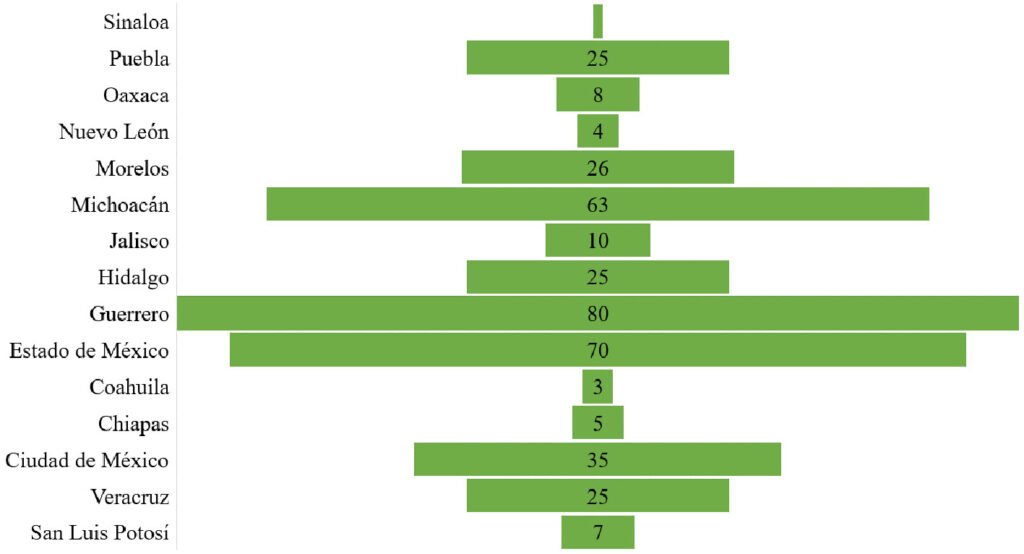
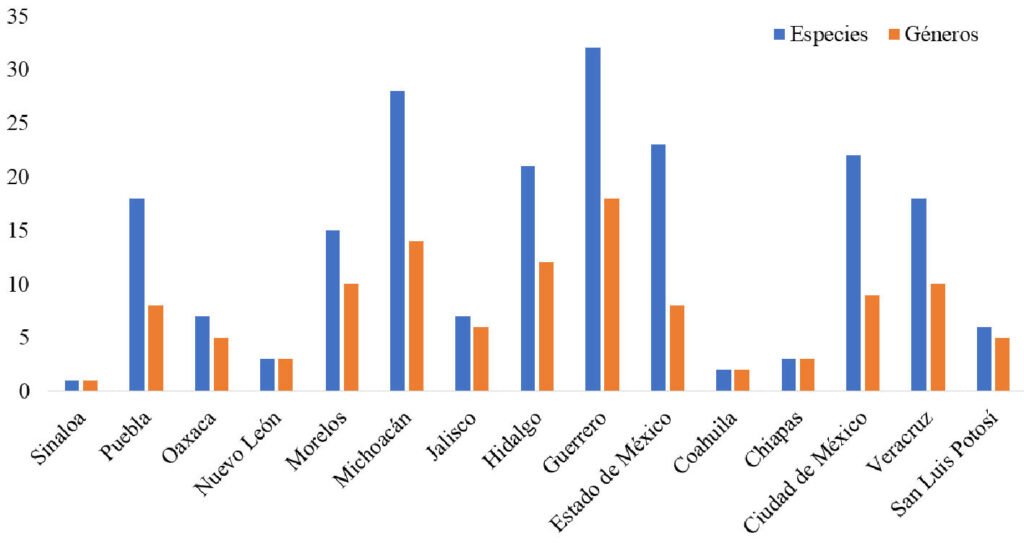
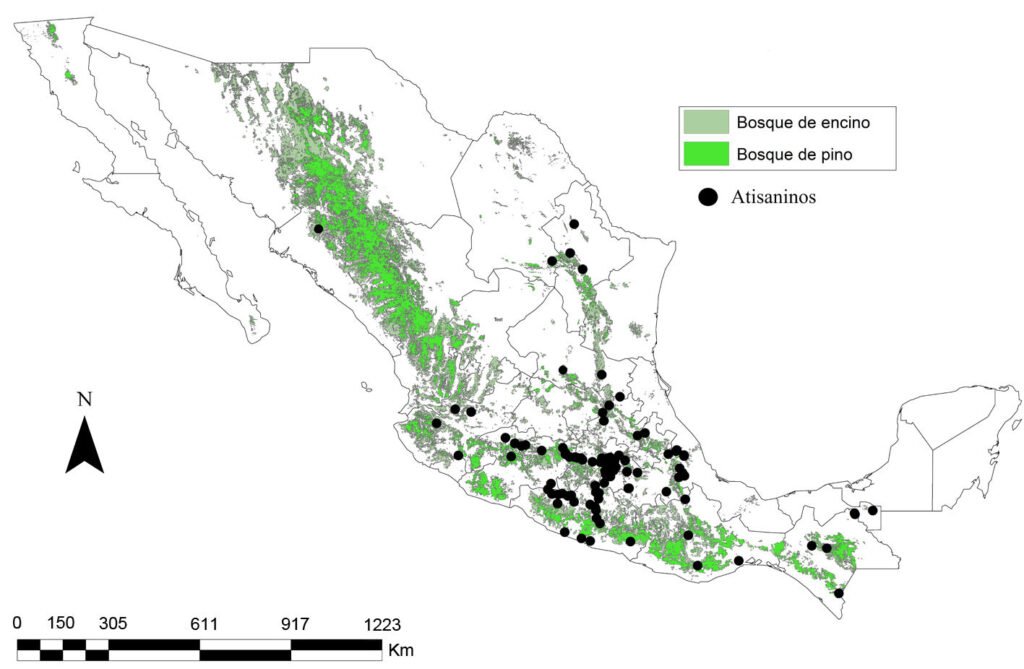
Históricamente los insectos herbívoros de la tribu de cicadélidos Athysanini (Hemiptera: Cicadellidae) han sido ávidamente recolectados en bosques de pino y encino en México, además de contar con una notable distribución en el país, sin embargo, se desconoce cuáles géneros y especies están asociadas a estos ambientes boscosos. Esta es la primera contribución mediante múltiples eventos de recolección, especímenes revisados en colecciones y literatura especializada en la que se compiló un total de 385 georreferencias para 83 especies de 31 géneros, donde 90% de las especies son endémicas para el territorio mexicano y los datos demuestran presencia sobre 15 estados; Guerrero lidereó tanto en el número de registros como en número de especies. Además, se describe una especie nueva del género Eutettix Van Duzee, 1892, recolectada en el estado de Jalisco y se discute la distribución de las especies de Athysanini presentes sobre las pináceas y encinares mexicanos.
Historically, herbivorous insects of the leafhopper tribe Athysanini (Hemiptera: Cicadellidae) have been avidly collected in pine and oak forests in Mexico and have a remarkable distribution in the country. However, it is unknown which genera and species are associated with these forest environments. In this contribution, through multiple collection events, specimens reviewed in collections and specialized literature, a total of 385 georeferences were compiled for 83 species from 31 genera, where 90% of the species are endemic to the Mexican territory and its occurrences extend over 15 states; Guerrero led both, number of records and number of species. In addition, a new species of the genus Eutettix Van Duzee, 1892, collected in the state of Jalisco, is described and known distribution of the Athysanini species present in Mexican pine and oak forests is discussed.
Los bosques mexicanos cubren una significante extensión del territorio mexicano manteniendo una biota muy diversa y en algunos casos, hasta exclusiva (Rzedowski, 1991a, b, 2006). La cobertura vegetal forestal dentro del país se encuentra interconectada por límites de ecotonos diferenciándose por diversos factores estructurales, entre ellos, la composición de los bosques ya sean de coníferas, encino, tropical caducifolio, mesófilo de montaña o lluvioso (Rzedowski, 1991a, 2006). Algunos de estos últimos, son resilientes en áreas uniformes de vegetación, o en parches disruptivos con superficies fragmentadas, perturbadas o en constante presión ambiental por actividades antropogénicas (Parada-Aragón et al., 2019; Rzedowski, 1991b; Sosa y De-Nova, 2012; Steinmann, 2002). Las pináceas y encinares en México según Gernandt y Pérez-de la Rosa (2014), Tantray et al. (2017) y Valencia-Ávalos (2010) están ampliamente distribuidos desde 32º hasta 14º latitud norte en un rango altitudinal que oscila entre 200 y 3,700 m snm. A lo largo de la topografía mexicana se reportan 49 especies de pináceas, de las cuales 22 son endémicas y el resto están compartidas en gran parte con otros países del hemisferio norte (30%). En cambio, para los encinares se conocen 160 especies, de las cuales, 109 son endémicas (60%) y el resto se comparten en límites del norte o el sur del país (Gernandt y Pérez-de la Rosa, 2014; Tantray et al., 2017; Valencia-Ávalos, 2010, 2004).
La familia Cicadellidae (Hemiptera: Auchenorrhyncha) es un grupo de insectos que cuenta con una distribución cosmopolita albergando en la actualidad más de 23,000 especies en todos los ecosistemas terrestres conocidos, a excepción de los hielos perpetuos (Bartlett et al. 2018; Dietrich 2005). Los cicadélidos son organismos estrictamente obligados a consumir savia de las plantas vasculares superiores y, en consecuencia, su distribución está estrechamente sujeta a los gradientes tanto en latitud como en longitudes regidas por la vegetación asociada donde residen (Hamilton y Whitcomb, 2010; Pinedo-Escatel y Moya-Raygoza, 2015, 2018). A su vez, esta familia de insectos presenta altos grados de especialización y algunas especies particularmente consumen exclusivamente de una familia o especie vegetal, por lo cual, ciertas agrupaciones de especies se han considerado como organismos potenciales o vectores efectivos en la trasmisión de enfermedades fitopatogénicas a diferentes plantas ya sean cultivadas o silvestres alrededor del mundo (Hamilton y Whitcomb, 2010; Moya-Raygoza et al., 2019).
Por otro lado, la tribu Athysanini comprende a un grupo de cicadélidos muy diverso tanto en especies como en morfología. La tribu cuenta con 911 especies reportadas en el mundo y en México. Pinedo-Escatel, Aragón-Parada et al.(2021) y Pinedo-Escatel, Dietrich et al.(2021) documentaron 146 especies pertenecientes a 46 géneros, de las cuales 70% del total de especies son endémicas. Los hábitos alimenticios de estos organismos bajo esta categoría de tribu son variables y se encuentran desde pastizales o herbáceas, hasta árboles de tallas considerables. De 1930 a la fecha, se han descrito y reportado atisaninos asociados a sistemas boscosos en México (DeLong, 1939; Nielson, 1988; Pinedo-Escatel, Moya-Raygoza et al., 2021), sin embargo, no se ha detallado cuáles son las especies que exclusivamente residen en los bosques mexicanos de pinos y/o encinos, por consecuencia, el nombre de las pináceas hospederas aún sigue sin ser documentado; sin embargo, el rango altitudinal ha sido contundente para la distribución de las especies.
Los bosques de pinos y encinos, históricamente, albergan cicadélidos a lo largo del continente americano, sin embargo, poco o casi nada se conoce sobre su biología incluyendo aspectos como la alimentación o la reproducción (Taylor et al., 1993), a diferencia de otras familias dentro del suborden Auchenorrhyncha reportando ciclos biológicos a detalle (p. ej., Cercopidae en Castro-Valderrama et al. [2017]). En esa misma línea, poco o casi nada se ha profundizado para dar a conocer las especies de atisaninos sobre estos ecosistemas boscosos. Aunque Pinedo-Escatel, Aragón-Parada et al. (2021) ejemplificaron los patrones de distribución que la tribu exhibe sobre varios tipos de bosques mexicanos: seco, encinar, nuboso y de pino, no enlista en detalle las especies que residen exclusivamente en estos hábitats.
La presente contribución tiene como objetivo documentar las especies de la tribu Athysanini asociadas a los bosques de pino y encino en México con base en ejemplares recolectados por el autor, especímenes revisados en colecciones entomológicas y registros de la literatura. Además, se describe una especie nueva del género Eutettix Van Duzee, 1892 a partir de la recolecta en proximidades de la sierra madre del Sur en el estado de Jalisco.
Materiales y métodos
Se utilizaron todos los registros de especímenes recolectados por Pinedo-Escatel, Dietrich et al. (2021) sobre los bosques de pino y encino de México. Además de una serie de trabajos de campo entre 2022 a 2024, se implementó el uso de una red entomológica (35 cm de diámetro × 75 cm de profundidad) y una trampa de luz modificada de acuerdo con Aguilar-Pérez et al. (2019). Los ejemplares recolectados fueron preservados en frascos con etanol al 96% y depositados en refrigeración a -25 °C. Los segmentos terminales masculinos se examinaron siguiendo las técnicas de Triplehorn y Johnson (2005) y Oman (1949) para muestras de Auchenorrhyncha con las siguientes modificaciones: abdómenes sumergidos en solución caliente de KOH al 15%, enjuagados 3 veces en agua destilada y remojados con ácido acético para neutralizar remanentes de la potasa. Posterior al proceso de aclaración, los segmentos terminales se almacenaron en microtubos con glicerina debajo de las muestras correspondientes montadas en seco. Los especímenes fueron revisados en un microscopio estereoscópico Stemi DVA4 Carl Zeiss y digitalizados a través de una cámara óptica Olympus XLC. Las etiquetas de los especímenes estudiados incluyen el tipo de hábitat en el que fueron recolectados.
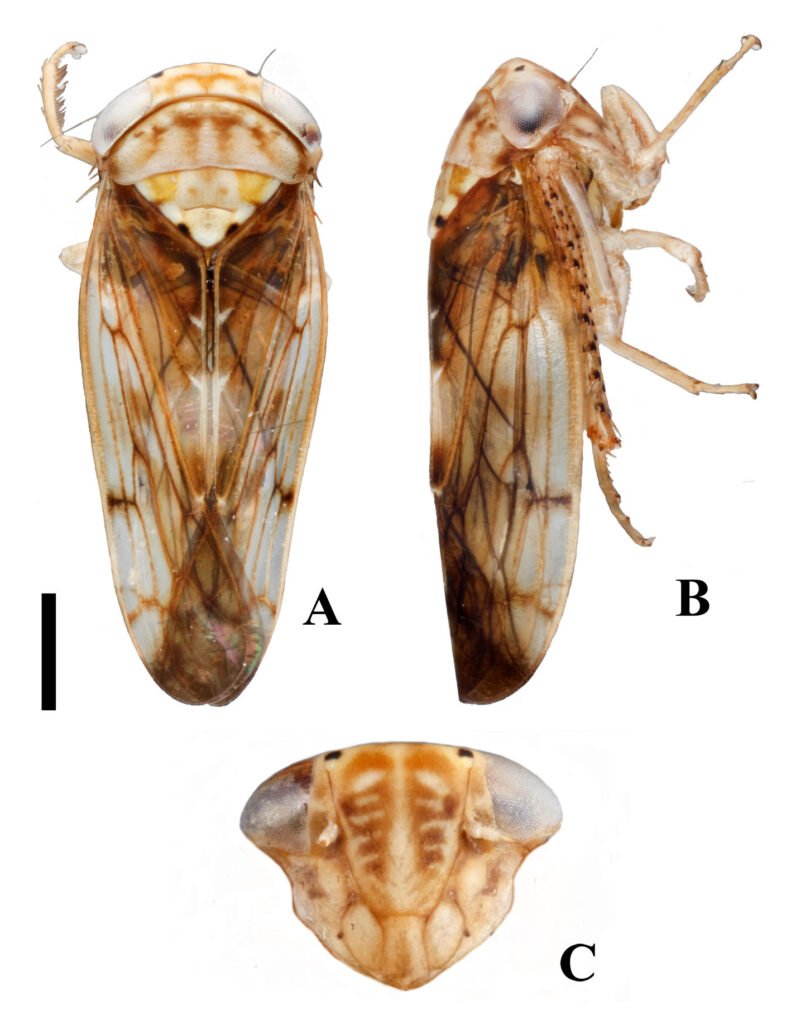
Para la especie nueva, se tomaron fotografías digitales de los organismos en vista dorsal, lateral y anterior, utilizando una cámara montada en un microscopio estereoscópico Olympus SZX12. La morfología interna de los machos fue fotografiada mediante un microscopio compuesto Olympus BX31 a través del software Gryphx. Todas las imágenes de múltiples planos focales se apilaron utilizando el software Helicon Focus (versión 8.2.18). La longitud del cuerpo se midió con un vernier electrónico desde el margen anterior de la corona, hasta el ápice de las alas anteriores en reposo. El color de los especímenes estudiados fue descrito con base en los ejemplares montados en seco. Los especímenes recolectados de la especie nueva se encuentran en la Colección Nacional de Insectos del Instituto de Biología, Universidad Nacional Autónoma de México, Ciudad de México, México (CNIN) y el Illinois Natural History Survey de la University of Illinois at Urbana-Champaign, Illinois, EUA (INHS).
La morfología externa sigue la esquematización de Dietrich (2005) y Pinedo-Escatel, Dietrich et al. (2021), la venación de las alas sigue el sistema propuesto por Anufriev y Emeljanov (1988) y la quetotaxia de los apéndices sigue a Rakitov (1998). Los cambios nomenclaturales y los nombres válidos siguieron la lista de verificación de Linnavuori (1959), Pinedo-Escatel, Dietrich et al. (2021), Oman et al. (1990), Omán (1949) y Zanol (2008). La descripción morfológica de la especie nueva sigue el modelo y circunscripción para la tribu Athysanini en México por Pinedo-Escatel, Dietrich et al. (2021).
Compilación de registros de Athysanini en pináceas y encinares mexicanos. Se generó una base de datos general que incluye todos los registros conocidos para las especies que se distribuyen específicamente en los bosques de pino y encino en México mediante: a) organismos recolectados por el autor entre 2010 y 2024, especialmente en áreas con bosque de pino y encino en el país, b) la revisión de especímenes tipos y otros adicionales en las siguientes colecciones entomológicas nacionales e internacionales: Colección de Insectos del Instituto de Fitosanidad, Colegio de Postgraduados, Estado de México, México (CEAM); Colección Nacional de Insectos, Instituto de Biología, Universidad Nacional Autónoma de México, Ciudad de México, México (CNIN); Centro de Estudios en Zoología, Centro Universitario de Ciencias Biológicas y Agropecuarias, Jalisco, Zapopan, México (CZUG); Illinois Natural History Survey, Champaign, Illinois, EUA (INHS); Ohio State University, C.A. Triplehorn Insect Collection, Columbus, Ohio, EUA (OSUC); United States National Museum of Natural History, Washington, DC, EUA (USNM), y c) los registros conocidos por Nielson (1988) y DeLong (1939, 1946). Todos los registros de presencia, de manera individual, fueron reunidos en un archivo único para cada especie de México. Se utilizaron los trabajos de Pinedo-Escatel, Aragón-Parada et al. (2021) y Pinedo-Escatel, Dietrich et al. (2021) como referencia para las especies endémicas y la homogenización entre los ambientes de pino y encino debido a que demostraron una preferencia por estos hábitats debido a su rango altitudinal.
Renderización de mapas. Los trazos vectoriales con todos los puntos georreferenciados provenientes de la literatura, especímenes en colecciones y eventos de recolección mediante trabajo de campo, fueron compilados y proyectados mediante ArcGis. Los polígonos de la vegetación en los mapas vectorizados siguen el sistema propuesto por Rzedowski (2006) y el mapa resultante incluye la distribución traslapada de los bosques de pino y de encino, además de los registros de atisaninos incluidos en los resultados de Pinedo-Escatel, Aragón-Parada et al. (2021) y Pinedo-Escatel, Dietrich et al. (2021). Únicamente los sitios con presencia de atisaninos fueron proyectados en el mapa. Todos los renderizados fueron elaborados por el autor.
Resultados
Se compiló un total de 385 georegistros de atisaninos para 83 especies de 31 géneros (120 de recolectas, 160 de revisión en colecciones y 105 de literatura) asociados a los bosques mexicanos de pino y encino. Del total de registros, 90% de las especies (74) y 53% de los géneros (17) son endémicos de México. En cambio, 27 especies (32%) residen exclusivamente sobre las pináceas y encinares mexicanos (tabla 1). Se presentan registros a lo largo de 15 estados del país, Guerrero ocupa el primer lugar (n = 80) seguido del Estado de México (n = 70) y Michoacán (n = 63) (fig. 1). El estado con más especies fue Guerrero (32 spp., 40%), seguido de Michoacán (28 spp., 35%) y el Estado de México (23 spp., 22%). Por otro lado, también Guerrero reportó 18 géneros (equivalente a 60% del total) y es el estado con el mayor número de taxones, tanto en registros como en especies endémicas (fig. 2). La distribución de los registros abarca latitudes desde el norte hasta el sur de México sobre la distribución reportada para ambos tipos de bosques (fig. 3).
Diagnosis. Color general amarillo blanquecino con múltiples manchas marrón. Dorso pigóforo fuertemente esclerotizado; apéndice en el interior fuertemente curvo dividido en 2 proyecciones, una delgada en longitud media y otra ensanchada sobresaliendo por el margen caudal. Edeago curvo dorsalmente con 1 par de procesos apicales lateralmente y gonoducto esclerotizado.
Descripción. Chicharritas con cuerpo alargado y moderadamente robustas, en vista dorsal semicilíndricas. Longitud media corporal 2.8 veces más larga que ancha. Dorso blanquecino con múltiples manchas marrones distribuidas disruptivamente. Cabeza con una banda no lineal de color naranja a distancia media entre el margen anterior y posterior dispuesta a manera transocular. Corona, 2.9 veces más ancha que larga; línea media ligeramente marcada; línea transocular convexa; superficie ligeramente estriada. Ojos blancos, 2.5 veces más anchos que largos, basolateral borde interno redondeado (fig. 4A, B). Ocelos negros, distancia al ojo menos de 0.3 veces del diámetro ocelar y 4 veces hacia la línea media. Rostro, 1.3 veces más largo que ancho; línea central blanca con 1 par de manchas naranjas transversales arriba y 4 pares de color marrón subsecuentes. Margen antenal de color marrón obscuro, sin formar una prolongación lateral y débilmente carinado. Antena igual a 1.1 veces en longitud respecto al rostro, color marrón y negro en ápice. Frontoclípleo con suturas laterales parcialmente subparalelas y con construcción media al costado de los pozos antenales, límite superior del frontoclípeo naranja claro y resto de la superficie con múltiples franjas transversales de color marrón delimitando una franja blanquecina sobre la línea media. Anteclípeo con construcción cerca de la base con márgenes laterales subparalelos, ápice expandido y sobrepasando ligeramente el margen posterior de la gena, superficie general de color marrón. Gena igual de amplia como el ancho del frontoclípeo y margen exterior débilmente angulado bajo el ojo (fig. 4C).
Tórax, pronoto blanquecino con manchas irregulares en color marrón, 2.2 veces más ancho que largo, margen anterior débilmente proyectado, margen lateral carinado y no extendido más allá del ancho de la base del ojo, margen posterior cóncavo y una muesca central; superficie trasversalmente surcada con algunas puntuaciones distribuidas sobre todo el disco. Escutelo blanquecino con margen anterior ancho (1.2 veces más que largo) y 1 par de manchas amarillas; margen posterior con 1 par de puntos negros sobre margen lateral; no protuberante en vista lateral. Tegminas. Membrana del primer par de alas translucida con patrones marrón sobre la sección claval y ápice de color negruzco, venas teñidas de color marrón; vena costal con margen blanco y líneas naranjas cercanas a la base alar; sin falsas venas trasversales, celda subapical externa sin falsas venas trasversales, celda subapical central traslucida, celda subapical interna sin venas trasversales adicionales y de color uniforme; 4 celdas apicales presentes, celda interior 1.2 veces más corta que la celda exterior, segunda y tercera celda igual en longitud pero la segunda presenta el doble de ancho que la tercera; región del clavo conectada con la vena Pcu y Cs mediante una vena trasversal en el primer tercio de la región y vena Pcu no conectada a A1. Segundo par alar, con esquema de venación típico para la tribu Athysanini. Patas blancas con máculas anaranjadas y patrón marrón, profémur fila AM con 1 macroseta a media altura, fila IC con 10 setas finas; protibia con 21 macrosetas sobre fila AD; mesotrocánter con 1 seta apical; metafémur con formula 2+2+1 sin setas adicionales.
Tabla 1
Listado de especies de la tribu Athysanini asociadas a bosques de pino y encino en México. Taxón endémico (*).
Género
Especie
Estado
Acunasus*
capitatus*
Guerrero, Jalisco
luteus*
Guerrero, Hidalgo
viridus*
Guerrero, Michoacán
Aligia
alvona*
Guerrero, Hidalgo, Ciudad de México, Veracruz
bicolor*
Ciudad de México
mexicana*
Ciudad de México, Veracruz, Hidalgo
Tabla 1. Continúa
Género
Especie
Estado
Alladanus*
mexellus*
Michoacán, Veracruz, Oaxaca
Angulanus*
incisurus*
Estado de México, Morelos, Jalisco, Oaxaca, Guerrero
Idiodonus
beamerellus*
Michoacán, Hidalgo
copulus*
Michoacán, Guerrero, Veracruz
edentulus*
Estado de México
excavatus*
Hidalgo, Estado de México
plummeri*
Estado de México, Morelos
wickhami*
Puebla, Estado de México, Ciudad de México, Puebla, Michoacán
Bardana*
depressa*
Estado de México, Morelos
Pseudaligia*
nigropunctata*
Hidalgo, Guerrero
Jaacunga*
spatulata*
Ciudad de México
vincula*
Hidalgo, Guerrero, Ciudad de México, Veracruz
Bonneyana
schwartzi
Coahuila, Nuevo León, Chihuahua
caldwelli*
Guerrero, Morelos, Michoacán, Puebla
Colladonus
anademus*
Estado de México
beameri*
Michoacán, Estado de México, Hidalgo, Puebla, Veracruz
claustrus*
Veracruz, Chiapas
bicinctus*
Ciudad de México
dampfi*
Veracruz, Estado de México, Michoacán
verecundus*
Estado de México, Michoacán, Morelos
albocinctus*
Estado de México, Hidalgo, Michoacán, Morelos, Ciudad de México
fasciaticollis*
Puebla, Michoacán, Estado de México
clathrus*
Puebla, Estado de México
titulus*
Ciudad de México, Veracruz, Estado de México
incidus*
Ciudad de México
Paracolladonus*
insculptus*
Estado de México
Paranurenus*
latidens*
Michoacán, Ciudad de México
Stoneana*
balli*
Guerrero
Crassana
marginella*
Guerrero, Oaxaca, Nuevo León
Paracrassana*
nigrifrons*
Puebla
Dampfiana*
deserta*
Guerrero
Conversana*
conversa*
Puebla, Morelos, Ciudad de México
Bandara
spinella*
Guerrero, Michoacán
mimica
Veracruz
Cahya
variabilis
Guerrero, Hidalgo, San Luis Potosí, Oaxaca
Eutettix
copula*
Ciudad de México
discapa*
Michoacán, Estado de México, Ciudad de México
placida*
Michoacán
ortegai*
Puebla
pedus*
Estado de México, Michoacán, Puebla, Morelos, Ciudad de México
Tabla 1. Continúa
Género
Especie
Estado
spinus*
Hidalgo, Ciudad de México, Estado de México
alvadus*
Hidalgo
chelatus*
Estado de México, Ciudad de México, Veracruz
contorqus*
Michoacán, Jalisco, Hidalgo
divergens*
Ciudad de México
harlani
Michoacán, Ciudad de México, Michoacán
krameri*
Hidalgo
lanceolatus*
Puebla
amixtlani sp. nov.*
Jalisco
Mesamia
alta*
Michoacán, Puebla, Guerrero
bifurcata*
Puebla, Michoacán, Ciudad de México, Estado de México, Morelos, Veracruz, Hidalgo
divisa*
Guerrero, Hidalgo, Veracruz, Michoacán, Jalisco
interrupta*
Ciudad de México
frigida*
Estado de México
orizaba*
Veracruz, Michoacán, Guerrero, Puebla, Ciudad de México, Hidalgo
puebla*
Puebla
montana*
Michoacán
interrupta*
Jalisco, Ciudad de México
separata*
Veracruz, Guerrero, Puebla, Hidalgo, Jalisco
Norvellina
cincta*
Puebla, Guerrero
denotata*
Ciudad de México, Guerrero, Michoacán, Estado de México
forficata*
Veracruz, Puebla
recepta*
Zacatecas
uncata*
San Luis Potosí, Guerrero, Puebla, Michoacán, Jalisco
Neodonus*
piperatus*
Michoacán, Hidalgo, San Luis Potosí
Renonus*
rubraviridis*
Jalisco, Guerrero
Retusanus*
luteus*
Guerrero
apicatus*
Guerrero
Cetexa
graecula
Coahuila
Cocrassana*
sexvarus*
Jalisco, Campeche, San Luis Potosí, Veracruz, Michoacán, Morelos
Figura 1. Número total de registros de presencia de la tribu Athysanini en bosques de pino y encino por entidades federativas de la República Mexicana.Figura 2. Número de géneros y especies de la tribu Athysanini presentes en bosques de pino y encino por entidades federativas de la República Mexicana que presentan registros.
Abdomen de color marrón, apodemas no evidentes del esternito I y apodemas del segundo esternito amplios basalmente, pero pobremente desarrollados.
Cápsula genital, macho. Pigóforo 3.0 veces más ancha que alta, dorso fuertemente esclerotizado e inciso a mediana distancia de la base, márgenes sin procesos; con un proceso interior supra desarrollado con 2 terminales, la primera delgada saliendo ligeramente de la cápsula genital y la segunda, robusta y extendida más allá del margen ventral; lóbulos laterales con 3 hileras de 3 a 4 macrosetas distribuidas sobre el tercer tercio del pigóforo; microsetas pronunciadas y puntuaciones desde la longitud media hasta el ápice del pigóforo (fig. 5A, C). Tubo anal 2 veces más largo que ancho con relación al largo total, margen lateral y dorsal esclerotizado. Valva y placas masculinas libres, articuladas con el pigóforo (fig. 5 B). Valva masculina triangular, 3 veces más corta que ancha, superficie numerosamente puntuada. Placa subgenital, con forma triangular; superficie punteada; margen exterior sinuoso con una fila de 10-12 setas finas y margen interior recto sin setas; 5 a 8 macrosetas dispuestas a lo largo del margen externo de la placa (fig. 5 B). Estilo fuertemente bilobulado en la base, con 6 setas en lóbulo preapical y textura corrugada; lóbulo medial corto, no extendido; lóbulo preapical pobremente desarrollado; apófisis curvo, simple y con ápice romo. Conectivo más corto que el estilo; 2.5 veces más corto que el tamaño del edeago en vista dorsal, con forma de Y, brazos anteriores 2 veces más largos que la longitud total del tallo (figs. 5B, 6C). Edeago moderado dentro del pigóforo cubriendo cerca de 2/4 del espacio interior, en dirección dorsal, atrio desarrollado, preatrio poco desarrollado y fuertemente esclerotizado; en vista lateral edeago curvo, ápice con 1 par de espinas laterales; procesos aedeagales sinuosos y direccionados dorsalmente; gonoducto tan amplio como el eje edeagal; gonoducto bien esclerotizado más allá del preatrio hasta el ápice; gonoporo en posición caudal y abierto tan amplio como el eje (fig. 6A, B).
Figura 3. Puntos georreferenciados de registros de atisaninos en bosques de pino y encino en México. Mapa elaborado por J.A. Pinedo-Escatel.
Medidas (mm). Cuerpo: longitud ♂ 4.18-4.55; ancho 1.60-1.67. Cabeza, ancho 1.20-1.28; longitud media 0.36-0.39; ancho previo a los ojos 0.63-0.69; ancho entre los ojos 0.50-0.53. Ojo, ancho 0.46-0.50 y longitud 0.20-0.22. Distancia entre ocelos 0.60-0.62. Frontoclípeo, ancho 0.56-0.57 y longitud 0.96-0.98. Anteclípeo, ancho 0.18-0.19 y longitud 0.26-0.29. Lora, ancho 0.19-0.20 y longitud 0.30-0.33. Gena, ancho 0.50-0.53 y longitud 0.28-0.30. Pronoto, ancho 1.30-1.33 y longitud 0.52-0.54. Escutelo, ancho 0.90-0.96 y longitud 0.72-0.75. Primer par de alas, longitud 3.59-3.62. Pigóforo, altura 0.55-0.59 y longitud 0.85-0.98. Valva, ancho 0.60-0.65 y longitud 0.40-0.53. Placa subgenital, ancho ápice 0.10-0.12, ancho medial 0.22-0.26, ancho base 0.32-0.33 y longitud 0.81-0.83. Estilo, longitud 0.50-0.52. Edeago, longitud 0.77-0.80.
Figura 4. Eutettix amixtlanus sp. nov., aspecto general macroscópico del holotipo macho. A, Hábito general en vista dorsal; B, hábito general en vista lateral; C, hábito del rostro en vista anterior. Escala 1 mm.
Resumen taxonómico
Holotipo. Macho (CNIN) – México: Jalisco, Zapotitlán de Vadillo, Centro Ecoturístico Amixtlan, 19°29’43.1” N, 103°43’16.6” O, 1,543m, 22 febrero 2019, Pinedo-Escatel Col., Trampa de Luz – MEXJAL158.
Paratipos. Dos hembras: 1 hembra (INHS) – México: Jalisco, Autlán de Navarro, Reserva de la Biosfera Sierra de Manantlán, Puerto Los Masos, 19°41’20.0” N, 104°23’48.2” O, 1,651m, 3 noviembre 2017, Pinedo-Escatel Col., Red Entomológica – MEXJAL19; 1 hembra (CNIN) – México: Jalisco, Zapotitlán de Vadillo, Centro Ecoturístico Amixtlan, 19°29’41.6” N, 103°43’17.1” O, 1,545m, 23 febrero 2019, Pinedo-Escatel Col., Trampa de Luz – MEXJAL154
Etimología. El epíteto de la especie, con género masculino, está compuesto por la palabra Amixtlán derivada de la lengua originaria Náhuatl; formada de los vocablos: atl (agua), mixtli (nube) y tan (lugar), que significa “lugar entre las nubes”, nombre que recibe la región por los pobladores locales donde fue encontrado el espécimen holotipo.
Figura 5. Eutettix amixtlanus sp. nov., capsula genital del holotipo. A, Pigóforo en vista dorsal; B, placas subgenitales, estilos y conectivo en vista ventral; C, pigóforo y segmento X y XI en vista dorsal. Escala 0.5 mm.
Hábitat y plantas huésped. La nueva especie se encuentra en bosque de encino en la provincia sierra Madre del Sur, en Jalisco. La caracterización de la localidad tipo cuenta principalmente con Quercus spp., parches de Pinus douglasiana y P. oocarpa (fig. 8A, B).
Anotaciones adicionales. La especie nueva es muy similar a E. apicalus Hepner, 1942, sin embargo, de esta última puede ser diferenciada fácilmente por la disposición de los apéndices de la cápsula masculina, la curvatura del edeago y por los procesos apicales del edeago dispuestos lateralmente.
Discusión
Del total de registros obtenidos de las especies de atisaninos, la mayoría son reportes inéditos para el país (60%) y de éstos, únicamente 8 especies se han registrado en Norteamérica (Oman, 1949). En cambio, la presente contribución registra 74 especies endémicas mexicanas asociadas con los bosques mexicanos de pino y encino. Del total de especies endémicas registradas, algunas se habían reportado anteriormente por Nielson (1988) y DeLong (1946, 1939), sin embargo, no especifican detalles o la especie de árbol hospedero.
Figura 6. Eutettix amixtlanus sp. nov., detalles internos de la cápsula genital del holotipo. A, Edeago en vista lateral; B, ápice del edeago en vista anterior; C, estilos y conectivo en vista ventral. Escala 0.5 mm.
De las 83 especies, 12 cicadélidos fueron colectados en 7 especies de pinos y 2 encinos (tabla 2), en cambio para el resto de las especies que se reportan en asociación con estos bosques, no fue posible documentar el hospedero. Los registros demostraron también que la distribución de los atisaninos recae sobre las principales cadenas montañosas de México, sin embargo, algunas presentan pocos hallazgos como es el caso de la sierra Madre Occidental, a pesar de la extensión de este complejo montañoso, lo cual refleja el hueco que existe en el esfuerzo de muestreo para dicha zona.
Algunas de las especies aquí compiladas han sido mencionadas por Nielson (1988) y DeLong (1946), quienes detallan que los organismos que habitan estos bosques de altitud cuentan con múltiples registros exclusivamente sobre las Pinofitas; sin embargo, se desconocen las especies a las que están asociadas, en contraparte los registros en encinares son inéditos. Así mismo, se ha observado que los patrones de distribución presentados por varios organismos son inespecíficos o por el contrario para algunas especies puntuales, por ejemplo, Colladonus albocinctus (DeLong, 1946), que a pesar de ser una especie endémica de México, podría contar con hospederos alternativos a causa de la cantidad de registros conocidos en altitudes superiores a 2,500 m en Morelos, Ciudad de México, Hidalgo, Michoacán y Estado de México, ésto con fundamento en la distribución que presentan las pináceas mexicanas, según Gernandt y Pérez-de la Rosa (2014). En cambio, C. trabilis Nielson, 1988 se conoce de una localidad en el Estado de México a una altitud de 2,900 m, lo cual podría sugerir un microendemismo en una única planta hospedera, que Nielson (1988) no mencionó. Por consiguiente, otra evidencia es la adaptabilidad de algunas especies de cicadélidos al maniobrar e incitar más actividad en otro tipo de vegetación, como por ejemplo los encinos, como es el caso del género Acunasus DeLong, 1945, que mayormente se ha registrado en varias especies de encinares cercanos a pinos. La complejidad de la biología de los atisaninos por residir en los doseles ha complicado comprender los patrones de distribución, y a su vez, las causas o razones de asociación directamente hacia una o varias especies de plantas hospederas (Pinedo-Escatel, Aragón-Parada et al., 2021; Pinedo-Escatel, Moya-Raygoza et al., 2021).
Figura 7. Distribución de Eutettix amixtlanus sp. nov. en el estado de Jalisco. Mapa elaborado por J.A. Pinedo-Escatel.
Tabla 2
Especies endémicas de la tribu Athysanini con referencia directa de asociación a pinos y encinos en México.
Cicadélidos
Hospederos
Acunasus capitatus
Pinus jaliscana; Pinus douglasiana
Acunasus luteus
Pinus douglasiana; Pinus patula; Quercus affinis
Acunasus viridus
Pinus herrerae; Quercus affinis
Aligia alvona
Pinus douglasiana
Idiodonus beamerellus
Pinus douglasiana; Quercus mexicana
Jaacunga spatulata
Pinus douglasiana
Bonneyana schwartzi
Pinus greggii
Colladonus beameri
Pinus patula
Colladonus incidus
Pinus douglasiana; Quercus mexicana
Eutettix amixtlani sp. nov.
Pinus douglasiana; Pinus oocarpa
Mesamia alta
Pinus lawsonii; Quercus mexicana
Comayagua taeniata
Pinus patula; Quercus affinis
Figura 8. Bosque de encino en localidades donde los especímenes fueron recolectados en la proximidad de la sierra Madre del Sur, Jalisco.
Por otro lado, estos organismos son indicadores de la calidad del hábitat o de hábitats en regeneración debido a la sensibilidad que presentan al adaptarse a las condiciones que requieren para desempeñar sus ciclos biológicos (Biedermann et al., 2005; Hollier et al., 2005). Varias especies de esta tribu también tienden a presentar distribuciones estrechas y no se desplazan más allá de los límites geográficos de su planta huésped (Pinedo-Escatel, Aragón-Parada et al., 2021; Pinedo-Escatel, Moya-Raygoza et al., 2021), lo cual ha generado evaluaciones sobre su conservación, proponiendo que varias de éstas se encuentran en un estatus vulnerable o amenazadas, paralelamente junto al ambiente donde se encuentran (Pinedo-Escatel y Dietrich, 2020). Una consecuencia o reflejo directo es la disminución de especies por causas antropogénicas y por 1 o múltiples factores que intervienen directamente en el número de poblaciones en términos de riqueza, por lo cual las colecciones, acervos y registros disponibles reflejan una oportunidad para realizar evaluaciones pertinentes en la toma de decisiones para su conservación (Pinedo-Escatel et al., 2024). La nueva especie, E. amixtlanus, presenta una distribución restringida ya que reside en 2 localidades aisladas, donde las actividades antropogénicas alrededor van en súbito aumento, limitando la dispersión fuera del hábitat para ambos, la chicharrita y la vegetación hospedera. El aumento de la deforestación no regulada, ganadería con sobrecarga y uso de pesticidas desmedidos se suman a ejercer presión en la región, además de las reportadas por Pinedo-Escatel, Moya-Raygoza et al. (2021). Por ello, para comprender mejor el estatus de conservación de la chicharrita y de los insectos, deben dedicarse esfuerzos futuros en marcos de referencias en acciones de protección de flora y fauna en áreas clave y que prioricen a las especies que residen en ecosistemas paralelamente amenazados.
Agradecimientos
A Cristina Mayorga por su apoyo técnico en la Colección Nacional de Insectos (CNIN) del Instituto de Biología, UNAM. A Edith Blanco Rodríguez (Colegio de Postgraduados) por la toma de fotografías durante su estancia en el Illinois Natural History Survey, Univeristy of Illinois en Urbana-Champaign. A Diego y Axel Pinedo por su apoyo en la recolecta de los organismos estudiados. Esta investigación recibió apoyo por PAPIIT-DGAPA-UNAM (Núm. IT200324).
Referencias
Aguilar-Pérez, J. G., Pinedo-Escatel, J. A. y Valdez-Quezada, B. C. (2019). Three new Mexican species of the endemic Athysanini leafhopper genus Devolana DeLong (Hemiptera: Cicadellidae) from the tropical dry forest. Journal of Natural History, 53, 2039–2056. https://doi.org/10.1080/00222933.2019.1683244
Anufriev, G. A. y Emeljanov, A. F. (1988). Suborder Cicadinea (Auchenorrhyncha). En P. A. Lehr (Ed.), Keys to the insects of the Far East of the USSR. Homoptera and Hemiptera (pp. 12-504). Leningrado: Nauka Publishing House.
Bartlett, C. R., Deitz, L. L., Dmitriev, D. A., Sanborn, A. F., Soulier-Perkins, A. y Wallace, M. S. (2018). The diversity of the true hoppers (Hemiptera: Auchenorrhyncha). En R. G. Foottit y P. H. Adler (Eds.), Insect biodiversity: science and society (pp. 501–590). Glasgow: John Wiley. https://doi.org/10.1002/9781118945582.ch19
Biedermann, R., Achtziger, R., Nickel, H. y Stewart, A. J. (2005). Conservation of grassland leafhoppers: a brief review. Journal of Insect Conservation, 9, 229–243.
Castro-Valderrama, U., Romero-Nápoles, J., Peck, D. C., Valdez-Carrasco, J. M., Llanderal-Cázares, C., Bravo-Mojica, H. et al. (2017). First report of spittlebug species (Hemiptera: Cercopidae) associated with Pinus species (Pinaceae) in Mexico. Florida Entomologist, 100, 206–208. https://doi.org/10.1653/024.100.0136
Dietrich, C. H. (2005). Keys to the families of Cicadomorpha and subfamilies and tribes of Cicadellidae (Hemiptera: Auchenorrhyncha). Florida Entomologist, 88, 502–517. https://doi.org/10.1653/024.100.0136
DeLong, D. M. (1939). Los phlepsidos (Phlepsius y Texananus) de México (Homoptera-Cicadellidae). Anales de la Escuela Nacional de Ciencias Biológicas, 1, 379–405.
DeLong, D. M. (1946). The Mexican species of Idiodonus (Homoptera-Cicadellidae). Ohio Journal of Science, 46, 13–30.
Gernandt, D. S. y Pérez-de la Rosa, J. A. (2014). Biodiversidad de Pinophyta (coníferas) en México. Revista Mexicana de Biodiversidad, 85 (Supl.), 126–133. https://doi.org/10.7550/rmb.32195
Hamilton, K. G. A. y Whitcomb, R. F. (2010). Leafhoppers (Homoptera: Cicadellidae): a major family adapted to grasslands habitats. En J. D. Shorthouse y K. D. Floate (Eds). Arthropods of Canadian grasslands: ecology and interactions in grassland habitats (pp. 169–197). Cambridge: Biological Survey of Canada, Cambridge University Press.
Hollier, J. A., Maczey, N., Masters, G. J. y Mortimer, S. R. (2005). Grassland leafhoppers (Hemiptera: Auchenorrhyncha) as indicators of habitat condition–a comparison of between-site and between-year differences in assemblage composition. Journal of Insect Conservation, 9, 299–307.
Linnavuori, R. (1959). Revision of the Neotropical Deltocephalinae and some related subfamilies (Homoptera). Annales Botanici Societatis Zoologicae-Botanicae Fenni- cae Vanamo, 20, 1–370.
Moya-Raygoza, G., Cuevas-Guzmán, R., Pinedo-Escatel, J. A. y Morales-Arias, J. G. (2019). Comparison of leafhopper (Hemiptera: Cicadellidae) diversity in maize and its wild ancestor teosinte, and plant diversity in the teosinte habitat. Annals of the Entomological Society of America, 112, 99–106. https://doi.org/10.1093/aesa/say053
Nielson, M. W. (1988). Colladonus and related genera of Mexico and Central America with new taxa and synonymy (Homoptera: Cicadellidae). Great Basin Naturalist Memoirs, 39, 103–134.
Oman, P. W. (1949). The Nearctic leafhoppers (Homoptera: Cicadellidae). A generic classification and check list. Memoirs of the Entomological Society of Washington, 3, 1–253.
Oman, P. W., Knight, W. J. y Nielson, M. W. (1990). Leafhoppers (Cicadellidae): a bibliography, generic check-list and index to the world literature 1956–1985. Wallingford, Inglaterra: CAB International.
Parada-Aragón, J., Reyes, P. C., Rodríguez, A. y Lino, G. M. (2019). Diversidad y distribución geográfica del género Sedum (Crassulaceae) en la Sierra Madre del Sur, México. Revista Mexicana de Biodiversidad, 9, e902921. https://doi.org/10.22201/ib.20078706e.2019.90.2921
Pérez-de la Rosa, J. A. y Gernandt, D. S. (2017). Pinus vallartensis (Pinaceae), a new species from western Jalisco, Mexico. Phytotaxa, 331, 233–242. https://doi.org/10.11646/phytotaxa.331.2.7
Pinedo-Escatel, J. A., Aragón-Parada, J., Dietrich, C. H., Moya-Raygoza, G., Zahniser, J. N. y Portillo, L. (2021). Biogeographical evaluation and conservation assessment of arboreal leafhoppers in the Mexican Transition Zone biodiversity hotspot. Diversity and Distributions, 27, 1051–1065. https://doi.org/10.1111/ddi.13254
Pinedo-Escatel, J. A. y Dietrich, C. H. (2020). Nomenclatural changes and two new species in the leafhopper genus Usanus DeLong (Hemiptera: Cicadellidae) with notes on conservation status. Zootaxa, 482, 567–576. https://doi.org/10.11646/zootaxa.4822.4.6
Pinedo-Escatel, J. A., Dietrich, C. H. y Aragón-Parada, J. (2024). Natural history collections as resources for assessing biodiversity hotspots and insect declines: case studies, opportunities, and challenges. En J. L. León-Cortés y A. Córdoba-Aguilar (Eds.), Insect decline and conservation in the Neotropics (pp. 275–299). The Netherlands: Springer International Publishing. https://doi.org/10.1007/978-3-031-49255-6_14
Pinedo-Escatel, J. A., Dietrich, C. H., Zahniser, J. N., Moya-Raygoza, G. y Portillo, L. (2021). A dichotomous key and checklist for Mexican Athysanini leafhopper genera (Hemiptera: Cicadellidae) with a new species from the Oaxacan dry tropical forest. European Journal of Entomology, 118, 255–278. https://doi.org/10.14411/eje.2021.027
Pinedo-Escatel, J. A. y Moya-Raygoza, G. (2015). Diversity of leafhoppers during the winter dry season on perennial grasses bordering harvested fields of maize. Southwestern Entomologist, 40, 263–272. https://doi.org/10.3958/059.040.0203
Pinedo-Escatel, J. A. y Moya-Raygoza, G. (2018). Diversity of leafhoppers (Hemiptera: Cicadellidae) associated with border grasses and maize during the wet and dry seasons in Mexico. Environmental Entomology, 47, 282–291. https://doi.org/10.1093/ee/nvx204
Pinedo-Escatel, J. A., Moya-Raygoza, G., Dietrich, C. H., Zahniser, J. N. y Portillo, L. (2021). Threatened Neotropical seasonally dry tropical forest: evidence of biodiversity loss in sap-sucking herbivores over 75 years. Royal Society Open Science, 8, 1–13. https://doi.org/10.1098/rsos.201370
Rakitov, R. A. (1998). On differentiation of cicadellid leg chaetotaxy (Homoptera: Auchenorrhyncha: Membracoidea). Russian Entomological Journal, 6, 7–27.
Rzedowski, J. (1991a). Diversidad y orígenes de la flora fanerogámica de México. Acta Botanica Mexicana, 14, 3–21.
Rzedowski, J. (1991b). El endemismo en la flora fanerogámica mexicana: una apreciación analítica preliminar. Acta Botanica Mexicana, 15, 47–64.
Rzedowski, J. (2006). Vegetación de México. Ciudad de México: Comisión Nacional para el Conocimiento y Uso de la Biodiversidad. Recuperado el 07 de junio, 2014 de: https://www.biodiversidad.gob.mx/publicaciones/librosDig/pdf/VegetacionMx_Cont.pdf
Sosa, V. y De-Nova, J. A. (2012). Linajes de angiospermas endémicas en México: zonas de alto endemismo para la conservación. Acta Botanica Mexicana, 100, 293–315.
Steinmann, V. W. (2002). Diversidad y endemismo de la familia Euphorbiaceae en México. Acta Botanica Mexicana, 61, 61–93.
Tantray, Y. R., Wani, M. S. y Hussain, A. (2017). Genus Quercus: an overview. International Journal of Advance Research in Science and Engineering, 6, 1880–1886.
Taylor, R. A. J., Nault, L. R. y Styer, W. E. (1993). Experimental analysis of flight activity of three Dalbulus leafhoppers (Homoptera: Auchenorrhyncha) in relation to migration. Annals of the Entomological Society of America, 86, 655–667.
Triplehorn, C. A. y Johnson, N. F. (2005). Borror and DeLong’s introduction to the study of insects. Belmont, TN: Thomson.
Valencia-Ávalos, S. (2010). Notes on the genus Quercus in Mexico. International Oaks, 21, 100–120.
Valencia-Ávalos, S. (2004). Diversidad del género Quercus (Fagaceae) en México. Boletín de la Sociedad Botánica de México, 75, 33–53.
Zanol, K. M. R. (2008). Catalogue of the Neotropical Deltocephalinae (Hemiptera: Cicadellidae). Part III–Tribe Athysanini. Acta Biológica Paranaense, 37, 1–104.
Universidad Autónoma del Estado de México, Instituto de Ciencias Agropecuarias y Rurales, Instituto Literario Núm. 100, Colonia Centro, 50000 Toluca, Estado de México, México
*Autor para correspondencia: arendaraa@uaemex.mx (A.R. Endara-Agramont)
Recibido: 13 febrero 2024; aceptado: 11 julio 2025
Resumen
La extensión forestal de México es de 138.7 millones de ha, 42% de las cuales se encuentran afectadas por plantas parásitas. El Área de Protección de Flora y Fauna Sierra de Quila tiene 6,788 ha de bosques de pino-encino y encino-pino, que son susceptibles al ataque de plagas y enfermedades. El objetivo fue determinar su distribución espacial y niveles de infestación. Para ello, se establecieron 330 sitios de muestreo (SM) circulares de 1,000 m2, utilizando las curvas de nivel como transectos de acceso al bosque, con una separación altitudinal de 100 m entre curvas desde 2,000 hasta 2,600 m snm, con una equidistancia entre sitios de 300 m. En cada sitio se registraron datos físico-geográficos, dasonómicos y afectación por plantas parásitas. Más de 2,050 ha de sus bosques (30%) están afectadas por muérdago enano (Arceuthobium durangense) y diversos muérdagos verdaderos (Phoradendron bolleanum, P. brachystachyum, P. lanceolatum, P. reichenbachianum, Cladocolea cupulata, C. grahamii, C. mcvaughii, C. microphylla y Psittacanthus calyculatus), todos con niveles bajos de infestación, por lo que aún resulta oportuno establecer estrategias de manejo y control para evitar mayores daños al bosque.
The forested area of Mexico is 138.7 million ha, 42% of which are affected by parasitic plants. The Sierra de Quila Flora and Fauna Protection Area has 6,788 ha of pine-oak and oak-pine forests, which are susceptible to pests and diseases. The objective was to determine their spatial distribution and infestation levels. To this end, 330 circular sampling sites (SM) of 1,000 m2 were established, using contour lines as forest access transects. The elevations were separated by 100 m between contours from 2,000 to 2,600 m asl, and the distance between sites was 300 m. Physical-geographical and forestry data, as well as the impact on parasitic plants, were recorded at each site. More than 2,050 ha of its forests (30%) are affected by dwarf mistletoe (Arceuthobium durangense) and various true mistletoes (Phoradendron bolleanum, P. brachystachyum, P. lanceolatum, P. reichenbachianum, Cladocolea cupulata, C. grahamii, C. mcvaughii, C. microphylla, and Psittacanthus calyculatus), all with low levels of infestation, so it is still possible to establish management and control strategies to avoid further damage to the forest.
México posee una extensión forestal de 138.7 millones de ha (Conafor, 2021). Éstas son susceptibles a disturbios; particularmente los ocasionados por insectos fitófagos, plantas parásitas e incendios (USDA, 2013). En particular, en Jalisco, durante el periodo 2012-2021 se reportaron 54,158 ha de bosque con diversos problemas fitosanitarios: plantas parásitas (61%), enfermedades (cancro resinoso, pudrición de raíz y roya; 19%), insectos descortezadores (13%) e insectos defoliadores (6%) (Semadet, 2022). Un factor ambiental que incrementa la vulnerabilidad de las especies forestales a plagas o enfermedades es el cambio climático (Bentz et al., 2010).
En México, se tienen registros de más de 200 especies de insectos y patógenos que provocan daños en los ecosistemas forestales (Conafor, 2007). En Jalisco, las plantas parásitas que se registran con mayor incidencia en los bosques son 4 especies de muérdagos enanos (Arceuthobium spp.) en coníferas y 21 especies de muérdagos verdaderos en latifoliadas (Semadet, 2021). La mayor riqueza de plantas parásitas se encuentra en las sierras de Tapalpa, Quila, Primavera, Cacoma, Manantlán (Vázquez-García et al., 1995), Bolaños (Vázquez-García et al., 2004), del Halo, Nevado de Colima, Cerro Grande y volcán Cerro Viejo, con 16 especies de plantas parásitas, el mayor número de especies encontradas para un municipio (Vázquez-García et al., 1995).
Los muérdagos son plantas hemiparásitas que dependen parcialmente de otros organismos para poder subsistir (Conafor, 2007; Nickrent y Musselman, 2004). Cuando se establecen en el tallo de su hospedero, compiten con él por agua y nutrimentos, lo que dificulta su crecimiento (Espinoza-Zúñiga et al., 2019). Por otra parte, cuando los muérdagos son abundantes en el árbol hospedero pueden provocarle la muerte (Alvarado-Rosales et al., 2007). Abarcan especies del género Arceuthobium, conocidas como muérdagos enanos, así como de los géneros Cladocolea, Phoradendron, Psittacanthus y Struthanthus, todos ellos conocidos como muérdagos verdaderos (Nickrent y Musselman, 2004). Son plantas arbustivas que se establecen en la parte aérea, más frecuentemente en ramas (muérdagos verdaderos) o en las ramas y en el fuste (muérdagos enanos), que afectan el desarrollo de su hospedero a través del sistema endofítico (Hawksworth, 1961; Rey et al., 1991), lo que induce cambios fisiológicos y bioquímicos (Mathiasen et al., 2008). Endara-Agramont et al. (2022) encontraron que algunas de las variables que influyen en la presencia de muérdago son la altitud y la orientación de ladera, y que su existencia en un árbol hospedero lo predispone al establecimiento de insectos descortezadores y plantas parásitas debido a que hay pérdida del vigor y reducción en su crecimiento, lo que genera mortalidad y facilita la dispersión de semillas (Cibrián-Tovar et al., 1995; Klutsch et al., 2014).
Las plantas parásitas tienen un valor ecológico. Son indicadoras de la salud del bosque, pues a mayores niveles de disturbio su prevalencia se incrementa (Cházaro et al., 1992). En contraste, promueven la diversidad de los bosques al proporcionar recursos alimentarios para algunas especies animales debido a la disponibilidad de sus frutos en épocas en las que otros alimentos son escasos (Matula et al., 2015).
La información sobre la distribución espacial de muérdagos en la sierra de Quila es escasa, a pesar de haber sido reportada como una zona con alta riqueza de plantas parásitas (Vázquez-García et al., 1995), por lo que el objetivo de esta investigación fue identificar las plantas parásitas y sus hospederos, así como determinar la distribución espacial y los niveles de infestación a través de un muestreo intensivo en esta área.
Materiales y métodos
El estudio se realizó en el Área de Protección de Flora y Fauna (APFF) Sierra de Quila (fig. 1), en Jalisco entre los municipios de Tecolotlán, San Martín de Hidalgo y Tenamaxtlán, a 100 km al suroeste de la ciudad de Guadalajara, Jalisco (Villavicencio et al., 2005). Forma parte del Sistema Volcánico Transmexicano, incluida en la subprovincia “Sierras de Jalisco”, el relieve es montañoso con pendientes de 15 a 60° (Guerrero y Cházaro, 1995). La altitud oscila entre 1,350 y 2,560 m snm y de acuerdo con la clasificación de Köppen, el clima en la región es templado húmedo con lluvias en verano C(w2) (W) (Santiago et al., 2012). La alta variedad de condiciones geográficas y climáticas de esta sierra le permiten albergar una muestra representativa de la biodiversidad del occidente de México, con distintos tipos de bosques, que incluyen encino, pino-encino, encino-pino y selva baja caducifolia (Villavicencio etal., 2015) (fig. 1).
Este estudio se realizó en los bosques de pino-encino y encino- pino (6,788 ha); debido a que el mayor número de reportes de presencia de muérdago se encuentra en éstos (Cibrián-Tovar et al., 2007; Galván, 2016; Geils et al., 2002; Martínez-Ambriz, 2020; Ornelas, 2019; Rzedowski y Calderon de Rzedowski, 2011; Sandoval y Siqueiros, 2019). El muestreo se realizó de noviembre 2021 a noviembre 2022. Para ello, se establecieron 330 sitios de muestreo (SM) circulares de 0.1 ha (35.6 m de diámetro) establecidos sobre las curvas de nivel con una separación altitudinal de 100 m entre curvas (fig. 2); las cuales fueron ubicadas en 7 distintas altitudes fijadas entre 2,000 y 2,600 m snm. Lo anterior se hizo para considerar la variabilidad climática y los cambios de vegetación asociados a las diferencias de altitud (Mayer y Ott, 1991). Dentro de la misma cota altitudinal los sitios tuvieron una separación equidistante de 300 m, lo que permitió superar la intensidad mínima de muestreo recomendada de 0.28% (Dauber, 1995).
En cada SM se registraron las variables fisiográficas, las características de la vegetación (cobertura de pastos y arbustos) e información dasonómica de las especies arbóreas con un diámetro normal (DN) ≥ 2.5 (Endara-Agramont et al., 2022, 2023; Rojas-García et al., 2019) (tabla 1), así como, el nivel de infestación de los árboles con muérdago enano y verdadero (Alvarado-Rosales y Saavedra-Romero, 2005; Hawksworth, 1983) (tabla 2). Además, se recolectaron muestras botánicas de las plantas parásitas y del árbol hospedero, las cuales fueron identificadas mediante las claves taxonómicas de Alvarado-Cárdenas (2010), Martínez-Ambriz (2020) y Vázquez-Collazo et al. (2006), así como otros ejemplares en el Herbario CHAP, de la Universidad Autónoma Chapingo y el Herbario Nacional de México de la Universidad Nacional Autónoma de México, para poder rectificar que las muestras recolectadas coincidieran con otras previamente identificadas.
Se elaboró una base de datos que permitió generar los polígonos con la distribución espacial de muérdago a través del software ArGis ver. 10.8, en el cual se aplicó la metodología de interpolación de datos del vecino natural (Sibson, 1982), que consiste en generar polígonos con información específica (asignada a través de la generación de la base de datos) para formar superficies continuas (Childs, 2004; Pirotti y Tarolli, 2010).
Figura 1. Mapa de ubicación geográfica del Área de Protección de Flora y Fauna Sierra de Quila, Jalisco. Fuente: Elaboración propia con base en información de Conabio (2019) y Villavicencio et al. (2015).Figura 2. Distribución de los sitios de muestreo (SM). Fuente: elaboración propia, con base en Villavicencio et al. (2015).
Se realizó un Anova para determinar el efecto de la densidad del bosque sobre el porcentaje de cobertura y los individuos con muérdago con el programa Statgraphics Centurion XVI v.16.1.03 (StatPoint Technologies Inc., 2009). Finalmente, se realizó un gráfico descriptivo para analizar si existe relación entre la presencia de muérdago y la estructura arbórea.
Resultados
Se encontró que cerca de 40% de los SM tiene presencia de muérdagos, lo que corresponde a poco más de 2,050 ha afectadas. Las especies encontradas fueron: Arceuthobium durangense (A) (42%) sobre Pinus douglasiana y P. devoniana; Phoradendron bolleanum (B)(9%), P. brachystachyum (C)(2%), P. lanceolatum (D) (2%) y P. reichenbachianum (E) (2%) sobre Arbutus xalapensis, Quercus castanea, Q. laeta y Q. coccolobifolia; Cladocolea cupulata (F)(25%), C. grahamii (G) (5%), C. mcvaughii (H) (7%)y C. microphylla (I) (2%) sobre Pinus lumholtzii, P. oocarpa, Quercus coccolobifolia, Q. castanea, Q. resinosa, Q. rugosa y Q. crassipes; así como Psittacanthus calyculatus (J) (4%) sobre Quercus resinosa, Q. laeta y Q. rugosa (tabla 3), lo que muestra que estos bosques son dañados por una parte representativa de la diversidad de muérdagos presentes en Jalisco.
Asimismo, el muestreo señala que la distribución espacial de muérdagos enanos y verdaderos sobre los bosques de pino-encino y encino-pino de la sierra de Quila obedece patrones de distribución altitudinal para cada género de plantas parásitas: Cladocolea de 2,000 a 2,300 m, Arceuthobium de 2,100 a los 2,300 m, Phoradendron de 2,200 a 2,400 m y Psittacanthus únicamente en 2,400 m (fig. 3). Por otro lado, de acuerdo con la superficie afectada de la sierra de Quila, 35% presenta muérdago enano (A. durangense), 47% muérdago verdadero (Cladocolea, Phoradendron y Psitthacanthus) y 18% asociaciones de diferentes especies de muérdagos. Si bien, todas las especies de muérdago (A. durangense, Cladocolea, Phoradendron y Psitthacanthus) se encuentran en niveles bajos dentro de los hospederos (tabla 2), la distribución en términos de superficie es de 30% dentro de todo el bosque (fig. 4), pudiendo incrementar hacia otros hospederos y rodales.
Tabla 1
Variables de sitio e individuos; información recabada en los sitios de muestreo (SM).
Diámetro a la altura del pecho (DAP) Altura total Adaptación de la escala del nivel de infestación para muérdagos enanos (Hawksworth, 1983) Nivel de infestación de muérdagos verdaderos (Alvarado-Rosales y Saavedra-Romero, 2005) Observaciones (daños por rayo, sin ápice o muertos)
Tabla 2
Escalas de evaluación para muérdagos enanos y verdaderos.
Escalas de evaluación de muérdagos enanos Adaptada de Hawksworth (1983)
Escalas de evaluación de muérdagos verdaderos Alvarado-Rosales y Saavedra-Romero (2005)
0 Sano. No muestra rasgos de muérdago 1 Infestación ligera (50% o menos de las ramas infectadas) 2 Infestación severa (más de 50% de las ramas infectadas o en el fuste)
0 Sano. Sin infección aparente 1 infección ligera (1-30%) 2 Infección media (31-60%) 3 Infección severa (61-90%)
Otro factor que influye en la presencia de muérdagos es la densidad, lo que corrobora el Anova, donde se determinaron 3 categorías, denso, semidenso y fragmentado; el total de los árboles registrados fueron de 10,346 y se clasificaron de la siguiente manera: denso (≥ 361), semidenso (151-360) y fragmentado (30-150). (tabla 4). Estos resultados muestran que la presencia de muérdago se concentra en el bosque semidenso (13%) y fragmentado (34%) (fig. 5), observando estas afectaciones en el dosel dominante y codominante, donde se confirma que la reducción del número de árboles por unidad de superficie implica una mayor cantidad de luz al interior del bosque, relacionado con el incremento de las poblaciones de muérdago. Aun cuando el muérdago afecta generalmente a todas las categorías diamétricas, es más abundante entre los 5 y 40 cm de DAP (fig. 6). Del total de árboles registrados mencionados anteriormente, 10% está infestado por muérdago, lo que indica que los niveles se encuentran dentro de los límites del parasitismo (Mathiasen, 1998).
Figura 3. Mapa de la distribución espacial de tipo de muérdagos en APFF Sierra de Quila, Jalisco. Fuente: trabajo de campo.Figura 4. Mapa de los niveles de infestación por muérdagos enanos y verdaderos en el APFF Sierra de Quila, Jalisco. Fuente: trabajo de campo.
Discusión
El muestreo realizado indica un rango altitudinal que oscila entre 2,100 y 2,400 m snm, lo que coincide con Queijeiro-Bolaños et al. (2013) y Endara-Agramont et al. (2023), quienes mencionan que a mayor altitud existe menor número de las plantas parásitas; así mismo, la distribución de éstos obedece a la presencia de sus hospederos y a su capacidad de dispersión (Cibrián-Tovar et al., 2007). Estos registros muestran que Arceuthobium durangense es el único que presenta niveles de infestación medio, siendo más agresivo debido a que ataca en mayor medida al fuste en comparación con el muérdago verdadero (Hawksworth, 1961; Rey et al., 1991).
Cabe destacar que de los 122 SM con muérdago, 10% de los individuos se ve afectando principalmente a individuos juveniles de pinos y encinos (5 y 40 cm de DAP), lo que concuerda con Cibrián-Tovar et al. (2007), donde mencionan que el arbolado juvenil es el más susceptible al establecimiento de estas plantas parásitas. De acuerdo con la estructura y densidad del bosque, el dosel dominante y codominante compuesto por diversas especies de pinos y encinos y los rodales fragmentados son los más afectados, lo anterior coincide con lo reportado por Queijeiro-Bolaños y Cano-Santana (2015), quienes afirman que los muérdagos responden a presiones ambientales, donde la disminución de las densidad de los hospederos favorece la infestación debido a que estas condiciones son necesarias para la producción de estructuras vegetativas y reproductivas, teniendo menos competencia por recursos al tener una menor cantidad de árboles vecinos; por lo tanto, estos son directamente aprovechados por los muérdagos aumentando la probabilidad de infestación dentro de los individuos.
Figura 5. Comparación del porcentaje de individuos infestados por muérdagos en parcelas con distinta densidad de árboles (p < 0.0001).
Tabla 4
Asociaciones arbóreas encontradas en el APFF Sierra de Quila, Jalisco.
Asociaciones arbóreas
Densidad (núm./ha)
Especie
DAP Promedio (cm ± e.e.)
Altura promedio (m ± e.e.)
Dosel
Clethra sp. – Pinus sp. – Quercus sp.
310
Pinus sp.
34
20
Dominante
Quercus sp.
24
16
Codominante
Clethra sp.
17
11
Suprimido
Pinus sp. – Quercus sp.
287
Pinus sp.
24
15
Dominante
Quercus sp.
18
11
Codominante
Quercus sp. – Pinus sp.
292
Pinus sp.
24
14
Dominante
Quercus sp.
17
11
Codominante
Figura 6. Número de árboles en sitios sanos y enfermos de acuerdo con las categorías diamétricas.
En este estudio se encontró que la altitud, la densidad de árboles, y el DN favorecen la prevalencia de muérdagos (Ferrenberg, 2020; Mathiasen, 2019), como consecuencia reducen el vigor de los árboles infestados, ésto coincide con lo encontrado por Cibrián-Tovar et al. (1995) y Endara-Agramont et al. (2023), quienes reportan que la pérdida del vigor y reducción en el crecimiento de árboles parasitados genera mayor probabilidad de muerte en los hospederos y facilita la infestación por descortezadores y/o enfermedades (Klutsch et al., 2014).
Hawksworth (1983) encontró que otro de los factores que afecta inversamente la prevalencia de los muérdagos es la densidad de árboles, a mayor densidad arbórea menor presencia de muérdago. En relación con ésto, se ha reportado que las semillas de estos organismos proliferan bajo un dosel forestal semidenso o fragmentado (Endara-Agramont et al., 2023). Más de 30% de la superficie de la sierra de Quila está infestada por muérdagos de 4 géneros (Arceuthobium, Cladocolea, Phoradendron y Psittacanthus), distribuidos entre 2,000 y 2,400 m snm, mismos que afectan a todas las categorías diamétricas, sobre todo los que están establecidos en bosques semidensos y fragmentados.
Agradecimientos
Agradecemos el apoyo financiero del proyecto Conafor-Conacyt A-S-130105 “Identificación, evaluación y manejo integrado de plantas parásitas en cuatro regiones de México: Noroeste (Durango), Centro-Occidente (Michoacán y Jalisco), Oriente (Puebla y Veracruz), Centro-Sur (Estado de México y Tlaxcala)”; a las brigadas contra incendios de las localidades de Quila, El Cobre, Mesa del Cobre y Lagunillas y al grupo de investigación de Bosques de Alta Montaña del Instituto de Ciencias Agropecuarias y Rurales.
Referencias
Alvarado-Cárdenas, L. (2010). Flora del valle de Tehuacán-Cuicatlán, fascículo 75, VISCACEAE Bastch. México D.F.: Universidad Nacional Autónoma de México.
Alvarado-Rosales, D. y Saavedra-Romero, L. (2005). El género Cladocolea (Loranthaceae) en México: muérdago verdadero o injerto. Revista Chapingo. Serie Ciencias Forestales y del Ambiente, 11, 5–9.
Alvarado-Rosales, D., Saavedra-Romero, L. y Almaraz-Sánchez, A. (2007). Agentes asociados y su papel en la declinación y muerte de encinos (Quercus, Fagaceae) en el centro-oeste de México. Polibotánica, 23, 1–21.
Bentz, B. J., Régniére, J., Fettig, C.J., Hansen, E. M., Hayes, J. L., Hicke, J. A. et al. (2010). Climate change and bark beetles of the Western United Satates and Canada: direct and indirect effects. BioScience, 60, 602–613. https://doi.org/10.1525/bio.2010.60.8.6
Cházaro, B., Huerta, M. M., Patiño, B. R., Sánchez, F. R., Lomelí, M. E. y Flores, M. A. (1992). Los muérdagos (Loranthaceae) de Jalisco, parásitas poco conocidas. Ciencia y Desarrollo, 17, 70–85.
Childs, C. (2004). Interpolating surfaces in ArcGIS spatial analyst. In ArcUser, ESRI, California, pp. 32-35.
Cibrián-Tovar, D., Alvarado-Rosales, D. y Gracia-Díaz, S. E. (2007). Enfermedades forestales en México. Chapingo, Estado de México: Universidad Autónoma de Chapingo.
Cibrián-Tovar, D., Méndez-Montiel, J. T., Campos-Bolaños, R., Tates III, H. O. y Flores-Lara, J. E. (1995). Insectos forestales de México. Chapingo, Estado de México: Universidad Autónoma de Chapingo.
Conafor (Comisión Nacional Forestal). (2007). Manual de sanidad vegetal. México D.F.: Conafor.
Conafor (Comisión Nacional Forestal). (2021). Estado que guarda el sector forestal en México. Bosques para el bienestar social y ambiental 202. México D.F.: Conafor.
Conabio (Comisión Nacional para el Conocimiento y Uso de la Biodiversidad). (2019). División política estatal, escala 1:250000. Catálogo de metadatos geográficos. México D.F.
Dauber, E. (1995). Guía práctica y teórica para el diseño de un inventario forestal de reconocimiento. Santa Cruz. BOLFOR.
Endara-Agramont, A, R., Heredia-Bobadilla, R. L., García-Almaraz, L. A., Luna-Gil, A. A y Aguirre-Zúñiga, J. J. (2023). Distribución espacial del descortezador Dendroctonus adjunctus Blandford, 1897 (Coleoptera: Curculionidae, Scolytinae) en dos bosques de alta montaña del centro de México. Acta Zoológica Mexicana, 39, 1–17. https://doi.org/10.21829/azm.2023.3912569
Endara-Agramont, A. R., Calderón-Contreras, R., Nava-Bernal, G. y Franco-Mass, S. (2013). Analysis of fragmentation processes in high-mountain forests of the Centre of México. American Journal of Plant Sciences, 4, 697–704. https://doi.org/10.4236/ajps.2013.43A088
Endara-Agramont, A. R., Heredia-Bobadilla, R. L., García-Almaraz, L. A., Luna-Gil, A. A., Franco-Mass, S. y Cibrián-Llanderal, V. D. (2022). Factores asociados con la distribución espacial de muérdagos enanos en dos poblaciones de Pinus hartwegii del centro de México. Revista Mexicana de Biodiversidad, 93, e935008. https://doi.org/10.22201/ib.20078706e.2022.93.5008
Espinoza-Zúñiga, P., Ramírez-Dávila, J. F., Cibrián-Tovar, D., Villanueva-Morales, A., Cibrián-Llanderal, V. D., Figueroa-Figueroa, D. K. y Rivera-Martínez, R. (2019). Modelación de la distribución espacial del muérdago (Santalales: Loranthaceae) en las áreas verdes de la delegación Tlalpan, México. Bosque,40, 17–28. https://doi.org/10.4067/S0717-92002019000100017
Ferrenberg, S. (2020). Dwarf mistletoe infection interacts with tree growth rate to produce opposing direct and indirect effects on resin duct defenses in lodgepole pine. Forests, 11, 222. https://doi.org/10.3390/f11020222
Galván, G. L. (2016). El género Cladocolea Tiegh. (Loranthaceae) en México (Tesis de maestría). Universidad Autónoma Metropolitana, Unidad Iztapalapa. México D.F.
Geils, B. W y Vázquez, C. (2002). Loranthaceae and Viscaceae in North America. En B. W. Geils, J. C. Tovar y B. Modoy (Coords.), Mistletoes of North America conifers. (pp. 1–5). Gen. Tech. Rep. RMRS-GTR-98. U. S. Department of Agriculture, Forest Service, Rocky Mountain Research Station, Ogden, Utah.
Guerrero, N. J. y Cházaro, B. (1995). Datos generales sobre la Sierra de Quila, Jalisco. En M. Cházaro Basáñez, E. Lomelí-Mijes, R. Acevedo-Rosas y S. Ellerbracke-Román (Compiladores) Antología botánica del estado de Jalisco (pp. 70–73). Guadalajara: Universidad de Guadalajara.
Hawksworth, F. (1961). Dwarf mistletoe of ponderosa pine in the Southwest. Technical Bulletin, 1246. USDA, Washington DC.
Hawksworth, F. (1983). Mistletoes as forest parasites. En M. Calder y P. Bernhardt (Eds.), The biology of mistletoes (pp. 320–329). Nueva York: Academic Press.
Klutsch, J. G., Beam, R. D., Jacobi, W. R. y Negrón, J. F. (2014). Bark beetles and dwarf mistletoe interact to alter downed woody material, canopy structure, and stand characteristics in northern Colorado ponderosa pine. Forest Ecology and Management, 315, 63–71. https://doi.org/10.1016/j.foreco.2013.12.024
Martínez-Ambriz, E. (2020). Familia Loranthaceae, fascículo 214. Flora del Bajío y Regiones adyacentes. Pátzcuaro, Mich.: Instituto de Ecología, A.C.
Mathiasen, R. L. (1998). Comparative susceptibility of conifers to larch dwarf mistletoe in the Pacific Northwest. Forest Science, 44, 559–568. https://doi.org/10.1093/forest science/44.4.559
Mathiasen, R. L. (2019). Susceptibility of red fir and white fir to fir dwarf mistletoe (Arceuthobium abietiunum) in California. Forest Pathology, 2019, e12516.
Mathiasen, R. L., Nickrent, D., Shaw, D. y Watson, D. (2008). Mistletoes. Pathology, systematics, ecology, and management. The American Phytopathological Society, 92, 988–1006. https://doi.org/10.1094/pdis-92-7-0988
Matula, R., Svátek, M., Pálková, M., Volařík, D. y Vrška, T. (2015). Mistletoe infection in an oak forest is influenced by competition and host size. Plos One, 10, 1–11. https://doi. org/10.1371/journal.pone.0127055
Mayer, H. y Ott, E. (1991) Gebirgswaldabau-Schutzwaldpflege: ein waldbauulicher Beitrag zur Landschaftssokologie und zum Umweltschutz(Silviculture in Mountain Forest-Management of protection forest: A silvicultural contribution to landscape ecology and enviromental protection), 2nd revised Edn. Stuttgart: Gustav Fischer.
Nickrent, D. L. y Musselman, L. J. (2004). Introduction to parasitic flowering plants. The plant health instructor. Heide-Jorgensen HS (Ed.) Brill. https://doi.org/10.1094/PHI-I-2004-0330-01
Ornelas, J. F. (2019). Los muérdagos Psittacanthus en México: ecología, evolución, manejo y conservación. Biodiversitas, 146, 12–16.
Pirotti, F. y Tarolli, P. (2010). Suitability of LiDAR point density and derived landform curvature maps for channel network extraction. Hydrological Processes, 24, 1187–1197. https://doi.org/10.1002/hyp.7582
Queijeiro-Bolaños, M. E. y Cano-Santana, Z. (2015). Dinámica temporal de la infestación por muérdago enano (Arceuthobium globosum y A.vaginatum) en Zoquiapan (Parque Nacional Iztaccíhuatl Popocatépetl), México. CienciaUAT, 9, 6–14.
Queijeiro-Bolaños, M. E., Cano-Santana, Z. y Castellanos-Vargas, I. (2013). Does disturbance determine the prevalence of dwarf mistletoe (Arceuthobium, Santalales: Viscaceae) in Central Mexico? Revista Chilena de Historia Natural, 2, 181–190. https://doi.org/10.4067/s0716-078×2013000200007
Rey, L., Sadik, A., Fer, A. y Renaudin, S. (1991). Trophic relations of the dwarf mistletoe Arceuthobium oxycedri with its host Juniperus oxycedrus. Journal of Plant Physiology, 138, 411–416. https://doi.org/10.1016/S0176-1617(11)80515-8
Rojas-García, F., Fredericksen, T. S., Vázquez, L. S. y Endara, A. A. R. (2019). Impact of timber harvesting on carbon storage in montane forests of central Mexico. New Forest, 50, 1043–1061. https://doi.org/10.1007/s11056-019-09714-z
Rzedowski, J. y Calderón-de Rzedowski, C. (2011). Dos especies notables de Phoradendron (Viscaceae) de la mixteca Oaxaqueña (México), una nueva y una complementada. Acta Botanica Mexicana, 1, 3–10. https://doi.org/10.21829/abm96.2011.254
Sandoval, O. M. y Siqueiros, D. M. (2019). Cladocolea loniceroides, un nuevo registro para la flora de Aguascalientes, México. Investigación y Ciencia de la Universidad Autónoma de Aguascalientes, 27, 51–54. https://doi.org/10.33064/iycuaa2019782232
Santiago, P. A. L., Domínguez, M. L., Rosas, V. E. y Rodríguez, J. M. (Coords.). (2012). Anfibios y reptiles de las montañas de Jalisco: Sierra de Quila. Orgánica Editores/ Conabio. Guadalajara, Jal., México.
SEMADET (Secretaría de Medio Ambiente y Desarrollo Territorial). (2021). Diagnóstico y plan de acción para la atención a plagas y enfermedades forestales en el Estado de Jalisco. Recuperado el 23 de noviembre, 2023 de: http://sivicoff.cnf.gob.mx/ContenidoPublico/02%20Informes%20de%20acciones%20operativas/DiagnosticosEstatales/2021/Jalisco.pdf
SEMADET (Secretaría de Medio Ambiente y Desarrollo Territorial). (2022). Programa operativo estatal de sanidad forestal para el estado de Jalisco. Recuperado el 23 de noviembre, 2023 de: http://sivicoff.cnf.gob.mx/ContenidoPublico/02%20Informes%20de%20acciones%20operativas/DiagnosticosEstatales/2022/Jalisco.pdf
Sibson, R. (1982). A brief description of natural neighbor interpolation. En John Wiley y Sons (Eds.), Interpolating multivariate data (pp. 21–36). Nueva York: John Wiley & Sons.
StatPoint Technologies, Inc. (2009). Version, 16, 17. Statgraphics Centurion, X. V. I.
USDA (United States Departament of Agriculture). (2013). National strategy framework for invasive species management. Forest Service. Washington: United States Department of Agriculture. Recuperado el 14 de diciembre, 2023 de: https://www.fs.usda.gov/foresthealth/publications/Framework_for_Invasive_Species_FS-1017.pdf
Vázquez-Collazo, I., Villa, R. y Madrigal, H. (2006). Los muérdagos (Loranthaceae) en Michoacán. Libro TécnicoNúm. 2. Mich. Uruapan, Michoacán: CIRPAC/ INIFAP.
Vázquez-García, J. A., Cházaro B., Nieves H., Vargas-Rodríguez, M., Vázquez-García, A. y Flores, M. (2004). Flora del norte de Jalisco y etnobotánica huichola. Guadalajara: Universidad de Guadalajara.
Vázquez-García, J. A., Cuevas, G. R., Cochrane, T. S., Litis, H. H., Santana, M. F y Guzmán, H. L. (1995). Flora de Manantlán: plantas vasculares de la Reserva de la Biósfera Sierra de Manantlán Jalisco-Colima, México. Sida, Botanical Miscellany, 13, 1−312.
Villavicencio, G. R., Ávila, C. R., Treviño, G. E. y Muñiz, C. M. (2015). Cartografía de la cobertura vegetal y uso actual del suelo de la Sierra de Quila, Jalisco, México. Memorias de resúmenes en extenso SELPER-XXI-México-UACJ-2015.
Villavicencio, G. R., Bauche, P., Gallegos, R., Santiago, P. y Huerta, M. (2005). Característica estructural y diversidad de comunidades arbóreas de La Sierra de Quila. Boletín del Instituto de Botánica de la Universidad de Guadalajara, 13, 67−76.
What’s done is done: taxonomic update and geographical distribution of the vascular flora of the Los Tuxtlas Tropical Biology Station, Veracruz, Mexico
Guillermo Ibarra-Manríquez *, Guadalupe Cornejo-Tenorio y Santiago Sinaca-Colín
Universidad Nacional Autónoma de México, Instituto de Investigaciones en Ecosistemas y Sustentabilidad, Antigua carretera a Pátzcuaro Núm. 8701, 58190 Morelia, Michoacán, México
*Autor para correspondencia: gibarra@iies.unam.mx (G. Ibarra-Manríquez)
Recibido: 21 julio 2025; aceptado: 10 octubre 2025
Resumen
El objetivo principal del presente trabajo es actualizar la nomenclatura y el inventario de las especies registradas en la Estación de Biología Tropical Los Tuxtlas (ELT), localizada en el estado de Veracruz, con base en la consulta de literatura florístico-taxonómica, ejemplares de herbario, bases de datos electrónicas y taxónomos. Se registran 934 especies, 571 géneros y 139 familias. Las 20 familias con mayor número de especies abarcan 58.8% de la flora, destacando Orchidaceae (108 especies), Asteraceae (61) y Fabaceae (58); los géneros más relevantes fueron Epidendrum (16), Piper (14) y Ficus (10). Un total de 48 familias (34.5%) y 410 géneros (71.8%) están representados por una especie. Las formas de crecimiento más frecuentes son las hierbas (453 especies, 48.5%) y árboles (259, 27.7%). Noventa y tres especies (10%) son endémicas de México. Las especies de la ELT que se comparten exclusivamente con Centroamérica son las más frecuentes (29.8%), seguidas por las que se registran conjuntamente en Centroamérica, Antillas y Sudamérica (23.2%). Se enfatiza la importancia de continuar con el inventario de esta reserva ubicada en una de las regiones con mayor tasa de deforestación en México.
Palabras clave: Endemismo; Forma de crecimiento; Hábito; Selva alta perennifolia
Abstract
The main objective of this work is to update the nomenclature and inventory of the flora of the Los Tuxtlas Tropical Biology Station, located in Veracruz State, based on floristic-taxonomic literature, herbarium specimens, electronic databases, and support of taxonomists. We registered 934 species, 571 genera, and 139 families. The 20 families with the greatest number of species comprise 58.8% of the flora, highlighting Orchidaceae (108 species), Asteraceae (61), and Fabaceae (58); the most specious genera were Epidendrum (16), Piper (12), and Ficus (10). Forty-eight families (34.5%) and 410 genera (71.8%) are represented by one species. The most common growth forms were herbs (453, 48.5%) and trees (259, 27.7%). Ninety-three species (10%) are endemic to Mexico, and 29.8% of the species are shared exclusively with Central America, followed by the area encompassing Central America, Antilles, and South America (23.2%). The importance of maintaining the inventory of this conservation area in one of Mexico’s regions with the highest rates of deforestation, is emphasized.
Key words: Endemism; Growth form; Life form; Tropical rain forest
Introducción
La región de Los Tuxtlas, localizada en el estado de Veracruz, forma parte de una de las áreas con mayor número de especies del bioma bosque tropical húmedo en México (Villaseñor, 2016) y fue incluida en la provincia biogeográfica de la Costa del Golfo de México por Rzedowski (1978), perteneciente al Reino Neotropical, lo que concuerda con la delimitación de este reino propuesta por Liu et al. (2023). En esta región se decretó, en 1998, la Reserva de la Biosfera Los Tuxtlas, con una extensión de 155,122-46-90 ha (Conanp, 2006). El establecimiento de esta reserva concuerda con su designación como una de las áreas prioritarias más importantes para la conservación de los bosques húmedos de México (Villaseñor et al., 2003). En la zona núcleo Volcán San Martín Tuxtla de esta reserva de la biosfera, se asienta la Estación de Biología Tropical Los Tuxtlas (ELT), perteneciente a la Universidad Nacional Autónoma de México.
De acuerdo con Reynoso et al. (2017), la ELT tiene como áreas de investigación fundamentales el inventario de las especies que protege y estudios sobre la ecología y restauración de la selva tropical húmeda de la región de Los Tuxtlas. Ambas áreas de investigación requieren conocimiento confiable sobre la identidad taxonómica de las especies que conforman su flora. En particular, la primera de ellas no ha perdido vigencia, puesto que los inventarios florísticos son un componente fundamental de agendas de investigación nacionales e internacionales (e.g., Daly et al., 2012; Villaseñor y Meave, 2022), ya que sus resultados permiten realizar distintos tipos de análisis para la obtención de patrones biogeográficos, ecológicos y evolutivos de la biodiversidad (Antonelli et al., 2023; Raven et al., 2020; Sarukhán et al., 2015; Ulloa et al., 2017; Villaseñor y Meave, 2022; Villaseñor y Ortiz, 2014).
Con base en el material de colectores botánicos pioneros como Juan Ismael Calzada, Refugio Cedillo Trigos, Guadalupe Martínez Calderón, Marino Rosas R. y Ángel Villegas Herrera, así como en el trabajo florístico, iniciado en febrero de 1982 para establecer un herbario de referencia para la ELT, Ibarra-Manríquez y Sinaca (1987) publicaron el primer listado de plantas de esta área de conservación. Posteriormente, con el objetivo de aportar datos más detallados de cada especie —e.g., nombre común, forma de crecimiento, fenología reproductiva, usos—, estos autores publicaron una lista comentada (Ibarra-Manríquez y Sinaca, 1995, 1996a, b), en la que se reportaron 940 especies y 543 géneros, agrupados en 137 familias. Un análisis de los usos que para el ser humano tiene este contingente florístico se encuentra en Ibarra-Manríquez, Ricker et al. (1997), así como de su potencial para actividades de restauración regional (Ibarra-Manríquez 2017).
Otras publicaciones que pueden citarse relacionadas con el conocimiento florístico de la ELT son las diagnosis de especies de palmas y trepadoras (Campos et al., 2004; Ibarra-Manríquez, 1988), así como de los frutos y semillas de cerca de 350 especies (Ibarra-Manríquez et al., 2015; Sánchez-Garfías et al., 1991). Más recientemente, Cornejo-Tenorio et al. (2019) publicaron una guía ilustrada que incluye 464 especies con diversas formas de crecimiento. Para toda la región de Los Tuxtlas, existe un manual de determinación de especies de árboles (Vázquez et al., 2010), así como el trabajo de Villaseñor et al. (2018), en el que se analizan distintos aspectos de la flora y que incluye una lista de 2,548 especies.
En el presente siglo, han ocurrido avances sustanciales en el conocimiento florístico y taxonómico de las plantas neotropicales. Por ejemplo, hace todavía un par de décadas habría sido difícil pensar que se contaría con un listado de la flora mexicana (Villaseñor, 2016) y, menos probable aún, con un inventario florístico para todo el continente americano (Ulloa et al., 2017). Estos progresos han sido impulsados, entre otros aspectos, por el desarrollo de bases electrónicas que manejan un gran cúmulo de datos (e.g., POWO, 2025; Tropicos, 2025), en combinación con la conformación del Angiosperm Phylogeny Group, el cual se ha abocado a la elaboración de un sistema de clasificación que refleje, cada vez con mayor precisión, las relaciones de parentesco entre los diferentes taxones de las plantas vasculares de todo el mundo (APG IV, 2016).
Como se describe en el párrafo previo, la lista aportada por Ibarra-Manríquez y Sinaca (1995, 1996a, b), la más detallada para toda la flora de la ELT, requiere una revisión nomenclatural, lo cual fue sugerido previamente por Ibarra-Manríquez (2017). En consecuencia, el presente estudio tiene como objetivos principales: 1) actualizar la nomenclatura taxonómica de las especies registradas en esta área de conservación, 2) adicionar a su inventario las especies descritas desde 1997 a la fecha y 3) documentar la forma de crecimiento, el hábito y la distribución geográfica de cada especie.
Materiales y métodos
La Estación de Biología Tropical Los Tuxtlas es un área de conservación de 640 ha, con elevaciones entre 130 y 560 m (fig. 1), que pertenece al municipio de San Andrés Tuxtla, Veracruz. El relieve de la sierra de Los Tuxtlas es principalmente volcánico, cuya actividad data del Terciario; los sedimentos más antiguos (arcillas tobáceas y areniscas marinas de la formación La Laja) han sido fechados del Oligoceno (Martin-Del Pozzo, 1997). La información detallada sobre el clima de la región de Los Tuxtlas, que incluye mapas de los promedios anuales de temperatura y precipitación, puede consultarse en Gutiérrez-García y Ricker (2011). Con base en Soto y Gama (1977), se infiere que el clima en la ELT es cálido-húmedo [Af (m)], con lluvias todo el año, precipitación promedio anual entre 3,000 y 4,000 mm, precipitación del mes más seco mayor de 60 mm, lluvia invernal con respecto a la anual menor de 18%, temperatura media anual mayor de 22 oC y temperatura del mes más frío superior a 18 oC. Recientemente, Ek-Rodríguez et al. (2022) reportan para la ELT promedios anuales de temperatura (24.2 °C) y precipitación (3,433 mm), con una época seca corta (abril y mayo).
El tipo de vegetación en la ELT es la selva alta perennifolia (Miranda y Hernández, 1963), bosque tropical perennifolio (Rzedowski, 1978) o con base en la clasificación de Holdridge, bosque tropical húmedo (Ibarra-Manríquez et al., 1997; Gutiérrez-García y Ricker, 2011). Ibarra-Manríquez, Martínez-Ramos et al. (1997) enlistan las especies más frecuentes en 3 variantes del bosque tropical húmedo que difieren en fisonomía, elevación y tipos de suelo sobre los que se establecen (figs. 2-5; ver material suplementario para las autoridades taxonómicas de las especies). Los autores destacaron la presencia en el estrato bajo del bosque (1-10 m) de las palmas, particularmente de Astrocaryum mexicanum y Chamaedorea spp. Otras especies importantes de este estrato son Acalypha skutchii (Euphorbiaceae), Piper spp. (Piperaceae), Trophis mexicana (Moraceae) y otras pertenecientes a Urticaceae (Myriocarpa longipes, Urera glabriuscula y Urera simplex) y Rubiaceae (Faramea occidentalis, Palicourea faxlucens y Palicourea tetragona). En el estrato medio y alto se encuentran Bursera simaruba (Burseraceae), Calatola uxpanapensis (Metteniusaceae), Cecropia obtusifolia (Urticaceae), Croton schiedeanus (Euphorbiaceae), Ceiba pentandra (Malvaceae), Cymbopetalum baillonii (Annonaceae), Damburneya ambigens (Lauraceae), Dendropanax arboreus (Araliaceae), Garcinia intermedia (Clusiaceae), Guarea glabra (Meliaceae), Licaria velutina (Lauraceae), Omphalea oleifera (Euphorbiaceae), Pterocarpus rohrii (Fabaceae) y especies de Moraceae (Brosimum alicastrum, Ficus isophlebia, Ficus yoponensis, Poulsenia armata y Pseudolmedia glabrata. Entre las lianas destacan varias especies de Bignoniaceae (e.g., Callichlamys latifolia, Fridericia schumanniana, Tanaecium pyramidatum), así como Abuta panamensis (Menispermaceae), Forsteronia acouci (Apocynaceae) y Salacia cordata (Celastraceae). En lo que se refiere a las hierbas, ya sean terrestres, epífitas o hemiepífitas, es evidente la abundancia de especies de Acanthaceae (Aphelandra aurantiaca, Schaueria parviflora), Araceae (Anthurium spp., Dieffenbachia oerstedii, Philodendron spp., Spathiphyllum ortgiesii, Syngonium spp.), Orchidaceae (Epidendrum spp., Nidema boothii, Oncidium sphacelatum, Prosthechea cochleata) y Piperaceae (Peperomia spp.).
Figura 1. Ubicación de la zona de estudio. A) Localización del estado de Veracruz (área de color negro); B) región de Los Tuxtlas (zona UTM 15), destacando la localización de la Estación de Biología Tropical Los Tuxtlas (ELT; área con el contorno amarillo); C) contorno de la ELT, en la que puede observarse la continuidad del bosque tropical perennifolio dentro de su territorio y la fragmentación de éste en el paisaje que la rodea.Figura 2. Especies registradas en la zona de estudio. A) Aphelandra aurantiaca (Acanthaceae); B) Cymbopetalum baillonii (Annonaceae); C) Desmopsis ibarrarum (Annonaceae); D) Forsteronia acouci (Apocynaceae); E-F) Dieffenbachia oerstedii (Araceae); G) Dendropanax arboreus (Araliaceae); H-I) Astrocaryum mexicanum (Arecaceae); J) Chamaedorea alternans (Arecaceae); K) Reinhardtia gracilis (Arecaceae); L) Amphitecna tuxtlensis (Bignoniaceae); M) Tanaecium pyramidatum (Bignoniaceae); N-O) Bursera simaruba (Burseraceae); P) Jacaratia dolichaula (Caricaceae).
La vegetación cambia sus hojas de manera paulatina a lo largo del año, con algunas especies caducifolias (Ibarra-Manríquez, Martínez-Ramos et al., 1997), particular- mente durante la época de secas, por ejemplo, Bernoullia flammea, Ceiba pentandra (ambas Malvaceae), Bursera simaruba (Burceraceae), Dussia mexicana, Erythrina folkersii, Vatairea lundelli (todas Fabaceae), Ficus isophlebia, Handroanthus guayacan (Bignoniaceae), Jacaratia dolichaula (Caricaceae) y Omphalea oleifera. La altura de los árboles del dosel puede alcanzar entre 10-20 m en las cimas de los cerros El Vigía o Cerro Azul (Lázaro Cárdenas), mientras que en sitios con menor pendiente pueden alcanzar de 30 a 40 m (Ibarra-Manríquez, Martínez-Ramos et al., 1997). Para información más detallada sobre la vegetación consultar Bongers et al. (1988), Popma et al. (1988), Manríquez, Ricker et al. (1997), Ibarra-Manríquez, Martínez-Ramos (1997), Navarrete-Segueda et al. (2021), Miranda-Gallegos et al. (2023) y Ek-Rodríguez et al. (2022, 2024, 2025).
Figura 3. Especies registradas en la zona de estudio. A-B) Salacia cordata (Celastraceae); C) Ipomoea philomega (Convolvulaceae); D) Acalypha skutchii (Euphorbiaceae);(E) Omphalea oleífera (Euphorbiaceae); F) Cojoba arborea (Fabaceae); G) Dussia mexicana (Fabaceae); H) Erythrina folkersii (Fabaceae); I-J) Inga sinacae (Fabaceae); K) Mucuna argyrophylla (Fabaceae); L) Pithecellobium hymenaeifolium (Fabaceae); M-N) Heliconia uxpanapensis (Musaceae); O) Lacistema aggregatum (Lacistemataceae); P) Damburneya ambigens (Lauraceae).Figura 4. Especies registradas en la zona de estudio. A) Licaria velutina (Lauraceae); B) Bernoullia flammea (Malvaceae); C) Ceiba pentandra (Malvaceae); D) Mortoniodendron guatemalense (Malvaceae); E) Guarea glabra (Meliaceae); F) Trichilia moschata (Meliaceae); G) Abuta panamensis (Menispermaceae); H) Calatola uxpanapensis (Metteniusaceae); I) Ficus isophlebia (Moraceae); J) Poulsenia armata (Moraceae); K) Pseudolmedia glabrata (Moraceae); L) Trophis mexicana (Moraceae); M) Myrcia bartlettii (Myrtaceae); N) Pimenta dioica (Myrtaceae); O) Eugenia aeruginea (Myrtaceae), P) Gongora truncata (Orchidaceae).
La lista de especies para helechos y grupos afines está ordenada con base en PPG I (2016) y para las angiospermas la clasificación de APG IV (2016). Las familias, géneros y especies siguen un orden alfabético. La familia y especie con el que los integrantes de la flora fueron citados en Ibarra-Manríquez y Sinaca (1995, 1996a, b) fueron revisados y en caso de ser necesario, se actualizaron nomenclaturalmente con base en lo indicado por estudios taxonómicos (tabla 1), la revisión de las bases de datos POWO (2025) y Tropicos (2025), así como la consulta directa con taxónomos; estas fuentes de consulta fueron también usadas para indicar la distribución geográfica de cada especie.
Figura 5. Especies registradas en la zona de estudio. A) Coryanthes picturata (Orchidaceae); B) Ornithocephalus tripterus (Orchidaceae); C) Catasetum integerrimum (Orchidaceae); D) Stanhopea dodsoniana (Orchidaceae); E) Trichostigma octandrum (Petiveriaceae); F) Piper hispidum (Piperaceae); G) Ardisia pellucida (Primulaceae); H) Faramea occidentalis (Rubiaceae); I) Palicourea faxlucens (Rubiaceae); J) Palicourea tetragona (Rubiaceae); K-L) Sideroxylon portoricense subsp. minutiflorum (Sapotaceae); M) Siparuna thecaphora (Siparunaceae); N) Cecropia obtusifolia (Urticaceae); O) Urera glabriuscula (Urticaceae); P) Orthion veracruzense (Violaceae).
La forma de crecimiento, hábito, altura de las especies, nombre común, así como la asociación con pastizales antropogénicos o vegetación ruderal de las especies, se derivaron de observaciones en campo realizadas de febrero de 1982 a junio de 2025, así como de la consulta de material depositado en el Herbario Nacional (MEXU) y el herbario de referencia que se encuentra en la ELT. Las formas de crecimiento y hábito siguen las definiciones de Moreno (1984). En particular, los árboles y arbustos fueron clasificados con base en su altura, ya que los primeros son plantas leñosas ≥ 3 m, mientras que los arbustos no superan este valor. En el caso de las especies con hábito trepador, las leñosas se denominan lianas, mientras que las que no presentan esta condición son trepadoras. Para las especies cuyo ejemplar tipo fue recolectado en la ELT, se indican los nombres de los colectores, el número de colecta y las siglas de los herbarios en los que se encuentran depositados el holotipo e isotipos. El listado excluye las especies cultivadas como Mangifera indica L. (Anacardiaceae) y Pachira aquatica Aubl. (Malvaceae).
Resultados
La lista compilada incluye 934 especies, 571 géneros y 139 familias (material suplementario). Entre los grupos de clasificación con jerarquía más alta (tabla 2; material suplementario), las Eudicotiledóneas son las que tienen una representación mayor respecto al número de familias (68.3%), géneros (67.4%) y especies (60.9%). Las 20 familias con mayor número de especies abarcan 59.1% de la flora, destacando Orchidaceae (108 especies), Asteraceae (61), Fabaceae (58), Rubiaceae (35) y Poaceae (28) (tabla 3). A nivel de género, los más relevantes al respecto son Epidendrum L. (16 especies), Piper L. (13), Ficus L. (10), así como Peperomia Ruiz et Pav. y Solanum L. (9 especies cada uno). Cuarenta y ocho familias (34.5%) y 410 géneros (71.8%) están representados por 1 especie. Un total de 27 especies fueron descritas como nuevas para la ciencia con base en colectas realizadas en la ELT; de 1997 a la fecha, 45 especies son integrantes adicionales de su flora (material suplementario).
Las formas de crecimiento más frecuentes fueron las hierbas (48.5%) y los árboles (27.7%); respecto al hábito de crecimiento, 77.6% de las especies son terrestres, seguidas en importancia por las trepadoras y epífitas que representan 17.3% y 16%, respectivamente (tabla 4). Las distribuciones geográficas con mayores registros de especies fueron las que se comparten exclusivamente entre México y Centroamérica (278 especies, 29.8%), ocupando el segundo sitio la agrupación formada por estas 2 áreas con Antillas y Sudamérica (217, 23.2%) (tabla 5). Catorce especies son cosmopolitas, 3 pantropicales y 14 introducidas (material suplementario). Un total de 93 especies (10%) son endémicas de México y 17 restringen su presencia a la región de Los Tuxtlas o Veracruz (tabla 6, fig. 6). Cerca de 24% de las especies se asocian con pastizales antropogénicos y vegetación ruderal (material suplementario), sin que se haya registrado su presencia en el bosque tropical perennifolio de la reserva, tanto en su fase madura como en etapas sucesionales tempranas o intermedias.
Discusión
Florística
La dominancia actual de las angiospermas entre las plantas vasculares del mundo es un hecho ampliamente documentado y se constata en el presente estudio (tabla 2), ya que engloban 91.5% de las especies, porcentaje prácticamente igual al que reportan Villaseñor et al. (2018) para toda la región de Los Tuxtlas (91.2%). El comparativo de la riqueza taxonómica reportado por Ibarra-Manríquez y Sinaca (1995, 1996a, b) y el del presente estudio no presentan diferencias cuantitativas notables a nivel de familias (139 y 138, respectivamente) ni de especies (940 y 934). Sin embargo, cualitativamente los cambios son numerosos (material suplementario). A nivel de familia, existen casos en que algunas de ellas han sido reconocidas como distintas (e.g., Phyllanthaceae, antes incluida en Euphorbiaceae; Dipentodontaceae, anteriormente en Celastraceae) o, por el contrario, como sinónimos (e.g., Asclepiadaceae de Apocynaceae; Bombacaceae y Tiliaceae de Malvaceae; Hippocrateaceae de Celastraceae; Myrsinaceae y Theophrastaceae de Primulaceae).
Tabla 1
Referencias florístico-taxonómicas consultadas para la elaboración del material suplementario. La etiqueta de varias incluye familias de helechos y licófitos.
Familias
Referencias
Acanthaceae
Ramamoorthy y Uribe (1988), Daniel (2002, 2004, 2005)
Annonaceae
Ortiz-Rodriguez (2022), Ortiz-Rodríguez et al. (2024)
Apocynaceae
Morales (1997), Alvarado-Cárdenas et al. (2020)
Araceae
Krömer et al. (2019)
Arecaceae
Bacon y Bailey (2006), Henderson (2011)
Asteraceae
Villaseñor y Ortiz (2025)
Bromeliaceae
Espejo-Serna et al. (2005), Espejo-Serna y López-Ferrari (2018)
Celastraceae
Lombardi (2014), Biral (2021)
Costaceae
García-Mendoza e Ibarra-Manríquez (1991)
Cyperaceae
González-Elizondo et al. (2018)
Elaeocarpaceae
Palacios-Wassenaar y Castillo-Campos (2020)
Erythroxylaceae
Palacios-Wassenaar y Castillo-Campos (2019)
Fabaceae
Sousa y Rudd (1993), Pennington (1997), Zamora (2006), Sousa (2009, 2010), Aviles et al. (2022)
Gesneriaceae
Ramírez-Roa y Ibarra-Manríquez (1998), Clavijo et al. (2021), Ramírez-Roa et al. (2023)
Icacinaceae
Vera-Caletti y Wendt (2001)
Lamiaceae
Martínez-Gordillo et al. (2017)
Lauraceae
Rowher (1993), Lorea-Hernández (2002)
Loganiaceae
Islas-Hernández y Alvarado-Cárdenas (2023)
Malvaceae
Fryxell (1992)
Moraceae
Ibarra-Manríquez et al. (2012), Berg (2015), Hernández-Esquivel et al. (2020)
Orchidaceae
Salazar (1988)
Passifloraceae
Fragoso-Martínez y Castillo-Campos (2023)
Piperaceae
Vergara-Rodríguez et al. (2017), Callejas-Posada (2020), Carmona-Hernández et al. (2022)
Poaceae
Dávila et al. (2018)
Polygonaceae
Ancona et al. (2025)
Proteaceae
Edwards y Prance (2003)
Rubiaceae
Lorence y Nee (1987), Torres-Montúfar y Ochoterena (2013), Torres-Montúfar y Torres-Díaz (2022)
Sambucaceae
Villareal (2003)
Sapotaceae
Swenson et al. (2023)
Selaginellaceae
Zhou y Zhang (2023)
Smilacaceae
Ferrufino-Acosta (2010)
Thelypteridaceae
Riba (2009), Salino et al. (2015)
Urticaceae
Monro (2009)
Varias
Acebey et al. (2015), Smith y Tejero-Díez (2014), Krömer et al. (2020), Ruiz et al. (2025)
Tabla 2
Síntesis taxonómica de la flora vascular de la Estación de Biología Tropical Los Tuxtlas.
Taxones
Familias
Géneros
Especies
Lycopodiopsida
2
4
11
Polypodiopsida
16
37
68
Magnólidas
9
21
55
Monocotiledóneas
17
124
231
Eudicotiledóneas
95
385
569
Total
139
571
934
Tabla 3
Familias y géneros con mayor número de especies en la zona de estudio.
Familias
Especies
Géneros
Especies
Orchidaceae
108
Epidendrum
16
Asteraceae
61
Piper
14
Fabaceae
58
Ficus
10
Rubiaceae
35
Peperomia
9
Poaceae
28
Solanum
9
Euphorbiaceae
26
Eugenia
8
Araceae
23
Inga
8
Piperaceae
23
Passiflora
8
Solanaceae
23
Asplenium
7
Apocynaceae
20
Chamaedorea
7
Lauraceae
19
Cyperus
7
Bromeliaceae
17
Ocotea
7
Malvaceae
17
Begonia
6
Bignoniaceae
16
Desmodium
6
Moraceae
16
Lasiacis
6
Verbenaceae
13
Miconia
6
Arecaceae
12
Mikania
6
Melastomataceae
12
Philodendron
6
Polypodiaceae
12
Pleopeltis
6
Total
539 (57.7%)
152 (16.3%)
Tabla 4
Número de especies de las formas de crecimiento y hábito de las plantas vasculares en la Estación de Biología Tropical Los Tuxtlas.
Formas de crecimiento
Especies (%)
Hábito
Especies (%)
Árboles
259 (27.7)
Epífitas
149 (16)
Arbustos
85 (9.1)
Hemiepífitas
24 (2.6)
Helechos arborescentes
3 (0.3)
Hemiparásitas
3 (0.3)
Hierbas
453 (48.5)
Rupícolas
14 (1.5)
Palmas
12 (1.3)
Parásitas
1 (0.1)
Trepadoras leñosas (lianas)
94 (10.1)
Terrestres
725 (77.6)
Trepadoras herbáceas
67 (7.2)
Trepadoras
161 (17.3)
Tabla 5
Número de especies de la flora vascular de la Estación de Biología Tropical Los Tuxtlas registradas en distintas áreas geográficas de América.
En el material suplementario se puede revisar que 202 especies son actualmente consideradas como sinónimos y 48 han sido redeterminadas; en conjunto, representan 26.7% del total de la flora, con un promedio anual de 8.6 especies (1997-2025). En ambos casos, su clasificación actual puede incluso asociarse con distintos géneros, como lo ejemplifican Bolbitis bernoullii, sinónimo de Mickelia bernoullii (Dryopteridaceae), Oerstedianthus brevipes de Ardisia tuerckheimii (Primulaceae), Psychotria faxlucens de Palicourea faxlucens (Rubiaceae) o Rheedia edulis de Garcinia intermedia (Clusiaceae); en este rubro, destacan particularmente Bignoniaceae y Lauraceae, ya que alrededor de la mitad de sus especies fueron transferidas a otros géneros. Finalmente, se han descrito varias especies nuevas para la ciencia (material suplementario, tabla 6), que abarcan diversas formas de crecimiento y familias (e.g., Acanthaceae, Annonaceae, Gesneriaceae, Magnoliaceae, Polygonaceae, Proteaceae, Rubiaceae, Sapotaceae).
Las 15 familias con mayor número de especies concentran 52.5% del total registrado para la ELT (tabla 3) y al comparar este rubro con Villaseñor et al. (2018), nuevamente existe una coincidencia alta (50.8%). Ambos estudios concuerdan en 13 de ellas y de las 5 primeras, solo difieren en la posición particular que ocupan Orchidaceae, Asteraceae y Fabaceae. La jerarquía de estas familias se explica por su ubicación entre las más diversas de México y del continente americano (Ulloa et al., 2017; Villaseñor, 2016). Sin embargo, es conveniente considerar que 67.2 y 89.3% de las especies de Asteraceae y Poaceae, respectivamente, se registran únicamente en ambientes ruderales o pastizales de origen antropogénico (material suplementario). En el caso de los géneros con mayor diversidad, 9 de 15 concuerdan entre la región de Los Tuxtlas y el presente estudio, en particular Epidendrum (Orchidaceae), Piper y Peperomia (Piperaceae), Ficus (Moraceae), Solanum (Solanaceae) y Asplenium L. (Aspleniaceae). Los 3 primeros géneros son también encontrados entre los de mayor riqueza en México y América (Ulloa et al., 2017; Villaseñor, 2016).
En situación opuesta, 48 familias (34.5%) y 410 géneros (71.8%) tienen solo una especie en la ELT. Este resultado guarda relación con lo que se registra en México (Villaseñor, 2016), como acontece con Haemodoraceae y Lacistemataceae. Una situación análoga ocurre con numerosos géneros, entre los que pueden citarse Ampelocera Klotzsch (Ulmaceae), Aphananthe Planch. (Cannabaceae), Astrocaryum G. Mey (Arecaceae), Calophyllum L. (Calophyllaceae), Dialium L. (Fabaceae), Lunania Hook. (Salicaceae), Mosquitoxylum Krug et Urb. (Anacardiaceae), Nidema Britton et Millsp. (Orchidaceae), Ochroma Sw. (Malvaceae), Odontocarya Miers (Menispermaceae), Petrea L. (Verbenaceae), Pimenta Lindl. (Myrtaceae), Pleuranthodendron L.O. Williams (Salicaceae), Poulsenia Eggers (Moraceae), Sapindus L. (Sapindaceae), Tuxtla Villaseñor et Strother (Asteraceae) o Vatairea Aubl. (Fabaceae).
Tabla 6
Especies con distribución restringida a la región de Los Tuxtlas o al estado de Veracruz; se indica con un asterisco las que fueron descritas después de las publicaciones de Ibarra-Manríquez y Sinaca (1995, 1996a, b).
Especies/área
Familia
Forma de crecimiento
Región de Los Tuxtlas
Capparidastrum tuxtlense*
Capparaceae
Árbol
Clethra tuxtlensis*
Clethraceae
Árbol
Costus dirzoi
Costaceae
Hierba
Drymonia mexicana*
Gesneriaceae
Arbusto
Hoffmannia altipetens*
Rubiaceae
Arbusto
Magnolia sinacacolinii*
Magnoliaceae
Árbol
Miconia ibarrae
Melastomataceae
Árbol
Mosannona depressa subsp. abscondita*
Annonaceae
Árbol
Piper marginecontinuum*
Piperaceae
Arbusto
Tridimeris tuxtlensis*
Annonaceae
Árbol
Veracruz
Arachnothryx pumae*
Rubiaceae
Árbol o arbusto
Croton sousae*
Euphorbiaceae
Árbol
Daphnopsis megacarpa
Thymelaeaceae
Arbusto
Eugenia colipensis
Myrtaceae
Árbol
Eugenia inirebensis
Myrtaceae
Árbol
Macroclinium pachybulbon
Orchidaceae
Hierba
Ruellia tuxtlensis
Acanthaceae
Hierba
Formas de crecimiento y hábito
La fisonomía del bosque tropical perennifolio se debe a la abundancia y al tamaño de los árboles, primordialmente a los del estrato de mayor altura y la ELT no es la excepción al respecto (Bongers et al., 1988; Ibarra-Manríquez, Martínez-Ramos et al., 1997; Navarrete-Segueda et al., 2021). La importancia del componente arbóreo no se relaciona solo con la estructura de los bosques (e.g., contribución a la biomasa), sino también por su desempeño en aspectos funcionales, como la captura de carbono y las interacciones que mantiene con polinizadores y frugívoros (Beckman y Sullivan, 2023; Fuster, et al., 2018; Lutz et al., 2018; Ollerton, 2017; Spicer et al., 2020). Si bien en la ELT esta forma de crecimiento es relevante por su número de especies (259; 27.7%), es superada ampliamente por las hierbas (453, 48.5%).
Este patrón de dominancia del número de especies de hierbas respecto a los árboles debe destacarse en los estudios florísticos de los bosques tropicales, puesto que ha sido registrado previamente (Ibarra-Manríquez et al., 2021; Linares-Palomino et al., 2009; Meave et al., 2017; Rojas-Martínez y Flores-Olvera, 2019). A nivel de bioma, este patrón de riqueza se mantiene, ya que la proporción de hierbas y árboles es de 45% y 30%, respectivamente (Spicer et al., 2020). Para la flora de México, Villaseñor y Ortiz (2014) destacaron la predominancia de las hierbas perennes o anuales (13,408) sobre los árboles (4,044), un aspecto que había sido sugerido primeramente por Rzedowski (1991a). Como una consecuencia de lo anterior, el hábito terrestre es el preponderante en la ELT (77.6%), debido al efecto aditivo de la riqueza de las hierbas y árboles, aunado al aporte de las trepadoras, tanto leñosas como herbáceas. Para los bosques tropicales, Spicer et al. (2020) concuerdan en resaltar la dominancia de este hábito, al englobar 80% de las especies, con el remanente adscrito a las epífitas.
Figura 6. Especies endémicas de la región de Los Tuxtlas o del estado de Veracruz. A-B) Ruellia tuxtlensis (Acanthaceae); C) Tridimeris tuxtlensis (Annonaceae); D-E) Capparidastrum tuxtlense (Capparaceae); F-G) Costus dirzoi (Costaceae); H) Magnolia sinacacolinii (Magnoliaceae); I) Miconia ibarrae (Melastomataceae); J-K) Eugenia inirebensis (Myrtaceae); L) Roupala mexicana (Proteaceae); M-N) Arachnothryx pumae (Rubiaceae); O-P) Daphnopsis megacarpa (Thymelaeaceae).
Distribución geográfica y endemismo
El 29.8% de la flora vascular de la ELT se comparte exclusivamente con Centroamérica, mientras que 21.2% se registra en esta área en conjunto con Sudamérica (tabla 5), posiciones que coinciden con lo reportado por Villaseñor et al. (2003) en su estudio biogeográfico de los bosques tropicales húmedos de México (31.4 y 12.7%, respectivamente). Estas afinidades biogeográficas también coinciden con Wendt (1993), quien determinó que el componente arbóreo del dosel de los bosques tropicales de México tenía sus mayores nexos con Centroamérica y con lo destacado por Rzedowski (1991a, b), en relación con las afinidades marcadamente meridionales del bosque tropical perennifolio de México.
Al respecto, es interesante destacar las distribuciones vicariantes de 4 especies, que sólo se han recolectado en la región de Los Tuxtlas y en localidades de Costa Rica (Haydenoxylon calzadae [Celastraceae], Styphnolobium parviflorum [Fabaceae] y Tuxtla pittieri [Asteraceae]) y Honduras (Justicia tuxtlensis [Acanthaceae]), lo que demanda estudios más detallados para explicarlas debidamente, ya que no parecen asociarse a una exploración deficiente de la flora, tomando en cuenta los distintos proyectos florísticos que se están implementando desde hace décadas en la región mesoamericana (e.g., Flora de Costa Rica, Flora de Nicaragua, Flora Mesoamericana).
Por otro lado, se debe discutir lo expuesto por Villaseñor et al. (2018), quienes resaltaron que 6 especies de la región de Los Tuxtlas solo se encuentran en la ELT, lo cual no es correcto para Justicia tuxtlensis, debido a su distribución vicariante previamente expuesta. Esta aseveración tampoco es válida para Capparidastrum tuxtlense (Capparaceae) y Hoffmannia altipetens (Rubiaceae), ya que han sido colectadas tanto en la ELT como en otras localidades de la región. Las 3 especies restantes carecen de registros que certifiquen su presencia en la reserva. Styrax tuxtlensis P.W. Fritsch (Styracaceae) se conoce únicamente de un registro proveniente del volcán Santa Marta, lo que hace muy improbable su presencia en la ELT. En el caso de Guaduatuxtlensis Londoño et Ruiz-Sánchez (Poaceae), es factible que pueda ser colectada en los perímetros de la ELT que colindan con pastizales para la crianza de ganado (fig. 1), ya que es uno de los tipos de vegetación en los que se le ha reportado. De igual manera, la presencia de Diospyros tuxtlensis Provance et A.C. Sanders (Ebenaceae) es viable considerando su colecta en localidades no tan lejanas al oeste de la reserva. Hasta ahora, las especies que se conocen exclusivamente de la ELT son Piper marginecontinuum (Piperaceae) y Tridimeris tuxtlensis (Callejas Posada, 2020; Ortiz-Rodríguez et al., 2024).
La flora endémica de México registrada en la ELT representa 10% del total, una cifra mayor que la sugerida por Rzedowski (1991a) para el bosque tropical perennifolio (5%), similar (9.6%) a la que reportó Wendt (1993) y menor (20.5%) que la citada en Villaseñor et al. (2003). A pesar de la discrepancia de estos valores, existe concordancia en que la región de Los Tuxtlas ha desempeñado un papel relevante como área de concentración de especies arbóreas endémicas (Wendt, 1993), junto con el norte de Oaxaca (Tuxtepec) y el SE de Veracruz (Uxpanapa). Las marcadas similitudes florísticas del bosque tropical húmedo de Veracruz son mayores con Chiapas, Oaxaca, Tabasco y Puebla (Villaseñor y Ortiz, 2025). A nivel de familia, es interesante señalar que 7 de las 8 especies registradas de Gesneriaceae son endémicas de México.
Como conclusiones generales del estudio se debe resaltar que la actualización taxonómica de la flora vascular de la ELT modifica el reconocimiento de una proporción importante de especies, géneros y familias, y por su relevancia, es una actividad que requiere de actualizaciones continuas. Lo dinámico de este proceso se refleja en la tasa de cambios nomenclaturales registrada para la reserva de 1997 a la fecha (8.6 especies anualmente). Se espera que la presente contribución facilite recabar información de diferentes áreas del conocimiento sobre las especies citadas en el material suplementario, por ejemplo, coordinar iniciativas para la restauración regional (Ibarra-Manríquez, 2017). El número de especies registrado en esta área protegida (934 especies) representa 27.8% de las 3,362 que citan Villaseñor y Ortiz (2025) para este bioma en Veracruz, un porcentaje muy importante si se considera la pequeña extensión de esta reserva (640 ha).
Se recomienda continuar con el inventario de la ELT, con el objetivo de cuantificar la composición florística actual con más detalle, que permita, entre otras cosas, detectar la abundancia de las especies y realizar actividades que promuevan su conservación, particularmente para aquellas poco abundantes o con una distribución restringida a ciertas áreas de la ELT (Ibarra-Manríquez, Martínez-Ramos et al., 1997); lo anterior podría ser más aplicable para las especies que registran un bajo número de exsiccatas (material suplementario). Sin duda alguna, esta actividad prioritaria también podría identificar especies nuevas para la ciencia, como lo demuestran los hallazgos registrados desde la década de los 80 hasta la fecha. Una evidencia que respalda lo anterior es que el material tipo de 27 especies fue recolectado dentro de los límites territoriales de la ELT (material suplementario), de las cuales 15 fueron descritas de 1997 a la fecha. Se espera que el presente estudio fomente acciones para conservar el valioso patrimonio biológico del bosque tropical húmedo que resguarda la ELT, límite más norteño de este tipo de vegetación en América. Se debe valorar aún más este papel, especialmente si se considera su localización en elevaciones bajas, que, debido a diversos factores, cada vez tiene menor extensión en la región de Los Tuxtlas (Bonilla-Moheno y Aide, 2020; von Thaden et al., 2020). También sería extremadamente valioso atemperar el deterioro biológico señalado por Ibarra-Manríquez (2017), especialmente en las partes con mayor acceso a actividades humanas.
Agradecimientos
Dos árbitros anónimos y M. Socorro González-Elizondo, en su calidad de editora asociada, aportaron valiosas sugerencias para mejorar una primera versión del presente estudio. Agradecemos a los taxónomos que amablemente revisaron las especies de las familias de su especialidad: Leonardo O. Alvarado-Cárdenas (Apocynaceae), Thomas F. Daniel (Acanthaceae), Mario Adolfo Espejo Serna (Bromeliaceae), Francisco Gerardo Lorea Hernández (Lauraceae). Se reconoce el apoyo de Armando Navarrete Segueda en la elaboración de la figura 1 y finalmente, el de María Antonieta Arizmendi Espinosa en las distintas fases editoriales para finalizar esta publicación.
Referencias
Acebey, A. R., Krömer, T., Vázquez-Torres, M. y Tejero-Díez, J. D. (2015). Helechos y licofitos de la Reserva de la Biosfera Los Tuxtlas, Veracruz, México. Botanical Sciences, 93, 1–32. https://doi.org/10.17129/botsci.124
Alvarado-Cárdenas, L. O., Lozada-Pérez, L., Islas-Hernández, C. S., Cortez, E. B., Maya-Mandujano, K. G. y Chávez-Hernández, M. G. (2020). Apocináceas de ayer y hoy. Conocimiento histórico y reevaluación de la diversidad y distribución de Apocynaceae en México. Botanical Sciences, 98, 393–416. https://doi.org/10.17129/botsci.2525
Ancona, J. J., Ortiz-Díaz, J. J. y Hernández-Ledesma, P. (2025). Eight new species of Coccoloba sect. Campderia (Polygonaceae, Eriogonoideae) from Mexico and Central America. Acta Botanica Mexicana, 132, e2435. https://doi.org/10.21829/abm132.2025.2435
Antonelli, A., Fry, C., Smith, R. J., Eden, J., Govaerts, R. H. A., Kersey, P. et al. (2023). State of the World’s plants and fungi 2023. Royal Botanic Gardens, Kew. England. https://doi.org/10.34885/wnwn-6s63
APG IV (The Angiosperm Phylogeny Group). (2016). An update of the Angiosperm Phylogeny Group classification for the orders and families of flowering plants: APG IV. Botanical Journal of the Linnean Society, 181, 1–20. https://doi.org/10.1111/boj.12385
Aviles, P. G., Koenen, E. J. M., Riina, R., Hughes, C. E., Ringelberg, J. J., Carnevali Fernández-Concha, G. et al. (2022). Re-establishment of the genus Pseudalbizzia (Leguminosae, Caesalpinioideae, mimosoid clade): the New World species formerly placed in Albizia. Phytokeys, 205, 371–400. https://doi.org/10.3897/phytokeys.205.76821
Bacon, C. D. y Bailey, C. D. (2006). Taxonomy and conservation: a case study from Chamaedorea alternans. Annals of Botany, 98, 755–763. https://doi.org/10.1093/aob/mcl158
Beckman, N. G. y Sullivan, L. L. (2023). The causes and consequences of seed dispersal. Annual Review of Ecology, Evolution, andSystematics, 54, 403–427. https://doi.org/10.1146/annurev-ecolsys-102320-104739
Berg, C. C. (2015). Moraceae. En G. Davidse, M. Sousa, S. Knapp y F. Chiang (Eds.), Flora Mesoamericana, Saururaceae a Zygoplyllaceae (pp. 90–116). St. Louis Missouri: Sheridan Books.
Biral, L. (2021). A new combination and a new synonym in Haydenoxylon (Celastraceae). Novon, 29, 74–76. https://doi.org/10.3417/2021646
Bongers, F., Popma, J., Meave-del Castillo, J. y Carabias, J. (1988). Structure and floristic composition of the lowland rain forest of Los Tuxtlas, Mexico. Vegetatio, 74, 55–80. https://doi.org/10.1007/BF00045614
Bonilla-Moheno, M. y Aide, T. M. (2020). Beyond deforestation: land cover transitions in Mexico. Agricultural Systems, 178, 102734. https://doi.org/10.1016/j.agsy.2019.102734
Callejas-Posada, R. (2020). Piperaceae. En G. Davidse, C. Ulloa-Ulloa, H. Hernández-Macías y S. Knapp (Eds.) Flora Mesoamericana (pp. 1–590). St. Louis Missouri: Sheridan Books.
Campos, V. A., Kelly, L. M. y Delgado, S. A. (2004). Bejucos y otras trepadoras de la Estación de Biología Tropical Los Tuxtlas, Veracruz, México. México D.F.: Instituto de Biología, Universidad Nacional Autónoma de México.
Carmona-Hernández, O., Laccetti, L., Martínez-Hernández, M. D. J., Luna-Rodríguez, M., Fernández, M. D. S., Guerrero-Analco, J. A. et al. (2023). Plant conservation in the Mesoamerican biodiversity hotspot: a case study on the Piper genus in Veracruz (Mexico). Tropical Ecology, 64, 324–336. https://doi.org/10.1007/s42965-022-00271-9
Clavijo, L., Ramírez-Roa A. y Clark, J. L. (2021). Drymonia mexicana (Gesneriaceae), a new endemic species from Veracruz (Mexico). Journal of the Botanical Research Institute of Texas, 15, 60–63. https://doi.org/10.17348/jbrit.v15.i1.1050
Conanp (Comisión Nacional de Áreas Naturales Protegidas). (2006). Programa de conservación y manejo Reserva de la Biosfera Los Tuxtlas. México D.F.: Comisión Nacional de Áreas Naturales Protegidas.
Cornejo-Tenorio, G., Ibarra-Manríquez, G. y Sinaca-Colín, S. (2019). Flora de Los Tuxtlas. Guía Ilustrada. México D.F.: Universidad Nacional Autónoma de México.
Daly, M., Herendeen, P. S., Guralnick, R. P., Westneat, M. W. y McDade, L. (2012). Systematics agenda 2020: the mission evolves. Systematic Biology, 61, 549–552. https://doi.org/10.1093/sysbio/sys044
Daniel, T. F. (2002). New and reconsidered Mexican Acantha- ceae IX. Justicia. Proceedings of the California Academy of Sciences, 53, 37–49.
Daniel, T. F. (2004). Further range extensions of Mexican Acanthaceae. Polibotánica, 18, 1–12.
Daniel, T. F. (2005). Catalog of Honduran Acanthaceae with taxonomic and phytogeographic notes. Contributions from the University of Michigan Herbarium, 24, 51–108.
Dávila, P., Mejía-Saulés, M. T., Soriano-Martínez, A. M. y Herrera-Arrieta, Y. (2018). Conocimiento taxonómico de la familia Poaceae en México. Botanical Sciences, 96, 462–514. https://doi.org/10.17129/botsci.1894
Edwards, K. S. y Prance, G. Y. (2003). Four new species of Roupala (Proteaceae). Brittonia, 55, 61–68. https://www.jstor.org/stable/3218415?seq=1
Ek-Rodríguez, I. L., Coates, R., Sinaca-Colín, S. e Ibarra-Manríquez, G. (2022). Liana community attributes in one of the northernmost neotropical rainforests. Botanical Sciences, 100, 353–369. https://doi.org/10.17129/botsci.2955
Ek-Rodríguez, I. L., Meave, J. A., Navarrete-Segueda, A., González-Arqueros, M. L. e Ibarra- Manríquez, G. (2024). Environmental heterogeneity influences liana community differentiation across a neotropical rainforest landscape. Ecology et Evolution, 14, e11170. https://doi.org/10.1002/ece3.11170
Ek-Rodríguez, I. L., Navarrete-Segueda, A., Siebe, C., Meave, J. A., Vela-Correa, G. e Ibarra- Manríquez, G. (2025). Relief, soil and tree community attributes jointly shape liana community structure and diversity in a Neotropical rainforest landscape. Catena, 255, 109017. https://doi.org/10.1016/j.catena.2025.109017
Espejo-Serna, A. y López-Ferrari, A. R. (2018). La familia Bromeliaceae en México. Botanical Sciences, 96, 533–554. https://doi.org/10.17129/botsci.1918
Espejo-Serna, A., López-Ferrari, A. R. y Ramírez-Morillo, I. (2005). Bromeliaceae. Flora de Veracruz. Xalapa: Instituto de Ecología, A.C. Flora de Veracruz. https://doi.org/10.21829/fv.343.2005.136
Fragoso-Martínez, I. y Castillo-Campos, G. (2023). Passifloraceae. Flora de Veracruz. Xalapa: Instituto de Ecología, A.C. Flora de Veracruz. https://doi.org/10.21829/fv.585.20 23.200
Ferrufino-Acosta, L. (2010). Taxonomic revision of the genus Smilax (Smilacaceae) in Central America and the Caribbean Islands. Willdenowia, 40, 227–280. https://doi.org/10.3372/wi.40.40208
Fuster, F., Kaiser-Bunbury, C., Olesen, J. M. y Traveset, A. (2018). Global patterns of the double mutualism pheno- menon. Ecography, 42, 826–835. https://doi.org/10.1111/ecog.04008
Fryxell, P. A. (1992). Malvaceae. Flora de Veracruz. Xalapa: Instituto de Ecología, A.C. Flora de Veracruz. https://doi.org/10.21829/fv.420.1992.68
García-Mendoza, A. e Ibarra-Manríquez, G. (1991). A new species of Costus (Costoideae, Zingiberaceae) from Veracruz, Mexico. Annals of the Missouri Botanical Garden, 78, 1081–1084. https://doi.org/10.2307/2399745
González-Elizondo, M. S., Reznicek, A. A. y Tena-Flores, J. A. (2018). Cyperaceae in Mexico: diversity and distribution. Botanical Sciences, 96, 305–331. https://doi.org/10.17129/botsci.1870
Gutiérrez-García, G. y Martin, R. (2011). Climate and climate change in the region of Los Tuxtlas (Veracruz, Mexico): a statistical analysis. Atmósfera, 24, 347–373.
Henderson, A. (2011). A revision of Geonoma (Arecaceae). Phytotaxa, 17, 1–271. https://doi.org/10.11646/phytotaxa. 17.1.1
Hernández-Esquivel, K., Piedra-Malagón, E. M., Cornejo-Tenorio, G., Mendoza-Cuenca, L., González-Rodríguez, A., Ruiz-Sánchez, E. et al. (2020). Unraveling the extreme morphological variation in the neotropical Ficus aurea complex (subg. Spherosuke, sect. Americanae, Moraceae). Journal of Systematics and Evolution, 58, 263–281. https://doi.org/10.1111/jse.12564
Ibarra-Manríquez, G. (1988). The palms of a tropical rain forest in Veracruz, Mexico. Principes, 32, 147–155.
Ibarra-Manríquez, G. (2017). Avances en la investigación botánica en la Estación de Biología Tropical Los Tuxtlas ¿Qué hacer ahora? En V. H. Reynoso, R. I. Coates y C. M. L. Vázquez (Eds.), Avances y perspectivas en la investigación de los bosques tropicales y sus alrededores: la región de Los Tuxtlas (pp. 101–116). Ciudad de México: Instituto de Biología, Universidad Nacional Autónoma de México.
Ibarra-Manríquez, G., Cornejo-Tenorio, G., González-Castañeda, N., Piedra-Malagón, E. M. y Luna, A. (2012). El género Ficus L. (Moraceae) en México. Botanical Sciences, 90, 389–452. https://doi.org/10.17129/botsci.472
Ibarra-Manríquez, G., Cornejo-Tenorio, G., Hernández-Esquivel, K. B., Rojas-López, M., Sánchez-Sánchez, L. (2021). Vegetación y flora vascular del ejido Llano de Ojo de Agua, Depresión del Balsas, municipio de Churumuco, Michoacán, México. Revista Mexicana de Biodiversidad, 92, e923482. https://doi.org/10.22201/ib.20078706e.2021.92.3482
Ibarra-Manríquez, G., Martínez-Morales, M. y Cornejo-Tenorio, G. (2015). Frutos y semillas del bosque tropical perennifolio. región de Los Tuxtlas. Veracruz. Ciudad de México: Comisión Nacional para el Conocimiento y Uso de la Biodiversidad.
Ibarra-Manríquez, G., Martínez-Ramos, M., Dirzo, M. y Núñez-Farfán, J. (1997). La Vegetación. En S. E. Gónzález, R. Dirzo y R. C. Vogt (Eds.), Historia natural de Los Tuxtlas (pp. 61–85). Ciudad de México: Universidad Nacional Autónoma de México.
Ibarra-Manríquez, G., Ricker, M., Ángeles, G., Sinaca-Colín, S. y Sinaca-Colín, M. A. (1997). Useful plants of the Los Tuxtlas rain forest (Veracruz, Mexico): considerations of their market potential. Economic Botany, 51, 362–376. https://doi.org/10.1007/BF02861046
Ibarra-Manríquez, G. y Sinaca-Colín, S. (1987). Lista florística de la Estación de Biología Tropical Los Tuxtlas. Listados Florísticos de México VII. México D.F.: Instituto de Biología, Universidad Nacional Autónoma de México.
Ibarra-Manríquez, G. y Sinaca-Colín, S. (1995). Lista florís- tica comentada de la Estación de Biología Tropical “Los Tuxtlas”, Veracruz, México. Revista de Biología Tropical, 43, 75–115.
Ibarra-Manríquez, G. y Sinaca-Colín, S. (1996a). Lista florística comentada de la Estación de Biología Tropical Los Tuxtlas, Veracruz. México: Mimosaceae a Verbenaceae. Revista de Biología Tropical, 44, 41–60.
Ibarra-Manríquez, G. y Sinaca-Colín, S. (1996b). Lista comentada de plantas de la Estación de Biología Tropical Los Tuxtlas, Veracruz, México (Violaceae-Zingiberaceae). Revista de Biología Tropical, 44, 427–447.
Islas-Hernández, C. S. y Alvarado-Cárdenas, L. O. (2023). Sinopsis del género Spigelia (Loganiaceae) en Norteamérica, Centroamérica y el Caribe. Acta Botanica Mexicana, 130, e2202. https://doi.org/10.21829/abm130.2023.2202
Krömer, T., Acebey, A. R., Armenta-Montero, S. y Croat, T. B. (2019). Diversity, distribution, and conservation status of Araceae in the state of Veracruz, Mexico. Annals of the Missouri Botanical Garden, 104, 10–32. https://doi.org/10.3417/2018214
Krömer, T., Espejo-Serna, A., López-Ferrari A. R., Acebey, A. R., García-Cruz, J. y Mathieu, G. (2020). Las angiospermas epífitas del estado de Veracruz, México: diversidad y distribución. Revista Mexicana de Biodiversidad, 91, e913 415. https://doi.org/10.22201/ib.20078706e.2020.91.3415
Linares-Palomino, R., Cardona, V., Hennig, E. I., Hensen, I., Hoffmann, D., Lendzion, J. et al. (2009). Non-woody life-form contribution to vascular plant species richness in a tropical American forest. Plant Ecology, 201, 87–99. https://doi.org/10.1007/s11258-008-9505-z
Liu, Y., Borregaard, M. K., Xu, X., Dimitrov, D., Pellissier, L., Shrestha, N. et al. (2023). An updated floristic map of the world. Nature Communications, 14, 2990. https://doi.org/10.1038/s41467-023-38375-y
Lombardi, J. A. (2014). Celastraceae (Hippocrateoideae e Salacioideae). Flora Neotropica, 114, 1–227.
Lorea-Hernández, F. G. (2002). La familia Lauraceae en el sur de México: diversidad, distribución y estado de conservación. Botanical Sciences, 71, 59–70. https://doi.org/10.17129/botsci.1663
Lorence, D. H. y Nee, M. (1987). Randia retroflexa (Rubiaceae), a new species from southern Mexico. Brittonia, 39, 371–375. https://doi.org/10.2307/2807136
Lutz, J. A., Furniss, T. J., Johnson, D. J., Davies, S. J., Allen, D., Alonso, A. et al. (2018). Global importance of large-diameter trees. Global Ecology and Biogeography, 27, 849–864. https://doi.org/10.1111/geb.12747
Martin-Del Pozzo, A. L. (1997). Geología. En E. Gónzález, R. Dirzo y R. C. Vogt (Eds.). Historia natural de Los Tuxtlas (pp. 25–31). Ciudad de México: Universidad Nacional Autónoma de México.
Martínez-Gordillo, M., Bedolla-García, B., Cornejo-Tenorio, G., Fragoso-Martínez, I., García-Peña, M. R., González-Gallegos, J. G. et al. (2017). Lamiaceae de México. Botanical Sciences, 95, 780–806. https://doi.org/10.17129/botsci.1871
Meave, J. A., Rincón-Gutiérrez, A., Ibarra-Manríquez, G., Gallardo-Hernández, C., Romero-Romero, M. A. (2017). Checklist of the vascular flora of a portion of the hyper-humid region of La Chinantla, Northern Oaxaca Range, Mexico. Botanical Sciences, 95, 722–759. https://doi.org/10.17129/botsci.1812
Miranda, F. y Hernández, E. (1963). Los tipos de vegetación de México y su descripción. Botanical Sciences, 28, 29–179. https://doi.org/10.17129/botsci.1084
Miranda-Gallegos, K. V., Navarrete-Segueda, A., Cortés-Flores, J., González-Arqueros, M. L., Acosta-Pérez, E. E. e Ibarra-Manríquez, G. (2023). Landscape heterogeneity drives spatial distribution of palm community in a Neotropical rainforest reserve affected by defaunation. Botanical Sciences, 101, 654–669. https://doi.org/10.17129/botsci.3204
Monro, A. K. (2009). Two new species and a nomenclatural synopsis of Myriocarpa (Urticaceae) from Mesoamerica. Novon, 19, 85–95. https://doi.org/10.3417/2006211
Morales, J. F. (1997). A synopsis of the genus Prestonia (Apocynaceae) section Tomentosae in Mesoamérica. Novon, 7, 59–66. https://doi.org/10.2307/3392074
Moreno, N. P. (1984). Glosario botánico ilustrado. México D.F.: Compañía Editorial Continental, S.A. de C.V.
Navarrete-Segueda, A., Cortés-Flores, J., Cornejo-Tenorio, G., González-Arqueros, L., Torres-García, M. e Ibarra-Manríquez, G. (2021). Timber and non-timber forest products in the northernmost Neotropical rainforest: ecological factors unravel their landscape distribution. Journal of Environmental Management, 279, 111819. https://doi.org/10.1016/j.jenvman.2020.111819
Ollerton, J. (2017). Pollinator diversity: distribution, ecological function, and conservation. Annual Review of Ecology, Evolution and Systematics, 48, 353–376. https://doi.org/10.1146/annurev-ecolsys-110316-022919
Ortiz-Rodríguez, A. E. (2022). Naming the long-known: a new species of Desmopsis (Annonaceae) endemic to Mexico. Acta Botanica Mexicana, 129, e2110. https://doi.org/10.21829/abm129.2022.2110
Ortiz-Rodríguez, A. E., Nge, F. J., Rodrígues‑Vaz, C., Soulé, V., Schatz, G. E., Martínez‑Velarde, M. F. et al. (2024). Taxonomy, systematics and conservation of the highly threatened and endemic Mexican genus Tridimeris (Annonaceae). Plant Systematics and Evolution, 310, 47. https://doi.org/10.1007/s00606-024-01929-8
Palacios-Wassenaar O. M. y Castillo-Campos, G. (2019). Erythroxylaceae. Flora de Veracruz. Xalapa. Instituto de Ecología, A.C. https://doi.org/10.21829/fv.43.2019.182
Palacios-Wassenaar O. M. y Castillo-Campos, G. (2020). Elaeocarpaceae. Flora de Veracruz. Xalapa. Instituto de Ecología, A.C. https://doi.org/10.21829/fv.489.2020.185
Pennington, T. D. (1997). The genus Inga: botany. Belgium: The Royal Botanic Gardens, Kew. Continental Printing.
Popma, J., Bongers, F. y Meave-del Castillo, J. (1988). Patterns in the vertical structure of the tropical lowland rain forest of Los Tuxtlas, Mexico. Vegetatio, 74, 81–91. https://doi.org/10.1007/BF00045615
POWO (2025). Plants of the World Online. Facilitated by the Royal Botanic Gardens, Kew. Recuperado 13 abril, 2025, de: https://powo.science.kew.org/
PPG (The Pteridophyte Phylogeny Group) 1. (2016). A community-derived classification for extant lycophytes and ferns. Journal of Systematics and Evolution, 54, 563–603. https://doi.org/10.1111/jse.12229
Ramamoorthy, T. P. y Uribe, Y. H. (1988). A new name and a new species in Mexican Ruellia (Acanthaceae). Plant Systematic and Evolution, 159, 161–163. https://doi.org/10.1007/BF00935968
Ramírez-Roa, A. e Ibarra-Manríquez, G. (1998). A new species of Solenophora (Gesneriaceae) from southeast Veracruz, Mexico. Novon, 7, 281–284. https://doi.org/10.2307/3391945
Ramírez-Roa, A., Paniagua-Ibáñez, M. y Mora-Jarvio, M. A. (2023). Gesneriaceae. Flora de Veracruz. Xalapa: Instituto de Ecología, A.C. https://doi.org/10.21829/fv.579.2023.199
Raven, P. H., Gereau, R. E., Phillipson, P. B., Chatelain, C., Jenkins, C. N. y Ulloa, U. C. (2020). The distribution of biodiversity richness in the tropics. Science Advances, 6, eabc6228. https://doi.org/10.1126/sciadv.abc6228
Reynoso, V. H., Coates, R. I. y Vázquez, C. M. L. (Eds.). (2017). Avances y perspectivas en la investigación de los bosques tropicales y sus alrededores: la región de Los Tuxtlas. Ciudad de México: Instituto de Biología, Universidad Nacional Autónoma de México.
Riba, R. (1989). A new species of Thelypteris subg. Goniopteris from the state of Veracruz, Mexico. American Fern Journal, 79, 122–124. https://doi.org/10.2307/1547294
Rojas-Martínez, C. y Flores-Olvera, H. (2019). Florística de la sierra El Pelado, Acatlán, Puebla, México. Revista Mexicana de Biodiversidad, 90, e902694. https://doi.org/10.22201/ib.20078706e.2019.90.2694
Rowher, J. G. (1993). Lauraceae: Nectandra. Flora Neotropica, 60, 1https://doi.org/10.17129/botsci.3673332.
Ruiz, G. M. G., Gómez D. J. A. y Krömer, T. (2025). Las plantas vasculares endémicas de Veracruz: análisis de 30 años de conocimiento. Botanical Sciences, 103, 876–898. https://doi.org/10.17129/botsci.3673
Rzedowski, J. (1978). Vegetación de México. México D.F.: Limusa.
Rzedowski, J. (1991a). El endemismo en la flora fanerogámica mexicana: una apreciación analítica preliminar. Acta Botanica Mexicana,15, 47–64. https://doi.org/10.21829/abm15.1991.620
Rzedowski, J. (1991b). Diversidad y orígenes de la flora fanerogámica de México. Acta Botanica Mexicana, 14, 3–21. https://doi.org/10.21829/abm14.1991.611
Salazar, G. A. (1988). Mormodes tuxtlensis, nueva especie de Veracruz, México. Orquídea (Méx.), 11, 51–62.
Salino, A., Almeida, T. E. y Smith, A. R. (2015). New combinations in Neotropical Thelypteridaceae. Phytokeys, 57, 11–50. https://doi.org/10.3897/phytokeys.57.5641
Sánchez-Garfias, B., Ibarra-Manríquez, G. y González-García, L. (1991). Manual de identificación de frutos y semillas anemócoros de árboles y lianas de la Estación “Los Tuxtlas”, Veracruz, México. Cuadernos 12. México D.F.: Instituto de Biología, Universidad Nacional Autónoma de México.
Sarukhán, J., Urquiza-Haas, T., Koleff, P., Carabias, J., Dirzo, R., Ezcurra, E. et al. (2015). Strategic actions to value, conserve, and restore the natural capital of megadiversity countries: the case of Mexico. BioScience, 65, 164–173. https://doi.org/10.1093/biosci/biu195
Smith, A. R. y Tejero-Díez, J. D. (2014). Pleopeltis (Polypodiaceae), a redefinition of the genus and nomenclatural novelties. Botanical Sciences, 92, 43–58. https://doi.org/10.17129/botsci.29
Soto, M. y Gama, L. (1997). Climas. En E. González, R. Dirzo y R. C. Vogt (Eds.), Historia natural de Los Tuxtlas (pp. 7–23). México D.F.: Universidad Nacional Autónoma de México.
Sousa, S. M. (2009). Adiciones al género Inga (Ingeae, Mimosoideae, Leguminosae) para la Flora Mesoamericana. Acta Botanica Mexicana, 89,25–41. https://doi.org/10.21829/abm89.2009.303
Sousa, S. M. (2010). Revisión del complejo de Lonchocarpus cruentus (Leguminosae: Papilionoideae: Millettieae), con descripciónes de cinco especies nuevas. Brittonia, 62, 321–336. https://doi.org/10.1007/s12228-009-9116-6
Sousa, S. M. y Rudd, V. E. (1993). Revision del género Styphnolobium (Leguminosae: Papilionoideae: Sophoreae). Annals of the Missouri Botanical Garden, 80, 270–283. https://doi.org/10.2307/2399827
Spicer, M. E., Mellor, H. y Carson, A. P. (2020). Seeing beyond the trees: a comparison of tropical and temperate plant growth forms and their vertical distribution. Ecology, 101, e02974. https://doi.org/10.1002/ecy.2974
Swenson, U., Lepschi, B., Lowry, P. P. II, Terra-Araujo, M. H., Santos, K., Nylinder, S. et al. (2023). Reassessment of generic boundaries in Neotropical Chrysophylloideae (Sapotaceae): eleven reinstated genera and narrowed circumscriptions of Chrysophyllum and Pouteria. Taxon, 72, 307–359. https://doi.org/10.1002/tax.12894
Torres-Montúfar, A. y Ochoterena, H. (2013). Dos especies nuevas de la familia Rubiaceae de la sierra de los Tuxtlas, Veracruz, México. Revista Mexicana de Biodiversidad, 84, 1082–1089. https://doi.org/10.7550/rmb.32503
Torres-Montúfar, A. y Torres-Díaz, A. N. (2022). Las Rubiáceas de México: ¿Ya está hecho el trabajo? Botanical Sciences, 100, 446–468. https://doi.org/10.17129/botsci.2847
Ulloa, U. C., Acevedo-Rodríguez, P., Beck, S., Belgrano, M. J., Bernal, R., Berry, P. E. et al. (2017). An integrated assessment of the vascular plant species of the Americas. Science, 358, 1614–1617. https://doi.org/10.1126/science.aao0398
Vázquez, T. M., Armenta, M. S., Campos, J. J. y Carvajal, H. C. I. (2010). Árboles de la región de Los Tuxtlas. Veracruz: Comisión Organizadora del Estado de Veracruz de Ignacio de la Llave para la Conmemoración del Bicentenario de la Independencia Nacional y del Centenario de la Revolución Mexicana/ Secretaría de Educación-Gobierno de Veracruz.
Vera-Caletti, P. y Wendt, T. (2001). Una nueva especie de Calatola (Icacinaceae) de México y Centroamérica. Acta Botanica Mexicana, 54, 39–49. https://doi.org/10.21829/abm54.2001.867
Vergara-Rodríguez, D., Mathieu, G., Samain, M. S., Armenta-Montero, S. y Krömer, T. (2017). Diversity, distribution, and conservation status of Peperomia (Piperaceae) in the state of Veracruz, Mexico. Tropical Conservation Science, 10, 1–28. https://doi.org/10.1177/1940082917702383
Villareal, Q. J. A. (2003). Sambucaceae. Flora de Veracruz. Xalapa: Instituto de Ecología, A.C./ Universidad de California, Riverside. https://doi.org/10.21829/fv.350.2003. 129
Villaseñor, J. L. (2016). Checklist of the native vascular plants of Mexico. Revista Mexicana de Biodiversidad, 87, 559–902. https://doi.org/10.1016/j.rmb.2016.06.017
Villaseñor, J. L. y Meave, J. A. (2022). Floristics in Mexico today: insights into a better understanding of biodiversity in a megadiverse country. Botanical Sciences, 100, S14– S33. https://doi.org/10.17129/botsci.3050
Villaseñor, J. L., Meave, J. A., Ortiz, E. e Ibarra-Manríquez, G. (2003). Biogeografía y conservación de los bosques tropicales húmedos de México. En J. J. Morrone y J. Llorente (Eds.), Una perspectiva latinoamericana de la biogeografía (pp. 209–216). México D.F.: Comisión Nacional para el Conocimiento y Uso de la Biodiversidad/ Universidad Nacional Autónoma de México.
Villaseñor, J. L. y Ortiz, E. (2014). Biodiversidad de las plantas con flores (División Magnoliophyta) en México. Revista Mexicana de Biodiversidad, 85 (Suplem.), S134–S142. https://doi.org/10.7550/rmb.31987
Villaseñor, J. L. y Ortiz, E. (2025). Floristic richness comparison among the Mexican states. Revista Mexicana de Biodiversidad, 96, e965505. https://doi.org/10.22201/ib.20078706e.2025.96.5505
Villaseñor, J. L., Ortiz, E. y Campos-Villanueva, A. (2018). High richness of vascular plants in the tropical Los Tuxtlas Region, Mexico. Tropical Conservation Science, 11, 1–12. https://doi.org/10.1177/1940082918764259
von Thaden, J. J., Laborde, J., Guevara, S. y Mokondoko-Delgadillo, P. (2020). Dinámica de los cambios en el uso del suelo y cobertura vegetal en la Reserva de la Biosfera Los Tuxtlas (2006-2016). Revista Mexicana de Biodiversidad, 91, e913190. https://doi.org/10.22201/ib.20078706e.2020.91.3190
Wendt, T. (1993). Composition floristic affinities and origins of the canopy tree flora of the Mexican Atlantic slope rain forest. En T. P. Ramamoorthy, R. Bye, A. Lot y J. Fa (Eds.), Biological diversity of Mexico: origins and distribution (pp. 595–680). Nueva York: Oxford University Press.
Zamora, N. A. (2006). Two new species of Ormosia (Leguminosae – Papilionoideae, Sophoreae) from Mesoamérica. Edinburgh Journal of Botany, 63, 183–190. https://doi.org/10.1017/S0960428606000552
Zhou, X. M. y Zhang, L. B. (2023). Phylogeny, character evolution, and classification of Selaginellaceae (lyco-phytes). Plant Diversity, 45, 630e684. https://doi.org/ 10.1016/j.pld.2023.07.003
An analysis of iNaturalist data on several taxonomic groups of insects in Mexico is presented. A decreasing trend was observed in species diversity per year for 4 families of butterflies, bumblebees, and dragonflies and damselflies. Analyses were performed on several potential vegetation types (sensu Rzedowsky), and the roles of deforestation and pesticide use on the identified trends were explored. Challenges in using unsystematic data to estimate trends are discussed, and several hypotheses are provided to explain the results.
Se presenta un análisis de datos de iNaturalist sobre varios grupos taxonómicos de insectos en México. Se observó una tendencia decreciente en la diversidad de especies por año para 4 familias de mariposas, y para abejorros y libélulas. Se realizaron análisis sobre varios tipos potenciales de vegetación (sensu Rzedowsky) y se exploró el papel de la deforestación y el uso de pesticidas en las tendencias identificadas. Se discuten los desafíos del uso de datos no sistemáticos para estimar tendencias y se presentan varias hipótesis para explicar los resultados.
Palabras clave: Mariposas, Abejorros; Caballitos del diablo; Libélulas; NaturaLista
Introduction
Evidence indicates a decrease in insect populations in many countries (Edwards et al., 2025; Hallmann et al., 2017). This finding is worrisome for many reasons, including that insects are key components of ecosystems and provide societies with important ecosystem services, such as pollination (Potts et al., 2010). Moreover, insects have substantial but largely unappreciated cultural importance (Duffus et al., 2021), not only worldwide but particularly in countries such as Mexico, where insects have culinary uses (Ramos-Elorduy & Viejo-Montesinos, 2007), have been important for ancestral cultures (Beutelspacher, 1989), and have economic and societal value (Ayala et al., 2012; Rogel-Fajardo et al., 2011).
Most detailed evidence of the decline in insects has come from countries in temperate zones that have developed formal monitoring schemes (Streitberger et al., 2024; Thomas, 2005). In contrast, tropical regions are less well studied (Sánchez-Herrera et al., 2024), and the existing evidence is contradictory (Bonadies et al., 2024; Boyle et al., 2025; Wagner et al., 2021). For instance, studies on Hemiptera (Lucas et al., 2016) and on saturniid moths (Basset et al., 2017) have indicated no trends in Barro Colorado Island, Panama. Similarly, in Veracruz, Mexico, well monitored fruit flies have shown no trends (Aluja et al., 2012; Ordano et al., 2013). In contrast, decreases in saturniid larvae have been reported in Costa Rica (Salcido et al., 2020), and declines in arthropod biomass have been reported in Puerto Rico and, on the basis of a few data points, in Chamela, Mexico (Lister & García, 2018). The monarch butterfly, perhaps the best monitored insect species in Mexico, has shown consistent decreases in its wintering aggregations (Thogmartin et al., 2017; Vidal & Rendón-Salinas, 2014; Zylstra et al., 2021).
Because of its history, climate, topography, and cultural milieu (Ramamoorthy et al., 1993), Mexico is among the world’s megadiverse countries (Mittermeier et al., 1997). Therefore, assessing the trends in insect populations in Mexico should be prioritized. Unfortunately, long-term insect monitoring in Mexico is rare. Although Mexico has a long history of entomological research, including many collections and hundreds of publications (Michán & Llorente, 2002), monitoring has been limited to only a few species. Although the reasons for the lack of national monitoring schemes like those existing in other countries should be determined, this study does not attempt to do so. It takes as a premise that, in Mexico, just a few systematically obtained insect time series of more than 2-3 years long are available. This study is aimed at estimating insect biodiversity trends in Mexico, despite the absence of systematic monitoring efforts.
Systematic monitoring results are compiled in several worldwide time series databases, such as the Living Planet Index (Almond et al., 2020) and the Global Population Dynamics database (NERC Centre for Population Biology, 1999). Unfortunately, these databases have sparse insect information and contain no data for Mexico. Another possibility is using so-called citizen science (CS) data (Cohn, 2008), which, although opportunistic and unsystematic, is often abundant. Data on insects collected by non-professionals have been used to estimate phenology and distributions (Soroye et al., 2018). However, using such data to estimate population trends is challenging, as discussed below.
In Mexico, perhaps the most comprehensive CS initiative is iNaturalist (known as Naturalista in Mexico). iNaturalist began its operations in Mexico in 2008, although in 2013 the initiative came under the leadership of the national biodiversity agency, Conabio, under the name of Naturalista (Macías & Freire, 2017) and obtained funding from the Slim Foundation. Therefore, in Mexico, iNaturalist began in earnest in 2013. Despite this relatively late start, Mexico is the third country in amount of data (Mason et al., 2025) and it contains more than 80,000 records tagged as “research level” for 3 families of butterflies, and the damselflies, dragonflies, and bumblebees. This substantial information may be used to assess trends. However, CS data must be corrected for biases, of which are many (Crall et al., 2011). Specifically, in Mexico, the number of observers (and thus of observations) in iNaturalist increases each year (Table S1), and this bias should be considered when using such data.
Indeed, a major problem in using opportunistic CS data to estimate trends is correcting for biases in recording efforts (Di Cecco et al., 2021). Several methods can be used to address this problem (Isaac et al., 2014; Outhwaite, 2019; Tang et al., 2021). One of the simplest methods is correcting bias by obtaining the quotient of the metric used to report biodiversity to some measure of the effort invested in a locality, for a given period. What is “effort,” and how can it be measured in iNaturalist data? Collection effort is difficult to define but can be described in terms of: 1) the time spent collecting, 2) the method of collection and number of collectors, or 3) the number of specimens or species observed (Gulland, 1969; Willott, 2001). iNaturalist data allows for extraction of a measure of time (number of monthly observations in a year), but data quality (beyond the “research” tag, which refers to the reliability of the name assigned to the species), remains unreported, and worse, in the case of iNaturalist, this quality is known to change (Di Cecco et al., 2021). Di Cecco (2021) has suggested that, in iNaturalist, observers with at least 2 observations are more reliable than those with just 1 observation. Therefore, as a measure of effort, this study used the number of observers with 2 or more observations. As biodiversity measures it is used the number of species, and the number of observations, pooled for spatial units and year. Two indices are then calculated: number of species/effort, and number of records/effort.
Ordinary regressions of metrics against time often experience problems of autocorrelated errors and non-equal variances (heteroskedasticity). These are characteristic of time series (Shumway & Stoffer, 2005) and must be accounted for. One method of addressing the complexities of analysis of count time series data is using a package such as “trim” (in the R platform), which assumes a Poisson model for the underlying data (Pannekoek, 1998). This approach corrects for the autocorrelation of errors and for heteroskedasticity. Trim has frequently been used for European (van Strien et al., 2019) and tropical American (Novoyny & Basset, 2000) data, but the key assumption of count data (a discrete scale) complicates analysis of continuous-scale indices, or data including many non-occurrences, because the software is sensitive to the presence of zeroes, or NAs, in the data.
Another possibility is estimating whether a significant trend exists in the data, by using a non-parametric Mann-Kendall test (Lyubchich et al., 2013). An ordinary least squares linear regression (OLS) of metric against time is first performed, and the existence of trends (linear or monotonic) is subsequently determined. This method uses the sign of the slope in the OLS, and the significance is tested with the Mann-Kendall test.
Additional methods can be used, such as, for a single species, the logit of the probability of occupancy of a cell, on a time unit (van Strien et al., 2019) and fit a generalized linear model of predictors, by using the length of the list of species as a measure of effort (Szabo et al., 2010). Then several single species regressions can be combined in an index (van Strien et al., 2019). One problem with this approach is that generalized linear modeling is based on an assumption of independence of errors, which might be violated in a time series.
A statistically more sophisticated modification of the above idea is reporting the proportion of occupied sites under a hierarchical model that separates the actual presence from the act of observation (Outhwaite, 2019). Although apparently very rigorous, this approach has its own problems, including the need to define an appropriate model for the “present” and “observer” components, and the need to have replicated visits to the same site within the same season (van Strien et al., 2019).
Another possibility is using generalized least squares (GLS) regressions, which allow for autocorrelated errors and heteroskedasticity. The R package “nlme” implements this technique. This method can fit an ordinary regression of the index against covariates such as time, and another regression including autocorrelation with power variance decay in its model. Subsequently, the 2 models can be compared with the Akaike criterion, and the best model can be retained. This option was used here, with the simplest ARIMA model with lag = 1 as a model of correlated errors.
This study further assessed whether any existing trends might have differed for different ecological regions of Mexico. A variety of subdivisions of Mexico have been suggested, according to different ecological perspectives, at different spatial resolutions (Anonymous, 1997; Challenger & Soberón, 2012; Miranda & Hernández, 1963; Olson et al., 2001). Here, Rzedowsky’s potential vegetation types were used (Rzedowsky, 1986). Although coarse-grained, these types are based primarily on straightforward floristic criteria, are well known in Mexico, and have a small number of categories.
An important caveat in using CS data is that species that are difficult to identify by sight should be avoided. This work focused on 3 families of butterflies (Papilionidae, Pieridae, and Nymphalidae), with 316 names (skippers and the smallest families in the Papilionoidea were excluded); 23 names for bumblebees; and 293 names for the Odonata (both Zygoptera and Anysoptera). In addition, as a comparison, data on 307 names for Solanaceae were included. The numbers of names (without proper taxonomic validation by experts), as reported by iNaturalist, are listed in Table 1.
For the butterflies, although using species identified as indicators of “conservation” status (Orta et al., 2022) would have been interesting, most species identified by these authors as indicators had only a few records in the iNaturalist database. Therefore, the analysis was performed not by individual species, but by pooling all the data in the 3 families of butterflies, all the dragon and damselflies, and all the bumblebees.
For obtaining uncertainty bands, grids of hexagons covering the territory of Mexico were defined at several resolutions (Fig. 1). For a given year and taxonomic group, the means and variances over hexagons were determined. Each unique combination of year and hexagon defined an “event,” and thus the abundance metrics were: 1) the number of observations per event (cumulative monthly observations); and 2) the number of different species per event. As a measure of effort, the total number of different observers with at least 2 observations in each “event” was used. The final index was the average over all hexagons with at least 1 record, for a given year, of the number of observations or the number of species, per observer.
Table 1
Numbers of scientific names for the different taxonomic groups in the 4 most visited potential vegetation classes. The butterflies are the Papilionidae (swallowtails), Pieridae (sulfurs), and Nymphalidae (brushfoots).
All Mexico
Xerophytic Shrub
Pine Oak Forest
Grasslands
Tropical Deciduous Forest
Butterflies
413
153
220
220
198
Odonata
292
185
187
105
184
Bombus
23
16
20
9
14
Solanaceae
307
176
210
111
153
Changing the hexagon area might potentially change the results. This problem, described as the “modifiable areal unit problem,” has been long known to geographers (Openshaw, 1984). Fortunately, in this case, the qualitative results were not affected by the resolution of the hexagons (data correlations among resolutions always exceeded 0.7). Consequently, only the analysis using the largest (2 degrees) hexagons (n = 81) is reported.
The literature has suggested that the decrease in insect abundance has been due to: 1) increased use of pesticides, 2) decreased habitat area (or increased transformed land area), and 3) climate change. At the scale of the whole country, regressions of data versus time series of pesticide use and deforestation rates are reported.
Figure 1. Hexagons of an area of 2 degrees covering Mexico. The occurrences inside a hexagon, in a year, are pooled for analysis.
Materials and methods
CS data are not ideally suited to the estimation of trends, primarily because of the biased and uneven methods of sampling sites, times, and species. This work used 1 of the 3 methods proposed by Isaac et al. (2014): correcting the reported number of sightings according to a measure of effort. iNaturalist data were downloaded from the Global Biodiversity Information Network (GBIF), as detailed in Table 2.
Data were divided into subsets (keeping records with coordinates) for the 4 largest families in the Papilionoidea: Papilionidae (5,583 records), Pieridae (29,994 records), Nymphalidae (20,145 records), and Lycaenidae (2,326 records). The Lycaenidae was removed from the analysis because many species are relatively difficult to determine visually. Data for the genus Bombus (bumblebees, 6,543 records) and the 2 suborders of the Odonata (the Zygoptera, 12,772 records, and the Anisoptera, 24,003 records) were also downloaded. For comparison purposes, observations of the nightshade family, the Solanaceae (39,014 records), were downloaded. The number and positions of every observation in Mexico are presented in figure 2.
Table 2
Digital Object Identifiers (DOIs) from GBIF for the datasets used in the work.
Taxon
GBIF DOI
iNaturalist Records
Unique names
Nymphalidae
doi.org/10.15468/dl.qta4zp
20,145
223
Papilionidae
doi.org/10.15468/dl.uu4unc
5,583
13
Pieridae
doi.org/10.15468/dl.zug4ee
29,994
80
Lycaenidae
doi.org/10.15468/dl.xgad6g
2,326
97
Odonata
doi.org/10.15468/dl.atdkfz
36,775
292
Anisoptera
24,003
163
Zygoptera
12,772
129
Bombus
doi.org/10.15468/dl.c6h4jz
6,543
23
Solanaceae
doi.org/10.15468/dl.597nj5
39,014
307
Data tagged as “research quality” in the downloaded GBIF data were retained, and basic data cleaning was performed to keep the coordinates inside Mexico. No attempt was made to correct for outdated taxonomy or other known issues present in aggregator data (Chapman, 2005).
Data can be organized as time series, by pooling the observations in a year. This method has a drawback of potentially missing seasonality; however, pooling by month produces tables that are too sparse and therefore are difficult to analyze. To include some measure of uncertainty in the trends, the averages of the calculated indices over all non-empty (i.e., with at least 1 observation) hexagons of 2 degrees of surface were determined, and its standard error calculated.
Two indices were used: different_species/observer and records/observer. The first is a measure of diversity, whereas the second is a measure of abundance. Findings for both are reported. “Observers” refers to the number of observers with at least 2 registered observations.
To summarize trends, a useful statistic may be the slope of a linear model of index as a function of time, which requires regressions of index vs. year. However, as previously discussed, the errors in many time series are not independent, and the equal variance assumption of ordinary least squares is also often violated. If uncorrec- ted, these problems interfere with rigorous calculations of probability under a null hypothesis (McShane et al., 2019). Among the many methods for addressing this problem, generalized least squares regressions (Baillie & Kim, 2018), which enable inclusion of an autoregressive structure of correlations and violations of homoscedasticity, were chosen herein. Two models were fitted to the data: an ordinary linear least squares, and a first order auto-regressive, moving average model (ARIMA) (Shumway & Stoffer, 2005) allowing for heteroskedasticity. The 2 models were compared with an ANOVA (Fox & Weisberg, 2019), and the most likely model (based on the Akaike criterion; see Fox & Weisberg, 2019) was used. This process permitted to obtain, in a rigorous way, the probability for the observed slope values, under a null hypothesis of a slope equal to zero. Reporting the “significance” of slopes has been substantially criticized (McShane et al., 2019). Therefore, the probability (rather than the “significance”) of the slope, based on the assumption of a null model of no trend, is reported. Very small probabilities are highlighted.
The regressions included 2 possible causal factors: forest loss and use of pesticides. The deforestation rate was obtained from the Global Forest Watch website (Sims et al., 2024) with a threshold of 30% of forest cover, as recommended by Sims et al. (2024). This dataset has maintained methodological consistency (Hansen et al., 2013) and therefore is preferable to the INEGI Series (Gebhardt et al., 2015). Agrochemical use was determined as the amount of pesticides used per hectare of cropland, as reported on the FAO Web site. The data came from government reports https://www.fao.org/faostat/en/#data/RP. A discussion of the FAO dataset’s strengths and problems has been provided by Shattuck et al. (2023).
Figure 2. Points of occurrence of observations, for iNaturalist, for (A) the dragonflies (Anysoptera, 24,003 records), (B) the damselflies (Zygoptera, 12,772 records), (C) 3 families of butterflies (Papilionidae, Pieridae, Nymphalidae, 58,048 records) and (D) the bumblebees (genus Bombus, 6,543 records).
Because the probability of the observed values of the slope of the index of diversity per unit of effort vs. time, under a null hypothesis of 0 slope, was small in most cases, the regression was assumed to remove the time trend, and factors affecting just the residuals were searched for. That is, the residual of the index vs. time regressions was regressed against 2 predictors: deforestation rate and use of pesticides. The results are shown in the Supplementary materials.
To aggregate by “biome,” the subdivision of the Potential Vegetation of Mexico (Rzedowsky, 1986) was selected. A shapefile of Rzedowsky’s map at 1:4,000,000 scale, available at Conabio Geoportal, is produced by Instituto de Geografía, UNAM México. This map was used to pool the iNaturalist records according to potential vegetation, by using the 4 categories with the highest number of iNaturalist reports.
An informal survey was circulated among scientists working in 3 major ecology research centers in Mexico (INECOL, Veracruz, Instituto de Ecología, UNAM, and Ecosur, Chiapas). A total of 37 questionnaires were sent with Qualtrics. The questions are provided in the Supplementary materials. The main data tables and R code are openly available (Creative Commons CC0: 1) at https://github.com/jsoberon/iNaturalistInsectsMexico
Results
The informal questionnaire received 27 responses out of 37 requests. Among the respondents, 84% stated that they have observed a decrease in the number of insects either in streetlights in villages, or in the windshields or radiators of field vehicles. Although these answers lacked statistical rigor, they suggested a widespread perception among field biologists in Mexico that insect populations are becoming smaller.
The iNaturalist data provided a more nuanced picture. Before examining the trends in biodiversity indices, basic data were analyzed. Indeed, both the number of species and the number of observers (with more than 2 observations) increased (Fig. 3).
The numbers of observed species and observers both increase over time. The increased number of observers introduced an important bias in the data, given that more species (or more individuals) would reasonably be expected to be reported if more observers were present. However, although the diversity of insects appeared to be decreasing, the evidence of a decrease in abundance was unclear (Fig. 4; Tables 3, 4).
Diversity per unit effort appeared to decrease (Table 3). However, the trends in the abundance (observations/number observers) were either positive or indistinguishable from 0 (Table 4). Box plots of the slopes of the regressions for the 2 indices (species, and observations) are shown in figure 5.
The above results suggest that diversity is decreasing, but abundance is stable. This finding is inconsistent with the informal perceptions of field biologists (as indicated by the questionnaire), most of whom perceived diminished insect abundance. Among the few insect species whose abundance in Mexico has been monitored systematically, Danaus plexippus (monarch butterfly) populations are decreasing (Vidal & Rendón-Salinas, 2014; Zylstra et al., 2021), whereas Anastrepha fruit fly populations appear to be stable (Aluja et al., 2012; Ordano et al., 2013). Comparing these 2 cases is challenging, because monarch butterflies are affected by a variety of factors occurring on a continental scale, whereas fruit flies might be affected primarily by local factors.
Might the negative trend in diversity correlate with predictors often associated with insect loss? Forest cover, as measured via remote sensing over 15 years (Hansen et al., 2013), is decreasing in Mexico (Supplementary materials). Pesticide use per hectare of crop, as reported by the FAO, increased until 2018, when the FAO database indicated an abrupt decrease (Supplementary materials). The causes of this decrease, if real, are unknown; however, after the COVID-19 pandemic, Mexico’s primary sector experienced a marked decrease in activity (Sánchez et al., 2022), which may explain a drop in the use of agrochemicals. Regressions of the residuals of the diversity/effort vs. time models against 2 predictors, deforestation rate and pesticide use per hectare, were not associated with small probabilities of an H0 of 0 slope (Supplementary materials). Consequently, the data did not provide evidence that negative slopes in insect diversity were due to pesticide use or deforestation.
Finally, for the major taxonomic groups, the slopes of the generalized least squares, in the first 4 potential vegetation types according to Rzedowsky (1986) were most negative for bumblebees in tropical deciduous forest, followed by pine-oak forest and xerophytic shrub. For the butterflies, the most negative slope was in pine-oak forest, followed by tropical deciduous forest and xerophytic shrub (Supplementary materials: Table S3). In the case of the Solanaceae, a group included for comparison purposes, the slope is only negative in the grasslands vegetation type.
Figure 3. Growth in the mean reported number of species (A) and the mean number of observers with more than 2 observations during the study period (B). The average was taken over hexagons of 2 degrees of area covering the country. Bmblbs are all the species in the genus Bombus, Drgs, Anisoptera (dragonflies); Dmsls, Zygoptera (damselflies). The other lines correspond to butterflies in 3 families, and to the nightshade family of plants.Figure 4. Average and standard error (band) of different_species/effort vs. time in years, for the bumblebees (A), damselflies (Zygoptera) (B), dragonflies (Anisoptera) (C), nymphalids (D), swallowtails (Papilionidae) (E), and sulfurs (Pieridae) (F). Except for the damselflies (which has a slope indistinguishable from zero), the slopes were all negative and, except for (B) and (E), had very low probabilities of the observed values, under a null hypothesis of zero slope (Table 2).
Table 3
Regression analysis (generalized least squares) of diversity/observer vs. time in the iNaturalist data, for the main taxonomic groups. The analysis was performed over the mean values in hexagons of 2 degrees of resolution. With the exception of the Zygoptera, for which the first order autoregressive model did not converge, the ordinary least squares regression did not significantly differ with respect to models with autocovariance and heteroskedasticity. Consequently, the table shows the slope of ordinary linear models of different_species/effort with respect to time. The probabilities of the obtained values under a null hypothesis of slope of zero were very small, with the exception of the dragonflies and swallowtails (Fig. 2).
Taxon
Species, 2 degrees
Slope
p
Model
n
Bombus
-0.0428
0.0000237
OLS
6,543
Anisoptera
-0.0206
0.00155
OLS
24,003
Zygoptera
0.0003
0.942
OLS_NO_CNV
12,772
Nymphalidae
-0.0372
0.000000242
OLS
20,145
Papilionidae
-0.0108
0.104
OLS
5,583
Pieridae
-0.0247
0.000202
OLS
29,994
Table 4
Regression analysis (generalized least squares) of records/observer vs. time in the iNaturalist data, for the main taxonomic groups. The data were averaged over hexagons of 2 degrees of resolution. Except for the Zygoptera, for which a first order autoregressive model was used, the ordinary least squares regression did not significantly differ with respect to models with autocovariance and heteroskedasticity. Consequently, the table shows the slope of ordinary linear regressions of number_of_records/effort with respect to time. Notably, every regression had a positive, low probability slope.
Taxon
Slope
p
Model
n
Bombus
0.0446
0.00000766
OLS
6,543
Anisoptera
0.0201
0.00649
OLS
24,003
Zygoptera
0.0366
6.86E-08
ARIMA
12,772
Nymphalidae
0.0089
0.034
OLS
20,145
Papilionidae
0.0669
0.00000176
OLS
5,583
Pieridae
0.0154
0.0000984
OLS
29,994
Figure 5. Box plot of the slopes of the regression of index vs. time, for observations/effort (O) or species/effort (S). Note that for S, 5 of the 6 slopes are negative. The dashed horizontal line highlights the zero slope.
Discussion
The results show a tendency to decrease the number of species with time, for the insects, and a much less marked negative trend for the Solanaceae. This suggests that CS data does capture some sort of biological signal in the data. However, a diminishing trend of diversity, together with a stable pattern of abundance, are compatible with several hypotheses. One entirely biological hypothesis is that insect diversity, but not abundance, is decreasing. If the rarest species are disappearing, then the country is homogenizing (McKinney & Lockwood, 1999). Thus, Mexico’s highly diverse and unique insect biodiversity is slowly being replaced by a more homogeneous, more cosmopolitan set of species. This rather alarming possibility, supported by the CS data, must be more directly assessed in the field.
Another explanation for the observed negative trend in insect species numbers might be that, over time, observers have reached the asymptote of the total number of species available to be observed. Since the total number of species in any given area is probably roughly constant, with sufficient effort, no more than that constant number can be reported; however, if the number of observers is increasing, a negative trend in the index of species/observers would result. The total number of species in the database, for each taxonomic group, is shown in Table 1. The average number of species reported per hexagon was well below that total (Supplementary materials: Table S4), thus suggesting that a saturation effect was not present, and the results presented here indeed indicate a decreasing trend in insect diversity. This complex point is discussed at more length in the Supplementary materials.
Finally, the negative trend is also compatible with a hypothesis regarding the quality of iNaturalist observers in which the number of observers has increased, as indicated by the data, whereas the observers’ discrimination ability or interests might have changed over time, perhaps because they focused on common species. Unfortunately, the very nature of the information in CS data makes assessing this effect very difficult. This aspect essentially describes the main problem with using unstructured CS data: because the methods are not standardized, any trend in the data might be explained by a trend in the behavior of the observers.
What explanations can be deduced for the absence of trends in the number of observations/effort? One possibility is that the presence of more observers simply resulted in more observations, and the number of observations and observers with more than 2 observations are roughly proportional. This means that the lack of trend could be an artifact of the data.
These results should be considered as hypotheses to be examined through more direct methods. Nonetheless, the results strongly suggest decreasing numbers of species in butterflies (important from a cultural perspective and perhaps a pollination perspective), bumblebees (important as pollinators), and Odonata (important as insect predators and as indicators). Therefore, the biodiversity of some of the most important and underappreciated groups of species in Mexico appears to be decreasing. If confirmed, this result would be highly alarming. Indeed, insects are key components of ecosystems (Noriega et al., 2018). Although for most insect species in Mexico we do not have direct documentation of their role, or of the economic and cultural value of their services, we have substantial indirect evidence of their importance as pollinators (Ashworth et al., 2009), as natural enemies of agricultural pests (López et al., 1999; Aluja et al., 2014), and as potential for non-conventional agri-business (López-Gutierrez et al., 2023). If substantiated, the decrease we report should be a major cause of alarm for Mexicans.
What might be causing a decrease? In a study in Europe (Schuch et al., 2012), in which a similar decrease in diversity was reported in a family of bugs of agricultural importance, a concomitant loss of non-agricultural habitat for the insects was reported. The study was conducted at the species level, and the authors argue that the more specialized, less tolerant species are those disappearing because of agricultural expansion. Again, monitoring using standardized procedures is required to test this idea.
Climate change is often cited as a cause of population decline in insects. However, climate change is a long-term phenomenon that occurs at the scale of many decades. To demonstrate climate change as a factor affecting population size, modeling or documentation of the effect of mean and variance in climatic variables on long-term population time series is necessary (Batalden et al., 2014; Boggs, 2016). The data used in this work is not appropriate for this purpose.
The results suggested that negative trends might not be identical among ecological regions. However, interestingly, the iNaturalist data indicated that pine-oak forest, xeric shrub, and tropical deciduous forest might be hotspots of diversity loss. This finding is somewhat surprising, given the widespread concern regarding tropical rainforests. Of course, the results may be due to the scarcity of data for tropical wet vegetation types.
CS data exists in substantial and growing amounts. It is a very valuable source of data. However, as with any data, it contains biases that are sometimes difficult to remove. The unavoidable conclusion is that Mexico must crucially invest in countrywide insect monitoring schemes based on systematic methods. Several approaches could be used. The first is improving CS schemes, providing training, and applying standard protocols, as performed in Canada, the USA, and many European countries (Streiter et al., 2024). This approach might be useful only for conspicuous, easily identifiable species, yet it markedly influences public environmental awareness and therefore should be maintained (Dickinson et al., 2012). Several methods using advanced technologies include computer vision, bioacoustics, and metagenomics can also be used (Van Klink et al., 2022). For bats, monitoring is already underway in Mexico (Zamora-Gutiérrez et al., 2020). Adoption of high technology methods would require funding, training, and substantial analytical capacity.
Regardless of the method chosen, in Mexico, the fourth most biologically diverse country on the planet, monitoring as many biodiversity components as possible is critical, and insects, “the little things that run the world” in the words of E. O. Wilson, appear to be disappearing very rapidly. Societies need to pay attention.
Acknowledgements
I am very grateful to Luis Eguiarte and Rodrigo Medellín, of the Mexican Instituto de Ecología, for their detailed and positive criticism of the methods I used. Their feedback led to several changes in the data analysis methods. Exequiel Ezcurra, of the University of California at Irvine, and Carlos Martinez, formerly of the University of Wyoming, also made very helpful statistical suggestions. My students Jennifer Ramos and Anahí Quezada helped me download and organize the data and patiently discussed the project with me. I gratefully thank the field ecologists in Mexico who took the time to respond to the questionnaire regarding their experiences with insects in the field.
References
Almond, R. E., Grooten, M., & Peterson, T. (2020). Living planet report 2020-Bending the curve of biodiversity loss. Gland, Switzerland: World Wildlife Fund.
Aluja, M., Ordano, M., Guillén, L., & Rull, J. (2012). Understanding long-term fruit fly (Diptera: Tephritidae) population dynamics: implications for areawide manage- ment. Journal of Economic Entomology, 105, 823–836. https://doi.org/dx.doi.org/10.1603/EC11353
Aluja, M., Sivinski, J., Van Driesche, R., Anzures-Dadda, A., & Guillén, L. (2014). Pest management through tropical tree conservation. Biodiversity and Conservation, 23, 831–853. https://doi.org/10.1007/s10531-014-0636-3
Anonymous. (1997). Ecological regions of North America. Towards a common perspective. Montreal: Comisión de Cooperación Ambiental de América del Norte.
Ashworth, L., Quesada, M., Casas, A., Aguilar, R., & Oyama, K. (2009). Pollinator-dependent food production in Mexico. Biological Conservation, 142, 1050–1057. https://doi.org/10.1016/j.biocon.2009.01.016
Ayala, R., González, V. H., & Engel, M. S. (2012). Mexican stingless bees (Hymenoptera: Apidae): diversity, distribution, and indigenous knowledge. Pot-honey: a legacy of stingless bees. New York: Springer. https://doi.org/10.1007/978-1-4614-4960-7_9
Baillie, R. T., & Kim, K. H. (2018). Choices between OLS with robust inference and feasible GLS in time series regressions. Economics Letters, 171, 218–221. https://doi.org/10.1016/j.econlet.2018.07.036
Basset, Y., Lamarre, G. P., Ratz, T., Segar, S. T., Decaëns, T., Rougerie, R. et al. (2017). The Saturniidae of Barro Colorado Island, Panama: a model taxon for studying the long-term effects of climate change? Ecology and Evolution, 7, 9991–10004. https:// doi.org/10.1002/ece3.3515
Batalden, R. V., Oberhauser, K., & Peterson, A. T. (2014). Ecological niches in sequential generations of eastern North American Monarch butterflies (Lepidoptera: Danaidae): the ecology of migration and likely climate change implications. Environmental Entomology, 36, 1365–1373. https://doi.org/10.1603/0046-225x(2007)36[1365:enisgo]2.0.co;2
Beutelspacher, C. R. (1989). Las mariposas entre los antiguos mexicanos. Mexico D.F.: Fondo de Cultura Económica.
Boggs, C. L. (2016). The fingerprints of global climate change on insect populations. Current Opinion in Insect Science, 17, 69–73. https://doi.org/10.1016/j.cois.2016.07.004
Bonadies, E., Lamarre, G. P., Souto-Vilarós, D., Pardikes, N. A., Silva, J. A. R., Perez, F. et al. (2024). Population trends of insect pollinators in a species-rich tropical rainforest: stable trends but contrasting patterns across taxa. Biology Letters, 20, 20240170. https://doi.org/10.1098/rsbl.2024.0170
Boyle, M. J., Bonebrake, T. C., Dias da Silva, K., Dongmo, M. A., Machado-França, F., Gregory, N. et al. (2025). Causes and consequences of insect decline in tropical forests. Nature Reviews Biodiversity, 1, 315–331. https://doi.org/10.1038/s44358-025-00038-9
Challenger, A., & Soberón, J. (2012). Los ecosistemas terrestres, en Capital natural de México. Conocimiento Actual de la Biodiversidad. México D.F.: Conabio.
Chapman, A. (2005). Principles and methods of data cleaning-primary species and species-occurrence data. Copenhagen: Global Biodiversity Information Facility.
Cohn, J. P. (2008). Citizen science: Can volunteers do real research? Bioscience, 58, 192–197. https://doi.org/10.1641/B580303
Crall, A. W., Newman, G. J., Stohlgren, T. J., Holfelder, K. A., Graham, J., & Waller, D. M. (2011). Assessing citizen science data quality: an invasive species case study. Conservation Letters, 4, 433–442. https:// doi.org/10.1111/j.1755-263X.2011.00196.x
Di Cecco, G. J., Barve, V., Belitz, M. W., Stucky, B. J., Guralnick, R. P., & Hurlbert, A. H. (2021). Observing the observers: How participants contribute data to iNaturalist and implications for biodiversity science. Bioscience, 71, 1179–1188. https://doi.org/10.1093/biosci/biab093
Dickinson, J. L., Shirk, J., Bonter, D., Bonney, R., Crain, R. L., Martin, J. et al. (2012). The current state of citizen science as a tool for ecological research and public engagement. Frontiers in Ecology and the Environment, 10, 291–297. https://doi.org/10.1093/biosci/biab093
Duffus, N. E., Christie, C. R., & Morimoto, J. (2021). Insect cultural services: how insects have changed our lives and how can we do better for them. Insects, 12, 377. https://doi.org/10.3390/insects12050377
Edwards, C. B., Zipkin, E. F., Henry, E. H., Haddad, N. M., Forister, M. L., Burls, K. J. et al. (2025). Rapid butterfly declines across the United States during the 21st century. Science, 387, 1090–1094. https://doi.org/10.1126/science.adp4671
Fox, J., & Weisberg, S. (2019). Nonlinear regression, nonlinear least squares, and nonlinear mixed models in R. In J. Fox, & Weisberg, S. (Eds.), An R companion to applied regression, 3rd Ed. (pp. 1–31). Los Angeles: Sage Publications.
Gebhardt, S., Maeda, P., Wehrmann, T., Argumedo-Espinoza, J., & Schmidt, M. (2015). A proper land cover and forest type classification scheme for Mexico. The International Archives of the Photogrammetry, Remote Sensing and Spatial Information Sciences, 40, 383–390. https://doi.org/10.5194/isprsarchives-XL-7-W3-383-2015
Gulland, J. A. (1969). Manual of methods for fish stock assessment. Part 1. Fish Population Analysis. Rome: Fishery Resources and Exploitation Division, FAO.
Hallmann, C. A., Sorg, M., Jongejans, E., Siepel, H., Hofland, N., Schwan, H. et al. (2017). More than 75 percent decline over 27 years in total flying insect biomass in protected areas. Plos One, 12, e0185809. https://doi.org/10.1371/journal.pone.0185809
Hansen, M. C., Potapov, P. V., Moore, R., Hancher, M., Turubanova, S. A., Tyukavina, A., D. et al. (2013). High-resolution global maps of 21st-century forest cover change. Science, 342, 850–853. https://doi.org/ 10.1126/science.1244693
Isaac, N. J., van Strien, A. J., August, T. A., de Zeeuw, M. P., & Roy, D. B. (2014). Statistics for citizen science: extracting signals of change from noisy ecological data. Methods in Ecology and Evolution, 5, 1052–1060. https://doi.org/10.1111/2041-210X.12254
Lister, B. C., & García, A. (2018). Climate-driven declines in arthropod abundance restructure a rainforest food web. Proceedings of the National Academy of Sciences, 115, E10397–E10406. https://doi.org/10.1073/pnas.1722477115
López-Gutiérrez, S., Pozo, C., Muñoz, D. E. R., & Baltazar, E. B. (2023). The live butterfly trade as bio-business in southern Mexico. Journal of Rural and Community Development, 18, 131–152.
López, M., Aluja, M., & Sivinski, J. (1999). Hymenopterous larval–pupal and pupal parasitoids of Anastrepha flies (Diptera: Tephritidae) in Mexico. Biological Control, 15, 119–129. https://doi.org/10.1006/bcon.1999.0711
Lucas, M., Forero, D., & Basset, Y. (2016). Diversity and recent population trends of assassin bugs (Hemiptera: Reduviidae) on Barro Colorado Island, Panama. Insect Conservation and Diversity, 9, 546–558. https://doi.org/10.1111/icad.12191
Lyubchich, V., Gel, Y. R., & El-Shaarawi, A. (2013). On detecting non-monotonic trends in environmental time series: A fusion of local regression and bootstrap. Environmetrics, 24, 209–226. https://doi.org/ 10.1002/env.2212
Macías, C. G. V., & Freire, L. R. (2017). Plataforma Naturalista en México: herramienta de ciencia ciudadana. Índice, 12, 762.
Mason, B. M., Mesaglio, T., Barratt-Heitmann, J., Chandler, M., Chowdhury, S., Gorta, S. B. Z. et al. (2025). iNaturalist accelerates biodiversity research. Bioscience, 2025, biaf104. https://doi.org/10.1093/biosci/biaf104
McKinney, M. L., & Lockwood, J. L. (1999). Biotic homogenization: a few winners replacing many losers in the next mass extinction. Trends in Ecology & Evolution, 14, 450–453. https://doi.org/10.1016/S0169-5347(99)01679-1
McShane, B. B., Gal, D., Gelman, A., Robert, C., & Tackett, J. L. (2019). Abandon statistical significance. The American Statistician, 73, 235–245. https://doi.org/10.1080/00031305.2018.1527253
Michán, L., & Llorente, J. (2002). Hacia una historia de la Entomología en México. Publicaciones Especiales del Museo de Zoologia, UNAM, Mexico, 3, 3–52.
Miranda, F., & Hernández, E. (1963). Los tipos de vegetación de México y su clasificación. Botanical Sciences, 215, 29–179. https://doi.org/10.17129/botsci.1084
Mittermeier, R., Robles-Gil, P., & Mittermeier, C. (1997). Megadiversidad: los países biológicamente mas ricos del mundo. México D.F.: CEMEX.
NERC Centre for Population Biology, I. C. (1999). The global population dynamics database. https://knb.ecoinformatics.org/view/doi%3A10.5063%2FAA%2Fnceas.167.1
Noriega, J. A., Hortal, J., Azcárate, F. M., Berg, M. P., Bonada, N., Briones, M. J. et al. (2018). Research trends in ecosystem services provided by insects. Basic and Applied Ecology, 26, 8–23. https://doi.org/10.1016/j.baae.2017.09.006
Novoyny, V., & Basset, Y. (2000). Rare species in communities of tropical insect herbivores: pondering the mystery of singletons. Oikos, 89, 564. https://doi.org/10.1034/j.1600-0706.2000.890316.x
Olson, D. M., Wikramanayake, E. D., Burges, N. D., Powell, G. V. N., Underwood, E. C., D’Amico, J. A. et al. (2001). Terrestrial ecorregions of the world: a new map of life on earth. Bioscience, 51, 933. https://doi.org/10.1641/0006-3568(2001)051[0933:TEOTWA]2.0.CO;2
Openshaw, S. (1984). The modifiable areal unit problem. Norwich: Geo Books.
Ordano, M., Guillén, L., Rull, J., Lasa, R., & Aluja, M. (2013). Temporal dynamics of diversity in a tropical fruit fly (Tephritidae) ensemble and their implications on pest management and biodiversity conservation. Biodiversity and Conservation, 22, 1557–1575. https://doi.org/10.1007/s10531-013-0468-6
Orta, C., Reyes-Agüero, J. A., Luis-Martínez, M. A., Muñoz-Robles, C. A., & Méndez, H. (2022). Mariposas bioindicadoras ecológicas en México. Acta Zoológica Mexicana, 38, 1–33. https://doi.org/10.21829/azm.2022.3812488
Outhwaite, C. L. (2019). Modelling biodiversity trends from occurrence records. London: UCL (University College London).
Pannekoek, J., & van Strien, A. (1998). TRIM 2.0 for Windows (TRends and Indices for Monitoring Data).
Potts, S. G., Biesmeijer, J. C., Kremen, C., Neumann, P., Schweiger, O., & Kunin, W. E. (2010). Global pollinator declines: trends, impacts and drivers. Trends in Ecology & Evolution, 25, 345–353. https://doi.org/10.1016/j.tree.2010.01.007
Ramamoorthy, T. R., Bye, R., Lot, A., & Fa, J. (1993). Biological diversity of Mexico: origins and distribution. Oxford: Oxford University Press. https://doi.org/ 10.1007/bf02908211
Ramos-Elorduy, J., & Viejo-Montesinos, J. (2007). Los insectos como alimento humano: breve ensayo sobre la entomofagia, con especial referencia a México. Boletín de la Real Sociedad Española de Historia Natural Sección Biológica, 10, 61–84.
Rogel-Fajardo, I., Rojas-Lopez, A., & Ortega-Vega, S. Y. (2011). El turismo alternativo como estrategia de conservación de la reserva de la biosfera de la mariposa monarca (2008-2010). Quivera Revista de Estudios Territoriales, 13, 115–133.
Rzedowsky, J. (1986). Vegetación de México. México D.F.: Limusa.
Salcido, D. M., Forister, M. L., García-Lopez, H., & Dyer, L. A. (2020). Loss of dominant caterpillar genera in a protected tropical forest. Scientific Reports, 10, 422. https://doi.org/10.1038/s41598-019-57226-9
Sánchez-Herrera, M., Forero, D., Calor, A. R., Romero, G. Q., Riyaz, M., Callisto, M. F. et al. (2024). Systematic challenges and opportunities in insect monitoring: a Global South perspective. Philosophical Transactions of the Royal Society B, 379, 20230102. https://doi.org/10.1098/rstb.2023.0102
Sánchez, M. V., Cicowiez, M., & Ortega, A. (2022). Prioritizing public investment in agriculture for post-COVID-19 recovery: a sectoral ranking for Mexico. Food Policy, 109, 102251. https://doi.org/10.1016/j.foodpol.2022.102251
Schuch, S., Bock, J., Krause, B., Wesche, K., & Schaefer, M. (2012). Long-term population trends in three grassland insect groups: a comparative analysis of 1951 and 2009. Journal of applied Entomology, 136, 321–331. https://doi.org/10.1111/j.1439-0418.2011.01645.x
Shumway, R. H., & Stoffer, D. S. (2005). Time series analysis and its applications (Springer texts in Statistics). Cham, Switzerland: Springer-Verlag.
Sims, M. J., Stanimirova, R., Raichuk, A., Neumann, M., Richter, J., Follett, F. et al. (2024). Global drivers of forest loss at 1 km resolution. Environmental Research Letters, 20, 074027. https://doi.org/10.1088/1748-9326/add606
Soroye, P., Ahmed, N., & Kerr, J. T. (2018). Opportunistic citizen science data transform understanding of species distributions, phenology, and diversity gradients for global change research. Global Change Biology, 24, 5281–5291. https://doi.org/10.1111/gcb.14358
Streitberger, M., Stuhldreher, G., Fartmann, T., Ackermann, W., Ludwig, H., Pütz, S. et al. (2024). The German insect monitoring scheme: establishment of a nationwide long-term recording of arthropods. Basic and Applied Ecology, 80, 81–91. https://doi.org/10.1016/j.baae.2024.08.004
Szabo, J. K., Vesk, P. A., Baxter, P. W., & Possingham, H. P. (2010). Regional avian species declines estimated from volunteer-collected long-term data using List Length Analysis. Ecological Applications, 20, 2157–2169. https://doi.org/10.1890/09-0877.1
Tang, B., Clark, J. S., & Gelfand, A. E. (2021). Modeling spatially biased citizen science effort through the eBird database. Environmental and Ecological Statistics, 28, 609–630. https://doi.org/10.1007/s10651-021-00508-1
Thogmartin, W. E., Diffendorfer, J. E., López-Hoffman, L., Oberhauser, K., Pleasants, J., Semmens, B. X. et al. (2017). Density estimates of monarch butterflies overwintering in central Mexico. PeerJ, 5, e3221. https://doi.org/10.7717/peerj.3221
Thomas, J. (2005). Monitoring change in the abundance and distribution of insects using butterflies and other indicator groups. Philosophical Transactions of the Royal Society B: Biological Sciences, 360, 339–357. https://doi.org/10.2307/2265653
Van Klink, R., August, T., Bas, Y., Bodesheim, P., Bonn, A., Fossøy, F. et al. (2022). Emerging technologies revolutionise insect ecology and monitoring. Trends in Ecology & Evolution, 37, 872–885. https://doi.org/10.1016/j.tree.2022.06.001
van Strien, A. J., van Swaay, C. A., van Strien-van Liempt, W. T., Poot, M. J., & Wallis De Vries, M. F. (2019). Over a century of data reveal more than 80% decline in butterflies in the Netherlands. Biological Conservation, 234, 116–122. https://doi.org/10.1016/j.biocon.2019.03.023
Vidal, O., & Rendón-Salinas, E. (2014). Dynamics and trends of overwintering colonies ofthe monarch butterfly in Mexico. Biological Conservation, 180, 165–175. http://dx.doi.org/10.1016/j.biocon.2014.09.041
Wagner, D. L., Fox, R., Salcido, D. M., & Dyer, L. A. (2021). A window to the world of global insect declines: Moth biodiversity trends are complex and heterogeneous. Proceedings of the National Academy of Sciences, 118, e2002549117. https://doi.org/10.1073/pnas.2002549117
Willott, S. (2001). Species accumulation curves and the measure of sampling effort. Journal of Applied Ecology, 38, 484–486. https://doi.org/10.1046/j.1365-2664.2001.00589.x
Zamora-Gutiérrez, V., Ortega, J., Ávila-Flores, R., Aguilar-Rodríguez, P. A., Alarcón-Montano, M., Ávila-Torresagatón, L. G. et al. (2020). The Sonozotz project: assembling an echolocation call library for bats in a megadiverse country. Ecology & Evolution, 10, 4928–4943. https://doi.org/10.1002/ece3.6245
Zylstra, E. R., Ries, L., Neupane, N., Saunders, S. P., Ramírez, M. I., Rendón-Salinas, E. et al. (2021). Changes in climate drive recent monarch butterfly dynamics. Nature Ecology & Evolution, 5, 1441–1452. https://doi.org/10.1038/s41559-021-01504-1
Ecological interactions and demographic history shape the genetic diversity of populations. Tegeticula baja is the specialist pollinator of different Yucca hosts in the Baja California Peninsula, a region that experienced changes in habitat distribution during the Pleistocene. To assess the effects of host specificity and historical changes in habitat configuration, we i) analyzed the genetic structure of moth populations associated with 3 different Yucca plant species, ii) identified signatures of historical demographic changes, and iii) reconstructed the past potential distribution of T. baja at different periods. We genotyped the COI of 128 moths from 39 locations and estimated genetic diversity, population structure, and demographic history. We found an overall haplotype diversity of 0.708 and a nucleotide diversity of 0.0015. Moth populations associated with the 3 hosts exhibited similar diversity levels, with no evidence of genetic structure. These findings suggest that ecological associations with different host plants do not drive T. baja diversification. Instead, its demographic history has played a more significant role in shaping the levels and the distribution of the genetic diversity.
Las interacciones ecológicas y la historia demográfica moldean la diversidad genética de las poblaciones. Tegeticula baja es una polinizadora especialista de diferentes yuccas hospederas en la península de Baja California, una región que experimentó cambios en la distribución de los hábitats durante el Pleistoceno. Para evaluar los efectos de la especificidad del huésped y los cambios históricos en la configuración de los hábitats, i) analizamos la estructura genética de las poblaciones de polillas asociadas a distintos hospederos, ii) identificamos señales de cambios demográficos históricos y iii) reconstruimos su distribución potencial en el pasado. Genotipificamos el COI de 128 polillas de 39 localidades y estimamos la diversidad genética, la estructura poblacional y la historia demográfica. Encontramos una diversidad haplotípica global de 0.708 y una diversidad nucleotídica de 0.0015. Las poblaciones de polillas asociadas a las 3 especies de plantas mostraron niveles de diversidad similares, sin evidencia de estructura genética. Estos hallazgos sugieren que la asociación ecológica con diferentes plantas huésped no impulsa la diversificación de T. baja. En cambio, su historia demográfica ha desempeñado un papel más importante en la configuración de su diversidad genética.
The ecological interaction between pollinator insects and their host plants plays a crucial role in shaping the distribution and genetic diversity of the species involved, influencing processes such as natural selection, genetic drift, and gene flow among populations (Futuyma, 2000; Gloss et al., 2013, 2016). Additionally, other factors, such as geographic distance (e.g., Driscoe et al., 2019) and demographic history shaped by past climatic changes (e.g., Liu et al., 2016; Smith et al., 2011), can influence the amount of genetic variation within populations and its spatial distribution.
Moths of the genus Tegeticula Zeller are specialist pollinators of the genus Yucca Linnaeus, maintaining an obligate mutualism (Engelmann, 1872; Pellmyr, 2003). Generally, each Tegeticula species pollinates a single Yucca species. However, few moth species pollinate multiple Yucca species (Althoff et al., 2006, 2012). During the flowering period, adult moths emerge and mate within Yucca flowers. The female uses specialized mouthparts to collect pollen and transfer it to other flowers. Upon arrival, she inserts her ovipositor into the ovary to lay her eggs. After, she deposits the pollen onto the flower’s stigma, ensuring fertilization and fruit development, from which the larvae will feed on a small portion of the seeds (Engelmann, 1872; Pellmyr, 2003). This obligate interaction between yucca and yucca moths influences the gene flow, facilitating differentiation and diversification processes in both pollinators and host plants (Arteaga et al., 2020; Leebens-Mack & Pellmyr, 2004; Leebens-Mack et al., 1998)
Yucca plants and yucca moths are distributed across North America (Pellmyr et al., 2008). This region has experienced changes in habitat distribution due to Pleistocene climatic fluctuations, which have impacted the genetic diversity and structure of both Yucca populations and their pollinators (Alemán et al., 2024; Arteaga et al., 2020; De la Rosa et al., 2020; Smith et al., 2011). In the Baja California Peninsula (BCP), Mexico, Tegeticula baja Pellmyr is an endemic moth species distributed from the central to the southern part of the peninsula. This moth pollinates 2 endemic Yucca species and their hybrid populations, which exhibit an allopatric distribution: Yucca valida Brandegee occurs in the arid ecosystems of the Central Desert and the northern Magdalena Plains, hybrid populations are found in the southern Magdalena Plains (Arteaga et al., 2020), and Y. capensis Lenz is located in the tropical dry forest of southern BCP (Lenz, 1998; Pellmyr et al., 2008; Turner et al., 1995).
The flowering phenology of these endemic Yucca species and their hybrid populations is asynchronous and influenced by water availability. Yucca valida blooms from April to July (Turner et al., 1995), hybrid populations flower in August and September, and Y. capensis blooms from September to October (Arteaga et al., 2015; Lenz, 1998). The asynchronous flowering limits the temporal coexistence of moths from different populations, as each group responds to the floral signals of its host plant. Additionally, these moths exhibit short-distance dispersal (Álamo-Herrera et al., 2022). Consequently, the temporal availability of floral resources and the limited dispersal of these pollinators may contribute to genetic structuring among populations across their distribution.
Given the obligate interaction between pollinators and plants, we hypothesize that distinct genetic lineages of T. baja are associated with each host Yucca species, influenced by geographic distances and asynchronous flowering. Additionally, considering historical habitat changes in the BCP (Dolby et al., 2015), we expect an impact on the species’ demographic history. Specifically, we i) examined the genetic structure among moth populations associated with each Yucca species and their hybrids, ii) identified signals of historical population changes, and iii) determined how the distribution of suitable conditions for the species has changed over time. This study will contribute to a better understanding of how ecological interactions and historical environmental changes shape the genetic diversity of pollinating moths in the Yucca-Tegeticula mutualism.
Materials and methods
We visited 75 localities where the endemic yuccas and their hybrids were found (Fig. 1A). We collected 3 to 5 fruits from at least 5 plants per locality. We dissected the fruits and examined them for the presence of T. baja larvae, which are typically found among the seeds. We stored the larvae in 96% ethanol and preserved them at -80 °C. We collected a total of 128 moth larvae from 39 of the 75 localities (Fig. 1A), including 16 sites of Yucca valida (N = 49), 8 of Y. capensis (N = 39), and 15 of hybrid plants (N = 40).
We used 20 mg of larval tissue for DNA extraction following the commercial kit “Qiagen DNeasy Blood & Tissue Kit” protocol. We amplified a fragment of the Cytochrome Oxidase subunit I (COI) marker using primers S1461 (5’-ACAATTTATCGCCTAAACTTCAGCC-3’) and A2302 (5’-CTACAAATCCTAATAATCCATTG-3’; Smith et al., 2009). The PCR mixture consisted of 5 μl of buffer (1X), 2 μl of MgCl (2 mM), 0.4 μl of dNTPs (0.6 mM), 0.2 μl of Taq polymerase (1U), 1 μl of each primer (0.4 mM each), 3 μl of DNA, and 12.4 μl of molecular-grade water, for a total reaction volume of 25 μl. Thermocycler conditions were: initial denaturation at 95 °C for 3 min, 35 cycles of denaturation at 94 °C for 30 s, annealing at 48 °C for 45 s, extension at 72 °C for 1 min, and a final elongation at 72 °C for 1 min. We verified the amplification quality using 1% agarose gels. PCR products were sequenced by SeqXcel (www.seqxcel.com). We also tested protocols for amplifying the nuclear EF1α gene and 9 nuclear microsatellites previously used in other species of the same genus (Drummond et al., 2010; Smith et al., 2008); however, amplifications were unsuccessful.
Figure 1. A, Distribution of study sites of Tegeticula baja. Host plant species are indicated in green (Yucca valida), yellow (hybrid populations) and blue (Yucca capensis), and locations with moth genetic data are marked with black dots; B, haplotype network. Circles represent individual haplotypes, with their size proportional to the number of individuals sharing them. Relationships between haplotypes are shown as straight lines, with perpendicular lines indicating the number of mutations. Colors correspond to host plant species.
We visualized and edited COI sequences using MEGA X 4.0 and aligned them with MUSCLE (Tamura et al., 2007). We estimated the genetic diversity for the complete dataset and separately for individuals collected in locations from Y. valida, Y. capensis, and the hybrid Y. valida × Y. capensis using DNAsp (Rozas et al., 2003). We calculated the number of polymorphic sites (PS), number of haplotypes (H), haplotype diversity (h), and nucleotide diversity (π). To explore genealogical relationships, we constructed a haplotype network using the Median-Joining method in NETWORK 5.0 (Bandelt et al., 1999). Finally, to assess genetic structure among moths associated with different host plants, we implemented an analysis of molecular variance (AMOVA) using Arlequin (Excoffier et al., 2005).
We assessed the demographic history of T. baja using 3 methods. First, we conducted Tajima’s D test using DNAsp (Rozas et al., 2003). Negative values indicate population expansion, while positive values suggest population reduction (Nakamura et al., 2018). Second, we performed a mismatch distribution analysis in Arlequin, where an unimodal distribution suggests population expansion, while a multimodal distribution indicates a stable population size (Rogers & Harpending, 1992). Finally, we conducted a Bayesian Skyline Plot (BSP) analysis (Drummond et al., 2005) using BEAST 2.6.0 (Bouckaert et al., 2014). As input data, we used the commonly reported nucleotide substitution rate for COI in arthropods (1.77% divergence per lineage per million years; Papadopoulou et al., 2010), a strict molecular clock, and the HKY substitution model defined in JmodelTest2 (Darriba et al., 2012). We ran 100 million steps, sampling every 10,000 generations in the MCMC method. We calculated the effective sample size (ESS) value and constructed the BSP using TRACER 1.7 (Rambaut et al., 2018).
Table 1
Genetic diversity of Tegeticula baja based on the mitochondrial COI marker. The table includes the host plant, sample size (N), number of polymorphic sites (PS), number of haplotypes (H), haplotype diversity (h), and nucleotide diversity (π).
Host yucca plant
N
PS
H
h
π
Yucca valida
49
14
17
0.733
0.0016
Hybrid populations
40
9
10
0.750
0.0015
Yucca capensis
39
11
11
0.617
0.0012
We built species distribution models to assess changes in the geographic distribution of suitable conditions for Tegeticula baja and to support the interpretation of its genetic diversity and demographic history estimates. We considered 4 time periods: present (years 1970-2000), mid-Holocene (6,000 years ago), Last Glacial Maximum (22,000 years ago), and Last Interglacial (120,000 – 140,000 years ago). We constructed the models using the 75 sampling points obtained in this study, the 19 bioclimatic variables from the WorldClim 2.1 database (Fick & Hijmans, 2017), and the MAXENT software (Phillips et al., 2006), with 80% of the data used for training and 20% for validation. We configured 2,000 iterations and 10 replicates. The model evaluation included the area under the curve (AUC) and binomial probabilities, where an AUC > 0.9 reflects excellent predictive capacity.
Figure 2. Historical demographic analysis of Tegeticula baja. A, Pairwise sequence differences distribution (mismatch analysis), with the bars representing observed differences and the dashed line representing expected differences; B, skyline plot showing effective population size (Ne) over time (Ka). The median line represents the average value of Ne and the upper and lower lines represent the 95% credibility intervals.
Results
The alignment of 128 sequences resulted in 767 bp with 27 polymorphic sites, defining 30 haplotypes (NCBI ID: PX127684-PX127713; Fig. 1B). The overall haplotype diversity was moderate (h = 0.708), and nucleotide diversity was low (π = 0.0015). Moth populations associated with the 3 host plants exhibited similar diversity levels (Table 1). The haplotype network indicated that haplotypes were closely related, and that the most abundant haplotype was widely distributed among the 3 moth populations pollinating different host plants (Fig. 1B). The AMOVA revealed that the variance among moths associated with different host plants was low and not significant (Fst = 0.011, p = 0.13). In contrast, most variation was found within populations.
Since no signs of genetic structure were detected, demographic analyses and niche modeling were conducted considering all individuals as a panmictic population. Demographic analyses provided evidence of a historical population expansion. Tajima’s D test showed significant negative values (D = -2.27970, p < 0.01), and the mismatch analysis distribution was unimodal (Fig. 2A). Consistently, the BSP analysis suggested a population expansion beginning approximately 25,000 years ago (Fig. 2B).
The species distribution models, with high predictive power (AUC > 0.9), revealed historical changes in the extent and distribution of environmentally suitable areas for T. baja (Fig. 3). During the Last Interglacial (120 ka), the distribution was limited to 2 areas, one in the central and other in the southern regions of the peninsula. During the Last Glacial Maximum (22 ka) and the mid-Holocene (6 ka), an expansion occurred in both regions. Finally, in the present period (1970-2000), the potential distribution of suitable conditions for these moths is observed to be continuously present along the western portion of the peninsula, connecting the central and southern regions.
Discussion
In the obligate mutualism between Yucca plants and Tegeticula moths, the distribution of feeding and oviposition resources provided by host plants determines the presence of moths in the landscape. In this study, we evaluated the genetic structure of Tegeticula baja populations associated with different Yucca species with allopatric distributions. Contrary to our expectations, we found a single panmictic population of pollinator moths throughout its geographic range. Additionally, we detected signals of historical demographic expansion. This suggests that the ecological association with different hosts is not driving the diversification of this species and that its historical demography has played a more relevant role in the distribution of its genetic diversity.
The genetic structure of a species is influenced by multiple factors, such as dispersal capacity, the intensity of ecological interactions, and the climatic history of the areas it inhabits (Driscoe et al., 2019; Futuyma, 2000; Smith et al., 2011). Specifically, T. baja has a limited dispersal distance per generation, and only 1 generation per year (~ 42 m; Álamo-Herrera et al., 2022); its host plants have a discontinuous distribution in the current landscape, and they also exhibit asynchronous flowering (Arteaga et al., 2020; Lenz, 1998; Turner et al., 1995). Together, these factors suggested that we could find genetic structure among moth populations associated with different Yucca species. However, we did not observe significant genetic differentiation. It is possible that the age of origin of its host plants and changes in the distribution of suitable habitat conditions could partially explain this pattern.
Figure 3. Species distribution models of Tegeticula baja at 4 different periods. Colors indicate the habitat suitability values.
The divergence between the 2 endemic Yucca species of the BCP is estimated to have occurred approximately 500,000 years ago (Alemán et al., 2024). The formation of hybrid populations is even a more recent event, proposed to have occurred during the Pleistocene, around 21,000 years ago, when favorable climatic conditions allowed the co-occurrence of Y. valida and Y. capensis in the same region (Arteaga et al., 2020). This period of change in host plant distribution likely also influenced the distribution of the moth Tegeticula baja. Species distribution models and demographic analyses support this, indicating a population expansion beginning around 25,000 years ago, followed by a stabilization phase approximately 3,000 years ago. These historical changes in habitat configuration likely shaped the demographic history of the moth, reducing the potential for genetic divergence across its range due to alternating periods of population isolation and secondary contact. Although the current distribution of host plants is fragmented, the slow generational turnover of T. baja, with 1 generation per year, suggests that insufficient time has passed for genetic drift to produce detectable genetic structure.
The phylogeographic pattern of Tegeticula baja does not exhibit genetic structuring associated with host plant identity, which contrasts with that of other Tegeticula species, where genetic differentiation is correlated with either geographic distance or Yucca host species. For example, T. yucasella exhibits high genetic differentiation associated with geographic distance and interactions with different Yucca species (Leebens-Mack & Pellmyr, 2004). Similarly, T. maculata, the pollinator of Hesperoyucca Engelmann, exhibits genetic clades associated with the biogeographic history of its region (Althoff et al., 2007; Segraves & Pellmyr, 2001). Although all these studies, including ours, used the same mitochondrial marker (COI subunit), we did not detect genetic differentiation in our samples. These differences between our findings and previous reports may be related to the spatial scale, which is much larger in the study of T. yucasella, and to the time of origin and biogeographic history of the host plants in the case of T. maculata (Segraves & Pellmyr, 2001).
The levels of genetic diversity detected in the panmictic population of T. baja were moderate. In particular, moths associated with Y. valida exhibited a higher number of haplotypes, possibly due to their larger geographic range (Fig. 1A). The overall nucleotide diversity was low (π = 0.0015), falling below values reported for other species in the genus, such as T. antithetica and T. synthetica (π = 0.004 and 0.005, respectively; Smith et al., 2008). This pattern of low genetic diversity observed in T. baja may be related to the historical demographic growth detected in this species. A similar pattern was reported in the panmictic population of the parasitoid wasp Digonogastra sp., which interacts with 2 Tegeticula species in the BCP (π = 0.002; Álamo-Herrera et al., 2024). This supports the idea that the levels and distribution of genetic variation in these moths are more related to their historical demography than to their ecological interactions.
In conclusion, integrating genetic data with species distribution models allows us to understand how the climatic history of the BCP has influenced the distribution of genetic diversity and demographic changes in this species. Since the moths’ life cycle depends on Yucca flowering, which in turn responds to precipitation, climate change is likely to affect the population dynamics of these insects. Periods of extreme drought, such as those occurring in recent decades in the peninsula, may impact moth demography and exacerbate a population decline. Future studies focusing on the ecology and evolution of Prodoxus species associated with Yucca and Hesperoyucca in this region could enhance our understanding of the hidden diversity within this group and complement existing information on the northern species (Smith & Leebens-Mack, 2024).
Acknowledgements
The authors are grateful to Lita Castañeda and Mario Salazar for their help with laboratory analysis, technical support, and assistance in the fieldwork. They also thank Alberto López Alemán for his valuable assistance in improving the English language of the manuscript. This study was supported financially by Secretaría de Ciencia, Humanidades, Tecnología e Innovación (Secihti) (CB-2014-01-238843, infra-2014-1-226339). The Rufford Foundation also provided financial support for a part of this study (RSG 13704-1) and the Jiji Foundation. The authors thank the Associate Editor and the anonymous reviewers for their valuable comments. The authors declare no conflicts of interest.
References
Álamo-Herrera, C. R., Arteaga, M. C., Bello-Bedoy, R., & Rosas-Pacheco, F. (2022). Pollen dispersal and genetic diversity of Yucca valida (Asparagaceae), a plant involved in an obligate pollination mutualism. Biological Journal of the Linnean Society, 136, 364–374. https://doi.org/10.1093/biolinnean/blac031
Álamo-Herrera, C. R., Arteaga, M. C., & Bello-Bedoy, R. (2024). Genetic diversity and phenotypic variation in a parasitoid wasp involved in the yucca – yucca moth interaction. Revista Mexicana de Biodiversidad, 95, e955461. https://doi.org/10.22201/ib.20078706e.2024.95.5461
Alemán, A., Arteaga, M. C., Gasca-Pineda, J., & Bello-Bedoy, R. (2024). Divergent lineages in a young species: the case of Datilillo (Yucca valida), a broadly distributed plant from the Baja California Peninsula. American Journal of Botany, 111, e16385. https://doi.org/10.1002/ajb2.16385
Althoff, D. M., Segraves, K. A., Leebens-Mack, J., & Pellmyr, O. (2006). Patterns of speciation in the yucca moths: parallel species radiations within the Tegeticula yuccasella species complex. Systematic Biology, 55, 398–410. https://doi.org/10.1080/10635150600697325
Althoff, D. M., Svensson, G. P., & Pellmyr, O. (2007). The influence of interaction type and feeding location on the phylogeographic structure of the yucca moth community associated with Hesperoyucca whipplei.Molecular Phylogenetics and Evolution, 43, 398–406. https://doi.org/10.1016/j.ympev.2006.10.015
Althoff, D. M., Segraves, K. A., Smith, C. I., Leebens-Mack, J., & Pellmyr, O. (2012). Geographic isolation trumps coevolution as a driver of yucca and yucca moth diversification. Molecular Phylogenetics and Evolution, 62, 898–906. https://doi.org/10.1016/j.ympev.2011.11.024
Arteaga, M. C., Bello-Bedoy, R., León-de la Luz, J. L., Delgadillo, J., & Domínguez, R. (2015). Phenotypic variation of flowering and vegetative morphological traits along the distribution for the endemic species Yucca capensis (Agavaceae). Botanical Sciences, 93, 765–770. https://doi.org/10.17129/botsci.214
Arteaga, M. C., Bello-Bedoy, R., & Gasca-Pineda, J. (2020). Hybridization between yuccas from Baja California: Genomic and environmental patterns. Frontiers in Plant Science, 11, 685. https://doi.org/10.3389/fpls.2020.00685
Bandelt, H. J., Forster, P., & Röhl, A. (1999). Median-joining networks for inferring intraspecific phylogenies. Molecular Biology and Evolution, 16, 37–48. https://doi.org/10.1093/oxfordjournals.molbev.a026036
Bouckaert, R., Heled, J., Kühnert, D., Vaughan, T., Wu, C. H., Xie, D. et al. (2014). BEAST 2: a software platform for Bayesian evolutionary analysis. Plos Computational Biology, 10, e1003537. https://doi.org/10.1371/journal.pcbi.1003537
Darriba, D., Taboada, G. L., Doallo, R., & Posada, D. (2012). jModelTest 2: more models, new heuristics and high-performance computing. Nature Methods, 9, 772. https://doi.org/10.1038/nmeth.2109
De la Rosa-Conroy, L., Gasca-Pineda, J., Bello-Bedoy, R., Eguiarte, L. E., & Arteaga, M. C. (2020). Genetic patterns and changes in availability of suitable habitat support a colonisation history of a North American perennial plant. Plant Biology, 22, 233–242. https://doi.org/10.1111/plb.13053
Dolby, G. A., Bennett, S. E. K., Lira-Noriega, A., Wilder, B. T., & Munguia-Vega, A. (2015). Assessing the geological and climatic forcing of biodiversity and evolution surrounding the Gulf of California. Journal of the Southwest, 57, 391–455.
Driscoe, A. L., Nice, C. C., Busbee, R. W., Hood, G. R., Egan, S. P., & Ott, J. R. (2019). Host plant associations and geography interact to shape diversification in a specialist insect herbivore. Molecular Ecology, 28, 4197–4211. https://doi.org/10.1111/mec.15220
Drummond, A. J., Rambaut, A., Shapiro, B. E. T. H., & Pybus, O. G. (2005). Bayesian coalescent inference of past population dynamics from molecular sequences. Molecular Biology and Evolution, 22, 1185–1192. https://doi.org/10.1093/molbev/msi103
Drummond, C. S., Xue, H. J., Yoder, J. B., & Pellmyr, O. (2010). Host-associated divergence and incipient speciation in the yucca moth Prodoxus coloradensis (Lepidoptera: Prodoxidae) on three species of host plants. Heredity, 105, 183–196. https://doi.org/10.1038/hdy.2009.154
Engelmann, G. (1872). The flower of yucca and its fertilization. Bulletin of the Torrey Botanical Club, 3, 33.
Excoffier, L., Laval, G., & Schneider, S. (2005). Arlequin (version 3.0): an integrated software package for population genetics data analysis. Evolutionary Bioinformatics Online, 2005, 47–50. https://doi.org/10.1177/117693430500100003
Fick, S. E., & Hijmans, R. J. (2017). WorldClim 2: new 1-km spatial resolution climate surfaces for global land areas. International Journal of Climatology, 37, 4302–4315. https://doi.org/10.1002/joc.5086
Futuyma, D. J. (2000). Some current approaches to the evolution of plant–herbivore interactions. Plant Species Biology, 15, 1–9. https://doi.org/10.1046/j.1442-1984.2000.00029.x
Gloss, A. D., Dittrich, A. C. N., Goldman-Huertas, B., & Whiteman, N. K. (2013). Maintenance of genetic diversity through plant–herbivore interactions. Current Opinion in Plant Biology, 16, 443–450. https://doi.org/10.1016/j.pbi.2013.06.002
Gloss, A. D., Groen, S. C., & Whiteman, N. K. (2016). A genomic perspective on the generation and maintenance of genetic diversity in herbivorous insects. Annual Review of Ecology, Evolution, and Systematics, 47, 165–187. https://doi.org/10.1146/annurev-ecolsys-121415-032220
Leebens-Mack, J., Pellmyr, O., & Brock, M. (1998). Host specificity and the genetic structure of two yucca moth species in a yucca hybrid zone. Evolution, 52, 1376–1382. https://doi.org/10.1111/j.1558-5646.1998.tb02019.x
Leebens-Mack, J., & Pellmyr, O. (2004). Patterns of genetic structure among populations of an oligophagous pollinating Yucca moth (Tegeticula yuccasella). Journal of Heredity, 95, 127–135. https://doi.org/10.1093/jhered/esh025
Lenz, L. W. (1998). Yucca capensis (Agavaceae, Yuccoideae), a new species from Baja California Sur, Mexico. Cactus and Succulent Journal, 70, 289–296.
Liu, S., Jiang, N., Xue, D., Cheng, R., Qu, Y., Li, X. et al. (2016). Evolutionary history of Apocheima cinerarius (Lepidoptera: Geometridae), a female flightless moth in northern China. Zoologica Scripta, 45, 160–174. https://doi.org/10.1111/zsc.12147
Nakamura, H., Teshima, K., & Tachida, H. (2018). Effects of cyclic changes in population size on neutral genetic diversity. Ecology and evolution, 8, 9362–9371. https://doi.org/10.1002/ece3.4436
Papadopoulou, A., Anastasiou, I., & Vogler, A. P. (2010). Revisiting the insect mitochondrial molecular clock: the mid-Aegean trench calibration. Molecular Biology and Evolution, 27, 1659–1672. https://doi.org/10.1093/molbev/msq051
Pellmyr, O. (2003). Yuccas, yucca moths, and coevolution: a review. Annals of the Missouri Botanical Garden, 90, 35–55.
Pellmyr, O., Balcazar-Lara, M., Segraves, K. A., Althoff, D. M., & Littlefield, R. J. (2008). Phylogeny of the pollinating yucca moths, with revision of Mexican species (Tegeticula and Parategeticula; Lepidoptera, Prodoxidae). Zoological Journal of the Linnean Society, 152, 297–314. https://doi.org/10.1111/j.1096-3642.2007.00361.x
Phillips, S. J., Anderson, R. P., & Schapire, R. E. (2006). Maximum entropy modeling of species geographic distributions. Ecological Modelling, 190, 231–259. https://doi.org/10.1016/j.ecolmodel.2005.03.026
Rambaut, A., Drummond, A. J., Xie, D., Baele, G., & Suchard, M. A. (2018). Posterior summarization in Bayesian phylogenetics using Tracer 1.7. Systematic Biology, 67, 901–904. https://doi.org/10.1093/sysbio/syy032
Rogers, A. R., & Harpending, H. (1992). Population growth makes waves in the distribution of pairwise genetic differences. Molecular Biology and Evolution, 9, 552–569. https://doi.org/10.1093/oxfordjournals.molbev.a040727
Rozas, J., Sánchez-Del Barrio, J. C., Messeguer, X., & Rozas, R. (2003). DnaSP, DNA polymorphism analyses by the coalescent and other methods. Bioinformatics, 19, 2496–2497. https://doi.org/10.1093/bioinformatics/btg359
Segraves, K. A., & Pellmyr, O. (2001). Phylogeography of the yucca moth Tegeticula maculata: the role of historical biogeography in reconciling high genetic structure with limited speciation. Molecular Ecology, 10, 1247–1253. https://doi.org/10.1046/j.1365-294X.2001.01275.x
Smith, C. I., Godsoe, W. K., Tank, S., Yoder, J. B., & Pellmyr, O. (2008). Distinguishing coevolution from covicariance in an obligate pollination mutualism: asynchronous divergence in Joshua tree and its pollinators. Evolution, 62, 2676–2687. https://doi.org/10.1111/j.1558-5646.2008.00500.x
Smith, C. I., Drummond, C. S., Godsoe, W., Yoder, J. B., & Pellmyr, O. (2009). Host specificity and reproductive success of yucca moths (Tegeticula spp. Lepidoptera: Prodoxidae) mirror patterns of gene flow between host plant varieties of the Joshua tree (Yucca brevifolia: Agavaceae). Molecular Ecology, 18, 5218–5229. https://doi.org/10.1111/j.1365-294X.2009.04428.x
Smith, C. I., Tank, S., Godsoe, W., Levenick, J., Strand, E., Esque, T. et al. (2011). Comparative phylogeography of a coevolved community: concerted population expansions in Joshua trees and four yucca moths. Plos One, 6, e25628. https://doi.org/10.1371/journal.pone.0025628
Smith, C. I., & Leebens-Mack, J. H. (2024). 150 Years of coevolution research: evolution and ecology of yucca moths (Prodoxidae) and their hosts. Annual Review of Entomology, 69, 375–391. https://doi.org/10.1146/annurev-ento-022723-104346
Tamura, K., Dudley, J., Nei, M., & Kumar, S. (2007). MEGA4: molecular evolutionary genetics analysis (MEGA) software version 4.0. Molecular Biology and Evolution, 24, 1596–1599. https://doi.org/10.1093/molbev/msm092
Turner, R. M., Bowers, J. E., & Burgess, T. L. (1995). Sonoran Desert plants: an ecological atlas. Tucson: University of Arizona Press.
Hermenia Grube & Örsted (in Grube, 1856) contains 3 described species, with H. verruculosa Grube & Örsted (in Grube, 1856) as its type species and distributed in the Grand Caribbean. H.acantholepis (Grube, 1876) from the Philippines, and H. neoverruculosa Pettibone, 1975 from the Cargados Carajos, Republic of Mauritius. After the revision of type and non-type specimens, differences were observed in body shape, pigmentation pattern, prostomium, size of elytra, dorsal tubercles, and ventral papillae. Type material for the 3 species in the genus was revised, and Hermenia is redefined, its species are redescribed, and 4 species are described: H. chuarae sp. nov. from Indonesia, H. mezianei sp. nov. from Vietnam, H. treadwelli sp. nov. from the Grand Caribbean, and H. wehei sp. nov. from the Arabian Sea. On the other hand, Lepidonotus hermenioides Amoureux, 1974, described from Madagascar, resembles Hermenia species by having papillate integument, but differs by having elytra with long fimbriae. Parahermenia gen. nov. is proposed for including it, and Parahermenia piotrowskiae sp. nov. from Philippines. Identification keys for all species of Hermenia and Parahermenia were included.
Hermenia Grube et Örsted (in Grube, 1856) contiene 3 especies descritas, con H. verruculosa Grube et Örsted (in Grube, 1856) como la especie tipo y distribuida en el Gran Caribe, H. acantholepis (Grube, 1876) de Filipinas y H. neoverruculosa Pettibone, 1975 de Cargados Carajos, República de Mauricio. Después de la revisión del material tipo y de ejemplares no tipo, se observaron diferencias en la forma del cuerpo, en el patrón de pigmentación, prostomium, tamaño de los élitros, tubérculos dorsales y papilas ventrales. El material tipo para las 3 especies fue revisado y Hermenia es redefinida, sus especies son redescritas y se describen 4 nuevas: H. chuarae sp. nov. de Indonesia, H. mezianei sp. nov. de Vietnam, H. treadwelli sp. nov. del Gran Caribe y H. wehei sp. nov. del mar Arábigo. Por otro lado, Lepidonotus hermenioides, descrita de Madagascar, es similar a las especies de Hermenia por tener integumento papilado, pero difiere por tener élitros con fimbria larga. Parahermenia gen. nov. se propone para incluir a ésta y a Parahermenia piotrowskiae sp. nov. de Filipinas. Se proveen claves de identificación para las especies de Hermenia y Parahermenia.
Grube (1850: 36) separated the species of Polynoe Savigny in Lamarck, 1818 after the cover of the dorsum by elytra; in one group he placed all species with elytra large, completely covering dorsum, and in the other, he placed all species with smaller elytra, leaving most of dorsal surface uncovered. In his following paper (Grube, 1851: 120), he added the number of cephalic appendages and separated one species (Polynoe muricata Savigny in Lamarck, 1818) because it has only 4 (no median antenna), and for the other species, he continued using the size of elytra or cover of dorsal surface. In these groups, he used the type of elytra, and their number, sometimes with additional details, to separate similar species, a method that is still used for the whole family.
Kinberg (1856) proposed several new families and genera of scaleworms, and described many species collected during the “Eugenie Expedition”. For the Polynoidae, he proposed 5 genera and diagnosed them, including the elytral cover of the dorsal surface. In Halosydna Kinberg, 1856 the dorsum could be exposed, and in Hermadion Kinberg, 1856, the posterior segments were uncovered.
Hermenia Grube & Örsted in Grube, 1856 was proposed after the finding of an unusual polynoid scale worm because it has a few large elytrae along anterior chaetigers, and minute elytrae in median and posterior segments. The body is robust, and not easily to be broken in parts, as is the case for other polynoids; further, the surface of the body instead of being smooth bears tubercles or papillae, its elytra are fleshy, firmly attached in their elytrophores, and elytra surface has spiny non-sclerotized tubercles and digitiform papillae.
Grube & Örsted in Grube (1856) proposed Hermenia for a species seemingly without palps. Treadwell (1911) noted the palps and corrected the diagnosis for the genus, redescribed H. verruculosa, and regarded Polynoe nodosa Treadwell, 1901 (non P. nodosa Sars, 1861) as a junior synonym. Seidler (1923) redescribed H. verruculosa and redefined the genus to include Lepidonotus acantholepis (Grube, 1876), and redescribed the latter species in a posterior publication (Seidler, 1924).
Hermenia includes H. verruculosa Grube & Örsted in Grube, 1856 from the Caribbean Sea, H. acantholepis (Grube, 1876) from the Philippines, and H. neoverruculosa Pettibone, 1975 from the Seychelles, Indian Ocean. The most recent revision in the genus was carried out by Pettibone (1975) who added the third species: H. neoverruculosa. Pettibone separated the 3 species after the presence of dorsal tubercles or papillae, the number of accessory teeth in neurochaetae, presence of ventral papillae, and number of anterior larger elytrae.
The Caribbean Sea species, H. verruculosa, has been recorded in many localities along the Western Atlantic: New Jersey, Bahamas, Gulf of Mexico, Antilles, and Central to South America, from intertidal down to depths of 220 m (Pettibone, 1975; Salazar-Vallejo, 1996). It has been observed in cracks and interstices of coral rocks (Treadwell, 1911), and it has been reported as living with the brittle starfish Ophiocoma pumilla (now Ophiocomella pumilla [Lütken, 1856] after O’Hara et al., 2019) (Devaney, 1974; Pettibone, 1993). On the other hand, the Indian Ocean species, H. neoverruculosa, is apparently restricted to a few localities, whereas H. acantholepis, described from the Philippines, has been recorded in many localities in the Western Pacific, in coral fragments or on sand (Hanley & Burke, 1991).
During the study of available specimens previously identified as H. verruculosa from different localities along the Grand Caribbean, some were found, indicating the presence of another species. The most relevant differences were the presence of a nuchal lappet (missing in H. verruculosa), the shape of anterior dorsal tubercles, and the pigmentation pattern. First, the anterior margin of chaetiger 2 can be projected anteriorly in a semicircular nuchal lappet, or not projected at all. Second, in most specimens the dorsal tubercles are globular, and in one species they are depressed, being wider than long if seen from above, whereas in a single species they are modified into thin papillae. Third, there are 2 pigmentation patterns; in H. verruculosa there is a rectangular white spot in chaetigers 5 and 6, and in some specimens, there can be paler areas in dorsal surface of parapodia of chaetiger 6, sometimes becoming an inverted T-shaped spot, in the other pattern, the dorsum along first 5-6 chaetigers is completely white, or has an inverted triangular white area. Other species have rather homogeneous pigmentation along the body; further, the dorsal cirrostyle of median segments can be whitish (H. verruculosa), or brownish. These differences were used to separate similar species.
Other morphological features were found to be too variable such as body shape (rectangular vs. fusiform), parapodial size is modified after body contraction, and notochaetae are thin, denticulate capillaries that are usually broken, sometimes from the base, such that their number or presence was regarded as irrelevant for separating similar species.
To standardize these characters, type material of all the described species was examined. Consequently, Hermenia is redefined, H. verruculosa is restricted, and 3 new species are described, 1 from the Grand Caribbean, another one from the Sunda Strait, Indonesia, and a third one from Vietnam. A key to identify all species in Hermenia is also included.
One species, Lepidonotus hermenioides Amoureux, 1974 described from Madagascar, resembles Hermenia species by having papillate integument and neurochaetae with 2-3 additional teeth, but differs from those species by having large elytra in median and posterior segments, each with fimbriate elytra. The finding of another similar species from the Philippines made us propose Parahermenia gen. nov. for including them, and the additional species is described as H. piotrowskiae sp. nov.
Materials and methods
This study was based on the analysis of type material of H. verruculosa, H. acantholepis, and H. neoverruculosa. Further, the study of many specimens previously identified as H. verruculosa from different localities in the Grand Caribbean were examined from the University of Miami, mostly made during their cruises now well-known as University of Miami Deep Sea Expeditions, on board of RVs Gerda and John Elliot Pillsbury (1964-1975), and specimens from the Mexican Caribbean deposited in the Colección de Referencia, ECOSUR, Chetumal (ECOSUR).
Specimens were examined with stereoscopes and with compound microscopes. The length of the specimens was measured from the prostomial anterior margin to the posterior pygidial border, body width was measured in the widest part of the body, including parapodia but excluding chaetae. Body, segmental and parapodial terms follow Pettibone (1975). Segments without elytrae but provided with dorsal cirri are called cirrigers, whereas those having elytrae are called elytrigers.
Drawings were carried out with a camera lucida; some specimens were photographed with a digital camera, and a series of focal successions were compressed with HeliconFocus Ver. 8. Plates were generated with Paint Shop Pro ver. 2021.
To standardize the differences between species the following features were used: a) nuchal lappet over the prostomium, which is an anterior projections from segment 2 (Fig. 5A); b) expansion and anterior projection of the first 2 elytrophores; c) width of the second segment dorsally and in its anterior part, being regarded as narrow if shorter than prostomial width (Fig. 2A), or wide if being as long as, or larger than prostomial width (Fig. 4B); d) parapodial size in comparison to body width, being regarded as long if longer than half body-width, or short if smaller than half body width; e) presence of notochaetae; f) abundance and prominence of dorsal tubercles; g) abundance of ventral papillae; h) size of median and posterior segments elytrae, being regarded as tiny if smaller than dorsal segmental width; i) elytral insertion, being regarded as embedded if not lying on the surface; j) body shape being cylindrical roughly rectangular, fusiform depressed wider anteriorly, swollen wider anteriorly.
Known species are presented in chronological sequence, whereas the newly described taxa will be arranged alphabetically. The material belongs to the following institutions and museums: BMNH: The Natural History Museum, London, England. CAS: California Academy of Sciences, Invertebrate Zoology, San Francisco, California, U.S.A. ECOSUR: Colección de Referencia, El Colegio de la Frontera Sur, Chetumal, Quintana Roo, México. LACM: Natural History Museum of Los Angeles County, Allan Hancock Polychaete collection, Los Angeles, California, U.S.A. MNHN: National Museum of Natural History, Paris, France. MZB: Museum Zoologicum Bogoriense, National Research and Innovation Agency, Cibinong, Indonesia. SMF: Senckenberg Museum, Frankfurt, Germany. UF: Florida Museum of Natural History, University of Florida, Gainesville, Florida, U.S.A. UMML: Museum of Marine Invertebrates, Rosenstiel School of Atmospheric and Marine Sciences, University of Miami, Florida, U.S.A. USNM: National Museum of Natural History, Smithsonian Institution, Maryland, U.S.A. ZMH: Zoologischen Museum und Institut, Hamburg (now Leibniz Institute for the Analysis of Biodiversity Change), Germany. ZMUC: Museum of Zoology, University of Copenhagen, Denmark.
Diagnosis (modificated of Pettibone, 1975). Lepidonotinae with short body; integument tuberculate or papillate, venter smooth or papillate. Body with 26 segments, 12 pairs of elytrae on segments 2, 4, 5, 7, 9, 11, 13, 15, 17, 19, 21, 23. Elytra with globular macrotubercles and microtubercles, few papillae, fimbriae very short; first or first 3 elytra larger than median and posterior ones, most non-overlapping laterally or dorsally. Prostomium bilobed, with 2 pairs of eyes. Tentacular segment with few notochaetae and bulbous facial tubercle. Parapodia sub-biramous, notopodia small, neuropodia large. Notochaetae short, few to absent, slender, finely spinous. Neurochaetae stout, falcate, with 1-2 large accessory teeth. Dorsal cirri with cirrophores cylindrical, cirrostyles short. Ventral cirri short, subulate. Pharynx with 2 pairs of jaws and 11 pairs of marginal papillae. Nephridial papillae short, cylindrical from chaetigers 6-8.
Taxonomic summary
Type species. Hermenia verruculosa Grube & Örsted in Grube, 1856:44, by monotypy.
Distribution. Hermenia includes species from the Western Atlantic, the Indian and Western Pacific Oceans, that have been found mostly in shallow water mixed bottoms.
Remarks
Pettibone (1975) redefined Hermenia, but she did not regard the presence of the nuchal lappet as a distinctive character, although it is present in both H. acantholepis and H. neoverruculosa. The members of this genus are easily distinguished from other species belonging to lepidonotin genera provided with 12 pairs of elytra because, among other features, the reduction of the elytrae in medial and posterior segments, thick neurochaetae with separate accessory teeth, by having integument tuberculate or papillate with transverse lappet, and because the neurochaetae in segments 2 and 3 differ from those present in other segments (see key to genera below).
Hermenia resembles Parahermenia gen. nov. by having a tuberculate or papillate integument, neurochaetae subdistally smooth with tips bi- or tridentate. They differ because in Hermenia the first and last pair of elytra may overlap laterally, with most others being reduced, and by having minute fimbria with abundant macrotubercles; whereas in Parahermenia the elytra overlap laterally and have very long fimbria with few macrotubercles.
Key to Lepidonotinae with 12 pairs of elytra (modified after Fauchald, 1977)
1 With branchial filaments on the elytrophores ……………………………………………………………………………… 2
9 (6) All elytra overlapping laterally, with long fimbriae and a few macrotubercles ………………………………………………………………………………Parahermenia gen. nov.
– A few anterior elytra overlapping laterally, most elytra small, non-overlapping laterally, fimbria very short, macrotubercles abundant ………………………………………………………………………………Hermenia Grube & Örsted in Grube, 1856
Hermenia verruculosa Grube & Örsted in Grube, 1856 restricted
(Figs. 1, 2)
Hermenia verruculosa Grube & Örsted in Grube, 1856: 44-45; Treadwell, 1911: 9-11, Figs. 23-26 (partim; Dry Tortugas, Florida, dead coral rock); Seidler, 1923: 261, Fig. 6 (Saint Thomas); Seidler, 1924: 95-96 (Antillas: Barbados and Saint Thomas); Hartman, 1939: 4 (Old providence Island, Colombia, reef in tide pool); Ebbs, 1966: 500, Fig. 4 (Margot Fish Shoal, Florida in coral debris and red coral patch); Pettibone, 1975: 235-238, Figs 1, 2 (synonyms, partim; Gulf of Mexico Florida, off Lousiana, Yucatán, Mexico, low water to 223 m).
Polynoe nodosa Treadwell, 1902: 187, Figs 8, 9 (non Sars, 1861; Fajardo, Puerto rico, Saint Thomas, 20-23 m, coral bottom).
Lepidonotus verruculosus: Horst, 1922: 198 (Caracas bay, Curazao in coral Porites).
Diagnosis.Hermenia with body subrectangular; first pair of elytra bigger, covering prostomium, remaining elytra tiny; dorsal integument with abundant globular tubercles, in segments 4 and 5 forming a pale; segment 2 not projected over prostomium as nuchal lappet; neurochaetae with 1 accessory tooth.
Description. Holotype (ZMUC-1101), complete, body dorsally curved, wider anteriorly, 25 mm long, 6.5 mm wide, 26 segments. Dorsum brownish with transverse pale and dark bands, each segment with dark or pale series of tubercles, densely packed, larger in anterior and posterior segments. Venter smooth or pilose, with abundant thin micropapillae. Segments 5 and 6 with globular pale or colorless papillae arranged in small diffuse pale spots, 1 per segment.
Prostomium bilobed (Fig. 1A), partially retracted into segment 2; facial tubercle round; eyes colorless, 2 pairs, dorsolateral, subdermal, posterior eyes faded color, hidden by peristomium. Median antenna with ceratophore prominent, annulate, inserted frontally, ceratostyle smooth, thin subdistally swollen, with a darker band, tip thin. Lateral antennae with ceratophores cylindrical, ceratostyles thick, smooth, half as long as median antenna, subdistally swollen, tips long. Palps lost.
Tentacular segment indistinct dorsally, without chaetae. Tentaculophores thick, cylindrical. Tentacular cirri unequal to each other, dorsal ones larger, as long as median antenna. Second segment, chaetiger, narrow mid-dorsally with a prominent globular tubercle (Fig. 2A, B), without nuchal lappet. Elytrophores not expanded, nor extended anteriorly (Fig. 1A).
First pair of elytra largest, colorless (Fig. 1B), completely cover prostomium; elytral surface with abundant macrotubercles and cylindrical papillae; macrotubercles wart-like, semispherical, spinulose, larger towards margin, concentrated posteriorly; papillae thick, shorter along elytral margin (Fig. 1C, D), slightly swollen distally (Fig. 1E); other elytra circular, of similar size, strongly adhered in the back, elytral surface with 4 large semispherical macrotubercles, spinulose, and scattered cylindrical papillae, elytral margins with abundant thick, digitate papillae (Fig. 1F).
Parapodia short, as long as half body width; dorsally with traverse arrays of globular tubercles along notopodium, remaining surface with arrays of papillae; ventrally with transverse pleats and scattered tiny papillae (Fig. 1G). Notopodia reduced, acicular lobe small, covered by a small papilla, without notochaetae. Neuropodia slantingly truncated, dorsally furrowed, prechaetal lobe longer than postchaetal one, distally with some papillae.
Cirrigerous segments with cylindrical, thick, short cirrophores, cirrostyles smooth, short, with some filiform papillae, not reaching neurochaetal tips. Ventral cirri with cirrophores thick, very short, cirrostyles thick, short, tapered. Nephridial papillae from segment 7, progressively larger posteriorly, becoming thick, long, cylindrical papillae.
Neurochaetae amber color. Segments 2 and 3 with neurochaetae thin and small; second segment with broken chaetae (after Pettibone [1975]) with long, entire tips and marginal large spines]. Segment 3 with 2 types of neurochaetae, upper ones with tips entire, marginally spinulose, lower ones bidentate, smooth. Following segments with thick neurochaetae, with a main tooth, thick, slightly falcate, tips sharp or blunt, and a single accessory tooth, thin, separated from the main one (Fig. 1H).
Posterior region tapered, truncate; pygidium with anus terminal, with 1 pair of translucent, long, subdistally swollen anal cirri.
Variation. The additional specimens have palps with abundant short papillae. In some specimens the pigmentation of the macrotubercles can be reddish, instead of dark brown, or light brown, but in most specimens, there is a small white spot including unpigmented tubercles middorsally between segments 4 and 5, sometimes it can be completely reduced such that the dorsum is brownish, or there can be 2 smaller spots over parapodia (Fig. 2A).
The nuchal lappet is reduced (Fig. 2B). First elytron can be almost triangular (Fig. 2C), probably after being modified by pharynx eversion. The pharynx is a cylindrical tube with 11 pairs of marginal papillae (Fig. 2D-E), with lateral papillae being smallest.
Parapodia biramous (Fig. 2F), but notochaetae often few, fragile, usually broken; neurochaetae usually brownish, with a darker core, and with a single additional subdistal denticle (Fig. 2F, inset). The posterior region is barely tapered (Fig. 2G), elytra are of similar size as those present in preceding segments; pygidium truncate with anus between chaetigers 25 and 26.
Figure 1. Hermenia verruculosa Grube & Örsted in Grube, 1856, restricted, holotype (UZMC-1101). A, Anterior end; B, first elytron; C, same, marginal papillae; D, elytron from median segment; E, papillae from elytral surface; F, same, marginal papillae; G, parapodium from median segment; H, same, neurochaetae. Scale bars: A, 1 mm; B, G, 250 µm; C, 25 µm; D, 35 µm; E, 62.5 µm; F, 40 µm; H, 71.2 µm.
A small specimen (LACM 14774; 7.5 mm long, 3 mm wide) has morphological features present in larger specimens, such as the body shape, the pharynx is exposed and has 11 pairs of marginal papillae, with the midlateral ones smaller. The first elytra are markedly larger than the following ones, and it has many globular macro- and microtubercles, with surface echinulate, the fimbriae are slightly larger than 2 times longer than wide. Further, the parapodia are biramous and their integument is papillate, with few notochaetae, mostly 1 per ramus, and they are denticulate along a single side. The neurochaetae have a single accessory denticle, looking bifurcate, and lower neurochaetae tend to be sharper.
Taxonomic summary
Type material. Caribbean Sea, Virgin Islands. Holotype of Hermenia verruculosa Grube & Örsted, 1856 (ZMUC-1101), St. John, U.S. Virgin Islands, 6 Jun. 1846, coll. Krøyer. Smaller syntype of Polynoe nodosa Treadwell, 1902 (USNM 16013), Saint Thomas, U.S. Virgin Islands, USFCS Fish Hawk, Sta. 6079, 37-42 m, 6 Feb. 1899 (15 mm long, 3.5 mm wide); larger syntype (USNM 16014), Puerto Rico, Fajardo, US Steamer Fish Hawk, Sta. unumb., depth not given, probably intertidal, 17 Jan. 1899 (bent ventrally; first pair of elytra and left parapodia of chaetigers 2, 3 and 15-18, and right parapodium of chaetiger 20 previously removed (1 elytron, and 3 posterior ones left in container); paler dorsal transverse bands in chaetigers 8 and 10; venter with abundant tiny papillae. Body 25 mm long, 6 mm wide, 27 chaetigers).
Figure 2. Hermenia verruculosa Grube & Örsted in Grube, 1856, restricted, non-type specimen (UF 1879). A, Anterior region, dorsal view; B, anterior end, dorsal view; C, first left elytron, seen from above; D, anterior region, right lateral view; E, pharynx, frontal view, after Shirlastain-A (numbers indicate papillae); F, chatiger 14, left parapodium, posterior view (insets: tips of neurochaetae); G, another specimen (UF 1885), posterior region, dorsal view. Scale bars: A, 0.9 mm; B, 0.8 mm; C, F, 0.3 mm; D, 0.7 mm; E, 0.4 mm; G, 1.4 mm.
Distribution. Widely recorded along the tropical Western Atlantic, in shallow water, mixed, rocky, or coral bottoms. The indication for the Eastern Pacific (Salazar-Vallejo & Eibye-Jacobsen, 2012) was wrong. The record for the Arabian Sea (Wehe 2006) is shown below to belong to a different, newly described species (see below).
Additional material. Florida. One specimen (UF 1878), Gulf coast, N of St. Petersburg (28.59° N, 84.26° W), rock bottom, sponges, 29 m, 13 Mar. 2011, G. Paulay, M. Bemis & J. Moore, coll. complete, slightly bent ventrally; posterior end removed for molecular studies; no nuchal lappet; white spot rectangular, with paler areas in chaetiger 6; dorsal cirrostyles with swollen area white; anus position unknown; body 12 mm long, 3.5 mm wide, 26 chaetigers).
One specimen (UF 1879), same data as above (complete, slightly bent ventrally; pharynx exposed; first pair of elytra, and right parapodium of chaetiger 14 removed for observation (kept in container); no nuchal lappet; white spot rectangular, with paler areas in chaetiger 6; dorsal cirrostyles with swollen area white; anus terminal in chaetiger 26; body 21 mm long, 7 mm wide, 26 chaetigers).
One specimen (UF 1885), same data as above (complete, slightly bent ventrally; right elytron 1, and right parapodium of chaetiger 12 removed for observation (kept in container); no nuchal lappet; white spot rectangular, with paler areas in chaetiger 6; dorsal cirrostyles with swollen area white; anus terminal in chaetiger 26; body 24 mm long, 6 mm wide, 26 chaetigers).
Two specimens (USNM 17733), Dry Tortugas, Jun. -Jul. 1914, A.L. Treadwell, coll. (markedly bent ventrally; larger one with pharynx fully exposed, with 10-11 marginal papillae; body 25-30 mm long, 4.5-6.0 mm wide, 26 chaetigers).
Two specimens (USNM 46913), Tortugas,1930, W.L Schmitt, coll. (only 1 specimen in container; bent ventrally; chaetiger 6 with 3 white spots dorsally; 2 parapodia and first elytron from another specimen in container); body 30 mm long, 8 mm wide, 26 chaetigers).
Caribbean Sea. One specimen (ECOSUR 1309), University of Miami, Cruise P6806, RV Pillsbury, Southern Caribbean, off NE Venezuela, Sta. 709 (11°08.8’ N, 62°46.1’ W), 46 m, 19 Jul. 1968 (complete, anterior region almost completely brownish, with 1 middorsal small white spot in chaetiger 5, 2 laterals in chaetiger 6; no nuchal lappet; anus terminal in chaetiger 26; body 28 mm long, 6 mm wide, 26 chaetigers).
One specimen (ECOSUR 1310), University of Miami, Cruise P6802, RV Pillsbury, Nortwestern Caribbean, off Honduras, Sta. 629 (15°58’ N, 86°09’ W), 40 m, 21 Mar. 1968 (complete, anterior region with 1 middorsal small white spot in chaetiger 5, 2 laterals in chaetiger 6; no nuchal lappet; anus terminal in chaetiger 26; body 26 mm long, 7 mm wide, 26 chaetigers).
One specimen (ECOSUR 1311), Majagual, reef lagoon, rocks, 4 m, 6 Jun. 1998, M.A. Ruiz-Zárate, coll. (bent ventrally; with small narrow middorsal white and 2 lateral white spots in chaetiger 6; no nuchal lappet; anus terminal in chaetiger 26; body 18 mm long, 5 mm wide, 26 chaetigers).
Three specimens (ECOSUR 1316), Majagual, reef lagoon, rocks, 4 m, 6 Jun. 1998, M.A. Ruiz-Zárate, coll. (juveniles, bent ventrally, 1 with pharynx exposed, 10 pairs of marginal papillae; with wide middorsal white spot in chaetigers 4-5, and 2 lateral white spots in chaetiger 6; no nuchal lappet; anus terminal in chaetiger 26; body 8.1-8.5 mm long, 2.0-2.1 mm wide, 26 chaetigers).
One specimen (ECOSUR 3289), Majagual, Quintana Roo, México, reef lagoon, 4 m 6 Jun. 1998, M.A. Ruiz-Zárate, coll. (bent ventrally; pharynx exposed, 11 pairs of marginal papillae; 3 round white spots in chaetiger 6, anus terminal in chaetiger 26; body 13 mm long, 4 mm wide, 26 chaetigers).
One specimen (ECOSUR 3289), Punta Nizuc, Quintana Roo, México, 4 m, 10 Feb. 2001, P. Salazar-Silva, coll. (bent ventrally; with white middorsal band in chaetiger 5, wide transverse band in chaetiger 6; no nuchal lappet; anus terminal in chaetiger 26; body 11 mm long, 3 mm wide, 26 chaetigers).
One specimen (LACM 14763), British Virgin Islands, Guana Island, Muskmelon Bay, off Crab Cove (18.48° N, 64.57° W), reef slope coral heads, 10-16 m, 13 Jul. 2000, G. Hendler, T. Zimmerman, J. Martin & R. Ware, coll. (bent ventrally, with salt particles adsorbed on body; chaetigers 5-6 with a median rectangular white spot, and 2 smaller lateral ones on chaetiger 6; body 20 mm long, 6 mm wide, 26 chaetigers).
Two specimens (LACM 14774), British Virgin Islands, Guana Island, Pelican Ghut (18°28’36” N, 64°33’31” W), 6-12 m, G. Hendler, coll. (body 7.5-18.0 mm long, 3.0-6.5 mm wide, 26 chaetigers; smaller specimen features included in variation).
One specimen (LACM A44-39), Tortuga Island, RV Velero III, Sta. 44-39 (11°02’30” N, 65°14’45” W to 11°03’30” N, 65°14’00” W), 38-40 m, 21 Apr. 1939 (bent ventrally; chaetiger 6 with a median and 2 lateral white spots; body 23 mm long, 6 mm wide, 26 chaetigers).
Two specimens (LACM 147856), British White Bay, ARMS (18.3° N, 64.37° W), 9 m, 15 Jul. 2000, J. Zimmerman, J. Martin & R. Ware, coll. (almost colorless; both without nuchal hood, pharynx exposed, with 10 pairs of marginal papillae, body 6-8 mm long, 1.5-2.0 mm wide, 25-26 chaetigers).
One specimen (UMML 22.729a), University of Miami, Cruise P7006, Hispanola and Jamaica, RV Pillsbury, Sta. 1198 (17°49.4’ N, 76°12.3’ W), 29-37 m, 4 Jul. 1970 (bent ventrally; with 3 white spots, 1 in chaetigers 5-6, 2 laterals in chaetiger 6; without nuchal lappet; anus terminal in chaetiger 26; body 20 mm long, 6 mm wide, 26 chaetigers).
One specimen (UMML P979), University of Miami, Cruise P6907, Antillean Arc, Leeward Islands, RV Pillsbury, Sta. 979 (17°51’ N, 62°39’ W), 37 m, 22 Jul. 1969 (anterior fragment; without nuchal lappet; colorless, 10 mm long, 5 mm wide, 16 chaetigers).
One specimen (USNM 46916) Ascención Bay, Quintana Roo, Mexico, Central Part of Nicchehabin Reef., 1.2-1.8 m, Apr. 1960, E.L. Bousfield, coll. (slightly twisted; brownish, white spot in chaetiger 6; posterior nephridial lobes brownish; body 19.5 mm long, 5 mm wide, 26 chaetigers).
One specimen (USNM 46917), Ascensión Bay, Nicchehabin Reef., Quintana Roo, México, 21-19 m, 13 Apr. 1960, E.L. Bousfield, coll. (bent ventrally; dorsum with 3 white spots in chaetiger 6, chaetiger 5 with a median spot; body 28 mm long, 6 mm wide, 26 chaetigers).
One specimen (USNM 46920) Majito Reef, Puerto Rico, 0.3-0.6 m, 9 Mar. 1967, M.E. Rice, coll. (bent laterally; median segments swollen; body 20 mm long, 6 mm wide, 26 chaetigers).
Two specimens (USNM 50112), Carrie Bow Cay, Belize, 30 m, 11 Jun. 1972, M.E. Rice, coll. (bent ventrally; pharynx fully everted, 11-12 marginal papillae; body 16-21 mm long, 4-7 mm wide, 25-26 chaetigers).
One specimen (ZMUC-1102), St. Croix Island, H. Riise, coll. (no further data; prostomium retracted into second segment, without palps; body 19 mm long, 6.5 mm wide, 25 chaetigers).
Remarks
Hermenia verruculosa Grube & Örsted in Grube, 1856 differs from other species in the genus (see Hermenia key below)because it has a subrectangular dorsal white spot; segment 2 wide among the elytrophores, not projected on the prostomium as a nuchal lappet, elytrophores not expanded, dorsum with prominent globular densely packed tubercles; between segments 4 and 5 there is a dorsal small spot diffuse to well defined of unpigmented tubercles; venter wrinkled with abundant short thin papillae; elytra fleshy, rounded, attached firmly. The first pair of elytra is larger than the middle and posterior ones. All elytra with macrotubercles semispherical, spinous, unpigmented on the first pair of elytra, on subsequent elytrae reddish. Parapodia short, neuropodia diagonally truncate with an incipient prechaetal lobe. Neurochaetae with 1 accessory tooth and notochaetae absent in most of the parapodia. Pharynx everted with 11 pairs of marginal papillae and 2 pairs of jaws. The dorsal spot of unpigmented tubercles (Fig. 2F) is herein considered as distinctive of H. verruculosa.
Hermenia verruculosa has been recorded from different localities in the Grand Caribbean (Fauvel, 1953b; Horst, 1922; Bellan, 1964); however, the characterizations were short, often without illustrations, and the specimens are not available. Ebbs (1966) recorded 2 specimens from a coral patch of Margot Fish Shoal, Miami, Florida, as H. verruculosa, and his description referred red pigmentation; these specimens are colorless now, and the tubercles are white. On the other hand, part of Ebbs’ material corresponds with the features of H. verruculosa (UMML 150), whereas another lot (UMML 22:149) includes what we regard as an undescribed species described below.
Hermenia acantholepis (Grube, 1876) restricted
(Figs. 3, 4)
Polynoe acantholepis Grube, 1876: 61.
Polynoe (Lepidonotus) acantholepis: Grube, 1878: 24, Pl. 2, Fig. 1 (Samoa y Philippines).
Lepidonotus acantholepis: Herdman & Hornell, 1903: 25 (Ceylan, currently Sri Lanka, 82-92 m, in coral); Fauvel, 1922: 490-491, Fig. 1 (Houtman Abrolhos, Indian Ocean, in coral reef).
Hermenia acantholepis: Seidler, 1923: 262; Seidler, 1924: 94-95 (North West of Madagascar); Monro, 1924: 39-40, Figs 2-3 (Goto Island, Japon); Pruvot, 1930: 11-13, Pl. 1, Figs 27-32 (syn.); Fauvel, 1932a: 16-17 (Indian Ocean); Fauvel, 1947: 16-17, Fig. 12 (syn.), New Caledonia, South Pacific; Fauvel, 1953a: 38, Fig. 14a, b (Ceylan currently Sri Lanka); Pettibone, 1975: 239-241, Fig. 3 (partim, Fig. 4 corresponds to H. mezianei sp. nov., see below); Hanley & Burke, 1991: 62-64, Fig. 19A-G (Chesterfield Islands, New Caledonia, coral shallow water to 69 m, coral sand).
Diagnosis. Hermenia with body subrectangular; first and last pairs of elytra larger, overlapping, first 3 pairs larger than following ones; median elytra circular covering adjacent segments; elytral tubercles globular, with a basal hump; dorsal integument white, almost smooth, with thin papillae; segment 2 briefly projected over prostomium as a small nuchal lappet; neurochaetae tridentate.
Description. Holotype (ZMH 504) complete, mature female; dorsum wrinkled, globular tubercles scarce, whitish; venter wrinkled, without papillae; body depressed, 24 mm long, 6.5 mm wide, 26 chaetigers.
Prostomium in bad condition, wider than long, partially covered by segment 2; facial tubercle round; 2 pairs of eyes, both almost unpigmented. Median antenna with ceratophore cylindrical, long, inserted frontally; ceratostyle long, thick, surface smooth, without papillae; subdistally swollen, tip filiform. Lateral antennae with ceratophores thin, ceratostyle shorter, similar in shape to median antenna. Palps thick, without pigmentation, surface with rows of short papillae.
Tentacular segment not visible dorsally, tentaculophores thick, without chaetae; tentacular cirri similar in shape to median antennae. Segment 2 with nuchal lappet. Elytrophores expanded, not covering tentaculophores.
Elytra small, not overlapped laterally nor covering dorsum; elytra of anterior and posterior segments larger than elytra of middle segments, first pair of elytra round (Fig. 3C), second pair reniform (Fig. 3A); median and posterior elytra round (Fig. 3E), covering at least half width of adjacent segments. Elytral surface with tubercles and abundant filiform papillae. Tubercles abundant, ovoid, spinous, basally bulbous, projected beyond elytral margin (Fig. 3B, D). Elytra of median and posterior segments with marginal macrotubercles thinner, compressed (Fig. 3E-F), mostly brownish.
Parapodia with notopodia reduced, cylindrical ridge over neuropodia. Neuropodia thick, surface with transverse wrinkled rows, prechaetal lobe truncate, slightly larger than postchaetal lobe, distally with short papillae.
Dorsal cirri short, not longer than neuropodia, expanded subdistally, tips short filiform, similar in shape to antennae. Cirrophore cylindrical, short. Ventral cirri short, basally thick, tapered into fine tips, surface smooth. Nephridial papillae thick, short, distally blunt along chaetigers 6-25.
Notochaetae of anterior and middle segments short, scarce, upper region long, tapered into fine tip, absent in posterior segments. Neurochaetae thick, with striae; upper region short; tips thick, slightly curved, with 2 short, subdistal accessory teeth (Fig. 3G).
Posterior region tapered, blunt; pygidium with anus dorsal between chaetigers 25 and 26, anal cirri missing (thin, distally swollen, as long as last segment).
Variation. One specimen recently collected from Indonesia (UF 41) has a body almost pure white with brownish elytra (Fig. 4A); first 3 pairs of elytra larger than median ones, progressively smaller, such that the third is about twice as large as the fourth. The prostomium is white, with darker ceratophores and a basal medial region of ceratostyles, with a small dark band before swollen areas (Fig. 4B); eyes are black, of similar size, anterior eyes in the widest prostomial area, posterior ones towards the posterior margin. The nuchal lappet is truncate, well defined (Fig. 4B). The elytra have brownish macrotubercles, larger ones are marginal, with a basal swollen area, and globular microtubercles, more abundant along the inner anterior region (Fig. 4C). Parapodia biramous with small notochaetae (Fig. 4D, inset). Neurochaetae brownish with darker core, each with 2 subdistal teeth, often of similar size but different width (Fig. 4E). The posterior region is slightly tapered, with last pair of elytra slightly larger than preceding ones (Fig. 4F); anus dorsal, in posterior margin of chaetiger 25, anal cirri thin, resembling dorsal cirri, as long as last segment.
Taxonomic summary
Type material. Holotype of Polynoe acantholepis Grube, 1876 (ZMH 504), Upolu, Philippines.
Distribution. Indian Ocean and Western Pacific (Horst, 1917; Monro, 1939; Hanley & Burke, 1991; Imajima, 1997), in shallow mixed bottoms.
Additional material. Sri Lanka. One specimen (BMNH 1973:12), Talili, 73 m, no further data (dorsum wrinkled, with few tiny tubercles; venter with small papillae; first and second pair of elytra covering prostomium; elytral macrotubercles projected beyond margin, other elytra with marginal papillae filiform; notopodia small, with an acicular papilla).
Maldives. One specimen (BMNH 1941.4.4.195), Felidu, J.S. Gardiner, coll. (dorsum pale color, wrinkled with few papillae; notopodia short lobes; dorsal papillae short, compressed; venter with abundant short papillae; elytra of middle segments smaller than those of anterior segments, but larger than posterior ones).
Andaman Sea. Two specimens (LACM 2831963), juveniles, International Indian Ocean Expedition, RV Anton Bruun, Sta. 29 (11°23’ N, 93°31’ E), 55-40 m, 28 Mar. 1963 (1 dried-out; complete, whitish, cephalic appendages lost; elytra mostly white, barely compressed; nuchal lappet indistinct after eversion of pharynx; 11 pairs of marginal papillae; left parapodium of chaetiger 12 removed for observation kept in container; body 8 mm long, 2.5 mm wide, 26 chaetigers).
Indonesia. One specimen (UF 41), Sulawesi (Celebes Island), southern outer barrier reef (0.49° S, 122.07° E), 1-3 m, 22 Sep. 1999, G. Paulay, coll. (bent ventrally; body white, corrugated, pilose; elytra brownish, marginal macrotubercles L-shaped, internal lobe shorter; first elytra and left parapodium of chaetiger 14 removed for observation, kept in container; nuchal lappet distinct; dorsal cirrostyles with swollen area white; anus in chaetiger 25; body 23 mm long, 6 mm wide, 26 chaetigers).
Philippines. One specimen (CAS 187233), Hearst Philippine Biodiversity Expedition 2011, Luzon, Batangas Province, Mabini (Calumpan Peninsula), Maricaban Strait, Arthur’s Rock (13.70° N, 120.87° E), 16 m, 10 May 2011, A. Hermosillo, coll. (bent ventrally; body dirty white, first elytra whitish, all others brownish; first 3 and last elytra with marginal macrotubercles compressed, basally expanded (L-shaped); nuchal lappet short; dorsal cirrostyles with swollen areas white; anus in chaetiger 25; body 43 mm long, 9 mm wide, 26 chaetigers).
One specimen (CAS 214669), Verde Island Passage Expedition 2015, Mindoro, Oriental Mindoro Province, Puerto Galera, Shipyard Dive Site (13.52° N, 120.96° E), 6.5-16.0 m, sandy mud, 12 Apr. 2015, C. Piotrowski, coll. (partially dehydrated; middorsal area grayish, laterally white, elytra elytra brownish; first 3 and last elytra with marginal macrotubercles compressed, basally expanded (L-shaped); nuchal lappet distinct; dorsal cirrostyles with swollen areas white; anus between chaetigers 25-26; body 18.5 mm long, 5 mm wide, 26 chaetigers).
Figure 3. Hermenia acantholepis (Grube, 1876), holotype (ZMH 504). A, Third left elytron; B, same, marginal macrotubercles; C, first left elytron; D, same, marginal macrotubercles; E, posterior elytron, F, marginal macrotubercle; G, neurochaetae. Scale bars: A, C, E, 0.6 mm; B, D, 0.2 mm; F, G, 50 µm.
Papua New Guinea. One specimen (MNHN IA 2015-1924), Kavieng 2014 Expedition, New Ireland, RV Alis, Sta. DW4492 (02°25’23.99’’ S, 149°57’35.42’’ E), 112-140 m, 6 Sep. 2014 (bent ventrally, dried-out; first left elytron without macrotubercles along anterior inner area; median and posterior elytra circular, last pair larger than previous one; body 37 mm long, 7 mm wide, 26 chaetigers).
Coral Sea. One specimen (MNHN IA 2023-19), Cruise CORAIL 2, RV Coriolis, Sta. DW31 (19°24’51.59’’ S, 158°45’1.81’’ E), 57 m, 23 Jul. 1988, B. Richer de Forges, coll. (complete, slightly bent ventrally, first left elytron without macrotubercles along anterior inner area; median and posterior elytra circular, last 2 pairs larger than previous ones; body 22 mm long, 5.5 mm wide, 26 chaetigers).
Figure 4. Hermenia acantholepis (Grube, 1876), non-type specimen (UF 41). A, Anterior region, dorsal view; B, anterior end, dorsal view, after removal of first 2 pairs of elytra; C, first left elytron, seen from above; D, chaetiger 14, left parapodium, anterior view (inset: notochaetae); E, same, superior neurochaetae (inset: tip of neurochaetae); F, posterior region, dorsal view. Scale bars: A, 1 mm; B, 0.4 mm; C, 0.3 mm; D, 0.2 mm; E, 0.1 mm; F, 1.3 mm.
Japan. One specimen (BMNH 1925.1.28.4-5), Goto Island, no further data (dorsum wrinkled without tubercles or papillae; dorsum smooth; notopodia cylindrical ridges; coelom with numerous oocytes).
New Caledonia. One specimen (MNHN IA 2023-57), Musorstom Cruise LAGON, Yaté Sector, RV Vauban, Sta. DW642 (21°54’12.0024’’ S, 166°42’12.0204’’ E), 44-47 m, 7 Aug. 1986, B. Richer de Forges, coll. (complete, slightly bent ventrally, first left elytron without macrotubercles along anterior inner area; median and posterior elytra circular, last pair larger than previous ones; body 21 mm long, 6 mm wide, 26 chaetigers).
One specimen (MNHN IA 2023-58), Musorstom Cruise LAGON, Yaté Sector, RV Vauban, Sta. DW737 (22°08’23.99’’ S, 166°59’06’’ E), 49-50 m, 12 Aug. 1986, B. Richer de Forges, coll. (complete, slightly bent ventrally, first left elytron without macrotubercles along anterior inner area; median and posterior elytra circular, last pair larger than previous ones; body 17.5 mm long, 5.5 mm wide, 26 chaetigers).
Remarks
Hermenia acantholepis differs from H. verruculosa by having a depressed body; segment 2 wide projected on the prostomium as a short nuchal lappet; dorsum with transverse wrinkled ridges, tubercles small, flattened, scarce. Venter smooth, without papillae. Elytra with 2 kinds of tubercles, bulbous-ovoid basally and larger around margin. In earlier species diagnoses the marginal macrotubercles have been regarded as ovoid, but they are roughly bottle-shaped, with a basal swollen area; H. acantholepis is also distinguished by its neurochaetae because they have 2 subdistal accessory teeth, and notochaetae are present along most notopodia.
Pruvot (1930: 11) and Fauvel (1947: 17) noted that H. acantholepis has a milky white body, with brownish elytra, and dorsal cirri with brownish bases. Pruvot (1930: 13) also noted 2 varieties: the western one found from Sri-Lanka to the Philippines with very small elytra (matching H. neoverruculosa Pettibone, 1975, see below), and an eastern one, found in New Caledonia and Samoa, with larger elytra (matching the current H. acantholepis).
Hermenia neoverruculosa Pettibone, 1975
(Figs. 5, 6)
Hermenia acantholepis: Fauvel, 1932b: 132 (Gulf of Suez, Read Sea); Fauvel, 1933: 41 (Gulf of Suez, Read Sea); Wehe, 2006: 79, Fig. 13a-c. (non Grube, 1876; Red Sea).
Diagnosis. Hermenia with body subrectangular; first and second pair of elytra overlapping; dorsal integument with abundant globular tubercles, often with black core; segment 2 with nuchal lappet wide, round; median and posterior elytra with black macrotubercles; neurochaetae tridentate.
Description. Holotype (BMNH 1941.4.4.197) complete, body depressed, subrectangular, 30 mm long, 6.5 cm wide, 26 chaetigers. Dorsum with transverse rows of globular tubercles with darker cores, larger along anterior and posterior segments. Tubercles light brown, except on segments 3-4, where some tubercles are whitish, without pigmentation, forming a small, diffuse middorsal spot. Venter pale, wrinkled, pubescent.
Prostomium bilobed (Fig. 5A), wider than long, not retracted into segment 2; facial tubercle round, pale. Eyes black; anterior eyes directed anteriorly, on the widest part of the prostomium, subdermal; posterior eyes near posterior margin, darker, slightly larger Fig. 6B). Median antenna with ceratophore inserted frontally, thick, surface with papillae, ceratostyle tubular, 2 times as long as prostomium length, subdistally swollen, tip filiform, surface smooth, with dark bands; lateral antennae with ceratophores cylindrical, short, about as long as prostomium; ceratostyles shorter, resembling median antenna. Palps missing.
Tentacular segment not visible dorsally, tentaculophores thin, long, with scarce, short chaetae. Tentacular cirri thin, long, resembling antennae, surface smooth.
Segment 2 narrow with a wide rounded nuchal lappet. First pair of elytrophores reaching bases of tentaculophores. Nephridial papillae not visible along anterior segments, distinct from chaetiger 7, longer along median and posterior segments.
First 2 pairs of elytra larger than following ones; elytron 3 slightly larger than elytron 4; first pair of elytra overlapped dorsally; elytral surface with macrotubercles blackish (Fig. 5B), or pale, and papillae; macrotubercles scattered, ovoid, short to elongate, blunt, spinous, micropapillae cylindrical, abundant (Fig. 5C), thicker along margin. Elytra of median and posterior segments small (Fig. 5D), macrotubercles black, with abundant cylindrical papillae on surface and along margins (Fig. 5E).
Parapodia with notopodia reduced to acicular lobe, acicular papilla present (Fig. 5F). Neuropodia thick, robust, distally with small papillae, and small prechaetal and postchaetal lobes with long papillae, postchaetal lobe larger than prechaetal one; dorsal surface with transverse rows of globular pale tubercles. Dorsal cirri thin, smooth, short, not reaching neurochaetae tips, same shape as antennae; cirrophore short, cylindrical. Ventral cirri short, thin, not reaching the lower tip of the neurochaetal lobe.
Notochaetae thin, short, 2-3, laterally denticulate capillaries. Neurochaetae thick, upper region short, main fang long, thick, slightly curved, more curved in posterior segments, accessory teeth short, 1/4 as long as main fang. Second parapodia with thin neurochaetae, tips entire with 3 long spines. Median parapodia with neurochaetae often with 2 accessory teeth, sometimes 1 broken (Fig. 5G).
Posterior region tapered, truncate; pygidium with anus dorsal, anal cirri lost.
Variation. One specimen (UF 3985) has body grayish, dorsal tubercles with cores slightly darker, better defined in intersegmental areas; first elytra pale with macrotubercles blackish, other elytra grayish with dark macrotubercles; first and second pair of elytra of similar size, second pair about 3 times as large as third pair (Fig. 6A); following elytra small, round, with black macrotubercles.
Prostomium pale, with ceratophores blackish with pigmentation extended along anterior prostomial areas, ceratostyles brownish, with a wide brownish band before enlarged pale area, tips pale (Fig. 6B); nuchal lappet barely developed, truncate. First elytron (Fig. 6C) with marginal macrotubercles lobate, not basally expanded, inner macrotubercles globular, shorter, blackish and paler ones (Fig. 6C).
Parapodia biramous (Fig. 6D) with few notochaetae (Fig. 6D, inset); neurochaetae abundant, brownish and paler, with darker cores (Fig. 6E), each with 2 fragile, tapered accessory teeth, sometimes with a single denticle left (Fig. 6E, inset), or all broken. Posterior region tapered; last pair of elytra as large as preceding ones, with black macrotubercles; anus dorsal between chaetigers 25-26, anal cirri thin, delicate, as long as last chaetiger (Fig. 6F).
Taxonomic summary
Type material. Republic of Mauritius. Holotype of Hermenia neoverruculosa Pettibone, 1975 (BMNH 1941.4.4.197), Cargados Carajos, 55 m, Sea Lark Expedition, 28 Aug. 1905, J.S. Gardiner, coll.
Figure 5. Hermenia neoverruculosa Pettibone, 1975, holotype (BMNH 1941.4.4.197). A, Anterior end; B, first elytron; C, same, marginal papillae; D, elytron from median segment; E, same, marginal papillae; F, parapodium from median segment; G, same, neurochaetae. Scale bars: A, 1 mm; B, 120 µm; C, 65 µm; D, F, 250 µm; E, 50 µm; G, 100 µm.
Distribution. Indian Ocean to Western Pacific, in shallow water mixed bottoms.
Additional material. Red Sea. One specimen (MNHN A403), Mission Dollfus en Égypte 1927-1929, Sta. 24, ‘bloc des vermets’ (probably intertidal Dendropoma vermetid mass, see Ben-Eliahu 1975), 30 Dec. 1928, R.P. Dollfus, coll. (complete, bent ventrally, partially dehydrated, integument damaged, middorsally eroded, with fine sediment particles laterally; dorsum with tubercles; all elytra on site, with fine sediment particles, median and posterior elytra circular; anus between chaetigers 25-26; body 14.5 mm long, 4 mm wide, 26 chaetigers).
Figure 6. Hermenia neoverruculosa Pettibone, 1975, non-type specimen (UF 3985). A, Anterior region, dorsal view; B, anterior end, dorsal view, after removal of first pair of elytra; C, first right elytron, seen from above; D. chaetiger 12, right parapodium, anterior view (inset: notochaetae); E, same, neurochaetae (inset: tip of neurochaetae); F, posterior region, dorsal view. Scale bars: A, 0.7 mm; B, 0.6 mm; C, 0.2 mm; D, 0.3 mm; E, 80 µm; F, 1.5 mm.
One specimen (MNHN A894), Mission Dollfus en Égypte 1927-1929, Sta. 24, ‘bloc des vermets’ (probably intertidal Dendropoma vermetid mass, see Ben-Eliahu 1975), 30 Dec. 1928, R.P. Dollfus, coll. (complete, breaking in 2 parts, integument damaged, almost completely detached from body wall; dorsum with tubercles; 2 anterior elytra and right parapodium of chaetiger 12 previously removed, kept in container; most elytra on site, median and posterior ones circular; anus between chaetigers 25-26; body 18.5 mm, long, 5 mm wide, 26 chaetigers).
Papua New Guinea. One specimen (MNHN IA 2017-3596), Papua Niugini Expedition, W. Wongat Island, Sta. PR108 (05°08’04.44” S, 145°49’29.21” E), 2-30 m, 26 Nov. 2012 (complete, bent ventrally; all elytra on site, median elytra circular, smaller than segment width; anterior end markedly retracted, nuchal lappet not seen; dorsal tubercles globular, with black core; venter pubescent; anus dorsal between chaetigers 25-26; body 45 mm long, 8 mm wide, 26 chaetigers).
One specimen (UF 3985), Madang Province, BilBil Island (5.2962° S, 145.7822° E), outer reef, 13 m, 12 Nov. 2012, B. Faure, R. Ibik & P.-H. Kuo, coll. (complete, slightly bent laterally; first pair of elytra and right parapodia of chaetigers 10 and 12 removed for observation, kept in container; nuchal lappet distinct; dorsal tubercles globular with black core; venter pubescent; anus dorsal between chaetigers 25-26; body 40 mm long, 7 mm wide, 26 chaetigers).
One specimen (UF 3986), Madang Province, University Road (5.22° S, 145.79° E), 15 m, 12 Nov. 2012, B. Faure, R. Ibik & P.-H. Kuo, coll. (complete, juvenile, markedly bent ventrally after removal of left parapodia of chaetigers 11-16; not dissected to avoid further damage; elytra 2-6 with black spot in insertion area; elytra of median and posterior chaetigers with macrotubercles pale and black; nuchal lappet short; dorsal tubercles globular with black core, better defined intersegmentally; venter pubescent; anus dorsal between chaetigers 25-26; exposed enteron with globular, longer than wide caeca; body 14 mm long, 2.5 mm wide, 26 chaetigers).
Remarks
Hermenia neoverruculosa resembles H. verruculosa because both have dorsal globular tubercles, elytra with spinous macrotubercles and papillae. However, H. neoverruculosa differs from H. verruculosa in that its dorsal tubercles are shorter and densely packed, its venter is smooth, segment 2 is dorsally narrow between the first pair of elytrophores, and projected as a nuchal lappet over the prostomium, notochaetae are small in most parapodia, and neurochaetae have mostly 2 accessory teeth.
Hermenia neoverruculosa had been recorded only in the Indian Ocean, including D’arros Island (Monro, 1924:40), and the Seychelles (Monro, 1939:169). Pettibone (1975) recorded both materials and the features match the species.
Hermenia acantholepis: Chuar et al., 2021: 64-65, Fig. 3G (non Grube, 1876 (Sunda Strait, Indonesia, 448-469 m, on sediment).
Diagnosis. Hermenia with body subrectangular; first and second pair of elytra overlapping; dorsal integument with abundant depressed tubercles, with pale core; segment 2 with nuchal lappet wide; median and posterior elytra with pale and brownish macrotubercles; neurochaetae tridentate.
Description. Holotype (MMMM 000) complete, body depressed, subrectangular, slightly bent laterally, 37 mm long, 6 mm wide, 26 chaetigers. Dorsum with transverse rows of depressed tubercles (Fig. 7A), core pale, of similar size along body; tubercles brownish, darker basally. Venter pale, wrinkled, with abundant filiform papillae.
Prostomium bilobed, about as wide as long, slightly retracted into segment 2; facial tubercle not visible dorsally, pale, with a median globular tubercle. Eyes black; anterior eyes about 2 times as large as posterior ones, directed anteriorly, on the widest part of the prostomium (Fig. 7B); posterior eyes near posterior margin. Antennae, palps, and tentacular cirri directed posteriorly. Median antenna with ceratophore papillate, inserted frontally, 2 times as wide and longer than laterals, ceratostyle about 2 times as long as prostomium, thin, subdistally swollen, swollen region pale, darker along it, tip thin, dark; lateral antennae with ceratostyles 1.5 times as long as prostomium, shorter than median one, with similar pigmentation pattern. Palps tapered, papillate, subdistally with a black ring, tips pale.
Tentacular segment indistinct dorsally, tentaculophores thin, long, with a single short chaeta. Tentacular cirri longer than median antenna, shorter than palps, with a similar pigmentation pattern to the antennae.
Segment 2 narrow with a wide rounded nuchal lappet. First pair of elytrophores reaching bases of tentaculophores. Nephridial papillae not visible along anterior segments, distinct from chaetiger 7, longer along median and posterior segments, often with marginal papillae.
First 3 pairs of elytra larger than the following ones, elytron 3 slightly larger than twice elytron 4. First pair of elytra overlapped dorsally; elytral surface with macrotubercles white and brownish (Fig. 7C), and papillae indistinct; macrotubercles short, globular to elongate, blunt. Elytra of median and posterior segments small, macrotubercles pale or brownish, with abundant papillae along margins.
Parapodia with notopodia reduced to acicular lobe (Fig. 7D), acicular papilla present. Dorsal cirri thin, smooth, short, not reaching neurochaete tips, resembling antennae; cirrophore short, cylindrical. Neuropodia thick, robust, distally with small papillae, and small prechaetal and postchaetal lobes with long papillae; prechaetal lobe larger than postchaetal one. Ventral cirri short, tapered, reaching the lower tip of the neurochaetal lobe.
Notochaetae thin, short, 3-4 laterally denticulate capillaries (Fig. 7D, inset). Neurochaetae thick, upper region short, main fang long, slightly falcate, accessory teeth short, 1/3 as long as main fang (Fig. 7E). Median parapodia with neurochaetae often with 2 accessory teeth, sometimes 1 denticle broken.
Posterior region tapered, truncate (Fig. 7F); pygidium with anus dorsal, anal cirri long, resembling antennae, about as long as last 3 chaetigers.
Taxonomic summary
Type material. Sunda Strait, Indonesia. Holotype (MZB Pol. 300), South Java Deep-Sea Biodiversity Expedition 2018, RV Baruna Jaya VIII, Sta. DW17 (06°07.33’ S, 105°00.76’ E to 06°07.22’ S, 105°00.86’ E), 448-469 m, 26 Mar. 2018.
Distribution. Only known from the Sunda Strait, Indonesia, in bathyal depths.
Etymology. This species is named after Miss Cheah Hoay Chuar. She is a polychaete taxonomist at the National University of Singapore, in recognition of her involvement in the South Java Deep Sea Biodiversity Expedition 2018, and because she kindly allowed us to study the holotype for this species.
Remarks
Hermenia chuarae sp. nov. resembles H. neoverruculosa, originally described from the Cargados Carajos Archipelago, Republic of Mauritius, Indian Ocean. Both species have a dorsum grayish with transverse rows of tubercles and elytral macrotubercles globular, non-L-shaped. However, they differ because H. chuarae has dorsal tubercles depressed, without black cores, and the median and posterior elytra have pale and brownish macrotubercles, whereas in H. neoverruculosa the dorsal tubercles are globular with black cores, and its median and posterior elytra have black macrotubercles.
On the other hand, the holotype of H. chuarae is the deepest record for any Hermenia species, being collected in sediments at 448-469 m depth.
Diagnosis. Hermenia with body blunt fusiform; only first pair of elytra overlapping, first 3 pairs larger than following ones; median elytra oval barely covering adjacent segments; elytral tubercles globular, with a basal hump; dorsal integument white, barely rugose anteriorly, with thin papillae; segment 2 barely projected over prostomium as a small nuchal lappet; neurochaetae 2 accessory teeth.
Description. Holotype (MNHN A398) complete, dorsum wrinkled, almost smooth, a few sparse tubercles and larger papillae anteriorly (Fig. 8A); left elytra 1, right elytra 1, 2, and right parapodia of chaetigers 2, 14, and 15 previously dissected (kept in container), venter smooth, without papillae; body depressed, 13.5 mm long, 4.5 mm wide, 26 chaetigers.
Prostomium partially retracted into following segment, subhexagonal, wider than long (Fig. 8B); facial tubercle not visible dorsally, low; 2 pairs of black eyes of similar size. Median antenna with ceratophore 2 times as wide and slightly longer than laterals, ceratostyle short, tapered (probably in regeneration); right lateral ceratostyle smooth, tapered, subdistally wider, longer than palps. Palps barely papillate.
Tentacular segment not visible dorsally, tentaculophores thick, without chaetae; right tentacular cirri asymmetrical, ventral ceratostyle one 2 times as long as dorsal one (probably in regeneration). Segment 2 was previously slightly dissected, with a short nuchal lappet. Elytrophores not covering tentaculopohores.
Elytra small, not overlapped laterally nor covering dorsum: first 3 elytra larger than median ones, elytra 1 and 2 of similar size, elytron 3 about half their size, elytron 4 and following ones slightly smaller than elytron 3, oval, wider than long, barely covering adjacent segments. Elytra surface with tubercles and sparse filiform papillae (Fig. 8C). Tubercles abundant, ovoid, spinous, some basally bulbous, most globular, projected beyond elytral margins; marginal tubercles progressively smaller in median and posterior segments, pale or brownish.
Parapodia with notopodia reduced, blunt conical ridge over neuropodia (Fig. 8D). Neuropodia thick, surface with transverse wrinkled rows, prechaetal and postchaetal lobes truncate, of similar size, with margin papillate.
Dorsal cirri long, reaching upper neurochaetae, subdistally swollen, brownish, tips long filiform, resembling antennae and tentacular cirri. Cirrophore very short, cylindrical. Ventral cirri short, tapered, surface smooth. Nephridial papillae globular, short, along chaetigers 6-25.
Figure 7. Hermenia chuarae sp. nov., holotype (MZB Pol. 300). A, Anterior region, dorsal view; B, anterior end, after removing some anterior elytra; C, first right elytron, seen from above; D, chaetiger 12, right parapodium, frontal view (inset: basal region of notochaetae); E, same, neurochaetae (inset: tip of neurochaeta); F, posterior region, dorsal view. Scale bars: A, 0.5 mm; B, 0.6 mm; C, 0.3 mm; D, 0.2 mm; E, 0.1 mm; F, 1.5 mm.Figure 8. Hermenia mezianei sp. nov., holotype (MNHN A398). A, Anterior region, dorsal view; B, anterior end, dorsal view, after removal of left elytron 1; C, left elytron 1, seen from above; D, chaetiger 14, right parapodium, anterior view (inset: notochaetae); E, same, neurochaetae (inset: tip of neurochaetae); F, posterior region, dorsal view. Scale bars: A, F, 0.7 mm; B, 0.3 mm; C, D, 0.2 mm; E, 80 µm.
Posterior region tapered, blunt (Fig. 8F); last pair of elytra of similar size as preceding ones, pygidium with anus dorsal between chaetigers 25 and 26, anal cirri missing.
Taxonomic summary
Type material. Vietnam. Holotype (MNHN A398), Hón Lön Island (Honlohé, Ile Mamelles), By of Nha Trang, C. Dawydoff, coll. (no further data).
Distribution. Only known from Vietnam and Futuna Island (South Pacific Ocean), in substrates in platform-shelf depths.
Etymology. The specific epithet is after Dr. Tarik Meziane, curator of the Annelid collection in the Muséum National d’Histoire Naturelle, Paris, in recognition of the support he has kindly provided to our research projects.
Additional material. Futuna Island, Western Pacific, One specimen (MNHN IA 2023-45), Cruise MUSORSTOM 7, RV Alis, Sta. CP517 (14°13’23.99’’ S, 178°10’24.02’’ W), 223-235 m, 12 May 1992, P. Bouchet et al., coll. (partially dehydrated, markedly bent ventrally, integument tuberculate; first 3 pairs of elytra larger than following ones, third elytra about 2 times as large as fourth one; median and posterior elytra circular to oval, slightly wider than long, barely covering segment; last pair of elytra as large as previous one; not measured to avoid further damage).
Two specimens (MNHN IA 2023-48), Cruise MUSORSTOM 7, RV Alis, Sta. CP498 (14°18’54’’ S, 178°03’05.99’’ W), 105-160 m, 10 May 1992, P. Bouchet et al., coll. (integument tuberculate; first 3 pairs of elytra larger than following ones, third elytra about 2 times as large as fourth one; median and posterior elytra circular to oval, slightly wider than long, barely covering segment; last pair of elytra slightly larger than precedent one; body 18-28 mm long, 5.5-6.0 mm wide, 26 chaetigers).
Remarks
Hermenia mezianei sp. nov. resembles H. acantholepis restricted, by having a whitish, almost smooth integument, first 3 pairs of elytra larger than the following ones, each with marginal macrotubercles basally swollen, and trifid neurochaetae. Their main differences are the shape and size of the median and posterior elytra, the distribution of macrotubercles in the first elytra, and the type of macrotubercles in the median and posterior elytra. First, in H. mezianei the median and posterior elytra are oval, wider than long, barely covering adjacent segments, whereas in H. acantholepis they are circular and cover at least half of the adjacent segments. Second, the first elytra of H. mezianei have the anterior inner area with round macrotubercles, whereas there are no macrotubercles in the same area in H. acantholepis, only microtubercles. Third, macrotubercles in median and posterior elytra in H. mezianei are short, globular, mostly pale, barely projected from the elytral margin, whereas in H. acantholepis they are digitate, almost all brownish, markedly projected from the elytral margin.
Hermenia verruculosa: Treadwell, 1911: 9-11, Figs 23-26 (partim, nonGrube & Örsted in Grube, 1856; Dry Tortugas, Florida in dead coral); Pettibone, 1975: 235-238, Figs 1, 2 (syn., partim; only his specimens completely white along anterior chaetigers.
Diagnosis. Hermenia with body fusiform; segment 2 with short nuchal lappet; first pair of elytra bigger, not overlapping, other elytra tiny; dorsal integument with abundant dorsal tubercles, paler ones forming an inverted T-shaped spot in segments 5 or 5 anterior segments white, with pale tubercles; segment 2 with short projection over prostomium as a nuchal lappet; neurochaetae bidentate.
Description. Holotype (ECOSUR 1396) with body robust, depressed, fusiform, widest medially, 24 mm long, 6.5 mm wide, 26 segments. Dorsum covered with globular tubercles of different sizes, some larger than the others, larger in anterior and posterior segments, tubercles dark brown in anterior segments, paler towards posterior part in cirrigerous segments, giving an appearance of banding of dark segments alternating with pale ones. First 5 segments almost completely white (Fig. 9A). Venter with thick digitiform papillae.
Prostomium bilobed (Fig. 9B), retracted into the second segment. Two pairs of dark eyes, anterior pair on the widest part of the prostomium; posterior eyes covered by second segment. Palps robust with papillae, tapered, tips filiform (left palp lost). Three antennae, median antennae with ceratophore inserted frontally on prostomial lobe, about 2 times as wide as laterals, cylindrical, darker than prostomium, ceratostyles lost. Pharynx not everted.
First pair of elytra largest, round (Fig. 9C), covering prostomium, following elytra smaller; first pair of elytra with papillae digitiform, short, thick on the surface and along margin; elytral surface with many macrotubercles, present on elytrophore mark, larger towards margin. Elytra of median and posterior segments with abundant digitiform papillae on surface and along margin; macrotubercles thick, hemispherical, spinous.
Tentacular segment not visible dorsally; tentaculophores short, without chaetae; tentacular cirri thick, similar in shape and length as the median antenna. Segment 2 narrow between the first pairs of elytrophores, projected on the prostomium as a nuchal lappet. First pair of elytrophores expanded.
Parapodia biramous, truncate, dorsal surface with rows of globular tubercles (Fig, 9D). Notopodia short, acicular ridge covered with 1 blunt papilla (Fig. 10D, inset left). Neuropodia thick with prechaetal and postchaetal lobes reduced, each with abundant marginal papillae. Cirrigerous segments with dorsal cirri short, not surpassing neuropodia tips, surface smooth, similar in shape to antennae; cirrophore short, thick, with papillae; ventral cirri thin, short. Nephridial papillae visible from segment 7, thick, and becoming larger on posterior segments.
Notochaetae absent. Neurochaetae of median and posterior segments thick (Fig. 9D, insets above), upper region short with a long tooth, slightly curved, and a secondary straight denticle distant from each other. Parapodia of the second segment with neurochaetae thinner, of 2 kinds, some with long spines, tips entire, others with spines only subdistally.
Figure 9. Hermenia treadwelli sp. nov., holotype (ECOSUR 1396). A, Anterior region, dorsal view; B, anterior end, dorsal view, after removal of first pair of elytra, and Shirlastain-A; C, first left elytron, seen from above; D, chaetiger 14, right parapodium, anterior view (insets: notacicular tubercle, and tips of neurochaetae); E, posterior region, dorsal view. Scale bars: A, 1 mm; B, 0.3 mm; C, 160 µm; D, 0.4 mm; E, 1.4 mm.
Posterior region pale, truncate (Fig. 9E); last pair of elytra as large as preceding ones, pygidum terminal, dorsal anus, anal cirri lost.
Variation. Other specimens have first elytra pale, and an anterior, inverted triangle spot along the dorsum of the chaetigers 3-5 (Fig. 10A). The prostomium retains dark-reddish pigmentation along ceratophores, and the median antenna ceratostyle, palps, and tentacular cirri are brownish, with pale swollen areas (Fig. 10B). The nuchal lappet is better defined as well.
The first elytron has globular macrotubercles, mostly brownish, with abundant marginal papillae and pale microtubercles along its surface (Fig. 10C). Parapodia biramous (Fig. 10D) with barely projected notopodia (Fig. 10D, left inset), and dorsal cirri with conical cirrophore (Fig. 10D, upper inset). Notochaetae broken and lost. Neurochaetae abundant, brownish (Fig. 10E), with 1 subdistal accessory denticle (Fig. 10E, insets).
Figure 10. Hermenia treadwelli sp. nov., non-type specimen (ECOSUR 1318), slightly dehydrated. A, Anterior region, dorsal view; B, anterior end, dorsal view, first pair of elytra removed; C, first left elytron, seen from above; D, chaetiger 12, right parapodium, frontal view (insets: notacicular lobe and dorsal cirrophore); E, same, neurochaetae (insets: tips of neurochaetae); F, posterior region, dorsal view. Scale bars: A, 1 mm; B, 0.4 mm; C, D, 0.2 mm; E, 0.1 mm; F, 1.4 mm.
Posterior region banded (Fig. 10F), elytrigerous chaetigers with dorsal surface darker, cirrigerous chaetigers paler; pygidium with anus dorsal, between chaetigers 25-26, anal cirri lost.
Taxonomic summary
Type material. Caribbean Sea. Holotype (ECOSUR 1396), Chinchorro Bank, Cayo Norte, R/V Edwin Link, Sta. 2774 (18º45.63’ N, 87º15.84’ W), 55 m, August, 1990 E. Escobar, L. Soto, J.L. Villalobos, coll.
Distribution. Western Tropical Atlantic (Bahamas to Venezuela), in shallow mixed bottoms.
Etymology. The species is named to honor the late Dr. Aaron Treadwell in recognition of his contributions to the knowledge of different families of polychaetes.
Additional material. Northwestern Atlantic. One specimen (USNM 3296), USFCS Albatross, Sta. 2246 (39°56’45” N, 70°20’30” W), off New Jersey, U.S.A., Sta. 188, 220 m, 26 Sep. 1884 (posterior region bent ventrally; dorsum of chaetigers 2-5 with a discontinuous inverted T-shaped white spot; body 22 mm long, 5.5 mm wide, 26 chaetigers).
Bahamas. One specimen (USNM 16492), Holding Key, Andros Island, 13 May 1912, P. Bartsch, coll. (slightly bent laterally; chaetigers 2-5 with dorsum almost completely white; body 20 mm long, 5 mm wide, 26 chaetigers).
One specimen (USNM 46921), outer reef, point north of Clarencetown, Long Island, 15 May 1970, C. Riser, coll. (chaetigers 4-5 with a wide, inverted T-shaped white band, interrupted laterally; median and posterior nephridial lobes brownish; body 28.5 mm long, 5.5 mm wide, 26 chaetigers).
Florida. One specimen (USNM 17722), Tortugas, 1914, A.L. Treadwell, coll. (dorsum brownish, with inverted T-shaped wide band in chaetigers 4-5; body nephridial lobes from chaetiger 8, progressively larger posteriorly; 34 mm long, 7 mm wide, 26 chaetigers).
Caribbean Sea. One specimen (ECOSUR 9), Majagual, Quintana Roo, México, 6 Jun. 1998, M.A. Ruiz-Zárate, coll. (juvenile; slightly twisted; no dissected to avoid further damage; without nuchal lappet; anterior region with inverted T-shaped white spot along chaetigers 4-5; anus in chaetiger 26; body 11 mm long, 3 mm wide, 26 chaetigers).
One specimen (ECOSUR 1305), Majagual, Quintana Roo, México, 6 Jun. 1998, M.A. Ruíz-Zárate, coll. (juvenile, complete; bent ventrally; chaetigers 1-5 completely white; nuchal lappet distinct; anus terminal in chaetiger 26; body 11 mm long, 3.5 mm wide, 26 chaetigers).
One specimen (ECOSUR 1312), Xcacel, Quintana Roo, México, 17 Apr. 1996, S.I. Salazar-Vallejo & L.F. Carrera-Parra, coll. (complete; bent ventrally; pharynx exposed, 10 pairs of marginal papillae; chaetigers 1-5 completely white; nuchal lappet short; anus terminal in chaetiger 26; body 18 mm long, 5 mm wide, 26 chaetigers).
One specimen (ECOSUR 1318), Venezuela, Margarita Island, Los Testigos, seagrasses, 6 Jun. 1961 (partially dehydrated; anterior region with inverted triangle white spot along chaetigers 4-5; nuchal lappet distinct; anus in chaetiger 26; body 19 mm long, 5 mm wide, 26 chaetigers).
Two specimens (ECOSUR 1394), Punta Nizuc, Cancún, Quintana Roo, coral rocks, 1 Sep. 1997, S.I. Salazar-Vallejo, L.F. Carrera-Parra & M.A. Ruiz-Zárate, coll. (complete, fusiform; first 5 chaetigers almost completely white; nuchal lappet short; anus terminal in chaetiger 26; body 20-27 mm long, 5.5-7.5 mm wide, chaetigers).
One specimen (ECOSUR 1395), Majagual, Quintana Roo, reef lagoon, rocks, 18 Mar. 2002, S.I. Salazar-Vallejo, coll. (complete, fusiform; first 5 chaetigers almost completely white; nuchal lappet distinct; anus terminal in chaetiger 26; body 28.5 mm long, 7 mm wide, chaetigers).
One specimen (ECOSUR 2429), Punta Herradura, Quintana Roo, México, 28 Oct. 1997, P. Salazar-Silva, coll. (bent laterally; first right elytron and left parapodium of chaetiger 5 previously removed, kept in container; anterior region with inverted T-shaped white spot along chaetigers 4-5; anus prolapsed, in chaetiger 26; body 21 mm long, 5.5 mm wide, 26 chaetigers).
One specimen (LACM 14762), British Virgin Islands, Guana Island, Beef Island, long white beach at far west end of airport property, (18.448° N, 64.541° W), coral rubble, 1-2 m, snorkel, hand, 23 Jul 2000. T. Zimmerman, T. Haney, R. Ware, D. Cadien, coll. (barely bent ventrally, with salt particles adsorbed on body; chaetigers 4-5 with an inverted T-shaped white band; body 26.5 mm long, 7 mm wide, 26 chaetigers).
One specimen (LACM 147883), Jamaica, Saint Ann Bay, Bull Reef (18.735° N, 77.289° W), coral rubble and algae, 8 m, 2 Jun. 2006, K. Rawlinson, M. Bolanos, A. DuPont, A. Allan, J. Dunn & L. Harris, coll. (slightly bent ventrally, pharynx partially exposed; chaetigers 2-5 completely white dorsally; body 14.5 mm long, 3.5 mm wide, 26 chaetigers).
Three specimens (LACM 147910), British Virgin Islands, Guana Island, White Bay, ARMS (18.3° N, 64.37° W), 9 m, 15 Jul. 2000, J. Zimmerman, J. Martin & R. Ware, coll. (smaller ones almost colorless, largest bent ventrally, with an inverted whitish T-shaped spot along anterior chaetigers; body 7-26 mm long, 2.0-6.5 mm wide, 26 chaetigers).
One specimen (UMML 22.729b), University of Miami, Cruise P7006, Hispanola and Jamaica, RV Pillsbury, Sta. 1198 (17°49.4’ N, 76°12.3’ W), 29-37 m, 4 Jul. 1970 (bent ventrally; smaller one with inverted T-shaped white spot in chaetigers 2-5, anus terminal in chaetiger 26; body 15 mm long, 5 mm wide, 26 chaetigers).
One specimen (UMML P341), University of Miami, Cruise 6607, Panama to Venezuela, R/V Pillsbury, Sta. 341 (09°02’ N, 77°02’ W), 44 m, 9 Jul. 1966 (anterior region with an inverted T-shaped spot in chaetigers 2-5; first left elytron and left parapodia of chaetigers 3, 4, 13 previously removed (elytron and 1 parapodium kept in container); anus in chaetiger 26; body 15 mm long, 5 mm wide, 26 chaetigers).
Three specimens (UMML P1148), University of Miami, Cruise P7006, Hispanola and Jamaica, RV Pillsbury, Sta. 1148 (20°00’ N, 71°41’ W), 38 m, 1 Jan. 1970 (anterior region with inverted T-shaped spot in chaetigers 2-5; 1 specimen with anterior end dissected, several parapodia and elytra previously remove, kept in container; nuchal lappet distinct; dorsal cirri completely pale; body 21-24 mm long, 6-7 mm wide, 26 chaetigers).
One specimen (UMML P1330), RV Pillsbury, Cruise P7101, Central America, off Nicaragua, Sta. 1330 (11°51’ N, 83°27’ W), 24 m, 28 Jan. 1971 (soft, bent ventrally; chaetigers 4-5 with an inverted triangle white spot; nuchal lappet indistinct; anus terminal in chaetiger 26; body 21 mm long, 6 mm wide, 26 chaetigers).
One specimen (USNM 951), off Colon, Panama, USFSS Albatross, Sta. 2146 (9°32’00” N, 79°54’30” W), 61 m, 2 Apr. 1884, 61 m. (bent ventrally and laterally; chaetigers 4-5 with an inverted T-shaped dorsal white band; body 26 mm long, 7.5 mm wide, 26 chaetigers).
One specimen (USNM 20489), Old Providence, Colombia, coll. W.L. Schmitt, coll., 6 Aug. 1938, shore, reef and tide pool. (bent ventrally, chaetigers 2-5 with an inverted T-shaped white band; body 22 mm long, 4 mm wide, 27 chaetigers).
One specimen (USNM 46912) St. James Island, near St. Thomas, 4.5 m, 10 Jul. 1915, C.R. Shoemaker, coll. (body slightly bent laterally; dorsum of chaetigers 4-5 with a discontinuous inverted T-shaped white spot; anterior chaetigers with notochaetae; body 21 mm long, 5.5 mm wide, 26 chaetigers).
One specimen (USNM 46915), Barbuda, around Spanish Point, in beach wrack, fossil coral and live Porites, Sta. 112-58, 28 Apr. 1958, W. L. Schmitt, coll. (chaetigers 4-5 with a wide, inverted T-shaped white band; left parapodia of chaetigers 22-23 broken; breaking in posterior end; body 25 mm long, 6 mm wide, 27 chaetigers).
One specimen (USNM 46919), off Loggerhead Key, Dry Tortugas, Florida, 6 m, matrix of brain coral, 19 Aug. 19 1966, R. F Cressey, coll., & donor, (only 1 of the 2 specimens identified by M. H. Pettibone: wider slightly bent ventrally, thinner with first few chaetigers almost completely white, wider with 3 white spots in chaetiger 6 and a median on in chaetigers 4-5; body 16-18 mm long, 5.0-5.5 mm wide, 26 chaetigers).
One specimen (USNM 46922), U.S. Virgin Islands, 90 m, Sep. 1970, J. Clark, coll. (chaetigers 4-5 with a wide, inverted T-shaped white band; many chaetae broken; posterior end bent ventrally; median and posterior nephridial lobes brownish; body 21.5 mm long, 6.5 mm wide, 26 chaetigers).
No location. USNM 34285 (2), w/o field data, 11 Jan. 1966. (soft, barely pigmented, 1 with a dorsal white spot, the other with a discontinuous inverted T-shaped white spot in chaetigers 4-5; smaller specimen with several left posterior parapodia previously removed, some in container; body 24-28 mm long, 6-7 mm wide, 26 chaetigers).
Remarks
Hermenia treadwelli sp. nov. is distinguished by having a body fusiform, depressed, wider medially, venter wrinkled, with papillae thick, abundant; nuchal lappet thick, shorter than in H. neoverruculosa. Dorsum with globular tubercles of different sizes, some prominent giving a crowded appearance, parapodia short; from the second pair of elytrophores, elytra smaller, fleshy, barely covering elytrophores, firmly attached.
Hermenia treadwelli differs from H. verruculosa by having a body depressed, fusiform, venter with papillae thick, long, segment 2 with a well-developed nuchal lappet, on anterior part of the dorsum with a T-shaped spot with pale tubercles, extended along almost the whole segment 6, and middorsal areas of segment 5, whereas in H. verruculosa the body is subrectangular, venter with papillae thin, short, without nuchal lappet on prostomium, and the small spot of unpigmented tubercles is small and extended middorsally along segments 5-6.
Further, H. treadwelli differs from H. neoverruculosa because its nuchal lappet is shorter, neurochaetae only have 1 accessory tooth, the venter has papillae instead of being smooth, and neurochaetae with 2 accessory teeth.
After the body shape, being depressed, and retracted prostomium, venter with thick papillae, H. treadwelli body indicates a species with reduced mobility in comparison with H. verruculosa or H. neoverruculosa.
Hermenia verruculosa: Wehe, 2006: 80-81, Pl. 1, Fig. d (non Grube & Örsted in Grube, 1856; Socotra Island, Indian Ocean, 8-10 m).
Diagnosis. Hermenia with body subrectangular; first pair of elytra bigger, cover prostomium, remaining elytra tiny; dorsal integument with abundant globular tubercles, without larger ones along middline; neurochaetae with 2 o 3 accessory teeth.
Description. Holotype (SMF 136089) complete, bent ventrally (Fig. 11A), slightly wider anteriorly, 26.5 mm long, 18 mm wide, 26 chaetigers. Dorsum almost without pigmentation (pale with elytrigerous segments brownish, cirrigerous whitish; elytra and a few middorsal tubercles brownish); dorsal tubercles medium sized, larger middorsal tubercles missing. Venter almost smooth.
Prostomium markedly retracted into segment 2 (Fig. 11B); facial tubercle not seen; eyes not seen. Median ceratophore slightly wider and longer than laterals; left lateral antenna present, almost half as long as palps. Palps bent ventrally, with abundant papillae in longitudinal rows.
Tentacular segment indistinct dorsally. Tentaculophores thick, cylindrical, without chaetae. Tentacular cirri subequal, almost as long as palps. Second segment narrow middorsal, without large globular tubercles, without nuchal lappet; elytrophores not expanded anteriorly; right ventral cirrus lost, left one about 6 times longer than the following one.
First pair of elytra largest, pale, completely cover prostomium; elytral surface with abundant macrotubercles markedly surpassing elytral margins (Fig. 11C), and smaller microtubercles; macrotubercles globular, longer than wide, surface spinulose, present along all elytral surface, some papillae present along inner margin. Following elytra of similar size, circular, not removed to avoid further damage, with macro- and microtubercles, mostly globular.
Figure 11. Hermenia wehei sp. nov., holotype (SMF 13608). A, Left view; B, anterior region after Methyl green staining; C, first left elytron, seen from above; D, chaetiger 16, left parapodium, posterior view; E, same, upper and lower neurochaetal tips; F, posterior region, dorsal view. Scale bars: A, 1.7 mm; B, 0.5 mm; C, 0.3 mm; D, 0.4 mm; E, 140 µm; F, 1.8 mm.
Parapodia short, 1/4 as long as body width; dorsally with transverse rows of globular tubercles along notopodia, remaining surface with papillae, ventrally with transverse pleats and scattered papillae. Notopodia reduced, acicular lobe small, with an apical papilla. Neuropodia truncate, dorsally furrowed, prechaetal lobe slightly larger than postchaetal one, with some distal papillae.
Cirrigerous segments with cylindrical, thick, short cirrophores, cirrostyles smooth, long, almost smooth, reaching the neuropodial tip (Fig. 11D). Nephridial papillae low, blunt, from chaetiger 12, continued to chaetiger 25, progressively larger.
Neurochaetae amber color. Most body segments with 2-3 notochaetae, curved, marginally denticulate. Neurochaetae decreasing in size and width ventrally, most with 2 accessory teeth, on lower position (Fig. 11E).
Posterior region tapered, truncate; pygidium with anus terminal, anal cirri lost (Fig. 11F).
Taxonomic summary
Type material. Arabian Sea. Holotype (SMF 136089, Socotra Island, Sta. 726, 8-10 m, 9 Apr. 2000, T. Wehe, coll.
Distribution. Known only from Socotra Island, Arabian Sea, and from Saya de Malha Bank, Indian Ocean; in subtidal substrates (8-26 m).
Etymology. The specific epithet is after Dr. Thomas Wehe, in recognition of his relevant publications on scaleworms, and especially because he collected the holotype.
Additional material: Indian Ocean, Saya de Malha Bank.One specimen (MNHN IA 2017-4879), Saya Expedition, RV Agulhas II, Sta. YS08 (09°41.9’ S, 60°51’ E), 26 m, 8 Nov. 2022, S. Hourdez, coll. (complete, bent ventrally, with ill-defined transverse bands in elytrigerous segments; first elytra pair markedly larger than following ones, barely covering prostomial sides; pharynx everted, 4 mm long, with 10 pairs of terminal papillae; right parapodium of chaetiger 15 removed for observation; neurochaetae with a single accessory denticle (rarely double); body 19 mm long, 5 mm wide, 26 chaetigers).
One specimen (MNHN 2021-727), Saya Expedition, RV Agulhas II, Sta. YS08 (16°50’ S, 59°31.3’ E), 17 m, 20 Nov. 2022, S. Hourdez, coll. (complete, bent ventrally with ill-defined transverse bands in elytrigerous segments; first elytra pair markedly larger than following ones, barely covering prostomial sides; left parapodia of chaetigers 16-19 removed for molecular studies; body 23 mm long, 6.5 mm wide, 26 chaetigers).
Remarks
Hermenia wehei sp. nov. belongs to the group of species (H. verruculosa, H. treadwelli) having only the first pair of elytra markedly larger than the following ones. However, H. wehei separates from the other species regarding differences in the first elytra, the development of middorsal tubercles, and in neurochaetal tips. Thus, H. wehei has the first elytra with macrotubercles clearly projected beyond the margin (against barely projected), medium-sized middorsal tubercles (against having larger ones middorsally), and its neurochaetae are bidentate or tridentate (against only bidentate in the other species).
Key to species of Hermenia Grube & Örsted in Grube, 1856
1 First 2-3 anterior pairs of elytra markedly larger than posterior ones; neurochaetae of median segments with 2 accessory teeth ………………………………………………………………………………2
– Only first pair of elytra markedly larger than posterior ones; neurochaetae of median segments with 1 accessory denticle, rarely with 2 accessory teeth ………………………………………………………………………………5
2 (1) Dorsum whitish, papillate or barely tuberculate; elytral macrotubercles globular, basally swollen or L-shaped (inner projection smaller) ………………………………………………………………………………3
– Dorsum grayish, clearly tuberculate; tubercles arranged in transverse series; elytral macrotubercles globular, no L-shaped ………………………………………………………………………………4
3 (2) Median and posterior elytra covering up to half of adjacent segments, elytra round, last one slightly larger than previous one ………………………………………………………………………………H. acantholepis (Grube, 1876) Philippines
– Median and posterior elytra barely covering adjacent segments, elytra oval to circular, last elytra as large as previous one ………………………………………………………………………………H. mezianei sp. nov. Vietnam
4 (2) Dorsum with rows of globular tubercles, each with blackish core; median and posterior elytra with black macrotubercles ………………………………………………………………………………H. neoverruculosa Pettibone, 1975 Cargados Carajos, Indian Ocean
– Dorsum with rows of depressed tubercles, each with pale core; median and posterior elytra with pale and brownish macrotubercles ………………………………………………………………………………H. chuarae sp. nov. Indonesia
5 (1) Neurochaetae with a single accessory tooth; middorsal surface with large globular tubercles; first left elytron with macrotubercles barely projected beyond margin ………………………………………………………………………………6
– Neurochaetae with 1-2 accessory teeth; middorsal surface without large globular tubercles; first left elytron with macrotubercles distinctly projected beyond margin ………………………………………………………………………………H. wehei sp. nov. Arabian Sea
6 (5) Segment 2 with nuchal lappet over prostomium; dorsal cirrostyle of median segments with swollen area brownish (fresh specimens with chaetigers 1-5 almost completely white, or with a large white inverted triangular spot over the dorsum of the chaetigers 3-5) ………………………………………………………………………………H. treadwelli sp. nov. Grand Caribbean Sea
– Segment 2 without nuchal lappet over prostomium; dorsal cirrostyle of median segments with swollen area whitish (fresh specimens with a middorsal white rectangular spot, or dorsum completely dark along chaetigers 5-6, sometimes separated by brownish area into 3 spots) ………………………………………………………………………………H. verruculosa Grube & Örsted in Grube, 1856 U.S. Virgin Islands, Caribbean Sea
Diagnosis. Lepidonotinae with short body; integument papillate, venter papillate. Body with 26 segments, 12 pairs of elytra on segments 2, 4, 5, 7, 9, 11, 13, 15, 17, 19, 21, 23. Prostomium bilobed, with 2 pairs of eyes. Elytra with globular macrotubercles and microtubercles, abundant papillae, fimbriae very long; elytra of similar size along body, overlapping laterally, not dorsally. Tentacular segment with few notochaetae and bulbous facial tubercle. Parapodia subbiramous, notopodia small, neuropodia large. Notochaetae long, slender, finely spinous. Neurochaetae stout, falcate, with 1-2 large accessory teeth. Dorsal cirri with cirrophores cylindrical, cirrostyles short. Ventral cirri short, subulate. Pharynx with 2 pairs of jaws and 9 pairs of marginal papillae. Nephridial papillae short, cylindrical, from chaetigers 6-8.
Taxonomic summary
Type species. Lepidonotus hermenioides Amoureux, 1974.
Distribution. Parahermenia includes 2 species found in shallow water sediments, 1 from Madagascar, the other from the Philippines.
Etymology. Parahermenia is made by combining the stem genus name Hermenia with the Greek prefix para-, meaning “besides, nearby” (Brown 1954: 587), and this new name indicates the affinities to the older genus group name. Gender: Feminine.
Remarks
Pettibone (1977:40) noted that there are 3 genera with long filiform papillae on the distal end of neuropodia. She proposed 2 new genera, Lepidonopsis Pettibone, 1977 and Parahalosydnopsis Pettibone, 1977, which, together with Halosydnopsis Uschakov & Wu, 1959, were the only genera provided with filiform papillae. The number of pairs of elytra and neurochaetal tips separates these 3 genera because Lepidonopsis has 12 pairs and bidentate neurochaetae, Halosydnopsis has 17 and unidentate neurochaetae, and Parahalosydnopsis has about 30 pairs and unidentate neurochaetae. These 3 genera have small denticles in series along the pectinate area.
Lepidonotus hermenioides does not belong in Lepidonopsis although it has 12 pairs of elytra, because each elytron is provided with very long fimbria, only 2 macrotubercles in the insertion area and the elytra do not overlaped dorsally, whereas in Lepidonopsis the elytra overlap covering the body, have short fimbriae and different types of microtubercles (Salazar-Silva & Carrera-Parra, 2014). On the other hand, L. hermenioides does not fall within Hermenia despite sharing a papillate integument, and neurochaetae with 1-2 accessory teeth. The main differences are in the elytra. In L. hermenioides elytra are of similar size along the body, overlapping laterally but not dorsally, and their margin has abundant long fimbriae, whereas in the species of Hermenia median and posterior segments have elytra that do not overlap laterally or dorsally, and fimbriae are minute.
Amoureux (1974) avoided proposing a new genus because he only had a single specimen, and it was regarded as a very small juvenile. He might have suspected some ontogenetic modifications that would complicate separating the new group. We agree this and the new species described below include small specimens; however, after the study of many specimens of different size, we do not find evidence that elytra would be so drastically modified such that they would become progressively smaller during growth, or that the elytral margins would be modified from having very long fimbriae to becoming progressively reduced to become minute.
Diagnosis. Parahermenia with body papillate, elytra with long filamentous papillae, without macrotubercles or spines, margin fimbriate; neurochaetae with 2-3 accessory large teeth.
Description. Holotype (MNHN POLY TYPE 1275) complete, brownish, with abundant papillae along body (Fig. 12A); pharynx fully exposed; elytra paler with long fimbriae, and filaments on elytral surface; first pair of elytra on site, right elytra 10 and 12 on site; right parapodia of chaetigers 10, 12, 14, and left parapodia of chaetigers 13 and 14 previously removed (1 elytron and 1 parapodium in container). Body depressed, wider anteriorly, 3.5 mm long (pharynx 0.8 mm long), 1.2 mm wide (without chaetae), 23 chaetigers.
Prostomium oval, as long as wide; only left lateral antenna, ceratostyle on site, short, all other lost (Fig. 12B); median antenna ceratophore about twice wider than laterals. Palps lost. Eyes indistinct. Pharynx cylindrical, grayish, with 9 pairs of marginal papillae.
Facial tubercle globular, small. Tentacular segment indistinct dorsally; second segment chaetiger without nuchal lappet, dorsum without tubercles; tentacular cirri present on left side, 4-5 times longer than left antenna, subdistally swollen, with 4-5 chaetae.
Ventral cirri of chaetiger 2 are about 3-4 times longer than the following ones, surpassing neurochaetal tips. Nephridial lobes barely developed, not visible.
Elytra oval, with 2 globular macrotubercles in the insertion area, each with small conical papillae; microtubercles conical over elytral surface, and long filaments on surface, margin with long fimbriae, filaments 1/2-1/3 elytral length (Fig. 12C).
Parapodia biramous. Notopodia reduced, low round lobes. Dorsal cirri resembling tentacular cirri, barely swollen subdistally. Notochaetae thin, with a single series of fine denticles (Fig. 12D).
Neuropodia larger, prechaetal and postchaetal lobes blunt, papillate. Neurochaetae barely swollen subdistally, unidentate, with 2-3 large subdistal accessory teeth (Fig. 12E).
Posterior region truncate; pygidum with anus terminal, anal cirri tapered, resembling dorsal cirri.
Figure 12. Parahermenia hermenioidea (Amoureux, 1974), gen. nov., comb. nov., holotype (MNHN POLY TYPE 1275). A, Dorsal view; B, anterior end, dorsal view; C, left elytron from unknown chaetiger; D, chaetiger 12, right parapodium, anterior view (inset: upper notochaetae); E, same, tips of upper neurochaetae. Scale bars: A, 0.3 mm; B, 0.2 mm; C, 90 µm; D, 50 µm; E, 25 µm.
Taxonomic summary
Type material. Madagascar. Holotype of Lepidonotus hermenioides Amoureux, 1974 (MNHN POLY TYPE 1275), Nosy Tanikely, Madagascar, comb-dredge (faubertage) 1, 15 m, 6 Apr. 1960, G. Cherbonnier, leg.
Distribution. Only known from a single locality in Madagascar, in shallow rocky bottoms.
Remarks
Parahermenia hermenioidea (Amoureux, 1974) comb. nov. needed an alteration of the specific name for matching the genus gender. This is regarded as an adjective and, after Brown (1954: 483), the suffix –oid, –oides, –odes, –oideus, –a, –um, are derived from the Greek suffix –eides meaning “like, resembling, having the form of”. He also indicated that –oideus, –a, –um have their gender indicated by the adjectival endings –us, –a, –um.
Amoureux (1974) noted that the neurochaetae of Lepidonotus hermenioides resembles those present in Hermenia, and this explains the specific name. The generic affinities are problematic because L. hermenioides does not match Hermenia by having median and posterior elytra larger, with long fimbriae and long papillae along its surface, instead of large globular macro- and microtubercles and short fimbriae, as revised Pettibone (1975).
Diagnosis. Parahermenia with body papillate, elytra with globular macrotubercles and a single spine, and few filamentous papillae, margin fimbriate; neurochaetae with 2-3 accessory large teeth.
Description. Holotype (CAS 217917), complete, markedly bent ventrally, with abundant papillae along body; dorsum and vente white, first and last pairs of elytra whitish, first with 3 colorless macrotubercles, arranged in a triangle, last elytra with a single colorless globular macrotubercle; other elytra with globular brownish macrotubercles centrally, and long filamentous fimbriae. Second pair of elytra with 3 large globular central macrotubercles, arranged in a triangle (Fig. 13A), following elytra with smaller macrotubercles, arranged in an oblique row or a triangle (Fig. 13B). Some left median and posterior elytra detached; right elytron 6 and left parapodium of chaetiger 12 removed for observation (all kept in container). Body depressed, slightly tapered posteriorly, 6 mm long, 2 mm wide, 26 chaetigers.
Prostomium hexagonal, about as long as wide; median ceratophore 2 times as large and long as laterals, median ceratostyle lost; lateral ceratostyles tapered, subdistally swollen, 1/5 as long as palps, with reddish bands below and over swollen area, tips reddish. Palps papillate, with 2 longitudinal lateral reddish bands, middorsal area pale, with a subdistal reddish band, tips darker. Eyes black, of similar size, anterior eyes in wider prostomial area, posterior ones close to posterior margin.
Facial tubercle globular, small. Tentacular segment indistinct dorsally; second chaetiger without nuchal lappet, dorsum with transverse reddish bands, without tubercles; tentacular cirri resembling lateral antennae in pigmentation, slightly shorter than palps, chaetae not seen.
Ventral cirri of chaetiger 2 lost. Nephridial lobes not seen. Median elytra oval, overlapping laterally, not dorsally. Each with 2-3 large, central reddish or brownish globular macrotubercles, some with 4 (Fig. 13C), others with 2-3 macrotubercles, a single large falcate spine external to globular macrotubercles, and sparse papillae, most short (about as long as wide), a few 4-6 times longer than wide; fimbriae with cylindrical filaments, some distally swollen, 1/10-1/7 elytral length.
Parapodia biramous (Fig. 13D). Dorsal cirri resembling tentacular cirri, barely swollen subdistally, with brownish bands before and after a swollen dark area (Fig. 13D), ceratostyle with small papillae. Notochaetae thin, with a single series of fine denticles (Fig. 13D, inset below).
Neuropodia larger, prechaetal and postchaetal lobes blunt, papillate. Neurochaetae barely swollen subdistally, unidentate, with 2 large subdistal teeth (Fig. 13E).
Posterior region truncate; pygidium with anus terminal (Fig. 13F), anal cirri resembling dorsal cirri.
Taxonomic summary
Type material. Philippine Islands. Holotype (CAS 217917), Verde Island Passage Expedition 2016, Luzon Island, Batangas Province, Tingloy, Maricaban Island, Devil’s Point (13.65°N, 120.84°E), coral rubble, 40 m, 20 Apr. 2016, C. Piotrowski, coll.
Distribution. Only known from a subtidal locality (40 m) in Luzon Island, Philippines.
Etymology. This species is being named after M.Sc. Christina N. Piotrowski, Collection Manager of the Invertebrate Zoology collections in the California Academy of Sciences, in recognition of her support of our research activities, and because of her sampling efforts in many tropical localities of the world, especially because she collected the holotype.
Remarks
Parahermenia piotrowskiae sp. nov. resembles P. hermenioidea, the other only known species in the genus, because both have small bodies, and their elytra have long filamentous fimbriae. Their main differences are in the elytral ornamentation. In P. piotrowskiae elytra have globular, usually pigmented macrotubercles and a single spine, sparse filamentous papillae, and the fimbriae filaments are short, 1/10-1/7 as long as elytral length, whereas in P. hermenioidea the macrotubercles are markedly smaller, and there are no large spines, its filamentous papillae are long and abundant, and the fimbriae filaments are long, 1/2-1/3 of elytral length.
Key to species of Parahermenia gen. nov.
1 Median segments with elytral surface provided with large, reddish or brownish macrotubercles, a single large spine, papillation sparse; elytral fimbriae short (1/10-1/7 elytral length) ………………………………………………………………………………P. piotrowskiae sp. nov. Philippines
– Median segments with elytral surface provided with small, pale macrotubercles, without spines, papillation abundant; elytral fimbriae long (1/2-1/3 elytral length) ………………………………………………………………………………P. hermenioidea (Amoureux, 1974) comb. nov. Madagascar.
Figure 13. Parahermenia piotrowskiae gen. nov., sp. nov., holotype (CAS 217917). A, Anterior region, dorsal view, illumination from below; B, median region, dorsal view, left parapodium of chaetiger 12 removed; C, right elytron 6, seen from above (asterisk indicates spine); D, chaetiger 12, left parapodium, frontal view (insets: above, tip of cirrostyle; below, notochaetae); E, same, upper and lower neurochaetae; F, posterior region, dorsal view. Scale bars: A, B, 0.3 mm; C, D, 160 µm; E, 30 µm; F, 0.2 mm.
Discussion
The taxonomy of polynoid scaleworms has relied on morphological characters, such as the arrangement of cephalic appendages (subfamilies), and the features of the elytral and parapodial structures, including chaetae. Among Lepidonotinae, the traditional approach has been to use the number of pairs of elytra and other parapodial features for separating similar genera. In the group of lepidonotin genera provided with 12 pairs of elytra, the distinguishing features include the presence of some parapodial features (branchiae, pseudelytra) or types of chaetae. We have confirmed the distinguishing features of Hermenia such as the presence of reduced elytra along most body segments, and that neurochaetae have subdistal smooth regions, as opposed to most other genera having spinulose regions, and tips bi- or tridentate, opposed to being uni- or bidentate.
We have also refined the use of some distinguishing features for separating similar Hermenia species, and for newly describing other ones. They include the modifications of the nuchal lappet (distinctive, or indistinct), body integument (tuberculate, papillate, or both) and pigmentation, shape of elytra (mostly circular, some oval, wider than long), elytral size along body (similar to body end, or last pair larger than median ones), type of macrotubercles (most ovoid, a few basally swollen), and tips of neurochaetae (bi- or tridentate). Hermenia now includes 3 previously known species: H. verruculosa, described from the Caribbean Sea (type species), H. acantholepis, described from Philippines, and H. neoverruculoa, from Republic of Mauritius, and 4 new species: H. chuarae sp. nov. from Indonesia, H. mezianei sp. nov. from Vietnam, H. treadwelli sp. nov. from the Grand Caribbean, and H. wehei sp. nov. from the Arabian Sea and Indian Ocean.
Two other species, one already described, and another undescribed, resembled Hermenia species by having body papillate and neurochaetae subdistally smooth, but differed by having larger elytra overlapping laterally along body (restricted to a few anterior pairs in Hermenia), and elytra provided with long fimbria (short in Hermenia) and a few macrotubercles (very abundant in Hermenia). We proposed Parahermenia gen. nov. for these 2 species and separated them after the size of elytral fimbriae and number of macrotubercles. The new genus contains P. hermenioidea comb. nov. from Madagascar, and P. piotrowskiae sp. nov. from the Philippines. An interesting fact that no species of Hermenia or Parahermenia have been found along the Eastern Pacific or Western African coasts.
Acknowledgments
To Christina Piotrowski (CAS), Danny Eibye-Jacobsen and the late Mary Petersen (ZMUC), Leslie Harris (LACM), Marie-Louise Tritz and Ekin Tilic (SMF), Miranda Lowe and Emma Sherlock (BMNH), the late Nancy Voss and María Criales (UMML), Gisela Wegener and Angelika Brandt (ZMH), Fredrik Pleijel, Tarik Meziane, Laure Corbari and Stéphane Hourdez (MNHN), Gustav Paulay and Amanda Bemis (UF), kindly allowed us to study part of their collections. The then-known Consejo Nacional de Ciencia y Tecnología, México, funded the project Poliquetos del Gran Caribe (Conacyt 32529T), and provided a PhD scholarship to the first author (Conacyt 94497). The warm support by the late Kristian Fauchald and Len Hirsch, as well as Leslie Harris and David Ocker, Laure Corbari and Tarik Meziane, allowed us to make research visits to study their magnificent collections. Emilia González and Luis F. Carrera-Parra took care of the ECOSUR Reference Collection.
References
Amoureux, L. (1974). Annélides polychètes de Madagascar recueillies par G. Cherbonnier en 1960. Bulletin du Museum National d Histoire Naturelle, Paris, série 3, Zoologie, 217, 425–462.
Baird, W. (1865). Contributios towards a monograph of the species of Annelides belonging to the Aphroditacea, containing a list of the know species, and a description of some new species contained in the National Collection of the British Museum. Journal of the Linnean Society, Zoology, 8, 172–202. https://doi.org/10.1111/j.1096-3642.1865.tb02438.x
Bellan, G. (1964). Résultats scientifiques des campagnes de la Calypso dans l’Atlantique. Annélides polychetes. Annales de l’Institute Océanographique, 41, 301–314.
Ben-Eliahu, M. N. (1975). Polychaete cryptofauna from rims of similar intertidal vermetid reefs on the Mediterranean coast of Israel and in the Gulf of Elat: Sabellidae (Polychaeta Sedentaria). Israel Journal of Zoology, 24, 54–70. https://doi.org/10.1080/00212210.1975.10688411
Brown, R. W. (1954). Composition of scientific words: a manual of methods and a lexicon of materials for the practice of logotechnics. Baltimore: George W. King.
Chuar, C. H., Hadiyanto, H., & Lee, Y. L. (2021). Annotated checklist of polychaetes from deeper waters of the Sunda Strait and eastern Indian Ocean off southwest Java, Indonesia. Raffles Bulletin of Zoology, 36 (Supplement), 47–77. https://doi.org/10.26107/RBZ-2021-0030
Dawydoff, C. (1952). Contribution a l’étude des invertébrés de la faune marine benthique de l’Indochine. Bulletin Biologique de la France et de la Belgique, 37 (Supplement), 1–158.
Devaney, D. M. (1974). Shallow-water echinoderms from British Honduras, with a description of a new species of Ophiocoma (Ophiuroidea). Bulletin of Marine Science, 24, 122–164.
Ebbs, N. K. (1966). The coral-inhabiting polychaetes of the northern Florida reef tract, 1. Aphroditidae, Polynoidae, Amphinomidae, Eunicidae, and Lysaretidae. Bulletin of Marine Science, 16, 485–555.
Fauchald, K. (1977). The polychaeta worms: Definitions and keys to the orders, families and genera. Natural History Museum of Los Angeles County, Science Series, 28, 1–188.
Fauvel, P. (1922). Annélides polychètes de l’Archipel Hontman Abrolhos (Australie Occidentale) recueillies par M. le Prof. W.J. Dakin, F.L.S. Journal of the Linnean Society,Zoology,34, 487–500. https://doi.org/10.1111/j.1096-3642.1922.tb01843.x
Fauvel, P. (1932a). Annelida Polychaeta of the Indian Museum, Calcutta. Memoirs of the Indian Museum, 12, 1–262.
Fauvel, P. (1932b). Mission Robert Ph. Dollfus en Égypte (Décembre 1927 – Mars 1929). Résumé analytique sur les polychètes. Bulletin de I institut d Égypte, 15, 131–144. https://doi.org/10.3406/bie.1932.3260
Fauvel, P. (1933). Mission Robert Ph. Dollfus en Égypte (Décembre 1927 – Mars 1929). Annélides polychètes. Bulletin de l’Institut d’Égypte, 21, 31–83.
Fauvel, P. (1935). Annélides polychètes de l’Annam. Memorie de lla Pontificia Accademia Romana dei Nuovi Lincei, série 3, 2, 279–354.
Fauvel, P. (1939). Annélides polychètes de l’Indochine recueillies par M. C. Dawydoff. Comment Pontificale Academie des Sciences, Civ Vaticana, 3, 243–368.
Fauvel, P. (1947). Faune de l’Empire Français, 8. Annélides polychètes de Nouvelle-Calédonie et des Iles Gambier. Paris: Office de la Recherche Scientifique Coloniale.
Fauvel, P. (1953a). The fauna of India including Pakiastan, Ceylon, Burma and Malaya: Annelida Polychaeta. Allhabad: Indian Press.
Fauvel, P. (1953b). Annélides polychétes de la Croisiére du Président Theodore Tissier aux Antilles. Bulletin de l’Institut Océanographique, Monaco, 1033, 1–23.
Grube, E. (1850). Die Familien der Anneliden. Archiv für Naturgeschichte, Berlin, 16, 249–364.
Grube, E. (1851). Uebersicht der Annelidengattungen und Arten zu ihrer vorläufigen Uterschidung. InDie Familien der Anneliden mit Angabe ihrer Gattungen und Arten. Ein systematischer Versuch (pp. 117–164). Berlin: Nicolai’schen Buchhandlung.
Grube, A. E. (1856). Annulata Örstediana Enumeratio Annulatorum, quae in itinere per Indiam occidentalem et Americam centralem annis 1845-1848 suscepto legit cl. A. S. Örsted, adjectis speciebus nonnullis a cl. H. Kröyer in itinere ad Americam meridionalem collectis. Havniae Part, 1, 44 – 62.
Grube, E. (1878). Annulata Semperiana. Memoires de l’Academie Imperiale des Sciences de St. Petersbourg, série 7, 25, 1–300.
Hanley, J. R., & Burke, M. (1991). Polychaeta Polynoidae: scaleworms of the Chesterfield Island and Fairway Reef, Coral Sea. In A. Crosnier (Ed.), Resultats des campagnes Musorstom 8 (pp. 9–82). Paris: Mémoires du Muséum National d’Histoire Naturelle.
Hartman, O. (1939). The polychaetous annelids collected on the Presidential Cruise of 1938. Smithsonian Miscellaneous Collections, 98, 1–22.
Herdman, W. A., & Hornell, J. (1903). Narrative with an outline of the investigation and details of the stations where observations were made. Report to the Government of Ceylon on the pearl oyster fisheries of the Gulf of Manaar, 1, 17–98.
Horst, R. (1917). Polychaeta Errantia of the Siboga-Expedition, 2. Aphroditidae and Chrysopetalidae. Siboga-Expeditie Monographie, Leyden, 24b, 1–140.
Horst, R. (1922). On some polychaetous annelids from Curaçao. Bijdragen tot deDierkunde, 22, 193–201.
Imajima, M. (1997). Polychaetous annelids from Sagami Bay and Sagami Sea collected by the Emperor Showa of Japan and deposited at the Showa Memorial Institute, National Science Museum, Tokyo. Families Polynoidae and Acoetidae. National ScienceMuseum, Tokyo Monographs, 13, 1–130.
Kinberg, J. G. H. (1856). Nya slägten och arter af Annelider. Animalia Annulata nova 1. Minus rite cognita recensuit. Öfversigt af Kongliga Vetenskaps-akademiens forhan- dlingar, 12, 9–10, 381–388.
Monro, C. C. A. (1924). On the Polychaeta collected by H.M.S. ‘Alert’, 1881-1882. Families Polynoidae, Sigalionidae, and Eunicidae. Journal of the Linnean Society ofLondon, Zoology, 36, 37–64. https://doi.org/10.1111/j.1096-3642.1924.tb02207.x
Monro, C. C. A. (1939). On some tropical polychaetes in the British Museum mostly collected by Dr. C. Crossland at Zanzibar, Tahiti, and the Marquesas, 1. Families Amphinomidae to Phyllodocidae. Annals and Magazine of Natural History, series 11, 4, 161–184.
O’Hara, T. D., Hugall, A. F., Cisternas, P. A., Boissin, E., Bribiesca-Contreras, G., Sellanes, J. et al. (2019). Phylogenomics, life history and morphological evolution of ophiocomid brittlestars. Molecular Phylogenetics and Evolution, 130, 67–80. https://doi.org/10.1016/j.ympev.2018.10.003
Pettibone, M. H. (1975). Review of the genus Hermenia, with a description of a new species (Polychaeta: Polynoidae: Lepidonotinae). Proceedings of the Biological Society of Washington, 88, 233–248.
Pettibone, M. H. (1977). Review of Halosydnopsis and related genera (Polychaeta: Polynoidae: Lepidonotinae). In D. J. Reish, & K. Fauchald (Ed.), Essays on polychaetous annelids in memory of Dr. Olga Hartman (pp. 39–62). The Allan Hancock Foundation, University of Southern California. Los Angeles.
Pettibone, M. H. (1993). Scaled polychaetes (Polynoidae) associated with ophiuroids and other invertebrates and review of species referred to Malmgrenia McIntosh and replaced by Malmgreniella Hartman, with descriptions of new taxa. Smithsonian Contributions to Zoology, 538, 1–92.
Pruvot, G. (1930). Annélides polychètes de Nouvelle-Calédonie recueillies par M. François. Archives de Zoologie Expérimentale et Générale, Paris, 70, 1–94.
Salazar-Silva, P., & Carrera-Parra, L. F. (2014). Revision of Lepidonopsis humilis (Augener, 1922) and description of L. barnichae sp nov (Annelida: Polychaeta: Polynoidae) based upon morphological and molecular characters. Zootaxa, 3790, 555–566. https://doi.org/10.11646/zootaxa.3790.4.4
Salazar-Vallejo, S. I. (1996). Lista de especies y bibliografía de poliquetos (Polychaeta) del Gran Caribe. Anales del Instituto de Biología UNAM, serie Zoología, 67, 11–50.
Salazar-Vallejo, S. I., & Eibye-Jacobsen, D. (2012). Annulata örstediana: Publication dates, composition and annotated taxonomic list, with some comments on Hemipodus (Polychaeta: Glyceridae). Revista de Biologia Tropical, 60, 1391–1402.
Seidler, H. J. (1923). Über neue und wenig bekannt Polychäten. Zoologischen. Anzeiger, Leipzig, 56, 254–264.
Seidler, H. J. (1924). Beitrage zur Kenntnis der Polynoiden, 1. Archiv für Naturgeschichte, 89A, 1–217.
Treadwell, A. L. (1911). Polychaetous annelids, from the Dry Tortugas, Florida. Bulletin of the American Museum of Natural History, 30, 1–12.
Wehe, T. (2006). Revision of the scale worms (Polychaeta: Aphroditoidea) occurring in the seas surrounding the Arabian Peninsula. Part 1. Polynoidae. Fauna Arabia, 22, 23–197.