
Marzo-2017-prueba



Consulta de ejemplares
Vol. 88. núm. 1 (2017)
Marzo


Taxonomía y Sistemática
Review of the Elmidae (Coleoptera: Dryopoidea) of Chile
Revisión de los Elmidae (Coleoptera: Dryopoidea) de Chile
Marcos Ferrú a, b, *, William Shepard c
a Universidad Católica de la Santísima Concepción, Alonso de Ribera 2850, Concepción, Chile
b Centro de Muestreo y Análisis Biológico, Luis Acevedo 456 Chiguayante Bíobío-Concepción, Chile
c University of California, Essig Museum of Entomology, 1101 Valley Life Sciences Bldg., Berkeley, California, 94720 USA
*Corresponding author: marcos.ferru@gmail.com (M. Ferrú)
Received: 12 August 2025; accepted: 17 December 2025
Abstract
The family Elmidae is one of several families of aquatic beetles in the superfamily Dryopoidea. The Elmidae occur throughout the world (except Antarctica), with approximately 150 genera and 1,500 species. Elmidae have been studied as part of the taxa used to assess water quality. There are no keys to identify larvae of Chilean species, and to identify adults it is necessary to remove the male genitalia. Research carried out in Chile has included Elmidae in descriptions, lists and reviews of aquatic beetles in general. Until now, there has been no review dedicated entirely to Chilean Elmidae. In Chile, after this review there are 2 subfamilies, 7 genera and 18 species currently recognized. The species Austrelmis woytkowskii (Hinton), which has been cited in error for Chile, is eliminated from the Chilean list and the species Austrelmis sp. 1 is included, as is Austrolimnius elatus Hinton. Expanded distributions of some species are included.
Keywords: Elmidae; Elminae; Larainae; Diversity; Distribution
Resumen
La familia Elmidae es una de varias familias de escarabajos acuáticos perteneciente a la superfamilia Dryopoidea. Los Elmidae se encuentran en todo el mundo (excepto en la Antártida), con aproximadamente 150 géneros y 1,500 especies. Los Elmidae han sido estudiados como parte de los taxones utilizados para evaluar la calidad del agua. No existen claves para identificar larvas de las especies chilenas y para identificar adultos es necesario extraer los genitales de los machos. Investigaciones realizadas en Chile han incluido a los Elmidae en descripciones, listas y revisiones de escarabajos acuáticos en general. Hasta ahora, no había una revisión dedicada completamente a los Elmidae chilenos. En Chile, después de esta revisión hay 2 subfamilias, 7 géneros y 18 especies actualmente reconocidas. La especie Austrelmis woytkowskii (Hinton), que ha sido citada por error para Chile se elimina de la lista chilena y se incluye la especie Austrelmis sp. 1, al igual que Austrolimnius elatus Hinton. Se incluyen la ampliación de distribuciones de algunas especies.
Palabras clave: Elmidae; Elminae; Larainae; Diversidad; Distribución
Introduction
The family Elmidae (Coleoptera: Dryopoidea) colloquially known as riffle beetles is a group of globally distributed beetles (except for Antarctica) found in clean, permanent waters. Elmidae is divided into 2 subfamilies (Elminae and Larainae), with approximately 150 genera and 1,500 species Jäch et al. (2016) and more taxa are described every year. In Chile, the Elmidae have 2 large faunal divisions. This is a fauna with continental characteristics that shares genera, such as Heterelmis Sharp and Microcylloepus Hinton, with other South American countries. The other faunal area is the Southern Cone, which contains genera shared with New Zealand and Australia, or has genera only shared with Argentina, as is the case of the genera Hydora Anon. [Broun], Luchoelmis Spangler and Staines and Stethelmis Hinton. The different species of Elmidae have similar life cycles. Eggs are laid on submerged substrates such as stones or wood, with hatching occurring in approximately 2 weeks. Pupation lasts about 2 weeks. After about 2 weeks of pupation, the adults emerge, some fly to find new habitats before re-entering the water, while others just re-enter the stream from which they came. Adults can live approximately 10 years (Brown, 1974). Larvae and adults of Elmidae often co-occur in appropriate microhabitats, such as sand, gravel, leaf bundles, aquatic macrophytes, wood, and rocks in clear water, etc. The main requirement for Elmidae is uncontaminated water with high levels of dissolved oxygen, up to moderately polluted environments González-Córdoba et al. (2020). Most Elmidae consume fine particulate organic matter that they browse from the surface or find in the interstitial spaces between gravel particles. This material is usually algae, fungal hyphae, and crushed leaves or wood. The few species that feed on decaying and submerged wood take several years to develop due to the low levels of nutrients wood presents. Reviews of elmid biology are in Brown (1987) and Elliott (2008). Elmidae breathe with tracheal gills (larvae) or plastrons (adults). Both systems require relatively high levels of dissolved oxygen (Brown, 1987; Kodada et al., 2016). Elmidae have been found to be very susceptible to contaminants such as surfactants in soap, petroleum products, accordiong to Brown (1984), Elliott (2008), Lafuente et al. (2019) and anything that removes oxygen from the water. Therefore, their presence in a stream is a sign of uncontaminated water during the lifespan of the Elmidae. Thus, Elmidae are often targeted during water quality assessment programs, along with Ephemeroptera, Plecoptera and Trichoptera, all of which are also susceptible to contaminants (Fierro et al., 2012). When these studies are carried out, it is very important that the sampling considers the microhabitat requirements of the different species. The new global catalog of Elmidae has helped to understand generic and species distributions (Jäch et al., 2016). An identification key for adult genera of South American Elmidae has been developed by Manzo (2005) and an identification key for most larvae of South American Elmidae genera has been developed by Manzo and Archangelsky (2008), Pasos et al. (2018). These have been important scientific advances since Elmidae are an integral part of the ecology of streams and rivers and are often collected during sampling (Fierro et al., 2012). None the less despite its importance there are no keys to identify the larvae to species, and generally to identify the adults it is necessary to extract the male genitalia. The first Elmidae described in Chile are found in 2 articles by Germain (1854, 1892). This was followed by articles published by Champion (1918), Hinton (1941, 1945), Janssens (1957), Spangler and Brown (1981) and Spangler and Staines (2002). Some of the species described in these papers are now found in different genera. Other papers dealing with Chilean dryopoid beetles include authors like Lataste (1897 a, b), Dajos (1974), Solervicens (1974), Shepard (2016) and Shepard and Barr (2023). Nonetheless, the information is scattered and Elmidae continues to be a relatively unknown group. This study will facilitate further efforts on Chilean Elmidae by bringing together information and providing new distribution data.
Materials and methods
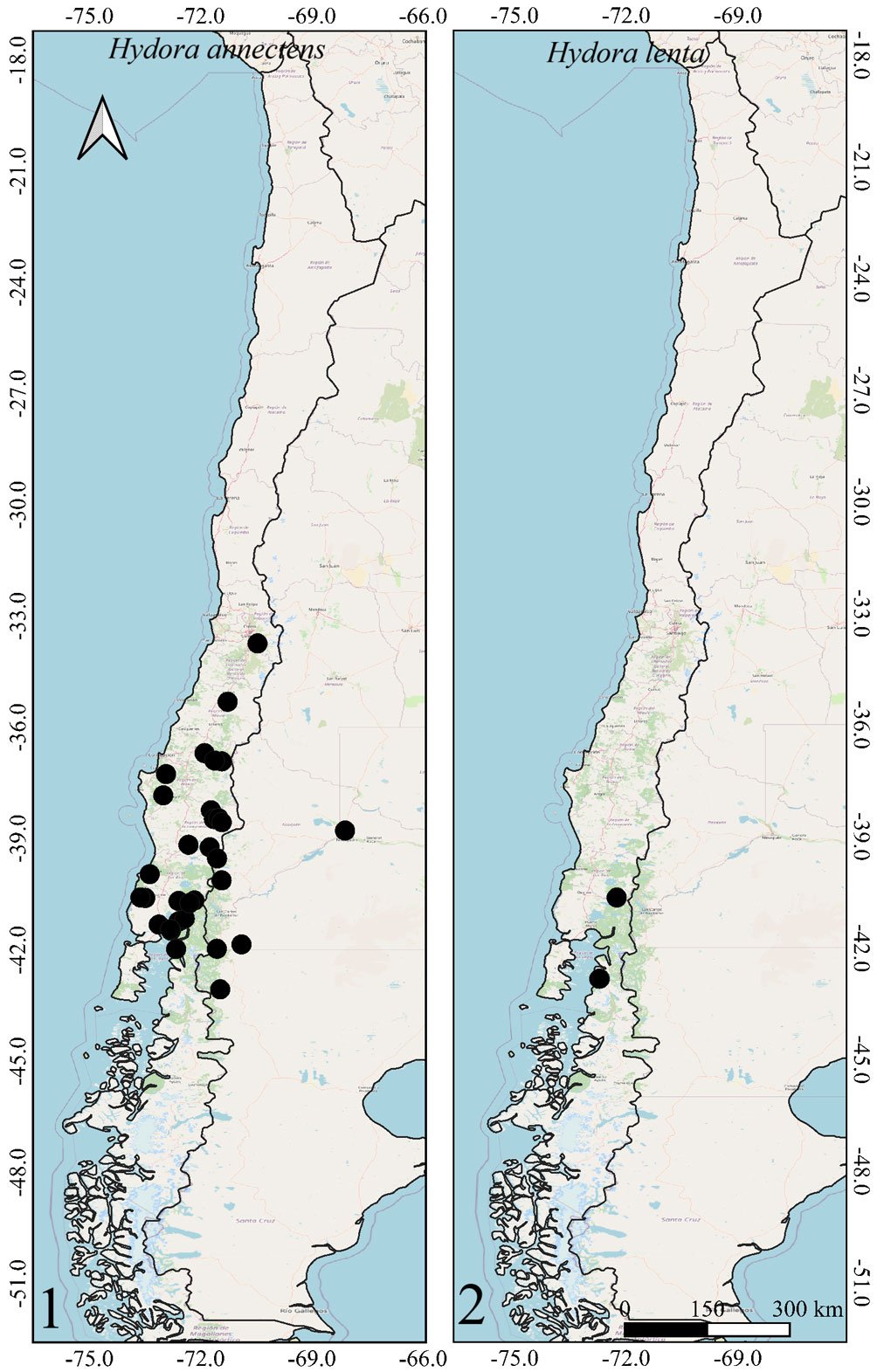
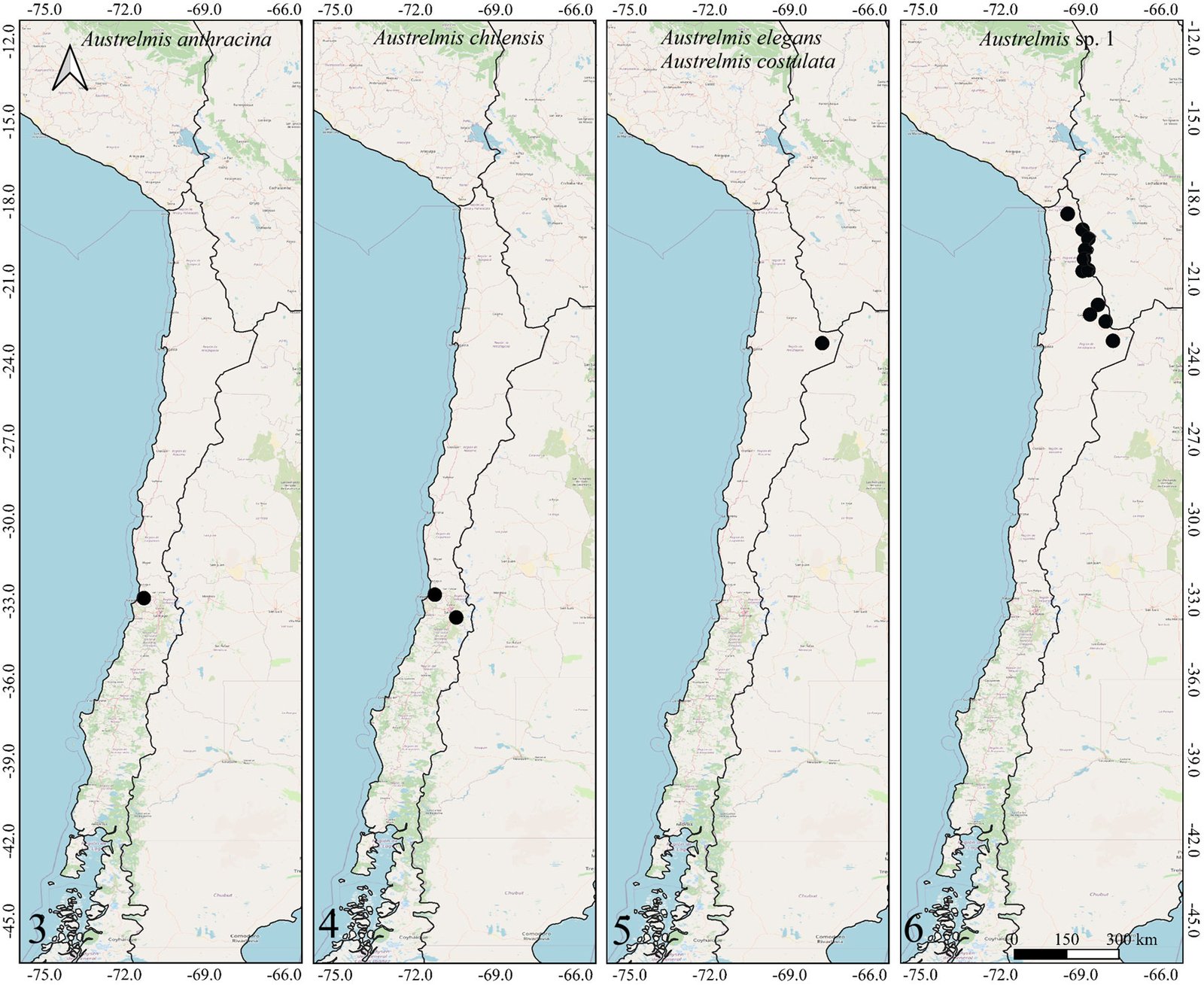
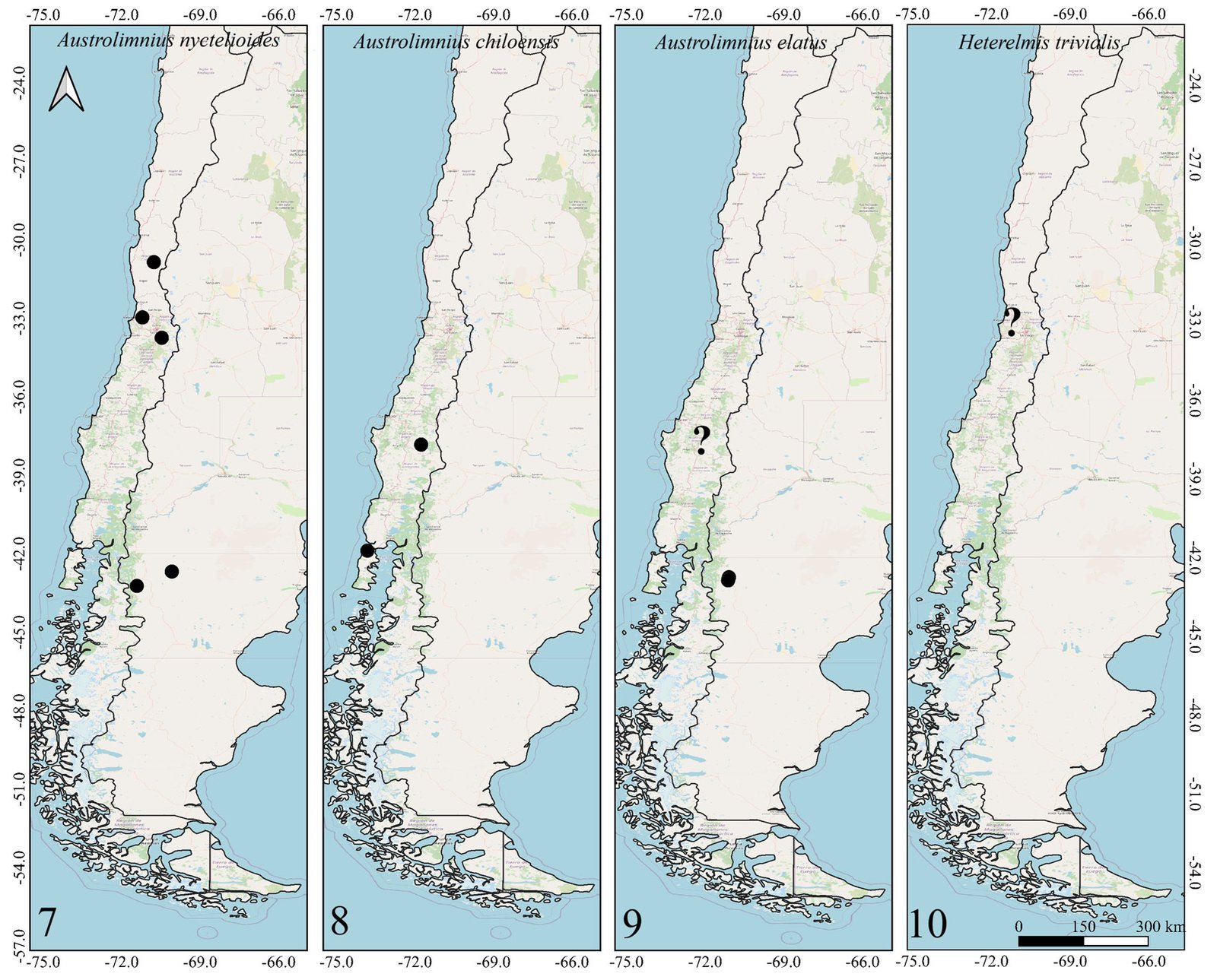
The collection of elmid larvae and adults usually involves aquatic nets that are placed downstream of the sampling area where the substrates are disturbed. Elmidae then drifts in the current and into the net. The specimens are collected from the net and preserved in 70% or 95% ethyl alcohol. Some of the net contents collected by WDS were entirely preserved in 95% alcohol bottles and then processed in the laboratory. This makes it easier to collect smaller adults (such as Austrolimnius) and younger larvae. After collecting at each site, ecological characteristics were recorded on field data sheets. Collection locality maps were produced with QGIS and used all known localities, published and new. Locality data are presented primarily as they occur on the specimen labels. A forward slash “/” indicates separate lines in a label and a double forward slash “//” indicates separate labels. Information included by “( )” is below the locality labels. Additional data provided here, but not in the labels, is indicated by brackets “[ ]”. The “WDS-A- ____” numbers refer to WDS data sheets. Collection locality maps were made using ArcGIS and used all known localities, published and new. Additional records of the specimens were obtained from the collections: National Museum of History of Chile (Santiago) and the Museum of the Department of Zoology of the University of Concepción, as well as from published literature on the Elmidae. Abbreviations cited in the text include the following: National Museum of Natural History, Washington, DC, USA (USNM); Natural History Museum, London, England (NHML); Royal Belgian Institute of Natural Sciences, Brusseels, Belgium (RBINS); William D. Shepard (WDS).
Results
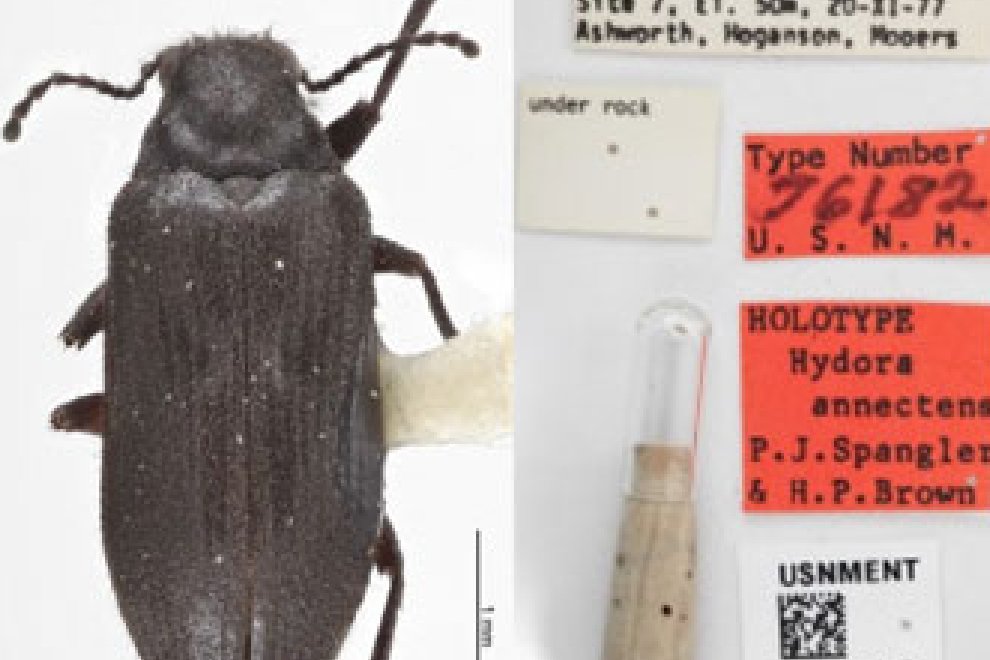
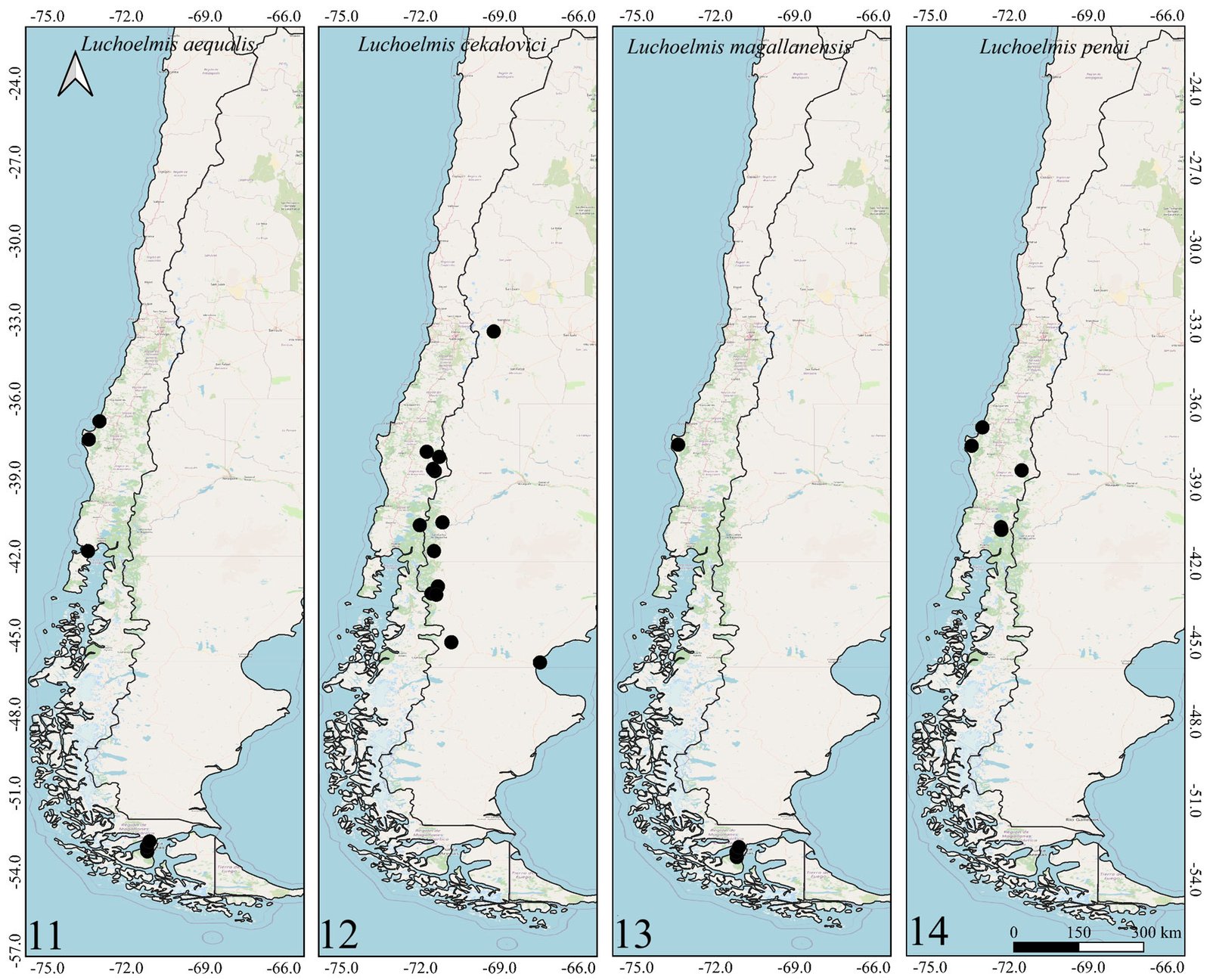
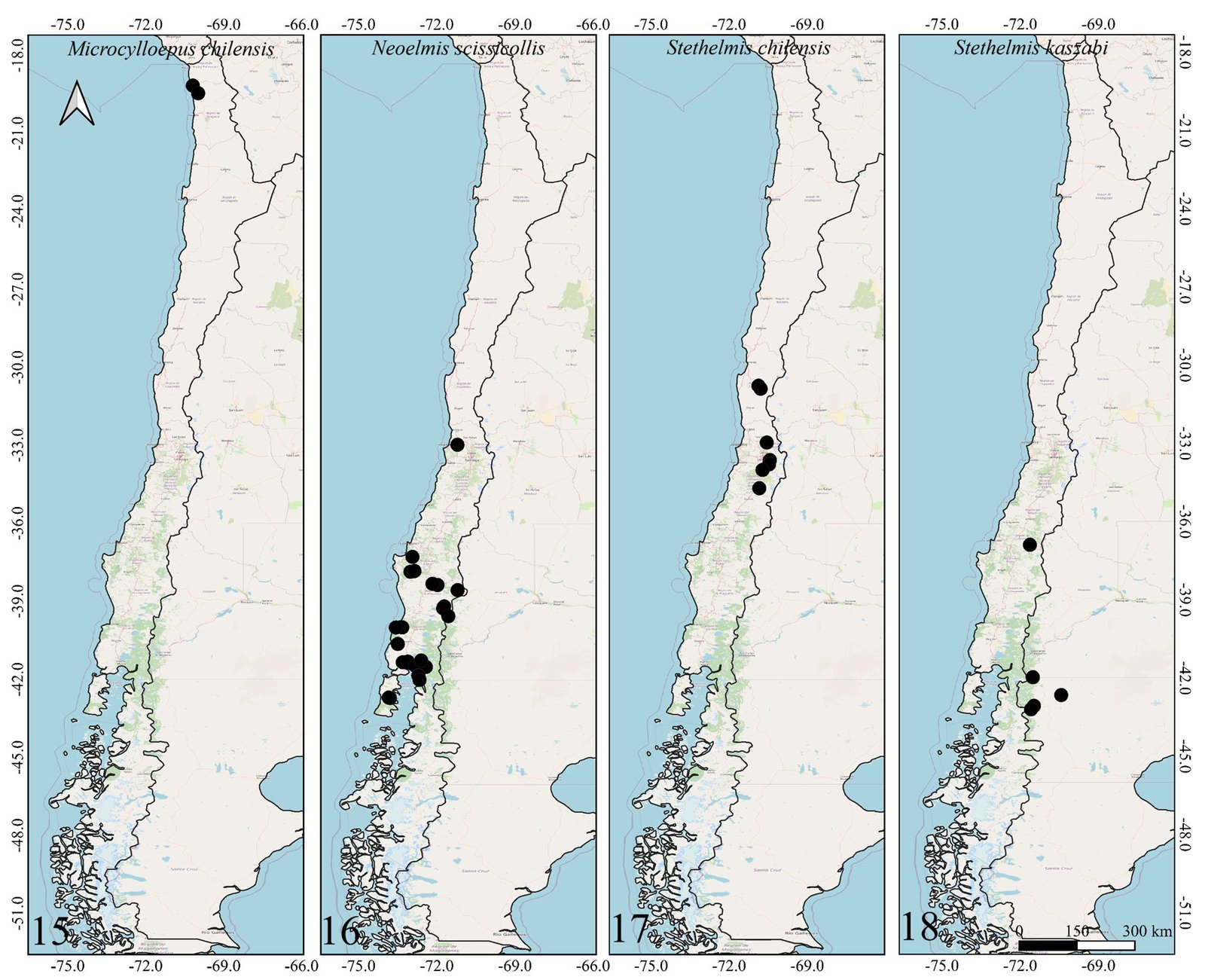
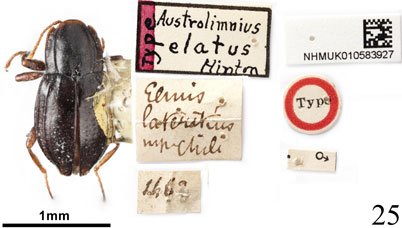
As a result of this work, we can consider the diversity of Elmidae to include 18 species, 7 genera and 2 subfamilies. The species Austrelmis woytkowskii (Hinton, 1937) is eliminated because the analysis of samples collected from various streams in northern Chile shows no evidence of its presence. The species Heterelmis trivialis (Germain, 1892) is also eliminated. One of the reasons for this decision is the loss of the type material. Another reason is the fragility of the stream where it was cited; this stream is small and urbanized and tends to have a considerable decrease in its water flow in summer. This species was searched for at the type locality on 2 occasions, thus corroborating its presence in Chile, but it has not been found or reported since its description. In these samplings, the other species described by Germain and cited for the area were found. In this work, the species Austrolimnius elatus, eliminated by Elgueta and Arriagada (1989), is reestablished; this is supported by the type material found. Finally, it is important to mention that despite the limited progress in species richness shown in this work, there are numerous new localities for the different species present in Chile. A list of the Elmidae known from Chile is provided (Table 1).
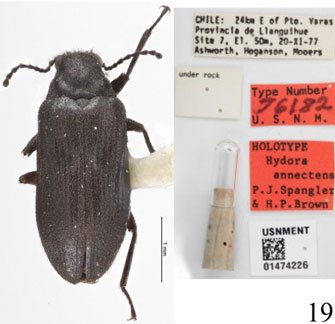
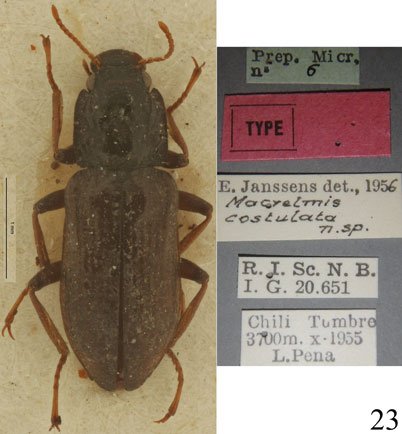
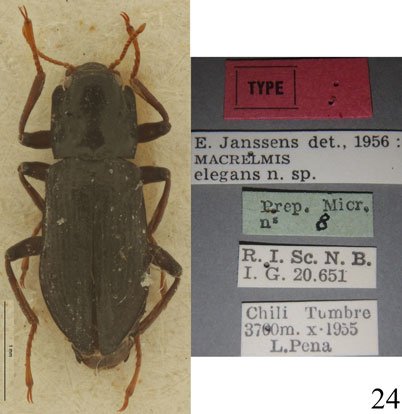
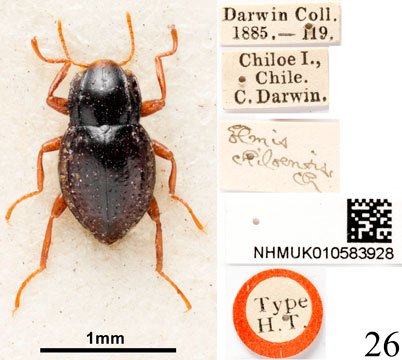
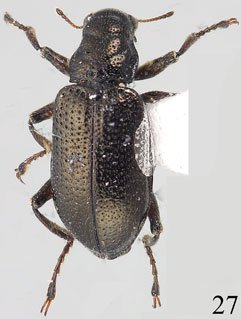
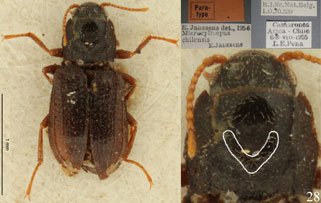
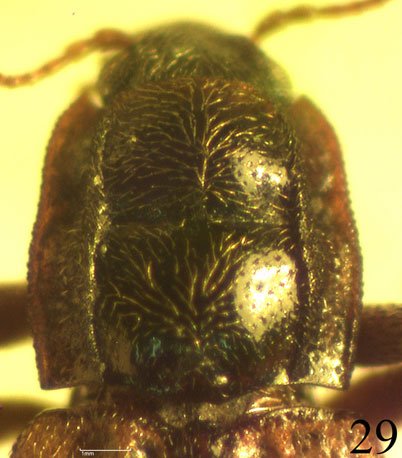
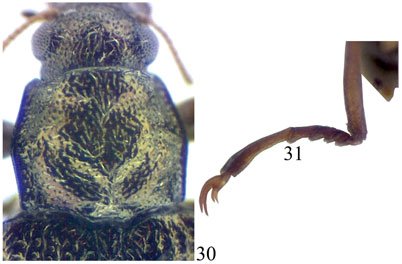
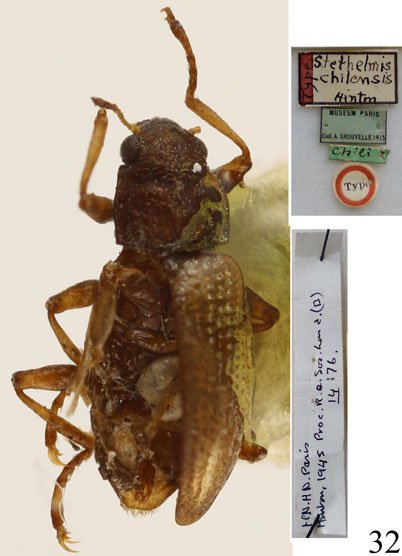
Key to the genera of adult Elmidae known from Chile extracted from Manzo and Archangelsky (2008) and Passos et al. (2018). 1 Body densely pubescent, without plastron; transverse procoxae, with exposed trochantins; adults fly easily from water or net — Larainae Hydora (Fig. 19). 1’ Body not pubescent, with plastron; procoxa globosa, with unexposed trochantins; adults do not fly from water or net — Elminae (2). 2 Thorax without sublateral carinae (Figs. 27, 30, 32) — 3. 2’ Thorax with sublateral carinae — 4. 3 Tarsal claws with basal teeth (Fig. 31) — Stethelmis. 3’ Tarsal claws without basal teeth — Luchoelmis. 4 Epipleura with 1 or 2 longitudinal lines of granules — Austrolimnius. 4’ Epipleura without longitudinal lines of granules — 5. 5 Pronotum with complete deep transverse groove (Fig. 29) — Neoelmis. 5’ Pronotum without deep transverse groove complete — 6. 6 Pronotum with circular anterior depression, with V-shaped carina in ½ basal, with sublateral elevation (Fig. 28) — Microcylloepus. 6’ Pronotum without depressions; sublateral carina restricted to anterior half (Figs. 25, 26) — Austrelmis.
| # | Species | Original generic placement | Author | Endemic |
|---|---|---|---|---|
| Subfamily Elminae Curtis, 1830 | ||||
| 1 | Austrelmis anthracina | Elmis | (Germain, 1892) | Yes |
| 2 | Austrelmis chilensis | Elmis | (Germain, 1854) | Yes |
| 3 | Austrelmis costulata | Macrelmis | (Janssens, 1957) | Yes |
| 4 | Austrelmis elegans | Macrelmis | (Hinton, 1937) | No |
| 5 | Austrelmis sp. | Macrelmis | (Janssens, 1957) | Yes |
| 6 | Austrolimnius chiloensis | Elmis | (Champion, 1918) | Yes |
| 7 | Austrolimnius elatus | Austrolimnius | Hinton, 1941 | No |
| 8 | Austrolimnius nycteloides | Elmis | (Germain, 1854) | No |
| 9 | Luchoelmis aequalis | Luchoelmis | Spangler & Staines 2002 | Yes |
| 10 | Luchoelmis cekalovici | Luchoelmis | Spangler & Staines 2002 | No |
| 11 | Luchoelmis magallanensis | Luchoelmis | Spangler & Staines 2002 | Yes |
| 12 | Luchoelmis penai | Luchoelmis | Spangler & Staines 2002 | Yes |
| 13 | Microcylloepus chilensis | Microcylloepus | Janssens, 1957 | Yes |
| 14 | Neoelmis scissicollis | Elmis | (Germain, 1892) | Yes |
| 15 | Stethelmis chilensis | Stethelmis | Hinton 1945 | Yes |
| 16 | Stethelmis kaszabi | Stethelmis | Hinton, 1970 | No |
| Subfamily Larainae LeConte, 1861 | ||||
| 17 | Hydora annectens | Hydora | Spangler & Brown, 1981 | No |
| 18 | Hydora lenta | Hydora | Spangler & Brown, 1981 | Yes |
Generic reviews
This section is reproduced from the article PDF; the genus-by-genus accounts (with new distributional records and material examined) are available in full in the linked PDF.
Discussion
The Chilean Elmidae include 2 subfamilies, 7 genera and 17 species. However, many additional species are known but not yet described. Many geographic areas remain unexplored, so additional species are likely to be found. Endemism is relatively high in the Chilean Elmidae, 82.3% (14 of 17 species) of the species are endemic to Chile. The only Chilean Elmidae not endemic to Chile are Austrolimnius elatus, A. nycteloides, and Hydora annectens.
The number of genera and species present in the South American countries on the Pacific slope decreases from north to south (Ecuador to Chile) (Table 2). Partly this is because the northernmost areas are closer to the equator, where temperatures are more favorable to elmid evolution. Also, partly this is due to Ecuador and Peru having areas located on the east front of the Andes near to the Amazon where the evolution of the Elmidae has gone in a different direction (Shepard unpublished data). Chile lacks an Amazonian component.
In Chile, the elmid fauna has been negatively impacted by coastal and Andean orogenies, especially in the north. This is mainly due to the isolation and desertification that characterizes this area (Shepard unpublished data). The only 2 genera present there are Austrelmis and Microcylloepus. Microcylloepus elsewhere has been able to maintain populations in desert environments where small springs or seeps occur, so it is not surprising that it would be found here, while Austrelmis is a very typical inhabitant of high mountain habitats throughout the Andes.
The Southern Cone area of Chile has genera that were thought to be restricted to this area, such as Austrolimnius, Luchoelmis, and Stethelmis. However, Austrolimnius and Stethelmis have now been collected somewhat farther north, Coquimbo in the case of Austrolimnius and Atacama in the case of Stethelmis, nonetheless their diversity remains in the Southern Cone area.
Two collection attempts in the type locality of Heterelmis trivialis failed to find extant populations. It is not known why this population might have disappeared. Likewise, attempts to find populations of Austrelmis woytkowskii were unsuccessful. These findings reinforce the necessity to amplify sampling focused on aquatic coleoptera and Elmidae specifically, in order to determine if these populations are truly extinct or only minimally abundant.
| Country | Area (km²) | Number of genera and species | Reference |
|---|---|---|---|
| Colombia | 916,445 | 31 genera and 65 especies | Hincapié-Montoya, 2023 |
| Ecuador | 276,841 | 19 genera and 59 especies | Monte and Mascani, 2012 |
| Perú | 1,285,216 | 17 genera and 51 especies | Shepard and Chaboo, 2015 |
| Chile | 756,950 | 7 genera and 18 especies | This review |
| Bolivia | 1,098,581 | 12 genera and 33 especies | Manzo and Moya, 2010 |
| Argentina | 2,780,400 | 14 genera and 21 especies | Manzo and Archangelsky, 2014 |
Acknowledgements
We thank all the people who made this work possible: Walter Sielfeld, for the support on the ground and collection of specimens; Mario Elgueta (National Museum of Natural History); Margarita Ruiz de Gamboa (CEMABIO); Pablo Fierro (Universidad del Valdivia) for his help, contribution of copies and ideas; the specialists Verónica Manzo (University of Tucumán, Argentina) and María Passos (Federal University of the State of Rio de Janeiro, Brazil) for their bibliography. And, finally, the Laboratory of Water Quality Bioindicators EULA-Chile, for their contribution in specimens and land. Additionally, we thank the following people for providing photographs of type specimens and labels under their care: Pol Limbourg (RBINS), Keita Matsumoto (NHML) and Charyn Micheli (USNM).
References
Archangelsky, M., & Brand, C. (2014). A new species of Luchoelmis Spangler & Staines (Coleoptera: Elmidae) from Argentina and its probable larva. Zootaxa, 3779, 563–572. https://doi.org/10.11646/zootaxa.3779.5.6
Archangelsky, M., & Manzo, V. (2006). The larva of Hydora annectens Spangler and Brown (Coleoptera: Elmidae, Larainae) and a key to New World Larainae larvae. Zootaxa, 1204, 41–52. https://doi.org/10.11646/zootaxa.1204.1.4
Archangelsky, M., & Manzo, V. (2007). Descripción de las larvas maduras de los géneros Stethelmis Hinton y Luchoelmis Spangler and Staines (Insecta: Coleoptera, Elmidae). Revista del Museo Argentino de Ciencias Naturales, 9, 79–87.
Archangelsky, M., Martínez-Román, N. R., & Manzo, V. (2016). Description of mature larvae of the genus Austrelmis Brown from Argentina (Insecta: Coleoptera, Elmidae). Annales de Limnologie, 52, 343–353. https://doi.org/10.1051/limn/2016024
Artigas, J. (1963). Descripción de la larva de un Psefenido chileno (Coleoptera-Psephenidae). Gayana Zoología, 8, 3–9.
Brown, H. P. (1974). Survival records for elmid beetles, with notes on laboratory rearing of various dryopoids (Coleoptera). Entomological News, 84, 278–284.
Brown, H. P. (1984). Neotropical Dryopoids, III. Major nomenclatural changes affecting Elsianus Sharp and Macrelmis motschulsky, with checklists of species (Coleoptera: Elmidae: Elminae). The Coleopterists Bulletin, 38, 121–129.
Brown, H. P. (1987). Biology of riffle beetles. Annual Review of Entomology, 32, 253–273. https://doi.org/10.1146/annurev.ento.32.1.253
Champion, G. C. (1918). Notes on various South American Coleoptera collected by Charles Darwin during the voyage of the “Beagle” with descriptions of new genera and species. Entomologists’ Monthly Magazine, 54, 43–54.
Dajos, R. (1973). Description du Coléoptere Chiloea chilensis, n. g., n. sp., type d’une nouvelle familie: Chiloeidae. Annals de la Societe Etomologique de France (N. S.), 9, 173–179. https://doi.org/10.1080/21686351.1973.12278133
Elgueta, M., & Arriagada, G. (1989). Estado actual del conocimiento de los coleópteros de Chile (Insecta: Coleoptera). Revista Chilena de Entomología, 17, 5–60.
Elliott, J. M. (2008). The ecology of riffle beetles (Coleoptera: Elmidae). Freshwater Reviews, 1, 189–203. https://doi.org/10.1608/FRJ-1.2.4
Emmerich, D., Manzo, V., & Morelli, E. (2025). Lista comentada y actualizada de los escarabajos acuáticos de la familia Elmidae (Insecta: Coleoptera) de Uruguay. Revista de la Sociedad Entomológica Argentina, 84, e0210. https://doi.org/10.25085/rsea.840210
Ferrú, M., & Elgueta, M. (2011) Lista de coleópteros (Insecta: Coleoptera) de las regiones de Arica y Parinacota y de Tarapacá, Chile. Boletín del Museo Nacional de Historia Natural, Chile, 60, 9–61. https://doi.org/10.54830/bmnhn.v60.2011.178
Fierro, P., Bertrán, C., Mercado, M., Peña-Cortés, F., Tapia, J., Hauenstein, E. et al. (2012). Benthic macroinvertebrate assemblages as indicators of water quality applying a modified biotic index in a spatio-seasonal context in a coastal basin of southern Chile. Revista de Biología Marina y Oceanografia, 47, 23–33. https://doi.org/10.4067/S0718-19572012000100003
Fierro, P., Ferrú, M., & Lara, C. (2020). Effects of forest conversion on the aquatic Coleoptera assemblage in Mediterranean-climate streams. Ecological Indicators, 111, 106043. https://doi.org/10.1016/j.ecolind.2019.106043
Germain, P. (1854). Descripción de 21 especies nuevas de coleópteros de Chile. Anales de la Universidad de Chile, 1854, 324–336.
Germain, P. (1892). Notes sur les coléopteros du Chili. Actes de la Société Scientifique du Chile, 2, 241–261.
González-Córdoba, M., Zúñiga, M. C., Giraldo, L. P., Ramírez, Y. P., & Chará, J. (2020). Sensibilidad de Elmidae (Insecta: Coleoptera) a la perturbación del hábitat y la calidad fisicoquímica del agua en ambientes lóticos de los Andes colombianos. Revista de Biología Tropical, 68, 601–622. https://doi.org/10.15517/rbt.v68i2.36702
Hincapié-Montoya, D. M. (2023). Nuevos registros para Elmidae (Coleoptera: Byrrhoidea) en Colombia. Acta Biológica Colombiana, 28, 345–349. https://doi.org/10.15446/abc.v28n2.103984
Hinton, H. E. (1940). The Percy Sladen Trust Expedition to Lake Titicaca in 1937. VII. The Peruvian and Bolivian species of Macrelmis Motsch. (Coleoptera, Elmidae). The Transactions of the Linnean Society of London (Ser. 3), 1, 117–147.
Hinton, H. E. (1941). A synopsis of the American species of Austrolimnius Carter (Coleoptera, Elmidae). Entomologists’ Monthly Magazine, 77, 156–163.
Hinton, H. E. (1945). Stethelmis chilensis, new genus and species of Elmidae from Chile (Coleoptera). Proceedings of the Royal Entomological Society of London (B), 14, 73–76. https://doi.org/10.1111/j.1365-3113.1945.tb00022.x
Jäch, M. A., Kodada, J., Brojer, M., Shepard, W. D., & Čiampor, Jr. F. (2016). World catalogue of insects, Vol. 14. Coleoptera: Elmidae and Protelmidae. Leiden, The Netherlands: Koninklijke Brill.
Janssens, E. (1957). Contribution à l’étude des coléoptères torrenticoles. V. Elmidae de la cordillère des Andes. Bulletin de l’Institut royal des Sciences Naturelles de Belgique, 33, 1–8.
Jerez, V., & Moroni, J. (2006). Diversidad de coleópteros acuáticos en Chile. Gayana, 70, 72–81. https://doi.org/10.4067/S0717-65382006000100012
Lafuente, W., Soto L. M., López C., & Domínguez-Granda, L. (2019). Efectos de un derrame de petróleo crudo en la comunidad de macroinvertebrados bentónicos de un río amazónico ecuatoriano. Revista de Ciencias Ambientales, 53, 1–22. https://doi.org/10.15359/rca.53-1.1
Lambert, P., Maier, C. A., & Leschen, R. A. B. (2015). A new species and lectotype designations for New Zealand Hydora (Elmidae: Larainae) with a world checklist. New Zealand Entomologist, 38, 38–57. https://doi.org/10.1080/00779962.2014.963910
Lataste, F. (1897a). Présentation d’une larve de Pseudo-Névroptère d’aspect crustacéen. Actes de la Société Scientifique du Chili, 7, 103–106.
Lataste, F. (1897b). La larve crustacéiforme de Peñaflor est de Coléoptère et non de Pseudo-Névroptère. Actes de la Société Scientifique du Chili, 7, 107–108.
Manzo, V. (2005). Key to South America genera of Elmidae (Insecta: Coleoptera) with distributional data. Studies on Neotropical Fauna and Environment, 40, 201–208. https://doi.org/10.1080/01650520500140619
Manzo, V. (2007). Cinco citas nuevas de Elmidae (Coleoptera) para la Argentina, con la redescripción de Austrolimnius (Telmatelmis) nyctelioides. Revista de la Sociedad Entomológica Argentina, 66, 11–20.
Manzo, M. V., & Archangelsky, M. (2008). A key to the known larvae of South American Elmidae (Coleoptera: Byrrhoidea), with a description of the mature larva of Macrelmis saltensis Manzo. International Journal of Limnology, 44, 63–74. https://doi.org/10.1051/limn:2008023
Manzo, M. V., & Moya, N. (2010). Description of the first South American species of Neocylloepus Brown (Coleoptera: Elmidae): N. chaparensis sp. nov. from Bolivia. Studies on Neotropical Fauna and Environment, 45, 129–138. https://doi.org/10.1080/01650521.2010.520210
Martínez-Román, N. M., & Archangelsky, M. (2017). Description of the mature larva of Austrolimnius nyctelioides (Germain, 1892) and A. elatus Hinton, 1941 (Coleoptera: Elmidae). Zootaxa, 4216, 585. https://doi.org/10.11646/zootaxa.4216.6.5
Martínez-Román, N. R., Manzo, V., & Archangelsky, M. (2019). A new species of Stethelmis Hinton (Coleoptera: Elmidae) from Argentina and description of its larva. Anais da Academia Brasileira de Ciências, 91, 1–13. https://doi.org/10.1590/0001-3765201920180954
Martínez-Román, N., Manzo, V., & Archangelsky, M. (2025). Descriptions of the mature larvae of the genera Austrelmis and Macrelmis (Coleoptera: Elmidae) from Argentina. Zoosystematica Rossica, 34, 181–207. https://doi.org/10.31610/zsr/2025.34.1.181
Monte, C., & Mascagni, A. (2012). Review of the Elmidae of Ecuador with the description of ten new species (Coleoptera: Elmidae). Zootaxa, 3342, 1–38. https://doi.org/10.11646/zootaxa.3342.1.1
Passos, M. I. S., Manzo, V., & Maier, C. A. (2018). Families Dryopidae, Elmidae and Psephenidae. In J. Thorp, & A. Covich (Eds.), Thorp and Covich’s freshwater invertebrates. Fourth Edition, Volume 3 (pp. 583–598). Salt Lake City: Elsevier. https://doi.org/10.1016/B978-0-12-804223-6.00027-5
Polizei, T. T. S. (2018). A new species and a key for the Brazilian species of the genus Heterelmis Sharp, 1882 (Coleoptera: Elmidae, Elminae). Papéis Avulsos de Zoologia, 58, e20185820. https://doi.org/10.11606/1807-0205/2018.58.20
Polizei, T. T. S., Costa, L. S. M., & Bispo, P. C. (2020). Austrolimnius cleidecostae, a new species of riffle beetle (Coleoptera: Elmidae) from Brazil. Papéis Avulsos de Zoologia, 60, 1–20. https://doi.org/10.11606/1807-0205/2020.60.special-issue.12
Shepard, W. D. (2016). Notes on the endemic Chilean terrestrial dryopoid Sosteamorrphus verrucatus Hinton 1936 (Coleoptera: Dryopidae). Boletín del Museo Nacional de Historia Natural, Chile, 65, 175–183. https://doi.org/10.54830/bmnhn.v65.2016.93
Shepard, W. D., & Barr, C. B. (2023). A revision of the Chilean water penny beetle genus Tychepsephus Waterhouse, 1876 (Coleoptera, Psephenidae, Eubriinae). Zookeys, 1164, 23–61. https://doi.org/10.3897/zookeys.1164.103184
Shepard, W. D., & Chaboo, C. S. (2015). Beetles (Coleoptera) of Peru: a survey of the families Elmidae. Journal of the Kansas Entomological Society, 88, 167–168. https://doi.org/10.2317/kent-88-02-167-168.1
Solervicens, J. (1974). Observaciones biológicas y de distribución acerca de Chiloea chilensis Dajos 1973. Anales del Museo de Historia Natural, 7, 234–240.
Spangler, P. J., & Brown, H. P. (1981). The discovery of Hydora, a hitherto Australian-New Zealand genus of riffle beetles in Austral South America (Coleoptera; Elmidae). Proceedings of the Entomological Society of Washington, 83, 596–606.
Spangler, P. J., & Staines, C. L. (2002). Luchoelmis, a new genus of Elmidae (Coleoptera) from Chile and Argentina. Insecta Mundi, 16, 215–220.
Redescription of Stagmomantis hebardi (Mantodea: Mantidae), with the description of the female
Redescripción de Stagmomantis hebardi (Mantodea: Mantidae), con la descripción de la hembra
Aarón Emilio Vásquez-Quintero a, Iker Cubillos-Macías b, Erick Omar Martínez-Luque c, Jovana M. Jasso-Martínez b y Fernando Varela-Hernández a, *
a Universidad Autónoma del Estado de Morelos, Escuela de Estudios Superiores del Jicarero, Laboratorio de Sistemática Molecular, Carretera Galeana-Tequesquitengo s/n, Col. El Jicarero, 62909 Jojutla, Morelos, Mexico
b Universidad Nacional Autónoma de México, Instituto de Biología, Colección Nacional de Insectos, Tercer Circuito Exterior s/n, Cd. Universitaria, Copilco El Alto, Coyoacán, Apartado postal 70-233, 04510 Mexico City, Mexico
c Universidad Autónoma de Querétaro, Facultad de Ciencias Naturales, Av. de las Ciencias s/n, Juriquilla, 76230 Querétaro, Querétaro, Mexico
*Corresponding author: fernando.varela@uaem.mx (F. Varela-Hernández)
Received: 02 September 2025; accepted: 08 December 2025
Abstract
The genus Stagmomantis Saussure, 1869 comprises a group of New World mantids whose taxonomic delimitation and composition have been challenging due to complex morphological variation. Stagmomantis hebardi Rehn, 1935, a species distributed in the Neotropical region and the Mexican Transition Zone, was originally described based on both a female and a male specimen. However, the female was subsequently recognized as belonging to a different species within the subgenus Auromantis. In this study, we provide the redescription of the male and the description of the female of S. hebardi. Descriptions are based on external morphology and both sexes internal genitalia characters. The conspecificity of the male and female is supported by molecular evidence provided in previous studies and further validated by biological observations from captive rearing. The corkscrew-like pda (posterior process of the ventral phallomere) in the male genitalia and the lobe-like structure between the fifth and sixth tergites in the female abdomen are diagnostic characters that distinguish this species from others of the genus Stagmomantis.
Keywords: External morphology; Internal genitalia; Mantids; Taxonomic description
Resumen
El género Stagmomantis Saussure, 1869 es un grupo de mantis del Nuevo Mundo cuya delimitación y composición han sido desafiantes debido a su compleja variación morfológica. Stagmomantis hebardi Rehn, 1935, una especie distribuida en la región Neotropical y la Zona de Transición Mexicana, fue descrita originalmente con base en un macho y una hembra. Más tarde, se reconoció que la hembra pertenecía a una especie diferente del subgénero Auromantis. En este estudio, proporcionamos la redescripción del macho y la descripción de la hembra de S. hebardi. Ambas descripciones se basan en caracteres de morfología externa y de la genitalia de ambos sexos. La asociación específica entre el macho y la hembra está respaldada por análisis moleculares previos y validada por observación directa en cautiverio. El pda (proceso posterior del falómero ventral) en forma de sacacorchos en la genitalia del macho y la estructura en forma de lóbulo entre los terguitos quinto y sexto en el abdomen de la hembra son caracteres clave para separar a esta especie de otras del género Stagmomantis.
Palabras clave: Morfología externa; Genitalia interna; Mantis; Descripción taxonómica
Introduction
The order Mantodea (praying mantises) comprises about 2,500 species worldwide, distributed in 16 superfamilies, 29 families, 60 subfamilies, and 436 genera (Ehrmann, 2002; Otte & Spearman, 2005; Schwarz & Roy, 2019). Mantidae Latreille, 1802 is the most species-rich family, containing approximately half of the described species (Patel & Singh, 2016; Svenson & Whiting, 2004, 2009); however, the limits and phylogenetic relationships within Mantidae remain unclear. Several groups previously defined based on morphological data were later recovered as non-monophyletic by analyses using mitochondrial and nuclear genes (Svenson & Whiting, 2004, 2009), as well as mitochondrial genomes (Wang et al., 2022; Xu et al., 2021).
Stagmomantis Saussure, 1869 is a New World genus belonging to the subfamily Stagmomantinae Giglio-Tos, 1919. It is one of the most species-rich genera within Mantidae, with 25 recognized species (Anderson, 2025). Species delimitation within Stagmomantis has been challenging due to significant morphological variation among its members, rendering the number of valid species debatable (Agudelo-Rondón et al., 2007; Anderson, 2020a, b, 2021; Ehrmann, 2002; Maxwell, 2014; Otte & Spearman, 2005; Terra, 1995). For instance, Maxwell (2014) did not recognize S. conspurcata Serville, 1869 as a valid species, treating it as a synonym of S. carolina (Johansson, 1763). Later, Anderson (2020b) revalidated S. conspurcata, arguing that sufficient morphological differences —such as body size and male hindwing coloration— justified its recognition as a distinct species. This case exemplifies the taxonomic instability present within Stagmomantis, which has important implications, such as constant changes in the reported geographic distribution patterns of its species.
In 1935, Rehn described Stagmomantis hebardi —named after the American entomologist Morgan Hebard— based on a female and a male specimen from Sinaloa, Mexico. Hebard (1923) had previously identified these specimens as S. limbata Hahn, 1835 and S. tolteca Saussure, 1861, respectively. In his description, Rehn included images of the dorsal habitus of both the female and male, as well as an illustration of the male’s internal genitalia. The taxonomic status of S. hebardi, based on the male-female association established by Rehn, has remained unchallenged for decades.
Recently, a molecular analysis grouped together a female and a male specimen previously identified as S. carolina (Varela-Hernández et al., 2022). In addition to the molecular data, that study included high-resolution images of the dorsal habitus. Subsequent comparison of those specimens with the descriptions and illustrations in Rehn (1935) revealed that the male assigned to S. carolina corresponded to S. hebardi. Crucially, the morphological traits of the female described as S. hebardi by Rehn (1935) did not match those of the female specimen molecularly associated with the male in Varela-Hernández et al. (2022).
Based on this evidence, we consider that Rehn (1935) erroneously associated the sexes of S. hebardi, establishing a heterospecific type series. Consequently, the main objectives of this study are to correctly associate both sexes of S. hebardi, to redescribe the male, and to formally describe the female of S. hebardi (Rehn, 1935). This work is supported by the aforementioned molecular evidence and is based on external morphology as well as a comprehensive analysis of male and female genitalia.
Materials and methods
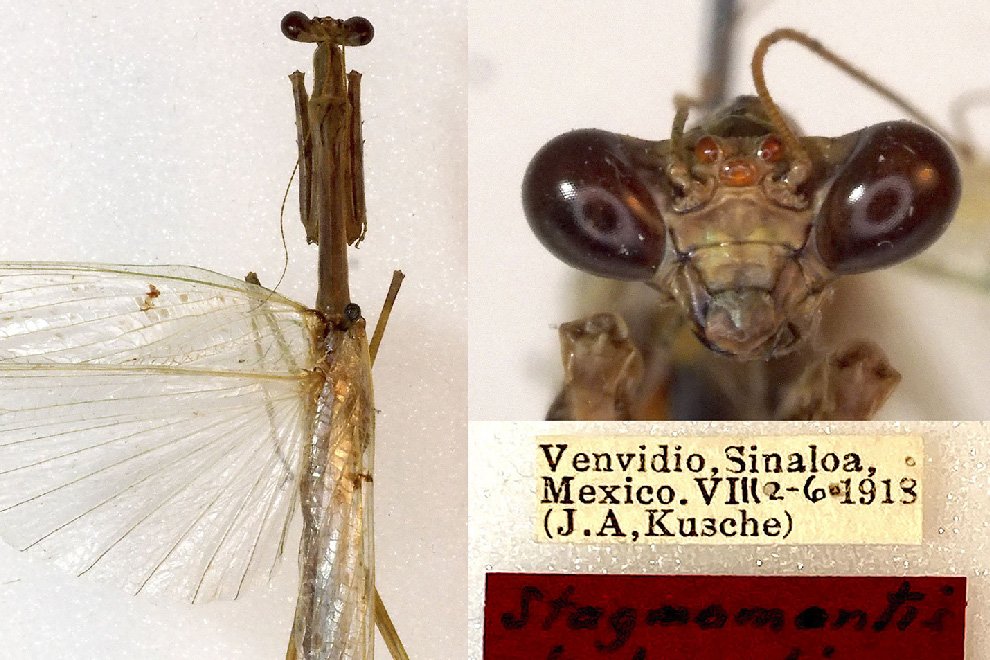
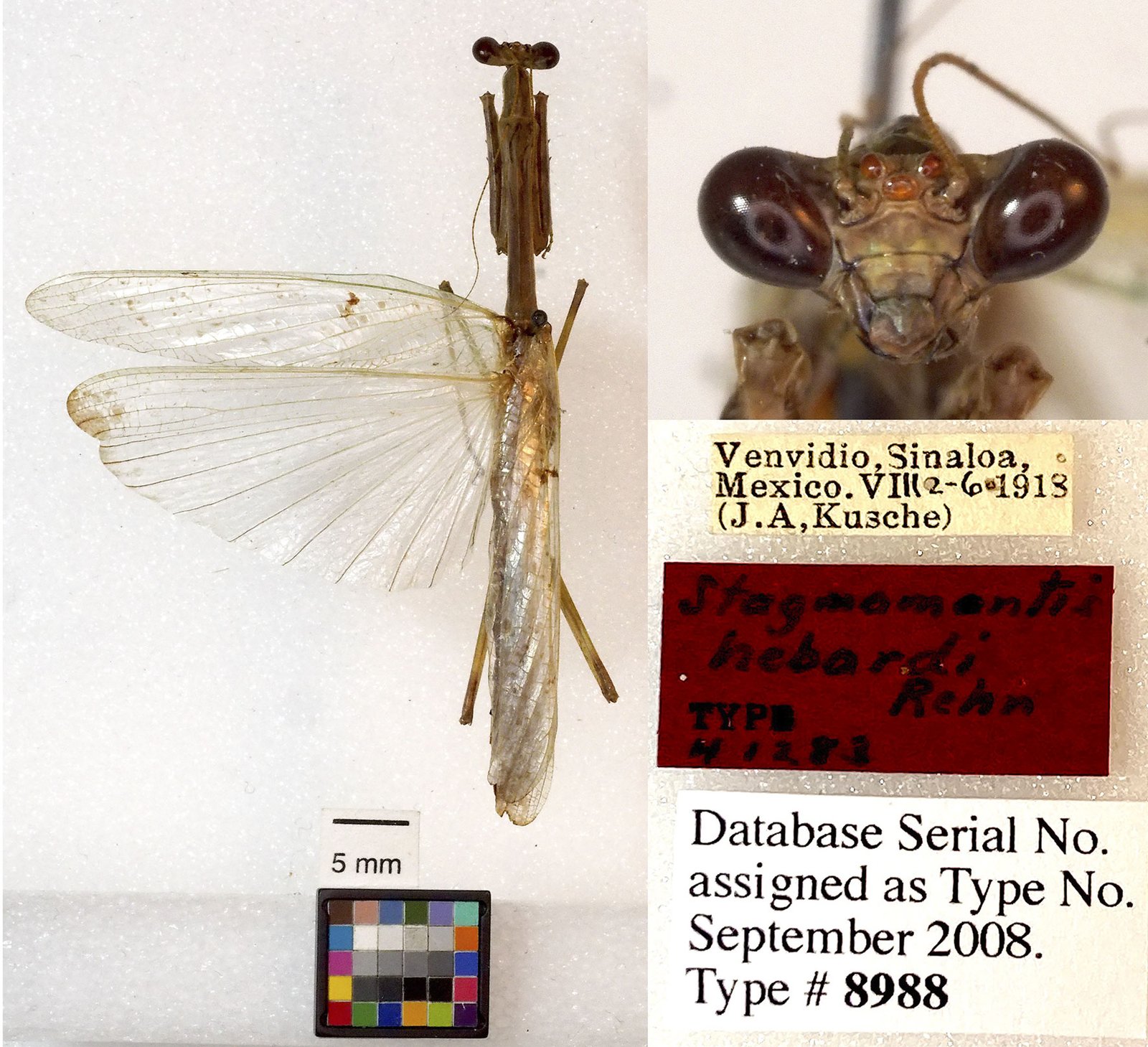
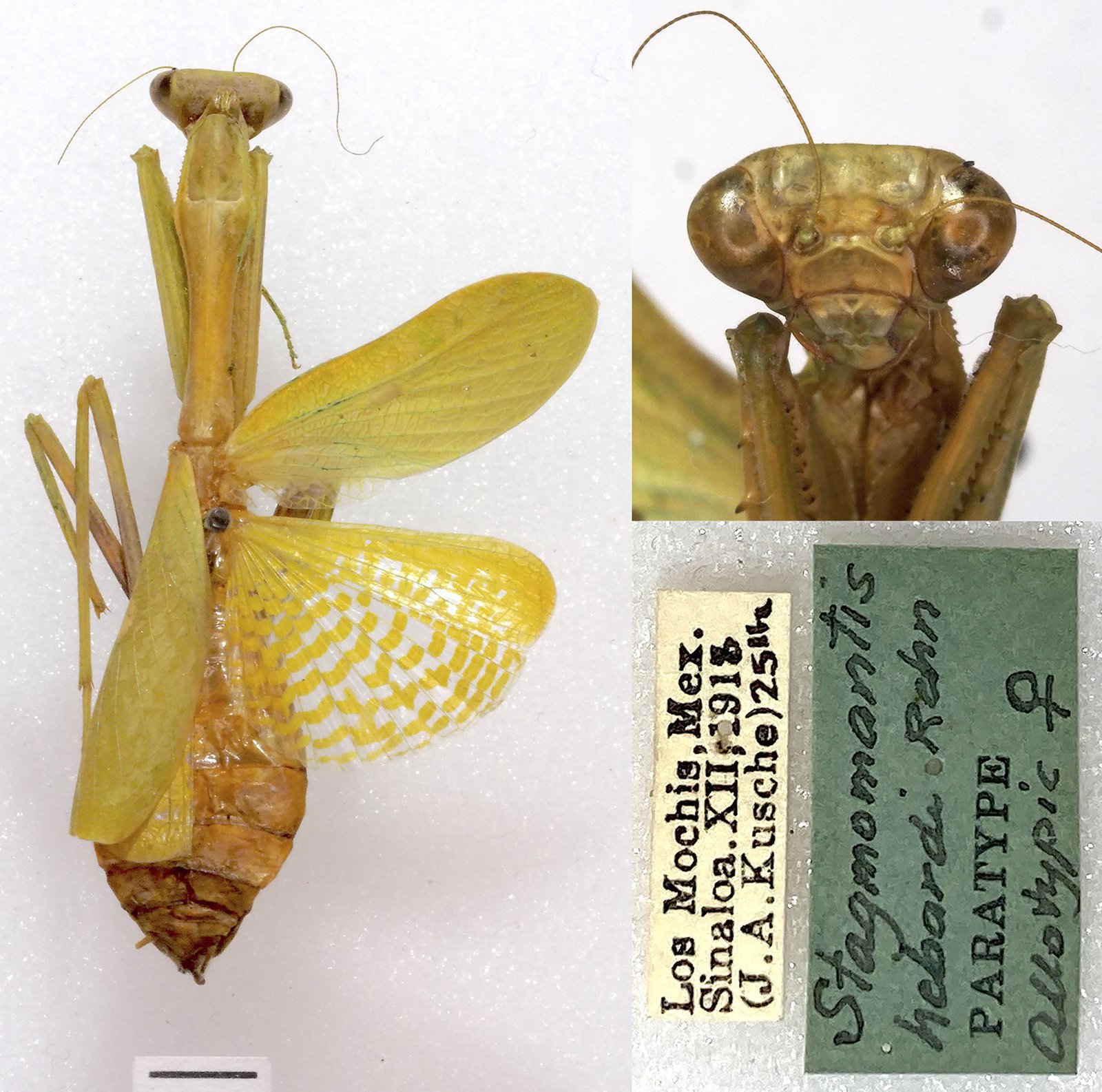
A total of 48 pinned specimens identified as Stagmomantis hebardi were examined (29 males and 15 females, see “Taxonomic summary”). These specimens are deposited at the Colección Nacional de Insectos, Instituto de Biología, Universidad Nacional Autónoma de México (CNIN-IBUNAM) and the Colección Entomológica de la Universidad Autónoma del Estado de Morelos, México (CEUAEM-MAN). Additionally, we examined high-resolution images of the holotype (Fig. 1) and allotype (Fig. 2) deposited at the Academy of Natural Sciences of Philadelphia (ANSP), USA.
Observations and measurements were conducted using an Olympus SZ stereomicroscope. Specimens identification at genus and species level followed the keys and descriptions provided by Rehn (1935), Agudelo-Rondón and Chica (2002), Maxwell (2014), and Anderson (2021). Specimens of both sexes were photographed from multiple angles using a Canon EOS Rebel T5 digital camera equipped with an EF 100 mm f/2.8 Macro USM lens. Camera control was managed via EOS Utility software; images were subsequently stacked and edited using Zerene Stacker and Photoshop CC 2019.
Terminalia of both sexes were softened in hot water (80-100 °C) for 15-20 min, following the protocol of Ferraz et al. (2023). Genitalia were then cleared in a 10% KOH solution at 40 °C for 20-30 min (Brannoch et al., 2017). The extraction of female genitalia followed the method described by Rodrigues and Cancello (2016). Cleared genitalia were rinsed twice in distilled water and stored in 70% ethanol. Remaining soft tissue was removed, and structures were photographed suspended in antibacterial gel to maintain their position (Su, 2016). Abbreviations for all measurements and genitalic structures are provided in Table 1.
To visualize the geographical distribution of the examined specimens, a map was generated using ArcGIS software, utilizing the State Geostatistical Framework, scale 1:250,000 (INEGI, 2024).
Description
Stagmomantis hebardi Rehn, 1935
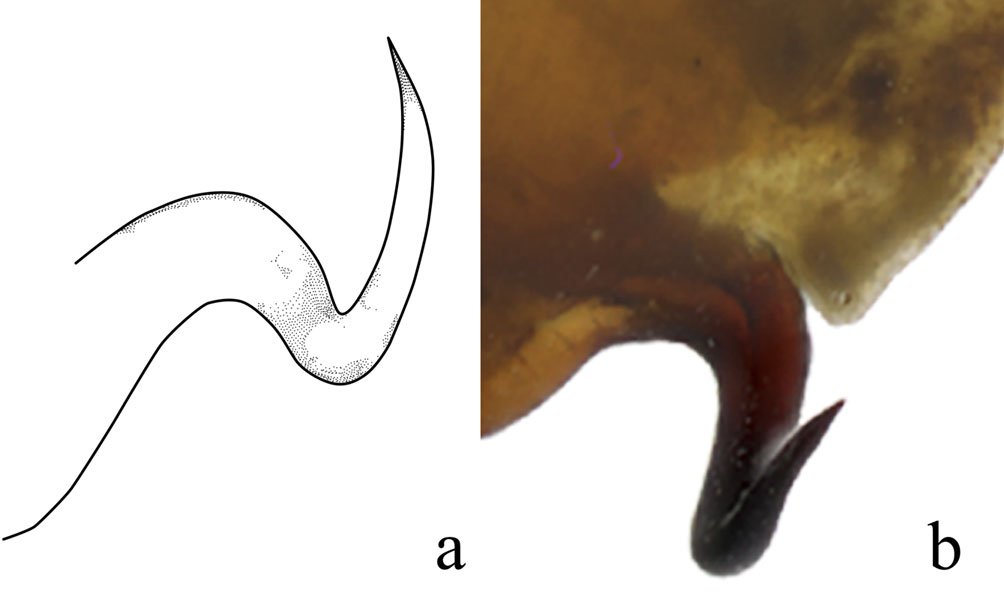
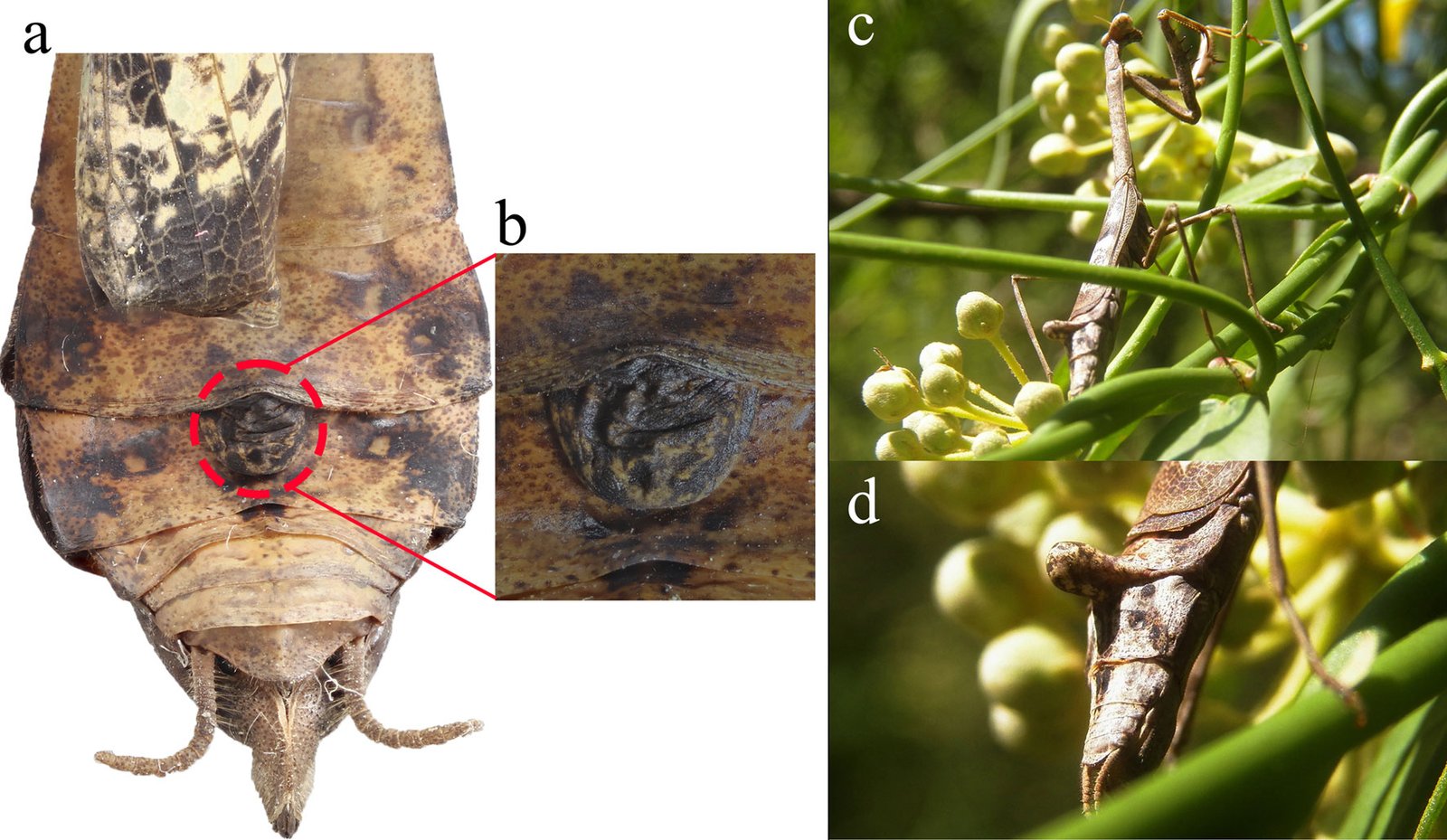
Diagnosis. Male: distinguished by the corkscrew-like posterior process of the ventral phallomere (pda) (Fig. 3). Female: prosternum (inter-coxal area) blackish; anterior coxae armed with 3-6 blackish spines; presence of a protrusible lobe-like structure located between abdominal tergites 5 and 6 (Fig. 4).
| Category | Abbreviation | Meaning |
|---|---|---|
| Morphological | ACL | Anterior coxae length |
| Morphological | AFL | Anterior femur length |
| Morphological | AFW | Anterior femur width |
| Morphological | ATL | Anterior tibia length |
| Morphological | AvS | Anteroventral spines |
| Morphological | DS | Discoidal spines |
| Morphological | FwL | Forewing length |
| Morphological | HH | Head height |
| Morphological | HW | Head width |
| Morphological | HwL | Hindwing length |
| Morphological | ML | Metazone length |
| Morphological | MFL | Metafemur length |
| Morphological | MTL | Metatibia length |
| Morphological | MsFL | Mesofemur length |
| Morphological | MsTL | Mesotibia length |
| Morphological | PL | Pronotum length |
| Morphological | PrL | Prozone length |
| Morphological | PvS | Posteroventral spines |
| Morphological | PW | Pronotum width |
| Morphological | TL | Total length |
| Male genitalia | aafa | Anterior lobe of phalloid apophysis (left phallomere) |
| Male genitalia | an | Anterior extension of sclerite R3 (right phallomere) |
| Male genitalia | bm | Dextral extension (right phallomere) |
| Male genitalia | fda | Main posterior lobe (right phallomere) |
| Male genitalia | L4A | Sclerite extending over the ventral wall (ventral phallomere) |
| Male genitalia | L4B | Sclerite extending over the dorsal wall (left phallomere) |
| Male genitalia | loa | Posteromesal (left phallomere) |
| Male genitalia | paa | Posterior process (left phallomere) |
| Male genitalia | pafa | Posterior lobe of phalloid apophysis (left phallomere) |
| Male genitalia | pda | Posterior process (ventral phallomere) |
| Male genitalia | pia | Process posterolateral to pva (right phallomere) |
| Male genitalia | pva | Process anteromesal to pia (right phallomere) |
| Male genitalia | R3 | Anteriorly extending sclerite (right phallomere) |
| Male genitalia | ssp | Secondary spine |
| Female genitalia | agsl | Accessory gland supporting lobe |
| Female genitalia | CG8 | Caudogyne |
| Female genitalia | CX8 | Coxa 8 |
| Female genitalia | cxdl | Dorsolateral coxal lobelet |
| Female genitalia | cxvl | Ventrolateral coxal lobelet |
| Female genitalia | gl9 | Gonoplac 9 |
| Female genitalia | gp8 | Gonapophysis 8 |
| Female genitalia | gp9 | Gonapophysis 9 |
| Female genitalia | gpal8 | Apical lobe of gonapophysis 8 |
| Female genitalia | gpmo8 | Medial outgrowth of gonapophysis 8 |
| Female genitalia | gptm9 | Medial tine of gonapophysis 9 |
| Female genitalia | rh | Rhachis |
| Female genitalia | spb | Spermathecal bulge |
| Female genitalia | vf7 | Ventral segmental fold 7 |
| Female genitalia | VS7 | Vestibular sclerite 7 |
Identification. Males: antennae longer than pronotum. Tubercle present between antennifer and compound eyes. Wings longer than abdomen; fore- and hindwings hyaline; costal area of forewings opaque with brown spots. Genitalia with the posterior process of ventral phallomere (pda) corkscrew-shaped. Females: abdominal tergites 4-6 dorsoventrally flattened; protrusible lobe-like structure present between tergites 5 and 6. Supragenital plate wider than long with well-developed longitudinal medial keel. Forewings opaque, greenish or brownish, with brown spots; hindwings opaque, anteriorly yellowish with brown spots near posterior margin, or yellowish with colorless spots posteriorly. Both sexes: ocellar tubercles absent; ocelli flush with surface of frons. Lower frons smooth, wider than long. Pronotum long and slender; lateral margins denticulate; dorsal surface smooth. Forecoxae approximately 3/4 the length of pronotum; anterior and posterior margins denticulate; forecoxal lobes convergent. Hearing organ of DK type.
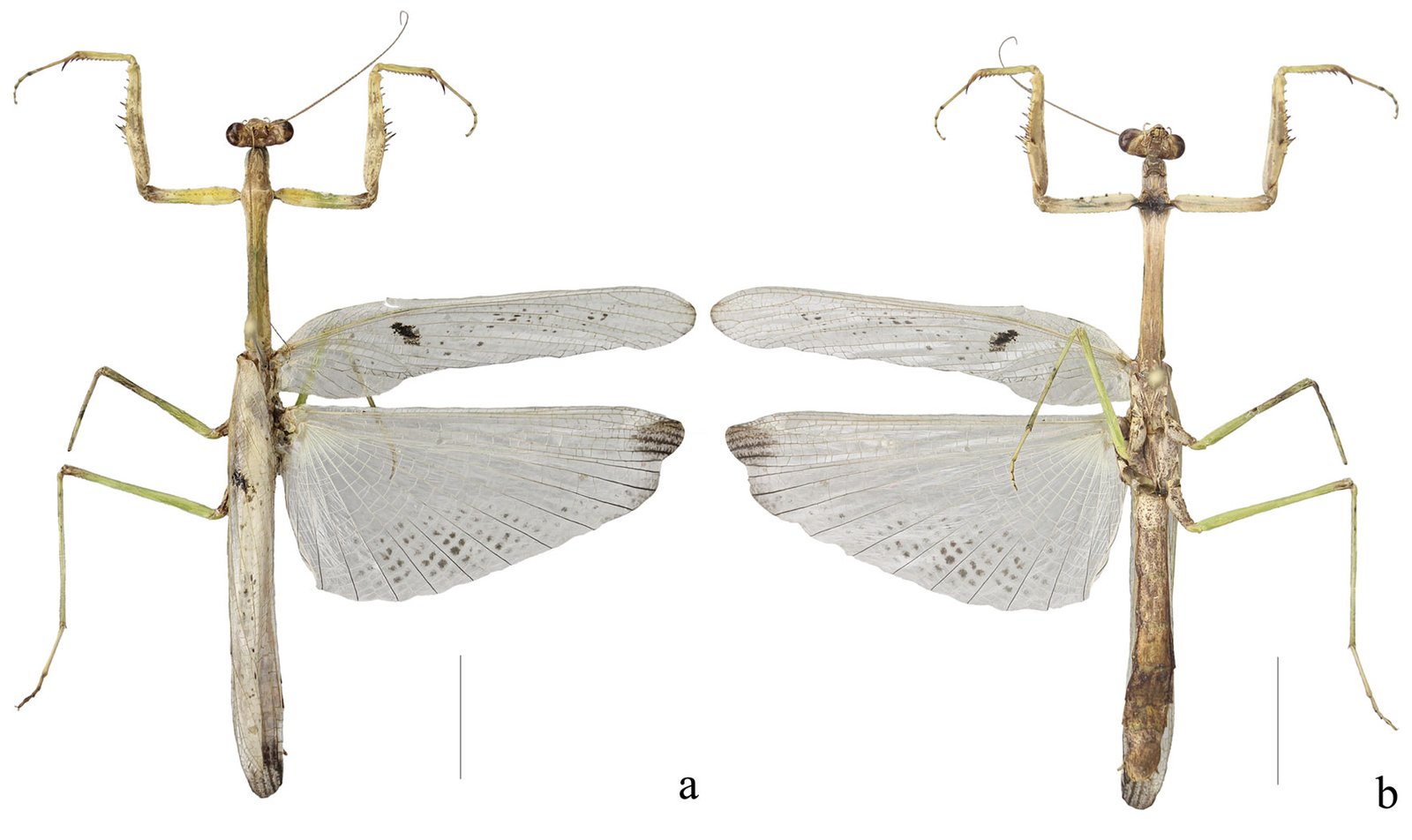
Male (Fig. 5). Measurements (Table 2). Head: head capsule (Fig. 6a) with oval eyes; juxtaocular bulges undeveloped; ocellar tubercles undeveloped. Anterior margin of vertex straight, depressed near parietal sulcus. Ocelli larger than in females. A small tubercle present between antennifer and compound eye. Antennae filiform, longer than pronotum, reaching anterior portion of the mesothorax; pedicel nearly as long as scape. Frons wider than long, with an M-shaped depression in the middle of the transverse carina. Thorax: pronotum, supracoxal dilation slightly pronounced; supracoxal groove well-marked. Lateral margins of prozone denticulate; lateral margins of metazone denticulate, denticles decreasing in size posteriorly. In ventral view, inter-coxal area dark-colored. Legs: forelegs, spination formula: F = 4DS/12-15AvS/4PvS; T = 9-14AvS/9-11PsV. Forecoxae armed with 3-5 blunt, often blackish spines, small denticles interspersed between them; coxal lobes convergent (Fig. 6b). Forefemur relatively long, slender; femoral brush located at the level of last 3 posteroventral spines; tibial spur groove located at approximately the middle of femur; first discoidal spine smaller than the others; third discoidal spine longer than the others; blackish spot present at the level of first anteroventral spine (AvS). Foretarsus: distal portion of each segment darkened (Fig. 6c, d). Wings: slightly surpassing tip of abdomen. Forewings: hyaline, with scattered brown spots in discoidal area; stigma covered by dark brown patch; anterior margin wide at base, narrowing posteriorly; apex rounded. Hindwings: hyaline with a dark patch at apex; main central longitudinal veins feature a series of spotted brownish lines running along posterior margin to about half the distance to anterior margin (Fig. 5). Abdomen: slender, cylindrical. Subgenital plate longer than wide. Supragenital plate wider than long; apex rounded, with marked longitudinal medial keel. Cerci elongate; cercomeres cylindrical, subequal in length; distal cercomere smaller, conical, rounded at apex.
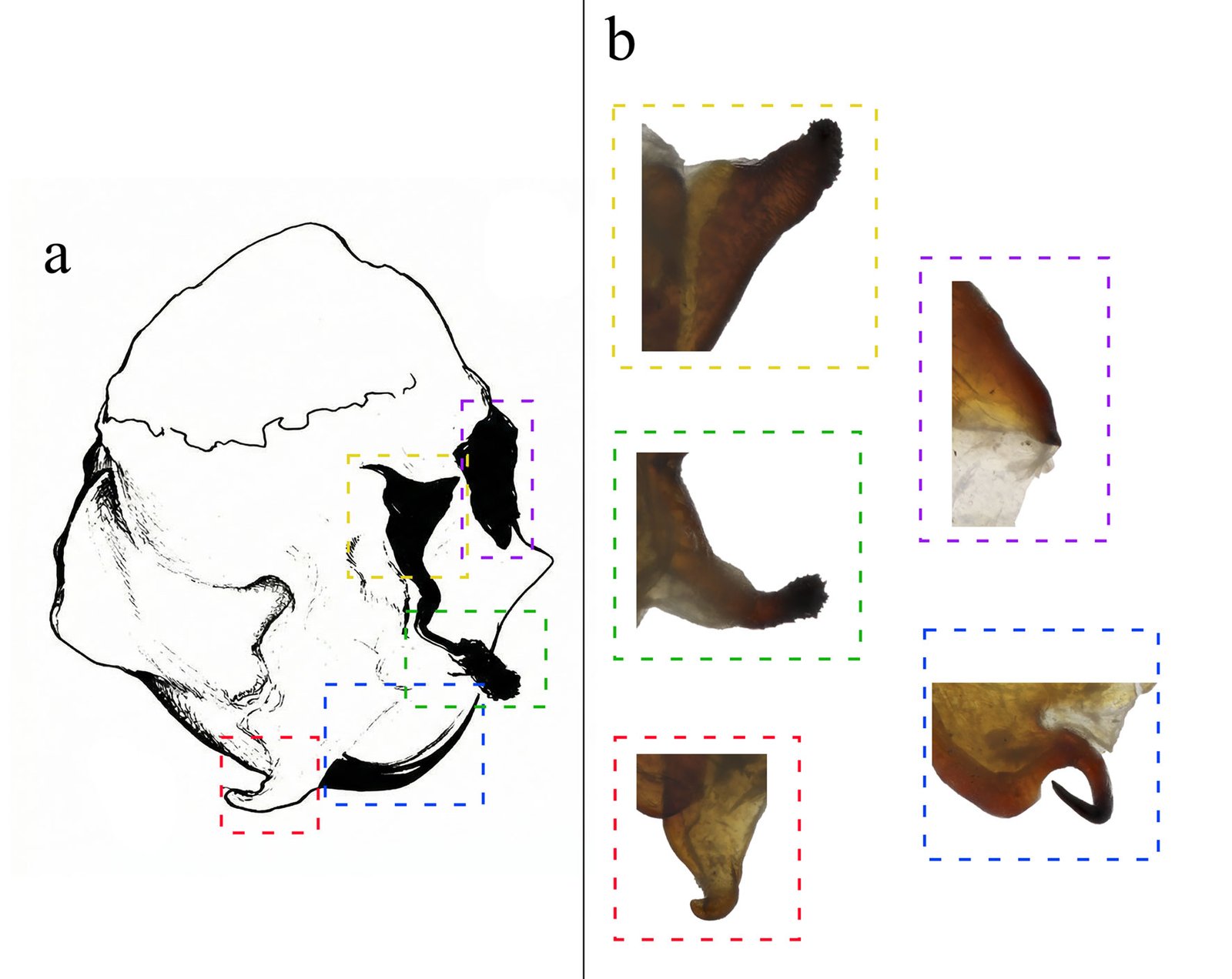
Genitalia: left phallomere, sclerite L4B almost rectangular, longer than wide, with left margin projected anteriorly (Fig. 7a). Anterior lobe of phalloid apophysis (aafa) linguiform, sometimes oval, distally dentate. Posterior lobe of phalloid apophysis (pafa) elongated, apically rounded, dentate, bearing 3-6 ventral denticles. Posteromesal lobe (loa) oval, bearing short setae. Posterior process (paa) robust, sometimes slender. Right phallomere: triangular (Fig. 7b); posterior apex rounded with short setae. Dextral extension (bm) thick, slightly elongate; anterior extension of sclerite R3 (an) elongate, slender. Process anteromesal to pia (pva) short, thick, smooth with rounded apex; process posterolateral to pva (pia) short, smooth. Ventral phallomere: sclerite L4A oval (Fig. 7c, d). Secondary spine (ssp) well-sclerotized, triangular. Posterior process (pda) corkscrew-shaped, twisted left or right, with apex angled to slightly flattened.
| Spec. ID | TL | PL | PrL | ML | PW | HH | HW | ACL | AFL | AFW | ATL | FwL | HwL | MsFL | MsTL | MFL | MTL |
|---|---|---|---|---|---|---|---|---|---|---|---|---|---|---|---|---|---|
| CEUAEM-MAN-140 | 51.0 | 16.5 | 3.5 | 13.0 | 2.5 | 4.0 | 5.0 | 8.5 | 9.5 | 1.0 | 6.0 | 33.0 | 30.5 | 10.0 | 9.0 | 13.0 | 13.0 |
| CEUAEM-MAN-135 | 51.0 | 15.5 | 3.0 | 14.0 | 3.0 | 4.0 | 5.0 | 7.5 | 10.0 | 1.0 | 6.0 | 32.0 | 31.0 | 10.0 | 9.0 | 13.0 | 13.0 |
| CEUAEM-MAN-013 | 55.0 | 18.0 | 4.0 | 14.5 | 3.0 | 4.0 | 5.5 | 9.0 | 11.0 | 1.5 | 7.0 | 35.0 | 34.0 | 11.0 | 10.0 | 13.0 | 13.0 |
| CEUAEM-MAN-021 | 45.5 | 15.5 | 3.0 | 12.0 | 2.5 | 3.5 | 5.0 | 7.5 | 9.5 | 1.0 | 5.0 | 31.0 | 27.0 | 10.0 | 9.0 | 11.0 | 12.0 |
| CEUAEM-MAN-015 | 47.0 | 16.5 | 4.0 | 12.5 | 2.5 | 4.0 | 5.0 | 8.0 | 10.0 | 1.5 | 6.0 | 34.0 | 31.5 | 10.0 | 9.0 | 13.0 | 12.0 |
| CEUAEM-MAN-014 | 45.0 | 18.0 | 3.5 | 13.5 | 3.0 | 3.5 | 5.5 | 8.5 | 10.5 | 1.5 | 6.0 | 34.0 | 31.0 | 10.5 | 9.5 | 13.0 | 13.0 |
| IBUNAM: CNIN: MA645 | 64.0 | 21.5 | 3.5 | 18.0 | 3.5 | – | – | – | 12.0 | – | 6.0 | – | – | – | – | 15.0 | 14.5 |
| IBUNAM: CNIN: MA810 | 55.5 | 19.0 | 3.0 | 16.0 | 3.0 | – | – | – | 11.0 | – | 5.0 | – | – | – | – | 14.0 | 15.0 |
| IBUNAM: CNIN: MA946 | 54.0 | 16.0 | 3.0 | 13.0 | 3.5 | – | – | – | 10.0 | – | 4.5 | – | – | – | – | – | – |
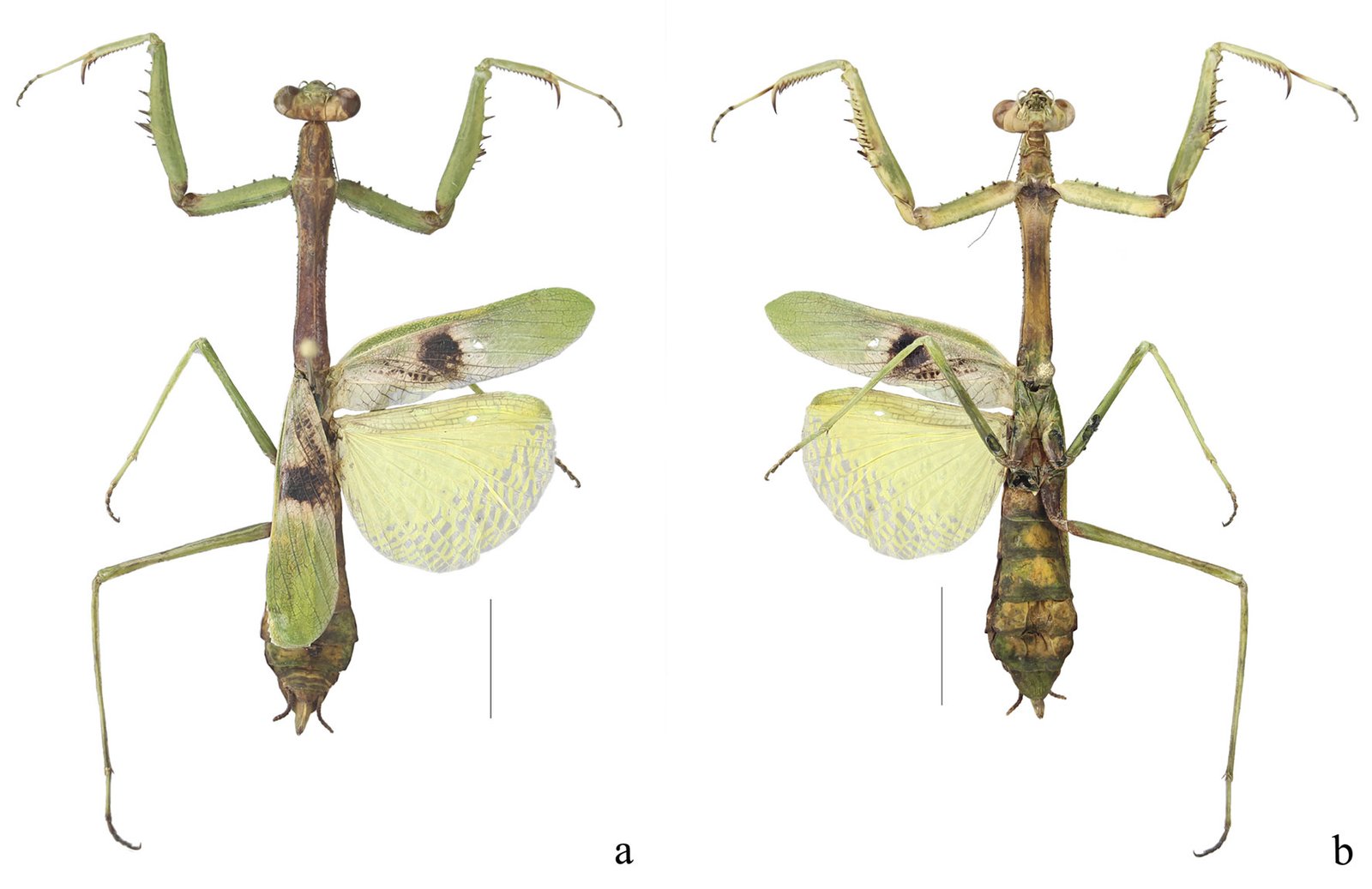
Female (Fig. 8). Measurements (Table 3). Head: head capsule with oval eyes; juxtaocular bulges absent; ocellar tubercles absent; ocelli smaller than in males. Anterior margin of vertex straight; vertex slightly depressed near parietal sulcus. Antennae filiform; scape almost twice as long as pedicel. Frons wider than long in frontal view, with M-shaped depression in the middle of transverse carina (Fig. 9a). Thorax: pronotum, supracoxal dilation slightly pronounced; supracoxal groove well-marked. Lateral margins of prozone denticulate; lateral margins of metazone denticulate, becoming smooth distally; medial keel of pronotum well-developed. In ventral view, inter-coxal area brownish. Legs: forelegs, spination formula: F = 4DS/14-16AvS/4PvS; T = 12-14AvS/8-10PvS. Forecoxae (Fig. 9b) armed with 3-6 apically blunt spines, often brownish, denticles interspersed among them; forecoxal lobes convergent. Forefemur relatively long, slender; femoral brush located at the level of last 3 posteroventral spines; tibial spur groove located at approximately half the length of femur; first discoidal spine smaller than the others; third discoidal spine longer than the others; with blackish spot at the level of first anteroventral spine (AvS). Foretarsus: distal portion of each segment blackish (Fig. 9c, d). Wings (fig. 10a-c): reaching approximately 3/4 the length of abdomen. Forewings: anterior margin wide at base, narrowing distally; color variable, ranging from brown to light hues; stigma darker than rest of wing. Hindwings fully colored; color variable, ranging from yellowish at base to middle area, with dark spots distally, to yellowish with hyaline spot; apex of hindwing yellowish with greenish portions. Abdomen: dorsoventrally flattened, reaching maximum width between 4th and 6th tergites, with prominent, protrusible lobe-like structure between 5th and 6th tergites. Supragenital plate wider than long, rounded at the apex, with a marked longitudinal medial keel. Cerci elongate; cercomeres cylindrical, subequal in length; distal cercomere smaller, conical, apically rounded.
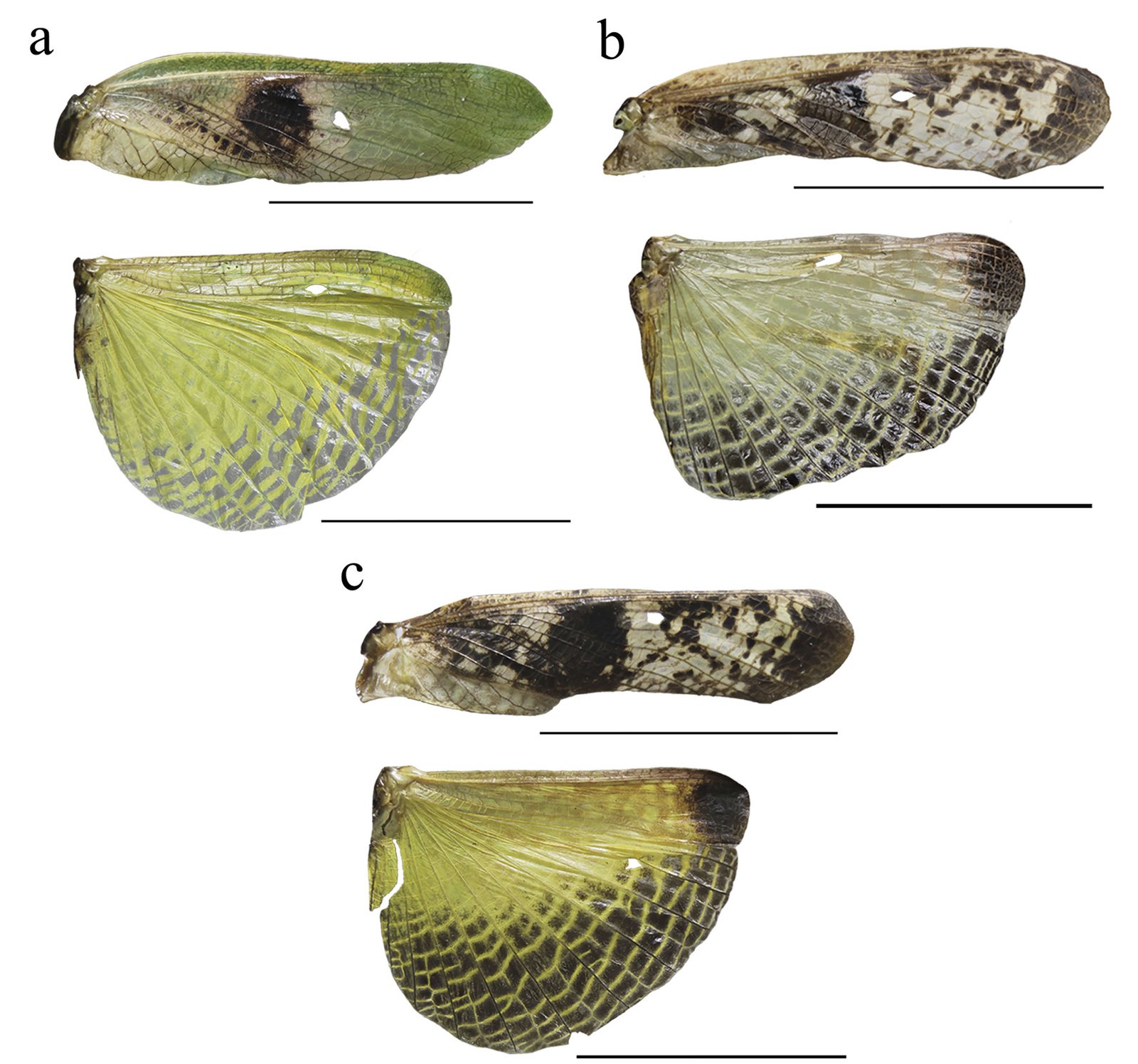
Genitalia (Fig. 11): gonoplacs (gl9), simple, elongate, apically rounded, bearing short setae throughout, with longer setae apically. Gonapophysis: gonapophysis 9 (gp9) membranous, elongate, shorter than gl9. Gonapophysis 8 (gp8) elongate, bearing short setae; in lateral view, distinct furrow near ventral margin; lateral margins sinuous depressed near base of apical lobe (gpal8). Apical lobe of gonapophysis 8 (gpal8) glove-shaped; dorsal portion laterally compressed, distally rounded; ventral portion short, elongate; surface covered with short setae, longer setae on inner surface. Medial outgrowth of gonapophysis 8 (gpmo8) well-developed. Coxa 8 (CX8): acuminate, broad, rounded at base, tapering distally; divided into dorsal and ventral regions by a marked depression, a prominent keel extending through middle of depression. Dorsal region of CX8 elongate lateral wider, more rounded than dorsal region. Caudogyne (CG8) weakly sclerotized; dorsal margin rounded, sinuous; ventral margin depressed at the middle (M-shaped). Spermathecal bulge (spb) well-sclerotized. Accessory gland supporting lobe (agsl) smooth, weakly sclerotized. Ventral segmental fold 7 (vf7) membranous, rounded, with sinuous margins. Vestibular sclerite (VS7) weakly sclerotized, rhomboidal in shape, with ventro-medial corner rounded.
| Spec. ID | TL | PL | PrL | ML | PW | HH | HW | ACL | AFL | AFW | ATL | FwL | HwL | MsTL | MFL | MTL |
|---|---|---|---|---|---|---|---|---|---|---|---|---|---|---|---|---|
| CEUAEM-MAN-139 | 52.0 | 20.0 | 4.5 | 15.5 | 4.0 | 4.5 | 7.0 | 10.0 | 13.0 | 1.5 | 8.0 | 19.5 | 17.0 | 12.0 | 10.5 | 15.5 |
| CEUAEM-MAN-129 | 48.0 | 18.0 | 3.5 | 15.0 | 3.0 | 4.2 | 6.0 | 9.0 | 11.5 | 1.5 | 7.0 | 19.0 | 17.0 | 11.0 | 10.0 | 15.0 |
| CEUAEM-MAN-019 | 48.0 | 20.0 | 4.5 | 15.5 | 3.8 | 4.5 | 7.0 | 9.5 | 12.0 | 2.0 | 8.0 | – | – | 12 | 11 | 16.0 |
| CEUAEM-MAN-018 | 49.0 | 21.0 | 4.5 | 17.0 | 4.0 | 4.5 | 6.5 | 10.0 | 13.0 | 2.0 | 8.0 | 21.0 | – | 12 | 11 | 15.5 |
| CEUAEM-MAN-017 | 51.0 | 20.0 | 4.5 | 15.5 | 4.0 | 5.0 | 7.0 | 10.0 | 13.0 | 2.0 | 8.0 | – | 17.0 | 12.0 | 11.0 | 16.0 |
| CEUAEM-MAN-138 | 53.0 | 20.0 | 4.5 | 16.0 | 4.0 | 5.0 | 7.0 | 10.5 | 13.0 | 2.0 | 8.0 | 22.0 | 18.0 | 12.0 | 11.5 | 16.0 |
| CEUAEM-MAN-109 | 48.0 | 19.5 | 4.0 | 15.5 | 4.0 | 4.0 | 7.0 | 9.5 | 12.5 | 2.0 | 6.5 | 20.0 | 16.0 | 12.0 | 11.0 | 15.0 |
| IBUNAM: CNIN: MA1560 | 55.0 | 23.0 | 5.0 | 18.0 | 4.0 | – | – | – | 13.0 | – | 6.5 | – | – | – | – | 17.0 |
| IBUNAM: CNIN: MA946 | 54.0 | 16.0 | 3.0 | 13.0 | 3.5 | – | – | – | 10.0 | – | 7.0 | – | – | – | – | 17.5 |
Taxonomic summary
Holotype: 1 ♀, Mexico. Sinaloa: Venvidio, 2-6.VIII.1918, type # 8988 (ANSP). Allotype: 1 ♀, Sinaloa: Los Mochis, 25.XII.1918 (ANSP). Additional material examined: Mexico. Estado de México: 1 ♂, Nepantla, Finca Badoni, 18°59’0.8” N, 98°50’44.9” W, 2,020 m asl, 05.X.2023 (CEUAEM-MAN-135); 1 ♀, Malinalco, Chalma, 118°55’56.3” N, 99°26’11” W, 29.XI.1980 (IBUNAM: CNIN: MA909). Guerrero: 10 specimens (5 ♂, 5 ♀). Five ♂: Acahuizotla, 17°28’8.9” N, 99°25’10.3” W, 18.XI.1983 (IBUNAM: CNIN: MA644, MA645); Iguala, Km 3 desv. a Tepecoacuilco, 18°17’32” N, 99°28’58” W, 14.X.2006 (IBUNAM: CNIN: MA724); Iguala, Tuxpan, 2 km a Microondas, 18°23’34” N, 99°28’27” W, 14.X.2006 (IBUNAM: CNIN: MA813); Tecpan, La Laguna, Km 15 San Luis, 17°13’14.9” N, 100°37’9.3” W, 1,425 m asl, 20.VII.2005 (IBUNAM: CNIN: MA816). Five ♀: Atenango del Río, Km 36 Huitzuco-Atenango, 18°8’32” N, 99°7’49” W, 200 m asl, 14.X.2006 (IBUNAM: CNIN: MA823); Guerrero, 22.IX.2022 (CEUAEM-MAN-159, CEUAEM-MAN-160); Guerrero, 2024 (CEUAEM-MAN-161, CEUAEM-MAN-162). Jalisco: 13 specimens (11 ♂, 2 ♀). Eleven ♂: La Huerta, Estación de Biología Chamela (UNAM), 19°29’55.2” N, 105°2’39.5” W, 01.VIII.1981 (IBUNAM: CNIN: MA426); 10.V.1980 (IBUNAM: CNIN: MA802, MA804); 24.V.1980 (IBUNAM: CNIN: MA803); 10.VIII.1981 (IBUNAM: CNIN: MA805-MA810); 01.IV.1981 (IBUNAM: CNIN: MA811). Two ♀: La Huerta, Estación de Biología Chamela (UNAM), 19°29’55.2” N, 105°2’39.5” W, 14.X.1990 (IBUNAM: CNIN: MA723); 08.VIII.1975 (IBUNAM: CNIN: MA1560). Morelos: 23 specimens (12 ♂, 11 ♀). 12 ♂: Jojutla, EESJ, 18°36’49.8” N, 99°13’50.2” W, 957 m asl: 08.III.2022 (CEUAEM-MAN-013); 07.X.2018 (CEUAEM-MAN-014); 21.XI.2018 (CEUAEM-MAN-015); 20.XI.2019 (CEUAEM-MAN-021); Jojutla, 18°36’41.6” N, 99°10’44.7” W, 894 m asl, 21.X.2023 (CEUAEM-MAN-140); Morelos, 18°39’3.9” N, 99°2’20.5” W, 16.XI.1972 (IBUNAM: CNIN: MA519, MA520); Tepalcingo, Sierra de Huautla, 18°32’31.3” N, 98°56’9.4” W, 12.VI.2016 (IBUNAM: CNIN: MA943-MA946). Eleven ♀: Zacatepec, Galeana, 18°38’24.1” N, 99°12’39.6” W, 934 m asl, 22.IX.2019 (CEUAEM-MAN-017); Jojutla, EESJ, 18°36’49.8” N, 99°13’50.2” W, 957 m asl: 28.XI.2019 (CEUAEM-MAN-018); 22.XI.2019 (CEUAEM-MAN-019); 25.IX.2020 (CEUAEM-MAN-109); 13.XI.2020 (CEUAEM-MAN-110); 04.X.2023 (CEUAEM-MAN-129); Tehuixtla, 18°33’16.8” N, 99°16’12.8” W, 26.XII.2019 (CEUAEM-MAN-072); Yautepec, 18°53’12.8” N, 99°3’47.8” W, 1,216 m asl, 17.X.2023 (CEUAEM-MAN-138); Jojutla, 18°36’41.6” N, 99°10’44.7” W, 894 m asl, 27.X.2023 (CEUAEM-MAN-139); Cuautla, 18°48’59.4” N, 98°56’56” W, XI.1954 (IBUNAM: CNIN: MA905); Morelos, 18°39’3.9” N, 99°2’20.5” W, IV.1981 (IBUNAM: CNIN: MA906). Nayarit: 1 ♂, Bahía de Banderas, San Rafael, Arroyo de la Virgen, P. H. Aguamilpa, 20°50’19.5” N, 105°16’44.4” W, 734 m asl, 01.XI.1991 (IBUNAM: CNIN: MA824).
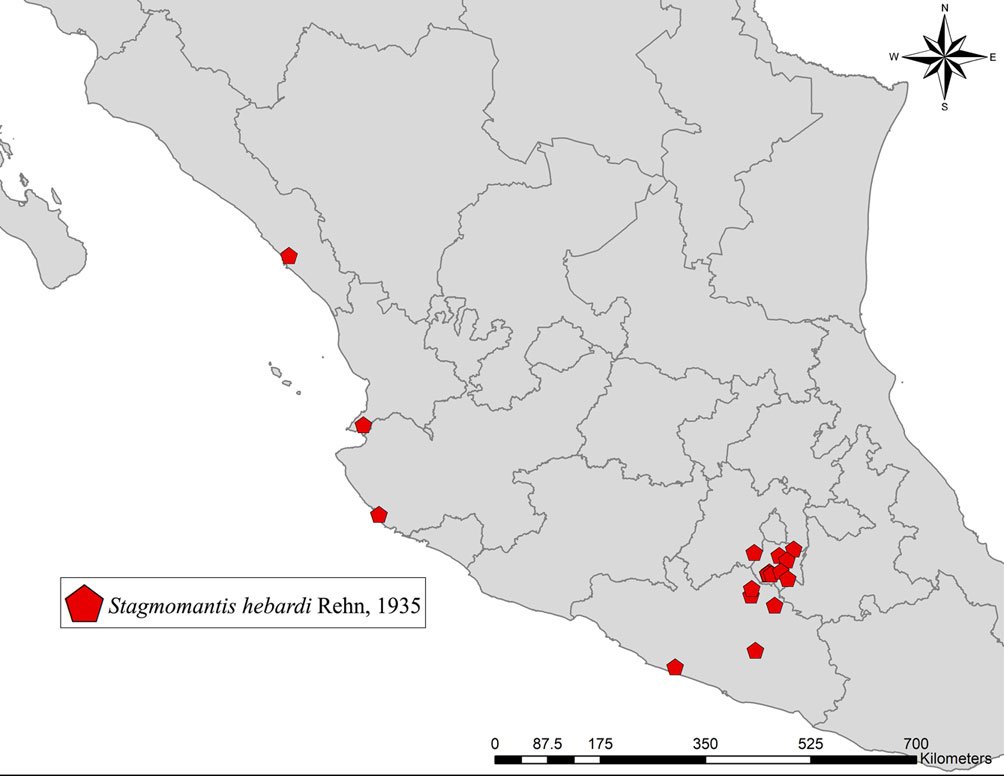
Geographic distribution: Stagmomantis hebardi is distributed in the states of Estado de México, Guerrero, Jalisco, Morelos, Nayarit, and Sinaloa (Fig. 12).
Remarks
Taxonomic delimitation within Stagmomantis based on male morphology has been a subject of study for decades. Notably, Saussure and Zehntner (1894) and Rehn (1935) considered the males of S. carolina and S. tolteca to be indistinguishable, grouping them within the “carolina group,” which currently corresponds to the subgenus Stagmomantis.
Morphological differences between the female originally described by Rehn (1935) and the females analyzed in this study are summarized in Table 4. Key distinctions include: a) the pronotum is proportionately wider in Rehn’s female compared to the slender pronotum in our specimens; b) wing shape and coloration differ significantly; Rehn’s specimen has wider forewings with a small, oval, light-colored stigma lacking a surrounding patch, whereas our specimens exhibit a stigma covered by a dark patch and surrounded by a white area covering nearly the proximal half of the wing; c) the abdomen in Rehn’s female is widely oval, whereas it is subfusiform (widening at the distal segments) in the females observed in this study; and d) the lobe-like structure between the 5th and 6th abdominal tergites, observed in all examined specimens, appears to be a diagnostic feature and a potential autapomorphy for this species.
| Rehn (1935) | Present study |
|---|---|
| Pronotum wide | Pronotum slender |
| Forewings solid light colored | Forewings with different combinations of colors |
| Forewing’s stigma not covered by a colored patch | Forewing’s stigma covered by a white and dark patch |
| Forewings wider | Forewings slender |
| Abdomen wider almost oval | Abdomen subfusiform |
| Abdomen without lobe-like structure | Abdomen with lobe-like structure |
Although Stagmomantis tolteca and S. hebardi are morphologically similar, significant differences in male genitalia provide reliable diagnostic characters. As noted by Arteaga-Blanco et al. (2016), the posterior process of the ventral phallomere (pda) in S. tolteca is strongly sclerotized, wide at the base, tapering distally into a spine, and directed sinistrally (Fig. 13a, blue). Conversely, in S. hebardi, the pda is corkscrew-shaped, twisted either sinistrally or dextrally (Figs. 1, 5, 13b, blue). Further comparisons revealed differences in other genitalic structures: the aafa in S. tolteca is triangular with an angulate apex (Fig. 13a, yellow), whereas it is rounded in S. hebardi (Figs. 5, 13b, yellow); the ssp in S. tolteca is more developed with a slightly angulate inferior margin (Fig. 13a, purple), compared to the small and triangular ssp in S. hebardi (Figs. 5, 13b, purple); finally, the pafa in S. tolteca is elongate and curved near the middle, with the apex directed inward (Fig. 13a, green), while the pafa of S. hebardi projects laterally, is less curved, and has a more rounded apex (Figs. 5, 13b, green). The paa is morphologically similar in both species (Fig. 13, red). Rehn’s (1935) illustrations of the male genitalia correspond more closely to the pda morphology described in the present study than to that illustrated in Arteaga-Blanco et al. (2016). Thus, the sclerotized structure of the pda serves as a robust diagnostic character to separate both species and supports the identification of our male specimens as S. hebardi, in accordance with Rehn (1935).
A remarkable feature observed in this study is the presence of a lobe-like structure on the female abdomen. While comparable structures are rare in Mantodea, a few instances have been documented. For example, Robinson and Robinson (1979) described a terminal abdominal structure in females of Acanthops falcata Stål, 1877, identifying it as a pheromone-releasing gland. Similarly, Schwarz and Glaw (2021) described a Y-shaped protrusible structure near the abdominal apex of Stenophylla lobivertex Lombardo, 2000, hypothesizing that it represents a pheromone-releasing gland more efficient than simpler structures performing the same function.
The precise function of the lobe-like structure identified in this study remains unknown; however, several hypotheses can be proposed. According to Robinson and Robinson (1979) and Schwarz and Glaw (2021), such structures may function as sex pheromone glands, as reported for A. falcata and S. lobivertex. However, we observed this structure in both sexes during the early developmental stages of S. hebardi, which suggests it may possess an alternative or additional function. Another hypothesis involves the release of prey-attracting pheromones (kairomones), similar to the aggressive mimicry observed in bolas spiders (Mastophora Holmberg, 1876), which mimic lepidopteran sex pheromones to capture prey (Yeargan & Quate, 1997). Finally, this structure might enhance crypsis, similar to strategies observed in the subfamily Vatinae. However, unlike Vatinae, which are characterized by fixed cuticular lobes on the legs or abdominal margins, the structure in S. hebardi is distinctively protrusible.
Acknowledgements
We thank Cristina Mayorga-Martínez for her support in reviewing the CNIN-IBUNAM; Michael R. Maxwell, Henrique M. Rodrigues, and Lohitashwa Garikipati for their comments on an earlier version of this work; Jason D. Weintraub for providing us high resolution images of the holotype and allotype of Stagmomantis hebardi. Aarón Emilio Vásquez Quintero was supported by a scholarship from the Secretaría de Ciencia, Humanidades, Tecnología e Innovación (Secihti; CVU 1315459).
References
Agudelo-Rondón, A. A., & Chica, E. L. M. (2002). Mántidos. Introducción al conocimiento del orden Mantodea. Universidad Distrital Francisco José de Caldas, Bogotá, Colombia.
Agudelo-Rondón, A. A., Lombardo, F., & Jantsch, L. J. (2007). Checklist of the Neotropical mantids (Insecta, Dictyoptera, Mantodea). Biota Colombiana, 8, 105–158.
Anderson, K. (2020a). Revision of Stagmomantis Saussure, 1869. Soothsayer, Journal of Mantodea Research, 1, 9–18.
Anderson, K. (2020b). Revalidation of Stagmomantis (Stagmomantis) conspurcata (Serville, 1839). Soothsayer, Journal of Mantodea Research, 1, 1–20.
Anderson, K. (2021). A new species of Stagmomantis Saussure, 1869 from North America. Soothsayer, Journal of Mantodea Research, 2, 86–96.
Anderson, K. (2025). Mantodea mundi: comprehensive nomenclatural catalogue of Mantodea (September 2025 edition). On line resource available at: file:///C:/Users/joelv/ Downloads/MantodeaMundi09.25.pdf
Arteaga-Blanco, L. A., de la Parra-Guerra, A. C., & Martínez- Hernández, N. J. (2016). Descripciones taxonómicas de mántidos (Insecta: Mantodea) del Departamento del Atlántico, Colombia, con apuntes sobre su distribución. Boletín Científico Centro de Museos. Museo de Historia Natural, 20, 211–236. https://doi.org/10.17151/bccm.2016.20.1.16
Brannoch, S. K., Wieland, F., Rivera, J., Klass, K. D., Olivier, B., & Svenson G. J. (2017). Manual of praying mantis morphology, nomenclature, and practices (Insecta, Mantodea). Zookeys, 696, 1–100. https://doi.org/10.3897/zookeys.696.12542
Ehrmann, R. (2002). Mantodea: Gottesanbeterinnen der Welt. Natur und Tier-Verlag. Münster, German.
Ferraz, B. R., Souza-Dias, P. G. B., & Rivera, J. (2023). A hidden gem from northeastern Brazil: a new species of Metaphotina Piza, 1964 (Mantodea, Acontistidae) ecologically linked to the Caatinga. Zootaxa, 5343, 31–54. https://doi.org/10.11646/zootaxa.5343.1.2
Garikipati, L. (2024). Description and total ontogeny of the Sonoran tiger mantis, Stagmomantis clauseni sp. nov., and key to the subgenus Nigralora (Mantodea: Mantidae). Zootaxa, 5501, 079–107. https://doi.org/10.11646/zootaxa.5501.1.4
Hebard, M. (1923). Dermaptera and Orthoptera from the state of Sinaloa, Mexico. Transactions of the American Entomological Society (1890-), 48, 157–196. INEGI (Instituto Nacional de Estadística y Geografía). (2024). Área geoestadística estatal, escala: 1:250000. Instituto Nacional de Estadística y Geografía. México, Ciudad de México. Retrieved March 23, 2025 from: https://www.inegi.org.mx/app/biblioteca/ficha.html?upc=794551132173
Maxwell, M. R. (2014). A synoptic review of the genus Stagmomantis (Mantodea: Mantidae). Zootaxa, 3765, 501– 525. https://doi.org/10.11646/zootaxa.3765.6.1
Otte, D., & Spearman, L. (2005). Mantida species file. Catalog of the mantids of the world. Philadelphia: Association of Insect Diversity.
Patel, S., & Singh, R. (2016). Updated checklist and distribution of Mantidae (Mantodea: Insecta) of the world. International Journal of Research Studies in Zoology, 2, 17–54. https://doi.org/10.20431/2454-941X.0204003
Rehn, J. A. G. (1935). On certain Mexican and Central American species of Melliera and Stagmomantis (Orthoptera, Mantidae). Transactions of the American Entomological Society, 61, 317–329.
Robinson, H. M., & Robinson, B. (1979). By dawn’s early light: matutinal mating and sex attractants in a Neotropical mantid. Science, 205, 825–827. https://doi.org/10.1126/science.205.4408.825
Rodrigues, H. M., & Cancello, E. M. (2016). Taxonomic revision of Stagmatoptera Burmeister, 1838 (Mantodea: Mantidae, Stagmatopterinae). Zootaxa, 4183, 1–78. https://doi.org/10.11646/zootaxa.4183.1.1
Saussure, H., & Zehntner, L. (1894). Fam. Mantidae. In H. Saussure, & L. Zehntner, A. (Eds.), Biologia Centrali- Americana, Insecta. Orthoptera, Vol. 1 (pp. 123–197). Paris: L‘Imprimerie Nationale.
Schwarz, C. J., & Glaw, F. (2021). The luring mantid: protrusible pheromone glands in Stenophylla lobivertex (Mantodea: Acanthopidae). Journal of Orthoptera Research, 30, 31–33. https://doi.org/10.3897/jor.30.55274
Schwarz, C. J., & Roy, R. (2019). The systematics of Mantodea revisited: an updated classification incorporating multiple data sources (Insecta: Dictyoptera). Annales de La Société Entomologique de France, 55, 101–196. https://doi.org/10.1080/00379271.2018.1556567
Su, Y. N. (2016). A simple and quick method of displaying liquid- preserved morphological structures for microphotography. Zootaxa, 4208, 592–593. https://doi.org/10.11646/zootaxa.4208.6.6
Svenson, G. J., & Whiting, M. F. (2004). Phylogeny of Mantodea based on molecular data: evolution of a charismatic predator. Systematic Entomology, 29, 359–370.
Svenson, G. J., & Whiting, M. F. (2009). Reconstructing the origins of praying mantises (Dictyoptera, Mantodea): the roles of Gondwanan vicariance and morphological convergence. Cladistics, 25, 468–514. https://doi.org/10.1111/j.1096-0031.2009.00263.x
Terra, P. S. (1995). Revisão sistemática dos gêneros de louva-a- deus da região Neotropical (Mantodea). Revista Brasileira de Entomologia, 39, 13−94.
Varela-Hernández, F., Martínez-Luque, E. O., Vázquez- Franco, C. M., & Pedraza-Lara, C. (2022). Contribution to the knowledge of mantids (Insecta, Mantodea) in Central Mexico: a morphological and molecular approach. Southwestern Entomologist, 47, 27–43.
Wang, W., Wang, H., Huang, H., Zhao, Y., & Zhou, Z. (2022). Mitochondrial genomes of 10 Mantidae species and their phylogenetic implications. Archives of Insect Biochemistry and Physiology, 111, e21874. https://doi.org/10.1002/arch.21874
Xu, X. D., Guan, J. Y., Zhang, Z. Y., Cao, Y. R., Storey, K. B., Yu, D. N. et al. (2021). Novel tRNA gene rearrangements in the mitochondrial genomes of praying mantises (Mantodea: Mantidae): translocation, duplication and pseudogenization. International Journal of Biological Macromolecules, 185, 403–411. https://doi.org/10.1016/j.ijbiomac.2021.06.096
Yeargan, K. V., & Quate, L. W. (1997). Adult male bolas spiders retain juvenile hunting tactics. Oecologia, 112, 572–576. https://doi.org/10.1007/s004420050347

Ecología
Diversidad de vertebrados visitantes a los estróbilos del complejo Dioon edule y su potencial polinizador
The diversity of vertebrates visiting the strobili of the Dioon edule complex and their potential for pollination
Abraham Isaías Galavíz-Hernández a, Laura Yáñez-Espinosa a, b, *, Alberto Prado c y Joel Flores d
a Universidad Autónoma de San Luis Potosí, Facultad de Ciencias, Av. Chapultepec Núm. 1570, Priv. del Pedregal, 78295 San Luis Potosí, San Luis Potosí, México
b Universidad Autónoma de San Luis Potosí, Instituto de Investigación de Zonas Desérticas, Altair Núm. 200, Col. Del Llano, 78377 San Luis Potosí, San Luis Potosí, México
c Universidad Nacional Autónoma de México, Escuela Nacional de Estudios Superiores, Campus Juriquilla, Boulevard Juriquilla Núm. 3001, 76230 Querétaro, Querétaro, México
d Instituto Potosino de Investigación Científica y Tecnológica, División de Ciencias Ambientales, Camino a la Presa San José Núm. 2055, Col. Lomas 4 sección, 78216 San Luis Potosí, San Luis Potosí, México
*Autor para correspondencia: lyaneze@uaslp.mx (L. Yáñez-Espinosa)
Recibido: 13 octubre 2025; aceptado: 23 febrero 2026
Resumen
La presencia de toxinas en Zamiaceae sugiere interacciones limitadas con vertebrados, aunque existe registro de depredación y dispersión de semillas. El estróbilo masculino, poco considerado para el análisis de interacciones, podría representar un recurso para la fauna. Las especies Dioon edule Lindl. y Dioon angustifolium Miq. constituyen un complejo de cícadas endémicas de México con riesgo de extinción, por lo que es esencial explorar sus relaciones ecológicas ya que sus visitantes podrían tener la capacidad de acercar el polen de un estróbilo a otro. Monitoreamos estróbilos masculinos y femeninos de las especies del complejo con cámaras en la sierra Madre Oriental. El objetivo fue analizar la diversidad de visitantes y su relevancia respecto de su potencial polinizador. Concluimos el registro de una elevada diversidad de fauna nativa que interactúa con los estróbilos de diversas formas y es casi totalmente distinta para cada especie del complejo. Identificamos a las aves como un posible grupo con mayor potencial de transferencia de polen. Los vertebrados que visitan ambos estróbilos son agentes con potencial polinizador de Zamiaceae. Sin embargo, los visitantes de alta frecuencia que interactúan solo con el estróbilo masculino también podrían estar robando el polen.
Palabras clave: Biodiversidad; Interacción planta-animal; Ecología reproductiva
Abstract
The presence of toxins in the Zamiaceae family suggests limited interaction with vertebrates, despite records of predation and seed dispersal. The male strobilus has received little attention in studies of these interactions, but it could represent a valuable wildlife resource. The Dioon edule Lindl. and Dioon angustifolium Miq. species constitute an endemic Mexican cycad complex at risk of extinction; therefore, exploring their ecological relationships is essential, as their visitors may be able to transfer pollen from one strobilus to another. We monitored the male and female strobili of these species in the Sierra Madre Oriental using cameras. Our aim was to analyze visitor diversity and its relevance to pollination potential. We recorded a high diversity of native fauna that interacts with the strobili in various ways, which are almost entirely distinct for each species in the complex. We identified birds as the group with the greatest potential for pollen transfer. Vertebrates that visit both strobili could potentially pollinate the Zamiaceae family. However, visitors that interact only with the male strobilus at high frequency may also be stealing pollen.
Keywords: Biodiversity; Plant-animal interaction; Reproductive ecology
Introducción
Las interacciones ecológicas son factores clave para el funcionamiento de los ecosistemas y para la generación de la biodiversidad en el planeta (Bascompte, 2009). El transporte de polen y la dispersión de semillas representan interacciones positivas que las plantas utilizan mediante una variedad de animales alados como insectos, aves y murciélagos (Herrera y Pellmyr, 2002; Ratto et al., 2018). Asimismo, se ha propuesto que en el pasado estos procesos pudieron haber sido facilitados por grandes vertebrados ahora extintos (Crowley et al., 2011; Hall y Walter, 2013). En las últimas 4 décadas, las investigaciones sobre la interacción planta-polinizador han señalado que los visitantes a las especies vegetales están relacionados filogenéticamente como resultado de un proceso de selección, es decir, dicho sistema ha evolucionado hacia una alta especialización (Campbell, 1989; Herrera, 1987).
Las zamiáceas son un grupo de gimnospermas que incluye a los géneros Bowenia Hook, Ceratozamia Brongniart, Dioon Lindley, Encephalartos Lehm, Lepidozamia Regel, Macrozamia Miquel, Microcycas (Miq.) A. DC., Stangeria T. Moore y Zamia L. (Nicolalde-Morejón et al., 2014; Stevenson, 1992). El género Dioon incluye a las especies D. edule y D. angustifolium, ambas endémicas de México. Estas especies presentan una altura de hasta 1.5 m, con tronco erecto y copa rígida de hojas largas de color verde claro. La estructura básica de sus estróbilos es similar en ambos sexos, con un eje central y esporófilas o escamas (Vovides, 1990). No obstante, los masculinos son cilíndricos y más largos que los femeninos, que son globulares.
El género Dioon se distribuye principalmente a lo largo de la sierra Madre Oriental de México y en algunas regiones de Centroamérica (Lázaro-Zermeño et al., 2012). Por su parte, D. angustifolium se encuentra principalmente en el extremo boreal de la sierra Madre Oriental, en Nuevo León y Tamaulipas (Rubio et al., 2020), mientras que D. edule en Tamaulipas, San Luis Potosí, Hidalgo, Querétaro y Veracruz (Whitelock, 2004; Yáñez-Espinosa, 2006). Ambas especies se encuentran catalogadas como en peligro de extinción, debido al cambio en el uso de suelo y la extracción ilegal de ejemplares (Semarnat, 2010).
Dioon edule y D. angustifolium son consideradas por Dorsey et al. (2018) como parte de un complejo, ya que presentan morfología muy similar sin límites definidos, lo que sugiere una posible continuidad entre ambas especies, además de la ausencia de una separación genética clara (Dorsey et al., 2018; González-Astorga et al., 2005; Rubio-Méndez et al., 2020).
Se ha argumentado que las cícadas se adaptaron a interacciones con grandes vertebrados ahora extintos (Hall y Walter, 2013; Janzen y Martin, 1982). A pesar de la extinción de la megafauna, las cícadas han logrado prevalecer gracias a estrategias ecológicas. Una de ellas es la formación de rodales, los cuales generan grupos de alta densidad poblacional, que favorecen la cercanía entre estróbilos masculinos y femeninos al ser organismos dioicos (Hall y Walter, 2013). Esta proximidad, pudo haber favorecido la polinización anemófila, mecanismo que se consideró predominante hasta principios del siglo XXI (Chamberlain, 1919, 1937).
Durante las últimas décadas se ha demostrado la contribución de insectos en la polinización de las cícadas (Terry et al., 2005, 2008). Estas interacciones parecen haber existido desde el Mesozoico, de las cuales las cícadas dependen actualmente. Los principales polinizadores corresponden a escarabajos de las familias Curculionidae y Erotylidae, los cuales habitan los estróbilos y poseen adaptaciones diseñadas para la polinivoría (Tang et al., 2018). Sin embargo, los reportes actuales de vertebrados visitantes a estróbilos de gimnospermas y especialmente de cícadas, demuestran su posible participación en el proceso de polinización (Fuster y Traveset, 2019; Yáñez-Espinosa, Barragán-Torres et al., 2021).
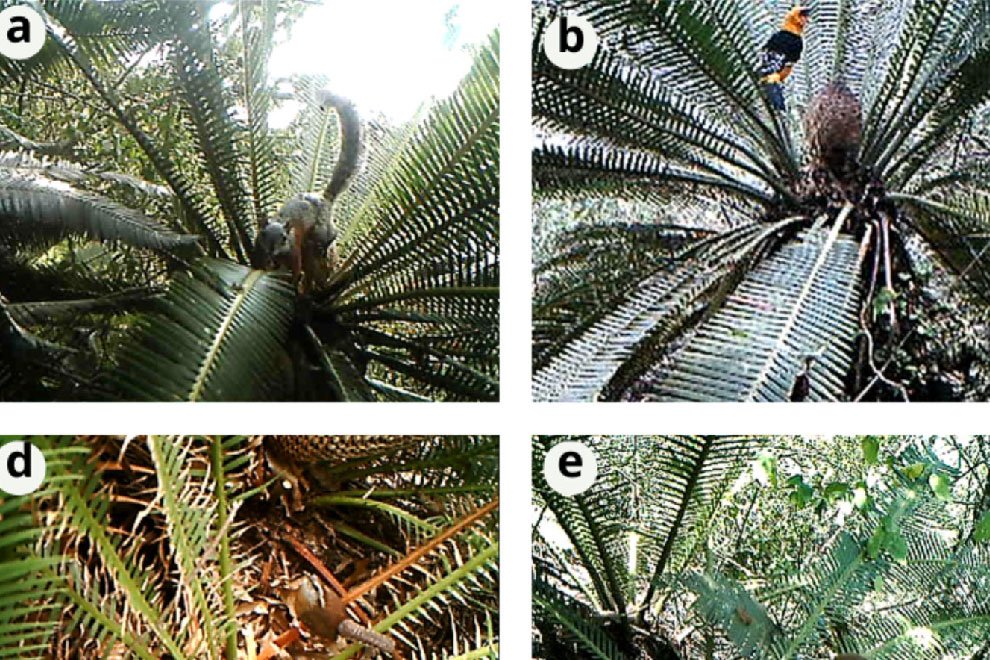
Se sabe que las zamiáceas presentan compuestos activos neurotóxicos y hepatotóxicos como metilazoximetanol, β-metilamino-L-alanina, β-oxalilamino-L-alanina y cicasina (Rivadeneyra y Rodriguez, 2014). Sin embargo, se han reportado alrededor del mundo interacciones ecológicas entre estructuras reproductivas de organismos vegetales, incluidas las cícadas y una diversidad de vertebrados. Estas interacciones incluyen reptiles (Fuster y Traveset, 2019; Nyhagen et al., 2001; Varela y Bucher, 2002), mamíferos (Cárdenas et al., 2017; González-Christen, 1990; Jones et al., 2024; Pérez-Farrera y Vovides, 2004; Pérez-Farrera et al., 2006; Vovides, 1990; Wester y Stanway, 2009; Yáñez-Espinosa, Barragán-Torres et al., 2021) y aves (David et al., 2015; Jones et al., 2024; Viana et al., 2016; Yáñez-Espinosa, Balderas-González et al., 2021), donde se les sugiere como potenciales polinizadores o dispersores de la planta a la cual visitan. Al buscar en sus estructuras reproductivas un recurso, estos trepan para lamerlas, picotearlas o morderlas. Estas conductas favorecen la adherencia de polen accidental a sus cuerpos, distribuyéndolo entre plantas masculinas y femeninas. En las interacciones ecológicas, la alta variedad de rasgos funcionales podría sugerir que no se trata solo de fauna especialista.
El análisis planta-vertebrado, en cícadas, se ha centrado esencialmente en la dispersión y depredación de semillas, monitoreando solo el estróbilo femenino, este hecho podría deberse a que el estróbilo masculino, independientemente de los insectos consumidores de polen, que son atraídos por sus compuestos volátiles (Suinyuy et al., 2012), no parece representar un recurso directo para los vertebrados como ocurre en otras gimnospermas de la familia Ephedraceae Dumort. (Celedón et al., 2016) o Ginkgoaceae Engl. (Gin et al., 2012). Asimismo, el tiempo en el que está disponible el polen suele ser corto (de 2 a 3 semanas). Sin embargo, indirectamente el estróbilo masculino podría ser una fuente importante de otros recursos, como los insectos que forman parte de la dieta de los vertebrados (Lovette y Fitzpatrick, 2016; Pianka, 1970), principalmente los escarabajos que obtienen del estróbilo masculino un refugio (Tang et al., 2018) y una fuente de alimento (Aguilar et al., 2017).
Considerando lo anterior, el estudio y monitoreo de los estróbilos masculinos y femeninos durante la etapa de polinización es esencial para comprender los procesos reproductivos en Zamiaceae. Si bien, la exclusión de sus insectos polinizadores reduce drásticamente el éxito reproductivo (Terry et al., 2008), los vertebrados también podrían desempeñar un papel relevante como transportadores potenciales de polen, contribuyendo al proceso de reproducción. En este contexto, es crucial explorar la composición de la comunidad de vertebrados que interactúan con las plantas del complejo D. edule, interacciones que podrían repercutir en la polinización. El estudio de estas interacciones es fundamental para desarrollar estrategias efectivas que promuevan la conservación íntegra y prioritaria de Zamiaceae y sus interacciones bióticas (Terry, 2005), especialmente en un grupo con alto riesgo de extinción. Nos planteamos el objetivo de determinar la diversidad de vertebrados visitantes y las interacciones que estos mantienen con los estróbilos masculinos y femeninos de las plantas del complejo D. edule Lindl. Zamiaceae (D. edule y D. angustifolium). El estudio se llevó a cabo durante el periodo de reproducción en 2 localidades de la sierra Madre Oriental.
Materiales y métodos
Para D. edule se seleccionó el municipio de Pisaflores, Hidalgo, que presenta un clima predominantemente tropical lluvioso, con una temperatura media anual de 26 °C. La vegetación está compuesta principalmente por bosque mesófilo de montaña, bosque de pino-encino, selva baja caducifolia y matorral xerófilo (Luna-Vega, 1997). Para D. angustifolium se seleccionó el municipio de Linares, Nuevo León, cuyo clima es principalmente semicálido subhúmedo con lluvias en verano. Con una temperatura media anual de 22.4 °C. Su vegetación está compuesta, principalmente, por matorral espinoso tamaulipeco, bosque de encino, selva baja caducifolia y pastizal (INEGI Marco Geoestadístico 2010, Versión 4.3). La localización geográfica exacta se reserva, para proteger las especies de amenazas como el tráfico ilegal o la actividad humana destructiva.
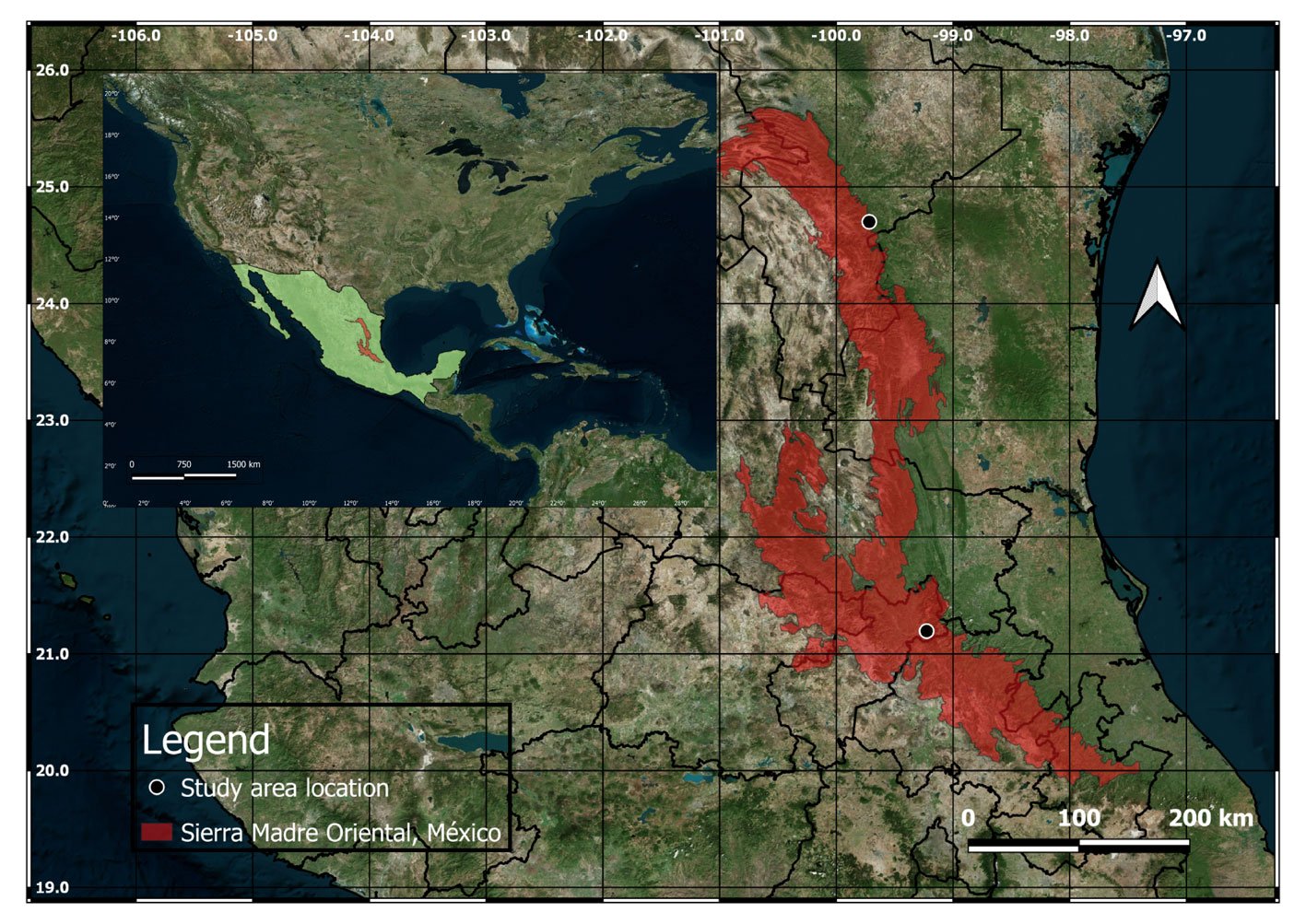
En los municipios antes mencionados se realizaron recorridos durante la etapa de polinización de las plantas del complejo D. edule en las áreas donde está reportada su presencia. Para este estudio, un sitio se definió como aquel punto que contara con la presencia de un par de plantas con el estróbilo en su periodo de polinización, se seleccionaron 10 sitios totales. Las coordenadas de las localidades de estudio fueron representadas en un mapa de la sierra Madre Oriental, el cual fue elaborado empleando el software QGIS 3.32.3 (QGIS Development Team, 2023) (fig. 1).
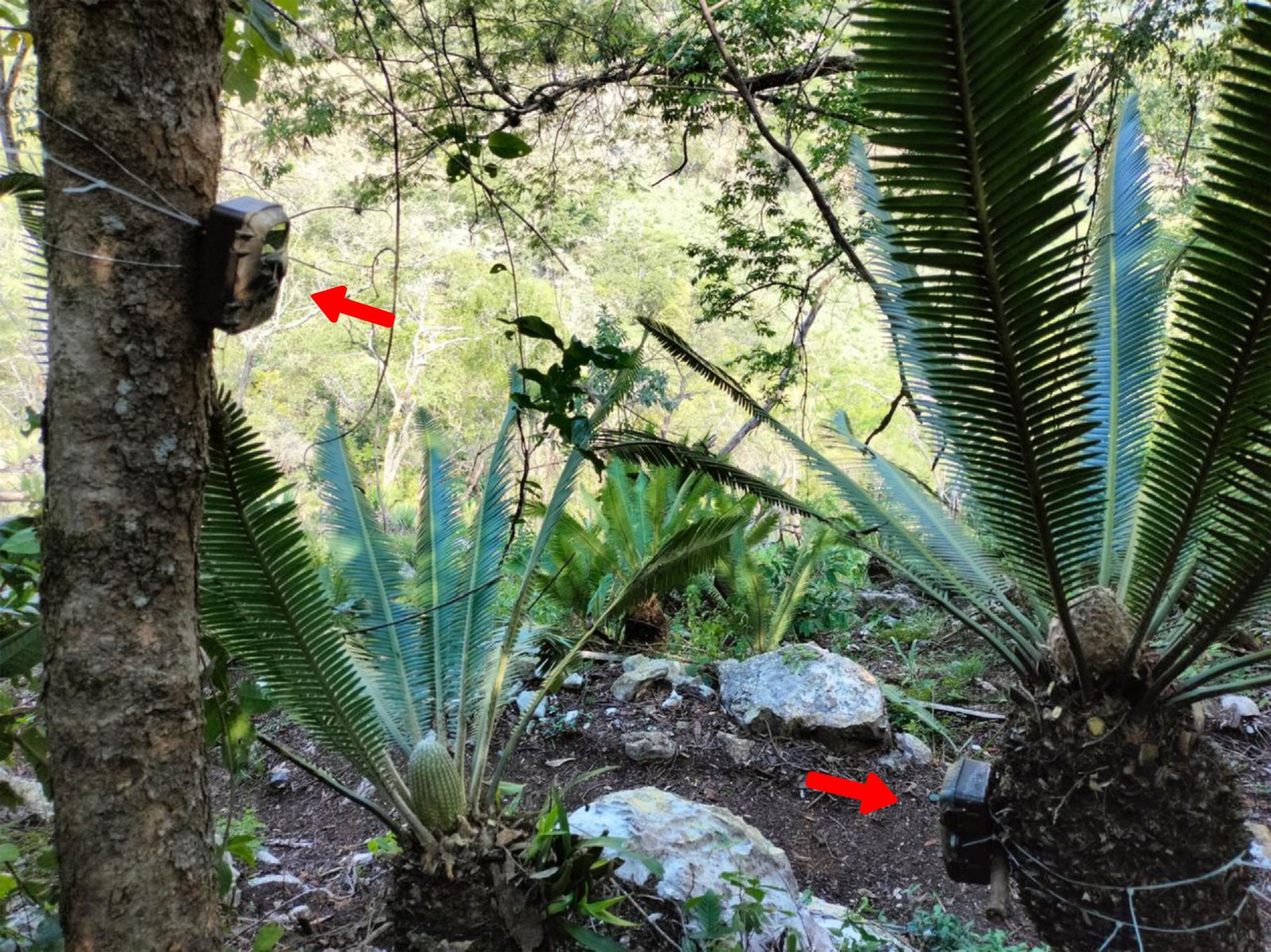
Una vez definidos y seleccionados los sitios para la observación de visitantes, se colocó una cámara trampa UOVision, modelo UV557 (fig. 2). Cada cámara estuvo enfocando y cubriendo la totalidad del estróbilo hacia cada una de las plantas (10 cámaras por sitio). El muestreo se realizó entre septiembre y noviembre de 2023 para D. angustifolium y entre agosto y octubre de 2023 para D. edule. Las cámaras fueron configuradas con modo video en formato VGA, resolución alta (8 megapixeles), sensibilidad normal y tiempo de filmación de 1 min. Analizados los videos, que representan casi 3 h de filmación en archivos de 1 min de duración, se realizó la identificación manual de éstos, utilizando los parámetros estándar y caracteres específicos descritos en las claves de identificación para campo y laboratorio de Álvarez-Castañeda (2017), Balderas y González-Hernández (2021) y Perlo (2006).
Para determinar a categoría de especie los ejemplares de roedores observados, fue necesario capturarlos y con base en los protocolos establecidos por Mills et al. (1998) y la guía técnica de Álvarez-Castañeda (2017), se colocó un transecto horizontal de 60 trampas Sherman plegables, no letales (HB Sherman traps, Tallahassee, FL, EE. UU.) con dimensiones de 23 x 8 x 9 cm, 60 en cada localidad, para un total de 120. Las trampas fueron cebadas con avena integral y esencia de vainilla, orientadas hacia la zona que, de acuerdo con lo observado en los videos, corresponde a la zona con mayor actividad de roedores, cubriendo los sitios de estudio y con una separación de 5 m entre ellas. Las trampas fueron colocadas por la noche y revisadas a la mañana siguiente, durante 3 días. Para su posterior identificación, cada uno de los ejemplares fue medido, fotografiado y liberado en el mismo punto de recolecta.
Análisis de datos
Primeramente, se analizaron las variables para evitar la colinealidad, excluyendo las que la presentaban, para posteriormente construir una matriz de datos de las observaciones de las especies registradas en cada uno de los sitios de estudio. La matriz fue sometida a un análisis con el software Xlstat 2020.3.1.1005 y con la finalidad de reducir el número de variables mediante la transformación de las variables originales en nuevas variables que son combinaciones lineales de las originales. Se tomaron como etiquetas de las variables los nombres de las especies y los sitios de estudio. Al ser variables discretas, se seleccionó una matriz de covarianza, para finalmente obtener los gráficos biplot de covarianza.
Para comparar la similitud de las comunidades de estudio respecto a sus especies visitantes y utilizando como criterio el coeficiente de Jaccard (Jaccard, 1901), se analizó la similitud de las comunidades respecto a las especies visitantes en cada uno de sus sitios, a través de un análisis de agrupamiento aglomerativo jerárquico (CAJ) con el software Xlstat (Addinsoft, 3.1.1005, 2020). Se seleccionaron como etiquetas de las variables a los sitios de estudio y las abundancias de cada especie registrada bajo un método de aglomeración de vinculación completa, generando así un dendrograma para la observación gráfica.
Para evaluar y comparar la biodiversidad y completitud de muestras de las localidades y los sitios de estudio, se emplearon los números de Hill. Las abundancias en las localidades fueron analizadas bajo el software iNext (Hsieh et al., 2016) utilizando el procedimiento de 4 pasos: 1) cálculo de los perfiles de completitud de la muestra; 2) rarificación/extrapolación basada en el tamaño de muestra; 3) aplicación de rarificación/extrapolación basada en cobertura, y 4) generación de perfiles de equidad.
Asimismo, para comparar la similitud de especies visitantes entre las localidades de estudio, se utilizó el índice de diversidad beta de Sorensen (Sorensen, 1948), evaluado mediante el software Past versión 4.03 (Hammer et al., 2001).
La clasificación de los tipos de interacción se realizó mediante la observación de las conductas de cada uno de los visitantes a ambos estróbilos, modificando y aumentando las categorías de Acevedo-Quintero et al. (2016), y se obtuvieron las siguientes clasificaciones. Neutro: visitar cualquier parte de la planta, pero no el estróbilo; trepar: subir al ápice del estróbilo; vuelo: volar alrededor del estróbilo; recorrido: recorrer o pasar por la base del estróbilo; salto: saltar sobre el ápice del estróbilo; percha: posarse sobre el ápice del estróbilo; picoteo: picotear entre las escamas de los estróbilos; depredación: morder el estróbilo parcial o totalmente.
Resultados
Se obtuvo el registro de 20 especies (figs. 3, 4) sumando las 2 localidades de estudio ubicadas en la sierra Madre Oriental; 13 aves, 6 mamíferos y 1 reptil. Se tuvieron un total de 49 visitas a los estróbilos (tabla 1), donde el ratón Peromyscus leucopus fue la especie con mayor frecuencia (38.78%), seguido del ave Thryothorus maculipectus (14.29%). Asimismo, se observó la presencia de invertebrados en ambos estróbilos que incluyen miembros de los órdenes Coleoptera, Hymenoptera y Orthoptera.
Tras el análisis de interacciones de las especies registradas, el cono masculino presentó un mayor número de interacciones (15) en comparación con el femenino (11); donde Peromyscus furvus y T. maculipectus fueron las únicas especies que presentaron actividad con ambos tipos de cono (fig. 5). Las interacciones de tipo neutro y picoteo fueron las más frecuentes en el cono masculino y las de tipo neutro y recorrido para el cono femenino. De esta forma, los grupos con mayor número de interacción con los estróbilos de D. angustifolium y D. edule fueron las aves y los mamíferos, respectivamente.
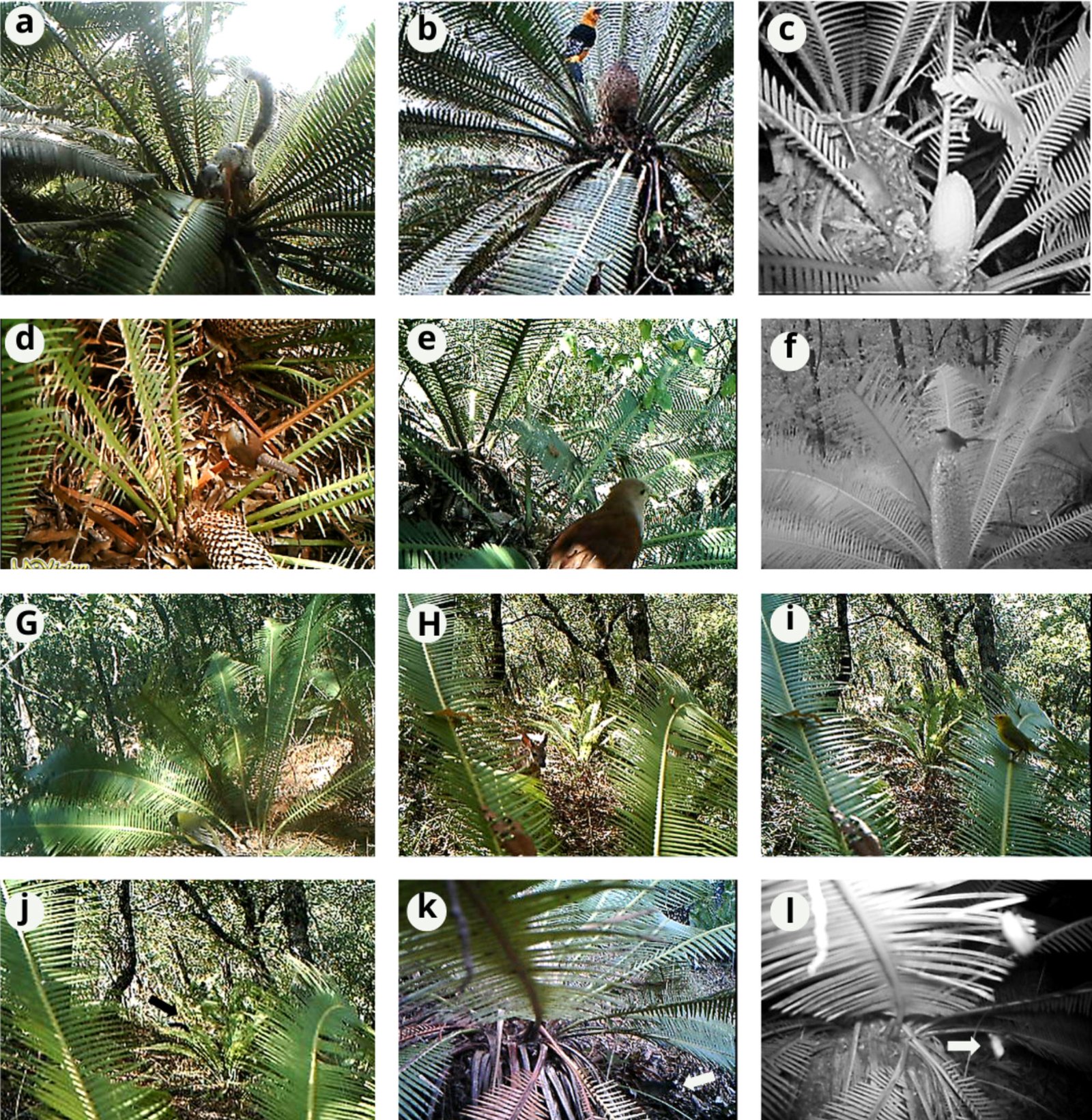
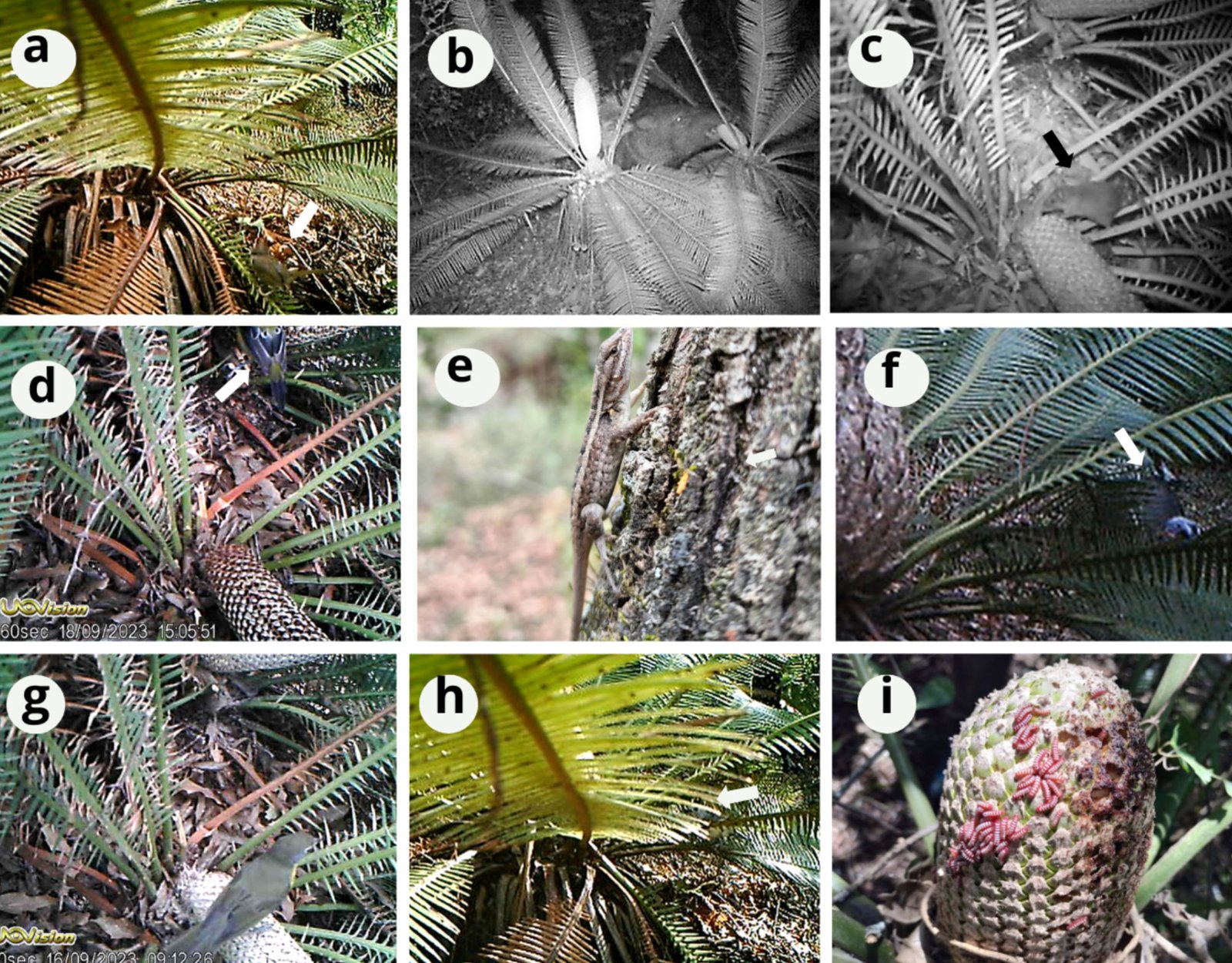
Aunque los índices Shannon de diversidad alfa de ambas localidades mostraron valores similares, el índice de diversidad en Linares (2.03) resultó superior al de Pisaflores (1.55). El índice de diversidad beta de Sorensen resultó alto (0.90). La completitud de las muestras varió con base en el orden de sensibilidad para especies raras (q), resultando Pisaflores con una menor completitud respecto a Linares, especialmente cuando q presenta valores bajos (fig. 6).
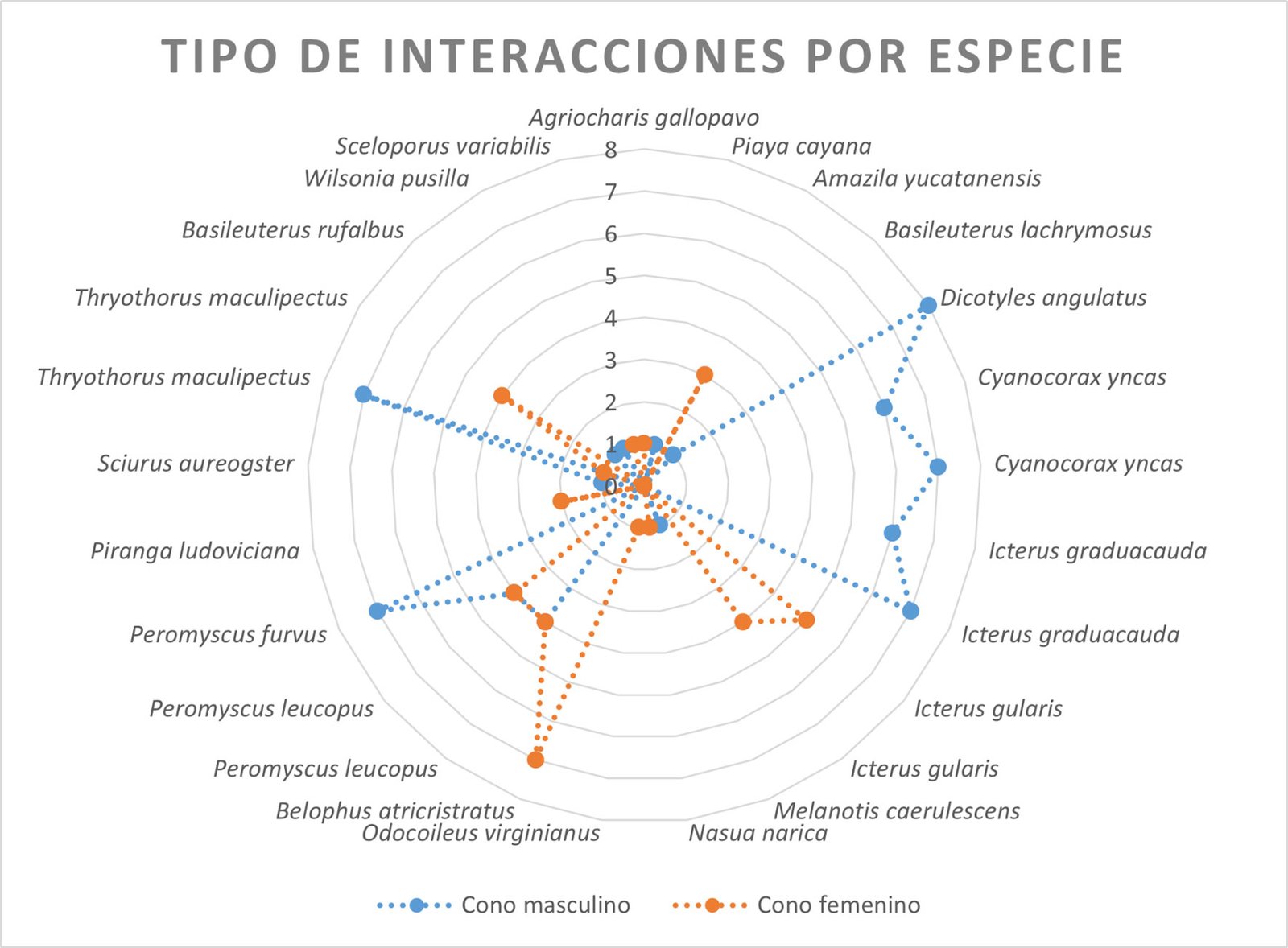
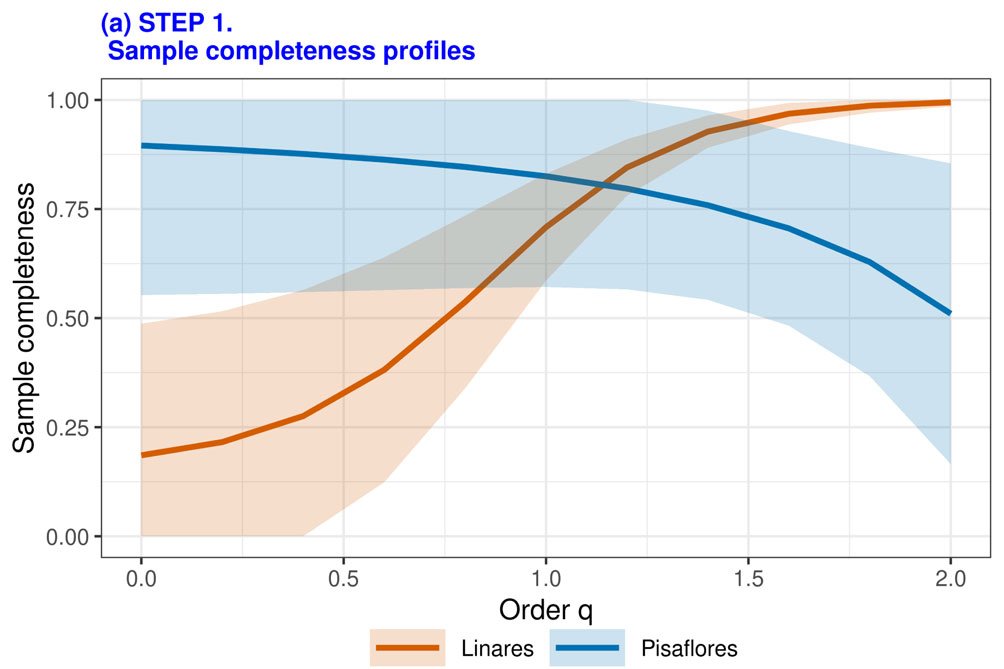
Rarificación/extrapolación con base en tamaño de la muestra (paso 2). Se presenta un incremento de la diversidad taxonómica cuando el tamaño muestral aumenta, Linares presentó mayores valores de biodiversidad, respecto a todos los niveles de q en comparación a Pisaflores (fig. 7a, b). La diversidad taxonómica presentó una diferencia entre las localidades, resultando Linares con una mayor diversidad estimada asintótica (fig. 8).
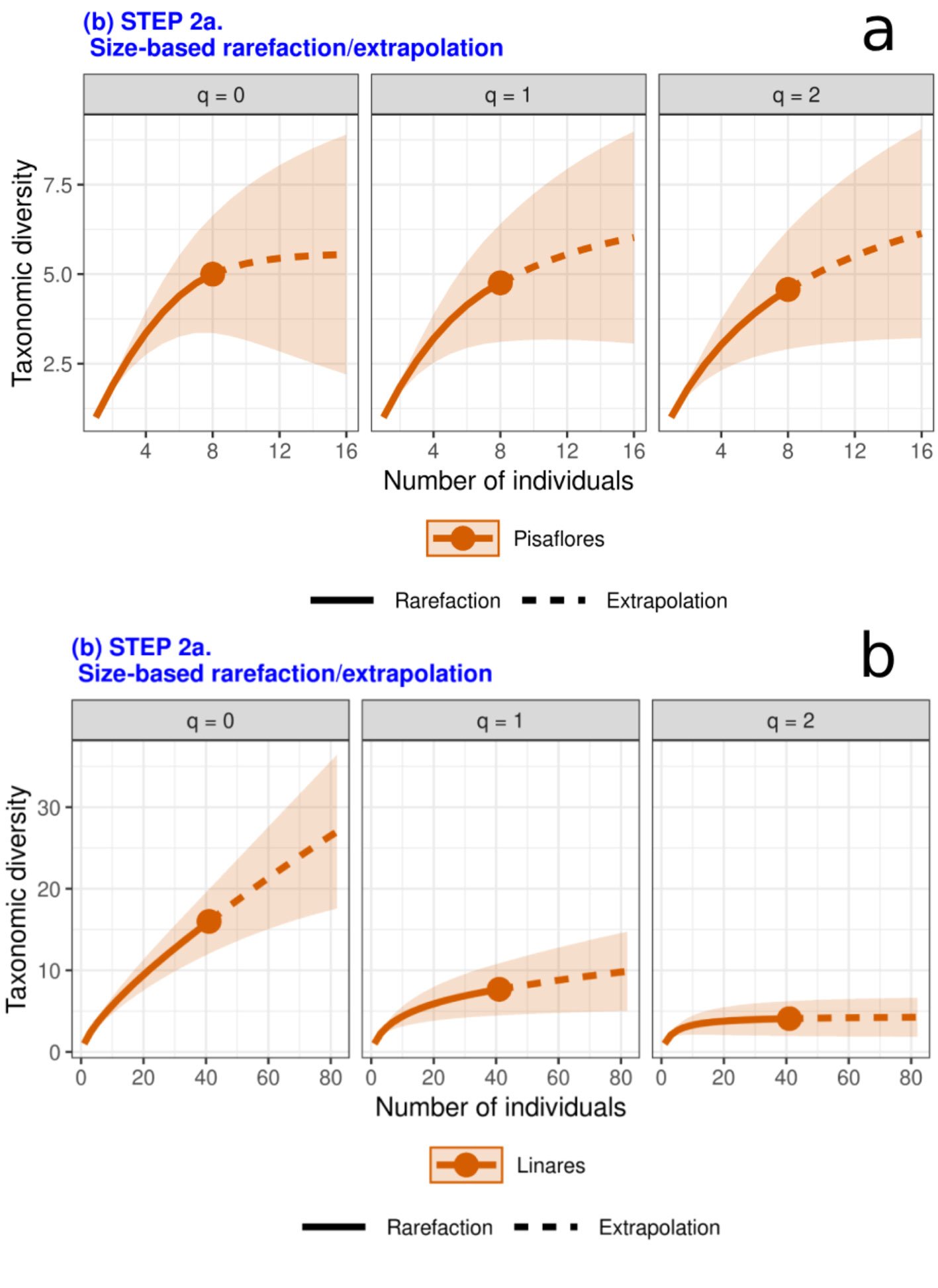
Rarificación/extrapolación basada en cobertura. Se observa un ajuste en la diversidad taxonómica respecto a la cobertura de la muestra. La localidad de Linares presenta una mayor diversidad para una misma cobertura en comparación a Pisaflores. En cuanto a la uniformidad en la distribución o equidad de especies, ésta presenta una disminución cuando el orden q incrementa. La localidad de Pisaflores muestra una menor equidad en comparación con Linares.
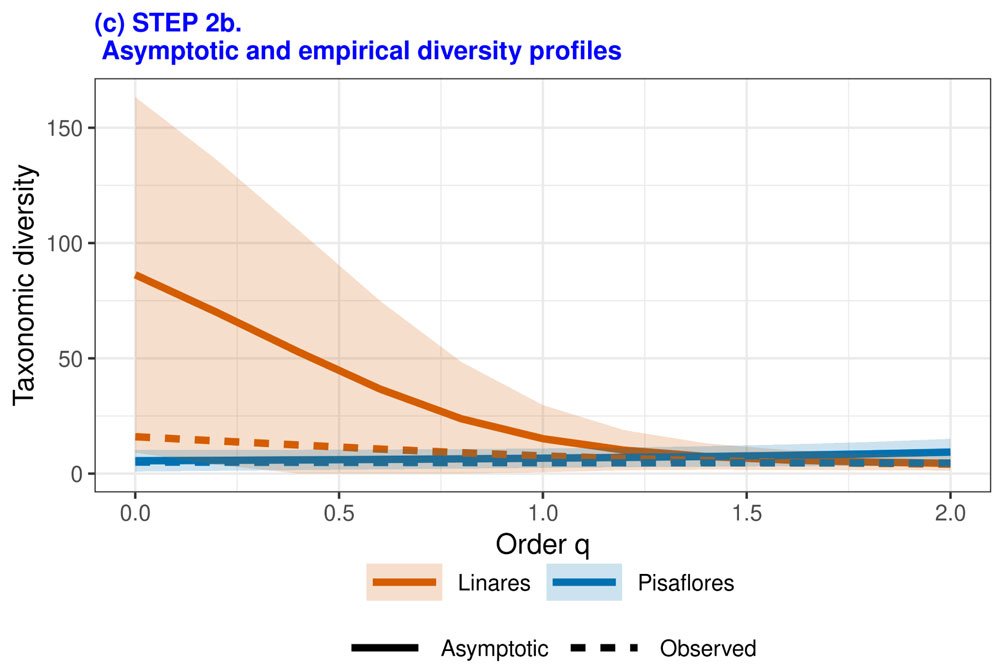
Valores resultantes de los números de Hill. Con valores para q,0 = 27.01, q,1 = 9.88 y q,2 = 4.25. La localidad de Linares presentó una mayor riqueza de especies y diversidad en general, mientras que Pisaflores con q,0 = 4.76, q,1 = 4.50, q,2 = 4.28 muestra una abundancia relativa ligeramente mayor en la distribución de las especies más abundantes. Los gráficos biplot del PCA muestran la distribución de las variables a lo largo de los ejes F1 (92.93%) y F2 (2.88%), los cuales explican, conjuntamente, 98.82% de la varianza total. Dado el carácter exploratorio del PCA y el tamaño reducido de muestra, los resultados se interpretan como un resumen de los patrones generales de asociación entre variables y sitios, por lo que continuamos realizando estudios incluyendo más sitios (fig. 9).
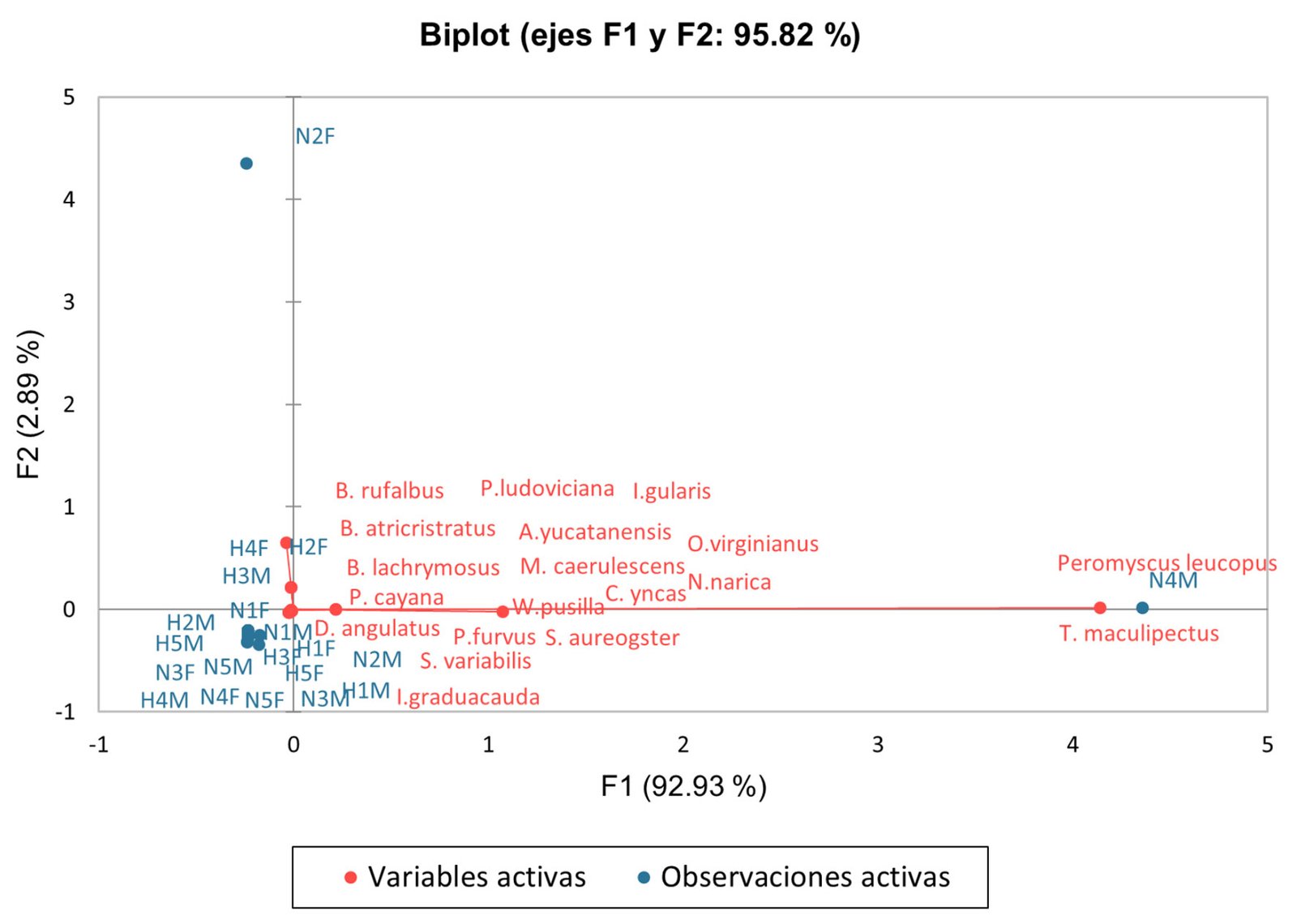
Discusión
La alta diversidad de visitantes e interacciones que se registraron en el presente estudio, establecen un precedente significativo al destacar el papel de los vertebrados en el proceso de polinización de plantas como las cícadas. Este proceso es considerado principalmente por invertebrados en diversas regiones del mundo (Hall y Walter, 2013). Esto se debe a que los estróbilos masculinos y femeninos representan un recurso alimenticio. Sin embargo, nuestros hallazgos coinciden con lo reportado en otras investigaciones que señalan el rol de vertebrados como transportadores de polen, el cual podría estar siendo subestimado (Hooks y Espindola, 2021).
Los resultados del presente estudio sugieren que el proceso de polinización en las plantas del complejo D. edule es más complicado que lo previamente pensado. El proceso involucra tanto factores abióticos (viento) como bióticos (vertebrados e invertebrados). Las interacciones de fauna con estróbilos representan redes complejas (Sounders, 2017). Con base en nuestros resultados y observaciones, se puede indicar que la finalidad de los vertebrados podría ser la búsqueda de una fuente de alimento en los estróbilos. En particular, los estróbilos albergan la variedad de invertebrados que forman parte de la dieta de vertebrados. El posarse, frotarse o acercarse a los estróbilos masculinos llenos de polen, podría provocar la adherencia al pelo, escamas o plumas. Posteriormente, este polen puede ser transportado durante la visita al cono femenino.
La posición de las variables N4M y P. leucopus en el espacio del PCA es consistente con la alta frecuencia de visita del ratón P. leucopus únicamente al estróbilo masculino de D. angustifolium, lo cual coincide con los patrones observados en los registros de interacción. Esto sugiere que P. leucopus podría contribuir al alejamiento del polen, en lugar de facilitar la transferencia a los estróbilos femeninos.
| Nombre científico | Familia | Frec # | Frec % | |
|---|---|---|---|---|
| Aves | Agriocharis gallopavo | Phasianidae | 1 | 2.04 |
| Amazila yucatanensis | Trochilidae | 1 | 2.04 | |
| Basileuterus lachrymosus | Parulidae | 1 | 2.04 | |
| Basileuterus rufalbus | Parulidae | 3 | 6.12 | |
| Baeolophus atricristratus | Trogonidae | 1 | 2.04 | |
| Cyanocorax yncas | Corvidae | 1 | 2.04 | |
| Icterus graduacauda | Icteridae | 2 | 4.08 | |
| Icterus gularis | Icteridae | 1 | 2.04 | |
| Melanotis caerulescens | Mimidae | 1 | 2.04 | |
| Piaya cayana | Cuculidae | 1 | 2.04 | |
| Piranga ludoviciana | Cardinalidae | 1 | 2.04 | |
| Thryothorus maculipectus | Troglodytidae | 7 | 14.29 | |
| Wilsonia pusilla | Parulidae | 1 | 2.04 | |
| Mamíferos | Dicotyles angulatus | Tayassuidae | 1 | 2.04 |
| Nasua narica | Procyonidae | 1 | 2.04 | |
| Odocoileus virginianus | Cervidae | 1 | 2.04 | |
| Peromyscus furvus | Cricetidae | 2 | 4.08 | |
| Peromyscus leucopus | Cricetidae | 19 | 38.78 | |
| Sciurus aureogaster | Sciuridae | 1 | 2.04 | |
| Reptiles | Sceloporus variabilis | Phrynosomatidae | 2 | 4.08 |
| Total | 49 | 100.0 |
Visitantes con potencial polinizador, adaptación ecológica y diversidad
Las cícadas mantienen una relación con los vertebrados actuales, además de emplear estrategias de densidad que favorecen la cercanía entre estróbilos masculinos y femeninos (Hall y Walter, 2013). De este modo, dada la alta frecuencia de visitantes como T. maculipectus a las plantas del complejo D. edule, podemos identificarlos como visitantes con potencial polinizador, al transportar granos de polen entre estróbilos, similar al papel que desempeñan las lagartijas Podarcis lilfordi, que transportan polen entre los estróbilos de la gimnosperma Ephedra fragilis (Ephedraceae) (Fuster y Traveset, 2019).
Los granos de polen transportados son posteriormente introducidos por los invertebrados que habitan los estróbilos de la cícada, aprovechando sus estructuras especializadas y completando así el proceso de polinización (Tang et al., 2018). Al considerar la cercanía de los estróbilos y los visitantes observados, se puede argumentar que tras perder sus relaciones con la megafauna, las cícadas han ido adoptando estrategias para aprovechar a la fauna actual, asegurando así la obtención de éste y otros beneficios ecológicos que les han permitido prevalecer.
Los valores de Hill muestran que la localidad de Nuevo León presenta una mayor riqueza y diversidad general, así como una mayor equidad en la distribución de especies. Además, al considerar el análisis de 4 pasos, Nuevo León exhibe niveles superiores de equidad y diversidad en la mayoría de los análisis, lo que sugiere que esta localidad tiene una comunidad más diversa y uniforme. En Nuevo León, una mayor variedad de especies interactúa con los estróbilos de D. angustifolium. Esto sugiere que los recursos que estos ofrecen durante la temporada de polinización atraen a una gran variedad de especies, independientemente de su abundancia.
La alta diversidad en la comunidad faunística de la localidad de Nuevo León incrementa la complejidad de las interacciones bióticas y la probabilidad de que algunos vertebrados actúen como visitantes con potencial polinizador. Asimismo, la elevada riqueza de especies respalda la idea de que las plantas del complejo D. edule dependen de faunas locales generalistas, lo cual podría conferir una mayor resiliencia frente a cambios ambientales. En contraste, en la localidad de Hidalgo, los niveles de equidad indican que los estróbilos de la especie D. edule son visitados por menos especies, pero de forma más consistente. Esto implica la posible dependencia de un número reducido de visitantes frecuentes, así como una mayor vulnerabilidad ante la pérdida de especies clave.
Thryothorus maculipectus surge como la única especie presente en los estróbilos de ambas especies. Esto indica que, aunque las localidades de estudio comparten 12 de las 20 especies registradas por las cámaras, las especies del complejo D. edule tienen visitantes mayormente distintos. Esta diferencia en la composición de fauna visitante se corrobora con el alto índice de diversidad beta, que evidencia una clara disimilitud entre las localidades de estudio y sugiere un remplazo de especies a lo largo de un gradiente espacial (Koleff et al., 2003). Los resultados obtenidos indican que, para sus interacciones, el complejo D. edule depende de faunas locales residentes, al contar con agentes bióticos con potencial de polinización de un carácter generalista, con respecto al hábitat.
La diferencia entre las especies de visitantes a cada especie del complejo D. edule, si bien parece ser distinta en cuanto a su diversidad, no lo es en cuanto a la variación de rasgos funcionales, la mayoría de ellos se limitaron a pequeñas aves y mamíferos. Esta diferencia no se podría sugerir como una asociación especialista como la observada en casos de angiospermas como Salvia plurispicata (Lamiaceae) con abejas o Salvia elegans (Lamiaceae) con colibríes (Espino et al., 2014), sino más bien un simple reemplazamiento por fauna residente con rasgos más generales que aprovecha los recursos de la planta como en el caso de la lagartija P. lilfordi con la gimnosperma E. fragilis (Fuster y Traveset, 2019). El fenómeno de reemplazamiento para las especies del complejo D. edule podría ser consecuencia de la separación biogeográfica que generó su diferenciación, propuesta por Gonzalez et al. (2005).
Los hallazgos aportan evidencia de que los estróbilos masculinos de cícadas también pueden ser consumidos por Dicotyles angulatus (fig. 4b), un fenómeno anecdótico que hasta ahora solo había sido reportado con evidencia para las semillas del estróbilo femenino, por lo cual estamos realizando más monitoreos que refuercen esta evidencia. Este hecho resulta relevante, ya que podría repercutir en el proceso de polinización. La depredación del estróbilo masculino podría limitar la interacción de otros visitantes con potencial polinizador.
Estos resultados proporcionan un punto de partida para investigaciones futuras sobre el valor nutricional del estróbilo. Asimismo, amplían el conocimiento sobre las interacciones ecológicas entre estas gimnospermas y vertebrados, y subrayan la importancia de considerar a los conos masculinos en los análisis de dinámicas de consumo de las cícadas.
Efectividad de los visitantes como vectores de polinización
Los roedores P. furvus y P. leucopus actúan como un visitante con potencial polinizador y el visitante más frecuente, respectivamente, del cono masculino de D. angustifolium. Este hallazgo coincide con estudios previos, como los de Balderas (2021), en los que los roedores fueron también identificados como los principales visitantes y dispersores de semillas de D. edule. Se ha descrito que los roedores pueden recoger polen en su pelaje mientras se alimentan de materia vegetal y actúan como polinizadores accidentales (Wester et al., 2024), lo que también se observó en esta investigación con los estróbilos de ambas especies de plantas del complejo D. edule. Sin embargo, la alta frecuencia de visita de P. leucopus únicamente al estróbilo masculino, representa un impacto que podría ser ambivalente, entre la polinización y el robo de polen.
Al resultar las aves el grupo taxonómico más diverso que visitó las plantas, interactuando a través de recorridos, perchas y picoteos dentro de ambos estróbilos y considerando que son reconocidas como importantes dispersoras de semillas en cícadas (Symes, 2018), surge una hipótesis que no solo las sugiere como dispersoras, sino también como los visitantes con potencial polinizador más probables para el complejo D. edule. Al ser organismos alados, las aves podrían transportar el polen a distancias y altitudes significativamente mayores en comparación con los organismos terrestres.
Ante los resultados y observaciones anteriores, surge la necesidad de ampliar el número de investigaciones centradas en la capacidad de los vertebrados para transportar efectivamente el polen de las plantas del complejo D. edule, así como comparar la contribución significativa al proceso de polinización entre los grupos de fauna que visitan las especies del complejo. Dado el alarmante índice de extinción entre los mamíferos y los vertebrados en general (Ceballos y Ehrlich, 2002; Ceballos et al., 2017), la disminución de estas especies y sus interacciones representa una amenaza significativa para la supervivencia de las poblaciones del complejo D. edule.
Una alta diversidad de vertebrados, incluyendo aves (13 especies), mamíferos (6 especies) y reptiles (1 especie), interactúan con los conos femeninos y masculinos de D. edule y D. angustifolium durante su fase de polinización, en esta etapa, los estróbilos representan una fuente indirecta de alimento que atrae un mayor número de interacciones, sobre todo en el estróbilo masculino. Las interacciones bióticas entre plantas y fauna son esenciales para la persistencia de las cícadas, estas plantas aprovechan la fauna actual para mantener interacciones que, en combinación con estrategias como la formación de rodales de alta densidad, favorecen la polinización debido a la proximidad entre estróbilos.
Este estudio genera antecedentes importantes para considerar la probable interferencia de vertebrados en el proceso de polinización de plantas del complejo D. edule.
Es fundamental ampliar las investigaciones sobre interacciones entre fauna y gimnospermas para comprender, a una escala mayor, las relaciones ecológicas entre estos organismos y contribuir a su preservación, especialmente en grupos en riesgo de extinción como las Zamiaceae.
Agradecimientos
Agradecemos al Conahcyt-México por financiar el proyecto CBF2023-2024-2780, Ciencia Básica y de Frontera 2023-2024. A Leslie Lugo, Ulises Casarubia, Luis Porras, Uriel Martínez, Sebastián Salazar, Alondra Alvarado y David Balderas por su apoyo en el trabajo técnico de campo. A Romeo Tinajero por el asesoramiento en la identificación de aves. A Rafael, Jesús y José Ángel Briones por permitirnos el acceso a los sitios. A los dos revisores anónimos cuyas observaciones contribuyeron a mejorar el manuscrito.
Referencias
Acevedo-Quintero, J. F. y Zamora-Abrego, J. G. (2016). Role of mammals on seed dispersal and predation processes of Mauritia flexuosa (Arecaceae) in the Colombian Amazon. Revista de Biología Tropical, 64, 5–15. https://doi.org/10.15517/rbt.v64i1.18157
Aguilar, P. O., Rivera-Fernández, A., Iglesias-Andreu, L. G., Vovides, P. A. y Núñez de Cáceres-González, F. F. (2017). Extinction risk of Zamia inermis: a demographic study in its single natural population. Biodiversity and Conservation, 26, 787–800. https://doi.org/10.1007/s10531-016-1270-z
Álvarez-Castañeda, S. T., Álvarez, T. y González-Ruiz, N. (2017). Keys for identifying Mexican mammals. Baltimore: Johns Hopkins University Press. https://doi.org/10.1353/book.50028
Balderas-González, D. (2021). Depredación y dispersión de semillas de Dioon edule por fauna nativa en tres localidades de la Sierra Madre Oriental (Nuevo León, Tamaulipas, San Luis Potosí) (Tesis de maestría). Universidad Autónoma de San Luis Potosí. San Luis Potosí, México.
Balderas-Valdivia, C. J. y González-Hernández, A. (2021). Inventario de la herpetofauna de México 2021. Herpetología Mexicana, 2, 10–71.
Bascompte, J. (2009). Disentangling the web of life. Science, 325, 416–419. https://doi.org/10.1126/science.1170749
Cai, C., Escalona, H. E., Li, L., Yin, Z., Huang, D. y Engel, M. S. (2018). Beetle pollination of cycads in the Mesozoic. Current Biology, 28, 2806–2812. https://doi.org/10.1016/j.cub.2018.06.036
Campbell, D. R. (1989). Measurements of selection in a hermaphroditic plant: variation in male and female pollination success. Evolution, 43, 318–334. https://doi.org/10.2307/2409210
Cárdenas-Cajamarca, J. D. (2017). Contribución de aves y mamíferos en la polinización de Oreocallis grandiflora (Lam.) R. Br. (Proteacea) en un matorral montano andino del sur de Ecuador (Tesis). Facultad de Ciencias y Tecnología, Universidad del Azuay. Cuenca, Ecuador.
Ceballos, G. y Ehrlich, P. R. (2002). Mammal population losses and the extinction crisis. Science, 296, 904–907. https://doi.org/10.1126/science.1069349
Ceballos, G., Ehrlich, P. R. y Dirzo, R. (2017). Biological annihilation via the ongoing sixth mass extinction signaled by vertebrate population losses and declines. Proceedings of the National Academy of Sciences, 114, E6089–E6096. https://doi.org/10.1073/pnas.1704949114
Celedón-Neghme, C., Santamaría, L. y González-Teuber, M. (2016). The role of pollination drops in animal pollination in the Mediterranean gymnosperm Ephedra fragilis (Gnetales). Plant Ecology, 217, 1545–1552. https://doi.org/10.1007/s11258-016-0667-9
Chamberlain, C. J. (1919). The living cycads. Chicago, Illinois: The University of Chicago Press.
Chamberlain, C. J. (1937). Gymnosperms: structure and evolution. Chicago, Illinois: The University of Chicago Press.
Chemnick, J. y Gregory, T. (2022). Dioon angustifolium, the IUCN red list of threatened species 2022. https://dx.doi.org/10.2305/IUCN.UK.2022-1.RLTS.T178868A243384900.en
Chemnick, J. y Gregory, T. (2022). Dioon edule, the IUCN red list of threatened species 2022. https://dx.doi.org/10.2305/IUCN.UK.2022-1.RLTS.T42158A243385825.en
Crowley, B. E., Godfrey, L. R. y Irwin, M. T. (2011). A glance to the past: subfossils, stable isotopes, seed dispersal, and lemur species loss in southern Madagascar. American Journal of Primatology, 73, 25–37. https://doi.org/10.1002/ajp.20817
David, J. P., Manakadan, R. y Ganesh, T. (2015). Frugivoría y dispersión de semillas por aves y mamíferos en los bosques siempreverdes secos tropicales costeros del sur de la India: una revisión. Ecología Tropical, 56, 41–55.
Dorsey, B. L., Gregory, T. J., Sass, C. y Specht, C. D. (2018). Pleistocene diversification in an ancient lineage: a role for glacial cycles in the evolutionary history of Dioon Lindl. (Zamiaceae). American Journal of Botany, 105, 1512–1530. https://doi.org/10.1002/ajb2.1149
Espino-Espino, J., Rosas, F. y Cuevas-García, E. (2014). Variación temporal de visitantes florales en dos especies simpátricas de Salvia con floración simultánea y síndrome de polinización contrastante. Revista Mexicana de Biodiversidad, 85, 161– 166. https://doi.org/10.7550/rmb.35248
Fuster, F. y Traveset, A. (2019). Evidence for a double mutualistic interaction between a lizard and a Mediterranean gymnosperm, Ephedra fragilis. AoB Plants, 11, plz001. https://doi.org/10.1093/aobpla/plz001
González-Astorga, J., Vovides, A. P., Cruz-Angon, A., Octavio- Aguilar, P. y Iglesias, C. (2005). Allozyme variation in the three extant populations of the narrowly endemic cycad Dioon angustifolium Miq. (Zamiaceae) from North- eastern Mexico. Annals of Botany, 95, 999–1007. https://doi.org/10.1093/aob/mci106
González-Astorga, J., Vovides, A. P., Ferrer, M. M. y Iglesias, C. (2003). Population genetics of Dioon edule Lindl. (Zamiaceae, Cycadales): biogeographical and evolutionary implications. Biological Journal of the Linnean Society, 80, 457–467. https://doi.org/10.1046/j.1095-8312.2003.00257.x
González-Christen, A. (1990). Algunas interacciones entre Dioon edule (Zamiaceae) y Peromyscus mexicanus (Rodentia: Cricetidae). La Ciencia y el Hombre, 5, 77–92.
González, D., Vovides, A. P. y Bárcenas, C. (2008). Phylogenetic relationships of the Neotropical genus Dioon (Cycadales, Zamiaceae) based on nuclear and chloroplast DNA sequence data. Systematic Botany, 33, 229–236. https://doi.org/10.1600/036364408784571699
Gutiérrez-Ortega, J. S., Salinas-Rodríguez, M. M., Martínez, J. F., Molina-Freaner, F., Pérez-Farrera, M. A., Vovides, A. P. et al. (2018). The phylogeography of the cycad genus Dioon (Zamiaceae) clarifies its Cenozoic expansion and diversification in the Mexican transition zone. Annals of Botany, 121, 535–548. https://doi.org/10.1093/aob/mcx165
Hall, J. A. y Walter, G. H. (2013). Seed dispersal of the Australian cycad Macrozamia miquelii (Zamiaceae): Are cycads megafauna-dispersed “grove forming” plants? American Journal of Botany, 100, 1127–1136. https://doi.org/10.3732/ajb.1200115
Hammer, O., Harper, D. A. T. y Ryan, P. D. (2001). PAST: paleontological statistics software package for education and data analysis. Paleontologia Electrónica, 4, 1–9.
Herrera, C. M. y Pellmyr, O. (2009). Plant animal interactions: an evolutionary approach. Oxford, UK: Blackwell Science.
Herrera, J. (1987). Biología reproductiva de algunas especies del matorral de Doñana. Anales del Jardín Botánico de Madrid, 44, 483–497.
Hill, M. O. (1973). Diversity and evenness: a unifying notation and its consequences. Ecology, 54, 427–432. https://doi.org/10.2307/1934352
Hooks, C. y Espíndola, A. (2021). Rodents and other non- flying mammal pollinators. Maryland agronomy news. The University of Maryland Extension. Recuperado el 14 enero, 2025, de: https://blog.umd.edu/agronomynews/2021/05/
Hsieh, T. C., Ma, K. H. y Chao, A. (2016). iNEXT: an R package for rarefaction and extrapolation of species diversity (Hill numbers). Methods in Ecology and Evolution, 7, 1451–1456. https://doi.org/10.1111/2041-210X.12613
Jaccard, P. (1901). Estudio comparativo de la distribución floral en una porción de los Alpes y el Jura. Bulletin de la Societe Vaudoise des Sciences Naturelles, 37, 547–579.
Janzen, D. H. y Martin, P. S. (1982). Neotropical anachronisms: the fruits the gomphotheres ate. Science, 215, 19–27. https://doi.org/10.1126/science.215.4528.19
Jin, B., Zhang, L., Lu, Y., Wang, D., Jiang, X. X., Zhang, M. et al. (2012). The mechanism of pollination drop withdrawal in Ginkgo biloba L. BMC Plant Biology, 12, 1–9. https://doi.org/10.1186/1471-2229-12-59
Jones, M. M., Liu, J. y Nagalingum, N. S. (2024). Evidence of a historical metapopulation: conservation genomics and management strategies of Cycas candida (Cycadaceae). International Journal of Plant Sciences, 185, 361–369. https://doi.org/10.1086/729720
Jolliffe, I. T. (2002). Principal component analysis for special types of data. Principal component analysis (pp. 338–372). Nueva York: Springer New York. https://doi.org/10.1007/0-387-22440-8_13
Koleff, P., Gaston, K. J. y Lennon, J. J. (2003). Measuring beta diversity for presence-absence data. Journal of Animal Ecology, 72, 367–382. https://doi.org/10.1046/j.1365-2656.2003.00710.x
Lázaro-Zermeño, J. M., González-Espinosa, M., Mendoza, A. y Martínez-Ramos, M. (2012). Natural history of Dioon merolae (Zamiaceae) in Chiapas, Mexico. Botanical Sciences, 90, 73–87. https://doi.org/10.17129/botsci.387
Lovette, I. J. y Fitzpatrick, J. W. (2016). The Cornell Lab. of Ornithology handbook of bird biology, Third edition. Oxford, UK: John Wiley & Sons.
Luna-Vega, M. I. (1997). Florística y biogeografía de algunos bosques mesófilos de la Huasteca Hidalguense: Fase I (Tenango de Doria y Tlanchinol). Comisión Nacional Para el Conocimiento y uso de la Biodiversidad. Occurrence dataset https://doi.org/10.15468/sbkl18
Mills, J. N., Childs, J. E., Ksiazek, T. G., Peters, C. J. y Velleca, W. M. (1998). Métodos para trampeo y muestreo de mamíferos pequeños para estudios virológicos. Atlanta, Georgia: U.S. Department of Health & Human Services, Public Health Service, Centers for disease control and prevention. Recuperado el 15 marzo, 2025, de: https://stacks.cdc.gov/view/cdc/11583
Mora, R., Yáñez-Espinosa, L., Flores, J. y Nava-Zárate, N. (2013). Strobilus and seed production of Dioon edule (Zamiaceae) in a population with low seedling density in San Luis Potosí, México. Tropical Conservation Science, 6, 268–282. https://doi.org/10.1177/194008291300600208
Moretti, A., Caputo, P., Cozzolino, S., De Luca, P., Gaudio, L., Siniscalco Gigliano, G. y Stevenson, D. W. (1993). A phylogenetic analysis of Dioon (Zamiaceae). American Journal of Botany, 80, 204–214. https://doi.org/10.1002/j.1537-2197.1993.tb13790.x
Nicolalde-Morejón, F., González-Astorga, J., Vergara-Silva, F., Stevenson, D. W., Rojas-Soto, O. y Medina-Villarreal, A. (2014). Biodiversidad de Zamiaceae en México. Revista Mexicana de Biodiversidad, 85 (Suplem.), S114–S125. https://doi.org/10.7550/rmb.38114
Norstog, K. y Nicholls, T. J. (2019). The biology of the cycads. Ithaca, NY: Cornell University Press. https://doi.org/10.7591/9781501737329
Nyhagen, D. F., Kragelund, C., Olesen, J. M. y Jones, C. G. (2001). Insular interactions between lizards and flowers: flower visitation by an endemic Mauritian gecko. Journal of Tropical Ecology, 17, 755–761. https://doi.org/10.1017/S0266467401001560
Osborne, R., Calonje, M. A., Hill, K. D., Stanberg, L. y Stevenson, D. W. (2012). The world list of cycads. Memoirs of the New York Botanical Garden, Vol 106 (pp. 480–510). Nueva York: New York Botanical Garden Press.
Owens, J. N., Takaso, T. y Runions, C. J. (1998). Pollination in conifers. Trends in Plant Science, 3, 479–485. https://doi.org/10.1016/S1360-1385(98)01337-5
Pérez-Farrera, M. A., Quintana-Ascencio, P. F., Salvatierra- Izaba, B. y Vovides, A. P. (2000). Population dynamics of Ceratozamia matudai Lundell (Zamiaceae) in El Triunfo Biosphere Reserve, Chiapas, Mexico. Journal of The Torrey Botanical Society, 127, 291–299. https://doi.org/10.2307/3088647
Pérez-Farrera, M. A., Vovides, A. P., Hernández-Sandoval, L., González, D. y Martínez, M. (2004). A morphometric analysis of the Ceratozamia norstogii complex (Zamiaceae). En T. Walters y R. Osborne (Eds.), Cycad classification: concepts and recommendations (pp. 127– 136). Wallingford, UK: CABI Publishing. Https://Doi. Org/10.1079/9780851997414.0127
Pérez-Farrera, M. A., Vovides, A. P., Octavio-Aguilar, P., González-Astorga, J., De la Cruz-Rodríguez, J., Hernández- Jonapá, R. et al. (2006). Demography of the cycad Ceratozamia mirandae (Zamiaceae) under disturbed and undisturbed conditions in a biosphere reserve of Mexico. Plant Ecology, 187, 97–108. https://doi.org/10.1007/s11258-006-9135-2
Perlo, B. V. (2006). Field guide to the birds of Mexico and Central America. Princeton, NJ: Princeton University Press.
Pianka, E. R. (1970). On r-and k-selection. The American Naturalist, 104, 592–597. https://doi.org/10.1086/282697
QGIS Development Team. (2023). QGIS Geographic Information System (Versión 3.32.3 [Software]. Open Source Geospatial Foundation. https://qgis.org
Ratto, F., Simmons, B. I., Spake, R., Zamora-Gutiérrez, V., MacDonald, M. A., Merriman, J. C. et al. (2018). Global importance of vertebrate pollinators for plant reproductive success: a meta-analysis. Frontiers in Ecology and the Environment, 16, 82–90.
Rivadeneyra-Domínguez, E. y Rodríguez-Landa, J. F. (2014). Las cícadas y su relación con algunas enfermedades neurodegenerativas. Neurología, 29, 517–522. https://doi.org/10.1016/j.nrl.2013.03.005
Rojas-Soto, O. R., Nicolalde-Morejón, F. y Yáñez-Arenas, C. (2014). Dioon edule (chamal). Registros de presencia usados para elaborar el mapa de distribución potencial. Proyecto: JM057. Distribución geográfica y ecológica potencial de las Cícadas de México. Xalapa: Instituto de Ecología, A.C. Recuperado el 13 de septiembre, 2024, de: http://geoportal.conabio.gob.mx/metadatos/doc/html/ded057rpgw.html
Rubio-Méndez, G., Yáñez-Espinosa, L. y Leija, E. G. (2020). Are the Dioon edule (Zamiaceae) forms from San Luis Potosí proposed by Whitelock (2004) recognizable? Morphological evidence. Revista Mexicana de Biodiversidad, 91, e913167. https://doi.org/10.22201/ib.20078706e.2020.91.3167
Rubio-Méndez, G., Yáñez-Espinosa, L., Salinas-Rodríguez, M. M., Hernández-Hernández, K. A. y Balderas-González, D. (2019). Demografía y estructura poblacional de Dioon angustifolium (Zamiaceae) en el noreste de México. Botanical Sciences, 97, 685–690. https://doi.org/10.17129/botsci.2262
Saunders, M. E. (2017). Insect pollinators collect pollen from wind-pollinated plants: implications for pollination ecology and sustainable agriculture. Insect Conservation and Diversity, 11, 13–31. https://doi.org/10.1111/icad.12243
Shannon, C. E. (1948). A mathematical theory of communication. The Bell System Technical Journal, 27, 379–423. https://doi.org/10.1002/j.1538-7305.1948.tb01338.x
Sorensen, T. (1948). A method of establishing groups of equal amplitude in plant sociology based on similarity of species content and its application to analyses of the vegetation on Danish commons. Biologiske Skrifter, 5, 1–34.
Stevenson, D. W. (1992). A formal classification of the extant cycads. Brittonia, 44, 220–223. https://doi.org/10.2307/2806837
Suinyuy, T. N., Donaldson, J. S., Johnson, S. D. y DeWet Bosenberg, J. (2012). Role of cycad cone volatile emissions and thermogenesis in the pollination of Encephalartos villosus Lem.: preliminary findings from studies of plant traits and insect responses. Memoirs of the New York Botanical Garden, Vol 106 (pp. 318–334). Nueva York: New York Botanical Garden Press.
Symes, C. T. (2018). Cycad seed dispersal: the importance of large frugivorous birds. Biodiversity Observations, 9, 9–4. https://doi.org/10.15641/bo.v9i0.503
Tang, W., Xu, G., O’Brien, C. W., Calonje, M., Franz, N. M., Johnston, M. A. et al. (2018). Molecular and morphological phylogenetic analyses of New World cycad beetles: what they reveal about cycad evolution in the New World. Diversity, 10, 38. https://doi.org/10.3390/d10020038
Terry, I., Forster, P. I., Moore, C. J., Roemer, R. B., & Machin, P. J. (2008). Demographics, pollination syndrome and conservation status of Macrozamia platyrhachis (Zamiaceae), a geographically restricted Queensland cycad. Australian Journal of Botany, 56, 321–332. https://doi.org/10.1071/BT06202
Terry, L. I., Walter, G. H., Donaldson, J. S., Snow, E., Forster, P. I. y Machin, P. J. (2005). Pollination of Australian Macrozamia cycads (Zamiaceae): effectiveness and behavior of specialist vectors in a dependent mutualism. American Journal of Botany, 92, 931–940. https://doi.org/10.3732/ajb.92.6.931
Varela, R. O. y Bucher, E. H. (2002). Seed dispersal by Chelonoidis chilensis in the Chalco Dry Woodland of Argentina. Journal of Herpetology, 36, 137–140. https://doi.org/10.1670/0022-1511(2002)036[0137:SDBCCI]2.0.CO;2
Viana, D. S., Santamaría, L. y Figuerola, J. (2016). Optimal methods for fitting probability distributions to propagule retention time in studies of zoochorous dispersal. BMC Ecology, 16, 3. https://doi.org/10.1186/s12898-016-0057-0
Vovides, A. P. (1990). Spatial distribution, survival, and fecundity of Dioon edule (Zamiaceae) in a tropical deciduous forest in Veracruz, Mexico, with notes on its habitat. American Journal of Botany, 77, 1532–1543. https://doi.org/10.1002/j.1537-2197.1990.tb11394.x
Vovides, A. P., Ogata, N., Sosa, V. y Peña-García, E. (1997). Pollination of endangered Cuban cycad Microcycas calocoma (Miq.) A. DC. Botanical Journal of the Linnean Society, 125, 201–210. https://doi.org/10.1111/j.1095-8339.1997.tb02254.x
Wester, P., Stanway, R. y Pauw, A. (2009). Mice pollinate the Pagoda Lily, Whiteheadia bifolia (Hyacinthaceae)— First field observations with photographic documentation of rodent pollination in South Africa. South African Journal of Botany, 75, 713–719. https://doi.org/10.1016/j.sajb.2009.07.005
Whitelock, L. M. (2004). Variation in the Mexican cycad Dioon edule (Zamiaceae). Botanical Review, 70, 240–249. https://www.jstor.org/stable/4354476
Yáñez-Espinosa, L. (2006). Las cycadas: biología y conservación en México. Ciudad de México: Universidad Autónoma Chapingo.
Yáñez-Espinosa, L., Balderas-González, D., Rubio-Méndez, G., Barragán-Torres, F. y Espinosa-Reyes, G. (2021). Dispersión de semillas de Dioon edule por aves. En H. Reyes-Hernández, J. A. Reyes-Agüero y A. Durán-Fernández (Eds.), Desafíos para la conservación de los ecosistemas y su biodiversidad en la Reserva de la Biosfera Sierra del Abra Tanchipa (pp. 38–48). San Luis Potosí, México: Universidad Autónoma de San Luis Potosí/ Conanp.
Yáñez-Espinosa, L., Barragán-Torres, F., Ibarra-Hernández, A. B. y Morales, J. I. (2021). Dispersal of Dioon edule cycad seeds by rodents in a tropical oak forest in Mexico. Tropical Zoology, 34, 57–71. https://doi.org/10.4081/tz.2021.105

Evolución

Biogeografía

Notas científicas
Notas científicas