Bolax de Colombia (Coleoptera: Scarabaeidae: Rutelinae: Geniatini): nuevas especies, registros y sinónimos
Julián Clavijo-Bustos a, *, Julián David Alzate-Cano b, Manuel D. Barria c, d
a Colección de Escarabajos Coprófagos de Colombia – Alejandro Lopera-Toro, Calle 7 No. 53-17, Villa de Leyva, Boyacá, Colombia
b Universidad de Antioquia, Grupo de Entomología-Universidad de Antioquia (GEUA), Calle 67 No. 53-108, Medellín, Colombia
c Universidad de Panamá, Museo de Invertebrados G. B. Fairchild de la Universidad de Panamá, Laboratorio de Artrópodos venenosos, Urbanización El Cangrejo, Vía Simón Bolívar con la intersección de la Vía Manuel Espinoza Batista y José De Fábrega, Ciudad de Panamá, Panama
d Universidad de Panamá, Vicerrectoría de Investigación y Postgrado, Programa Centroamericano de Maestría en Entomología, Urbanización El Cangrejo, Vía Simón Bolívar con la intersección de la Vía Manuel Espinoza Batista y José De Fábrega, Ciudad de Panamá, Panamá.
*Corresponding author: jclavijobent@gmail.com (J. Clavijo-Bustos)
Received: 05 April 2026; accepted: 29 July 2026
http://zoobank.org/urn:lsid:zoobank.org:pub:00C5B5F7-6A6A-4FBF-8D24-11ED1F24D860
Abstract
A taxonomic contribution to the genus Bolax Fischer von Waldheim, 1829 (Coleoptera: Scarabaeidae: Rutelinae: Geniatini) from Colombia is presented. This contribution is based on the examination of collection specimens and additional distributional data from the citizen science platform iNaturalist. Two new species, Bolax opita sp. nov. and Bolax verdita sp. nov., are described. Two species are recorded from Colombia for the first time (B. caurana Ohaus, 1931 and B. magna Bates, 1888), and 2 new synonymies are proposed: Bolax meyeri Soula, 2011 = B. castaneicollis Burmeister, 1844, and Bolax howdeni Soula, 2011 = B. caurana Ohaus, 1931. Diagnoses, taxonomic comments, and updated distributional data are provided for most species from the country. A total of 11 species are now recognized in Colombia, 4 of which are endemic. The genus is primarily distributed along the Andes and associated piedmonts. These results highlight the importance of national collections and continued collecting efforts for improving the knowledge of Geniatini diversity in Colombia.
Keywords: Citizen science; Distribution; Neotropics; Scarabs; Taxonomy
Resumen
Se presenta una contribución taxonómica sobre el género Bolax Fischer von Waldheim, 1829 (Coleoptera: Scarabaeidae: Rutelinae: Geniatini) para Colombia. Esta contribución se basa en la revisión de especímenes de colecciones y datos adicionales de distribución provenientes de la plataforma de ciencia ciudadana iNaturalist. Se describen 2 nuevas especies, Bolax opita sp. nov. y Bolax verdita sp. nov. Dos especies se registran por primera vez para Colombia (B. caurana Ohaus, 1931 y B. magna Bates, 1888) y se proponen 2 nuevas sinonimias: Bolax meyeri Soula, 2011 = B. castaneicollis Burmeister, 1844, y Bolax howdeni Soula, 2011 = B. caurana Ohaus, 1931. Se proporcionan diagnosis, comentarios taxonómicos y datos de distribución actualizados para la mayoría de las especies del país. Un total de 11 especies son ahora reconocidas en Colombia, 4 de las cuales son endémicas. El género se distribuye principalmente a lo largo de los Andes y piedemontes asociados. Estos resultados resaltan la importancia de las colecciones nacionales y de los esfuerzos continuos de colecta para mejorar el conocimiento de la diversidad de Geniatini en Colombia.
Palabras clave: Ciencia ciudadana; Distribución; Neotrópico; Escarabajos; Taxonomía
Introduction
The genus Bolax Fischer von Waldheim, 1829 belongs to the tribe Geniatini (Coleoptera: Scarabaeidae: Rutelinae) and comprises 50 species distributed from Central America to mid- and northern South America (Jameson & Hawkins, 2005; Soula, 2011). Brazil has the greatest diversity of the genus, and the species richness decreases toward the north into other countries (Soula, 2011). Hence, only 5 species are known from Central America (Barria et al., 2026), and 8 species have been recorded from Colombia (Jameson & Hawkins, 2005; Soula, 2011).
Adults of Bolax are characterized by their generally elongate and cylindrical shape, size 7-20 mm (females are longer), usually of tan or red tan color, in some cases coloration contrasting between head, pronotum and elytra (black and tan or red and tan) and in some others with metallic maculae, reflections or vitae; ventral surface clothed with white setae, scale-like white setae in pronotum or small setae in the elytra; eyes small and widely separated, interocular distance more than 6 times the dorsal width of the eye, vertex strongly convex, mentum strongly bulging, base of pronotum constricted, and protarsomeres 2 to 5 dorsoventrally flattened and setose ventrally (wider in males) (Barria et al., 2026; Jameson & Hawkins, 2005). Species of the genus are primarily phyllophagous and have been recorded both during the day and at night, with some causing damage to cultivated fruit trees and vineyards (Jameson & Hawkins, 2005; Ohaus, 1908).
After the description of a new species and a key for species identification by Frey (1976), Jameson and Hawkins (2005) published the synopsis of the genera of Geniatini and an annotated species catalog. Subsequently, Soula (2011) provided species descriptions and an identification key; however, his revision of Bolax lacked detailed examination of the morphological characters necessary for species determination (Moore et al., 2014). Finally, a short synopsis of the Central American species was recently published, including the description of a new species from Panama, Bolax azurita Barria, Clavijo-Bustos & Seidel, 2026 (Barria et al., 2026). Here, we present the description of 2 new species, new records, new synonyms and diagnoses for most species of the genus Bolax from Colombia.
Materials and methods
The examined specimens are deposited in the Canadian Museum of Nature (CMNC – Quebec, Canada); Colección entomológica, Museo de Historia Natural “Luis Gonzalo Andrade”, Universidad Pedagógica y Tecnológica de Colombia (UPTC-E – Tunja, Boyacá, Colombia); Colección Entomológica Universidad de Antioquia (CEUA – Medellín, Antioquia, Colombia); Colección Nacional de Insectos, Instituto de Ciencias Naturales of the Universidad Nacional de Colombia (ICN-E – Bogotá, Distrito Capital, Colombia); Colección Entomológica del Museo Javeriano de Historia Natural de la Pontificia Universidad Javeriana (MPUJ-ENT – Bogotá, Distrito Capital, Colombia); Naturhistorisches Museum Basel (NMB – Basel, Switzerland); Sección de Entomología, Colecciones Biológicas, Centro de Colecciones y Gestión de Especies, Instituto de Investigación de Recursos Biológicos Alexander von Humboldt (IAvH-E – Villa de Leyva, Boyacá, Colombia); and Sección de Entomología, Museo de Historia Natural, Universidad Pedagógica Nacional (MHN-UPN – Bogotá, Distrito Capital, Colombia).
Terminology follows Lawrence et al. (2010) and Barria et al. (2026), and distribution records were extracted from Soula (2011) and specimens labels. Additional records were obtained from the citizen science platform iNaturalist up to December 2025. Label information of examined material is presented verbatim. For transcriptions of type specimen labels, a vertical bar “| ” indicates different lines within a label, whereas 2 inclined bars “// ” denote different labels; label characteristics are presented between square brackets “[ ]”.
Specimens were photographed using a Canon EOS 5d Mark III camera with a Canon EF 100 mm f/2.8 macro lens, and with a Leica MC 190HD camera attached to a Leica S8APO stereomicroscope. Figures were prepared using Photoshop v.21.2.0., and the distribution map was produced with QGIS v3.34.
Descriptions
Family Scarabaeidae Latreille, 1802
Subfamily Rutelinae Macleay, 1819
Tribe Geniatini Burmeister, 1844
Genus Bolax Fischer von Waldheim, 1829
Bolax castaneicollis Burmeister, 1844 (Fig. 1)
Bolax castaneicollis Burmeister, 1844: 489 (original description)
Bolax meyeri Soula, 2011: 39 (new synonym)
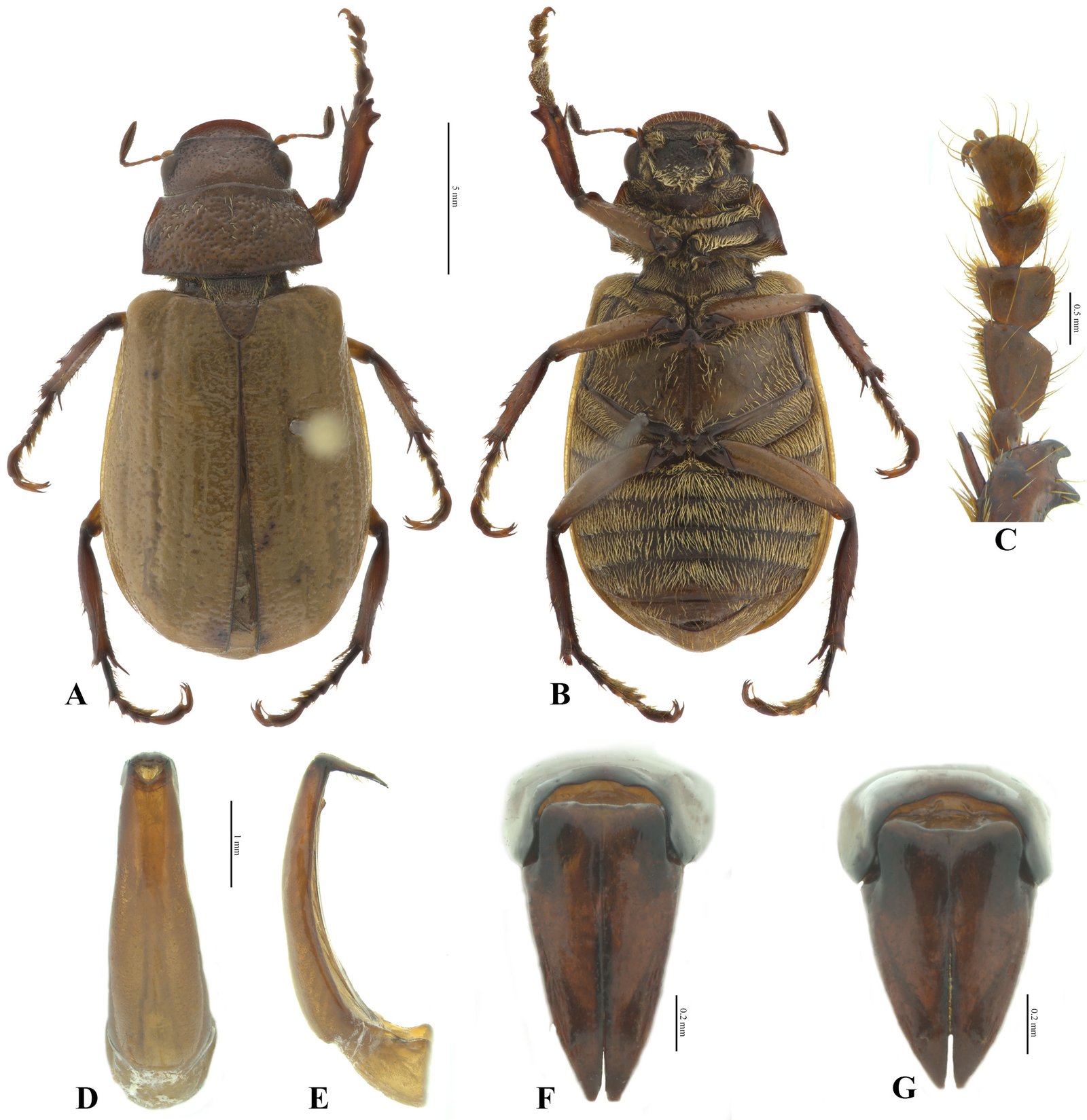
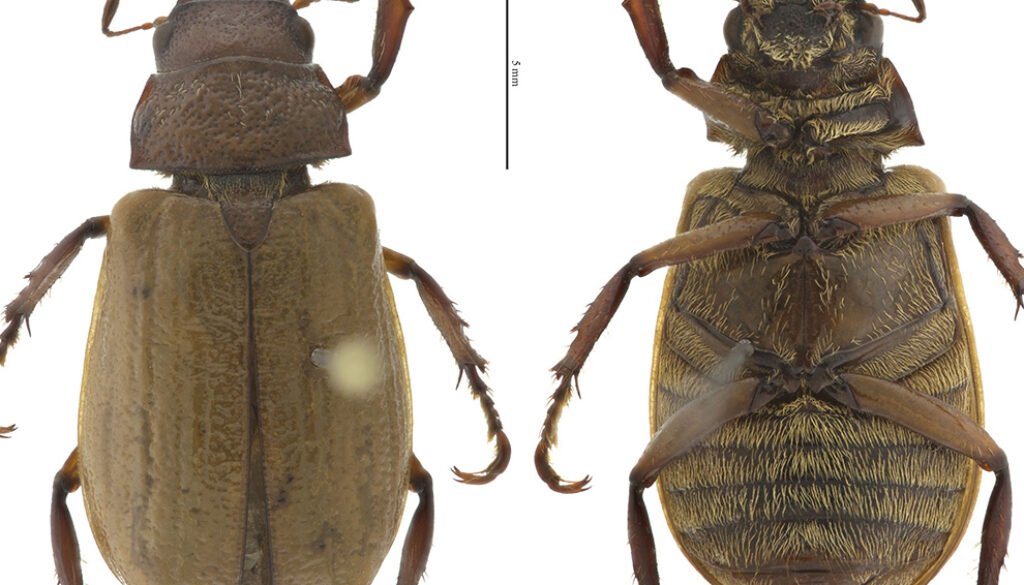
Diagnosis. Total length: 16.2-20.6 mm, elytral humeral width: 6.1-8.3 mm. Dorsally shiny, yellowish castaneous, some specimens bicolored with head and pronotum darker; ventrally yellowish castaneous (Fig. 1A, B). Dorsal surface subrugose, covered with deep coarse punctures; a few punctures on the pronotum bear a thick, long pale seta (Fig. 1A). Clypeus with punctures densely and irregularly distributed, separated by less than 1-1 times 1 puncture diameter; frons with punctures smaller than those of clypeus, densely and irregularly distributed, separated by less than 1-2 times 1 puncture diameter (Fig. 1A). Pronotum with punctures irregularly distributed, separated by 1-3 times 1 puncture diameter, punctures bigger laterally; pronotal posterior angles almost right angled (Fig. 1A). Ventral surface densely setose, but very scarce and sparser setae on metaventrite (Fig. 1B). Protibia with apical tooth on posterior margin oriented laterally, tooth subtriangular and with acute apex (Fig. 1C). Mesotibia and metatibia slightly constricted at subapex (Fig. 1A, B). Male protarsomere 2 longer than wide, subrectangular and almost as long as the combined length of the protarsomeres 3-4 (Fig. 1C). Parameres long, subtriangular, apex acute (Fig. 1D-G).
Taxonomic summary
Material examined. Colombia. Boyacá: Arcabuco, 2,600 m, 1-V-1996, J. C. Mendoza (1♀ ICN-E-025701). Cundinamarca: La Vega, 25-VI-1975, R. Delgado (1♀ MHN-UPN). Norte de Santander: Cucutilla, Vda. Carrizal, Sector Sisavita, Qda. Poveda, Borde Robledal-Potrero, 07°28’ N, 72°49’ W, 2,040-2,200 m, Cap. Manual, 26-28-III-2002, E. González, A. Pulido (1♀ IAvH-E-215866); Cucutilla, Vereda Sisavita, La Parcela, Bosque, Cap. Manual, 12-VIII-2001, Duque & Vélez (1♀ CEUA 23048). Santander: Piedecuesta, Sevilla, Vereda Cristales, Finca Rasgón, 2,600 m, Cap. Manual, IX-2001, Duque & Vélez (1♂ CEUA 24375); Piedecuesta, Vda. Cristales, Fca. Bellavista (L.A. Sandoval), Cultivo de mora (3 años), 27-VI-1995, E. Torres (2♂♂ IAvH-E-215867-68); Santa Bárbara, Vereda Salaminas, Finca San Francisco, campamento, 07°00’02.6” N, 72°52’46.1” W, 2,538 m, Cap. Manual, 10-IX-2018, M.I. Castro, J.C. Neita, J-S. Park & E. Torres (1♀ IAvH-E-205517); Tona, El Brasil, 1,800 m, 22-IV-2004, Amat & Vélez (1♂ ICN-E-103690).
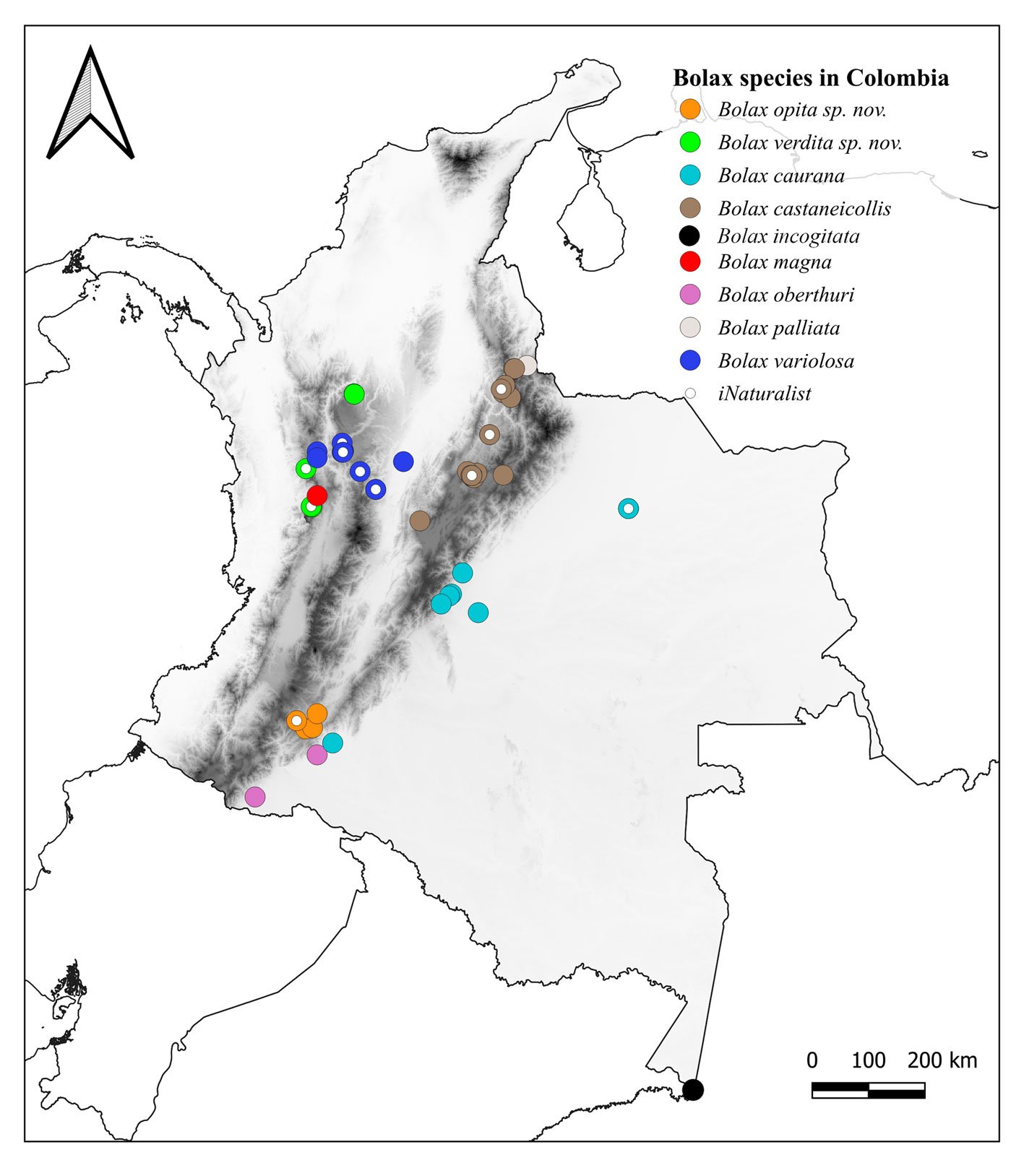
Distribution. Venezuela, Colombia (Soula, 2011). In Colombia, it is distributed in Andean localities across the northern part of the Eastern Cordillera (Fig. 12).
Records from iNaturalist. Colombia, Boyacá, Arcabuco, 5.742606 -73.504153, observed on 2020-09-19 by @acevedocharry (https://www.inaturalist.org/observations/63139926). Colombia, Boyacá, Gachantivá, 5.7422 -73.505202, observed on 2021-01-10 by @humbertomendozacifuentes (https://www.inaturalist.org/observations/67909953). Colombia, Boyacá, Gachantivá, 5.742275 -73.52055, observed on 2023-10-8 by @grallarinima (https://www.inaturalist.org/observations/187328015). Colombia, Boyacá, Gachantivá, 5.743098 -73.520109, observed on 2023-11-13 by @grallarinima (https://www.inaturalist.org/observations/193120289). Colombia, Boyacá, Gachantivá, 5.805831 -73.576208, observed on 2024-03-10 by @grallarinima (https://www.inaturalist.org/observations/205965655). Colombia, Boyacá, Gachantiva, 5.74388 -73.51912, observed on 2024-09-15 by @grallarinima (https://www.inaturalist.org/observations/248666284). Colombia, Boyacá, Villa de Leyva, 5.705998 -73.47708, observed on 2018-11-24 by @helpwithnames (https://www.inaturalist.org/observations/18678997). Colombia, Boyacá, Villa de Leyva, 5.711983 -73.49057, observed on 2022-10-09 by @sergmendezca (https://www.inaturalist.org/observations/138142100). Colombia, Boyacá, Villa de Leyva, observed on 2023-01-24 by @fungusfinder (https://www.inaturalist.org/observations/147321993). Colombia, Cesar, Río de Oro, 6.402311 -73.218459, observed on 2019-07-11 by @mateohernandezschmidt (https://www.inaturalist.org/observations/30319780). Colombia, Santander, Charalá, 6.402311 -73.218459, observed on 2022-07-03 by @apipa (https://www.inaturalist.org/observations/124813635). Colombia, Santander, Gambita, 5.779165 -73.425663, observed on 2023-11-11 by @biotariel (https://www.inaturalist.org/observations/192243392). Colombia, Santander, Tona, 7.135842 -73.031167, observed on 2022-04-24 by @mariajose1012_ (https://www.inaturalist.org/observations/112785429).
Remarks
Soula (2011) described B. meyeri based on the contrasting coloration of head and pronotum versus elytra, as well as differences in the length of parameres. However, we found specimens from the same locality exhibiting the contrasting color pattern but possessing both types of parameres (Fig. 1F, G), as well as the same type of parameres in specimens with different color patterns. Thus, Bolax meyeri Soula, 2011 is here proposed as a junior synonym of Bolax castaneicollis Burmeister, 1844.
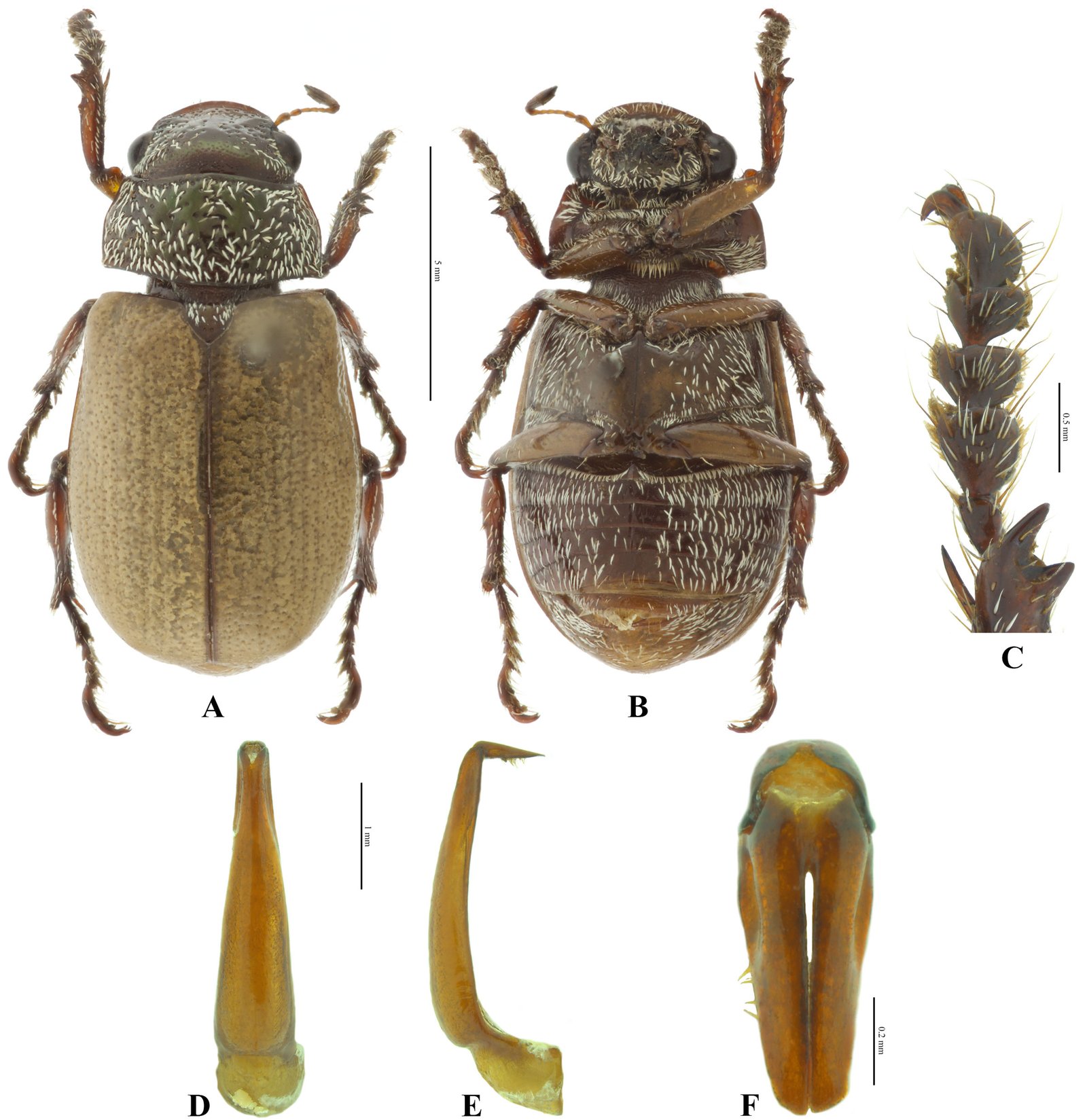
Bolax caurana Ohaus, 1931 (Figs. 2, 3)
Bolax cauranus Ohaus, 1931 (original description and spelling)
Bolax howdeni Soula, 2011: 59 (new synonym)
Diagnosis. Total length: 10.1-12.8 mm, elytral humeral width: 4.3-5.2 mm. Dorsally shiny, bicolored; head and pronotum reddish brown (sometimes with more or less evident green metallic reflections), and elytra yellowish castaneous; ventrally reddish brown (Fig. 2A, B). Dorsal surface with moderately dense, moderately long, scale-like white setae, present around the eyes and on the frons; on the pronotum throughout, but sparser medially (occasionally also along the lateral margins); and on the scutellar shield except at the center and along the posterior margin (Fig. 2A). Clypeus with punctures irregularly distributed, separated by less than 1-3 times 1 puncture diameter; frons with punctures slightly smaller than those of clypeus, irregularly distributed, separated by 1-3 times 1 puncture diameter (Fig. 2A). Pronotum with punctures irregularly distributed, separated by less than 1-3 times 1 puncture diameter; pronotal posterior angles obtuse (Fig. 2A). Ventral surface sparsely setose with moderately long, thick white setae, but setae scarce on metaventrite and the middle of abdominal ventrites (Fig. 2B). Protibia with apical tooth on posterior margin oriented laterally, tooth subtriangular and with acute apex (Fig. 2C). Mesotibia slightly constricted at subapex; metatibia strongly constricted at subapex (Fig. 2A, B). Male protarsomere 2 almost as long as wide, subtriangular and shorter than the combined length of the protarsomeres 3-4 (Fig. 2C). Parameres long, outer margin slightly sinuous, and apex subrounded and slightly asymmetric (Fig. 2D-F).
Taxonomic summary
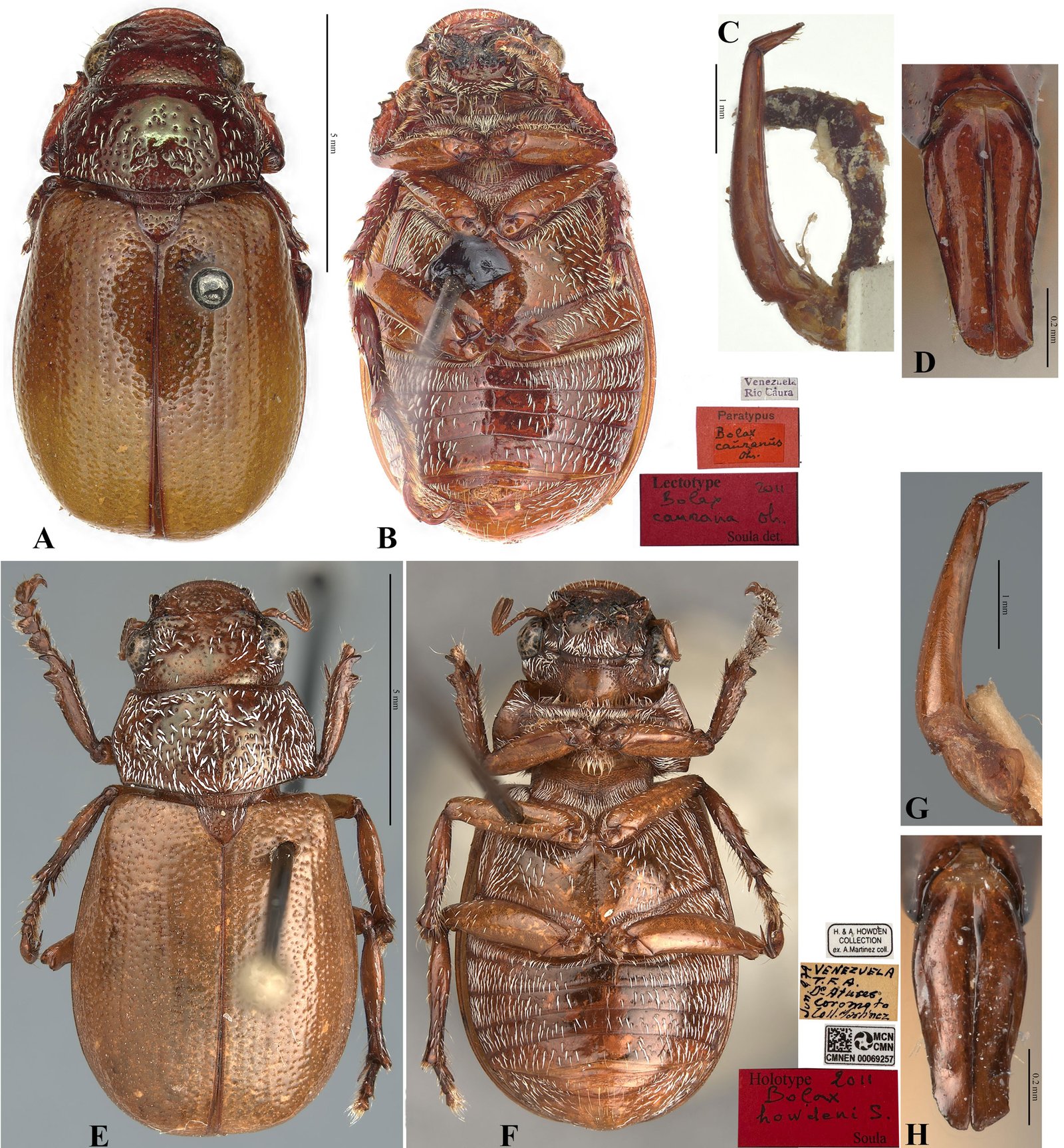
Type specimens examined. Male lectotype of Bolax caurana Ohaus, 1931 (Fig. 3A-D), deposited in NMB (examined by photos): “Venezuela | Rio Caura” [white label, printed] // “Paratypus | Bolax | caurana | Oha.” [red label, printed, with second to fourth line corresponding to a second red label glued to the first] // “Lectotype | 2011 | Bolax | caurana Oh. | Soula det.” [red label, printed, with second to fourth lines handwritten]. Male holotype of Bolax howdeni Soula, 2011 (Fig. 3E-H), deposited in CMNC (examined by photos).
Material examined. Colombia. Caquetá: Morelia, Vda. Albano, Fca. Guacarí, 01°25’41” N, 75°44’56” W, 251 m, 29-III-12-IV-2017, Y. Ramos (1♀, 1♂ LEUA-35601, 35602). Meta: Cubarral, F. La Rosanía, Establo, 03°49’46.56” N, 73°49’59.21” W, 620 m, Luz, IV-2018, A. Lopera, W. Chamorro (2♀♀ IAvH-E-215869-70); PNN Sumapaz, Cabañas Las Mirlas, 03°48’ N, 73°52’ W, WGS84, 710 m, Malaise #M3110, 19-III-03-IV-2002, H. Vargas (2♀♀ IAvH-E-215871-72); San Martín, Reserva Natural El Caduceo, Km 4.5 a San Francisco (1Unsexed MPUJ-ENT); San Martín, Reserva Rey Zamuro-Matarredonda, ~ 37km ESE S. Martín (1Unsexed MPUJ-ENT 65361); Villavicencio, 5-IV-1980, D. Castaño (11♀♀, 10♂♂ ICN-E-103656-59, 103662-65, 103667, 103669, 103671, 103673-74, 103676-78, 103681, 103683-85, 103687).
Distribution. Venezuela (Soula, 2011), Colombia (new country record). In Colombia, it is distributed across the Orinoquia and Orinoquian and Amazonian piedmonts (Fig. 12).
Records from iNaturalist. Colombia, Casanare, Trinidad, 5.208938 -70.980222, observed on 2024-04-20 by @wilsonlombana (https://www.inaturalist.org/observations/208785724). Colombia, Casanare, Trinidad, 5.209272 -70.979774, observed on 2024-04-20 by @wilsonlombana (https://www.inaturalist.org/observations/208255885).
Remarks
The external morphology and shape of parameres of B. caurana resemble those of B. howdeni (Fig. 3); however, Soula (2011) justified this species mainly on the basis of size differences, with B. howdeni being smaller. After examining the type specimens, we noted that B. caurana and B. howdeni have similar body sizes, and that other differences such as thickness of setae, dorsal punctuation, and shape of parameres apex, may represent intraspecific variation (Fig. 3). Thus, Bolax howdeni Soula, 2011 is here proposed as a junior synonym of Bolax caurana Ohaus, 1931.
Additionally, examined specimens from Colombia exhibit similar external morphology and the overall shape of parameres, but differ in the parameres thickness (compare Figs. 2F, 3D, H). We consider this to represent intraspecific variation, probably clinal in nature.
Bolax hirtula Burmeister, 1844
Bolax hirtulus Burmeister, 1844: 491 (original description and spelling)
Taxonomic summary
Distribution. Colombia, without precise location (Soula 2011).
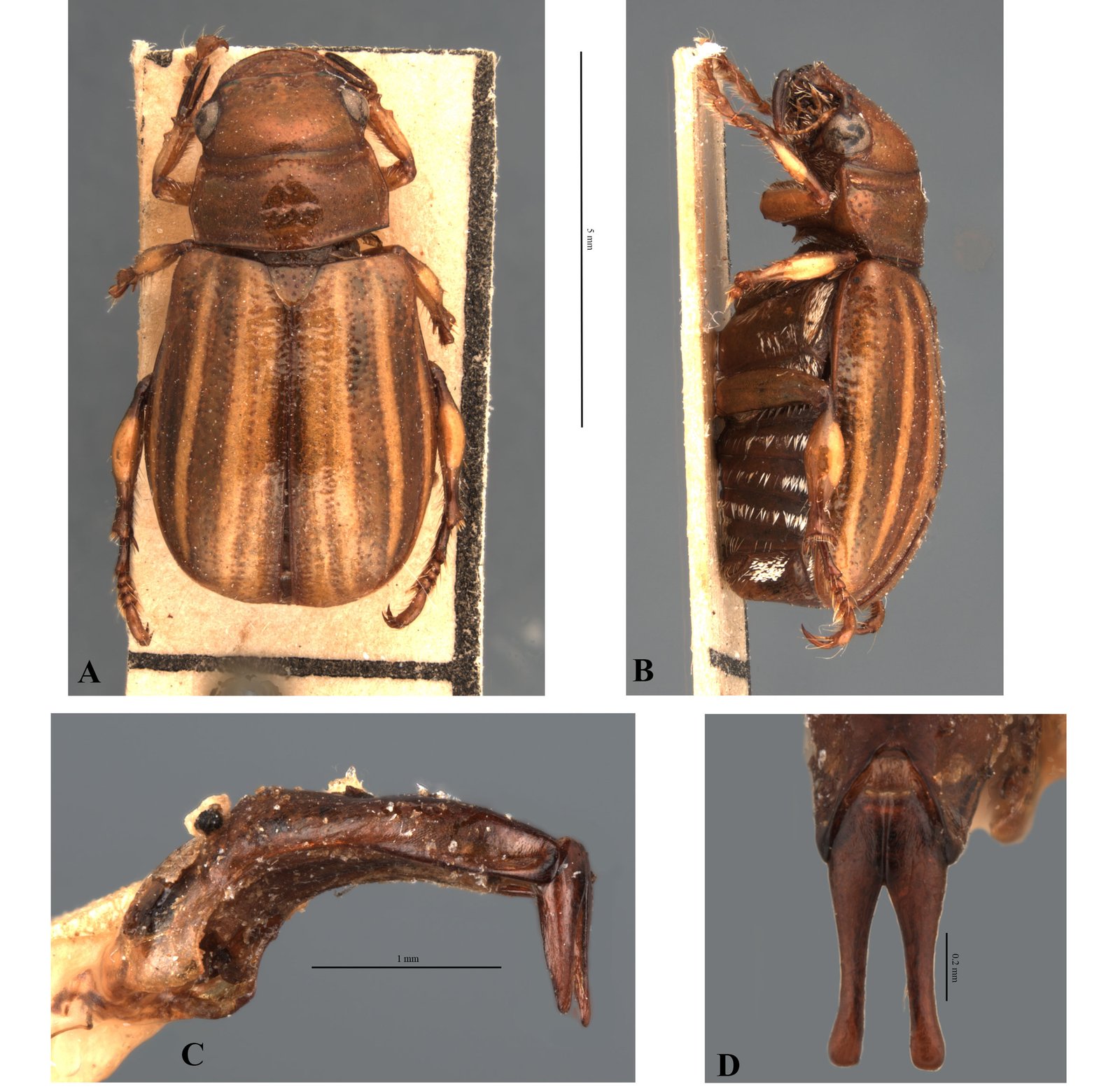
Bolax incogitata Dohrn, 1883 (Fig. 4)
Bolax incogitatus Dohrn, 1883: 427 (original description and spelling)
Diagnosis. Total length: 6.1-7.8 mm, elytral humeral width: 3.0-3.5 mm. Dorsally shiny, bicolored; head and pronotum light reddish brown, elytra alternating light reddish brown and yellowish brown color on interstriae; legs light reddish brown, but tibiae medially yellowish brown (Fig. 4A, B). Surface of clypeus, anterior portion of frons and elytra slightly subrugose with coarse, rounded punctures; also, with a transversal sulcus anteriorly in the pronotum covered by coarse, rounded punctures; otherwise punctures smaller and shallower (Fig. 4A). Clypeus with punctures densely and irregularly distributed, separated by around 1 time 1 puncture diameter; frons with punctures densely and irregularly distributed anteriorly, separated by less than 1 time 1 puncture diameter (Fig. 4A). Pronotum with punctures irregularly distributed, separated by 1-5 times 1 puncture diameter, except on the anterior sulcus with coarse punctures more densely distributed; pronotal posterior angles near right angled (Fig. 4A). Ventral surface sparsely setose with moderately long, thick white setae, but setae scarce on metaventrite and the middle of abdominal ventrites (Fig. 4B). Protibia with apical tooth on posterior margin oriented laterally, tooth subtriangular and with acute apex (Fig. 4A, B). Mesotibia and metatibia strongly constricted at subapex (Fig. 4A, B). Male protarsomere 2 almost as long as wide, subtriangular and shorter than the combined length of the protarsomeres 3-4 (Fig. 4A). Parameres long and thin, divergent between each other; each with outer margin sinuous, and the apex rounded and dilated (Fig. 4C, D).
Taxonomic summary
Material examined. Colombia. Amazonas: Leticia, 700 ft., 23-II-2-III-1974, H. & A. Howden (1♂ CMNC); same as preceding except for 19-25-II-1972, H. & A. Howden (1♂ CMNC).
Distribution. Colombia, Brazil, Peru (Soula, 2011). In general, it appears to be distributed throughout the Amazon basin, including Colombia at Amazonas department (Fig. 12).
Bolax magna Bates, 1888 (Fig. 5)
Bolax magnus Bates, 1888: 295 (original description and spelling)
Diagnosis. Total length: 15.3-18.9 mm, elytral humeral width: 6.3-8.2 mm. Dorsally shiny, bicolored, head and pronotum black, elytra yellowish castaneous; ventrally bicolored, abdomen dark yellowish castaneous, and legs and elsewhere black (Fig. 5A, B). Dorsal surface of elytra subrugose with slightly coarse, rounded punctures, otherwise punctures smaller and shallower (Fig. 5A). Clypeus with punctures very scattered, present almost exclusively on anterior surface, irregularly distributed, separated by 1-2 times 1 puncture diameter; frons with punctures sparsely and irregularly distributed, separated by 2-4 times 1 puncture diameter, punctures bigger laterally (Fig. 5A). Pronotum with punctures irregularly distributed, separated by 1-4 times 1 puncture diameter; pronotal posterior angles obtuse (Fig. 5A). Ventral surface sparsely setose, with very scarce and slender setae on metaventrite and abdominal ventrites (Fig. 5B). Protibia with apical tooth on posterior margin oriented apically, tooth subtriangular, apically downward curved and with acute apex (Fig. 5C). Mesotibia and metatibia strongly constricted at subapex (Fig. 5A, B). Male protarsomere 2 longer than wide, subrectangular and shorter than the combined length of the protarsomeres 3-4 (Fig. 5C). Parameres long rectangular, apex subrounded (Fig. 5D-F).
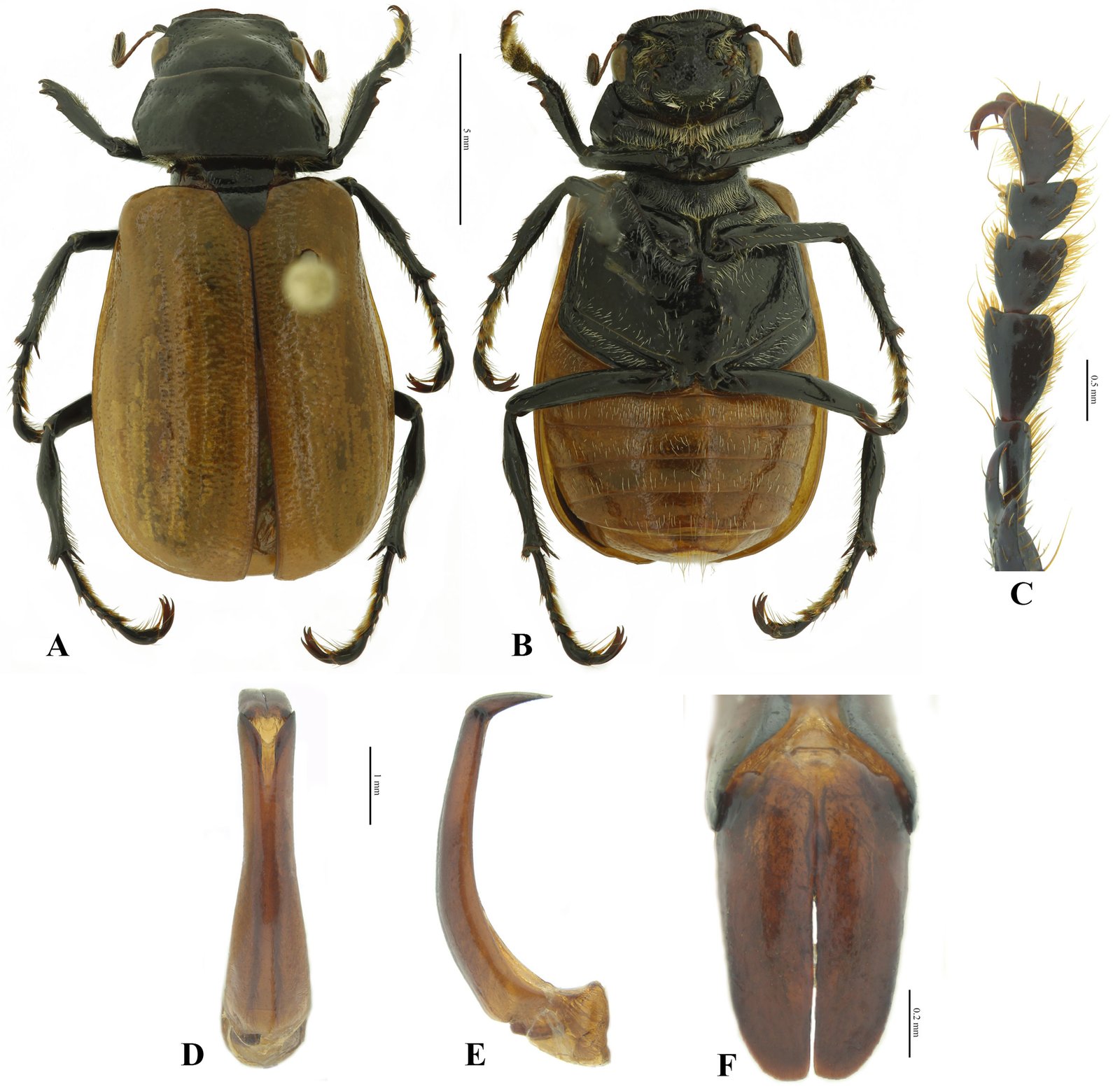
Taxonomic summary
Material examined. Colombia. Risaralda: Mistrató, Cgto. San Antonio del Chamí, Vda. Albania, 1,400 m, 05-IV-1992, F. Alvarado (3♀♀, 6♂♂ ICN-E-024987, 024989, 027706-10, 027713, 103689).
Distribution. Costa Rica, Panama (Barria et al., 2026), Colombia (new country record). In Colombia, it is distributed in the midlands of the Western Cordillera, over the Chocó biogeographic region (Fig. 12).
Bolax massai Soula, 2011
Bolax massai Soula, 2011: 61 (original description)
Taxonomic summary
Distribution. Colombia (Soula, 2011). It is known only from the type locality in the Amazonian Piedmont of Colombia, in the Putumayo department (Soula, 2011).
Bolax oberthuri Ohaus, 1903 (Fig. 6)
Bolax oberthuri Ohaus, 1903: 235 (original description)
Diagnosis. Total length: 13.2-13.9 mm, elytral humeral width: 5.2-5.5 mm. Dorsally shiny, bicolored; head and pronotum reddish brown, and elytra yellowish castaneous; ventrally reddish brown (Fig. 6A, B). Dorsal surface with moderately dense, moderately long, thick white setae: in the vertex laterally, posterior to the eyes, in the pronotum everywhere (Fig. 6A). Clypeus with punctures densely and irregularly distributed, separated by less than 1 time 1 puncture diameter, punctures smaller posterolaterally and smooth posteriorly in the middle; frons with punctures smaller than those of clypeus, densely and irregularly distributed, separated by 1-2 times 1 puncture diameter, sparser medially and smaller posteriorly in the middle (Fig. 6A). Pronotum with punctures irregularly distributed, separated by less than 1-2 times 1 puncture diameter; pronotal posterior angles obtuse (Fig. 6A). Ventral surface densely setose with moderately long, thick white setae (Fig. 6B). Protibia with apical tooth on posterior margin oriented apically, tooth long rectangular, apically downward curved and with truncate apex (Fig. 6C). Mesotibia slightly constricted at subapex; metatibia strongly constricted at subapex (Fig. 6A, B). Male protarsomere 2 longer than wide, subrectangular and almost as long as the combined length of the protarsomeres 3-4 (Fig. 6C). Parameres long rectangular, apex truncate; each with a sulcus on outer lateral surface and the ventral surface with a longitudinal line of long pale setae (Fig. 6D-F).
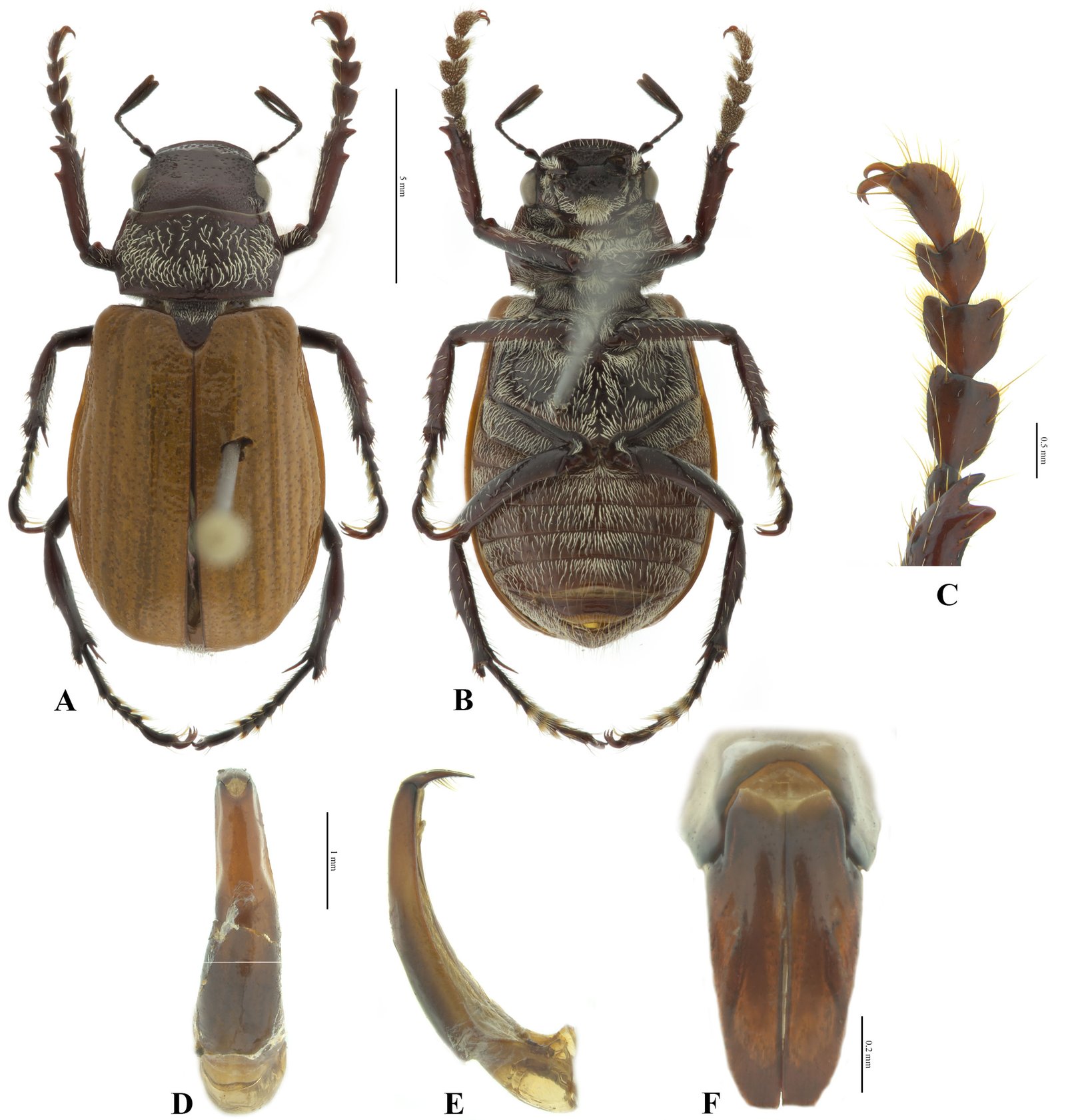
Taxonomic summary
Material examined. Colombia. Caquetá: Puerto Bello, Serranía de los Churumbelos, 20-VII-1998, J. Arias & B. Huertas (2♀♀, 1♂ MHN-UPN). Nariño: Territorio Kofan, Cap. Manual, 18-IX-1998, V. Rodríguez (1♂ IAvH-E-266891).
Distribution. Colombia, Ecuador (Soula, 2011). In Colombia, it is distributed across the Amazonian piedmont (Fig. 12).
Bolax opita Clavijo-Bustos & Barria sp. nov. (Figs. 7, 8)
http://zoobank.org/urn:lsid:zoobank.org:act:7E94730E-058C-45A6-9044-1A983F130961
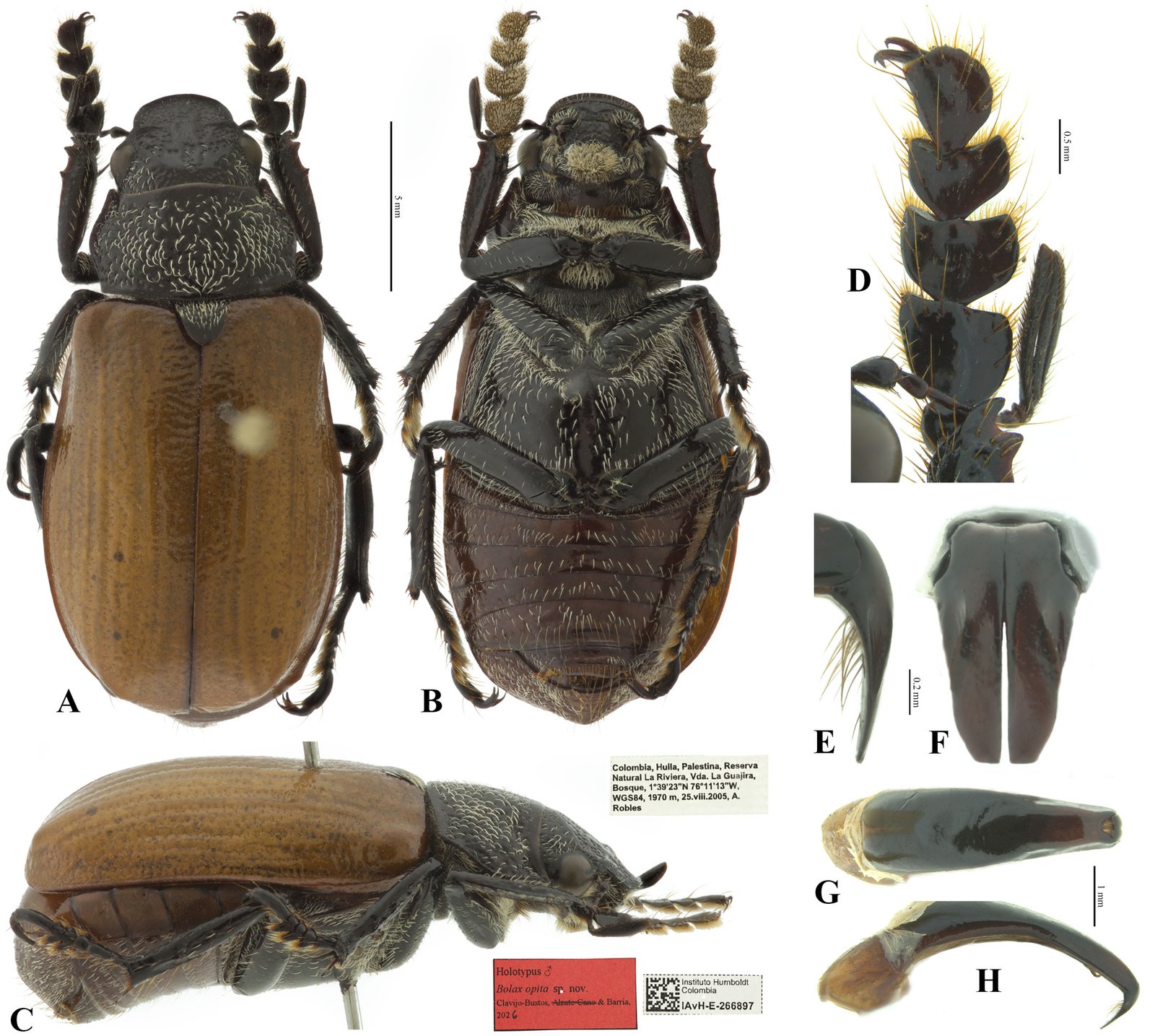
Description. Adult male, holotype (Fig. 7). Total length: 18.0 mm. Maximum width of pronotum: 6.1 mm, elytral humeral width: 6.9 mm. Color: dorsally shiny, bicolored; head and pronotum brownish black, and elytra yellowish castaneous; ventrally brownish black, except for the reddish brown abdomen. Head: clypeus subrounded, anterior margin upturned, covered by densely and irregularly distributed big, rounded punctures separated by less than 1 time 1 puncture diameter, punctures smaller postero-laterally. Frontoclypeal suture laterally tumescent. Frons covered by densely and irregularly distributed big, rounded punctures separated by less than 1 time 1 puncture diameter, punctures smaller posteriorly in the middle, and few punctures posteriorly bearing a long, thick white seta; surface smooth anteriorly in the middle; interocular distance about 5.5 times the dorsal width of the eye. Ocular canthus short and slender. Antenna with 10 antennomeres, antennomeres 8-10 (antennal club) as long as the combined length of antennomeres 2-7. Vertex covered by densely and irregularly distributed small, rounded punctures separated by 1-2 times 1 puncture diameter; punctures laterally bearing moderately long, thick white setae. Mouthparts densely covered by setigerous punctures, each bearing a thick, long, white seta, especially the labium medially; seta absent on the submentum and the anterior part of the labium. Pronotum: transverse, slightly wider near the middle; anterior angles acute, posterior angles almost right angled and slightly flattened. Surface similar to frons, with irregularly distributed big, rounded punctures separated by 1-2 times 1 puncture diameter, punctures closer and bigger posterolaterally, each bearing a moderately long, thick white setae. Lateral margins with a very thin bead. Hypomeron with the surface smooth and glabrous medially, anterior portion sparsely covered by setigerous punctures, posterior portion densely covered by setigerous punctures, each bearing a long, thick, white setae. Scutellar shield: longer than wide; surface with punctures and setae as pronotum but only in anterior half. Elytra: wider posteriorly; surface covered with shallow, small, rounded punctures separated by 2-4 times 1 puncture diameter, each bearing a minute pale seta; elytral striae finely marked, interstriae convex; elytral humeral and apical calluses poorly tumescent, round and slightly less and shallower punctate than elsewhere. Prosternum: surface densely covered by setigerous punctures bearing a thick white seta. Mesoventrite: surface densely covered by setigerous punctures, each bearing a very short white seta, setae shorter than those from prosternum. Metaventrite: surface covered by irregularly and sparsely distributed small, rounded punctures separated by 2-5 times 1 puncture diameter, each bearing a moderately long, thick white seta; punctures sparser around the central area of the disc, middle glabrous. Legs: profemur ventrally smooth, with few scattered thick white setae. Protibia with 3 teeth located in the apical third of the posterior margin, apical tooth oriented apically, tooth rectangular, apically downward curved and with truncate apex; apex with a spur slightly longer than the protarsomere 1; dorsal and ventral surfaces with few and sparse pale rufous setae. Protarsus dorsally with few pale rufous setae and ventrally densely covered by white setae; protarsomere 1 subcylindrical and slightly shorter than protarsomere 2, protarsomeres 2-5 dorsoventrally flattened, protarsomere 2 almost as long as wide, subquadrangular and shorter than the combined length of the protarsomeres 3-4, protarsomere 3 shorter than protarsomere 2 and longer than protarsomere 4, protarsomere 5 longer than protarsomere 4; protarsal claws shorter than protarsomere 5, anterior claw apically bifid, dorsal part shorter than ventral, posterior claw simple and shorter than anterior claw. Mesofemur and metafemur longer and slender than profemur; mesofemur with ventral surface slightly densely setose than profemur; metafemur with ventral surface similarly setose as profemur. Mesotibia shorter than metatibia, both not constricted at subapex; in both mesotibia and metatibia, ventral spur 1/3 shorter than dorsal spur. Mesotarsus and metatarsus cylindrical, ventrally densely covered by white setae. Mesotarsomere 1 subequal to the combined length of the mesotarsomeres 2-3, mesotarsomeres 2-4 subequal in length, mesotarsomere 5 subequal to the combined length of mesotarsomeres 2-4; mesotarsal claws subequal in length to the protarsomere 5, posterior mesotarsal claw simple and slightly shorter than anterior mesotarsal claw, which is apically bifid. Metatarsomere 1 longer than the combined length of metatarsomeres 2-4, metatarsomeres 2-4 nearly subequal in length, metatarsomere 5 subequal to the combined length of metatarsomeres 2-4; metatarsal claws longer than metatarsomere 5, posterior metatarsal claw simple and slightly shorter than anterior metatarsal claw, which is bifid. Abdomen: abdominal ventrites with an irregular line from side to side of setigerous punctures, each bearing a moderately long, white seta, on lateral sides densely setose; ventrite 5 with a posterior line from side to side of setigerous puncture bearing long, rufous setae; ventrite 6 shorter than ventrite 5 and anterior margin truncate. Pygidium convex, rounded in lateral view; surface strigulose, covered by small, rounded punctures bearing short, thick white setae, setae oriented to the middle area; apically with few punctures bearing a long, rufous setae. Genitalia: parameres long rectangular, apex truncate; each with a sulcus on outer lateral surface and the ventral surface with a longitudinal line of long pale setae; extremely shorter than the phallobase (1/6) (Fig. 7E-H).
Female. One female allotype (Fig. 8) and 2 female paratypes. Total length: 18.6-20.1 mm, Maximum width of pronotum: 6.9-7.0 mm, elytral humeral width: 7.6-7.9 mm. As male holotype except for: slightly bigger and robust; punctures on clypeus slightly smaller and sparser; antennal club smaller, antennomeres 8-10 (antennal club) shorter than the combined length of antennomeres 2-7; abdominal ventrite 6 subequal in length to ventrite 5 and anterior margin widely rounded; teeth on protibial posterior margin slightly thicker; protarsomeres 2-4 dorsoventrally flattened but not as strongly as in male; protarsal claws bigger, anterior claw strongly bifid, dorsal part longer than ventral. Genitalia: gonocoxites divided, proximal portion long quadrangular; distal portion oval and densely setose on ventral surface (Fig. 8E).
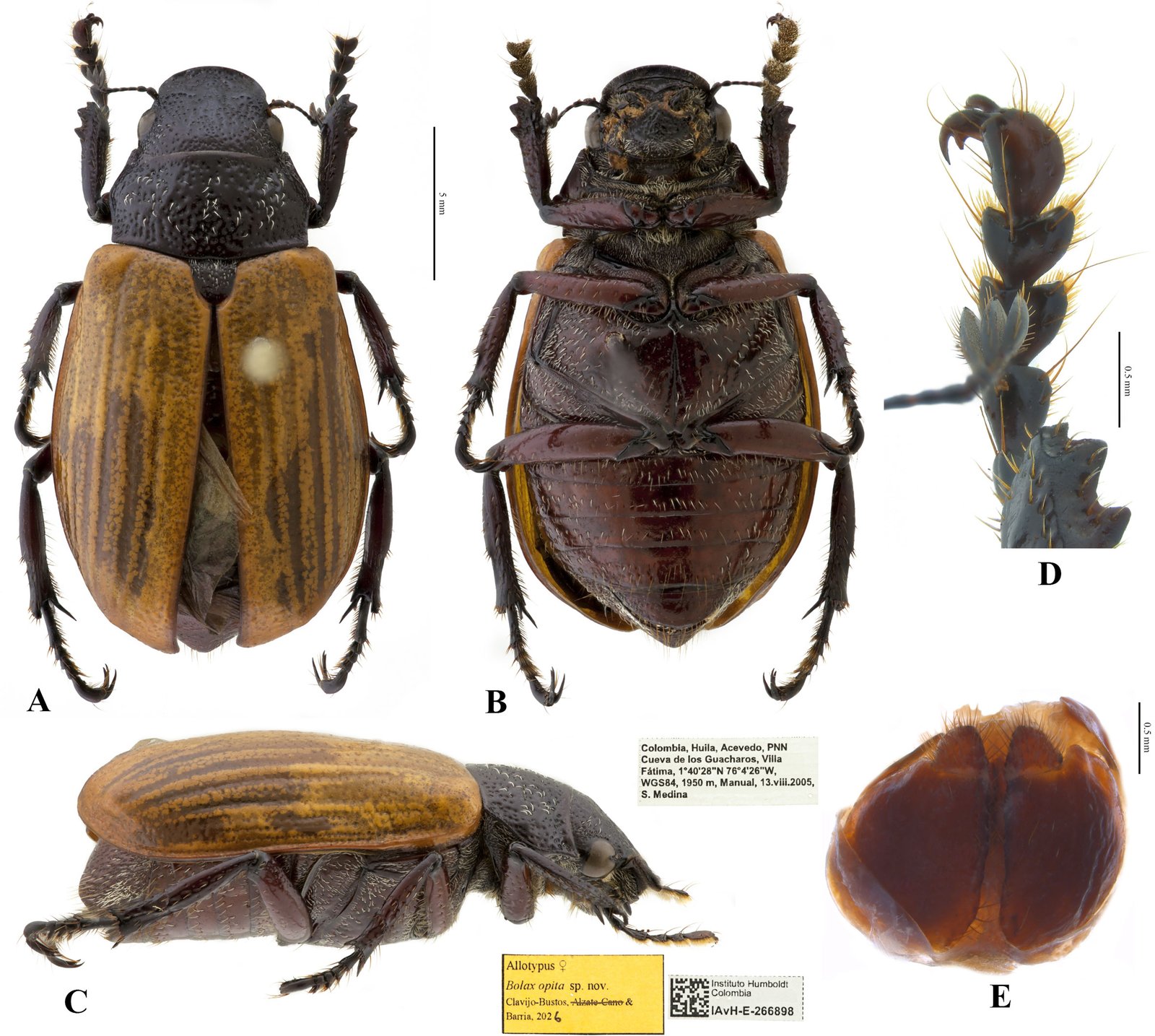
Diagnosis. Total length: 18-20.1 mm, elytral humeral width: 6.9-7.9 mm. Dorsally shiny, bicolored; head and pronotum brownish black, and elytra yellowish castaneous; ventrally brownish black, except for the reddish brown abdomen (Figs. 7A-C, 8A-C). Dorsal surface with moderately dense, moderately long, thick white setae: in frons scattered posteriorly, in the vertex laterally, posterior to the eyes, in the pronotum everywhere, and in the scutellar shield anteriorly (Figs. 7A, C, 8A, C). Clypeus with punctures densely and irregularly distributed, separated by less than 1 time 1 puncture diameter; frons with punctures densely and irregularly distributed, separated by less than 1 time 1 puncture diameter, smooth anteriorly in the middle, and smaller posteriorly in the middle (Figs. 7A, C, 8A, C). Pronotum with punctures irregularly distributed, separated by less than 1-2 times 1 puncture diameter; pronotal posterior angles almost right angled (Figs. 7A, C, 8A, C). Ventral surface sparsely setose with moderately long, thick white setae, setae scattered medially on the metaventrite and on abdominal ventrites (Figs. 7B, 8B). Protibia with apical tooth on posterior margin oriented apically, tooth rectangular, apically downward curved and with truncate apex (Figs. 7D, 8D). Mesotibia and metatibia not constricted at subapex (Figs. 7A-C, 8A-C). Male protarsomere 2 almost as long as wide, subquadrangular and shorter than the combined length of the protarsomeres 3-4 (Fig. 7D). Parameres long rectangular, apex truncate; each with a sulcus on outer lateral surface and the ventral surface with a longitudinal line of long pale setae (Fig. 7E-H).
Taxonomic summary
Type specimens examined. Holotype male (IAvH-E): “Colombia, Huila, Palestina, Reserva | Natural La Riviera, Vda. La Guajira, | Bosque, 1°39’23” N, 76°11’13” W, | WGS84, 1,970 m, 25.viii.2005, A. | Robles” [white label, printed] // “Holotypus ♂ | Bolax opita sp. nov. | Clavijo-Bustos, Alzate-Cano & | Barria, 2026” [red label, printed] // “IAvH-E-266897” [white printed label with QR code]. Paratype female labeled as allotype (IAvH-E): “Colombia, Huila, Acevedo, PNN | Cueva de los Guacharos, Villa | Fátima, 1°40’28” N, 76°4’26” W, | WGS84, 1,950 m, Manual, 13.viii.2005, | S. Medina” [white label, printed] // “Allotypus ♀ | Bolax opita sp. nov. | Clavijo-Bustos, Alzate-Cano & | Barria, 2026” [yellow label, printed] // “IAvH-E-266898” [white label with QR code, printed]. Paratype female (IAvH-E): “Colombia, Huila, PNN Cueva de Los | Guácharos, Cabaña Cedros, 01° | 37’ N, 76°6’ W, 2,100 m, Malaise, 2004-11-22/2004-12-06, R. Paramero” [white label, printed] // “Paratypus ♀ | Bolax opita sp. nov. | Clavijo-Bustos, Alzate-Cano & | Barria, 2026” [yellow label, printed] // “IAvH-E-271719” [white label with QR code, printed]. Paratype female (IAvH-E): “COL. Huila. San Agustín | Vereda La Argentina | 17-xiii-2012 | Karen Salazar – col” [white label, printed] // “HJG – 1013” [white label, printed] // “Paratypus ♀ | Bolax opita sp. nov. | Clavijo-Bustos, Alzate-Cano & | Barria, 2026” [yellow label, printed].
Etymology. The specific name “opita” is the demonym given to the people from the Huila Department, where the only 4 specimens known were collected. The epithet is a noun in apposition.
Distribution. Bolax opita sp. nov. is known from 4 specimens collected in Andean localities in the department of Huila (Fig. 12).
Records from iNaturalist. Colombia, Huila, San Agustín, 1.78756 -76.33026, observed on 2024-11-12 by @clementaubert (https://www.inaturalist.org/observations/251556089).
Remarks
Bolax opita sp. nov. is most similar to B. oberthuri because its overall appearance, mainly due to its dorsal body bicolored with head and pronotum of different coloration than elytra, and the density and distribution of the moderately long, thick white setae in the pronotum (Figs. 6A, B, 7A-C). Also, the shape of parameres is very similar, both being almost identical (Fig. 6F vs. Fig. 7H).
However, and in spite of the strong similarity of parameres, Bolax opita sp. nov. can be easily distinguished from B. oberthuri by the following characters (Fig. 7): body relatively more robust; punctures on head and pronotum slightly coarser; ventral surface sparsely setose; tarsus relatively shorter; male protarsus more strongly dorsoventrally flattened, relatively wider; male protarsomere 2 almost as long as wide, subquadrangular and shorter than the combined length of the protarsomeres 3-4.
Bolax palliata Burmeister, 1844 (Fig. 9)
Bolax palliatus Burmeister, 1844: 491 (original description and spelling)
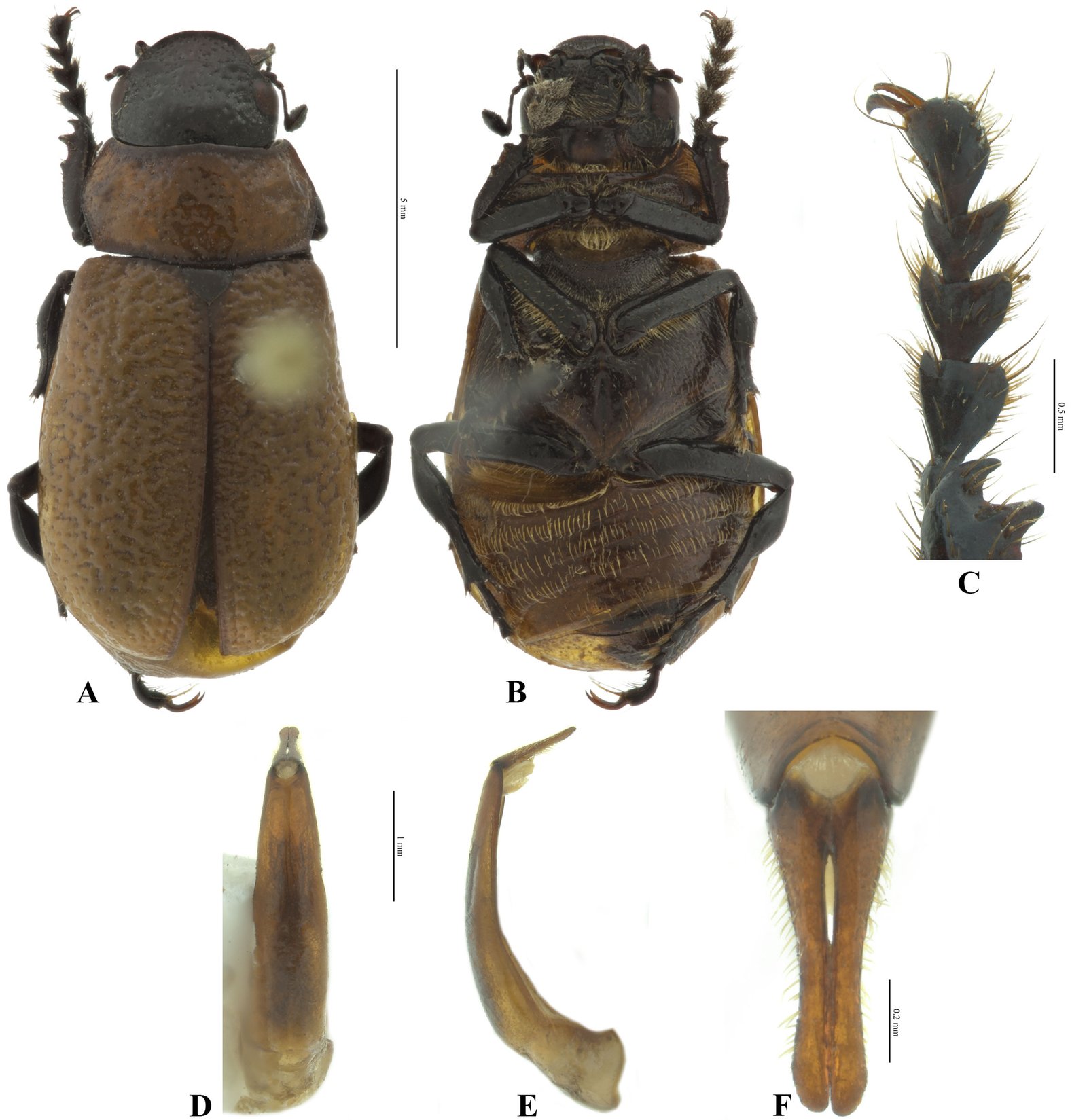
Diagnosis. Total length: 10.4-11.0 mm, elytral humeral width: 4.5-5.1 mm. Dorsally shiny, uni- or bicolored; sometimes head, pronotum and elytra black; sometimes head and elytra black, and pronotum reddish brown; sometimes head black, and pronotum and elytra reddish brown; ventrally bicolored, abdomen dark reddish brown, legs and elsewhere black (Fig. 9A, B). Dorsal surface rugose with deep coarse punctures (Fig. 9A). Clypeus with punctures densely and irregularly distributed, separated by 1 to 2 times 1 puncture diameter; frons with punctures densely and irregularly distributed, separated by 1-2 times 1 puncture diameter (Fig. 9A). Pronotum with punctures irregularly distributed, separated by 1-3 times 1 puncture diameter; pronotal posterior angles obtuse (Fig. 9A). Ventral surface scarcely setose, setae shorter on metaventrite, longer and denser on abdominal ventrites (Fig. 9B). Protibia with apical tooth on posterior margin oriented laterally, tooth subtriangular and with acute apex (Fig. 9C). Mesotibia and metatibia strongly constricted at subapex (Fig. 9A, B). Male protarsomere 2 almost as long as wide, subtriangular and shorter than the combined length of the protarsomeres 3-4 (Fig. 9C). Parameres long and thin, outer margin sinuous and densely covered by short pale setae, apex subrounded and dilated (Fig. 9D-F).
Taxonomic summary
Material examined. Colombia. Norte de Santander: Cucutilla, Vda. Carrizal, Sector Sisavita, Qda. Poveda, Bosque de Quercus humboldtii, 07°28’ N, 72°49’ W, 2,040-2,200 m, Cap. Manual, 26-28-III-2002, E. González, A. Pulido, A. Santamaria (1♂ IAvH-E-266893); Pamplonita, Villa Marina, 07°31’ N, 72°37’ W, Cap. Manual, 15-IV-2015, S. Delgado, D. Basto (1♂ IAvH-E-266892).
Distribution. Venezuela, Colombia (Soula, 2011). In Colombia, it is distributed in Andean localities across the Eastern Cordillera (Fig. 12).
Bolax variolosa Ohaus, 1917 (Fig. 10)
Bolax variolosus Ohaus, 1917: 4 (original description and spelling)
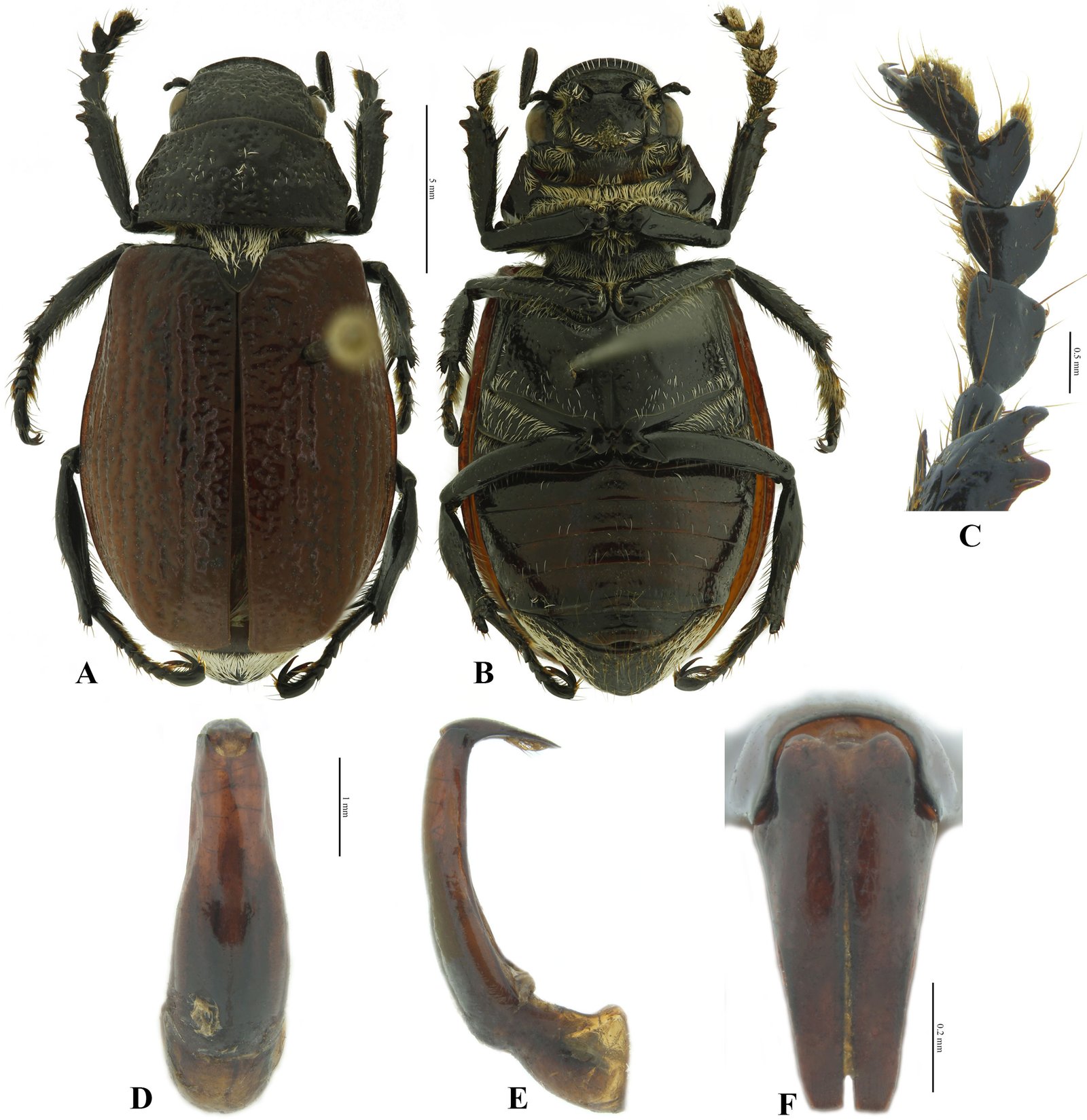
Diagnosis. Total length: 17.4-22.1 mm; elytral humeral width: 7.5-9.9 mm. Dorsally shiny, bicolored, head and pronotum black, elytra reddish brown; ventrally bicolored, abdomen reddish dark brown, and legs and elsewhere black (Fig. 10A, B). Dorsal surface rugose, covered with deep coarse punctures; some few punctures of the pronotum bearing a thick, long seta (Fig. 10A). Clypeus with punctures densely and irregularly distributed, separated by less than 1 puncture diameter; frons with punctures slightly smaller than those of clypeus, irregularly distributed, separated by 1-3 times 1 puncture diameter, punctures bigger laterally (Fig. 10A). Pronotum with punctures irregularly distributed, separated by 1-3 times 1 puncture diameter, punctures bigger laterally; pronotal posterior angles right angled (Fig. 10A). Ventral surface scarcely setose, but very scarce setae on metaventrite medially and anteriorly, and on abdominal ventrites (Fig. 10B). Protibia with apical tooth on posterior margin oriented apically, tooth rectangular, apically downward curved with subrounded apex (Fig. 10C). Mesotibia and metatibia slightly constricted at subapex (Fig. 10A, B). Male protarsomere 2 longer than wide, subrectangular and almost as long as the combined length of the protarsomeres 3-4 (Fig. 10C). Parameres long, narrowly rectangular, apex truncate (Fig. 10D-F).
Taxonomic summary
Material examined. Colombia. Antioquia: Caldas Primavera, Alto San Miguel, 1,840 m, en suelo, 24-IX-2009, J. Toro (1♀ MEFLG); Envigado, El Salado, Microcuenca Ayura, Vegetación en Bosque, Cap. Manual, 22-X-2007, J. Cardona-D. (1Unsex. CEUA 42636). Envigado, Loma del Escobero, Rastrojo, Jama, 23-IX-2011, J.D. Castaño (1♂ CEUA 68317); Sabaneta, Finca La Romera, 2,000 m, Bosque, Cap. Manual, 25-IX-2001, J. Cardona (1Unsex. CEUA 23255). Boyacá: Puerto Boyacá, 05°58’00” N, 74°36’30” W, 400 m, X-2001, A. Ramírez, A. Romero (1♀ IAvH-E-266894). Caldas: Samaná, Florencia, Vda. San Lucas, 05°31’05” N, 75°03’23” W, 1,834 m, Cap. Manual-Tronco descompuesto, 24-II-2020, I.C. Ríos-Malaver (1♂ IAvH-E-266895); Samaná, PNN selva de Florencia, Florencia, volcán El Escondido, camino a Vda. San Lucas, bosque subandino, 05°31’03.4” N, 75°03’17.0” W, 1,730 m, Cap. Manual-alimentándose en hongos sobre tronco podrido, 24-II-2020, I.C. Ríos-Malaver (1♀ IAvH-E-266896).
Distribution. Panama, Colombia (Barria et al., 2026; Soula, 2011). In Colombia, it is distributed in localities along the Cauca and Magdalena valleys (Fig. 12).
Records from iNaturalist. Colombia, Antioquia, Envigado, 6.125614 -75.582588, observed on 2024-01-10 by @luisalbertohernandezguanipa (https://www.inaturalist.org/observations/198526100). Colombia, Antioquia, Medellín, 6.264656 -75.596293, observed on 2024-01 by @juancarlosmejia (https://www.inaturalist.org/observations/206886954). Colombia, Antioquia, Sonsón, Morelia, 5.805848 -75.306855, observed on 2024-02-19 by @nuevo_turismo (https://www.inaturalist.org/observations/202294955). Colombia, Caldas, Samaná, 5.5176 -75.054712, observed on 2020-02-24 by @indianacristo (https://www.inaturalist.org/observations/68347452, same specimen deposited in IAvH-E). Colombia, Antioquia, Envigado, 6.11830 -75.58289, observed on 2025-08-15 by @dajafer (https://www.inaturalist.org/observations/307851993).
Bolax verdita Clavijo-Bustos, Alzate-Cano & Barria sp. nov. (Fig. 11)
http://zoobank.org/urn:lsid:zoobank.org:act:F5769858-40EF-493E-8FC3-FE5043D50FFD
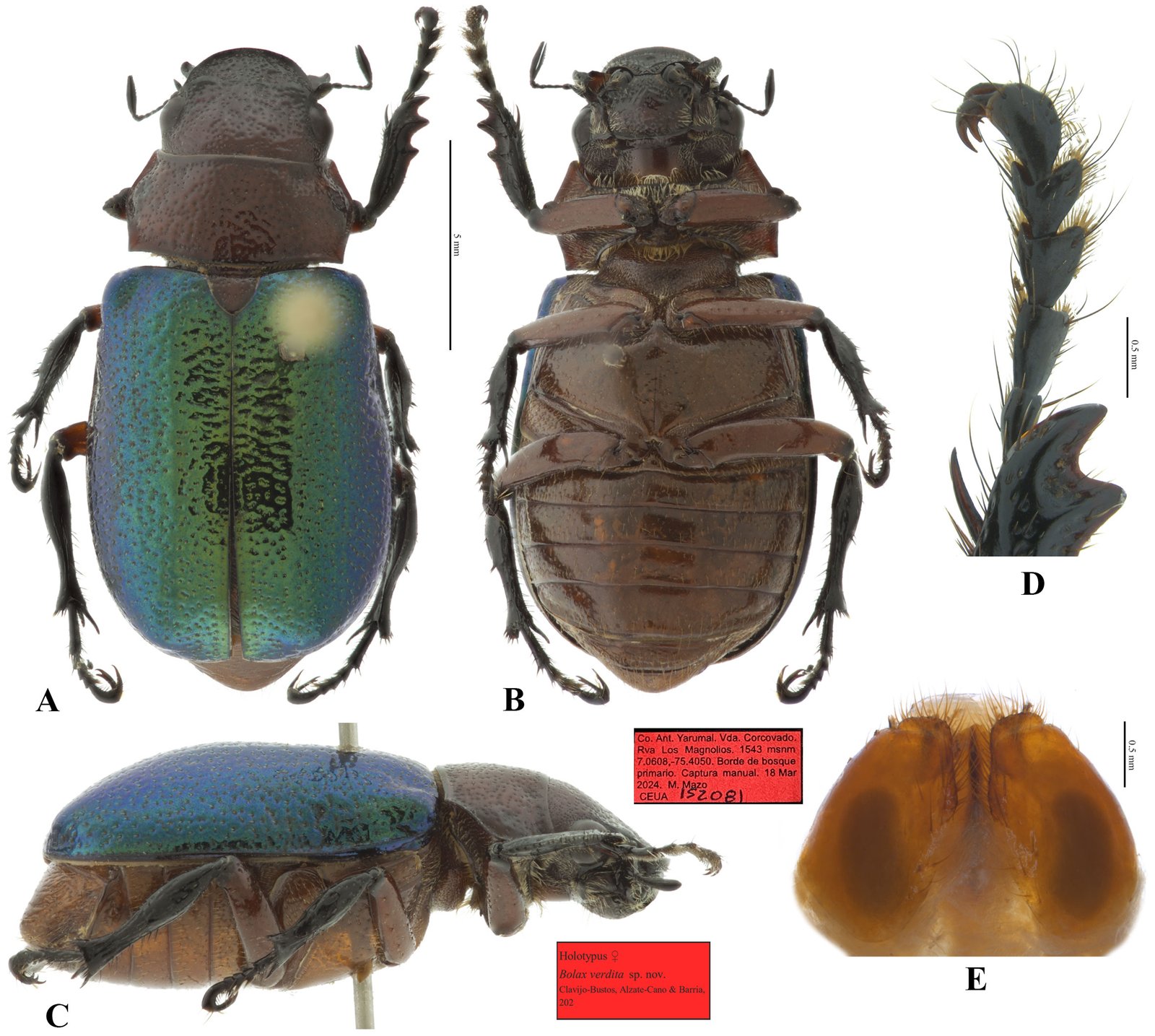
Description. Adult female, holotype (Fig. 10). Total length: 14.9 mm, maximum width of pronotum: 5.7 mm, elytral humeral width: 6.4 mm. Coloration: dorsally shiny, tricolored; clypeus black, frons, pronotum and scutellar shield dark reddish brown, elytra bright metallic green aquamarine; ventrally reddish brown, legs bicolored, femora reddish brown but apex black, tibiae and tarsi also black. Head: clypeus subrounded, anterior margin upturned, covered by densely and irregularly distributed big, rounded punctures separated by less than 1 or around 1 times 1 puncture diameter, punctures smaller posteriorly in the middle. Frontoclypeal suture laterally tumescent. Frons with punctures smaller than those of clypeus, densely and irregularly distributed rounded punctures separated by 1-3 times 1 puncture diameter, each puncture bearing a short, slender pale seta; punctures smaller posteriorly in the middle; interocular distance about 5.8 times the dorsal width of the eye. Ocular canthus short and slender. Antenna with 10 antennomeres, antennomeres 8-10 (antennal club) slightly shorter than the combined length of antennomeres 2-7. Vertex covered by densely and irregularly distributed small, rounded punctures separated by 1-2 times 1 puncture diameter. Mouthparts glabrous, only labium medially laterally and maxillae with few pale setae. Pronotum: transverse, slightly wider near the middle; anterior angles acute, posterior angles right angled and slightly flattened. Surface similar to frons, subrugose, with irregularly distributed small, rounded punctures separated by 1-3 times 1 puncture diameter, punctures closer and bigger posterolaterally, each bearing a short, slender pale setae. Lateral margins with a very thin bead. Hypomeron with the surface smooth and glabrous medially, anterior portion sparsely covered by scattered setigerous punctures, each bearing a long, pale setae. Scutellar shield: longer than wide; surface with punctures and setae as pronotum. Elytra: wider posteriorly; surface subrugose, covered with small, rounded punctures separated by 2-4 times 1 puncture diameter, each bearing a short, slender pale seta; elytral humeral and apical calluses poorly tumescent, round and slightly less and shallower punctate than elsewhere. Prosternum: surface densely covered by setigerous punctures bearing a long, pale seta. Mesoventrite: surface densely covered by setigerous punctures, each bearing a short pale seta, setae shorter than those from prosternum. Metaventrite: surface covered by irregularly distributed small, rounded punctures separated by 1-3 times 1 puncture diameter, each bearing a short, slender pale seta; punctures sparser around the central area of the disc. Legs: profemur ventrally smooth, with few scattered short, pale setae. Protibia with 3 teeth located in the apical third of the posterior margin, apical tooth oriented laterally, tooth subtriangular and with acute apex; apex with a spur slightly longer than the protarsomere 1; dorsal and ventral surfaces with few and sparse pale setae. Protarsus dorsally with few pale setae and ventrally densely covered by white setae; protarsomere 1 subcylindrical and slightly longer than protarsomere 2, protarsomeres 2-5 slightly dorsoventrally flattened and subtriangular, protarsomere 2 slightly shorter than the combined length of the protarsomeres 3-4, protarsomere 3 shorter than protarsomere 2 and longer than protarsomere 4, protarsomere 5 longer than protarsomere 4; protarsal claws subequal in length to protarsomere 5, anterior claw strongly bifid, dorsal part longer than ventral, posterior claw simple and shorter than anterior claw. Mesofemur and metafemur longer and slender than profemur; ventral surface of both similarly setose as profemur. Mesotibia shorter than metatibia, both strongly constricted at subapex; in both mesotibia and metatibia, ventral spur one-third shorter than dorsal spur. Mesotarsus and metatarsus cylindrical, ventrally covered by pale setae. Mesotarsomere 1 subequal to the combined length of the mesotarsomeres 3-4, mesotarsomeres 2-4 subequal in length, mesotarsomere 5 slightly longer than the combined length of mesotarsomeres 2-4; mesotarsal claws subequal in length to the protarsomere 5, posterior mesotarsal claw simple and slightly shorter than anterior mesotarsal claw, which is apically bifid. Metatarsomere 1 longer than the combined length of metatarsomeres 2-4, metatarsomeres 2-4 nearly subequal in length, metatarsomere 5 subequal to the combined length of metatarsomeres 2-4; metatarsal claws longer than metatarsomere 5, posterior metatarsal claw simple and slightly shorter than anterior metatarsal claw, which is bifid. Abdomen: abdominal ventrites sparsely setose, especially on lateral sides and on the ventrites 2-3, setae moderately long, pale rufous; ventrite 5 with a posterior line from side to side of setigerous puncture bearing long, pale rufous setae; ventrite 6 shorter than ventrite 5 and anterior margin subrounded. Pygidium convex, rounded in lateral view; surface strigulose, apical portion relatively densely with some long, pale rufous setae. Genitalia: gonocoxites divided, each portion long rectangular; distal portion densely setose on anterior and lateral internal margins (Fig. 11E).
Male. Unknown.
Diagnosis. Total length: 14.9 mm; elytral humeral width: 6.4 mm. Dorsally shiny, tricolored; clypeus black, frons, pronotum and scutellar shield dark reddish brown, elytra bright metallic green aquamarine; ventrally reddish brown, legs bicolored, femora reddish brown but apex black, tibiae and tarsi also black (Fig. 11A-C). Dorsal elytral surface subrugose, covered with deep coarse punctures, each bearing a short seta (Fig. 11A, C). Clypeus with punctures densely and irregularly distributed, separated by less than 1-1 times 1 puncture diameter; frons with punctures slightly smaller than those of clypeus, irregularly distributed, separated by 1-3 times 1 puncture diameter, punctures smaller posteriorly (Fig. 11A, C). Pronotum with punctures irregularly distributed, separated by 1-3 times 1 puncture diameter, punctures bigger laterally; pronotal posterior angles right angled (Fig. 11A, C). Ventral surface scarcely setose, only few short setae laterally on metaventrite and on abdominal ventrites (Fig. 11B). Protibia with apical tooth on posterior margin oriented laterally, tooth subtriangular and with acute apex (Fig. 11D). Mesotibia and metatibia strongly constricted at subapex (Fig. 11A, C).
Taxonomic summary
Type specimens examined. Holotype female (CEUA): “Co. Ant. Yarumal. Vda. Corcovado. | Rva Los Magnolios. 1,543 msnm | 7.0608-75.4050 [7°3’38.88” N, 75°24’18” W]. Borde de bosque | primario. Captura manual. | 18 Mar 2024. M. Mazo | CEUA 152081” [white label, printed] // “Holotypus ♀ | Bolax verdita sp. nov. | Clavijo-Bustos, Alzate-Cano & | Barria, 2026” [red label, printed].
Etymology. The specific name “verdita” is given because of the bright metallic green aquamarine coloration of the elytra, the reddish brown color of the pronotum and the black color of the clypeus, which resemble the appearance of the metamorphic rock of the same name. Also, the name is given in opposition to the species recently described from Panama, B. azurita, the most similar species. The epithet is a noun in apposition.
Distribution. Bolax verdita sp. nov. is known from a single specimen collected in an Andean locality from the northern part of the Central cordillera, in the department of Antioquia; however, there are also a couple of records in the platform iNaturalist, from the department of Risaralda, over the Western cordillera (Fig. 12).
Records from iNaturalist. Colombia, Antioquia, Yarumal, El Reposo, 7.054221 -75.401626, observed on 2023-05-22 by @carlosmauriciomazo (https://www.inaturalist.org/observations/165845473). Colombia, Chocó, El Carmen de Atrato, 5.85298 -76.17969, observed on 2025-05-10 by @fundacion_proaves (https://www.inaturalist.org/observations/280098569). Colombia, Risaralda, Pueblo Rico, 5.233317 -76.084661, observed on 2022-05-24 by @zacpeterson (https://www.inaturalist.org/observations/127629808). Colombia, Risaralda, Pueblo Rico, 5.244175 -76.095347, observed on 2022-05-24 by @zacpeterson (https://www.inaturalist.org/observations/128097307).
Remarks
Bolax verdita sp. nov. is most similar to B. azurita, being 2 species with a singular appearance among the species of the genus due to its dorsal body tricolored with head, pronotum and elytra different coloured; the metallic color of elytra; legs bicolored; coarse punctuation giving a subrugose to rugose aspect on the pronotum and especially on the elytra; each dorsal puncture bearing a slender pale seta, and the ventral surface also setose; and the mesotibia and metatibia strongly constricted at subapex. A detailed discussion and relation of these 2 species with other species of the genus can be found in the Remarks section for B. azurita in Barria et al. (2026).
Bolax verdita sp. nov. can be distinguished from B. azurita by the following characters (B. azurita in brackets): head bicolored with only the clypeus black (head completely black); elytra bright metallic green aquamarine (elytra dark metallic blue); surface of elytra subrugose (elytra rugose); each dorsal puncture bearing a short, slender pale seta (bearing a relatively long, slender pale rufous seta); and seta on ventral surface scattered and sparsely distributed (ventral surface densely setose). Although differences can not be confirmed on a male specimen, these do not correspond to sexual dimorphism as checked on B. azurita. Also, observed specimens of B. verdita sp. nov. from iNaturalist platform are from different latitudes and elevations, which allows us to discharge any kind of geographical or clinal variation, and consider Colombian records as a new species.
Discussion
The genus Bolax in Colombia is mainly distributed throughout the Andes, particularly in the piedmonts of the Amazonian, Orinoquian, and Pacific regions, as well as in inter-Andean valleys. Only a few species have been recorded in the lowlands of the Amazonia and Orinoquia. Future collecting efforts across the country are needed to fully understand the genus. Nevertheless, records from citizen science platforms such as iNaturalist, can improve our understanding of species distribution (Fig. 12) and their biology, including habitat preferences, behavioral ecology, and activity patterns. Data from these platforms, however, should be used with caution, as photo-based identifications are often challenging and may provide only limited taxonomic support (López-Guillén et al., 2024; Mesaglio & Callaghan, 2021; Seltzer, 2019). When diagnostic morphological characters are clearly visible, photographs may provide sufficient evidence to support species-level identifications (Minteer et al., 2014), especially when these are consistent with the known geographic distribution of the species.
Previous studies reported 8 species of Bolax from Colombia; here we increase this number to 11 through the description of 2 new species and the first Colombian records of 2 additional species, while also proposing a synonymy between 2 species previously reported from Colombia. Furthermore, we propose another synonymy involving 2 species formerly known only from Venezuela, which is now also recorded in Colombia. Of the 11 species known from Colombia, 4 are endemic, 2 of which are described as new: B. incogitata, B. massai, B. opita sp. nov., and B. verdita sp. nov.
This study highlights the importance of continuing research on other genera of Geniatini in Colombia, particularly through the examination of national entomological collections. The results further reveal that more than 30% of Bolax species in the country are endemic; 2 of the 11 species represent new country records, and 2 are described as new species. With these findings, Bolax becomes the second most diverse genus of the tribe in Colombia, surpassed only by Leucothyreus Macleay, 1819 (Jameson & Hawkins, 2005).
Acknowledgements
The authors thank the curators and staff from the institutions visited: I. Morales (UPTC-E), M. Wolff (CEUA), J.P. Botero (ICN-E), G. Fagua (MPUJ-ENT), J.C. Neita Moreno (IAvH-E), M.Y. García and A. Ávila (MHN-UPN), C. Germann and L. Albrecht (NMB), and J-M. Gagnon, A.B.T. Smith, R. Anderson and F. Génier (CMNC). Special thanks to L. Albrecht (NMB) and F. Génier (CMNC) for providing the photos of type specimens of Bolax caurana and Bolax howdeni, respectively. Additionally, the authors thank Carlos Mauricio Mazo for collecting the type specimen of Bolax verdita sp. nov. JCB thanks the Colecciones biológicas, Centro de colecciones y gestión de especies, Instituto de Investigación de Recursos Biológicos Alexander von Humboldt (Colombia), for granting access to the entomological collection and allowing the use of photograph equipment.
References
Barria, M. D., Clavijo-Bustos, J., & Seidel, M. (2026). A synopsis and new species of Bolax Fischer von Waldheim, 1829 (Coleoptera: Scarabaeidae: Rutelinae: Geniatini) from Central America. Zootaxa, 5752, 276–284. https://doi.org/10.11646/zootaxa.5752.2.6
Frey, G. (1976). Bestimmungstabelle der Gattung Bolax Fisch. (Col. Melolonthidae: Rutelinae: Geniatini). Entomologische Arbeiten aus dem Museum, 27, 107–117.
Jameson, M. L., & Hawkins, S. J. (2005). Synopsis of the genera of Geniatini (Coleoptera: Scarabaeidae: Rutelinae) with an annotated catalog of species. Zootaxa, 874, 1–76. https://doi.org/10.11646/zootaxa.874.1.1
Lawrence, J. F., Beutel, R. G, Leschen, R. A. B., & Slipinski, A. (2010). Glossary of morphological terms. In R. A. B. Leschen, R. G. Beutel, & J. F. Lawrence (Eds.), Handbook of Zoology. A natural history of phyla of the Animal Kingdom. Volume IV. Arthropoda: Insecta. Part 39. Coleoptera, beetles. Vol. 2. Morphology and systematics (Elateroidea, Bostrichiformia, Cucujiformia partim) (pp. 9–20). Berlin: Walter de Gruyter. https://doi.org/10.1515/9783110911213.9
López-Guillén, E., Herrera, I., Bensid, B., Gómez-Bellver, C., Ibáñez, N., Jiménez-Mejías, P. et al. (2024). Strengths and challenges of using iNaturalist in plant research with focus on data quality. Diversity, 16, 42. https://doi.org/10.3390/d16010042
Mesaglio, T., & Callaghan, C. T. (2021). An overview of the history, current contributions and future outlook of iNaturalist in Australia. Wildlife Research, 48, 289–303. https://doi.org/10.1071/WR20154
Minteer, B. A., Collins, J. P., & Puschendorf, R. (2014). Avoiding (re)extinction. Science, 344, 260–261. https://doi.org/10.1126/science.1250953
Moore, M. R., Jameson, M. L., & Paucar-Cabrera, A. (2014). Taxonomic and nomenclatural changes in the anticheirine scarabs (Coleoptera: Scarabaeidae: Rutelini). Insecta Mundi, 0392, 1–20.
Ohaus, F. (1908). Die Ruteliden meiner Sammelreisen in Südamerika (Col.). Deutsche Entomologische Zeitschrift, 1908, 239–262.
Ohaus, F. (1917). Neue Geniatinen (Col. lamell. Rutelin.). Stettiner Entomologische Zeitung, 78, 3–53.
Seltzer, C. (2019). Making biodiversity data social, shareable, and scalable: reflections on iNaturalist & citizen science. Biodiversity Information Science and Standards, 3, e46670. https://doi.org/10.3897/biss.3.46670
Soula, M. (2011). Les Coléoptères du Nouveau Monde, Geniatini 1, Révision du genre Bolax. Saintry-sur-Seine, France: AECFT.